Kurt Lewin famously asserted that ‘Nothing is as practical as a good theory’ (Reference Lewin and Cartwright1951, p. 169). Considering that we never stop developing, and that we never stop being educated, there is perhaps nowhere more in need of Lewin's advice than the conjoined fields of lifespan development and education. We propose that the intersection of these fields of inquiry is in the development and application of successful prevention and intervention strategies. While the developers of prevention and intervention strategies are often data driven and strive to be (at best) evidence based, psychological and educational theorists often neglect the context (social, political, cultural, historical) of development and the important relationship the child has with other people, policies, and systems in their immediate and wider environment.
School professionals, particularly those whose remit includes attention to the wider, non-curricula aspects of the student's school career (e.g., school counsellors and school psychologists), must be critically aware of the theoretical perspectives of human development and the wide range of programs, policies, and research that informs their practice. We present two theoretical perspectives of how the wider environment of the young person can be conceptualised and understood in an ecosystemic manner. Unlike many theories, however, we demonstrate how these two theories may be used in a practical and unrestricted manner so as to consider and understand an issue that confronts many school professionals, regardless of professional discipline or culture: the management of bully/victim problems.
The importance of the relationship between the child, their development, and the environment (ecology) they grow up in cannot be underestimated. As Mahler (Reference Mahler1968) pointed out, in its ‘bird's egg’ state, the newborn child has a shell around it, with its focus being exclusively on its own needs, unaware of the existence of others. The child quickly learns that rather than being a ‘passive’ participant in their social world, they are actually active participants with the ability to create influence (i.e., a reciprocal and contextual relationship with the wider environment and its agents). Thus, a key task for the child between birth and toddlerhood is to understand the key dichotomy of being an individual in society while also being a member of that society. In doing so, the child learns that they can utilise different types of crying for attention (Wolff, Reference Wolff1969), knows the impact of smiling (Darwin, Reference Darwin1872/1965), and seeks interesting visual (Fantz, Reference Fantz1961) and auditory (Brazelton, Reference Brazelton1976; DeCasper & Fifer, Reference DeCasper and Fifer1980) stimulation.
Despite such evidence that the child is an active participant in their development, the classical psychological theories of childhood development rarely pay heed to the environmental context of the child's development. While Piaget critically addresses the staged development of cognitive capacity in the child, he neglected the importance of the social world of the child and the fact that the child may be able to develop cognitive capacity further and faster if Piagetian tasks make ‘social sense’ to the child (e.g., Donaldson, Reference Donaldson1978). Thus, it is possible that Piaget underestimated childhood cognitive development by focusing solely on cognitive development to the exclusion of the child's social world.
Similarly, while Freud focused on the psychosexual world of the child until puberty (see Freud, Reference Freud, Strachey, Strachey and Strachey1990, Reference Freud, Dickson and Strachey1993), it required the work of Erikson (Reference Erikson1951) to extend Freud's work to the psychosocial world of the child through to adolescence and to older adulthood. However, while Erikson did focus attention on nurture, this was limited to immediate influences such as parents and peers.
A core criticism of the early research, upon which many of the classical theories of development were based, was that experiments were often artificial and far removed from real life, thus limiting the validity of conclusions drawn by the theorist. This lack of ecological validity is evidenced, for example, in Piaget's research with his daughters. In summing up this problem, Bronfenbrenner (Reference Bronfenbrenner1977) asserted that ‘. . . it can be said that much of contemporary developmental psychology is the science of the strange behavior of children in strange situations with strange adults for the briefest possible periods of time’ (emphases in original, p. 317).
Bronfenbrenner's Ecological Model
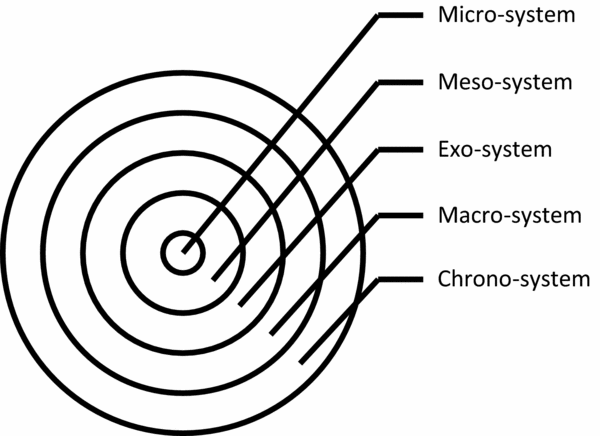
Placing the development of children within context has been an important challenge for social researchers and practitioners (e.g., Moen, Elder, & Luscher, Reference Moen, Elder and Luscher1995). Bronfenbrenner (Reference Bronfenbrenner1979) offers a conceptualisation of the child's environment (ecology) as a multi-layered set of nested and interconnected environmental systems, all of whose ‘agents’ influence the development of the child, but with varying degrees of directness. Bronfenbrenner's systems model can be graphically represented as a series of concentric rings surrounding the developing child. These rings are arranged from those which are proximal to the child to those whose influence is distal and indirect, but nonetheless important: these are the micro-, meso-, exo-, macro-, and chrono-systems (see Figure 1).
Bronfenbrenner's ecological model (Bronfenbrenner, Reference Bronfenbrenner1979, Reference Bronfenbrenner and Vasta1989.)

For example, at the closest level to the child, socialisation within the micro-system is influenced by those who are emotionally and practically closest to the individual (e.g., parents, carers, family). Much of the contact at this level is face to face, but often limited to dyadic relations. Increases in the size of the micro-system should lead to enhancements in the child's development.
At the next level, the model proposes that socialisation is influenced by those who interact with the child within the meso-system (e.g., school professionals, peers, neighbourhood). Characterised by the relations between multiple micro-systems, the meso-system is about ‘connections between contexts’ (e.g., the interrelationships between the home, day-care centre, schools). Ultimately, the stronger and more diverse these links are, coupled with high levels of communication between the socialisation agents involved, the more powerful an influence the resulting systems will be on the child's development. Gottfried, Gottfried, and Bathurst (Reference Gottfried, Gottfried, Bathurst, Gottfried and Gottfried1988) found that the child's ability to learn depends on the quality of instruction, but also on the extent to which parents value scholastic achievement.
At the wider levels, the model proposes that socialisation is influenced by the wider ecology of television, politics, governments, religion, and so on (e.g., Cairns, Reference Cairns1990). At the level of the exo-system, the focus is on the experience of systems in a social setting in which the child is not actually involved, but which nonetheless exert an indirect influence upon their life (e.g., parents’ place of work, governmental agencies). Greenberger, O'Neal, and Nagel (Reference Greenberger, O'Neil and Nagel1994) have shown that the child's emotional relationships at home are influenced by how much their parents enjoy work.
Representing influences at a removed level, such as regional, international, or global changes, the macro-level is viewed as providing the broad cultural, ideological, and organisational patterns within which the meso- and exo-systems reflect the ecology of human development. While at first seeming far removed from the immediate ecology of the child's development, the macro-level is not static and may change through, for example, revolution, economic recession, war, or technological change.
In showing that the theory is responsive and organic, a key point of the current article, Bronfenbrenner (Reference Bronfenbrenner and Vasta1989) added the chrono-system, a dimension that pays heed to the ‘temporal component’ in which the ecosystem is immersed. This dimension accommodates the ongoing reciprocal periods of development between the individual and the environment across the lifespan (e.g., effects of divorce, changes in family structure over the lifespan, changes in socioeconomic status, changes in geographical location of residence).
As with any robust theoretical model, Bronfenbrenner's (Reference Bronfenbrenner1979) ecological model of development is parsimonious and applicable to areas outside of its original purpose. Interpreted alongside Bronfenbrenner's model, the classical theories of childhood development attain greater explanatory power.
Applications of Bronfenbrenner's Ecological Model: The Head Start Programme (USA, 1960s onwards)
Bronfenbrenner's ability to translate his theoretical musings into operational research models and effective social policies is evidenced in the Head Start program he co-founded in 1965. Head Start is the longest running federal program in the United States designed to arrest the cycle of poverty. Administered on a local level by not-for-profit organisations and local education systems, Head Start includes support for the children's physical development, through health care and nutrition programs, as well as intellectual stimulation.
Key to the program is that the outcome assessed is academic achievement. The Congressional Head Start Impact Study and Follow-Up Study (2000–2010: US Department of Health and Human Services, 2010) has assessed the program's effectiveness as compared to a variety of other forms of community support and educational intervention. The results of the first report showed consistent small to moderate advantages for those children participating in Head Start programs, with a few areas where no advantage was reported. The benefits improved with early participation and varied among racial and ethnic groups.
Applications of Bronfenbrenner's Model in Ireland
Bronfenbrenner's model has proved useful to Irish researchers and guidance counsellors. Lewis, Cruise, Fearn, and Mc Guckin (Reference Lewis, Cruise, Fearn, McGuckin, Ziebertz and Kay2009) found the model useful as an organising framework for the analyses of data collected as part of a large cross-European study regarding religion and life perspectives among young people in Ireland.
Greene (Reference Greene1994) and Greene and Moane (Reference Greene and Moane2000) have also located the development of Irish children within Bronfenbrenner's systems model, and provide a description of how the micro-, meso-, and macro-level factors may impact on young people in Ireland. For example, in their analyses regarding the micro-system, they highlight the differential experiences of children from minority groups, such as children of Irish Travellers (gypsies) and of asylum seekers and refugees, and children brought up in care. Similarly, with regards the macro-system, they highlight culture-specific ideologies such as the Irish Constitution, the Catholic Church, and other aspects of Irish history and culture.
The Bildung-Psychology Approach
In a similar manner, the Bildung-Psychology approach is also easily understood and immediately useful to the daily work of the guidance counsellor. The Bildung-Psychology approach has . . . a strong focus on life-long learning and involves a scholarly process from basic principles and research to evidence-based practice’ and has been proposed as a ‘. . . framework that would allow for systematic representations of activities . . . [in] fields that exist on the interface between human development and education [which] have been gravely underrepresented in research in general, and in educational psychology in particular’ (Spiel, Reimann, Wagner, & Schober, Reference Spiel, Reimann, Wagner and Schober2008, p. 154).
Bildung-Psychology is derived from the German language term ‘Bildung’, which Spiel et al. (Reference Spiel, Reimann, Wagner and Schober2008) note has no precise equivalent in English. Bildung itself has a lengthy history in the German intellectual tradition as, for example, a political theory and a basis for a reforming program in education. Sorkin (Reference Sorkin1983), for example, provides a consideration of Wilhelm Von Humboldt's contributions to each of these in the years straddling the turn of the 19th Century. Bildung may be seen, then, as a ‘. . . German conception of self-formation or self-cultivation . . .’ (Sorkin, Reference Sorkin1983, p. 55); it may be ‘. . . defined on both a formative level and a substantive level. On the formative level, [it] is understood as a product [desirable personal characteristics from the standpoint of social norms] as well as a process [how those characteristics are developed] . . . [on] the substantive level [it] deals with the question of which products (individual character traits) are really desirable’ (Spiel et al., Reference Spiel, Reimann, Wagner and Schober2008, p. 154).
Of course, how closely the current Bildung-Psychology is to the traditional conception of Bildung could be a matter for debate (although space dictates that such a historically based analysis would be better conducted elsewhere: e.g., see Humboldt, 1970). Readers who are familiar with the history of psychology might see parallels here with the Gestalt psychology of the 1910s and 1920s, and the Gestalt psychotherapy, which dates from the 1950s. Gestalt, like Bildung, has no clear English translation (although it is usually understood by English speakers to mean ‘unified wholes’, or ‘totalities’ (Clarkson, Reference Clarkson2004; Perls, Hefferline, & Goodman, Reference Perls, Hefferline and Goodman1951).
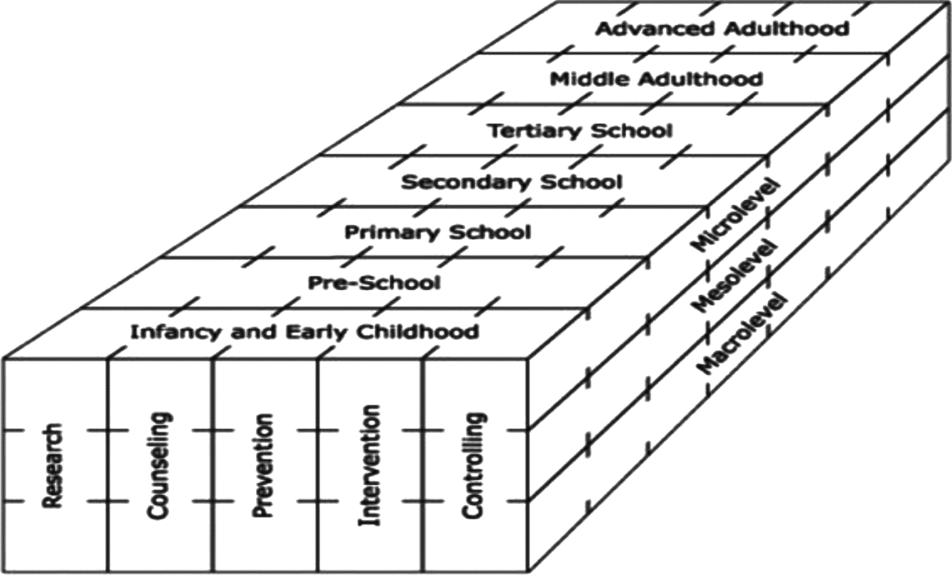
For this presentation of Bildung-Psychology, and our encouragement to guidance practitioners to feel confident in applying the theory to their work, we outline Spiel et al.'s (Reference Spiel, Reimann, Wagner and Schober2008) three-dimensional model in which (a) longitudinally, a person's Bildung-career, given by age-specific educational phases of the entire lifespan (infancy and early childhood, preschool, primary school, secondary school, tertiary school, middle adulthood, and advanced adulthood), is plotted against (b) horizontally, a variety of functional areas, which may be the subject of inquiry or action (research, counselling, prevention, intervention, and controlling); and (c) vertically, different levels of abstraction and activity (the micro-, meso-, and macro-levels).
If one was to apply these dimensions retrospectively to Olweus’ pioneering research into bully/victim problems (Olweus, Reference Olweus, Smith, Morita, Junger-Tas, Olweus, Catalano and Slee1999), one would find (a) a study of primary- and secondary-level school pupils (in terms of the stage of Bildung career of the respondents in his surveys), (b) utilising the functional area of research (although with a view to subsequent intervention and prevention, as this data informed the whole-school anti-bullying intervention programmes designed and implemented by Olweus (Reference Olweus, Smith, Morita, Junger-Tas, Olweus, Catalano and Slee1999), (c) undertaken at either the meso- or (possibly, due to the large sample sizes involved), macro-levels (Olweus had collected data from 120,000 Norwegian school pupils by 1999: Olweus, Reference Olweus, Smith, Morita, Junger-Tas, Olweus, Catalano and Slee1999).
Spiel et al. (Reference Spiel, Reimann, Wagner and Schober2008) also outline the potential for Bildung-Psychology, as an emerging discipline, to be applied to the concept of lifelong learning (in the context of how multinational bodies such as the European Commission and UNESCO conceptualise and use the term), the development of school-based social competence-building programs, and cooperative initiatives with other scientific disciplines. Given the focus of our current article, it is to the application of the Bildung-Psychology approach within the field of preventing and countering school bullying and violence that we now turn.
International Applications of the Bildung-Psychology Approach
To our knowledge, there have been no previous direct applications of the Bildung-Psychology approach within Ireland. As Spiel et al. (Reference Spiel, Reimann, Wagner and Schober2008) note, although there are elements of the lifelong learning and evidence-based practice approaches in evidence elsewhere, ‘. . . they have not crystallised in precisely the same manner that is occurring in the German-speaking countries’ (p. 154). In order to exemplify the Bildung-Psychology approach in action, we have selected a program that has seen use in both Germany (Gollwitzer, Eisenbach, Atria, Strohmeier, & Banse, Reference Gollwitzer, Eisenbach, Atria, Strohmeier and Banse2006) and Austria (Atria & Spiel, Reference Atria, Spiel and Smith2003, Reference Atria, Spiel, Zins, Elias and Maher2007).
In terms of its underlying philosophy and rationale, this program, the Viennese Social Competence Model (usually abbreviated to ViSC), has usually been presented in the context of its original aims, that is to say, as a school-based anti-bullying intervention program (Atria & Spiel, Reference Atria, Spiel and Smith2003, Reference Atria, Spiel, Zins, Elias and Maher2007; Farrington & Ttofi, Reference Farrington and Ttofi2010). ViSC has also previously been presented as a concrete application of the Bildung-Psychology approach (Spiel et al., Reference Spiel, Reimann, Wagner and Schober2008).
Atria and Spiel (Reference Atria, Spiel and Smith2003) report that the model was informed by Huesmann's (Reference Huesmann1988) social information-processing theory and Salmivalli's empirical results of bullying as a group process (e.g., Salmivalli, Lagerspetz, Björkqvist, Osterman, & Kaukiainen, Reference Salmivalli, Lagerspetz, Björkqvist, Österman and Kaukiainen1996). The most fundamental program principle that emerged from the consideration of such data was that when students do not know how to cope with critical situations they are more likely to be aggressive (Atria & Spiel, Reference Atria, Spiel and Smith2003). The aim of the ViSC program is, therefore, to provide students ‘. . . with systematic theoretically-based guidance in becoming responsible and competent actors in conflict situations’ (Atria & Spiel, Reference Atria, Spiel, Zins, Elias and Maher2007, p. 179).
The ViSC program itself consists of 13 lessons, which are divided into three phases: (a) impulses and group dynamics — six lessons on dealing with critical situations through stories, discussion and role-play; (b) one lesson reflecting on what had been learnt in the previous phase; and (c) action — six lessons in which the students are facilitated in expressing the aims for what they had learnt in the art/film production or planning a social event (Atria & Spiel, Reference Atria, Spiel and Smith2003, Reference Atria, Spiel, Zins, Elias and Maher2007; Farrington & Ttofi, Reference Farrington and Ttofi2010). ViSC, originally designed for ‘at risk’ and disadvantaged 15- to 19-year-olds in Austria (Atria & Spiel, Reference Atria, Spiel and Smith2003, Reference Atria, Spiel, Zins, Elias and Maher2007) has since been used with a lower secondary level participant base in Germany (Gollwitzer et al., Reference Gollwitzer, Eisenbach, Atria, Strohmeier and Banse2006) and primary school students in Austria (Spiel et al., Reference Spiel, Reimann, Wagner and Schober2008).
In terms of the Bildung-Psychology dimensions, the original program (preventative anti-bullying training for small, targeted ‘at risk’ classes) has a Bildung-career level of secondary school, a functional level of prevention, and a micro-level activity level. Attempts made with younger students in natural settings in Germany to optimise the training concept had the same Bildung-career and activity levels, but had a functional level of controlling, although the resultant expansion into school-wide and teacher training activities registers meso-level activity levels and middle adulthood Bildung-career levels respectively. Finally, the dissemination of the appropriate skills to teachers in delivering a program designed for adolescents to primary school children in Austria registers a functional level of counselling (Spiel et al., Reference Spiel, Reimann, Wagner and Schober2008).
A Suggested Synthesis of the Bronfenbrenner and Bildung-Psychology Models
We would like to suggest a set of variations of aspects of Spiel et al.'s (Reference Spiel, Reimann, Wagner and Schober2008) three-dimensional Bildung-Psychology model (see Figure 2), principally in order to accommodate the model proposed by Bronfenbrenner and to recast it in an psychology of education and guidance counselling light, rather than its current (as we feel) general psychological position. Longitudinally, Spiel et al. (Reference Spiel, Reimann, Wagner and Schober2008, see Figure 2) plot a person's Bildung-career, given by chronological rather than interactional age-specific educational phases of the entire lifespan: infancy and early childhood, preschool, primary school, secondary school, tertiary school, middle adulthood, and advanced adulthood. This is eminently suitable for their treatment. However, as Spiel et al. (Reference Spiel, Reimann, Wagner and Schober2008) themselves note, ‘. . . several educational situations are obligatory for all individuals; however, some are only significant for specific groups’ (p. 155). We would argue that the use of chronological age-specific educational phases renders this model as suitable really for European middle-class norms, and therefore being limited in socio-historical context and culture.
Dimensions in the ‘Bildung-Psychology’ Model (Spiel et al., Reference Spiel, Reimann, Wagner and Schober2008). Note: Reproduced with permission.
If a greater sense of (particularly cross-cultural) universality was aimed for, one might, for example, substitute the Eriksonian ‘Eight Ages of Man’ (Erikson, Reference Erikson1951) stages (basic trust vs. basic mistrust, autonomy vs. shame and doubt, initiative vs. guilt, industry vs. inferiority, identity vs. role confusion, intimacy vs. isolation, generativity vs. stagnation, ego integrity vs. despair — corresponding to infancy, toddlerhood, early childhood, middle childhood, adolescence, and early, middle, and late adulthood respectively), familiar to most educators and psychologists alike, which encapsulate the same timespan as Spiel et al.'s (Reference Spiel, Reimann, Wagner and Schober2008) age-specific educational phases. Such a suggestion does not negate further explorations that pay heed to neo-Eriksonian conceptualisations of Erikson's basic premise of psychosocial stages of development throughout the lifespan. Expansion of this ‘plane’ also pays heed to modern educational and vocational conceptualisations of lifelong and lifewide learning within the widening participation paradigm.
The second, vertical, dimension of Spiel at al.'s (Reference Spiel, Reimann, Wagner and Schober2008) Bildung-Psychology model (see Figure 2) specifies five functional areas, which may be the subject of inquiry or action (research, counselling, prevention, intervention, and controlling). These five functional areas are relatively suitable to describing the functions of psychologists in education. It would also be possible to imagine what the functional areas for educators and guidance counsellors would be. We would like to suggest that as an alternative, these dimensions could be research, instruction/training, assessment, pastoral care, and (continual) professional development.
As Spiel et al. (Reference Spiel, Reimann, Wagner and Schober2008) note, the third (horizontal) structural dimension of the Bildung-Psychology model — activity levels — is ‘. . . orientated in accordance with the ecological model presented by Bronfenbrenner. The micro-level, meso-level, and macro-level of the Bronfenbrenner model are included here’ (p. 156). We posit that the addition of the exo-level (Bronfenbrenner, Reference Bronfenbrenner and Vasta1989) would provide a more precise integration of the Bronfenbrenner and Bildung-Psychology models on this dimension. Of course, Bronfenbrenner's chrono-system is reflected in the temporal first dimension (in Spiel et al.'s Reference Spiel, Reimann, Wagner and Schober2008 model, Bildung-career) of the Bildung-Psychology model.
An Application of the ‘New’ Model to the Donegal Primary Schools Anti-Bullying Program (Ireland, 1998–2000)
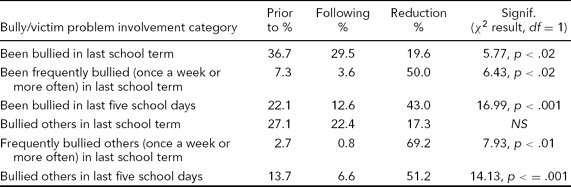
O'Moore and Minton (Reference O'Moore and Minton2005) reported on an anti-bullying program, which was implemented in primary schools in County Donegal, Ireland, between 1998 and 2000. The staff and pupils of 42 primary schools were involved. A network of professionals (11 teachers) was trained to coordinate the anti-bullying program in the schools, with their subsequent activities involving them training other teachers (a total of 197) and parents in three to five schools each. In evaluation, pupils from 22 of the schools completed modified versions of the Olweus Bully/Victim Questionnaire (Olweus, Reference Olweus1989; Whitney & Smith, Reference Whitney and Smith1993), with significant reductions being found both in pupils’ reports of having been victimised and having bullied others following the implementation of the program (Farrington & Ttofi, Reference Farrington and Ttofi2010; O'Moore & Minton, Reference O'Moore and Minton2005). The principal results are presented in Table 1.
Pupils’ Reports of Having Been Victimised and Having Bullied Others Prior to and Following the Anti-Bullying Programme in Donegal Primary Schools (1998–2000)
In applying these ‘new’ dimensions, the Donegal primary schools anti-bullying program would be considered: (a) longitudinally, given the age/Bildung career of the primary school students involved in the program, focused primarily on the Eriksonian stage of industry versus inferiority. However, given the age/Bildung career of the (mostly senior) staff, and, by extension, parents involved in the program, the Eriksonian stage of generativity versus stagnation is also implicated; (b) second, and vertically, all five of the new areas of function would be relevant — research (in terms of the design of the program), instruction/training (in a train-the-trainer model such as this of trainers, of peer teachers and parents by the trainers, and of students by the teachers), assessment (evaluation of the program components and effectiveness of the program), pastoral care (a key element of the program content), and professional development (of all personnel within the participating schools); and (c) finally, and horizontally, this sort of regionally operational whole-school anti-bullying program may be considered as having taken place at either the meso- or (possibly in this case, due to the county-wide nature of the program) macro-level.
Concluding Thoughts
The primary purpose of this article has been to introduce Bronfenbrenner's (Reference Bronfenbrenner1979, Reference Bronfenbrenner and Vasta1989) ecological model and the Bildung-Psychology model (Spiel et al., Reference Spiel, Reimann, Wagner and Schober2008) — essentially, systemic approaches that are complementary and enhancing to lifespan psychology — and their application to an educational and counselling focused audience. This has been done by illuminating the applications of these models to a variety of areas within education, guidance, and counselling, but with a particular emphasis on attempts to intervene against bully/victim problems. We have demonstrated the flexibility of the models by proposing modifications that would allow for their use by school counsellors and school psychologists who work in an area that is characterised by ever-changing policies, research, and contextual issues.
It can be demonstrated that both models are easily applied to research into school bullying, and the design of whole-school anti-bullying program, pioneered by Olweus (Reference Olweus, Smith, Morita, Junger-Tas, Olweus, Catalano and Slee1999) since the 1970s and 1980s respectively. Indeed, this whole-school approach has come to dominate the design and training/resource aspects of at least the large-scale implementations of anti-bullying programs Europe-wide (Cowie at al., Reference Cowie, Jennifer, Chankova, Poshtova, Deklerck, Deboutte and Sanchez2006). Most evaluation studies of large-scale anti-bullying programs have been focussed almost exclusively on students (e.g., Atria & Spiel, Reference Atria, Spiel and Smith2003, Reference Atria, Spiel, Zins, Elias and Maher2007; O'Moore & Minton, Reference O'Moore and Minton2005; Smith, Reference Smith2003; Smith et al., Reference Smith, Morita, Junger-Tas, Olweus, Catalano and Slee1999). There are two reasons, we believe, as to why this should be. First, the ‘acid test’ of an anti-bullying program is whether it does actually reduce the incidence rates of bullying — and, in terms of large-scale programs, this has been most easily obtained by students answering pre- and post-program self-report questionnaires (e.g., Olweus, Reference Olweus, Smith, Morita, Junger-Tas, Olweus, Catalano and Slee1999; O'Moore & Minton, Reference O'Moore and Minton2005; Smith, Pepler, & Rigby, Reference Smith, Pepler and Rigby2004; Whitney & Smith, Reference Whitney and Smith1993). Second, many researchers have sought comparison with Olweus’ pioneering data-sets from Norway and Sweden (Olweus, Reference Olweus, Smith, Morita, Junger-Tas, Olweus, Catalano and Slee1999), and the relative ease of use of the Olweus Bully/Victim questionnaire (Olweus, Reference Olweus1989; Whitney & Smith, Reference Whitney and Smith1993) has meant that many, but not all, have followed in his student-focussed evaluation methodology.
In recent years in Norway and Finland there has been a more pronounced emphasis on implementation as an area of research focus in itself in conducting anti-bullying programmes (Ertesvåg & Vaaland, Reference Ertesvåg and Vaaland2007; Kärnä et al., Reference Kärnä, Voeten, Little, Poskiparta, Kaljonen and Salmivalli2011; Roland, Bru, Midthassel, & Vaaland, Reference Roland, Bru, Midthassel and Vaaland2010). So it is to be expected that the whole school emphasis on program design is to be extended to program evaluation methodology also. The two models discussed in this article have been seen to provide a useful framework for the examination of all phases of anti-bullying and anti-violence intervention. It is to be hoped that such ecological/systemic thinking can usefully inform the design, the provision of resources and training, the implementation strategies, and the evaluation procedures of such efforts in the future.
Examples of application include those efforts designed to address a more contemporary form of bully/victim problems: cyberbullying. Such projects include: (a) the recently completed CyberTraining Project (funded by the EU Lifelong Learning Programme: [Project No.142237-LLP-1-2008-1-DE-LEONARDO-LMP] http://cybertraining-project.org), which has provided a well-grounded, research-based training manual on cyberbullying for trainers; and (b) the current EU supported project (COST Action IS0801: http://sites.google.com/site/costis0801) which, with significant input from psychologists, educators, and guidance professionals from Australia has been exploring many facets of this emerging area of importance.
To re-emphasise, there is ‘Nothing is as practical as a good theory’ (Lewin, Reference Lewin and Cartwright1951, p. 169). As we have argued, these simplistic and parsimonious models offer direct and applicable solutions to the organisation, synthesis, understanding, and use of the extensive amounts of information of which school counsellors and school psychologists are expected to be in command.