

PERCEPTIONS OF THREAT TO RELIGIOUS LIBERTY
Democratic theory assumes the existence of an informed citizenry—a body politic in which ideas and opinions are discussed and debated and citizens who actively engage in the political process. This assumes that individuals will follow the news and update their attitudes, beliefs, and evaluations in light of new information. The study of political psychology has long challenged this perspective, noting that citizens are cognitive misers rather than Bayesian statisticians (Fiske and Taylor Reference Fiske and Taylor1991). We not only hold on to our existing beliefs, we also interpret new information in accordance with existing predispositions. Indeed, if there is one constant in the study of public opinion, it is the importance of partisan filters for selecting and interpreting incoming news and information.
Individual citizens are not alone in this process because they rely on trusted elites to help make sense of the “blooming, buzzing confusion” of the world around them (James Reference James1890). Partisan cues have proven to be influential in agenda setting and framing (Druckman and Nelson Reference Druckman and Nelson2003; Huckfeldt and Sprague Reference Huckfeldt and Sprague1995; Iyengar and Kinder Reference Iyengar and Kinder1987; Mutz, Sniderman, and Brody Reference Mutz, Sniderman and Brody1996; Slothuus Reference Slothuus2010); public perceptions of media bias (Domke and Watts Reference Domke and Watts1999; Ladd Reference Ladd2010; Smith Reference Smith2010); and framing of complex issues such as stem-cell research (Nisbet, Brossard, and Kroepsch Reference Nisbet, Brossard and Kroepsch2003; Nisbet and Mooney Reference Nisbet and Mooney2007). Public responses to partisan cues, however, are not automatic. Across contexts, partisan elites compete to set the agenda and frame issues on favorable terms (Druckman Reference Druckman2001). Individual citizens take cues from like-minded and trusted partisan elites to form opinions, whereas aggregate opinion reflects elite partisan disagreement (Bennett Reference Bennett1991; Berinsky Reference Berinsky2007; Dancey and Goren Reference Dancey and Goren2010; Zaller Reference Zaller1992).
The intersection of religious beliefs and political attitudes provides an avenue for both the selective filtering of new information and cue-taking. Religious beliefs often are deeply rooted and serve to filter new information, whereas religious elites guide the faithful to preferred issue positions and political involvement (Djupe and Calfano Reference Djupe and Calfano2013b; Djupe and Gilbert Reference Djupe and Gilbert2008; Goidel and Nisbet Reference Goidel and Nisbet2006; Guth et al. Reference Guth, Smidt, Kellstedt and Green1993; Guth et al. Reference Guth, Green, Kellstedt and Smidt1995; Kellstedt et al. Reference Kellstedt, Green, Guth, Smidt, Green, Guth, Smidt and Kellstedt1996; Nteta and Wallsten Reference Nteta and Wallsten2012). Previous studies showed that clergy may have an important role in mobilizing religious supporters to participate, influencing political attitudes and beliefs, and serving as opinion leaders in local communities (Goidel and Nisbet Reference Goidel and Nisbet2006; Harrison and Michelson Reference Harrison and Michelson2015; Jelen Reference Jelen1991; Smidt Reference Smidt2003; Wilcox and Sigelman Reference Wilcox and Sigelman2001). Footnote 1
For much of American political history, evangelicals believed that their time was better spent saving souls than participating in the political arena (Guth et al. Reference Guth, Green, Kellstedt, Smidt, Green, Guth, Smidt and Kellstedt1996; Leege and Kellstedt Reference Leege and Kellstedt1993; Wald Reference Wald1992). Primarily as a result of a series of court rulings, including Engel v. Vitale and Roe v. Wade, evangelicals mobilized into the political process. They have had an important role ever since, especially in midterm elections and Republican presidential nominations, in which they comprise a disproportionate share of the electorate. The language used to mobilize religious voters, however, has necessarily shifted from protecting traditional values to protecting religious liberty (Lewis Reference Lewis2014). In January 1996, 59% of Americans believed the government should support traditional values. By 2014, this percentage had dropped 18 points to 41% (Blake Reference Blake2015). Growing public support for gay marriage has coincided with these shifts.
Preliminary evidence suggests that this reframing of traditional values to religious freedom has been successful. The Public Religion Research Institute routinely asks respondents: “In America today, do you believe that the right of religious liberty is being threatened, or not?” In March 2012, 39% believed that the right of religious liberty was threatened. By November 2012, the percentage was 50% and by May 2014, 54% believed that it was threatened. Similar increases are observed when the question is asked in an agree/disagree format; however, the shifts are mostly in intensity rather than direction of opinion. The percentage completely agreeing that “The right of religious liberty is being threatened in America today” increased from 18% in June 2012 to 28% in July 2014.
Primarily as a result of a series of court rulings, including Engel v. Vitale and Roe v. Wade, evangelicals mobilized into the political process. They have had an important role ever since, especially in midterm elections and Republican presidential nominations, in which they comprise a disproportionate share of the electorate.
Within this context, there is an extensive literature in political psychology that connects threat to political attitudes and behaviors. First, invoking threat serves as a tool to mobilize voters (Martin Reference Martin2004; Miller and Krosnick Reference Miller and Krosnick2004; Valentino et al. Reference Valentino, Hutchings, Banks and Davis2008). Second, conservatives may be more sensitive to negative stimuli, including threats (Hibbing, Smith, and Alford Reference Hibbing, Smith and Alford2014; Lilienfeld and Latzman Reference Lilienfeld and Latzman2014). Third, religious evangelicals respond to “religious threat,” meaning that the more secularists there are in a community, the more that white evangelicals vote for Republican candidates (Campbell Reference Campbell2006). Fourth, churches may actively encourage intolerance through their religious communications by communicating tensions with the larger world (Djupe and Calfano Reference Djupe and Calfano2013a). This leads to several testable hypotheses, as follows:
-
H1: Religious voters should be more likely to perceive that their religious liberties are being threatened.
-
H2: General political orientations (i.e., partisan affiliation and ideology) should influence perceptions that religious liberty is threatened.
-
H3: Arguments that religious liberties are under attack should be associated with two issues: abortion and gay marriage. As the more visible issue recently, gay marriage should yield stronger effects.
-
H4: The effect of political orientations should be contingent on news attentiveness. Republicans and conservatives who follow the news closely should be more likely to perceive their religious liberties as threatened.
DATA AND METHODS
The data for this project were drawn from the Public Religion Research Institute’s 2012 American Values Pre-Election Survey conducted from September 13 through 29, 2012. The survey included 3,003 adult (i.e., age 18 or older) respondents interviewed by telephone, including 1,201 respondents interviewed on cellphones. Final data were weighted to account for differences in probabilities for sample selection and to match census demographic estimates for gender, age, education, race, ethnicity, region, population density, and telephone usage. A full description of the methodology is available at http://publicreligion.org/site/wp-content/uploads/2012/10/AVS-2012-Pre-election-Report-for-Web.pdf.
Our analysis focuses on responses to a question that asked respondents to agree or disagree with the following statement: “The right of religious liberty is being threatened in America today.” Responses were coded from 0, indicating completely disagree, to 4, indicating completely agree (M = 2.23, SE = 0.03). A majority of respondents (57%) completely agreed (26%) or mostly agreed (31%) with the statement, whereas 42% completely disagreed (18%) or mostly disagreed (24%).
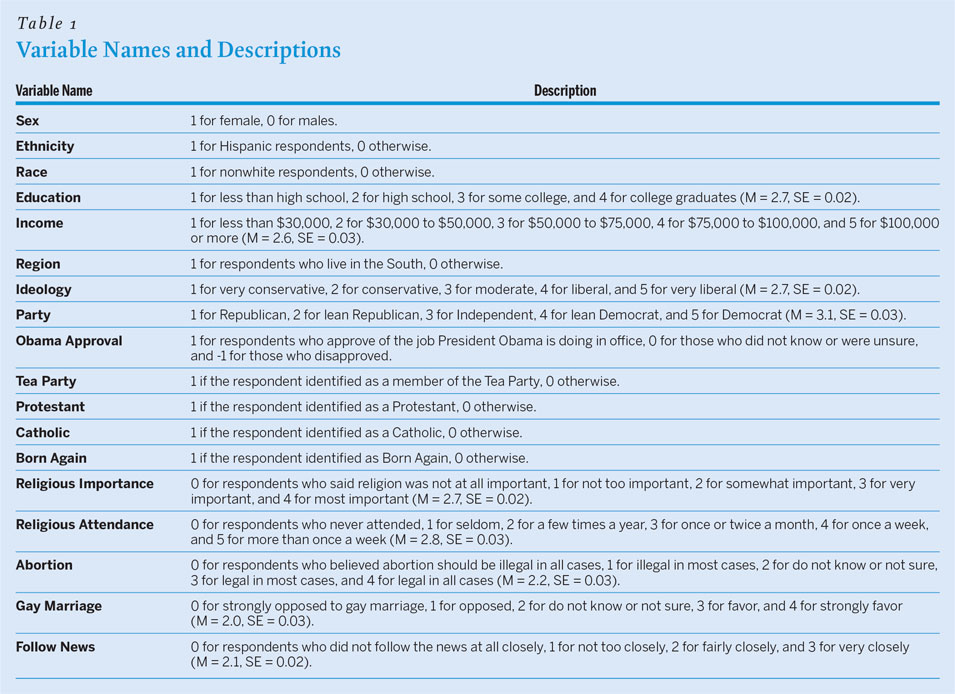
We modeled perceptions of religious liberty as a function of standard demographics (i.e., sex, ethnicity, race, marital status, education, income, and region); political orientations (i.e., partisan affiliation, ideology, and Tea Party identification); religious variables (i.e., religious denomination, Born Again status, importance of religion, and frequency of attending religious services); social issues (i.e., abortion and gay marriage); and attentiveness to news about the presidential election. Although we might expect differences across Protestant traditions—specifically between evangelical and mainline traditions—our measure of religious belonging captured only denominational differences among Catholics, Protestants, and other major religious designations. Footnote 2 The data, however, include several measures of religiosity, including whether respondents consider themselves Born Again, the importance of religion to individuals’ personal life, how frequently they attend religious services, and whether the Bible should be taken literally. Rather than combining these measures into a single index of religiosity, we entered them separately into the model to evaluate their independent effect on perceptions of religious liberty. We expected that individuals who are Born Again, believe religion plays an important role in their personal life, regularly attend church services, and believe that the Bible is literally the word of God would be more likely to believe that their religious liberties are being threatened. Finally, because we expected the effect of partisan affiliation to be contingent on news attentiveness, we included interactions between news exposure and partisan affiliation and between news exposure and ideology. Table 1 briefly describes the variables.
Variable Names and Descriptions
RESULTS
Table 2 presents results of ordinal regressions. Several conclusions merit discussion. First, the effects of marital status, sex, and region are mediated by religious importance and attendance. In the base model, all three variables are statistically significant, indicating that women, married respondents, and Southerners are more likely to agree that religious freedom is threatened. These relationships disappear when religious importance and religious attendance are entered into the model, indicating that sex and marital status influence perceptions of religious threat through the importance that these individuals assign to religion and their religious attendance. Income and education, in contrast, remain important across models, with better-educated and higher-income respondents less likely to believe that their religious liberties are threatened.
Ordinal Regressions of Religious Threat on Demographics, Political Orientations, and Attentiveness to News
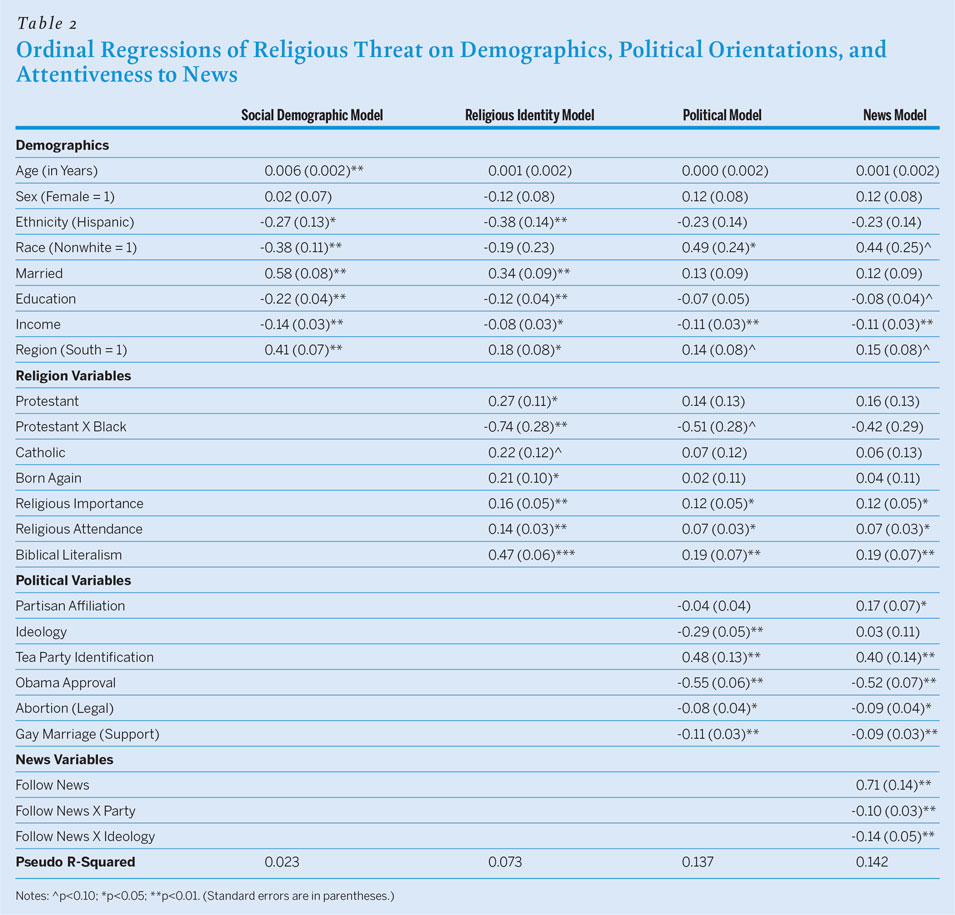
Notes: ^p<0.10; *p<0.05; **p<0.01. (Standard errors are in parentheses.)
Religious attendance and religious importance were significant across models. This may reflect messages from clergy or conversations with other religious adherents who believe that their religious values are being threatened. Overall, the results support H1 and also are consistent with H2. Perceptions of religious threat are a function of political orientations, with partisan affiliation, ideology, and Tea Party identification all exerting consistent and strong effects.
We found more conditional support for H3. Opposition to gay marriage—but not abortion—exerts a consistent effect on perceptions of religious threat. Gay marriage has been a defining issue in recent years, challenging traditional norms and values. Public opinion on abortion, in contrast, has been fairly stable over time, although the policy movement on abortion has leaned toward more restrictions and less access at the state level. Footnote 3
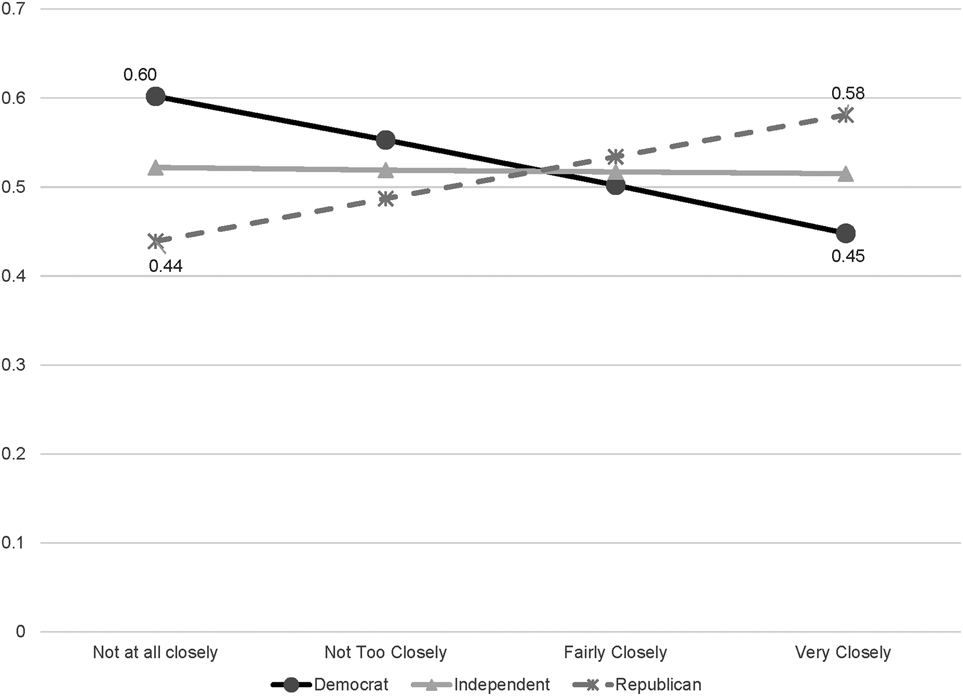
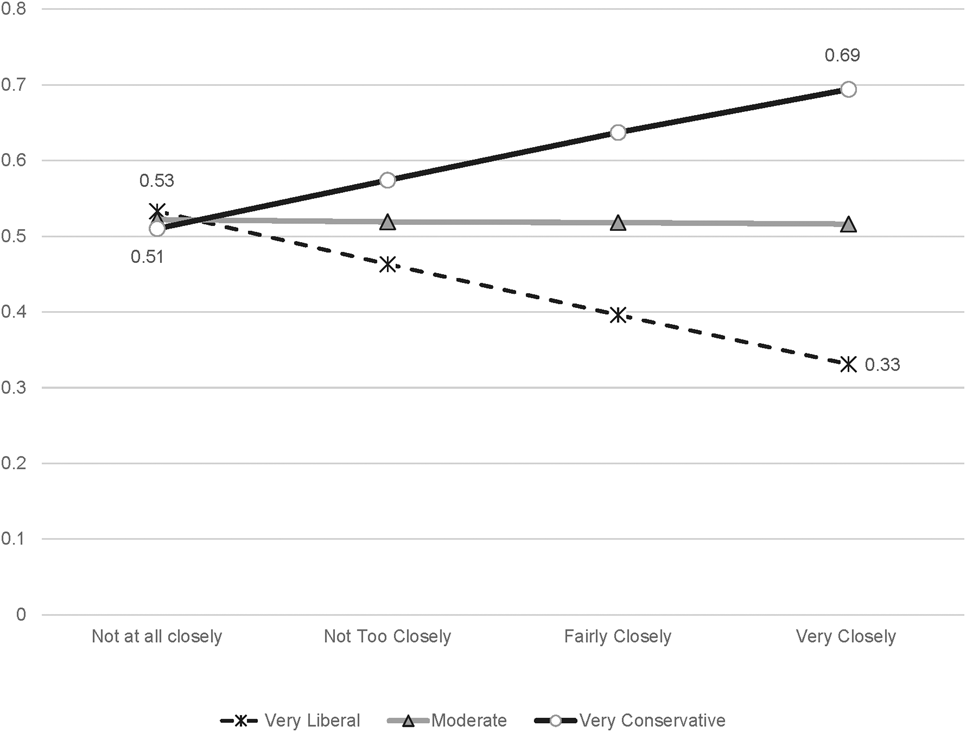
Finally, we found that the effects of political orientations (i.e., partisan affiliation and political ideology) are contingent on news attentiveness. Consistent with H4, partisan affiliation has different effects for Republicans and conservatives who closely follow the news than for Democrats and liberals. These effects are presented graphically in figures 1 and 2. Footnote 4 Republicans who do not follow the news closely are less likely to believe their religious liberties are being threatened. As attentiveness to the news increases among Republicans, perceptions of threat increase. Overall, more attentive partisans are more attuned to partisan cues and better reflect the frames provided by partisan elites. Independents are no more (or less) likely to perceive that their religious liberties are being threatened as news attentiveness increases. There was a slightly different effect for news attentiveness and ideology. Conservatives and liberals who do not follow the news are nearly indistinguishable. As news attentiveness increases, perceptions polarize along ideological lines, with attentive conservatives becoming increasingly likely to believe that their religious liberties are threatened.
Interactive Effect of Follow News and Partisan Affiliation Threat to Religious Liberty
Interactive Effect of Follow News & Ideology on Threat to Religious Liberty
CONCLUSIONS
Few citizens in the United States experience meaningful restrictions on their religious freedoms. Yet, religious and political conservatives who follow the news closely perceive that these freedoms as increasingly under assault. The recent Supreme Court decision, Obergefell v. Hodges, which declared same sex marriage a fundamental right, is only the most recent example. Although these attitudes are partially rooted in religious worldviews, they also are a consequence of partisan discourse and political calculation. Whereas socially conservative political leaders once defended traditional values, they now claim violations of religious freedom. This reframing was a strategy born of necessity as opinion polls increasingly have shown a public disinterested in protecting traditional values and growing support for gay marriage.
This reframing has had an effect—at least on its target audience (however, see Djupe, Lewis, and Jelen Reference Djupe, Lewis and Jelen2015). Political conservatives, Republicans, and Tea Party identifiers are more likely to perceive threats to religious liberty. However, this might have occurred without the reframing; therefore, the more convincing evidence is the conditional effect of partisan affiliation and news attentiveness on perceptions of religious threat. Attentive Republicans and conservatives reach different conclusions about threats to religious liberty than those who are less attentive. Indeed, as partisans and ideologues follow the news more closely, perceptual differences widen and expand.
Attentive Republicans and conservatives reach different conclusions about threats to religious liberty than those who are less attentive.
It is unclear whether this is a result of differences in source—Republicans pay more attention to Fox News, whereas Democrats attend to more liberal sources (Prior Reference Prior2007; Stroud Reference Stroud2011)—or differences in how Democrats and Republicans respond to partisan cues embedded within news stories (Arceneaux and Johnson Reference Arceneaux and Johnson2013). We can provide only suggestive evidence to this point. First, news coverage of issues related to perceived threats to religious liberty differs across sources. A 2013 Pew Center study found that 64% of stories on MSNBC were supportive of same-sex marriage compared to 29% on Fox News, whereas Fox News provided more mixed or neutral coverage (63%) than MSNBC (30%) but not more negative coverage (Mitchell Reference Mitchell2013). MSNBC and Fox also differed in how they covered President Barack Obama’s decision to support gay marriage in 2012 after opposing it during his initial run for the presidency in 2008 and throughout his first term in office. MSNBC covered the switch as a principled decision reflecting an evolving understanding of the issue. In contrast, Fox covered it as a calculated political decision designed to raise money and support for the 2012 election (Levendusky Reference Levendusky2013).
Second, framing around issues related to religious liberty, specifically same-sex marriage, matters (McCabe and Heerwig Reference McCabe and Heerwig2011). News coverage that emphasizes equality—as opposed to morality—increases public support for same-sex marriage (Brewer Reference Brewer2002, Reference Brewer2003; Johnson Reference Johnson2012). No previous study, however, directly answered the question of how the shift in the oppositional frame from protecting traditional values to protecting religious liberty affected partisan news coverage or, alternatively, public opinion.
We provide limited data on how the different sources have covered claims that religious liberty is under attack. Specifically, we collected all news transcripts from Fox and MSNBC from August 1 to September 29, 2012, that specifically used the phrase “religious liberty” or “religious freedom.” Footnote 5 This period corresponds with ongoing debates about the contraceptive mandate in the Affordable Care Act and questions about whether religiously affiliated organizations (e.g., universities and hospitals) should be required to provide the “morning-after” abortion pill. The findings are revealing if not surprising. Fox News routinely presented “religious liberty” as under attack, most often with a news anchor (i.e., Sean Hannity or Bill O’Reilly) directly making the point. On August 1, 2012, for example, Sean Hannity led his broadcast with this observation: “Freedom of speech and freedom of religion are under attack in America.” MSNBC, in contrast, typically raised the conservative claim that religious liberty was under attack but then followed it with a host or guest dismissing the claim and reframing it as an issue concerning women’s health. Several MSNBC segments during this period began with a video clip of Representative Mike Kelly (R, PA): “I want you to remember August the 1st, 2012, the attack on our religious freedom. That is a date that will live in infamy, along with those other dates.” The response across programs was fairly uniform. For example, Al Sharpton offered the following response:
A day of infamy? Providing new access to health care to 47 million women? How is that like Pearl Harbor? How is that like 9/11? House Speaker John Boehner echoed that line today when he called the coverage, quote, “tyranny and an attack on religious freedom.” Now, I’ve debunked that bogus claim before and I’ll do it again, but the important thing here is the people. The millions of women who will get improved care because of this law. Yesterday, Senator Tom Harkin put a deeply personal face on this policy debate in Washington.
While these results are suggestive, they are too limited to draw a more general conclusion about whether individual differences reflect differences in news content. We can conclude, however, that attentiveness to news polarizes Democratic and Republican identifiers and conservative and liberal ideologues on questions of religious liberty. Perceptions of threat increased as Republicans and conservatives paid more attention to the news.



