Critically ill young children, particularly infants and neonates, in an intensive care unit are at a high risk for thromboembolic complications. Although this risk appears to be multifactorial, patients in a cardiac intensive care unit have certain predisposing conditions that increase the overall risk for thrombosis. These include the frequent use of intravascular catheters, potentially decreased ventricular function and low cardiac output, and the presence of non-physiologic circulations, as in patients with single ventricle physiology.Reference Monagle1–Reference Kajimoto, Nakazawa and Murasaki5
Low molecular weight heparin has become an increasingly preferred agent for the acute and long-term treatment of paediatric thromboembolism, and in the United States the most frequently used low-molecular weight heparin is enoxaparin. The American College of Chest Physicians has recently published an evidence-based clinical practice guideline for antithrombotic therapy in neonates and children.Reference Monagle, Chalmers and Chan6 Low-molecular weight heparin is recommended for certain specific situations such as treatment and secondary prophylaxis of venous thrombosis, prophylaxis of thrombosis in clinically stable patients with a ventricular assist device, and patients with central arterial thrombosis in which thrombolysis or surgery is not required or is not feasible. The recommended starting therapeutic dose, with a target anti-factor Xa level of 0.5–1 units per millilitre, is 1.5 milligrams per kilogram every 12 hours in children less than 2 months of age and 1 milligram per kilogram every 12 hours in patients older than 2 months of age. The recommended starting prophylactic dose, with a target anti-factor Xa level of 0.2–0.4 units per millilitre, is 0.75 milligrams per kilogram every 12 hours for patients 2 months old or younger and 0.5 milligrams per kilogram every 12 hours for patients older than 2 months of age.Reference Monagle, Chalmers and Chan6–Reference O’Brien, Lee and Ritchey10 Based on adult data, twice-daily enoxaparin appears to have predictable and sustained anticoagulant action, and thus the need for monitoring is significantly lower than with unfractionated heparin.Reference Fareed, Hoppensteadt and Walenga11 Nonetheless, several studies have shown that infants less than 3 months of age may require a much higher enoxaparin dose to achieve target therapeutic and prophylactic anti-thrombotic levels.Reference Malowany, Knoppert, Chan, Pepelassis and Lee8, Reference Malowany, Monagle and Knoppert12 This finding, which is associated with multiple dose adjustments and longer time to achieve the target anti-factor Xa level, may have detrimental effects on some patients, with propagation of previous thrombuses or formation of new ones.
In view of the limited literature and guidelines regarding dosage and monitoring of enoxaparin in neonates and infants with associated cardiac conditions, we conducted a retrospective chart review study to evaluate our own institutional experience and determine whether further prospective studies are needed in this patient population to establish appropriate dosing guidelines.
Materials and methods
Study design and study population
This retrospective review of charts was approved by the University of Pittsburgh Institutional Review Board. A total of 33 patients less than 2 years of age who were admitted to the cardiac intensive care unit and received enoxaparin for the treatment or prophylaxis of venous thrombosis between January, 2005 and October, 2007 were included in the study.
Patients were classified as younger and older as well as prophylactic and therapeutic on the basis of age and enoxaparin dose, respectively. Younger patients were those 2 month old or less and older patients were those older than 2 months of age.
Patients were excluded from the study if anti-factor Xa levels were unavailable or inappropriately collected, that is, levels drawn less than 4 or more than 6 hours after enoxaparin administration.
Study measurements
Clinical data were collected for each patient including age, weight, gender, cardiac diagnosis, and type of surgical repair if present. Treatment data collection included enoxaparin doses, site and method of injection, that is, direct subcutaneous injection or use of subcutaneous catheter (Insuflon®), and anti-factor Xa levels. Possible associated adverse effects were monitored. Data regarding platelet count and renal function were also reviewed. Creatinine clearance was estimated using the Schwartz equation (CrCl (ml/min/1.73 m2) = K × length (cm)/SCr).Reference Schwartz, Haycock, Edelmann and Spitzer13 An estimated creatinine clearance less than 30 millilitres per minute per 1.73 square metres in patients less than 2 weeks old, less than 50 in patients less than 6 months old, and less than 80 patients less than 2 years old was considered significantly abnormal.
Statistical analysis
Data were entered into a data collection sheet and further analysed using SPSS 16.0 software (SPSS Inc., Chicago, Illinois, United States of America). Data are presented as mean with standard deviation or median with interquartile range where appropriate. The Wilcoxon signed-rank test or paired t-test was used to compare initial and final enoxaparin dose and laboratory paired values. An unpaired t-test was used to analyse the enoxaparin dose requirement between the two routes of administration. Statistical tests were two-sided, and p < 0.05 was considered statistically significant.
Results
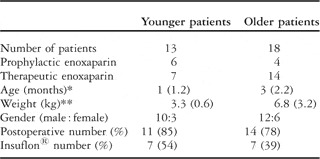
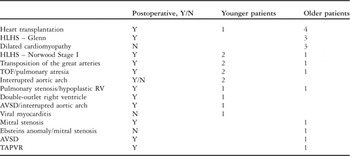
A total of 31 patients who met the study criteria were included for analysis; thirteen patients (42%) were 2 months old or younger and 18 patients (58%) were between 2 months and 2 years of age. There were 25 (81%) postoperative patients. Out of 31 patients, 22 (71%) were male and 9 (29%) were female. In all, ten patients (32%) received prophylactic and 21 (68%) received therapeutic doses of enoxaparin. The use of Insuflon® indwelling catheter was reported in 14 (45.2%) patients. In the postoperative patients, enoxaparin was started at a mean of 14 days with a standard deviation of 20 after surgery. Demographic data, cardiac diagnosis, and procedures performed are shown in Tables 1 and 2.
Demographic data by study groups.

*Median (interquartile range)
**Mean (standard deviation)
Cardiac diagnosis and procedures performed.

AVSD, atrioventricular septal defect; HLHS, hypoplastic left heart syndrome; RV, right ventricle; TAPVR, total anomalous pulmonary venous return; TOF, tetralogy of Fallot
Enoxaparin dose requirement
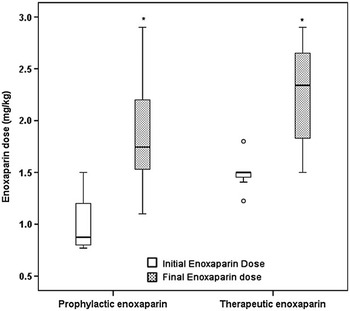
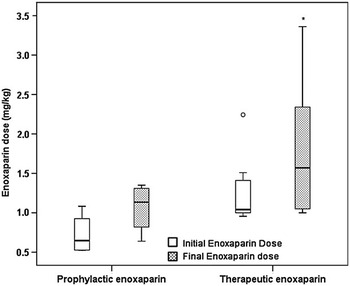
To achieve optimal anti-factor Xa levels, the enoxaparin dose was increased in all groups. By study groups, mean enoxaparin dose in milligram per kilogram every 12 hours was increased from 1.0 to 1.87 in younger patients who received prophylactic enoxaparin with a significant p value of 0.02 and from 1.5 to 2.37 in younger patients who received therapeutic enoxaparin p = 0.02; Fig 1; and from 0.73 to 1.06 in older patients who received prophylactic enoxaparin with a p value of 0.09 and from 1.23 to 1.82 in older patients who received therapeutic enoxaparin with a significant p value of 0.002; Fig 2. The overall enoxaparin dose was increased by a median of 50% with a standard deviation of 61.
Enoxaparin dose requirements in younger patients. Boxplots represent median and interquartiles. Open circles represent outliers, and the whiskers extend to 1.5 times the difference between the first and third quartiles; *p < 0.05.

Enoxaparin dose requirements in older patients. Boxplots represent median and interquartiles. Open circles represent outliers, and the whiskers extend to 1.5 times the difference between the first and third quartiles; *p < 0.05.

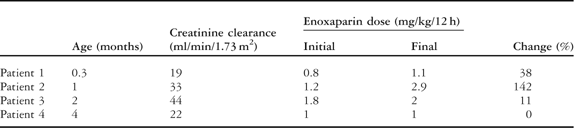
A total of four patients had a significantly abnormal estimated creatinine clearance for age. The dose requirement in these patients is shown in Table 3. Because of the small number of patients, a meaningful statistical analysis and comparison with other patients was not possible. The patient with the worst creatinine clearance of 44 millilitres per minute per 1.73 square metres required a 11% escalation in the enoxaparin dose, whereas another patient with a creatinine clearance of 33 millilitres per minute per 1.73 square metres required an approximate 140% escalation.
Enoxaparin dose requirement in patients with abnormal creatinine clearance.
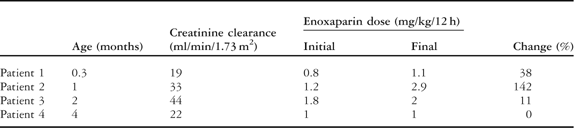
Patient 1 received prophylactic enoxaparin, whereas patients 2, 3, and 4 received therapeutic enoxaparin
To evaluate whether the route of administration had any influence on the final enoxaparin dose, we performed an analysis comparing patients who received enoxaparin via direct subcutaneous injection with those receiving enoxaparin via Insuflon® catheter. Because of the small number of patients in most groups, a meaningful analysis was only performed in older patients who received therapeutic enoxaparin (Table 4). Overall, we did not find any significant difference between these groups (p = 0.94).
Enoxaparin dosage and route of administration in older patients receiving therapeutic enoxaparin.

SC, subcutaneous
*Mean (standard deviation)
Anti-factor Xa Levels
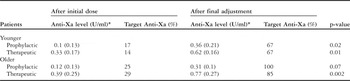
After collection of the first anti-factor Xa level, only two (15%) of the younger patients and five (28%) of the older patients had achieved target levels. After making the appropriate dose adjustments, eight (67%) of the younger patients and fifteen (89%) of the older patients reached target levels (Table 5).
Initial and final anti-factor Xa Levels.

Prophylactic, prophylactic enoxaparin; Therapeutic, therapeutic enoxaparin
*Mean (standard deviation)
Dose adjustments required to achieve recommended anti-factor Xa levels
Dosage adjustments required to achieve optimal anti-factor Xa levels per patient ranged from 0 to 5. Mean dose adjustment was 2.8 with a standard deviation of 1.2 in younger patients – 3 with a standard deviation of 1.1 in patients receiving prophylactic and 2.0 with a standard deviation of 1.8 in those receiving therapeutic enoxaparin. Among the older patients, the mean dose adjustment was 1.9 with a standard deviation of 1.6, but 1.7 with a standard deviation of 0.9 in patients receiving prophylactic and 2 with a standard deviation of 1.8 in those receiving therapeutic enoxaparin. There was no significant difference in the number of adjustments needed among groups (p = 0.11).
Adverse effects
Despite the increased enoxaparin dose usage in this population, heparin-induced thrombocytopenia, that is,drop of 50% of the initial platelet countReference Schmugge, Risch, Huber, Benn and Fischer14, seen occasionally after enoxaparin, was not observed in any of the study groups. On the contrary, the overall platelet count increased from a median of 278 with an interquartile range of 237 to 406 with an interquartile range of 288 (p = 0.014). No haemorrhagic complications were reported.
Discussion
Venous or arterial thrombosis is not an infrequent complication in children with significant cardiac disease. Postoperative and postcardiopulmonary bypass status, presence of non-physiologic circulations, suboptimal ventricular function, presence of indwelling catheters, and younger age are some of the well-known factors that contribute to the increased incidence of thrombosis.Reference Monagle1–Reference Kajimoto, Nakazawa and Murasaki5 Despite being a well-known complication, information regarding optimal prevention and treatment is limited. This is particularly true for infants and neonates. Enoxaparin, a low-molecular weight heparin, has been recommended by the American College of Chest Physicians Consensus Conference on Antithrombotic Therapy for use in the prevention and treatment of paediatric thromboembolism.Reference Monagle, Chalmers and Chan6 Unlike the use of enoxaparin in the adult population, the Consensus Conference did recognise the unpredictability of the anticoagulant effect with weight adjustment, and recommended that due to considerable interpatient dose differences, both children and neonates must have routine monitoring of anti-factor Xa levels. Beyond the factors noted above related to children with cardiac disease, this unpredictable interpatient dose difference appears to be related also to the larger volume of distribution, altered pharmacokinetics, and/or a decreased plasma concentration of antithrombin.Reference Massicotte, Adams, Marzinotto, Brooker and Andrew9
Our study shows that the currently recommended starting enoxaparin dosage recommendations for young children and infants with cardiac disease do not provide an adequate prophylactic or therapeutic anticoagulant effect. In order to achieve a target antifactor Xa level, the enoxaparin dose was increased by a median of 50% with an interquartile range of 61, and an average of 2.8 dosage adjustments were needed.
Our results are in agreement with those of other studies that raised similar concerns regarding dosage of low-molecular weight heparin in young children. Ho et alReference Ho, Wu, Hamilton, Dix and Wadsworth7, in a retrospective review study of 38 children, found that in patients less than 2 months old, only 16% of the initial anti-factor Xa levels were within the therapeutic range and several dose adjustments were needed to reach target values. Malowany et alReference Malowany, Monagle and Knoppert12, in a systematic review including published literature between 1996 and 2007, found that the mean enoxaparin maintenance dose in infants was increased from 1.48 to 2.27 milligrams per kilogram every 12 hours, and from 1.9 to 2.27 milligrams per kilogram every 12 hours in preterm neonates. This study suggested that the starting therapeutic enoxaparin dose should be increased to 1.7 milligrams per kilogram every 12 hours in term neonates and 2.0 milligrams per kilogram every 12 hours in preterm neonates. In a recently published retrospective review of 149 children by Bauman et alReference Bauman, Belletrutti and Bajzar15, a similar increase in the dose was found in patients less than 1 year of age and especially in those less than 3 months old. Importantly, in the same study it was found that patients receiving an initial higher enoxaparin dose achieved therapeutic anti-factor Xa levels sooner with fewer venipunctures required.
Bontadelli et alReference Bontadelli, Moeller and Schmugge16 investigated the efficacy and safety of enoxaparin for catheter-related arterial thrombosis in a cohort of 32 patients treated with enoxaparin. Though the treatment indications were different from those in our study, Bontadelli et alReference Bontadelli, Moeller and Schmugge16 found that newborns with congenital heart disease required increased doses of enoxaparin to achieve therapeutic anti-factor Xa levels.
This study supports a growing body of evidence that suggests an increased enoxaparin dosage requirement in young children, particularly in infants and neonates. Many children with cardiac disease require frequent invasive procedures, including cardiac surgery, catheterisation, and biopsy, and thus it is paramount that beyond minimising the inherent morbidity associated with thrombosis and thromboembolism they have patent vasculature for future access.
Limitations of our study are those related to the retrospective nature of data collection and the small sample size. Ideally, a prospective, randomised, double-bind controlled trial is needed to confirm these important findings. Until results from larger randomised studies are available, we recommend that this patient population undergo frequent monitoring and adjustments in the enoxaparin dosage to avoid complications related to delaying proper anticoagulation.
Conclusion
The use of enoxaparin in neonates, infants, and young children with cardiac disease has increased significantly in the last decade. However, despite the increased usage, large randomised controlled studies are lacking, and thus information regarding optimal dosage is scarce. Our study contributes to the growing evidence that an initial higher enoxaparin dose may be necessary to achieve target anticoagulation, and that frequent monitoring is warranted.