1. Introduction
As one of the largest Phanerozoic sites of juvenile crustal formation and metallogenic belt in the world, the Central Asia Orogenic Belt (CAOB) has attracted much attention from geoscientists in the last few decades (Wang & Liu, Reference Wang and Liu1986; Şengör, Natal’in & Burtman, Reference Şengör, Natal’in and Burtman1993; Şengör & Natal’in, Reference Şengör, Natal’in, Yin and Harrison1996; Jahn, Wu & Chen, Reference Jahn, Wu and Chen2000; Heubeck, Reference Heubeck, Hendrix and Davis2001; Xiao et al. Reference Xiao, Windley, Hao and Zhai2003, Reference Xiao, Windley, Huang, Han, Yuan, Chen, Sun, Sun and Li2009; Windley et al. Reference Windley, Alexeiev, Xiao, Kröner and Badarch2007; Jahn et al. Reference Jahn, Litivnovsky, Zanvilevich and Reichow2009). The Xing’an–Mongolia Orogenic Belt (XMOB) is one of its important tectonic components. The Urad Zhongqi area forms the north-western part of Inner Mongolia and is located in the eastern CAOB within the western XMOB (Xu et al. Reference Xu, Zhao, Bao, Zhou, Wang and Luo2014). The tectonism in this region records the evolution of the Paleo-Asian Ocean and the Palaeozoic collision between the North China and Siberian plates. This makes the area an ideal site to study the closure of the Paleo-Asian Ocean and accretion-type orogenesis.
Several issues dealing with the Palaeozoic evolution of the Paleo-Asian Ocean between the North China Craton and Mongolia Blocks are still controversial, especially the location of suture zone and the timing of the final oceanic closure. Ophiolites with various ages have been identified within different parts of the XMOB. The presence of these ophiolites, in addition to the available geological and palaeomagnetic data (Shao, Reference Shao1991; Tang Reference Tang1990, Reference Tang1992; Xu & Chen, Reference Xu and Chen1993, Reference Xu and Chen1997; Xu & Charvet, Reference Xu and Charvet2010; Xu et al. Reference Xu, Charvet, Chen, Zhao and Shi2013; Zhao et al. Reference Zhao, Chen, Xu, Faure, Shi and Choulet2013), have led to the development of several models of the timing and location of the collision between the Siberian and North China plates in the central–western part of Inner Mongolia, including models involving the closure of the Paleo-Asian Ocean during Late Devonian – early Carboniferous time, whereas other models have suggested that closure occurred during late Permian time (Wang, Reference Wang1996; Chen et al. Reference Chen, Jahn, Wilde and Xu2000; Xiao et al. Reference Xiao, Windley, Hao and Zhai2003, Reference Xiao, Windley, Huang, Han, Yuan, Chen, Sun, Sun and Li2009; Windley et al. Reference Windley, Alexeiev, Xiao, Kröner and Badarch2007; Jian et al. Reference Jian, Liu, Kröner, Windley, Shi, Zhanf, Shi, Miao, Zhang, Zhang, Zhang and Ren2008; Chen, Jahn & Tian, Reference Chen, Jahn and Tian2009; Jian, Liu & Kröner, Reference Jian, Liu and Kröner2010).
Certain types of magmatic activity can provide useful guides to specific tectonic regimes, for example, the association of A-type granites, alkaline rocks and shoshonitic rocks with extensional environments (Seo, Choi & Oh, Reference Seo, Choi and Oh2010; Yang et al. Reference Yang, Liu, Wu, Xu, Shi, Chen, Deloule and Wooden2005). Recognition of some special rocks, in particular those with significance indicating tectonic setting, is therefore critical for further understanding of the tectonic evolution of the XMOB. In the current study, we report new zircon laser ablation inductively coupled plasma mass spectrometry (LA-ICP-MS) U–Pb and whole-rock geochemical data for late Carboniferous – early Permian bimodal intrusive rocks, mainly composed of adakitic granites and gabbroic diorite within western Inner Mongolia, NW China. These data provide evidence for the late Carboniferous – early Permian tectonic setting of this area and the timing of closure of the Paleo-Asian Ocean. We conclude that the Haertaolegai late Carboniferous – early Permian bimodal intrusive rocks in western Inner Mongolia record a transitional period from collisional compression to post-collisional extension in western part of the XMOB.
2. Geological background and sample descriptions
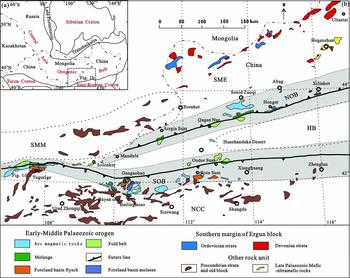
The Haertaolegai mafic and felsic intrusions are located in the northwest margin of the North China Craton, within the western Xing’an–Mongolia Orogenic Belt. Western Inner Mongolia is split into the following six tectonic units: the North China Craton (NCC); the Southern Orogenic Belt (SOB); the Hunshandake Block (HB); the Northern Orogenic Belt (NOB); the South Mongolia microcontinent (SMM); and the southern margin of the Ergun Block (SME) (Xu et al. Reference Xu, Charvet, Chen, Zhao and Shi2013). Solonker suture zone separates two opposite-facing continental blocks (Jian, Liu & Kröner, Reference Jian, Liu and Kröner2010). The northern block includes the SMM (Badarch, Cunningham & Windley, Reference Badarch, Cunningham and Windley2002) and the northern orogen (early – early late Palaeozoic) in northern China (Jian et al. Reference Jian, Liu, Kröner, Windley, Shi, Zhanf, Shi, Miao, Zhang, Zhang, Zhang and Ren2008; Xu et al. Reference Xu, Charvet, Chen, Zhao and Shi2013). The southern block comprises the southern orogen (early Palaeozoic) and the northern NCC (Jian, Liu & Kröner, Reference Jian, Liu and Kröner2010; Xu et al. Reference Xu, Charvet, Chen, Zhao and Shi2013). These two blocks behaved as the combined North China – Mongolian plate subsequent to the closure of the Paleo-Asian Ocean (Davis et al. Reference Davis, Zheng, Wang, Darby, Zhang, Gehrels, Hendrix and Davis2001; Zhang et al. Reference Zhang, Zhang, Wilde, Yang and Chen2010, Reference Zhang, Xue, Yuan, Ma and Wilde2012). The study area is located within the SOB, adjacent to the SMM to the north and the NCC to the south (Fig. 1a, b).
(a) Tectonic framework of the North China – Mongolia segment of the Central Asian Orogenic Belt (modified after Jahn, Reference Jahn, Malpas, Fletcher, Ali and Aitchison2004). (b) Tectonic sketch map of western Inner Mongolia (after Xu et al. Reference Xu, Charvet, Chen, Zhao and Shi2013). (c) Sketch geological map of northern North China showing the distribution of Palaeozoic magmatic rocks (modified after Zhang et al. Reference Zhang, Mao, Zhang, Zhai, Yang and Hu2011a ). (d) Detailed geological map of the Haertaolegai area, showing the location of felsic and mafic rock samples analysed during this study.


During late Palaeozoic time, the northern NCC experienced several magmatic events (Fig. 1c), such as Middle Devonian mafic and alkaline intrusions, Carboniferous foliated calc-alkaline plutons, early Permian high-K calc-alkaline I-, S- and A-type granitoids, and the latest Permian – Early Triassic high-K calc-alkaline–alkaline intrusive rocks (Zhang et al. Reference Zhang, Mao, Zhang, Zhai, Yang and Hu2011a ).
The small stock-like Haertaolegai intrusion was emplaced within metamorphic basement of the Palaeoproterozoic Baoyintu Group which divided into three petrofabrics (from bottom to top): quartzite-granulite formation (Pt1 by 1); garnet schist formation (Pt1 by 2); and quartzite-marble formation (Pt1 by 3). The intrusion also intrudes an early Silurian albite granite with LA-ICP-MS zircon U–Pb age of 426 Ma (unpublished data). The Baoyintu Group is composed mainly of quartzite, quartz-rich micaschist, staurolite–kyanite schist intercalated with marble and plagioclase amphibole schist, dolomitic marble, staurolite–garnet mica schist, biotite-bearing amphibole schist, leptynite and actinolite schist. A whole-rock Sm–Nd isochron age of 2485±128 Ma from the plagioclase amphibole schist is interpreted as the age of the Baoyintu Group (Xu et al. Reference Xu, Liu, Wang, Zheng and Tian2000, Reference Xu, Charvet, Chen, Zhao and Shi2013). The area contains well-developed NEE--SWW- and nearly E–W-trending faults and numerous intrusive rocks, including a Silurian albite granite, a Permian ultramafic–mafic complex, and a Permian monzogranite. The early Permian granite in this area is dominated by porphyritic adamellite and porphyritic granite phases, whereas the mafic rocks in the study area are dominantly gabbroic diorites (Fig. 1d).
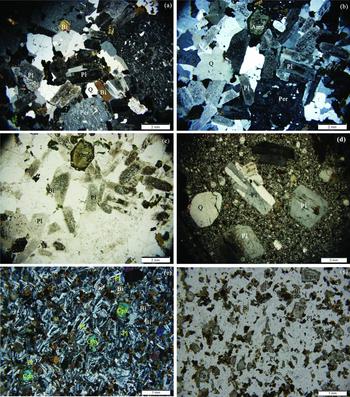
The adamellite (samples TG-1 and TG-2) within the study area is pale red and porphyritic, has a granitic texture and contains plagioclase (c. 45%), perthite (c. 25%), quartz (c. 20%), biotite (c. 5%) and amphibole (c. 3%) with accessory zircon, apatite, titanite, and Fe–Ti oxides (<2%) (Fig. 2a–c). This phase of the intrusion is cross-cut by quartz veins and porphyritic granite dykes. The latter consist of light flesh-pink-coloured porphyritic granite (sample TG-3) that is massive and contains plagioclase and quartz phenocrysts (20–25%) within a microgranular matrix of K-feldspar, quartz, plagioclase and biotite (Fig. 2d).
Representative photomicrographs of the mafic and felsic rocks analysed during this study, showing typical textures and internal structures: (a) adamellite (TG-1), cross-polarized light; (b) adamellite (TG-2), cross-polarized light; (c) adamellite (TG-2), single-polarized light; (d) granitic porphyry (TG-3), cross-polarized light; (e) gabbroic diorite (TG-4), cross-polarized light; (f) gabbroic diorite (TG-4), single-polarized light. Amp – amphibole; Bi – biotite; Cpx – clinopyroxene; Per – perthite; Pl – plagioclase; Q – quartz.

The gabbroic diorite (sample TG-4) within the mafic part of the pluton is gabbro textured and contains plagioclase (c. 70%), clinopyroxene (c. 12%), biotite (c. 10%) and hornblende (c. 5%) with accessory magnetite, apatite, zircon, and epidote (c. 5%) (Fig. 2e, f).
3. Analytical methods
3.a. Zircon U–Pb dating
The samples used for zircon U–Pb dating were conventionally crushed and separated using heavy liquids and a magnetic separator at the Langfang Regional Geological Survey, Hebei Province, China. Approximately 250 zircons were handpicked from each sample and were embedded within resin discs under a binocular microscope before being polished to expose grain centres. Transmitted and reflected light images were captured using a microscope, and cathodoluminescence (CL) imaging was undertaken using a JEOL scanning electron microscope. LA-ICP-MS zircon U–Pb analysis of TG-1 and TG-2 samples was conducted using an Agilent 7500a ICP-MS instrument equipped with a 193 nm laser at the State Key Laboratory of Continental Dynamics, Northwestern University, Xi’an, China, using a 30 μm spot diameter. Details of the analytical technique are described by Yuan et al. (Reference Yuan, Gao, Liu, Li, Gunther and Wu2004), common Pb concentrations were evaluated following Andersen (Reference Andersen2002) and ISOPLOT version 3.0. (Ludwig, Reference Ludwig2003) was used for age calculations and for constructing concordia diagrams.
LA-ICP-MS U–Pb analyses of zircons separated from TG-3 and TG-4 samples were performed using an Agilent 7500a ICP-MS instrument equipped with a 193 nm laser at the State Key Laboratory of Geological Processes and Mineral Resources, China University of Geosciences, Wuhan, China using a 91500 standard zircon as an external standard for age calibration and a NIST SRM 610 silicate glass standard for instrument optimization. This analysis used a 30 μm spot size with instrument parameters and detailed analytical procedures identical to those described by Liu et al. (Reference Liu, Hu, Gao, Günther, Xu, Gao and Chen2008). The ICPMS DataCal version 6.7 (Liu et al. Reference Liu, Hu, Gao, Günther, Xu, Gao and Chen2008) and Isoplot version 3.0 (Ludwig, Reference Ludwig2003) programs were used for data reduction, with correction for common Pb undertaken following Andersen (Reference Andersen2002). Errors on individual LA-ICP-MS analyses are quoted at the 1σ level, whereas errors on pooled ages are quoted at the 95% (2σ) confidence level. The dating results are presented in the online Supplementary Material (Table S1, available at http://journals.cambridge.org/geo).
3.b. Major and trace element determination
Major and trace element compositions of the mafic and felsic samples were determined by X-ray fluorescence spectrometer (XRF; Philips PW2404) and plasma mass spectrometer (ICP-MS; ELEMENT 1), respectively, at the Geological Analysis and Research Centre of Nuclear Industry of China, Beijing, China. Major elements concentrations were determined using a Philips PW-2404 X-fluorescence spectrometer, and all trace and rare Earth element (REE) concentrations, with the exception of Sb and Bi, were determined by ICP-MS and an Element-2 mass spectrometer. Sb and Bi concentrations were determined by atomic fluorescence spectrometry using a double-channel AFS-2202 spectrometer. The analytical precision for major elements is better than 5%, and trace element concentrations have relative deviations of <5% for concentrations of >10 ppm and of <10% for other concentrations. The detailed analysis process is described by Qu, Hou & Li (Reference Qu, Hou and Li2004).
3.c. In situ zircon Hf isotope analysis
In situ zircon Hf isotope analysis was undertaken using a Neptune Plus MC-ICP-MS instrument equipped with a 193 nm laser at the state Key Laboratory of Geological Processes and Mineral Resources, China University of Geosciences, Wuhan, China using the instrumental conditions and data acquisition procedures described by Hu et al. (Reference Hu, Liu, Gao, Liu, Yang, Zhang, Tong, Lin, Zong, Li, Chen and Zhou2012). A 91500 standard zircon was used as an external standard, and a spot size of 44 μm and a laser repetition rate of 6–8 Hz at 100 mJ were used during analysis. 179Hf/177Hf and 173Yb/171Yb ratios were used to calculate the mass bias of Hf (βHf) and Yb (βYb), and the interference of 176Yb on 176Hf was corrected by measuring the interference-free 173Yb isotope and using 176Yb/173Yb = 0.79639 (Fisher et al. Reference Fisher, Vervoort and Hanchar2014) to calculate 176Yb/177Hf values. The relatively minor interference of 176Lu on 176Hf was corrected by measuring the intensity of the interference-free 175Lu isotope and using the recommended 176Lu/175Lu = 0.02656 value (Blichert-Toft et al. Reference Blichert-Toft, Chauvel and Albarède1997) to calculate 176Lu/177Hf. Finally, the mass bias of Yb (βYb) was used to calculate the mass fractionation of Lu. The program ICPMSDataCal (Liu et al. Reference Liu, Hu, Zong, Gao, Gao, Xu and Chen2010) was used to perform off-line selection and mass bias calibrations, and to integrate analyte signals.
4. Results
4.a. Zircon U–Pb ages
Zircons from both mafic and felsic samples are generally euhedral and colourless, and contain typical magmatic rhythmic banding and oscillatory zoning (Fig. 3). The granitic zircons are long to short prismatic and have mean crystal sizes of 100–200 μm, whereas the gabbroic diorite zircons are 80–120 μm long and have widths of 40–60 μm (Fig. 3). Some zircons have inherited cores that are commonly corroded, reflecting the influence of magmatism on the cores. The majority of zircons have highly variable Th (384–7171 ppm for mafic, 67–981 ppm for felsic) and U (755–4733 ppm for mafic, 86–2595 ppm for felsic) concentrations, yielding high Th/U ratios of 0.45–1.51 and 0.19–0.52 for mafic and felsic samples, respectively, all of which is indicative of a magmatic origin for these zircons (Hoskin & Schaltegger, Reference Hoskin and Schaltegger2003).
Cathodoluminescence (CL) images of zircons from mafic and felsic rocks analysed during this study. The numbers on the images indicate individual analysis spots, and the values below the images show zircon ages and εHf(t) values.

Adamellite samples TG-1 and TG-2 yielded weighted mean 206Pb/238U ages of 300±6 (MSWD = 0.1; n = 20) and 297±2 Ma (MSWD = 0.2; n = 21), respectively (Fig. 4a, b), which represent the timing of formation of the monzogranite intrusion. Sample TG-3 from the porphyritic granite dyke yielded a weighted mean 206Pb/238U age of 286±3 Ma (MSWD = 4.1; n = 16; Fig. 4c) that is indicative of the timing of emplacement of the dyke. Finally, the 10 analyses of zircons from gabbroic sample TG-4 yielded a weighted mean 206Pb/238U age of 286±4 Ma (MSWD = 3.6; n = 10; Fig. 4d).
Zircon U–Pb concordia diagram for the mafic and felsic rocks analysed during this study.

4.b. Major and trace elements
The major and trace element compositions of the felsic rocks are given in the online Supplementary Material (Table S2, available at http://journals.cambridge.org/geo). The granitic samples have SiO2 concentrations of 68.34–70.74 wt%, Al2O3 concentrations of 14.88–15.67 wt%, MgO concentrations of 0.73–1.05 wt%, Na2O concentrations of 4.24–4.86 wt% and K2O concentrations of 3.38–4.36 wt%, yielding Na2O/K2O ratios of 0.97–1.42 (Table S2). These samples have A/CNK (molar Al2O3/(CaO+K2O+Na2O)) ratios of 0.88–0.98, indicating that these are metaluminous granites (Fig. 5b; Maniar & Piccoli, Reference Maniar and Piccoli1989) and are classified as sub-alkaline in a total alkalis versus SiO2 (TAS) diagram (Fig. 5a; Irvine & Baragar, Reference Irvine and Baragar1971). All of these samples are classified as high-K and calc-alkaline in a K2O versus SiO2 diagram (Fig. 5c). They are enriched with light rare Earth elements (LREEs) and large-ion lithophile elements (LILEs), are depleted in heavy REEs (HREEs) and high-field-strength elements (HFSEs) (Fig. 6a, b) and have (La/Yb)N ratios and Eu/Eu* values of 35.5–89.9 and 0.93–1.17, respectively. In addition, they have high Sr (521–736 ppm) and low Y (3.76–6.19 ppm) and Yb (0.22–0.60 ppm) concentrations, and are classified as adakites in Sr/Y versus Y and (La/Yb)N versus (Yb)N diagrams (Fig. 7a, b).
Chemical compositions of adamellite, granitic porphyry and gabbroic diorite rocks analysed during this study. (a) SiO2 versus total alkali (Na2O+K2O) concentrations. (b) A/CNK versus A/NK. IAG – island-arc granotoid; CAG – continental arc granotoid; CCG – continental collisional granotoid; POG– post-orogenic granotoid; RRG – rift ridge grantoid (Dong et al. Reference Dong, Liu, Santosh, Chen, Zhang, Li, He and Zhang2012). (c) SiO2 versus K2O. The boundary lines in the SiO2 versus (Na2O+K2O), SiO2 versus K2O and A/CNK versus A/NK diagrams are from Irvine & Baragar (Reference Irvine and Baragar1971), Peccerillo & Taylor (Reference Peccerillo and Taylor1976), and Maniar & Piccoli (Reference Maniar and Piccoli1989), respectively.

(a, c) Chondrite-normalized REE patterns and (b, d) primitive-mantle-normalized trace element spidergrams for the mafic and felsic rocks examined in this study. Chondrite and primitive mantle normalizing values are from Boynton (Reference Boynton and Henderson1984) and Sun & McDonough (Reference Sun, McDonough, Saunders and Norry1989), respectively. Symbols as for Figure 5c.

Plots of (a) Sr/Y versus Y and (b) (La/Yb)N versus (Yb)N for the adamellite and granitic porphyry rocks. Modified after Defant & Drummond (Reference Defant and Drummond1990); adakite fields from Martin (Reference Martin1999).

The samples from the mafic stock are generally classified as gabbroic diorites, and have SiO2 concentrations of 55.21–56.13 wt%, with high total Fe2O3 (8.93–9.31 wt%), Al2O3 (15.98–16.63 wt%), MgO (3.72–4.55 wt%), K2O (2.06–2.21 wt%) and CaO (6.67–7.24 wt%) concentrations and low TiO2 (0.88–0.95 wt%) and P2O5 (0.27–0.42 wt%) concentrations. These samples are high-K and calc-alkaline, with A/CNK ratios of 0.81–0.99 (Fig. 5b). They are moderately enriched with LREEs ((La/Yb)N = 11.0–14.2) and have weakly negative Eu anomalies (Eu/Eu* = 0.87–0.98; Fig. 6a), and are enriched with LILEs (such as Sr, Ba, and Rb) relative to the LREEs and HFSEs (such as Nb, Ta, P and Ti) within primitive-mantle-normalized multi-element variation diagrams.
4.c. Zircon Hf isotopes
The results of in situ Hf isotopic analysis of zircons from adamellite sample TG-2 are listed in Table 1 and depicted in Figure 8a,b.
Lu–Hf isotopic data for the adamellite rocks in the study area.

Correlations between Hf isotopic compositions and the formation ages of the adamellite (TG-2) in the study area. XMOB – Xing’an–Mongolia Orogenic Belt; YFTB – Yanshan Fold and Thrust Belt (Yang et al. Reference Yang, Wu, Shao, Wilde, Xie and Liu2006).

The initial 176Hf/177Hf ratios of zircons from the adamellite (TG-2) range from 0.282134 to 0.282219, with εHf(t) values and corresponding Hf two-stage model ages (T DM2) of 1.0–2.7 and 1032–1128 Ma consistent with those from the XMOB (Fig. 8a; Yang et al. Reference Yang, Wu, Shao, Wilde, Xie and Liu2006).
5. Discussion
5.a. Petrogenetic relationship between mafic and felsic rocks
The relationship between the early Permian mafic and felsic rocks in the study area can be determined using field relationships and geochemical data. First, the granitic and mafic magmas were intruded independently, and the granitic intrusions are exposed over a larger area than the coeval mafic intrusions. Second, the presence of a compositional gap between the mafic and granitic rocks (Fig. 5a) suggests that they formed independently. Finally, the gabbroic diorites have higher total REE abundances than the coeval granitoids (Fig. 6a, c), which is inconsistent with a fractional crystallization relationship between the mafic and felsic rocks. These features indicate that the early Permian granitic and mafic rocks have independent origins.
5.b. Petrogenesis of the mafic rocks and magma source
The early Permian mafic rocks in the study area have low SiO2 concentrations (55.21–56.13 wt%), high Ni (10.2–17.2 ppm), Co (24.5–29.2 ppm), Sc (19.1–23.9 ppm) and Cr (46.2–73.9 ppm) concentrations, and high Mg numbers (45.0–50.2; Mg no. = 100 Mg/(Mg+TFe2+)) and Na2O/K2O ratios (1.5–1.6; Table S2, available at http://journals.cambridge.org/geo) that suggest these rocks formed from a primary basaltic magma that was derived from the partial melting of lithospheric mantle material (Frey & Prinz, Reference Frey and Prinz1978). In addition, relevant experimental petrology had proved that high-Mg-number adakitic rocks cannot be produced by partial melting of basaltic rocks (Rapp & Watson, Reference Rapp and Watson1995). This further suggests that the magma source for the gabbroic diorites should be upper mantle, but not lower crust or crust–mantle transitional zone (Chen & Zhou, Reference Chen and Zhou2004). However, these mafic rocks are also significantly enriched with LILEs (e.g. Ba, Th, U) and LREEs and depleted in HFSEs (e.g. Nb, Ta, and Ti), as evidenced by chondrite-normalized REE and primitive-mantle-normalized trace element variation diagrams (Fig. 6c, d). These geochemical characteristics are consistent with formation from melts derived from a depleted mantle source that was metasomatized by subduction-related fluids (Abe, Arai & Yurimoto, Reference Abe, Arai and Yurimoto1998; Eiler et al. Reference Eiler, Crawford, Elliott, Farley, Valley and Stolper2000; Grove et al. Reference Grove, Elkins Tanton, Parman, Cartterjee, Muntener and Gaetani2003), or from melts from a depleted mantle source that assimilated crustal materials during magma ascent and emplacement (Wilson, Reference Wilson1989; Yang et al. Reference Yang, Wu, Wilde and Zhao2008).
In general, Nb/U and Ta/U ratios can be used as indices of crustal contamination. The mafic rocks in the study area have Nb/U and Ta/U ratios of 3.76–6.64 and 0.26–0.41, respectively, both of which are not only much lower than mid-ocean ridge basalt (MORB) and ocean island basalt (OIB) values (Nb/U = 47, Ta/U = 2.7; Hofmann, Reference Hofmann1988), but are also lower than typical crustal values (Nb/U = 12.1, Ta/U = 1.1; Taylor & McLennan, Reference Taylor and McLennan1995). Although the Nb/U and Ta/U ratios of these mafic rocks are similar to those of the upper continental crust (Nb/U = 8.9 and Ta/U = 0.2; Taylor & McLennan, Reference Taylor and McLennan1995), their Sr concentrations (726–769 ppm; Table S2, available at http://journals.cambridge.org/geo) are much higher than that of continental crust in general (Sr = 280–348 ppm; Rudnick & Gao, Reference Rudnick and Gao2003) and the upper continental crust (350 ppm; Taylor & McLennan, Reference Taylor and McLennan1995; 267 ppm, Gao et al. Reference Gao, Luo, Zhang, Zhang, Han, Zhao and Hu1998). In addition, the gabbroic diorites have higher La/Nb (4.55–5.09) and Ba/Nb (131–162) ratios than the continental crust, suggesting that the magmas that formed these rocks assimilated minimal crustal material during ascent and emplacement.
In summary, we suggest that the early Permian gabbroic diorites within the study area were derived from partial melting of lithospheric mantle material that was previously metasomatized by subducted slab-derived fluids.
5.c. Petrogenesis of the felsic rocks and magma source
The geochemistry of the adamellite and porphyritic granite phases of the felsic Haertaolegai intrusion suggests they are adakitic (Defant & Drummond, Reference Defant and Drummond1990; Fig. 7a, b), as evidenced by their high SiO2 (>56 wt%), Al2O3 (≥15 wt%), Na2O (>3.5 wt%) and Sr (>400 ppm) and low Y (<18 ppm) and Yb (<1.9 ppm) concentrations.
Several genetic models have been proposed for adakitic rocks, including: (1) partial melting of subducting oceanic slab material (Defant & Drummond, Reference Defant and Drummond1990; Martin, Reference Martin1999; Martin et al. Reference Martin, Smith, Rapp, Moyen and Champion2005); (2) partial melting of thickened mafic lower continental crustal material (Atherton & Petford, Reference Atherton and Petford1993; Wareham, Millar & Vaughan, Reference Wareham, Millar and Vaughan1997; Zhang et al. Reference Zhang, Wang, Qian, Yang, Wang, Zhao and Guo2001; Wang et al. Reference Wang, McDermott, Xu, Bellon and Zhu2005); (3) partial melting of delaminated lower continental crustal material (Kay & Kay, Reference Kay and Kay1993; Xu et al. Reference Xu, Shinjio, Defant, Wang and Rapp2002; Gao et al. Reference Gao, Rudnick, Yuan, Liu, Liu, Xu, Ling, Ayers, Wang and Wang2004); and (4) fractional crystallization of a parental basaltic magma (Castillo, Janney & Solidum, Reference Castillo, Janney and Solidum1999; Macpherson, Dreher & Thirwall, Reference Macpherson, Dreher and Thirwall2006). The adakitic rocks within the felsic Haertaolegai intrusion have Na2O concentrations (4.24–4.86 wt%) and Na2O/K2O ratios (0.97–1.42 with an average of 1.24) that are lower than those of adakitic rocks produced by partial melting of subducting oceanic slab material (Na2O concentrations of 4.88 wt% and Na2O/K2O ratios of 2.5–6.5; Sajona, et al. Reference Sajona, Maury, Pubellier, Leterrier, Bellon and Cotton2000). In addition, adakitic rocks that form by partial melting of subducting oceanic slab material have low K2O concentrations and Rb/Sr ratios (0.04–0.05), and high Mg numbers (Mg no. >47; Martin, Reference Martin1999; Smithies, Reference Smithies2000) that contrast with the high K calc-alkaline adakitic rocks in the study area; the latter have high K2O concentrations (3.46–4.36 wt%) and Rb/Sr ratios of 0.19–0.25. This indicates that the adakitic rocks within the Haertaolegai pluton were not produced by partial melting of subducting oceanic slab material.
The high SiO2 concentrations (68.34–70.74 wt%) and Th/U ratios (2.11–4.37) and low MgO (0.73–1.05 wt%), Cr (14.9–35.4 ppm) and Ni concentrations (6.84–13.8 ppm) and Mg numbers (39.4–44.8) of these adakitic rocks are also inconsistent with melts derived from delaminated lower crustal material. Typically, such melts would have high Cr and Ni concentrations and low Th/U ratios, similar to melts derived from thickened lower continental crustal material. Adakitic rocks can also be produced by the low-pressure fractional crystallization of basaltic magmas (Castillo, Janney & Solidum, Reference Castillo, Janney and Solidum1999; Gao et al. Reference Gao, Klemd, Long, Xiong and Qian2009). However, the low Cr and Ni concentrations of the adakitic rocks in the study area suggest that they are not the products of fractional crystallization of a hydrous basaltic magma. The low-pressure fractional crystallization of plagioclase and hornblende can generate concave REE patterns between the HREEs and the middle rare Earth elements (MREEs), leading to a decrease in Dy/Yb ratios with increasing SiO2 concentrations (Castillo, Janney & Solidum, Reference Castillo, Janney and Solidum1999; Macpherson, Dreher & Thirwall, Reference Macpherson, Dreher and Thirwall2006), although the adakitic rocks within the Haertaolegai pluton do not have either of these characteristics (Figs 6a, 9a). In addition, plotting the samples analysed during this study in a La/Sm versus La diagram (Fig. 10a) suggests that their evolution was mainly controlled by partial melting. This result, combined with a lack of Eu anomalies and a negative correlation between Na2O and La with SiO2 concentrations, suggests the Haertaolegai adakitic rocks were not derived by fractional crystallization of a basaltic magma (Castillo, Janney & Solidum, Reference Castillo, Janney and Solidum1999; Macpherson, Dreher & Thirwall, Reference Macpherson, Dreher and Thirwall2006; Zhu et al. Reference Zhu, Zhao, Pan, Lee, Kang, Liao, Wang, Li, Dong and Liu2008).
Plots of (a) Dy/Yb versus SiO2 and (b) Nb/Ta versus Zr/Sm for the felsic rocks of study area. After Foley, Tiepolo & Vannucci (Reference Foley, Tiepolo and Vannucci2002).

Plots of (a) La/Sm versus La and (b) MgO versus SiO2 for the adamellites and granitic porphyries in study area. After Karsli et al. (Reference Karsli, Dokuz, Uysal, Aydin, Kandemir and Wijbrans2010).

The adakitic rocks in the study area have high Sr concentrations and Sr/Y ratios, low Y, Yb, and HREE concentrations and do not have visible Eu anomalies, indicating the presence of residual garnet and the absence of plagioclase in the source region for the magmas that formed these rocks (Rapp, Xiao & Shimizu, Reference Rapp, Xiao and Shimizu2002; Xiong, Adam & Green, Reference Xiong, Adam and Green2005). However, these rocks also have flat HREE patterns that indicate that amphibole had a more important role than garnet in the generation of the adakitic melts that formed these intrusions (Fig. 6a; Moyen, Reference Moyen2009; Huang & He, Reference Huang and He2010). In addition, the low Nb/Ta ratios of these rocks are consistent with formation from adakitic melts derived from the melting of amphibolite material (Fig. 9b; Foley, Tiepolo & Vannucci, Reference Foley, Tiepolo and Vannucci2002; Xiong, Reference Xiong2006), and these samples plot close to adakitic melts derived from the melting of thickened mafic lower crustal material within a SiO2 versus MgO diagram (Fig. 10b; Karsli et al. Reference Karsli, Dokuz, Uysal, Aydin, Kandemir and Wijbrans2010). This suggests that the adakitic rocks in the study area formed from magmas generated by the melting of garnet-bearing amphibolite material within a thickened region of the mafic lower crust.
The Hf isotopic compositions of zircons within adamellites in the study area can also provide constraints on the nature of this thickened region of the mafic lower crust. Zircons within the adamellite have ɛHf(t) values of +1.0 to +2.7 and T DM2 ages of 1032–1128 Ma, indicating that these magmas could have formed from a thickened region of the mafic lower crust that accreted during Mesoproterozoic time.
5.d. Tectonic setting of magmatism and implications for regional geology
The timing of the final closure of the Paleo-Asian Ocean within the western part of Inner Mongolia remains controversial, with previous research on the geochronology and geochemistry of Permian – Early Triassic ultramafic–mafic rocks in this area suggesting the presence of an intra-oceanic arc–trench system with multiple south- and north-directed subduction zones between 530 and 250 Ma. This system collided along the Solonker suture zone during late Permian – Middle Triassic time (Chen et al. Reference Chen, Jahn, Wilde and Xu2000; Xiao et al. Reference Xiao, Windley, Hao and Zhai2003, Reference Xiao, Windley, Huang, Han, Yuan, Chen, Sun, Sun and Li2009; Jian et al. Reference Jian, Liu, Kröner, Windley, Shi, Zhanf, Shi, Miao, Zhang, Zhang, Zhang and Ren2008; Chen, Jahn & Tian, Reference Chen, Jahn and Tian2009; Jian, Liu & Kröner, Reference Jian, Liu and Kröner2010). However, other research has suggested that the oceanic basin along the northern margin of the North China Plate disappeared during Late Devonian – early Carboniferous time, as evidenced by the age of the youngest ophiolite identified to date (>350 Ma; Shao, Reference Shao1991; Tang, Reference Tang1992; Zhang, Zhou & Wang, Reference Zhang, Zhou and Wang2003). Although a Permian ophiolite has been identified within the Solon and Hegen mountains (Jian et al. Reference Jian, Liu, Kröner, Windley, Shi, Zhanf, Shi, Miao, Zhang, Zhang, Zhang and Ren2008; Miao et al., Reference Miao, Fan, Liu, Zhang, Shi and Guo2008), the presence of a widely distributed bimodal volcanic suite and A-type granite rocks to the north and south of the Solon and Hegen mountains is inconsistent with the subduction of oceanic crust during early Permian time in this area (Hong et al. Reference Hong, Huang, Xiao, Xu and Jin1994; Shi et al. Reference Shi, Miao, Zhang, Jian, Fan and Liu2004; Zhang & Jiang, Reference Zhang and Jian2008; Luo, Wu & Zhao, Reference Luo, Wu and Zhao2009). This suggests that this Permian ophiolite formed within a remnant ocean or a continental rift (Li, Reference Li2006; Zhang & Jiang, Reference Zhang and Jian2008). Xu et al. (Reference Xu, Zhao, Bao, Zhou, Wang and Luo2014) also propose that the Permian ophiolite in Solonker belongs to continental-margin-type ophiolite, the tectonic emplacement of which is associated with nappe structure but not oceanic crust subduction. In addition, the presence of an unconformity between Upper Devonian sediments and underlying rocks, and the differing styles of deformation between these units, led Tang (Reference Tang1990) and Xu et al. (Reference Xu, Charvet, Chen, Zhao and Shi2013) to suggest that the Paleo-Asian Ocean closed during Late Devonian time. Palaeomagnetic data also indicate that the North China and Mongolia blocks were amalgamated during Late Devonian – Permian time. Palaeomagnetic evidence suggests that the closure of the Paleo-Asian Ocean occurred previously to Late Devonian time (Zhao et al. Reference Zhao, Chen, Xu, Faure, Shi and Choulet2013) and that central Inner Mongolia was part of the NCC during late Carboniferous – early Permian time (Li et al. Reference Li, Zhang, Gao, Li, Zhao, Li and Guan2012). The discovery of early–middle Permian Cathaysian flora (Zhou et al. Reference Zhou, Gu, Liu, Yu, Zhang, Tian, He and Wang2010) north of the Erenhot–Hegenshan fault also indicates that the Paleo-Asian Ocean disappeared before early Permian time. All the above corroborate the theory that the Paleo-Asian Ocean was closed at least from Late Devonian time.
Certain types of magmatic activity are of importance to constrain the evolution of the orogeny. Recent research has identified late Palaeozoic rocks in western Inner Mongolia that were generated during post-collisional magmatism. This is as exemplified by Tang et al. (Reference Tang, Zhang, Li, Feng and Chen2011), who recognized a late Carboniferous bimodal volcanic suite within the western part of the Hunshandake Block that most likely formed in an extensional setting after collision between the North China Craton and the South Mongolia microcontinent. Zhang et al. (Reference Zhang, Wilde, Zhang and Zhai2011b , Reference Zhang, Yuan, Xue, Yan and Mao2014) also reported a bimodal high-K magmatic association with an A-type granite in the Bayinwula area. In addition the Kebu diorite massif in Urad Zhongqi (Luo, Wu & Li, Reference Luo, Wu and Li2007), within the northern margin of the North China Craton, is adakitic and yields a SHRIMP zircon age of 291±4 Ma; this suggests that these units formed from magmas generated by partial melting of mafic lower continental crustal material during post-collisional basaltic underplating. A-type granites with ages of 276 and 277 Ma have been identified in the Xilinhaote area and to the south of Urad Zhongqi (Shi et al. Reference Shi, Miao, Zhang, Jian, Fan and Liu2004; Luo, Wu & Zhao, Reference Luo, Wu and Zhao2009), respectively, all of which formed during post-collisional magmatism. Zhao, Wu & Luo (Reference Zhao, Wu and Luo2011) also identified a 269 Ma mafic–ultramafic pluton within the Wengeng and Urad Zhongqi areas, and suggested that this magmatism occurred in a post-collisional tectonic setting. The early Permian magmatic rocks from the northern NCC and the neighbouring orogenic belt constitute a magmatic province which exhibits temporal and spatial distribution, rock constituent, magma genesis and metamorphic style typical of post-collisional magmatism (Zhang et al. Reference Zhang, Mao, Zhang, Zhai, Yang and Hu2011a ). Jahn et al. (Reference Jahn, Litivnovsky, Zanvilevich and Reichow2009) also suggested that the voluminous early Permian peralkaline and alkaline granitoids and genetically related bimodal volcanics emplaced in the eastern CAOB occurred in an extensional tectonic setting.
In summary, these studies suggest that the Paleo-Asian Ocean in western Inner Mongolia closed prior to early Permian time, confirming studies from a wider area of the CAOB (Hong et al. Reference Hong, Zhang, Wang, Wang and Xie2004; Jahn et al. Reference Jahn, Litivnovsky, Zanvilevich and Reichow2009). To determine the precise time of the final closure of the Paleo-Asian Ocean, more research and evidence are required.
The felsic rocks in the study area are dominated by adamellite and porphyritic granite phases, both of which have low A/CNK ratios that are indicative of metaluminous granites (Fig. 5b). These samples have primitive-mantle-normalized multi-element variation patterns that are LILE enriched and HFSE (e.g. Nb, P, and Ti) depleted, similar to typical post-collisional I-type granites (Kuster & Harms, Reference Kuster and Harms1998). These felsic rocks are also adakitic and formed from magmas generated by partial melting of a thickened region of the mafic lower crust. The contemporaneous nature of mafic and felsic rocks in the study area is indicative of a bimodal igneous rock association that most likely formed in an extensional setting. This suggests that the Haertaolegai adakitic rocks and the associated gabbroic diorites formed during the transition from collisional compression to post-collisional extension, indicating in turn that the Paleo-Asian Ocean in western Inner Mongolia closed before early Permian time.
These data, combined with the geology of this region and our new knowledge of the petrogenesis of mafic and felsic rocks in the study area, allows the construction of the following genetic model for the Haertaolegai bimodal intrusive rocks. The early Permian continental collision of the South Mongolia microcontinent with the North China Craton caused a region of juvenile mafic lower crust to undergo tectonic thickening and metamorphism into garnet-bearing amphibolite material. Slab break-off caused asthenospheric mantle material to ascend, resulting in partial melting of the juvenile mafic lower crust and generating the magmas that formed the Haertaolegai adakitic intrusions. The upwelling asthenospheric material also provided sufficient heat energy to melt the lithospheric mantle, generating voluminous mafic magmas that formed the mafic rocks in the study area.
6. Conclusions
(1) A suite of bimodal intrusive rocks within western Inner Mongolia includes mafic intrusions that yield LA-ICP-MS zircon U–Pb dates of c. 286 Ma and felsic intrusions that were emplaced between 286 and 300 Ma.
(2) The primary magma that formed the early Permian mafic rocks was generated by partial melting of lithospheric mantle material that was previously modified by subduction-related fluids. The felsic rocks are adakitic and formed from primary magmas generated by partial melting of a thickened region of juvenile mafic lower crust.
(3) The late Carboniferous – early Permian bimodal intrusive rocks in western Inner Mongolia formed during the transition from collisional compression to post-collisional extension, indicating that the Paleo-Asian Ocean in western Inner Mongolia closed before 300 Ma.
Acknowledgements
We thank the staff of the State Key Laboratory of Continental Dynamics, Northwestern University, Xi’an, China; the State Key Laboratory of Geological Processes and Mineral Resources, China University of Geosciences, Wuhan, China; and Geological Analysis and Research Centre of Nuclear Industry of China for their assistance during U–Pb zircon dating, Hf isotope analyses and major and trace element analyses. This study was supported by Research Program ‘Au-Co-Ni Mineralization potential estimation of Tugurige gold mine and periphery in Urad Zhongqi, Inner Mongolia’ from Geological Brigade No. 208 of China National Nuclear Corporation. We are grateful to Gengxin Zhang and Guoyu Shao of the Geological Brigade No. 208 of China National Nuclear Corporation for their help during the field investigations. The helpful and constructive reviews and suggestions by Professor W.J. Xiao and an anonymous reviewer are greatly appreciated.