Recent empirical work on the determinants of trade policy preferences based on the United States reveals that individuals' responses to survey questions are susceptible to framing effects, the strength of which usually covaries with respondents' level of education, as Hiscox shows.Footnote 1 That is, more educated individuals are more likely to appreciate the benefits of integration—especially those who have been exposed to trade theory and the principle of comparative advantage—and to have a cosmopolitan outlook, and therefore greater tolerance toward foreigners and their products. For these reasons the educated are less sensitive to framing effects in defining their views on trade policy.Footnote 2 This conjecture seems to be borne out in studies using survey data for advanced economies and supported by experimental surveys in the United States. But it has not been duly tested beyond the United States and other developed economies with similar endowments of skill, which is correlated with educational attainment and socialization, thereby masking the confounding effect of trade on the relative demand for skill.
The interpretation of Hiscox's findings for the United States points to the cognitive effects of education, rather than to the expected material impact of trade on the demand for the labor market skills that the more educated are likely to possess. Building on the pioneering work of Bauer, de Sola Pool, and Dexter,Footnote 3 Mansfield and Mutz argue that sociotropic motivations and foreign policy stances dominate individual self-interest in shaping attitudes toward trade and economic integration.Footnote 4 The emphasis on socialization, ideological leanings, education, and sociotropic perceptions has relegated material interests to a secondary role in the most recent literature on trade policy preferences.Footnote 5 We aim to bring material interests back into the debate by focusing on material motivations as an alternative process affecting individuals' susceptibility to framing effects in public opinion surveys.
Understanding the determinants of trade policy preferences and the impact of issue framing on shaping such preferences is central to explaining changes in public support for different trade (and other economic policies) in democratic polities. Yet disentangling the role of material incentives from cognitive and informational determinants of individual responses to public opinion survey questions is a daunting task. Cognitive abilities are collinear with education and skill, and skill plays a central role in most theories of international trade, including factor content explanations of the direction and distributional consequences of trade;Footnote 6 theories of comparative advantage;Footnote 7 and the “new” new trade theory's emphasis on the skill premia generated by trade.Footnote 8 Hence exploring the relationship between skill and trade attitudes, and the mitigating effect of education and socialization, requires sampling beyond the set of countries with similar relative endowments of skill where the effect of material and nonmaterial determinants of attitudes toward trade cannot be easily disentangled.
To explore these determinants we conducted an original survey experiment in Argentina, which has different skill endowments than the United States thereby allowing us to better explore the role of material and nonmaterial attributes on trade policy preferences. The survey instrument reproduces the issue-framing design Hiscox introduced in his study of trade policy preferences in the United States.Footnote 9 The instrument randomly exposes different groups of individuals to alternative frames linking trade policy to employment and price effects, which are pervasive in political discourses on trade politics.
The results of our experiment show that material concerns are decisive in defining the strength of individuals' prior beliefs regarding international trade, and thereby their sensitivity to framing effects. Indeed, we show that the expected consequences of trade on an individual's well-being are not only associated with preferences over trade, but systematically affect an individual's sensitivity to the new dimensions introduced by question frames. We find that skill is a central predictor of support for openness, especially among individuals in the service sector and those in cities catering to producers of agricultural commodities. By contrast, support for trade is lowest among the less skilled, those employed in the manufacturing sector, and those who reside in large cities where import-competing industries tend to cluster. Our findings suggest that public support for openness is associated with the expected effect of trade on the relative demand for skills even in a country where skilled labor is relatively scarce. We also show that when the expected negative distributive consequences of integration are salient enough, individuals are likely to hold stronger prior beliefs, which make them less susceptible to change their views once subjected to framing effects. Moreover, we find this effect even among more-educated individuals, a finding that cannot be explained by theories that emphasize the role of socialization. Our results thus qualify the view that socialization is the main factor explaining support for free trade as well as permeability to issue framing. Individuals who are not clearly and directly affected by openness are more likely to hold diffuse prior beliefs over trade policy, and hence are more likely to update their opinion on trade's desirability when exposed to frames that emphasize its effects on prices and employment, even after conditioning on respondents' educational level. This novel result has important implications for our understanding of the politics of trade. It also serves as a cautionary note to researchers using framing experiments embedded in surveys about the need to take into account the sources of individuals' prior beliefs when assessing the effect of informational cues.
The Impact of Issue Framing on Individual Attitudes Toward Trade
When exploring the determinants of trade policy preferences, scholars have focused on the expected effect of trade on the well-being of individuals, firms, and interest groups.Footnote 10 Most of the empirical literature draws on workhorse models of international trade to derive predictions about the distributional consequences of trade opening on individuals and groups as a function of their position in the economic division of labor. The predictions are grounded in two strands of economic theory, which suggest that support for free trade is a function of the expected effects of trade on the return to the factors of production or the assets owned by the respondent as proposed by the Hecksher-Ohlin (and the Stolper-Samuelson theorem) or the specific factor (or Ricardo-Viner) models of trade, respectively.Footnote 11 Whether the fault line arises across factor ownership or sector of employment depends on the underlying assumptions about the determinants of trade flows—either the relative abundance of a factor in a country or a particular sector's degree of exposure to trade competition—and the level of intersectoral factor mobility.Footnote 12
Scheve and Slaughter, O'Rourke and Sinott, and Mayda and Rodrik find that skill levels (either educational attainment or occupation) dominate sector of employment as a determinant of trade policy preferences at the individual level.Footnote 13 The findings are consistent with factor content models of trade and Stolper-Samuelson effects: the skilled in skill-abundant countries are likely to benefit from the rise in prices of exports, which are likely to be skill intensive.Footnote 14 Scheve and Slaughter also note that American homeowners in areas that are negatively impacted by trade are less likely to support openness than their skill endowment would predict, showing that an indirect material effect of trade also shapes individual preferences.Footnote 15
Yet skilled individuals are also more supportive of trade in countries that are relatively better endowed with unskilled labor. While potentially refuting the Stolper-Samuelson theorem, this finding is still consistent with the predictions derived from recent developments in trade theory: increasing economic integration through trade can result in a rising skill premium. Given that not all firms have the potential to engage in trade, the ones that do are more likely to produce higher-quality goods resulting in higher demand for skills, and hence an increase in the skill premium.Footnote 16 These firms are also likely to demand skill-intensive services from the nontradable sector, which has the potential to increase the relative demand for skilled labor in all countries irrespective of their relative endowments.
In contrast to the literature on trade, public opinion scholars emphasize how framing effects can shape the perception of individual utility, thus calling into question the material origins of individual policy preferences, and focusing instead on how socialization, ideological bias, and elite consensus shape how individuals process policy preferences.Footnote 17 Several studies show that individuals' sensitivity to issue framing depends on their prior beliefs, which are generated by strongly held values and cognitive abilities.Footnote 18 Hiscox makes an important contribution to this literature with path-breaking insights on the effects of issue framing on trade policy preferences.Footnote 19 Using a survey experiment, Hiscox finds that the wording of survey questions has a sizeable effect on attitudes toward trade; yet he also finds that framing effects are weaker among individuals with higher education—who are more supportive of trade. Based on those results, he concludes that socialization shapes the impact of issue framing on responses to public opinion surveys.
Hiscox acknowledges, but does not explore, the potential effect that material interests could have on individuals' prior beliefs and how these interests could affect individual response to framing effects. Here we depart from Hiscox: the incentive to obtain information about an issue is as much related to an individual's education and sophistication as it is to the expected effect of that issue on the individual's material well-being. For material self-interest to affect public opinion, the policy issue must be tangible and immediate so that individuals can identify its material effects.Footnote 20 In particular, when individuals can clearly discern a policy's material consequences, they have more incentives to obtain information that generates stronger prior beliefs before being exposed to the survey experiment, thereby making them less susceptible to issue framing.Footnote 21 This assumption motivates our empirical strategy.
The Argentine Survey Experiment: Background and Expectations
In order to explore the influence of material self-interest—rooted in the expected distributive consequences of trade—on trade policy preferences and on individuals' sensitivity to issue framing, we fielded a survey experiment in Argentina during 2007. The survey experiment reproduces Hiscox's design—which he fielded in the United States in 2003—to allow for a better comparison across cases.Footnote 22 We chose Argentina, first, because the difference in skill endowments and educational attainment—Argentina's relative endowment of skill is low—compared to the United States enables a better assessment of predictions based on socialization and material interests. Second, Argentina has recently experienced high levels of contestation around trade policy, which is reflected in the political elite's efforts to frame political debates on the expected consequences of economic integration.
In the postwar era, Argentina embraced an inward-looking developmental strategy, which resulted in high levels of protectionism. During this period, the main political divisions were reflected in a strong and irresoluble urban-rural cleavage, with exporters of agricultural commodities promoting trade liberalization and industrialists and workers supporting import-substitution and protectionism.Footnote 23 Average tariffs rates hovered around 100 percent until the mid-1970s when the last military rulers (1976–83) dramatically reduced them.Footnote 24 Facing hyperinflation after his election in 1989, President Carlos Menem broke with the traditional protectionist stance of his party—the Peronist Party or Partido Justicialista—and embraced trade liberalization. Tariffs declined from an average of 39 percent to 10 percent in 1992.Footnote 25 Menem's trade reforms were explicitly framed as necessary to control hyperinflation, as Menem's Finance Minister Domingo Cavallo eloquently explained:
As a political strategy when I was appointed Secretary of economic affairs, I merged the Ministry of Public Works into a single Ministry of Economy and Public Works to link convertibility with privatization, economic liberalization, and improvements in economic efficiency. That is, all the reforms were linked to inflation, and this link facilitated the support of public opinion and Congress.Footnote 26
Argentine trade policy, however, took another sharp turn at the onset of the twenty-first century. In December 2001, a dramatic economic and political crisis led to a three-fold devaluation of the local currency, providing a boost to the tradable sectors by simultaneously protecting import-competing firms while making exports more competitive in foreign markets. Moreover, the sharp increase in the price of commodities in the 2000s positively affected Argentina's terms of trade: about two-thirds of Argentina's exports are primary products or manufactured goods of primary origin whose prices went up, while most of the country's imports are industrial, intermediate, and capital goods that experienced a relative decline in prices.
The favorable terms of trade—and consequent incentives to export agricultural products—led to sharp increases in the domestic price of food: in early 2006, for instance, food prices started growing at a faster pace than the general inflation rate and reversed the positive relationship between trade openness and prices people experienced under Menem.Footnote 27 The rising price of food, but more importantly the sharp increase in the price of meat—a main staple in Argentinians' diet—became a sensitive and salient political issue. In 2006 President Néstor Kirchner faced his first public conflict with agricultural producers and responded by restricting trade. In a public speech of February 2006, Kirchner provided a rationale for this stance:
We want the price of beef to come down, but we want it to come down due to the consciousness and responsibility of the production and processing sectors, and we do not want them to subject the domestic price of beef to that of exports.Footnote 28
In March 2006, he decreed export restrictions and price controls for meat. The saliency of trade on debates about the price of meat is reflected in a public opinion survey from the last quarter of 2006, where respondents estimated that meat constituted more than two-thirds of the country's exports when the true number was 2.4 percent mostly because of export restrictions.Footnote 29 By January 2007 the conflict over food prices had taken the center stage: 90 percent of Argentines perceived inflation as growing when its annual level reached 10 percent.Footnote 30 The public's growing perception of rising inflation in a country that had experienced hyperinflation in the 1990s encouraged the government to impinge on the technical autonomy of the INDEC, the national statistical office. The technicians in charge of estimating the consumer price index were sacked, and the administration started releasing a distorted inflation index, which was much lower than those recorded by private and provincial agencies. Hence, when we fielded our survey experiment in March–April 2007, the rising price of food was already a salient and sensitive issue. In people's minds inflation was linked to trade in the political discourse of a popular president whose wife would be elected as his successor a few months later.
The Argentine public, however, was divided in its perception of trade's material effects on a different dimension: an increase in the demand for services, including labor services in the nontradable sector, which constitutes the majority of employment in Argentina. The rising price of commodity exports resulted in a sharp increase in the demand for services mostly in the cities of the Argentine hinterland, which benefited from the multiplying effect of the expansion of agricultural production stimulated by the export boom.Footnote 31 By contrast, the demand for services in metropolitan areas was offset by the negative effect of trade on the import-competing industries, which cluster around the large cities. That is, the export-oriented coalition, which benefits from the positive spillovers of trade, is based in the hinterland and the protectionist coalition, which emerged around import-competing interests, is based in the major industrial cities of Buenos Aires, Córdoba, Rosario, and La Plata. This urban-rural cleavage, which had dominated Argentine politics since the early 1900s, was exacerbated by the improvement in Argentina's terms of trade. Moreover, in the 2000s, agricultural producers were backed by the growing service sector that caters to them in the country's interior.
Hence, we use the region of the respondent—either import-competing or not—as a proxy for the direct or indirect impact of trade on the relative demand for their services. We expect stronger prior beliefs and weaker sensitivity to issue framing among the losers from trade—those in import-competing industries as well as those in the service sector in the import-competing regions who make up the protectionist coalition—because the distributive consequences of trade are clearer for them. These respondents are net losers given the expected negative effects of trade both on the demand for their services and on their real income, through the impact of rising prices for food, which they consume but do not produce. By contrast, those in the non-import-competing hinterland, even those employed in the nontradable sector, will be positively affected by the (indirect) income effect created by trade on the demand for their services because of the positive spillover effects of higher activity in agriculture. However, the distributive effects of trade are less clear for them because they experience both the positive impact on the demand for their services and the negative impact of higher prices, thereby generating weaker prior beliefs and making them more susceptible to framing effects. Therefore, we expect both lower support for trade opening and weaker framing effects across individuals located in import-competing regions relative to respondents in non-import-competing regions. We can thus derive our first hypotheses as follows:
H1a: Individuals in import-competing regions are less supportive of trade than individuals in non-import-competing regions.
H1b: Individuals in import-competing regions are less sensitive to framing effects than individuals in non-import-competing regions.
The impact of education, which is central for Hiscox, can reflect both socialization and material effects associated with the demand for skilled labor, given that trade openness increased the demand for skilled labor and the wages of skilled workers in Argentina.Footnote 32 Both interpretations should thereby lead us to expect education to be positively correlated with support for openness. However, each of these interpretations—socialization and skill formation—leads to different expectations regarding the formation of prior beliefs and sensitivity to framing effects. According to Hiscox, the socializing effect of education should strengthen prior beliefs regarding trade and reduce sensitivity to issue framing regardless of the expected material effects of trade in the two regions. By contrast, if the effect of education is through skill formation, we should observe regional differences among skilled workers. The positive impact of trade on the demand for and wages of the more skilled workers in the hinterland, along with the negative income effects of higher prices, should generate weaker prior beliefs for educated respondents in the non-import-competing regions and make them more sensitive to issue framing than individuals with the same educational level in import-competing regions. In the import-competing regions, skilled workers suffer both from the negative effect of trade derived from a decrease in the (indirect) demand for their services as well as the negative effect of higher food prices. These skilled workers should have stronger prior beliefs, and therefore be less sensitive to issue framing than their peers in the nonimport-competing regions. We can derive a second set of hypotheses as follows:
H2a: Educated individuals are less sensitive to framing effects than less educated individuals.
H2b: Educated (less educated) individuals are less sensitive to framing effects in the import-competing regions than educated (less educated) individuals in the non-import-competing regions.
Alternatively, we look at the differences among those employed in manufacturing, a sector of revealed comparative disadvantage in Argentina, and those in services. We expect the former to hold stronger prior beliefs and be less susceptible to framing effects given the direct effect of trade on their well-being, while the effect of trade on service workers is likely to be more diffused and result in weaker prior beliefs and greater responsiveness to issue framing.
Results from a Survey Experiment
The experiment was embedded in a face-to-face national survey using a nationally representative sample of 2,793 individuals during April 2007.Footnote 33 For the experiment, respondents were randomly assigned to four groups, with each receiving different introductions to the survey question about the consequences of international trade.Footnote 34 These introductions, which reproduce Hiscox's setup, present either possible benefits of trade, possible costs, or both effects, while the fourth group is the control group and received no introduction at all. The exact wordings are shown below, with percentages indicating the size of the group in relation to the entire sample.
• Group 1 (25 percent)—pro-trade introduction: “Some people believe that increasing trade with other nations creates jobs and allows you to buy goods and services at lower prices.”
• Group 2 (25 percent)—anti-trade introduction: “Some people believe that increasing trade with other nations causes unemployment and hurts Argentine producers.”
• Group 3 (25 percent)—both introductions.
• Group 4 (25 percent)—no introduction.
To proxy for the regional effects that our first two hypotheses identified, we use the residence of respondents, classifying them as belonging to an import-competing region if they lived in the Metropolitan Area of Buenos Aires (AMBA), La Plata, Rosario, or Córdoba—the main industrial regions of the country where more than half of the national population lives.Footnote 35 Agricultural production is concentrated in the non-import-competing region. Yet, agriculture is not labor intensive in Argentina—it employs 1.54 percent of the working population in that region (and 0.48 percent in the import-competing region). Manufacturing comprises 16 percent of employment in the import-competing region as opposed to 10 percent in the non-import-competing region. Additionally, public employment (including education) is 16 percent of employment in the import-competing region and 19 percent in the non-import-competing region. This difference in public employment would generate a bias against our argument due to higher incidence of export taxes on government revenue.Footnote 36
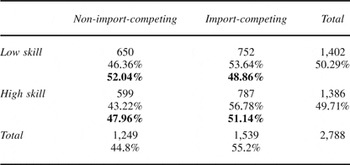
We define individuals as educated if they completed high school (twelve years of education). Defined this way, the sample is split in half between less-educated (50.29 percent) and more-educated (49.71 percent) respondents. Education and region do not overlap, as Table 1 shows.
Distribution of respondents by education level and region

Notes: For each entry in the first column, the first row indicates number of observations in each cell. The second row presents cell number as a percentage of observations by education category (low/high). The third row, in bold type, presents cell number as a percentage of total observations in each regional category (import-competing, non-import-competing).
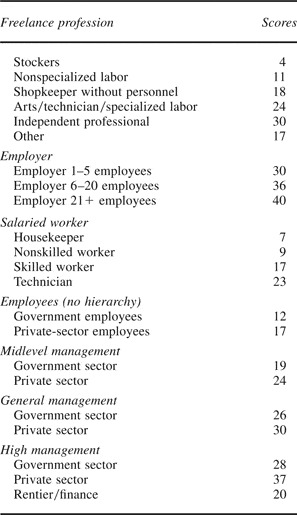
High-skilled services and high-tech industry constituted 19.5 percent of employment in the import-competing region, but only 12 percent in the non-import-competing region. This variation suggests different material effects derived from region and education interpreted as skill formation—the skilled workers would suffer from a negative effect on the demand for their services in the import-competing region. To tease out whether education's effect is because of socialization or skill distribution, we both control for the area of residency and use an occupational score as a measure of skills. The latter score assigns higher values to occupations involving larger numbers of subordinate employees (for employers/managers) and, in the case of employees, higher qualifications and job types, whereas white-collar workers are assigned a higher score than blue-collar workers.
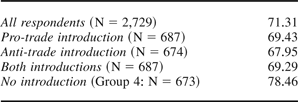
Table 2 reports the simple frequency distribution of responses in each of the four experimental groups. The table shows that all groups express strong overall support for trade and that issue framing has, in general, negative effects on responses. In particular, there are statistically significant differences between Group 4 (no introduction) and the rest of the respondents, while differences among groups across framing types are in the expected direction, yet do not attain statistical significance.
Percentages of respondents who favor increasing trade
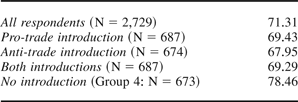
Note: Table shows percentage who strongly agree and somewhat agree with the question.
In line with the results Hiscox reported, we find that the anti-trade and the combined introductions reduced support for trade. Like Hiscox, we also find that even though respondents receiving the pro-trade frame were more likely to support trade than those who receive the anti-trade frame, they were less likely to support trade openness than those who received no introduction.
It is remarkable that we find the same result as Hiscox given the notable differences in contemporaneous growth rates in the United States in 2003 (no growth) and Argentina in 2007 (8 percent growth). Differences in economic performance are likely reflected in the emphasis on the consequences of trade in policy debates in both countries: in the United States the issue was framed in terms of employment effects;Footnote 37 in Argentina, the debate underlines trade's effects on food prices. Hiscox explains this result by pointing to the failure of pro-trade rhetoric focused on job creation in export industries and lower prices for consumers because of the weaker effect of potential gains vis-à-vis potential losses, as posited by prospect theory. We believe that since the wording of the frame in all its forms alludes to price effects, it introduces a new dimension that resonates with the daily experience of Argentine respondents. Hence, only individuals in the treatment group should report a lower support for trade liberalization because they are exposed to the price dimension in the question frame. In other words, respondents' everyday experience trumps the hypothetically positive effect on prices mentioned in the pro-trade framing vignette.Footnote 38
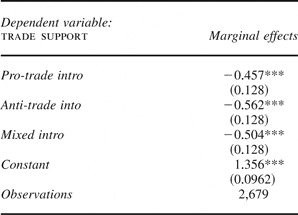
Based on the information in Table 2, we calculate marginal effects on the probability of trade support for the different treatment groups using logistic regression in Table 3. We follow Druckman in using the “no introduction” treatment as the excluded category to estimate the effects of each introduction on the probability for supporting trade.Footnote 39 The general effect of the anti-trade introduction is to reduce support for trade by twelve percentage points. The magnitudes of the effect produced by the mixed and pro-trade introductions are ten and nine percentage points lower than the baseline, respectively.
Impact of frames on individual support for trade (marginal effects from logistic regression)

Notes: Standard are errors in parentheses.
*** denotes statistical significance at p < .01.
Individuals' Sensitivity to Framing Effects
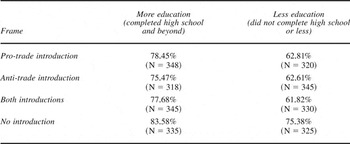
Consistent with the results in the United States reported by Hiscox, we find that less-educated respondents are less favorable to trade and more sensitive to framing. As Table 4 shows, less-educated individuals in the four experimental groups are less likely to support trade. Additionally, the differences between the “no introduction” group and each of the other groups are consistently larger for the less-educated respondents.
Sensitivity to framing by education level

Note: Table shows percentage of respondents supporting trade.
Our initial findings show that issue framing does affect public perception of trade because support for trade is higher among those receiving no frame (the control group). That is, framing makes all respondents—irrespective of their educational attainment—respond more negatively to the trade question. And, like Hiscox, we find that higher education is associated with weaker framing effects. The mitigating effect of education on issue framing could result from sophistication that reduces sensitivity to political discourse, but it could also reflect individuals' labor market skills and their capacity to benefit from trade gains.
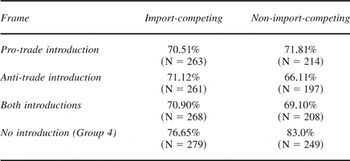
Disaggregating framing effects across individuals with different educational attainment and region of residence reveals an empirical pattern that cannot be explained by socialization and education: framing effects are indeed smaller among the more skilled in the population, as the conventional wisdom posits. But framing effects are stronger in non-import-competing areas across education levels. That is, for the more and the less educated alike, the indirect distributive effect of trade seemingly shapes the frame's impact on support for trade. In essence, it is harder to shift the views of those living in import-competing areas than of those living elsewhere. The basic intuition is that trade affects income through the demand of services and increases in the price of food, but only in the import-competing regions do both effects move in the same negative direction—making it easier for respondents to perceive the distributive effects of trade and making them less sensitive to framing effects.
We report the responses by each of the four different groups of respondents divided by region in Table 5. In every group, support for openness is higher among respondents in the non-import-competing region than in the import-competing region; the effect of all three introductions is weaker for respondents in the import-competing region than in the non-import-competing region. That is, respondents in the non-import-competing region were more sensitive to framing effects as our hypothesis about material effects suggests.
Sensitivity to framing effects by region

Note: Table shows percentage of respondents supporting trade.
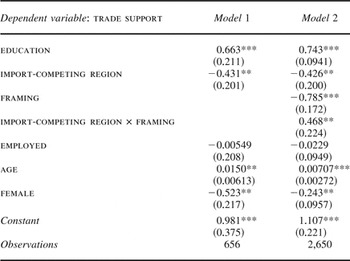
Using logistic regression, we test for the impact of region on support for trade openness and sensitivity to framing effects in Table 6.Footnote 40 To assess the direct effect on support for trade opening, we focus on individuals who were not treated with any frame in Model 1.Footnote 41 Model 1 presents results from a logistic model on that subsample in which the dependent variable, trade support, is regressed on our two main independent variables: a dummy variable indicating whether the respondent finished high school (education), and a dummy indicating residence in the import-competing region.Footnote 42 Following Hainmueller and Hiscox, we control for respondents' working status with a dummy variable (employed) that reflects whether they have paid work to assess the impact of education for individuals who are using their skills in the workforce.Footnote 43
Individual support for trade (logistic regression)

Notes: Standard errors are in parentheses. Asterisks denote statistical significance at the following levels:
*** p < .01;
** p < .05;
* p < .1.
As expected, Model 1 confirms that individuals living in import-competing districts are significantly less likely to support trade integration. In terms of marginal effects, the probability of trade support is reduced by six percentage points for individuals in import-competing regions. Model 1 also confirms that more-educated respondents express greater support for trade opening, controlling for working status as in Hiscox. In terms of marginal effects, having completed high school increases support for openness by ten percentage points. Like Hiscox, we also find that women are significantly more protectionist than men. We find no significant effect for respondents' working status.
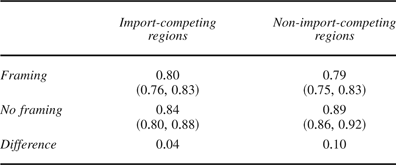
To explore framing effects, Model 2 analyzes the responses of all four groups (including the three groups exposed to framing vignettes) and introduces an interaction term between “framing” and “import-competing region.” The interaction's effect is positive; based on this model in Table 7 we compute predicted probabilities of trade support for individuals in import-competing and non-import-competing regions and compare framing effects for both groups.Footnote 44 The overlap in the confidence intervals (first data column) tells us that in import-competing regions framing's effects are not statistically different from 0 for our representative respondent, thereby suggesting stronger prior beliefs and weaker sensitivity to framing effects. This result supports our hypotheses about material effects.
Probability of trade support by framing and region
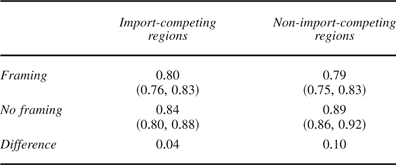
Notes: Predicted probabilities are derived from coefficients reported in Table 6.
95% confidence intervals are in parentheses.
To contrast the impact of education with the material effects captured by region, we assess how individuals with relatively similar education levels react to framing effects depending on their region of residence. Thus, we add to the simple models an interaction term between education, framing, and region. Table 8 (Model 1) presents the results from this model.Footnote 45
Impact of region, education, and occupation on individual support for trade (logistic regression)

Notes: Standard errors are in parentheses. Asterisks denote statistical significance at the following levels:
*** p < .01;
** p < .05;
* p < .1.
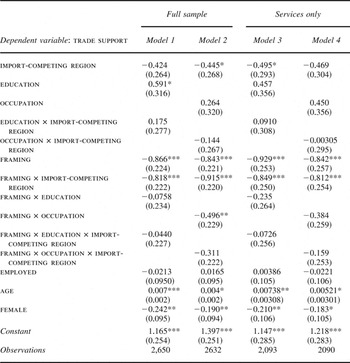
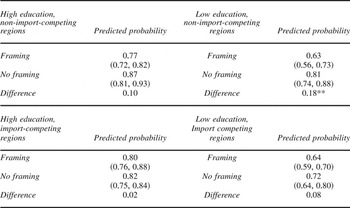
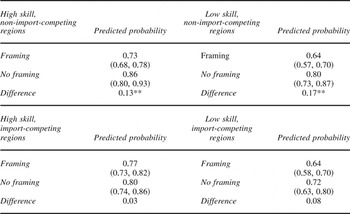
To further assess the different interpretations of education as socialization versus skill, we introduce a dummy variable (occupation) that provides an occupational measure of skill as an alternative to education (Model 2). This dummy variable takes a value of 1 if the occupational score for the household head is above the median of the sample (high skill), and 0 otherwise (low skill). The scoring is explained in Appendix Table A2. The models in Table 8 are therefore run both with education and occupation as a proxy for skill. Although education is significant and occupation is not, the results are robust to the change of education for occupation as a proxy for skills. Given the difficulties in interpreting interactions, we simulate the predicted probability of trade support for different groups of respondents, while keeping the rest of the variables constant at their means and the binary variables at their modal value. The substantive meaning of our results can thus be interpreted in Figures 1 and 2.
Probability of trade support: Framing effects across education and region
Notes: Predicted probabilities and 95% confidence intervals derived from coefficients reported in Table 8 (Model 1); High education = 1, if education greater than or equal to completed high school.
** denotes statistically significant differences (5% alpha level).

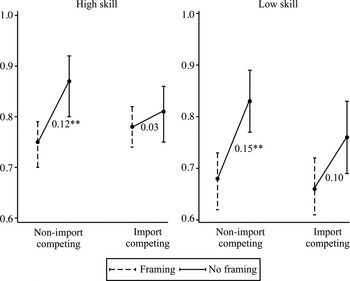
Probability of trade support: Framing effects across occupation levels and region
Notes: Predicted probabilities and 95% confidence intervals derived from coefficients reported in Table 8 (Model 2); High skill = 1 if occupational score greater than median.
** denotes statistically significant differences (5% alpha level).

Figure 1 shows that the impact of framing is higher in both regions for the less-educated respondents, whereas support for trade is higher across all education levels in the non-import-competing region. However, Figure 1 also demonstrates that, for individuals with similar education, the difference in the predicted probability is affected by framing to a much larger extent in the non-import-competing region: the difference is nine percentage points and statistically significant whereas in the import-competing region the difference is only three percentage points and not statistically significant. These results confirm our expectations that the clearer material effects of trade on individual well-being in the import-competing regions would be associated with stronger prior beliefs, and hence lower framing effects. Although framing effects impact less-educated individuals in both regions, these effects are stronger in non-import-competing regions, where framing produces a difference of seventeen percentage points, as opposed to eight percentage points in the import-competing locations. For educated individuals, we can identify framing effects only in the non-import-competing region where we expected the distributive impact of trade to be less clear. We therefore find stronger empirical support for our interpretation of material effects than for purely socialization effects derived from education. That is, the effect of education on weakening framing effects varies across regions. Moreover, in line with our predictions, education does not seem to mitigate framing effects in the non-import-competing region. This result cannot be explained by socialization. We cannot, however, rule out a mitigating effect of education as reflected by the weaker impact of framing among highly educated respondents in both regions. However, region is significantly associated with differences in the marginal effect of framing whereas education is not.
When we replace education for occupation and simulate the predicted probabilities of trade support for different groups of respondents in Figure 2, we find similar results in the direction and magnitude of effects. Whereas the low-skilled are affected by stronger framing effects than the high-skilled workers in both regions, framing effects are significant in only the non-import-competing region for both the high- and low-skilled respondents. The lack of significant effect among the low skilled in the import-competing region, in particular, gives further support to our hypothesis about material concerns.
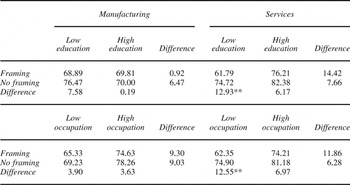
To further probe the argument that material incentives are likely to affect the susceptibility to issue framing, we analyze whether the pattern of responses varies between individuals in manufacturing, the comparative disadvantage sector of the Argentine economy, and those employed in the service sector. We would expect that those in manufacturing are less likely to support openness than those in services, and that they are also less likely to be affected by the frame in the survey.Footnote 46 The last two columns in Table 8 reproduce Models 1 and 2 for the sample reduced to individuals in the service sector. The results remain robust across subsamples. Table A4 in the appendix includes the simulation of predicted probabilities, showing stronger regional than skill-level differences in sensitivity to framing effects. Moreover, Table 9 compares mean levels of trade support in the manufacturing and service sectors, while controlling for education and skill levels. It shows that differences in education or skill have little impact on sensitivity to issue framing among individuals in the manufacturing sector. Yet these differences are substantial in the service sector, where the effect is indirect, especially for those with lower education or skill levels.
Framing effects on individual support for trade: Manufacturing versus services

Notes: Table shows percentage supporting trade.
** Significant at 95% confidence level (t-tests).
Summing Up
We find different framing effects for individuals with different levels of educational attainment in Argentina. These results are identical to those Hiscox found in the US. Yet we also find support for our hypothesis about the impact of material effects on the intensity of preferences and their sensitivity to framing effects. Individuals in import-competing regions are less sensitive to framing effects across educational or skill levels; we also find that framing effects are weaker among individuals employed in manufacturing than among those in the service sector, in line with our predictions. Our results cast doubt on arguments that suggest that the mitigating effects of education on framing are solely a function of respondents' sophistication and socialization to the issue. Indeed, the effects we find in import-competing regions are more in line with the interpretation of education reflecting skill differentials rather than socialization. Identifying the sources of material concerns is important not only for understanding trade preferences, but also for understanding individuals' incentives to inform themselves and form stronger prior beliefs, and hence affecting their sensitivity to issue framing.
Conclusion
We bring material interests back into the academic debate on the origin of trade policy preferences and the impact of framing effects in public opinion surveys. Using a survey experiment we find strong evidence that material concerns not only have the potential to shape individuals' trade preferences, but also to affect respondents' sensitivity to framing effects. Our results suggest that, when assessing the role of framing effects on individual preferences over trade policy, it is not enough to look at education and socialization effects. It is also necessary to analyze how the expected distributive effects of trade influences individuals' prior beliefs on the issue and, hence, mitigates the framing effects. Moreover, our results suggest that the positive correlation between education and support for trade—found in the United States and reproduced in the Argentine case—may in fact capture skill effects associated with the material distributive effects of trade. These findings are in line with the recent literature on trade, which suggests gains for skilled workers not only in countries where they are abundant, as in the United States, but also in countries where they are scarcer, as in Argentina.
Our work underscores the importance of understanding how material concerns affect framing effects by showing that stronger prior beliefs rooted in the distributive consequences of trade can mitigate the expected effects of issue framing. It is thus important to investigate how these different effects shape the impact of framing to better assess the evolution of public opinion and the role of political discourse in framing public policy views. These effects have been ignored in the literature to date, which has focused more narrowly on the mitigating effects of socialization and education.
Our findings, though preliminary, have important implications for political discourse. Politicians have an easier time shifting public views on trade among those citizens for whom the impact of trade is more ambiguous. Moreover, our results could help explain why politicians emphasize different consequences of trade that resonate with their constituents in order to shape the political agenda to their electoral advantage. Indeed, the Argentine presidents Néstor Kirchner and Cristina Fernández de Kirchner explicitly highlight the deleterious price consequence of exporting food staples in justifying both price controls and trade restrictions. These measures should have been popular in the import-competing regions where their core constituencies were located. But both presidents were able to frame these policies to also resonate with residents of the non-import-competing regions, for whom the effects of trade were more ambiguous, especially those in the service sector for which the positive spillovers of trade were indirect.
Our results suggest that, in order to understand political coalitions and the role of political discourse and persuasion on the formation of support of policy choices in democratic polities, it is incumbent upon scholars to blend trade theory with political psychology. In particular, our findings show that material concerns have as much bearing on identifying the strength of support for openness as they do on affecting the formation of prior beliefs that determine how sensitive individuals are to framing effects and thereby to public discourses that are used in the formation of policy coalitions.
Appendix. Argentine Public Opinion Survey
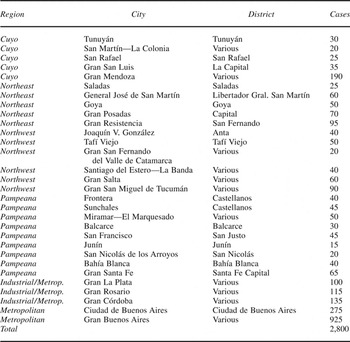
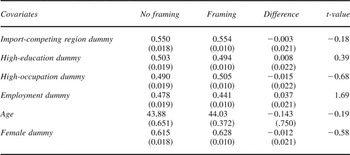
The public opinion survey was fielded in Argentina in March and April 2007. The subjects are drawn from a stratified random sample of adult population residing in cities of greater than 10,000 (excluding the four scarcely populated provinces in the Patagonia region). The breakdown of the number of subjects in each city and district are shown in Table A1; occupational scores in Table A2; distribution of covariates in Table A3; and robustness checks in Tables A4 and A5.
Number of survey subjects per city and district

Occupational scores

Distribution of covariates: Treatment and control groups

Probability of trade support in the service sector: Framing effects across education levels and region

Probability of trade support in the service sector: Framing effects across occupation levels and region