INTRODUCTION
Following the development of medium-secure psychiatric care there has been a growing trend to provide intensive care facilities within those areas (Adams & Clark, Reference Adams and Clark2008). The Mental Health Policy Implementation Guide for psychiatric intensive care units (PICUs; Department of Health, 2002) recommends the use of an extra care area (ECA) as an alternative to seclusion in managing the most acutely disturbed patients. Such alternatives are ‘of particular importance in view of the literature that views seclusion or a form of social control over those already excluded from the community and are often traumatic and harmful to patients’ (French et al., Reference French, Knapp and Cusack2005). An ECA is defined as a closely supervised living space away from the main clinical area where a single patient may be nursed away from other service users (Department of Health, Reference Barkham, Mellor-Clark, Roland and Gars2002) and is in accord with movements in ethical principles towards the use of the least restrictive treatment environment possible (Muir-Cochrane & Homes, Reference Muir-Cochrane and Holmes2001). Despite delineation of the characteristics of the typical PICU patient (young schizophrenic detained male belonging to an inner city ethnic minority; Kasmi, Reference Kasmi2007), there has been an absence of literature describing the use of such intensive care within medium security (Dolan & Lawson, Reference Dolan and Lawson2001; Adams & Clark, Reference Adams and Clark2008).
In the current setting (St Andrew’s Healthcare, Northampton, UK) a new purpose-built medium-secure facility for women was commissioned in 2007. This development included the provision of an extra care area on the admission unit in order to balance the need for procedural and relational security (Collins & Davies, Reference Collins and Davis2005) with the need to manage and treat an increasingly disturbed population, mostly referred from prisons with limited previous mental health input (Long et al., Reference Long, Mason, Mochty and Craig2009). The extra care area was intended for use by those with exceptional physical healthcare needs or with those considered to be at imminent risk of aggression, severe self-harm or suicide following risk behaviours (Dawson et al., Reference Dawson, Kingsley and Pereira2005). The patient group for which the unit was designed was personality disordered women with an offence history and complex needs (Long et al., Reference Long, Fulton and Hollin2008). This report presents the results of an audit to overview the use of the facility and to make recommendations about future practice following eighteen months of the units’ operation. The use of an audit tool to capture information about ECA episodes is a common feature of programmes that aim to reduce seclusion and positively change the therapeutic environment (Gaskin et al., Reference Gaskin, Elsom and Happell2007).
The rationale for the study was firstly to review both the clinical reason for use and the management practice of the ECA in an 18 month period, and to make appropriate recommendations for future use. A second aim was to review the extent to which ECA facilities were being used as a therapeutic environment.
THE SETTING
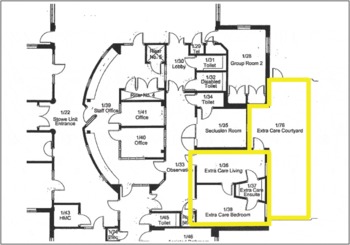
The admission unit, Smyth House, St Andrews Healthcare, is a 13 bedded unit with an extra care area (ECA). The ECA is a self contained area comprising: lounge, bedroom, bathroom and courtyard area (see Fig. 1). The unit is located behind the Nursing office, opposite the main entrance to the ward and adjacent to the seclusion area. Patients are nursed on 2:1 observations.
Floor plan of extra care area, women’s medium secure admissions unit

METHODOLOGY
A retrospective case note audit was undertaken of ECA use over the first 18 months of the unit’s opening. An ad-hoc audit tool was devised to collate data on:
• Risks presented before, during and after ECA use
• Reason for use and related care plan
• Length of stay and medication use
• Frequency of care plan review and written evidence of this
A brief ad-hoc service user questionnaire was designed to elicit views on, and experience of, ECA. This covered perceived reasons for ECA admission, occupation during ECA stay, involvement in post ECA care plan, staff contact and what they thought were the most and least helpful aspects of their ECA experience.
RESULTS
Disturbed behaviour: Use of the ECA and seclusion
In the review period seclusion was used following a risk incident on 281 occasions compared with 9 uses of the extra care area (ECA).
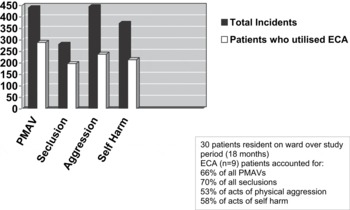
Fig. 2 details the prevention and management of aggression and violence procedures (PMAVs), seclusion and instances of self harm and physical aggression for ECA users (n = 9) and others (n = 21) over the review period.
Rates of disturbed behaviour on a medium secure admission unit for women: Comparison of patients placed in Extra Care Area (n = 9) with others (n = 21)

During this period ECA users accounted for 66% (n = 289) of all PMAVs (n = 440); 70% (n = 197) of all seclusions (n = 281); 58% (n = 214) of all self harm episodes (n = 372); and 53% (n = 238) of all acts of physical aggression (n = 445).
Characteristics of service users nursed in the ECA
Thirty service users were nursed on the admissions unit during the 18 month review period. Nine of these were nursed in the ECA. The majority had a diagnosis of borderline personality disorder (66%); were admitted from prison (55%) under pre- and sentenced sections of the Mental Health Act 1983 (66%); had index offences classified as serious offences against the person (66%); and were of below average intelligence as assessed by the Weschler Adult Intelligence Scale (WAIS).
Risk behaviours resulting in ECA admission
Of nine service users audited, two were admitted directly into the ECA from prison because of their level of disturbance (one on 3:1 observations; because of aggression and self harm and one whose florid psychosis made her vulnerable to aggression from others).
Six service users displayed more than one type of high-risk behaviour that led to use of the ECA.
Physical aggression (against staff, other patients or against objects) was a feature of seven (78%) of the nine cases. Three of these were attacks on other patients (two in combination with aggression against staff and self-harming). In two cases physical aggression was accompanied by property destruction.
Five ECA admissions followed from self-harm (ligature tying and cutting (n = 3); cutting only (n = 1); ligature tying only (n = 1)). In two cases use of seclusion had failed to prevent self harm. In three of five cases physical aggression (against staff and objects) was a consequence of staff attempts to prevent further self harm.
Risk behaviours during ECA use
All five service users whose ECA admission resulted from self harm also self harmed when placed in the ECA; all cut themselves and two of the five tied ligatures.
Four service users who had used physical aggression and verbal aggression against staff did so again in the ECA.
Use of PMAV procedures
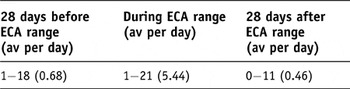
Use of PMAV procedures (including safe patient restraint) before, during and after the use of the ECA are listed in Table 1.
PMAV incidents before, during and after ECA use (n = 9 service users)

Table 1 shows a wide range of PMAV procedures before, during and after ECA use. In five cases only one incident of PMAV occurred in the month preceding the use of PMAV. While the use of PMAV in the month following ECA declined in five cases compared with the ECA period (of variable duration) there was an increased number of incidents in three cases.
In only three cases was PMAV used just once while in ECA, compared to an average for the nine service users of 8.1 incidents (range 1–21). However, when adjusted for length of stay it can be seen that PMAV incidents were at their highest during ECA reflecting in particular the disturbed behaviour of five of those admitted. PMAV incidents were lower during ECA stay than before or after ECA use in only one case.
Length of stay in the ECA
The average length of stay in the ECA was 15 days, with a median stay of 9 days (range 1–52 days). ECA was used for a total of 135 (25%) of available days (547) over the review period. Two service users stayed one and three days respectively. PRN medication was used in all cases during ECA stay. A change of medication was introduced in two of the nine cases.
ECA care plan documentation
Reasons for ECA use were clearly identified in eight out of nine cases.
The ECA care plan was fully completed in three cases (33%); partially completed in four cases (44%) and not available in two cases (22%). In most cases the care plan was not detailed or specific, and did not specify planned therapeutic engagement or diversion. There was no specification of criteria for reintegration into the unit environment.
In four cases there was evidence of a care plan review within 24 hours by medical and nursing staff; in two cases a review occurred within 72 hours. In other cases ECA care review occurred at the next multidisciplinary Care Plan Update (CPU) (held every 14 days for each service user).
A record of all care plan reviews was made in case records.
Service user questionnaire
Questionnaires were completed by six of the nine service users who had been nursed in the ECA (two had been discharged at the point of audit and one stated that they had been too thought disordered during their stay to provide an informed opinion).
Of completers (n = 6), five were able to accurately describe the risk behaviours that led to ECA use. The majority of completors (n = 5) stated that the opportunity to reflect and talk in a rational way with staff whilst maintaining safety was the most helpful aspect of ECA stay. The least helpful aspect of the ECA, as perceived by users, was isolation from peers and restrictions on their freedom and access to possessions.
• All service users reported contact with staff from more than four disciplines.
• Four service users shared that they had not had enough to occupy themselves during ECA stay.
• Three service users reported that they had been included in formulating a care plan that they were in agreement with before they left the ECA.
Post ECA audit actions
In addition to a defined audit tool the ECA protocol was revised to include detailed documentation and the following procedures:
• The use of an ECA register to have an accurate record of ECA use.
• Admission to ECA to be followed swiftly by MDT driven management and treatment protocol based on functional analysis and therapeutic engagement within the limitation of a restricted environment.
• Annual audit of the use of the ECA using a specific ECA audit tool.
• Maximising opportunities for engagement in therapeutic activities whilst in the ECA.
• Maximising opportunities for service user involvement in all aspects of their treatment during and following ECA use.
DISCUSSION
This audit of the use of ECA facilities to manage risk and challenging behaviour in a medium secure setting has highlighted the need for careful clinical management and care documentation of service users needing the facility. Although the very low frequency of use of this form of risk management/care (compared with seclusion) precludes definitive conclusions, this essentially qualitative review has highlighted issues that have implications for clinical practice.
Patients admitted to the ECA were the most troublesome patients in terms of accounting for a disproportionate number of PMAVs and seclusion, along with episodes of self harm and physical aggression. The finding that service users admitted from prison comprised the majority of ECA admissions within the review period is consistent with a trend for admission to be more likely from prison and to show an increased incidence of disturbed behaviour (Long et al., Reference Long, Mason, Mochty and Craig2009). In addition, the majority of service users were of below average IQ and more likely to have an index offence of arson (Long et al., Reference Long, Mason, Mochty and Craig2009). The emerging demands on forensic services from the criminal justice system (Bartlett et al., Reference Bartlett, Johns, Fiander and Jhawar2007) and a changing referral base may be a factor in the growing trend for the provision of intensive care within medium-secure facilities (Adams & Clark, Reference Adams and Clark2008).
Analysis of this very small sample of female patients admitted to secure care suggests that they are different to the typical admission to psychiatric intensive care units (PICUs; young males with schizophrenic illness; Kasmi, Reference Kasmi2007) in terms of their borderline personality diagnosis. Cordall (1999) highlighted the link between a history of sexual abuse (common in borderline service users) and the expression of anger within female mentally disordered offenders. The impulsivity, hostility and aggression that are core aspects of many personality disorders have been identified as key areas within treatment with such patients (McMurran et al., Reference McMurran, Charlesworth, Duggan and McCarthy2001).
Although it would be predictable that use of the ECA would be associated with periods of high disturbance/risk behaviours it is of concern that patients self-harmed during this period. This suggests the need for a careful balance between a low stimulus environment with an overbearing staff presence and the provision of personal possessions and objects that will aid diversionary engagement. That therapy planning should err toward the latter is suggested by the literature, which associates increased adaptive behaviours with opportunities to engage in leisure and other activities (Sigafoos & Kerr, Reference Sigafoos and Kerr1994; Brusca et al., Reference Brusca, Nieminen, Carter and Repp1989) and research linking the lack of stimulation and interaction with others with auto-aggression (Nijman et al., Reference Nijman, Joost and Campo2002). This is of particular significance given the opinion of some patients that too little occupational intervention was provided in the ECA.
That the use of the ECA was associated with a greater number of PMAV procedures than before or after raises the possibility that in selected cases the use of the ECA may be counter productive. Among some individuals self-injury may occur when staff are present but not engaged with the client (Carr, Reference Carr1977). There is also general agreement that being left alone and escape from an undesired environment (ECA provides an individualised rather than a group living arrangement) are two of the most common maintaining factors in challenging behaviours (Matson & Boisjoli, Reference Matson and Boisjoli2007). It is difficult to avoid the conclusion that, in the current setting, early use of ECA has been for risk management alone rather than to capitalise on the therapeutic opportunities afforded by this contingency. This setting provides an opportunity for the use of behaviour chain analyses (BCAs; Linehan, Reference Linehan1993) to structure the reflection patients find beneficial in the current setting.
Overall, the fact that limited use has been made of this facility and the finding that no service user had more than one admission is encouraging. In view of the widespread efforts to reduce the use of seclusion (Gaskin et al., Reference Gaskin, Elsom and Happell2007) it is important that ECA use is not viewed as an automatic alternative, particularly since clinical experience in the facility suggests that for some patients, who value close individual attention and separate living, self harm and aggression may be instrumental as a means of entering a desired (ECA) environment. Within the current setting a number of initiatives have been developed following the initial audit. These include the use of an ECA register to accurately record use and an annual audit to ensure adherence to a revised unit treatment and management protocol. The latter has involved the use of a specifically developed ECA audit tool to review clinical reasons for use and management practice. Other work has concentrated on the development of a wider range of ECA appropriate occupational activities and the routine engagement of service users in future care planning using information obtained from behaviour chain analysis. Such involvement has been previously used with services in attempts to reduce rates of disturbed behaviour (Schreiner et al., Reference Schreiner, Grafton and Sevia2004). Central to this are multidisciplinary care plans that begin the process of discharge immediately by presuming increasing time spent out of ECA, dependent on risk assessment, prior to a return to the usual ward environment.
Further research is clearly needed on service user benefit from ECA use and the circumstances under which this occurs. Service evaluation as a routine part of clinical practice (Barkham & Mellor-Clark, Reference Barkham, Mellor-Clark, Roland and Gars2000) may help to answer this question over time. Concurrent with these initiatives must be the broader use of non pharmacological interventions to reduce behavioural disturbance using leadership, monitoring, staff education and changing the therapeutic environment (Gaskin et al., Reference Gaskin, Elsom and Happell2007).