Introduction
Pierre Marie François de Sales Baillot (1771–1842) was a leading figure of the nineteenth-century French Violin School and a founding professor at the Paris Conservatoire, whose writing and career indicate an erudite and entrepreneurial man. Although well known in his time, Baillot has been relatively neglected in English-language musical scholarship.Footnote 1 Two recent articles, however, discuss Baillot from different perspectives: as a traditionalist employee of a state institution, the Paris Conservatoire,Footnote 2 and as a theatrical concert entrepreneur.Footnote 3 My reading of the multi-faceted life of Baillot, however, shows that this violinist, similar to entrepreneurial musicians today, succeeded in combining multiple roles and that he embraced new ideas while also upholding past musical traditions.
This article reviews the career of Baillot in order to set the context for an analysis of his comprehensive violin treatise and to trace his interest in extending the range of violin practice and performance. Baillot was interested in experimentation and communication for four reasons. First, he was trained in the historical tradition that expected musicians to put their own improvisatory stamp on performances. Second, he was influenced by Enlightenment ideas that liberated people from the constraints of tradition. Third, as an entrepreneurial musician Baillot recognized that audiences expected entertainment. Finally, Baillot aimed to build a firm foundation for his violin students. After laying this groundwork, I analyse three of Baillot's innovative approaches for extending violin effects: harmonic preluding, extended bowing techniques and his empirical exploration of Tartini tones.
Baillot's appeal to musicians and scholars today lies in both his versatile career and his fascinating writing. His career trajectory as a classical musician in early nineteenth-century France was shaped by the revolutionary shift in patronage from the church and the aristocracy to the state and the bourgeoisie. A second area of relevance in Baillot's career is that he showed how to extend both the expressive reach and technical effects of the violin. He cautioned, however, that new effects needed to pass the test of time: ‘It is, therefore, the function of genius to create new effects, the function of taste to regulate their use, and the function of time alone to sanction them.’Footnote 4
Louise Goldberg published the first available English translation of Baillot's L'Art du Violon (1834) in 1991, and this includes an insightful introduction.Footnote 5 She cites primary sources and discusses works about Baillot and French music of his time, by French authors including Brigitte François-Sappey and Joël-Marie Fauquet.Footnote 6 Other writing on Baillot includes accounts written by his contemporaries and the large literature on the history of music-making in nineteenth-century France, including on the French Violin School and the Paris Conservatoire.
The Life and Times of Pierre Baillot
Baillot's traits of broad-mindedness and resilience might be attributed in part to his living through turbulent times. The French Revolution (1789–1799) erupted when Baillot was 18 years old, with the overthrow of the old regime and subsequent Reign of Terror when thousands of aristocrats and their supporters were summarily executed.Footnote 7 These events were followed by European wars, the Napoleonic empire (1804–1814), restoration in 1815 of the Bourbon monarchy, a constitutional monarchy in 1830, followed in1848 by the European ‘Year of Revolution’ that ushered in the French Second Republic.Footnote 8
Huge political and social changes accompanied these events, making life for musicians precarious, but ultimately transforming their social status and opportunities. As McClellan and Trezise write of the French Revolution and its aftermath: ‘For many musicians, this break was ruinous. What had been a traditional sphere for music-making and an important source of income simply disappeared.’Footnote 9 Baillot, however, proved nimble enough socially and politically to adapt to changing times. As Weber writes: ‘Leaders of the Conservatoire and the Society of Concerts exercised much sagacity in retaining government positions from regime to regime and welcoming both Legitimists and Orleanists to their concerts’.Footnote 10 Many musicians in the early nineteenth century shifted away from being servants of the church or aristocracy to becoming independent artisans and professionals as well as entrepreneurs who managed their own careers.Footnote 11 Baillot's career is an early example of what these days is termed a ‘portfolio musician’, an artist who must seize varied income opportunities as they arise.Footnote 12 As a pedagogue, Baillot therefore stressed to his students the importance of adopting an entrepreneurial approach in their working lives, much as music educators do today.Footnote 13
Following his upbringing in the family of his benefactor, the magistrate de Boucheporn, Baillot went to Paris in 1791, then in the throes of revolution, where he successfully auditioned with the famous violinist, Giovanni Battista Viotti (1755–1824), for an orchestra position at the Théatre Feydeau. Viotti fled Paris in 1792 for London, however, and M. de Boucheporn was guillotined in 1794.Footnote 14 Baillot managed to obtain a position in the Ministère des Finances (which he held for many years), before being conscripted into the revolutionary army from 1793 to 1795.Footnote 15 Baillot's fortunes improved after his acclaimed public performance of a concerto by Viotti, which produced the offer in 1795 of a position at the newly established Paris Conservatoire de Musique. Life and finances remained precarious for Baillot, however, as he joined Napoleon's private orchestra in 1802, then went to Russia in 1805 for three years where he ran chamber music concerts in Moscow.Footnote 16 As he wrote plaintively in 1810 of these times:
Upon return from my travels, I had hopes to improve my lot in my musical career, none of which came true; none of the promises that had been made to me have had their effect and the resources that music offers me at the moment being absolutely insufficient to support my family which has become more numerous.Footnote 17
Baillot's appointment as one of the founding professors of the Paris Conservatoire, a position he held for the next 47 years, did transform his hopes and career. Established by the French state, the Conservatoire National Supérieur de Musique officially opened on 22 October 1796. One of the legacies of the French Revolution, this school of music was based on the egalitarian principle that the populace were entitled to a public education.Footnote 18 The violin professors appointed to this new Conservatoire in addition to Baillot included luminaries such as Rodolphe Kreutzer, Pierre Rode and Charles-Auguste de Bériot. This creative group, later termed the French Violin School, composed about 70 violin concertos between them, as well as considerable pedagogical material.Footnote 19 The high standard of the French Violin School is reflected in a remark of Beethoven's in 1809: ‘I should like to hear Mozart's symphonies in Paris; I am told that they are played better at the Conservatoire than anywhere else.’Footnote 20 Schueneman has discussed the French Violin School as a distinctive group of virtuoso musicians and composers who upheld the traditions of the past as well as adopting technical innovations and developing their own style.Footnote 21 While Baillot is regarded as a notable member of this influential group, his writing displays his more holistic approach to teaching and to aesthetic musicianship: ‘Happy is he to whom nature has given a profound sensitivity! He possesses within himself an inexhaustible source of expression. The years only increase his richness of expression: they give him new sensations, they vary his situation, they modify his feelings.’Footnote 22
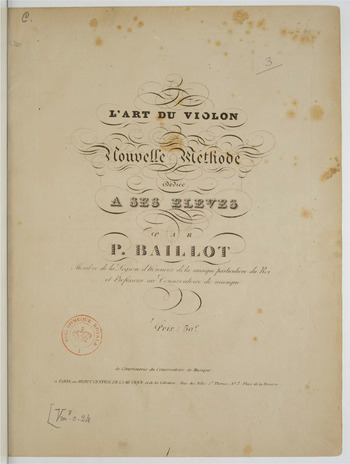
The new Conservatoire needed a violin curriculum for its students, and Baillot set about writing the text for the Méthode de Violon (1803) while Rode and Kreutzer supplied most of the exercises.Footnote 23 This was not the first Conservatoire text for violinists, as it previously had published Cartier's L'Art du Violon in 1798 with further editions in 1799 and 1803.Footnote 24 Baillot commandeered this title for his 1834 treatise L'Art du Violon.Footnote 25 The cover page (see Fig. 1) proclaims the treatise as the Conservatoire's new method textbook, one of many texts published by the Conservatoire in the early 1800s in order to standardise and make music education available to the general public.
Cover page of Pierre Baillot, L'Art du Violon Footnote 26

Baillot continued his concert tours around Europe as well as maintaining his Conservatoire appointment and orchestra positions, for example, with the Paris Opera from 1821 to 1831. The Conservatoire weathered political shifts between revolution, empire and back to monarchy: it closed in 1814 before reopening in 1816 under temporary Bourbon badging as the École Royale de Musique, presumably forcing its staff to find other ways to earn a living in those years, including Baillot who set off on a lengthy concert tour of Europe.Footnote 27
Baillot's Chamber Music Series
Baillot's chamber music series, which ran from 1814 to 1840, was an important contribution to music-making in France, and helped him position himself as an important figure in Parisian musical life. Fauquet's list of Baillot's concert series programmes shows that Baillot organized 154 concerts between 12 December 1814 and 4 April 1840.Footnote 28 The popularity of the series and its growing audience led Baillot to move his concerts in 1830 to the Hôtel de Ville, a large hall that seated seven hundred.Footnote 29 Baillot is credited with being the first to use the term ‘musique de chambre’.Footnote 30 The origin of chamber concerts lay in salon music for the nobles that gradually were transformed for a wider audience in a public setting.Footnote 31 With the breakdown of rigid social stratification in France in the early nineteenth century, the surviving aristocracy mingled with the growing bourgeoisie so that concerts attracted both social classes. Weber has described the range of subscribers to Baillot's concert series as including counts, dukes, a company director for mill and blast furnaces, and bankers.Footnote 32 Baillot was a key figure in moving chamber music out of an elite salon atmosphere into a public space.Footnote 33 Fauquet cites Baillot as saying that chamber music was ‘a privileged mode of sociability, diverse in practice, that brought together amateurs and artists as well as bourgeoisie and aristocrats’.Footnote 34 In Chapter 25 of L'Art du Violin, Baillot explains at length how to present a concert in order to appeal to a wide audience. For example: ‘The most important point, we feel, is the choice of pieces. Experience alone can lead the artist to that which is most suitable both to his type of talent and to an audience.’Footnote 35 He also kept meticulous business records of his concert series in which he itemized his expenses, payments to performers, and his ticket sales at six francs per concert, about the same price as other Paris concerts of the time.Footnote 36 Baillot's concert series also had serious educational aspirations. McClellan and Trezise assert that Baillot ‘organised performances that helped transform chamber music from an amateur pastime into a body of work intended for serious contemplation’.Footnote 37
Baillot promoted an historical link with the traditions of Baroque and Classical music in his teaching and performances. First, as discussed further below, he encouraged his students to practise the art of improvisation to in order to retain these historical skills. Second, he is regarded as an early and influential practitioner of the new art of ‘interpretation’ in presenting the works of composers from different eras and their individual voices.Footnote 38 Third, he rediscovered and popularized many older works that were performed in his chamber series concerts.Footnote 39 In this latter endeavour he was not alone but rather added his weight to the efforts of others.Footnote 40 Records of programmes from Baillot's concerts in the early 1800s, which he called concerts historiques, featured the works of composers such as Tartini, Corelli, Geminiani and Handel, and included concerti grossi, trio sonatas and solo concerti.Footnote 41
Baillot featured contemporary as well as historical composers: Vandoros notes that works by Boccherini appear most often in concert programmes at 222 times, followed by Haydn with 166 performances, Baillot with 125, Mozart with 122 and Beethoven with 109.Footnote 42 Baillot invited an impressive group of performers, including Frederic Chopin, Friedrich Kalkbrenner, and John Field, among others.Footnote 43 Mongrédien notes the impact of the series on chamber music appreciation: ‘Nothing of this kind had ever before been seen in the history of concert-going in France’.Footnote 44 There are records of many musical luminaries attending these concerts. The Mendelssohn family were early subscribers, as Baillot had tutored Felix and Fanny in the performance of chamber music.Footnote 45 The Mendelssohn's aunt Henriette later reminisced of Baillot: ‘You know Baillot's sensitive face, this expression remained as long as he spoke of Fanny and Felix, and we spoke of no one else.’Footnote 46
As an entrepreneurial musician, Baillot had to match other notable performers, such as Kreutzer and Paganini, from whom audiences expected virtuosity and entertainment.Footnote 47 Additional evidence of Baillot's theatrical approach comes from Morabito's analysis of a collection of Baillot's annotated music scores held in private collections and at the Bibliothèque Nationale de France.Footnote 48 Morabito uses examples of Baillot's marginalia on music parts to give insights into how he added rhetorical expression, character and colour to his performances.Footnote 49 Fétis regularly promoted Baillot's concert series in La Revue Musicale – then France's preeminent music journal. Fétis's reviews have left us a picture of cultural events of the time; he wrote of a concert by Baillot in 1827:
Moving in the same evening from Boccherini to Mozart, and from the latter to Beethoven and then Haydn, he [Baillot] is soft and naive with the first, melancholic and passionate with the second, spirited with the third and noble with the last. An endless variety of bowing adds to the delicate nuances the charm of a perfect performance.Footnote 50
Baillot is credited with introducing Ludwig van Beethoven to Parisian audiences. and musicologists have concentrated upon this aspect of his concert series.Footnote 51 Baillot founded his Quatuor Baillot in 1814 and remained as leader and first violinist through various personnel changes over the years. The dominance of this group is indicated by the fact that no other professional string quartet emerged in Paris until 1830.Footnote 52 Baillot's quartet introduced Beethoven's late intense and personal quartets, and the chamber series remained the main venue in Paris for hearing Beethoven's music.Footnote 53 For example, Baillot gave the Paris premiere in 1828 of Beethoven's Violin Concerto in D major, Op. 61. While Baillot was convinced of Beethoven's genius, Paris audiences continued to lack enthusiasm, as evidenced in a comment by Berlioz in 1829:
The other day I heard one of Beethoven's last quartets. M. Baillot performed it during one of his soirées. I hurried there to see what effect this unbelievable work would have on the audience. There were nearly three hundred people present; about six of us found ourselves overcome by the truth of the emotion we experienced, but we were the only ones who did not find this composition absurd, incomprehensible, and barbarous.Footnote 54
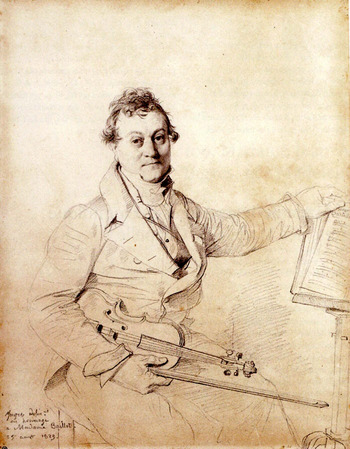
A portrait painted in 1829 by Jean-Auguste-Dominique Ingres, and dedicated to Madame Baillot, depicts Pierre Baillot around the time of his Beethoven violin concerto premiere. Ingres shows Baillot at the height of his powers posed with music stand and violin (Fig. 2). Ingres greatly admired Baillot and wrote of him: ‘I attended a musical soiree of quartets by Baillot. What he played is beyond compare, as is the man himself: he is sublime’.Footnote 55
Portrait of Pierre Baillot by Ingres.Footnote 56

L'Art du Violon 1834
Baillot expanded the 1803 Méthode textbook of around 180 pages to around 490 pages in his 1834 L'Art du Violon, the length reflecting his long career in teaching and performing as well as his philosophical views. Schoenbaum aptly describes Baillot's treatise as ‘at once a how-to book, a progress report, a memoir and a testament’.Footnote 57 According to Boyden, L'Art du Violon was the most influential violin treatise of the nineteenth century and the first major violin text since those in the 1750s by Leopold Mozart and by Francesco Geminiani.Footnote 58 Comparing Baillot's two treatises, Macnicol finds Baillot a nationalistic note in the 1834 treatise, as evidenced by his catalogue of French composers and appeal to Paris Conservatoire traditions.Footnote 59 Baillot's sentiments do not seem unwarranted, however, being a few celebratory comments in a ‘testament’ covering 40 years of violin teaching. Baillot's 1834 text is fascinating to read, if flowery and prolix, as a window onto the language style among French writers and philosophers of the time.Footnote 60 His treatise reflects prevailing philosophical currents and is replete with admonitions that seem idealistic and quaint to readers today.
A comparison of the Méthode and L'Art du Violon shows how violin technique had evolved over the 30 years that separated their publication; for example, the later treatise deals more extensively with double-stops and chords, as well as left-hand pizzicati and harmonics. It is also a comprehensive guide to playing the violin and a notably more holistic approach in its considerable philosophizing on the subject of how to produce a well-educated musician. Baillot offers practical guidance on how to play both old and new music, as he knew he must prepare his students for the greater technical expertise required by the contemporary violin repertoire. Historically, violinists had produced great performances by adding their own ornamentation. In contrast, composers of the Romantic era were beginning to expect musicians to produce great performances by following the composer's fully notated and dramatic scores.Footnote 61 As high-flown Romantic rhetoric did not necessarily help a violinist know how to transmit the emotional content of the music to listeners, Baillot proposes a somewhat mystifying scheme for conveying musical moods: ‘Musical character can be divided into four principal characters which serve as the source of the others, and which correspond naturally to the four ages of life and the general progression of the human soul.’Footnote 62 Baillot worries, however, that increasingly prescriptive ‘dramatic’ scores may constrain the creativity of performers: ‘An abundance of signs is favourable to music in that it can prevent many false readings and can serve as a guide to those who could not do without them, but it can end up extinguishing the genius of performance which delights in divining and creating its own way.’Footnote 63
An important contribution by Baillot to violin teaching is the high value he placed upon creative development, seeing technique as serving a higher aesthetic purpose. More than just a technical manual, L'Art du Violon aspired to be an inspirational life guide to being a musician. Baillot aimed to develop musicians who understood historical performance styles, but who also could interpret and perform the newer Romantic music, drawing on aesthetic judgement and the technical and expressive capacity to touch deep emotions in the listener.Footnote 64
Philosophical Influences
Baillot's writings reflect a familiarity with the ferment of ideas known as the Age of Enlightenment or The Age of Reason. This intellectual movement and its many philosophers shaped ideas in Europe during the eighteenth century onwards with their emphasis on free enquiry, liberty and religious tolerance.Footnote 65 Influential French-speaking philosophers included Montesquieu (1689–1755), Voltaire (1694–1778), Diderot (1713–1784) and Rousseau (1712–1778). Morabito attributes Baillot's ideas also to those of Saint-Simon (1760–1825) who called for more political power for the industrial or productive classes and recognition for the importance of scientific progress.Footnote 66 Enlightenment philosophers regarded science as the key to knowledge about nature and society. They challenged traditional authority, such as customs and religion, and advocated the replacement of monarchy by democracy, that is, the will of the people.Footnote 67
The dominant influence of Enlightenment ideas waned after the French Revolution, however, giving way to Romanticism with its emphasis on individual senses, and emotional exploration. In compositional terms this was reflected in complex structures and emotions shifting dramatically within the scope of one work.Footnote 68 Writing during these transitional times, Baillot incorporates both Enlightenment and Romantic ideas in his 1834 treatise. For example, he espoused the Enlightenment ideals of Immanuel Kant as well as the Romantic ideals of Georg Hegel and especially Jean-Jacques Rousseau, the latter a popular philosopher among the Jacobins. For example, Macnicol points out that Baillot's distinction between ‘taste’ and ‘genius’ is repeated almost verbatim from Rousseau's Dictionaire de Musique. Footnote 69 From his perspective as a teacher, Baillot lauds Rousseau's novel, Emile, which advocated stages of education designed to produce a virtuous and idealized ‘natural man’:Footnote 70
But do nothing in the name of the divine art which you are cultivating that is not worthy of it! Always prefer the Muses to the Sirens, and remember what Rousseau said to his Emile: ‘Be a man with feeling, but be a wise man; if you are only one of the two, you are nothing.Footnote 71
Baillot's 1834 violin textbook is an early example of a genre that combined philosophical musings with technical exercises. Stefan Knapik points out that this approach culminated in early twentieth-century treatises by violinists, such as Joachim, Auer and Flesch, in which they range across a somewhat strange mix of mind/body/spirit discussions and ideologies along with the mechanics of violin playing.Footnote 72
Improvisation and Preludes
L'Art du Violon offers students an excellent study manual on the art of improvisation. Baillot explains how to develop this skill and so retain historical connections to past traditions in a way that satisfies a musical aesthetic: ‘imagination invents ornamentation; good taste gives it variety, individuality, and its appropriate place.’Footnote 73 Violin virtuosi traditionally composed and performed their own works and improvised freely upon the music of others. Baillot was trained in the Classic tradition that expected performers to add their own improvisations, and he was himself renowned for this skill. According to the Revue Musicale, in 1829, while performing the Romanza for voice and violin by Panseron, Baillot ‘improvised a fermata, as remarkable for its form as it was for its perfect execution, that made an outstanding effect’.Footnote 74
Improvisations were highly regarded in the late eighteenth century; for example, Viotti, Baillot's mentor, was hailed as a master of the art. Lister cites an account of Viotti and the pianist Helene de Montgéroult at a private soirée in June 1792: ‘Viotti and Montgéroult improvised together, taking the thematic lead by turns in a tour de force of creative invention and expressivity’; while a listener at another soirée commented, apparently admiringly, that Viotti ‘paid little attention to the text before him’. Footnote 75 By the early nineteenth century, virtuosi violinists still were expected to thrill their audiences with an impromptu improvisation. A performance in 1816 in Milan by violinists Niccolò Paganini and Charles Lafont of Kreutzer's Sinfonia Concertante was described as a form of musical duelling.Footnote 76
Baillot's L'Art du Violon remains one of the few sources that explains the art of improvisation in depth for violinists: how to go about this skill and how to study and improve it. Baillot hoped to remedy the decline in the art of improvisation among young musicians. His concern was that the reliance of performers upon the increasing use of notation by composers paradoxically would mean a loss of capacity by the performer to creatively engage in and interpret the music. In his L'Art du Violon, therefore, he extensively covers different forms of improvising in over 70 pages of explanations and examples.
Baillot warns when improvising is appropriate and when silence will suffice. He declares that while improvisation can be free in pace, form and length it should follow some rules: an introductory prelude, for example, should be limited to about four bars of melody or ‘a few bars struck with resolution’, but in all cases there must be silence after the prelude before performing the piece to follow.Footnote 77 While improvisation should be systematically practised, a performance should aim for the sublime and spontaneous: ‘This device can be notated up to a certain point, but as with all passionate expression, it loses much of its effect if executed literally.’Footnote 78
The early nineteenth century saw a renewed appreciation of virtuosity, however, reaching a peak with a cult of performers, such as Paganini, Liszt and Chopin, who all performed in Paris around the 1820s and 1830s. Baillot understood that fashions of the day demanded spectacle from soloists, but also warned about effects: ‘They are precious gems whose rarity determines their price; if they are abused even the least bit, they become an indulgence which ends up undermining talent.’Footnote 79 Perhaps Baillot was referring to Paganini, whose showmanship was not universally admired by his contemporaries. For example, another notable violin virtuoso of the time, Louis Spohr, disliked grandstanding and excessive ornamentation, which he ridiculed in his Violin Concerto No. 14 in A minor, which he titled ‘Sonst und Jetzt’ (Then and Now).Footnote 80 Spohr also wrote of a Roman orchestra:
But each one makes his own embellishments according to his own dictates, with the result that the sound resembles that of an orchestra tuning up rather than a co-ordinated performance. I forbade the playing of any note not in the score, but to no avail. Free ornamentation has become so much a habit with them that they cannot do without it. One cannot imagine the noise that such an orchestra makes.Footnote 81
One aspect of improvisation is the sense of theatricality and risk it adds to a live performance. In today's world of classical performance perhaps the absence of improvisation means that the audience does not listen for the possibility of danger or triumph. As Baillot warns:
The prelude and the cadenza, both children of the imagination, must concern themselves with responding appropriately to its call, for once the artist has undertaken them, they become for him one more hidden danger or one more cause for triumph; if he has the misfortune not to succeed, others are less indulgent since they know that he could have avoided taking the chance in the first place.Footnote 82
Baillot uses the term ‘prelude’ in its historical meaning as a general term for improvisation. A prelude could mean a whole piece in an improvisatory style and can encompass many types of music, settings and length.Footnote 83 A prelude may be an introduction to an entire work, to a movement or to a particular section. It may be short, a series of chords, or a melodic extemporization setting the opening key.
Preludes that precede a piece offer a performer a chance to warm up, declaim the beginning of the concert, and gain the attention of an often-distracted audience. They can be used to try out the acoustics or instrument, familiarize the audience and performer with the key, and even with the spirit of the work to follow. Preludes in the Classical tradition were a means of marking a performer as a creative musician, thus placing the performer on a more equal footing to the composer in the work to follow. Kenneth Hamilton says of keyboard players among whom preluding was particularly common: ‘An improvised introduction was, for hundreds of years, a sign of musical good manners and a chance for the player to frame appropriately the pieces in his program. It was also an opportunity to give the audience a gentle reminder that the player too was a creative artist’.Footnote 84
In contrast to their neglect in violin treatises, notated preludes were common in keyboard treatises of the time, though they are seldom mentioned in reviews or programmes unless particularly notable.Footnote 85 There are numerous admiring accounts, however, of notable preluding on the keyboard by Mozart, Clementi, Felix Mendelssohn (1809–1847) and Clara Schumann (1819–1896). Carl Czerny, for example, who studied with Beethoven and taught Franz Liszt, wrote a vast collection of 121 preludes for the piano.Footnote 86 Written preludes for the violin while less common include an example by Baillot's student, Charles Auguste de Bériot.Footnote 87 Coppola regards such notated preludes for the violin as a connection to an improvisatory tradition while also teaching technical development: ‘Thus, we see in Bériot's Prélude ou Improvisation a remarkable record of an ephemeral practice that was dying out.’Footnote 88
Charles-Auguste de Bériot addressed style and improvisation at length in the second half of his Méthode de violon (Paris, 1858). The many other earlier treatises that emphasize preluding include L'Abbé le Fils in his Méthode (1761) and Bartolomeo Campagnoli in his Metodo per Violino (1797).Footnote 89
Harmonic Preluding: Extending Violin Conventions
Baillot's L'Art du Violon includes 24 melodic preludes in all keys and 100 harmonic preludes. He discusses melodic preluding and, more unusually for the violin, harmonic preluding in all keys and in extended passages of four-note chords leading up to a cadence. He presents a wonderful series of examples of the fingerings of Viotti, Rode and Kreutzer, all with their individual styles: whether staying sonorously on one string, shifting on a string for expression, or staying in one position for uniformity. Baillot contrasts the way these violinists chose their individual fingerings and discusses their personal violinistic aesthetic. He also includes elaborate rewritings of slow movements and cadenzas from Viotti's concertos as examples of how Viotti may have played them. Kreutzer was admired for his improvisational skills and according to Baillot particularly for his harmonic improvising: ‘we can mention only Rodolphe Kreutzer who used it with any success.’Footnote 90 Baillot's extensive examples offer a valuable way to gain technical fluency in improvisational skills and to promote creative development: ‘The improvised prelude permits the virtuoso to let his inspiration run entirely free … Improvisation demands an ease acquired by constant practice; some great talents lack no more than persistent study in this area.’Footnote 91
Since the violin traditionally had a largely melodic role, Baillot writes that harmonic preluding based on ‘the study of chords has been too neglected’, since it is the road to technical mastery of fugues, and so he sets out ground rules accompanied by an extensive number of exercises.Footnote 92 For example, harmonic preluding before the composed work begins should involve a string of three or four-note chords as a harmonic progression that resolves on a cadence point. Baillot explains that violinists will need harmonic preluding skills in order to play modern compositions: ‘Chords have been used successfully in some modern compositions; but since this aspect of playing seems to us to be still capable of much greater expansion, we have thought it necessary to assign special studies to it.’Footnote 93
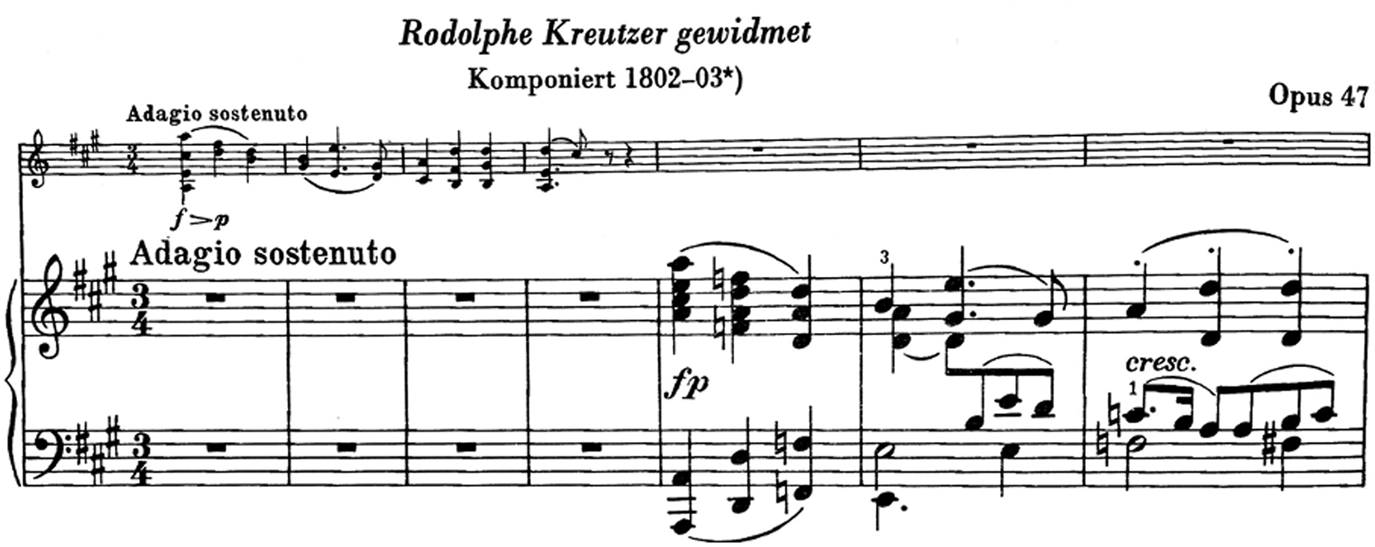
Baillot was an early exponent of Beethoven who was renowned for his skill in improvising.Footnote 94 The opening of Beethoven's Kreutzer Sonata, is a beautiful example of a written out harmonic prelude for both violin and piano. The series of ten chords opening the first movement are first played as a harmonic prelude by the violin alone, then answered as a harmonic prelude by the piano. The entire Adagio Sostenuto opening is a rhetorical improvisatory dialogue between the violin and piano and sets up the movement to come (Fig. 3). Kreutzer, the sonata's dedicatee, never in fact performed it, but Baillot did so in 1835 at his concert series.Footnote 95
Beethoven's Kreutzer Sonata: Opening Prelude.Footnote 96

Baillot's Adagio: An Extended Bowing Technique
Baillot is said to have set a new technical standard for playing the violin.Footnote 97 He recognized that ‘no art can remain stationary’, and that new music by composers called for new techniques by performers: ‘Let us be careful not to remain always in the narrow path of routine, but to open to the new generation all the doors of the future; let us not in any way stop its momentum nor cool its ardour.’Footnote 98 Violinists have a long history of using techniques to extend the capabilities of the violin and to produce different sounds, such as Heinrich Biber and Carlo Farina and also L'Abbe le Fils in his exploration of harmonics.Footnote 99 In L'Art du Violon, Baillot discussed the character of each of the four strings of the violin and their ability to mimic other sounds, for example, the ‘noble and velvety’ D string, and the ‘sweet and penetrating’ A string that can sound like a woman's voice or a flute or an oboe.Footnote 100
Virtuosic violin performances, such as those by Paganini, used extended techniques to impress audiences. Paganini amazed his listeners with techniques such as harmonics, left-hand pizzicato, trills in harmonics and playing entire themes on the G string.Footnote 101 And Louis Spohr, despite his disapproval of showmanship, suggested holding the violin like a guitar while playing long pizzicato passages.Footnote 102
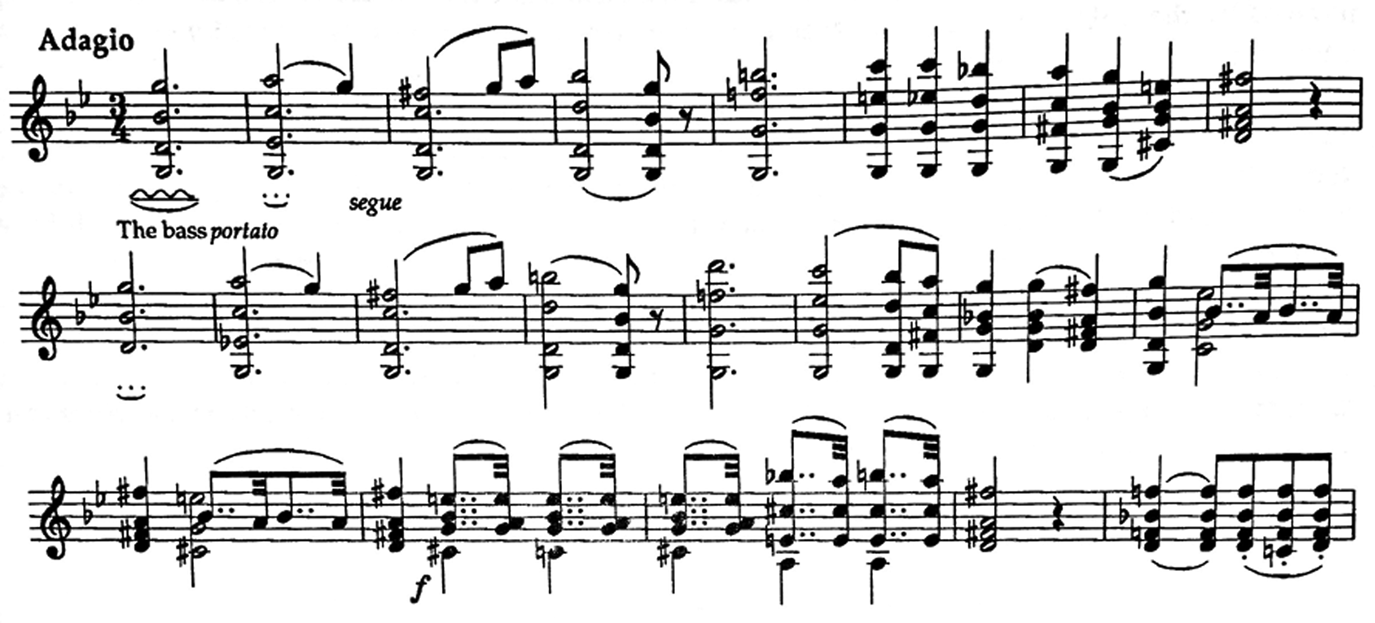
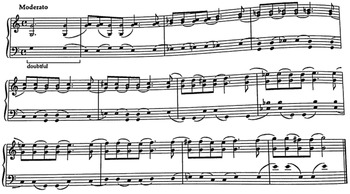
Although Baillot also had reservations about excessive use of effects, he nevertheless encouraged quite radical technical explorations of the violin and its bow. This is evidenced particularly by his own composition included in L'Art du Violon, the two-page Adagio (Fig. 4). In this composition, a remarkable example of chordal harmonic writing, he also experimented with an extended bowing technique.Footnote 103
First Lines from Baillot's Adagio. Footnote 104

The technical possibilities of bowing were expanded from the late 1780s by a new bow devised by François Tourte that was longer and made of the lighter and more flexible wood with the bow heavier at both ends. Metal pieces added to the frog shifted the balance point closer to the lower half of the bow and the bow hair remained flat, producing a greater volume of sound. With music-making shifting from salons to large halls, violinists needed to project more sound. The Tourte bow allowed greater variety and expressiveness of bow stroke and facilitated playing legato and longer slurs as well as more volume, clarity and speed at different bow strokes.Footnote 105 Denise Yim writes that L'Art du Violon was the first violin treatise to explore the ramifications of the new Tourte bow.Footnote 106
Astonishingly, Baillot's Adagio is played on all four strings at once.Footnote 107 He says to detach the hair of the bow from the stick, then place the stick under the violin and the bow hair over the top of the strings. The hair and the stick then are held together tightly, and all four strings are sounded together as a four-part harmony. Baillot claims this procedure is manageable and adds that a musician should not regard such manipulation as an unworthy trick:
Now we do not see in what way it would be unworthy of true talent to use such a procedure; it matters very little whether the bow hair is taut or slack, or whether the stick is placed under the violin instead of above the strings; the essential thing is to please and to move by means which have nothing bad in either their principle or their effect.Footnote 108
While many composers in their experimental scores now ask performers to undertake unusual techniques, this nineteenth-century Adagio is as extreme as any being demanded of twenty-first century violinists.Footnote 109 Despite our modern-era plethora of experimentation, I have found no reference to a performance of Baillot's Adagio, although there are examples of four strings being played at once with a modified bow. One such example is polyphonic playing with a curved bow. Some musicians have claimed that Bach intended his polyphonic works to be performed with a curved bow: examples include Spivakovsky and his Vega Bach Bow, and the German cellist, Michael Bach, who invented a curved bow for string instruments.Footnote 110 Modern composers, such as John Cage and Hans Zender, also have experimented with curved bows in their works and the cellist Frances-Marie Uitti developed a simultaneous two-bow technique.Footnote 111
Although he was probably unaware of Baillot's Adagio, jazz violinist Joe Venuti was renowned in the 1920s and 1930s for this technique, earning him the nickname ‘Four String Joe’.Footnote 112 I can attest that Baillot's Adagio is playable, albeit with difficulty, as I have recorded this work for violin using the technique described by Baillot and have uploaded my performance on YouTube.Footnote 113 Baillot intended to create a somewhat ‘religious’ and ethereal effect with this piece saying:
We are persuaded that with beautiful pieces of music of a calm and religious character, suited to this manner of playing and performed with all the necessary nuances and expression, the violinist would have yet another means to add to the effects on the violin, and thus to increase the appeal of its harmony.Footnote 114
Tartini Tones: An Empirical Exploration
In another surprisingly modern exploration, in Chapter 24 of L'Art du Violon Baillot addresses at length several sound effects including differential tones. Such tones were explored by organist Georg Andreas Sorge and by violinist Giuseppe Tartini in 1740 and 1754 respectively, and now are dubbed ‘Tartini tones’.Footnote 115 Pavenello attributes the continued popularity of Tartini's music in the nineteenth century mainly to Baillot.Footnote 116 Baillot included many references to Tartini in his treatise and is considered to have rediscovered Tartini's Devil's Trill Sonata, first published in 1798 by Cartier, which became a well-known party piece for Paganini and a succession of virtuosi.Footnote 117
Enlightenment ideas emphasized empirical knowledge based on scientific experiments or first-hand experience, in which, to be accepted as true, any proposition must be capable of practical demonstration and so verifiable.Footnote 118 In this spirit, Baillot describes his exploration of several sound effects. For example, he recommends placing a piece of paper on a second violin in order to feel the vibrations that unison tuning can produce when played on the first instrument.Footnote 119 Harmonics and artificial harmonics are discussed, including an exploratory tuning guide to encourage the spirit of experimentation. In his 1834 treatise Baillot describes ‘discovering by chance’ a bow-created harmonic octave effect achieved by bowing at high speed close to the bridge or over the fingerboard while still holding down the left-hand finger.Footnote 120 Baillot espoused artistic flexibility rather than a rule-bound approach; for example, he regarded the metronome, ‘music's clock’, as a guide rather than a strict regulator of rhythm and tempo: ‘A sublime regulator, it always yields to intelligence and to feeling.’Footnote 121
He uses scordatura (the word translates as ‘mistuning’) as a teaching device for escaping a rigid tuning framework, devoting 27 pages to different tuning combinations including a table setting out the advantages and disadvantages of each.Footnote 122 While scordatura was used extensively in the Baroque era, Baillot explored the technique further in a spirit of Enlightenment empiricism. In Baillot's example of his Etude Number 23, a cadenza-like passage is introduced by tuning the G string downwards through semitones to d (while playing), persisting with the tuning adjustments until the completion of the cadenza.Footnote 123
Baillot displays a fascination with Tartini tones. These are now described as an auditory illusion and are considered to be an otoacoustic emission created by the inner ear as a low note produced when two high notes are being sounded.Footnote 124 The effect is heard in the inner ear and perceived by the brain once the different frequencies are in mathematical ratio.Footnote 125 Tartini found these differential tones useful for correcting intonation. Baillot described Tartini tones as remarkable and set about exploring these both as a scientific observation and for creative musical effect.Footnote 126 By playing two notes with a very full tone, the conjunction of the sound waves results in perceiving a third lower tone (pictured as the perceived bass line in Figure 5) Baillot writes: ‘the conjunction of the sound waves results in a third note whose pitch geometricians and physicists have tried to determine; at this time, however, the question cannot be considered as completely resolved.’Footnote 127 Baillot suggests his own innovative touch to enhance the audibility of Tartini tones by placing a metal key, measuring around 4.26 to 5.33 inches and weighing just over two ounces, near the bridge on the side of the G string on the belly of the violin lying in the same direction as the violin's f hole. In essence, this is an attempt at pre-electric amplification. Later efforts by others to enhance the violin's acoustic properties include exploring the glow produced by sympathetic strings on the Norwegian Hardanger violin, and by experimenting before the advent of electrical recording with sounds from the large metal horn of the unusual Stroh violin (which looks like a cross between a violin and a saxophone).Footnote 128
Example of Tartini tones in a composition with perceived bass line.Footnote 129

Baillot demonstrates the creative effect of Tartini tones in two short works with a resulting differential tone bass line that he notated under the played two-note chords. The first work he suggests playing with a firm tone near to the bridge with a narrow vibrato that he describes as imitating the ‘nasard’ stop of the organ. This example, a chordal writing with a third Tartini tone bass line, is an imaginative attempt at creating a particular acoustic effect with a unique musical result. Baillot optimistically wrote proudly of its musical and scientific implications: ‘It is quite possible that it might someday become part of a general system.’Footnote 130
Further studies in the physics of Tartini tones followed with Helmholtz studying acoustic phenomena in the late 1800s and describing Combination tones as well as Summation tones.Footnote 131 This acoustic phenomenon is still being studied both physiologically and musically.Footnote 132 For example, modern-day tests use this phenomenon to determine how well a child can hear. Two tones are played loudly close to the child's ear, so that the inner ear should then produce a very quiet otoacoustic lower tone emission with all three tones picked up by a microphone and displayed on a spectrogram.Footnote 133 Other recent research into this acoustic phenomenon finds that two simultaneous tones of a particular musical interval played by a violin is experienced as Tartini tones in the inner ear that also can be measured outside the ear on electromechanical devices.Footnote 134
Tartini tones have been used as compositional inspiration also by electronic composers, such as visionary American composer and installation artist, Maryanne Amacher (1938–2009), whose pioneering works explored combination tones and otoacoustic emissions based on her own studies of acoustics and human hearing.Footnote 135 Modern day versions of Baillot's experiments with violins now explore the phenomenon of differential tones in anechoic chambers (a room designed to completely absorb echoes of either sound or electromagnetic waves), and in violin workshops using microphones and electrodynamic mini shakers on the violin near the f hole. Footnote 136 The nineteenth-century empirical experiments of Baillot, therefore, are still being explored both in electronic music and in scientific experiments.Footnote 137
Conclusion: A Life of Musical Possibility
What impresses me most from my reading of Baillot's L'Art du Violon is his quest to extend the potential of both the musician playing the instrument and the violin itself. Throughout the 1834 treatise written for his violin students at the Paris Conservatoire, Baillot draws upon Enlightenment and Romantic ideas in stressing the importance of striving for personal and musical growth throughout one's life. Similarly, he aimed to explore and extend the potential of the violin to arouse varied and deep emotions in its listeners and to extend its possibilities of expression. As a broadly educated musician he saw no conflict in upholding the historical traditions of the violin repertoire while also being a renowned exponent of new music of his time. He saw the art of improvising as offering a bridge between these two traditions, and as providing a means for a performer to develop his/her own creative and technical potential. Baillot's search to expand the capacity of the violin as an instrument led him to encourage the use of harmonic preluding and to experiment empirically with extended techniques. To these interesting technical effects, he applied his musical aesthetic, as indicated by the Baillot quotation with which I introduced this essay: ‘It is, therefore, the function of genius to create new effects, the function of taste to regulate their use, and the function of time alone to sanction them’.Footnote 138
Time has sanctioned efforts to discover new violin effects. Musicians today value historical performance practices including revitalizing improvisation as well as exploring innovative technical possibilities. Many successful performers embrace older music styles as well a diverse genres and contemporary directions. Baillot's emphasis on preluding, and improvisation in particular, offer a counter-view to our still overly notation-bound understanding of nineteenth-century performance. To give examples among contemporary virtuoso violinists, Patricia Kopatchinskaja and Isabelle Faust are influenced by historically informed practices including improvisations as well as new compositions including experiments with extended violin techniques.
Modern composers who explore extended techniques for the violin include Helmut Lachenmann, Salvatore Sciarrino, Gérard Grisey, Kaija Saariaho and Georg Friedrich Haas, as do performers such as violinist Jon Rose and violist Garth Knox.Footnote 139 These diverse techniques include bowing behind the bridge, extreme bow pressures, bowing the body of instrument, producing micro tonalities, preparations that involve adding objects on or between the strings, and working with electronics.
In my own violin performing career in Australia I work with several ensembles who explore historical performance, such as Ironwood, Pinchgut Opera and the Australian Romantic and Classical Orchestra. I also experiment with extended violin techniques, such as in my current projects with composer Damian Barbeler. These include the ‘Sound Bubble’ which is a transportable inflatable installation that reacts with audio and visual software to the improvised sounds of the violin. In another project ‘Violin and Ball of Wool’ we explore highly amplified textural sounds of wool being drawn over the strings of the violin as an additional bow.Footnote 140
As one who championed composers of his time, Baillot would have been amazed, but I think generally approving, of this twenty-first century ferment of new ideas, performance styles and techniques. Although written over 180 years ago, Baillot's comprehensive violin treatise, L'Art du Violon, deserves recognition for its multi-faceted exploration of both musician and instrument. Baillot himself exemplified a cultured musician who explored both intellectual and emotional aspects of violin practice in his methods for coaxing colour and passion and varied sound effects from the violin. In embracing diversity and creativity in his teaching and performance, Baillot showed young violinists then and now a path to a life of rich musical possibility.