Introduction
Individuals with substance use disorders (SUD) commonly continue to engage in use patterns with a high likelihood of negative consequences, even after education and the experience of such negative consequences (e.g., Garavan & Stout, Reference Garavan and Stout2005). The presence of neuropsychological impairments (e.g., memory and executive functions) in clients seeking treatment for SUD is well established (e.g., Cruickshank & Dyer, Reference Cruickshank and Dyer2009). However, the cognitive processes that predict risky decision-making in substance users remain elusive. Prior research has generally shown only small and inconsistent associations between engagement in risk behaviors and various aspects of executive functions (e.g., Gonzalez et al., Reference Gonzalez, Vassileva, Bechara, Grbesic, Sworowski, Novak and Marin2005). However, one neurocognitive construct that may be relevant to engagement in risk behaviors in SUD that has not been fully explored is prospective memory (PM; Martin et al., Reference Martin, Nixon, Pitrak, Weddington, Rains, Nunnally and Bechara2007).
PM refers to the ability to remember to perform a task at a certain occasion in the future, which may be cued by events (event-based: EB; e.g., taking medication with dinner) or time (time-based: TB; e.g., attending a medical appointment at 2:00 p.m.). Kliegel, Jager, Altgassen, and Sum (Reference Kliegel, Jager, Altgassen and Sum2008) have outlined the neurocognitive components in the Process Model of PM, including (1) formation of the intention (requiring effective planning), (2) retention of the intention (requiring long-term storage), (3) initiation of the intention (requiring automatic and/or strategic monitoring of the environment for the appropriate cue), and (4) execution of the intention (requiring inhibition for disengaging from any ongoing task, and switching to execution of the intention). Implicit in this model is the role of long-term retrospective memory, but also substantial dependence on an array of executive functions (e.g., planning, monitoring, inhibition, and switching). Accordingly, it is unsurprising that studies using a variety of methodologies are consistent in linking PM to a distributed neural network involving prefrontal (BA10), medial temporal, and inferior parietal lobe structures (Burgess, Gonen-Yaacovi, & Volle, Reference Burgess, Gonen-Yaacovi and Volle2011).
Importantly, PM is mildly-to-moderately impaired in a variety of substance-using populations, including alcohol (Heffernan, Ling, & Sholey, Reference Heffernan, Ling and Scholey2001), methamphetamine (Iudicello, Weber, Grant, Weinborn, & Woods, Reference Iudicello, Weber, Grant, Weinborn and Woods2011), and ecstasy users (Weinborn, Woods, Nulsen, & Park, Reference Weinborn, Woods, Nulsen and Park2011). PM is a ubiquitous aspect of daily-life functioning, having been associated with everyday memory failures (e.g., Weinborn, Woods, O'Toole, Kellogg, & Moyle, Reference Weinborn, Woods, O'Toole, Kellogg and Moyle2011) and healthcare compliance (Iudicello et al., Reference Iudicello, Weber, Grant, Weinborn and Woods2011) among individuals with SUD. While a variety of personality and neurocognitive factors may contribute to risky decision-making, the application of PM skills to management of risk behaviors is subsequently intuitively appealing. This is particularly the case among individuals who have the requisite knowledge base regarding the inherent risks associated with specific behaviors, and of effective methods to manage these risks (e.g., substance users in treatment).
The Process Model described above (Kliegel et al., Reference Kliegel, Jager, Altgassen and Sum2008) delineates specific components of PM that may fail in managing risk. For example, individuals who wish to mitigate risk related to sexual behaviors would first need to formulate the intentions relevant for doing so (e.g., condom use with casual partners). This would require successful planning (e.g., carrying condoms in circumstances where they may meet a casual partner), retention of this intention, initiation of the intention (requiring monitoring of the environment for the relevant circumstance, e.g., a Saturday night date or party), and execution of the intention (requiring task switching, e.g., inhibiting intimate engagement to retrieve the condom). Thus, implementation of risk management strategies requires an array of component PM processes, deficits in which could increase the likelihood of failing to implement risk mitigation strategies.
Given the intuitive appeal of the relationship between altered PM function and difficulty in implementing risk reduction strategies, as well as neuroanatomical (e.g., Burgess et al., Reference Burgess, Gonen-Yaacovi and Volle2011; Krain, Wilson, Arbuckle, Castellanos, & Milham, Reference Krain, Wilson, Arbuckle, Castellanos and Milham2006) findings suggesting shared neural resources recruited for PM and risky decision processing (suggesting that dysfunction of these regions, most significantly BA10, may produce deficits in both domains), it is surprising that there is a paucity of research examining the link between these domains among substance users. It is reasonable to expect that individuals who struggle with the executive demands of PM may display an increased propensity for risky decision-making, even when such individuals are armed with the required information and the best of intentions. Supporting this, findings from our research group indicated a relationship between aspects of PM requiring higher-level strategic resources (i.e., longer task delay intervals) and laboratory measures of risky decision-making (Weinborn, Woods, Nulsen, et al., Reference Weinborn, Woods, Nulsen and Park2011). Additionally, Martin et al. (Reference Martin, Nixon, Pitrak, Weddington, Rains, Nunnally and Bechara2007) found PM was inversely related to HIV transmission risk behaviors (primarily risky sexual behavior) in an SUD cohort with a high prevalence of HIV infection. Specifically, they found that a habitual TB task (informing the examiner every time 7 min had passed) was negatively correlated (−.37) with Risk Assessment Battery scores, while there was no relationship between risk and EB or other cognitive (working and retrospective memory) tasks.
The current study extends these intriguing preliminary findings by evaluating the relationship between performance on a well-validated, comprehensive prospective memory task, the Memory for Intention Screening Test (MIST; Raskin, Buckheit, & Sherrod, Reference Raskin, Buckheit and Sherrod2010), and a diverse range of self-reported risky behaviors while controlling for demographic, mood, and personality factors, as well as the potential contributions of other neurocognitive abilities. Two cohorts were included: (1) an (HIV-negative) group currently seeking treatment for problematic substance use, and (2) a substance-using undergraduate university sample, which allowed for evaluation of this relationship among groups with differing ages, substance use patterns (e.g., length, severity of use), and types of risk behaviors. Based on the initial findings of Martin et al. (Reference Martin, Nixon, Pitrak, Weddington, Rains, Nunnally and Bechara2007), it was hypothesized that PM would be a significant predictor of engagement in risk behavior, and that this relationship may be stronger for TB tasks.
STUDY 1
Prospective memory and its relationship to HIV-related risky behavior and criminal history in a substance using sample seeking treatment.
Method
Participants
Forty-five consecutively referred individuals seeking treatment from a substance use treatment center in Perth, Australia were included, and were a subset (85%) of the group reported in Weinborn, Woods, O'Toole, et al. (Reference Weinborn, Woods, O'Toole, Kellogg and Moyle2011) who had completed risk measures. Exclusion criteria were any relevant neurological (e.g., stroke, Attention-Deficit/Hyperactivity Disorder, traumatic brain injury with loss of consciousness >30 min) or severe psychiatric (e.g., schizophrenia) history. Participants were also excluded for invalid effort (using the Test of Memory Malingering; Tombaugh, Reference Tombaugh1996) or recent use of illicit drugs (a saliva test using the Cozart RapiScan© device; De Giovanni, Fucci, Chiarotti, & Scarlata, Reference De Giovanni, Fucci, Chiarotti and Scarlata2002) or alcohol (using the Alcotech AR 1005 Breathalyzer).
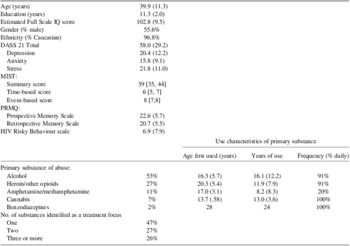
Demographic, psychiatric and substance use characteristics of the sample are presented in Table 1. Most presented with alcohol (53%), opiates (27%), or amphetamine/methamphetamine (11%) as their primary substances of abuse, and 53% had at least one other identified substance of abuse as a focus of treatment, most commonly cannabis (26.6%).
Demographic and substance characteristics of the Study 1 sample of treatment seeking alcohol and substance users (N = 45)

Note. Demographic data are presented as Mean (standard deviation), Median [Interquartile range], or as percentages as noted. Estimated Full Scale IQ score = Wechsler Test of Adult Reading – Demographics & Performance predicted Full Scale IQ score. MIST = Memory for Intentions Screening Test. PRMQ = Prospective and Retrospective Memory Questionnaire. DASS = Depression Anxiety Stress Scales – 21 (Total score).
Materials and procedure
Procedures were approved by the Human Research Ethics Office at the University of Western Australia and the St. John of God committee for the Drug and Alcohol Office. Participants were reimbursed 25.00 AUD for travel expenses. Substance use information, including substance(s) identified for primary treatment, age at first use, and frequency of use, was collected from the medical record and from participants using the substance use scales of the Opiate Treatment Index (OTI; Darke, Ward, Hall, Heather, & Wodak, Reference Darke, Ward, Hall, Heather and Wodak1991). An Overall Substance Use Index was calculated by summing the frequency of use for each substance used.
Prospective memory measures
Participants were administered the research version (Woods, Moran, Dawson et al., 2008) of the MIST (Raskin et al., Reference Raskin, Buckheit and Sherrod2010), which is a standardized measure of PM with adequate reliability (e.g., Woods, Moran, Dawson et al., 2008) and validity in substance use populations (e.g., Weinborn et al., Reference Weinborn, Woods, O'Toole, Kellogg and Moyle2011). The MIST includes four Time-Based (TB) and four Event-Based (EB) items, during which the participant completes an ongoing distracter task (i.e., a standardized word search). TB and EB trials are balanced on delay interval (2 min vs. 15 min delays) and action versus verbal responses.
Self-reported prospective and retrospective memory complaints were assessed with the Prospective and Retrospective Memory Questionnaire (PRMQ; Smith, Della Sala, Logie, & Maylor, Reference Smith, Della Sala, Logie and Maylor2000). The PRMQ measures the frequency of perceived memory difficulties in everyday life on a 5-point Likert-type scale, ranging from 1 (“never”) to 5 (“very often”), and including eight PM (e.g., “Do you decide to do something in a few minutes’ time and then forget to do it?”) and eight retrospective memory complaints (e.g., “Do you forget what you watched on television the previous day?”).
General neuropsychological and mood measures
Self-reported mood disturbance was assessed with the Total Score from the Depression, Anxiety, and Stress Scales-21 (DASS-21; Lovibond & Lovibond, Reference Lovibond and Lovibond1995). Estimated premorbid intelligence was assessed using the Wechsler Test of Adult Reading (Reference Wechsler2001) performance and demographics predicted Full Scale IQ score (WTAR; Psychological Corporation, 2001). We also administered clinical tests of executive functions and retrospective memory to evaluate the predictive contributions of these domains to risky behavior. The executive domain was comprised of three measures: (1) complex/divided attention, assessed with the Trailmaking Test (Part B; Reitan & Wolfson, Reference Reitan and Wolfson1985), (2) working memory, assessed with the Digit Span-Backwards subtest of the Wechsler Adult Intelligence Scale – III (WAIS-III; The Psychological Corporation, 1997), and (3) novel problem-solving, assessed with the Wisconsin Card Sorting Test, 64 Card Version, categories completed (WCST-64; Kongs, Thompson, Iverson, & Heaton, Reference Kongs, Thompson, Iverson and Heaton2000). Retrospective memory was assessed with the Rey Auditory Verbal Learning Test (RAVLT; Schmidt, Reference Schmidt1996) and Rey Complex Figure Test (RCFT, Meyers & Meyers, Reference Meyers and Meyers1995) long delay recall scores. Raw scores were converted to population-based Z-scores and averaged across executive and memory domains using standard, published methods (e.g., Iudicello et al., Reference Iudicello, Weber, Grant, Weinborn and Woods2011).
Assessment of risk behavior
Risky behavior was assessed in this sample with the HIV Risk-Taking Behaviour Scale (HRBS) from the OTI. This is a well-validated 11-item scale assessing drug use (e.g., needle sharing) and sexual (e.g., condom use) practices over the last 30 days that would place the individual at increased risk of acquiring/transmitting HIV or other blood-borne viruses. Higher scores are indicative of greater risk-taking. A lifetime history of criminality was also obtained. Criminal behavior places an individual at increased risk for a variety of negative consequences. However, the OTI Criminality scale, which assesses the frequency of a select group of criminal activities (property crime, dealing, fraud, violent crime), has displayed poor internal consistency (alpha = .38; Darke et al., Reference Darke, Ward, Hall, Heather and Wodak1991). Therefore, information from this scale and other structured questions about a history of criminal activities and jail/prison sentences was used to group participants into those with (n = 20) and those without (n = 25) a history of criminal behavior for subsequent analyses.
Results
Risk-taking behaviors, as well as performance on laboratory-based PM measures, tend to decline with age (e.g., Gonneaud et al., Reference Gonneaud, Kalpouzos, Bon, Viader, Eustache and Desgranges2011; Pappas & Helkitis, Reference Pappas and Halkitis2011), and similar patterns were found in the current sample. Specifically, correlational analyses indicated that increasing age was associated with lower HRBS scores (r = −.48; p = .001), but also poorer TB (r = −.30; p = .048) and EB (r = −.49; p = .001) PM. Accordingly, age was included as a covariate in all analyses involving the HRBS. However, criminal history was reported over the individual's entire life rather than just the last 30 days, and therefore unlikely to be a confounding factor. Supporting this, t tests revealed no significant difference (p > .10) in age between those reporting a criminal offense (M = 40.1; SD = 11.3) compared to those without a criminal history (M = 39.8; SD = 11.6).
Partial correlationsFootnote 1 between PM variables and the HRBS controlling for age were significant for the MIST Summary (r = −.46; p = .002) and TB scores (r = −.51; p = .001). MIST EB only correlated marginally (r = −.27; p = .09). To more directly compare the size of the relative relationships between TBPM and HRBS versus EBPM and HRBS, Steiger's Z (Reference Steiger1980) was used to compare the R values for two regression models, taking into account the correlation between the models. This revealed a significant difference between TB and EB prospective memory in the prediction of risky behavior (Steiger's Z = 7.18; p < .001), with the size of the relationship for TB and HRBS significantly larger than for EBPM.
The PM complaints scale of the PRMQ was not significantly related to the HRBS (r = .22; p > .10). T-tests revealed differences between those with and without a criminal history for MIST Summary (p = .003; d = 1.01) and TB (p = .005; d = .91) scores, with EB falling at a trend-level (p = .07; d = .60). Criminality group differences were found for the PM scale of the PRMQ (p = .04; d = .64).
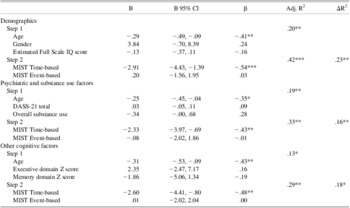
Three separate hypothesis-driven hierarchical linear regressions predicting the HRBS from MIST TB and EB scores, and three binary logistic regressions predicting criminal history status from MIST TB and EB scores, as well as PRMQ PM score, were conducted controlling for the potential effects of (1) Demographic variables, (2) Psychiatric and substance use variables, and (3) Other cognitive measures (see Table 2). In all regressions, addition of the MIST scores in Step 2 added unique predictive variance (ΔR2 = .16–.23, all p’s < .05), but only the TB scale was an independent predictor in all analyses (all p’s < .05). Specifically, more impaired TBPM was predictive of a greater likelihood of engagement in risky behaviors.
Hierarchical Regressions Predicting Risky Behavior from Time and Event Based Prospective Memory in a Treatment Seeking Sample of Substance Users after Controlling for Demographic, Psychiatric and Cognitive Factors

Note. Estimated Full Scale IQ score = Wechsler Test of Adult Reading Demographics & Performance predicted Full Scale IQ Score, MIST = Memory for Intentions Screening Test, DASS-21 = Depression Anxiety and Stress Scales 21 item version, combined score, Executive domain Z score is combined scores for Wisconsin Card Sorting Test – Categories, Digit Span Backwards, and Trailmaking test, Form B. Memory Z score is combined scores for Rey Auditory Verbal Learning Test Long Delay, and Rey Complex Figure Test, Long Delay Score. *p < .05 **p < .01 ***p < .001.
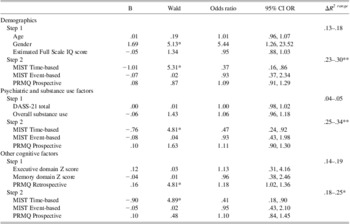
The three logistic regressions examining the association between criminal behavior and PM are presented in Table 3. Addition of the MIST and PRMQ Prospective scores significantly increased the variance explained in predicting criminal history status after accounting for demographic variables (Δ in Cox and Snell and Nagelkerke R2 range = .23–.30; p = .005), mood and substance use history (Δ in Cox and Snell and Nagelkerke R2 range = .25–.34; p = .004), and memory and executive function domains (Δ in Cox and Snell and Nagelkerke R2 range = .18–.25; p = .024). In all regressions, MIST EB and PRMQ PM were not significant predictors, and only TB PM remained an independent predictor of criminal history status, with poorer TBPM predictive of a greater likelihood of criminal history.
Logistic regressions predicting likelihood of history of criminal activity in a treatment seeking sample of substance users from time-based, event-based, and self-reported prospective memory after controlling for demographic, psychiatric, and cognitive factors

Note. Estimated Full Scale IQ score = Wechsler Test of Adult Reading Demographics & Performance predicted Full Scale IQ Score, MIST = Memory for Intentions Screening Test, PRMQ = Prospective and Retrospective Memory Questionnaire, DASS-21 = Depression Anxiety and Stress Scales 21 item version, combined score, Executive domain Z score is combined scores for Wisconsin Card Sorting Test – Categories, Digit Span Backwards, and Trailmaking test, Form B. Memory Z score is combined scores for Rey Auditory Verbal Learning Test Long Delay, and Rey Complex Figure Test, Long Delay Score. ΔR 2 range is the range of the obtained Cox & Snell ΔR2 and the Nagelkerke ΔR2 in Step 2 minus Step 1. *p < .05 **p < .01 ***p < .001.
Results of the first study were supportive of an association between TBPM and risky behaviors in a clinical sample of SUD. Such findings are consistent with Martin et al. (Reference Martin, Nixon, Pitrak, Weddington, Rains, Nunnally and Bechara2007), but extend that prior study by showing that this relationship remained after controlling for other potential contributory factors (e.g., age and mood). To evaluate whether this finding was unique to individuals with SUD in treatment, or whether this relationship may be evident among individuals who may be at risk of developing (or early in the course of) a SUD, a follow-up study in a sample of university students with high risk drinking (and/or other substance use) patterns was completed.
STUDY 2
Prospective memory and risky behavior among university students with high-risk alcohol or substance use
Participants
Fifty-nine high-risk substance-using participants were selected from 291 individuals recruited for a larger study of substance use and neuropsychological function. Eighty-eight percent of these participants were included in a previous study of PM among ecstasy users (Weinborn, Woods, Nulsen, et al., Reference Weinborn, Woods, Nulsen and Park2011). Recruitment took place via posters placed around the University of Western Australia campus, student email and Web pages, social networking sites, and word of mouth. General inclusion criteria were age 18–30 years and English as a first language. Exclusion criteria were history of significant medical or psychiatric history as in Study 1. Additionally, participants who had used any substance in the previous three days, or had consumed alcohol at binge levels (> 4 units) the previous day were excluded.
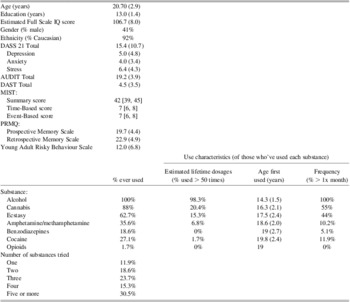
Descriptive data are presented in Table 4. The mean score on the Drug Abuse Screening Test-20 (DAST-20) was elevated (M = 4.5; SD = 3.5) and 37.3% of the sample scored above cutoffs suggested for identification of problematic substance abuse (e.g., Cocco & Carey, Reference Cocco and Carey1998). In comparison to the first study sample of treatment seeking individuals, these university students were not in treatment, were young (M = 20.7; SD = 2.9), and reported low levels of distress (DASS-21 M = 15.4; SD = 10.7).
Demographic and substance characteristics of the study 2 sample of nonclinical university student high-risk alcohol and substance users (N = 59)

Note. Demographic data are presented as Mean (standard deviation), Median [Interquartile range] or as percentages as noted. Estimated Full Scale IQ score = Wechsler Test of Adult Reading – Performance predicted Full Scale IQ score. DASS = Depression Anxiety Stress Scales – 21 (Total score), AUDIT = Alcohol Use Disorders Identification Test, DAST = Drug Abuse Screening Test. MIST = Memory for Intentions Screening Test. PRMQ = Prospective and Retrospective Memory Questionnaire.
Materials and Procedure
Study procedures were approved by the Human Research Ethics Office at the University of Western Australia. Participants were reimbursed 35.00 AUD for travel expenses.
To select those with a high likelihood of alcohol use disorders, a score of 15 or higher on the Alcohol Use Disorders Identification Test (AUDIT; Babor, Higgins-Biddle, Saunders, & Monteiro, Reference Babor, Higgins-Biddle, Saunders and Monteiro2001) was used to select participants. As can be seen in Table 4, the average AUDIT score of the sample was substantially elevated (M = 19.2; SD = 3.9). Use of other substances was common, with 88% having used at least one other substance, most commonly marijuana (88%) and ecstasy (67%). Alcohol and other drug (e.g., cannabis, amphetamine, etc) use information (total lifetime units, frequency of use, most recent use, and age at first use), as well as self-reported medical and psychiatric history was collected by computer-assisted interview. An Overall Substance Use Index was calculated by summing the frequency of use for each substance used.
Prospective Memory Measures
As in Study 1, PM was measured objectively by the MIST and in self-report by the PRMQ. For the present study, 4 of the 8 MIST items were slightly modified (as described in detail in Weinborn, Woods, Nulsen, et al., Reference Weinborn, Woods, Nulsen and Park2011) to change items requiring subjects to write down identifiable information (due to confidentiality considerations), or items with limited relevance to young adults.
General Neuropsychological, Mood, and Personality Measures
Mood was assessed using the summed score from the DASS-21, sensation-seeking was measured with the Brief Sensation Seeking Scale (Hoyle, Stephenson, Palmgreen, Pugzles Lorch, & Donohew, Reference Hoyle, Stephenson, Palmgreen, Pugzles Lorch and Donohew2002) and estimated premorbid intelligence was assessed by the performance-only predicted Full Scale IQ score from the WTAR due to the demographic similarity of the participants.
Executive and retrospective memory measures were administered as in Study 1, and a retrospective memory domain score was constructed as in that study. The WCST-64 was not administered in this sample and was replaced in the executive domain score with the Stroop Neuropsychological Screening Test (Trenerry, Reference Trenerry1989); thus, the executive score was comprised of the Stroop, Trailmaking Test B, and Digit Span Backwards. Also in the present sample, the Iowa Gambling Task (IGT; Bechara, Reference Bechara2007) and Balloon Analogue Risk Task (BART, Lejuez et al., Reference Lejuez, Read, Kahler, Richards, Ramsey, Stuart and Brown2002) were administered, allowing for a decision-making domain score to be constructed in the same manner as the other domains.
Assessment of Risk Behavior
The OTI was deemed inappropriate for a young, nonclinical sample, and a measure of risk-taking was developed based on a review of relevant scales (e.g., the Risky Sex Scale; O'Hare, Reference O'Hare2001; the Youth Risk Behavior Survey Questionnaire; Brener et al., Reference Brener, Kann, McManus, Kinchen, Sundberg and Ross2002) with items chosen or generated to be most relevant for this age group. This Young Adult Risky Behavior Scale (YARBS) was comprised of 15 items (available upon request from the first author), with higher scores reflecting more frequent (rated from “never” to “more than five times” over the last 12 months) engagement in behaviors with a high risk of legal, financial and interpersonal risk in the areas of driving (e.g., driving while intoxicated), sexual conduct (e.g., condom use), interpersonal conduct (e.g., physical altercations) and theft (e.g., more than $50.00). This scale produced good internal consistency (Cronbach's alpha = .79), and the frequency distribution in the present sample approximated normality (Shapiro-Wilk = .97; p > .10). Concurrent validity was demonstrated with a positive relationship (r = .41; p = .001) with the Disinhibition scale from the Barrett Sensation Seeking Scale (Hoyle et al., Reference Hoyle, Stephenson, Palmgreen, Pugzles Lorch and Donohew2002) and a trend-level negative relationship with the Iowa Gambling Task Total Score (r = −.26; p = .058). Divergent validity was supported by a trend level relationship (r = −.25; p = .06) with the Behavioral Inhibition Scale (Carver & White, Reference Carver and White1994).
RESULTS
Partial correlations controlling for age between the YARBS and PM variables were significant for MIST Summary Score (r = −.36; p = .001) and TB (r = −.41; p = .002) scores, but not EB (p > .10). Neither the PRMQ Prospective nor Retrospective subscales were related to risky behavior (ps > .10).
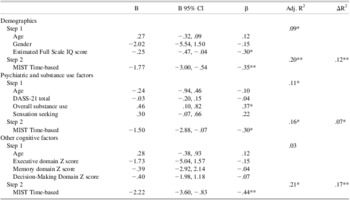
Three hypothesis-driven hierarchical linear regressions predicting Risky Behavior from TBPM were conducted controlling for the effects of (1) Demographic variables, (2) Psychiatric and substance use variables, and (3) Neuropsychological domain scores. Table 5 details the results. In all regressions, addition of the TB score in Step 2 added unique variance (ΔR2 = .07–.17; all p’s < .05), with poorer TBPM predictive of higher risk scores.
Hierarchical regressions predicting risky behavior from Time-Based Prospective Memory in a nonclinical university sample of high-risk alcohol and substance users after controlling for demographic, psychiatric, and cognitive factors

Note. Estimated Full Scale IQ score = Wechsler Test of Adult Reading Performance predicted Full Scale IQ Score, MIST = Memory for Intentions Screening Test, DASS-21 = Depression Anxiety and Stress Scales 21 item version, combined score, Executive domain Z score is combined scores for Wisconsin Card Sorting Test – Categories, Digit Span Backwards, and Trailmaking test, Form B. Memory Z score is combined scores for Rey Auditory Verbal Learning Test Long Delay, and Rey Complex Figure Test, Long Delay Score. *p < .05 **p < .01 ***p < .001.
General Discussion
Neuroanatomical (e.g., Burgess et al., Reference Burgess, Gonen-Yaacovi and Volle2011; Krain et al., Reference Krain, Wilson, Arbuckle, Castellanos and Milham2006) findings indicate shared neural resources for PM and risky decision processing, and cognitive models (e.g., Kliegel, Altgassen, Hering, & Rose, Reference Kliegel, Altgassen, Hering and Rose2011) provide a framework for understanding how impaired PM may influence an individual's ability to effectively implement risk management strategies. Consistent with this general conceptual framework, the present study found that PM uniquely predicted a variety of maladaptive risky behaviors in independent samples of substance users at treatment entry, and nonclinical at-risk younger substance users. Specifically, TB PM was associated with increased risky behavior (e.g., risky sexual practices and criminal behaviors) after controlling for demographic, psychiatric, and substance use variables, as well as other neuropsychological variables, including laboratory measures of risky decision-making (i.e., IGT and BART).
The finding of a relationship between PM and risky behavior is consistent with previous research from our group (Weinborn, Woods, Nulsen, et al., Reference Weinborn, Woods, Nulsen and Park2011) that found an association between PM and laboratory measures of risky decision-making. It is also consistent with the findings of Martin et al. (Reference Martin, Nixon, Pitrak, Weddington, Rains, Nunnally and Bechara2007), which has been the only prior study to evaluate PM and “real-world” risk taking, and found TB, but not EB, PM was inversely related to HIV-related (primarily risky sexual practices) risk behaviors.
Importantly, we found that the relationship between PM and risk is evident in both clinical and nonclinical, “at risk” samples. While direct comparisons between study samples were not possible, it is intriguing to note that the strength of the relationship between TBPM and risky behavior was somewhat stronger in the clinical sample (ΔR2 ranges from .16 to .34) in comparison to the younger nonclinical sample (ΔR2 ranges from .07 to .17). Although speculative, it is plausible that the younger sample did not yet have significant substance-induced PM impairments, but rather that the relationship may reflect a pre-existing weakness in the functioning of the rostral PFC (BA10) that adversely affects both TBPM and risky decision-making (e.g., the gateway hypothesis, Burgess et al., Reference Burgess, Dumontheil and Gilbert2007), and that places an individual at risk for the subsequent development of a SUD. While PM has not been specifically raised as an endophenotype or risk factor for SUD, other executive functions have, including impulsivity (Robbins, Gillan, Smith, de Wit, & Ersche, Reference Robbins, Gillan, Smith, de Wit and Ersche2012), error monitoring and reversal learning (Crews & Boettiger, Reference Crews and Boettiger2009). It is possible that a rostral PFC dysfunction reflected by a weakness or deficit in TBPM may be evident in substance-using adolescents and young adults early in the course of (or even before) their addiction. As substance use increases and PM becomes more impaired (e.g., Weinborn, Woods, O'Toole, et al., Reference Weinborn, Woods, O'Toole, Kellogg and Moyle2011), individuals may subsequently find it even more difficult to implement risk management strategies, and the effect size of the relationship between PM and risky behavior increases. Evaluation of PM as a risk factor, or even an endophenotype, for SUD would be an important next step to test this hypothesis as there would be clear potential for PM interventions early in the course of the disorder, or for at-risk adolescents.
Consistent with Martin et al. (Reference Martin, Nixon, Pitrak, Weddington, Rains, Nunnally and Bechara2007), we also found that TB, but not EBPM predicted risky behavior. TBPM tasks are thought to differ from EBPM tasks with otherwise similar task characteristics (e.g., interval lengths, cue focality, cue-intention relatedness) due to its requirements for greater self-initiated strategic control of monitoring and cue detection as outlined in the multiprocess theory (McDaniel & Einstein, Reference McDaniel and Einstein2000). Of note, the EB tasks on the MIST, while nonfocal, have cue-intention pairings high in semantic relatedness, which further decreases executive demands (Woods, Dawson, Weber, & Grant, 2010). Consistent with this, the EB task used by Martin et al. also involved semantically related cue-intention pairings, and Weinborn, Woods, Nulsen, et al. (Reference Weinborn, Woods, Nulsen and Park2011), while collapsing TB and EB cues, found a significant relationship with risky decision-making for longer, but not shorter, ongoing task delays. Longer delays would be associated with greater strategic resource demands according to multiprocess theory. It is possible that EBPM tasks with increased strategic resource demands may be better predictors of risky behavior than those without. Indeed, increasing the strategic demands of any PM task—whether TB or EB—in other ways (e.g., cue salience or focality) may increase the strength of the relationship, and manipulation of PM strategic demands would be an important avenue of future research.
Self-reported PM complaints were not uniquely associated with risky behavior in the present samples. The extant literature suggests that while self-reported PM does not have a strong relationship to objective PM performance (e.g., Kliegel and Jaeger, Reference Kliegel and Jager2006), it has generally shown promise as a predictor of self-reported daily functioning (e.g., Macan, Gibson & Cunningham, Reference Macan, Gibson and Cunningham2010; Zogg et al., 2012). However, this relationship is not always found, perhaps due to limited insight or the influence of depression (Woods et al., Reference Woods, Carey, Moran, Dawson, Letendre and Grant2007), which may be particularly relevant to the substance-using samples evaluated in the present studies.
It is also interesting to note that the traditional neuropsychological measures included in the present study were not significantly linked to risky behavior. This is consistent with Martin et al. (Reference Martin, Nixon, Pitrak, Weddington, Rains, Nunnally and Bechara2007) who also did not find a relationship between risk and non-PM cognitive measures, as well as previous research that has found only small and inconsistent associations between standard neuropsychological measures and risk behavior (e.g., Gonzalez et al., Reference Gonzalez, Vassileva, Bechara, Grbesic, Sworowski, Novak and Marin2005). Conversely, the current findings contribute to a growing research literature supporting PM as a predictor of everyday functioning across a variety of tasks and clinical and healthy groups. For example, PM has been found to be a unique predictor of medication adherence (Zogg, Woods, Sauceda, Wiebe, & Simoni, Reference Zogg, Woods, Sauceda, Wiebe and Simoni2012), unemployment (Woods, Weber, Weisz, Twamley, & Grant, Reference Woods, Weber, Weisz, Twamley and Grant2011), and declines in instrumental activities of daily living (Woods, Iudicello, Moran et al., 2008; Zogg et al., 2012) in healthy and clinical samples. Research evaluating neurocognitive predictors of everyday functioning among those with SUD is limited, but there is some evidence to support that aspects of cognitive function predict employment (e.g., among chronic methamphetamine users; Weber et al., 2012), and substance abuse treatment retention/outcome (e.g., Verdejo-Garcia, Clark, & Dunn, Reference Verdejo-Garcia, Clark and Dunn2012). The SUD literature is particularly sparse in the context of PM, but prior studies suggest that PM deficits are independently associated with more everyday memory failures (e.g., Weinborn, Woods, O'Toole, et al., Reference Weinborn, Woods, O'Toole, Kellogg and Moyle2011) and healthcare non-compliance (Iudicello et al., Reference Iudicello, Weber, Grant, Weinborn and Woods2011) among individuals with SUD. Extension of this research to include evaluation of the relationship between PM and everyday function (e.g., treatment outcomes, medication adherence, employment) would be a fruitful next step.
Indeed, the implications of the present findings are likely to be relevant to individuals with SUD as well as at-risk groups. Psychoeducational and other interventions are commonly implemented addressing a variety of risky behaviors, including driving while intoxicated (McMurran, Reimsma, Manning, Misso, Kleijnen, Reference McMurran, Riemsma, Manning, Misso and Kleijnen2011), HIV transmission behaviors (needle sharing; Marshall, Crepaz, & O'Leary, Reference Marshall, Crepaz and O'Leary2010; Koblin et al., Reference Koblin, Bonner, Hoover, Xu, Lucy, Fortin and Latka2010), and risky patterns of substance use (Croom et al., Reference Croom, Lewis, Marchell, Lesser, Reyna, Kubicki-Bedford and Staiano-Coico2009). Such interventions have had a mixed record of success and there are multiple potential reasons for intervention failure. However, once an individual has decided to manage risky behavior, addressing PM deficits that may interfere with the successful implementation of these intentions could be an important part of a larger treatment plan to improve outcomes. For example, clinically relevant interventions with a PM focus (e.g., Fish et al., Reference Fish, Evans, Nimmo, Martin, Kersel, Bateman and Manly2007) have displayed promise in improving “real world” PM performance, which may subsume fulfilling intentions to practice risk management. Cognitive rehabilitation interventions would be an important avenue of research as an adjunct to traditional substance use treatment, particularly in addressing the potential adverse effects of PM deficits in the implementation of homework activities and risk management strategies.
As is common in this area of research, limitations of the current research studies included diversity in the substance-using samples (i.e., polysubstance use, differing use patterns etc.). While this diversity prevents us from drawing conclusions about potential substance-specific relationships, it is arguably more representative of substance-using groups, supporting that this relationship likely generalizes to substance users more broadly. We also did not evaluate for a history of milder traumatic brain injuries (e.g., those with LOC < 30 min). There is evidence that mild injuries may be associated with changes in PM functioning (Tay, Ang, Lau, Meyyappan, & Collinson, Reference Tay, Ang, Lau, Meyyappan and Collinson2010), and it is possible that the presence of milder injuries may contribute to PM performance in these samples. However, the comorbidity of TBI and substance abuse is well established (e.g., Shahin & Robertson, Reference Shahin and Robertson2012), and inclusion of such individuals similarly increases the generalizability of the present findings to substance dependant individuals.
Finally, risky behavior assessment was largely self-report in nature. It would be preferable to include both self and informant or other objective information (e.g., medical or prison records) in future studies. Our sample sizes were also somewhat limited, particularly in the clinical group. While the effect sizes were substantial enough to detect the relationships of interest, limited group sizes (as well as low endorsement of some types of risky behavior – especially injection-related practices) prevented more thorough examination of some aspects of the data. For example, evaluation of the relationship of PM to specific types of risky behavior (i.e., injection practices, sexual practices, drunk driving) could not be completed, and would be desirable in future research.
Acknowledgments
This research was supported by grants from the Raine Medical Research Foundation and the Research Development Scheme Award from the University of Western Australia to MW and National Institute of Mental Health R01-MH73419 to SPW. The views expressed in this article are those of the authors and do not reflect the official policy or position of the Department of the Navy, Department of Defense, nor the United States Government. Aspects of these data were presented at the 2012 Mid-Year Meeting of the International Neuropsychological Society in Oslo, Norway. The authors extend their gratitude to Dr. Sarah Raskin for providing us with the MIST and to students and research assistants (Claire Nulsen, Stephanie O'Toole, Yarissa Herman, Helen Shield, Simone Fernandez, Katherine Park, Amy Hamilton, Gillian Wakeford, Dianna Bradley, and Whitney Swope) for their assistance with data collection and processing.