Introduction
Aging is associated with a range of neurobiological changes, as well as both cognitive decline and neuropsychiatric symptoms. Dementia is a leading cause of disability in adults aged 60 years and older, and is projected to increase in prevalence four-fold by 2040 (Ferri et al., Reference Ferri2005). Individuals with mild cognitive impairment (MCI) represent an “at risk” group for dementia (Gauthier et al., Reference Gauthier2006). Although the major cause of dementia is Alzheimer's disease (AD), there are established associations between cognitive impairment and both late-life depression and cerebrovascular disease, suggesting distinct etiological underpinnings in this group (Hickie et al., Reference Hickie, Naismith, Norrie and Scott2009). Additionally there is evidence to suggest that lifetime duration, severity or number of episodes of depression may increase the risk for MCI and dementia (Butters et al., Reference Butters2008). Given the lack of pharmacological agents available to modify the course of many forms of dementia, strategies targeting such modifiable risks as depression and vascular risk factors therefore require further attention (Naismith et al., Reference Naismith, Glozier, Burke, Carter, Scott and Hickie2009). Although addressing many of these risk factors will not indefinitely defer dementia due to Alzheimer's pathology or other neurodegenerative diseases such as the synucleinopathies, targeting modifiable risks early may serve to at least prevent or delay the onset or progress of cognitive decline (Naismith et al., Reference Naismith, Glozier, Burke, Carter, Scott and Hickie2009).
There is an increasing focus on the benefits of a preventative approach to cognitive decline and dementia (Middleton and Yaffe, Reference Middleton and Yaffe2009). In particular, the need for a multifactorial approach targeting depression, diet, exercise and cognition has been emphasized. Thus, a comprehensive “healthy brain aging” strategy should include psychoeducation, which ideally will encompass the many factors that have been associated with cognitive decline including depression, lifestyle factors, physical exercise, sleep, diet and nutrition (Naismith et al., Reference Naismith, Glozier, Burke, Carter, Scott and Hickie2009; Mowszowski et al., Reference Mowszowski, Batchelor and Naismith2010). Additionally, education programs that provide practical strategies for management of cognition (e.g. processing speed, memory and executive functions) are likely to be beneficial (Mowszowski et al., Reference Mowszowski, Batchelor and Naismith2010).
Therefore, it is important to understand whether older “at risk” adults (i.e. those suffering from depression, cognitive decline and/or cerebrovascular risk), benefit from psychoeducation targeting the recognized risks for dementia. Information about factors important for healthy brain aging should equip older adults with the knowledge and skills required to make informed choices about management of vascular risk factors, cognition and depression. Living to an advanced age, having good physical health, being cognitively intact with a good memory, and being socially involved are recognized as factors important in aging well (Laditka et al., Reference Laditka2009). However recent cross-cultural qualitative research has found that many older adults cannot recall hearing or reading anything about brain health in the media; moreover, those who could recall such messages were confused by conflicting or changing information (Friedman et al., Reference Friedman2009). Additionally, knowledge of cognitive decline and dementia is limited. Although most adults have heard of Alzheimer's disease (Anderson et al., Reference Anderson, Day, Beard, Reed and Wu2009) and can recognize the symptoms of dementia, they have little knowledge about specific risk factors, and importantly, data show that the association between cardiovascular disease and dementia is under-recognized by the general population (Low and Anstey, Reference Low and Anstey2009). Furthermore, although people may believe that the risk of dementia can be reduced (Anderson et al., Reference Anderson, Day, Beard, Reed and Wu2009), they cannot identify specific risk-reduction (Low and Anstey, Reference Low and Anstey2009) or protective strategies (Yeo et al., Reference Yeo, Horan, Jones and Pendleton2007). No studies have investigated participants' knowledge about the role of depression specifically in later cognitive decline, nor have any studies evaluated whether psychoeducation regarding healthy brain aging strategies improves knowledge in older “at risk” adults.
Such lack of knowledge, demonstrated in both clinical and community samples, is of concern. From the perspective of patients and their families, there is a perceived unmet need for education and information regarding dementia (van der Roest et al., Reference van der Roest2009), as well as calls for education programs about late-life depression aimed at older adults (Bird and Parslow, Reference Bird and Parslow2002). Improved knowledge regarding the complex links between vascular disease, depression, lifestyle risks and cognitive decline may provide individuals with incentives to lead healthier lifestyles. In this study, we therefore sought to investigate whether a psychoeducation program regarding “healthy brain aging” could benefit older “at risk” adults by increasing their knowledge of healthy brain aging strategies. We aimed to determine the participant factors associated with improved knowledge as this may indicate groups that could be targeted for education strategies. Additionally, we sought to ascertain whether participants were satisfied with the information provided.
Methods
Recruitment and eligibility screening
Participants were recruited from specialist neurology and psychiatry outpatient clinics at the Brain and Mind Research Institute, Sydney, as well as from local general practitioners. Participants were preferentially recruited according to criteria placing them “at risk” of cognitive decline (Naismith et al., Reference Naismith, Glozier, Burke, Carter, Scott and Hickie2009) including having (i) cerebrovascular risk as evidenced by at least one vascular risk factor (hypertension, diabetes, hypercholesterolaemia); (ii) subjective or objective memory impairment; and/or (iii) a lifetime history of major depression. Additionally, participants were required to be stabilized on medication, to have adequate English for neuropsychological assessment, and be willing to attend ten weeks of therapy.
Exclusion criteria were (i) history of stroke, (ii) neurological disorder, (iii) head injury with loss of consciousness >30 minutes, (iv) medical condition known to affect cognition (e.g. cancer), (v) psychiatric illness other than affective disorder, and (vi) diagnosis of dementia.
Study design
The psychoeducation was delivered in a group format comprising fewer than ten people. It was conducted as part of a larger study examining the effects of cognitive training of which a sub-set of data on cognitive outcomes have been published (Naismith et al., Reference van der Roest2010). Using a waitlist control design, participants were allocated to an immediate treatment group or a control group who waited ten weeks prior to commencing treatment, so that all participants received the treatment eventually. Allocation depended on availability in the group at the time of referral. Baseline assessments were conducted within two weeks of group allocation (i.e. weeks 0–2) and follow-up assessments were conducted within a fortnight of treatment cessation or at the end of the waiting period (i.e. weeks 13–14). All assessors were blinded to group allocation.
The Human Research Ethics Committee of the University of Sydney approved the study. Written informed consent was obtained from all participants.
Measures
Medical
An old age psychiatrist (LN) clinically assessed all participants. A full medical history was obtained. In order to verify a lifetime depression diagnosis, the affective component of the Structured Clinical Interview for DSM-IV-R (SCID-I) (First et al., Reference First, Spitzer, Gibbon and Williams1996) was performed, and current depression severity was rated using the 17-item Hamilton Depression Rating Scale (HDRS; Hamilton, Reference Hamilton1960) structured interview.
Cognitive
Neuropsychological assessments were conducted by research psychologists who were trained and supervised by clinical neuropsychologists (SN, KD). Participants were administered the Mini-mental-state Examination (MMSE; Folstein et al., Reference Folstein, Folstein and McHugh1975), as well as a standard battery of neuropsychological tasks, chosen for their sensitivity to neuropsychological deficits in affective disorders (Naismith et al., Reference Naismith, Hickie, Ward, Scott and Little2006). Diagnosis of MCI was based on decrements of at least 1.5 standard deviations in at least one neuropsychological domain (Artero et al., Reference Artero, Petersen, Touchon and Ritchie2006), and was made via consensus of three raters. Amnestic MCI was diagnosed if deficits on tests of delayed memory recall were present.
Intervention
Psychoeducation was conducted in a small group setting (fewer than ten participants) and was conducted weekly for ten weeks. The education component was developed by a team of experts in late-life depression, including specialists in clinical psychology (SF) and neuropsychology (SN, KD), old age psychiatry (LN, IH) and chronobiology (NR) with reference to key scientific literature. For a review see (Naismith et al., Reference Naismith, Glozier, Burke, Carter, Scott and Hickie2009).
The overarching focus was the promotion of strategies to enable healthy brain aging as well as prevent further depression or cognitive decline. As detailed elsewhere (Naismith et al., Reference van der Roest2010), topics included (i) The Brain, (ii) Memory Strategies, (iii) Attention Strategies, (iv) Executive Functioning Strategies, (v) Managing Vascular Risk Factors, (vi) Pharmacological Treatment of Depression, (vii) Non-Pharmacological Treatment of Depression, (viii) Non-Pharmacological Management of Anxiety and Stress, (ix) Diet and exercise and (x) Sleep. The program was led by clinical neuropsychologists (KD, SN) who introduced and moderated each session. Particular topics were presented by specialists in that area: Neuropsychologists (KD, SN) presented sessions on the brain and cognitive strategies (i–iv) as well as diet and nutrition (ix); an old age psychiatrist (LN) presented sessions on vascular risk (v) and depression (vi); a clinical psychologist (SF) presented sessions on psychological management of depression, anxiety and stress (vii–viii) and a chronobiologist (NR) presented on the session on sleep (x). Because the audience were older adults “at risk”, the material was presented in PowerPoint presentations and was supplemented with handouts to ensure that the participants were able to refer to written material both during and after the sessions. The sessions were designed to be interactive allowing for questions and clarification throughout.
Knowledge
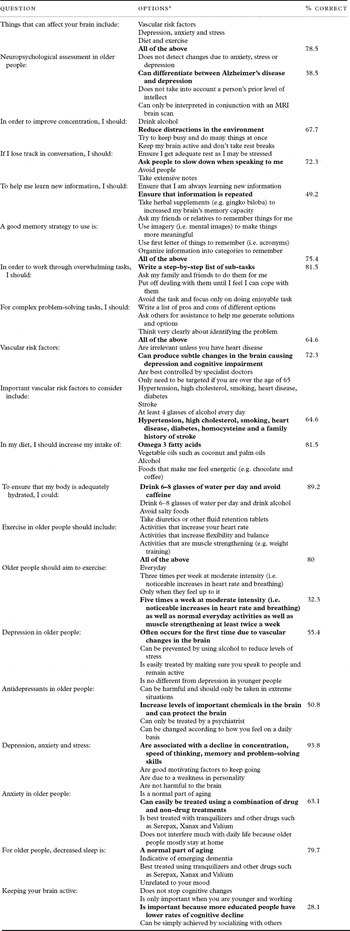
Participants' level of knowledge of the material taught in the psychoeducation sessions was assessed by a 20-item multiple-choice questionnaire (HBAQ). Participants were required to circle the correct answer to each question from a series of four alternatives. The questionnaire was developed based on empirical evidence from theoretical knowledge and a wide review of the literature, with the assistance of experts in late-life depression and its cognitive and vascular correlates, as well as with reference to literature developed for consumers with late-life depression, as referenced above. The HBAQ was designed to elicit knowledge of information provided in the psychoeducation sessions. It contained items pertaining to knowledge of cognitive strategies (7 items), vascular risk factors (2 items), diet (2 items), exercise (2 items), depression and anxiety (4 items), and sleep (1 item). Each item on the HBAQ was scored correct (1) or incorrect (0) and then summed for a total score (maximum = 20). Raw total scores on the HBAQ were transformed to percentages. Participant responses and performances on the HBAQ at baseline were utilized to provide evidence for the questionnaire's internal consistency. Cronbach's α coefficient was 0.77 for the 20 items on the HBAQ.
Procedure
The HBAQ was administered as part of a package of self-report measures sent to the participant prior to medical and neuropsychological assessment. The HBAQ was administered again within two weeks of completing the group-based intervention or, for the waitlist control group, at ten weeks from baseline assessment, thus measuring whether knowledge was retained over the period of the intervention. The questionnaire appears in Table 1, with the frequencies of correct answer at baseline testing.
Healthy Brain Ageing Questionnaire (HBAQ)

a The correct options are shown in bold.
Satisfaction
Participant's level of satisfaction with the program was measured with a questionnaire that sought to assess participant's enjoyment of various aspects of the course as well as satisfaction with the information received and quality of the service provided. Key questions were: “Did the Healthy Brain Ageing (HBA) education sessions help you to understand the brain and things that can affect it in older age?”, ‘Has the HBA program helped you to improve thinking problems you might feel you have (e.g. memory, expression, problem solving)?”, and “Has the HBA program helped you to deal more effectively with general problems you might feel you have (e.g. living, learning, at work, social situations)? Four response options for each question were: “Yes, it helped a great deal”, “Yes, it helped somewhat”, “Unsure”, and “No, it didn't really help”.
In response to the questions: “Would you use any of the strategies/advice suggested to improve your daily functioning?” and “If another person were in need of similar help, would you recommend the group to him or her?”, participants were asked to select one of four options: “Yes, definitely”, “Yes, I think so”, “Unsure”, and “No – definitely not”.
Finally participants were asked to rate the overall quality of the service they received as “Excellent”, “Good”, “Fair”, and “Poor”.
Outcomes
The primary outcome measure was change in score on the HBAQ as measured by the following computed change score [(score on follow up HBAQ – score on baseline HBAQ/baseline HBAQ) × 100)]. In the treatment group, “response” was defined as a positive change score (i.e. >0) and “non-response” by a negative change score (i.e. <0); that is, whether the participant scored higher or lower on the post-intervention HBAQ compared with the pre-intervention HBAQ. The secondary outcome was participant satisfaction.
Statistical analysis
Analyses were conducted using SPSS Version 16. One-way analysis of variance (ANOVA) was used to compare groups at baseline; χ2 was used for categorical variables. For the outcome measures, a two-way repeated measures ANOVA was constructed with time (baseline, follow up) as the within-subjects factor, and condition (control, treatment) as the between-subjects factor. Analyses were tested for a group × time interaction (i.e. time × condition). One-way ANOVA was used to compare “responders” and “non-responders” in the treatment group on a variety of clinical and neuropsychological variables. All analyses were two-tailed and employed an alpha value of 0.05. Satisfaction data was analyzed using frequencies.
Results
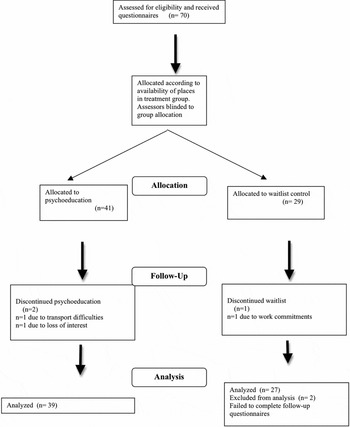
Seventy participants met eligibility criteria and received baseline HBAQs. Participants were largely engaged (80%) in specialist services. Specifically, 41 were currently in treatment with a psychiatrist, four with a psychologist, one participant was seeing both a psychiatrist and psychologist, six were in treatment with a neurologist, one with a geriatrician, four with a general practitioner, one was seeing a non-specific counselor. Only seven participants were not currently in treatment. Six participants were in full-time employment, 14 worked part-time, 36 participants were retired, two were unemployed, and five were on medical or psychiatric leave from work or were not working due to their current illness. Of the total sample, 29 were allocated to the control condition, while 41 were allocated to the treatment arm (Figure 1). Three people dropped out, two in the treatment arm and one in the waitlist control group. Reasons for dropout in the treatment arm were difficulties with transport (1) and loss of interest (1). In the waitlist arm, the dropout was due to work commitments. Two participants in the waitlist control did not return follow-up questionnaires and their results were not included in the analyses. Thus 65 participants participated in the psychoeducation program or waitlist control, and completed follow-up questionnaires. In the treatment group, 94.9% of participants attended eight or more sessions.
Participant Flow Chart.

Baseline differences
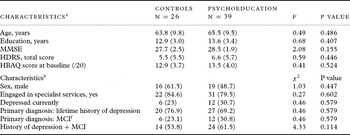
Baseline demographic, clinical, MCI and depression history data are presented in Table 2. There were no significant differences between the treatment and control groups in terms of sex, age, depressive symptoms, MMSE score, years of education, and whether they were engaged with specialist services. There was no significant difference between treatment and control groups with regard to primary diagnosis of MCI or lifetime history of depression, or DSM-IV diagnosis of current major depression. There was no significant difference in baseline scores on knowledge testing between groups.
Baseline clinical and demographic characteristics

a Data reported as mean, SD
b Data reported as number,%
MMSE = Mini-mental State Examination; HDRS = Hamilton Depression Rating Scale; HBAQ = Healthy Brain Ageing Questionnaire; MCI = Mild Cognitive Impairment.
Effects of psychoeducation
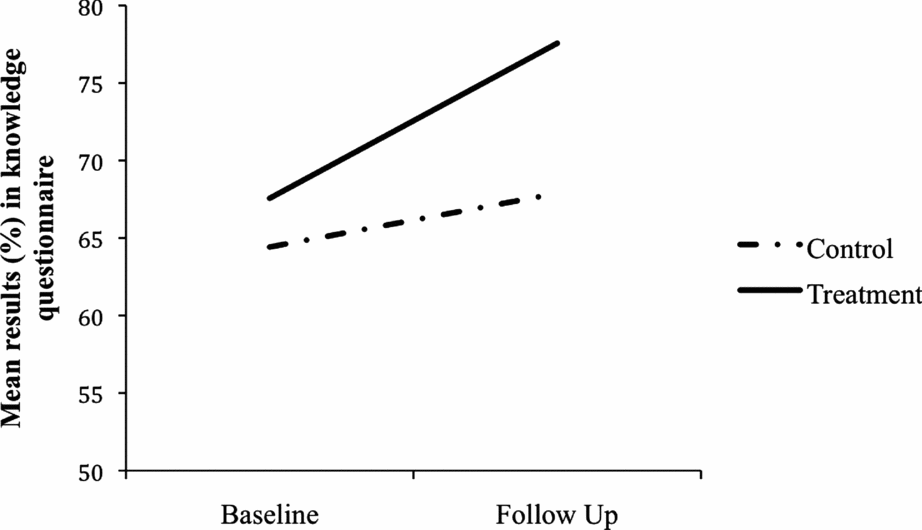
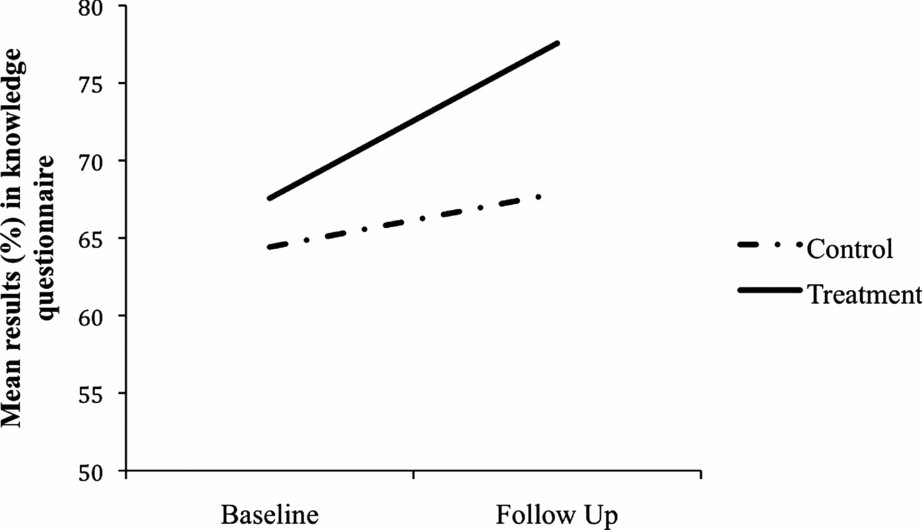
Mean baseline percentage correct score on the HBAQ in the control group was 64.42 (SD = 18.7) and in the treatment group 67.56 (SD = 19.8). As shown in Figure 2, repeated measures ANOVA shows a significant interaction effect depicting improvements in knowledge associated with psychoeducation [F (1,63) = 4.34, p = 0.04]. That is, those who received psychoeducation improved their HBAQ score by 15% at follow-up. The effect size was calculated as 0.35.
Improvements in knowledge associated with psychoeducation.
In the treatment group, further analysis was carried out to determine whether any differences existed among diagnostic groups with regards to change scores. One-way ANOVA found no significant differences in knowledge improvement (i.e. positive change score) in the treatment group based on the primary diagnosis of MCI or depression [F(1,38) = 0.25, p = 0.62], or whether the participant currently met criteria for major depression [F(1,38) = 0.05, p = 0.82].
Furthermore, participants in the treatment group were split into two groups depending on whether they did or did not “respond” to the psychoeducation program. One-way ANOVA found a significant difference between groups with regard to age at time of testing [F(1,38) = 5.36, p = 0.03]; that is those who were younger at time of testing were more likely to improve their knowledge score after psychoeducation. There were no significant differences between responders and non-responders with regard to other key clinical factors: MMSE [F(1,38) = 0.64, p = 0.43], years of education [F(1,38) = 0.30, p = 0.59], HDRS [F(1,38) = 0.17, p = 0.74].
Program evaluation
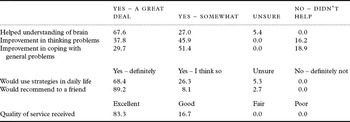
With regard to satisfaction, 37 of the 39 participants in the treatment group returned satisfaction surveys. As shown in Table 3, most participants felt the program helped “somewhat” or helped “a great deal” in improving their understanding of the brain. A large proportion believed the program helped “somewhat” or helped “a great deal” with thinking problems they might have, and thought the program had helped them “somewhat” or helped them “a great deal” to cope with everyday living problems; Nine out of 10 rated the service they received as “good” to “excellent”, and indicated that they “might” or would “definitely” use in everyday life the strategies they had been taught, as well as consider recommending the program to a friend.
Satisfaction data for the psychoeducation program: % of treatment group response

Discussion
Psychoeducation, as part of a multifaceted healthy brain aging intervention for older adults “at risk” of cognitive decline, was associated with improvements in knowledge of risk factors as well as cognitive and healthy brain aging strategies. Additionally, consistent with data showing that people prefer non-pharmacological treatment strategies (Jorm et al., Reference Jorm, Korten, Jacomb, Christensen, Rodgers and Pollitt1997), psychoeducation was well received and acceptable to this population. As far as we are aware, this is the first controlled study to examine the effect of psychoeducation on knowledge of healthy brain aging strategies. Of significance is the finding that there is no difference in improvements in knowledge between individuals with a primary diagnosis of depression or MCI, possibly demonstrating that early cognitive impairment does not preclude individuals from benefiting from psychoeducation in terms of knowledge of healthy brain aging strategies. This is important as both patient groups are at higher risk of ongoing cognitive decline, and represent an “at risk” target group for secondary prevention strategies (Naismith et al., Reference Naismith, Glozier, Burke, Carter, Scott and Hickie2009). However 80% of those with a primary diagnosis of depression were also found to have MCI, highlighting the overlap of cognitive impairment in older adults with a history of depression. Additionally, we found that younger participants were more likely to benefit from psychoeducation; thus further stressing the importance of early intervention.
Participants in this study generally performed well at baseline (the mean score on the HBAQ at baseline was 66%). This may reflect the fact that the sample was fairly well educated and 80% were currently receiving specialist services from a centre of excellence institute. That is, it is possible that they had received ample education regarding depression and brain aging from their treating clinician. This may also reflect the nature of the multiple-choice items in the HBAQ. However the participants did perform poorly as a group in specific areas; most notably, only a third of participants were aware of the American Heart Foundation's recommendations for exercise (Haskell et al., Reference Haskell2007), and only half the participants could answer questions about late-life depression and its treatment correctly. This suggests that a measure such as the HBAQ may be useful for clinicians to assist with the identification of particular knowledge deficiencies that need to be addressed, and, moreover, that the HBAQ might be more beneficially employed in primary or secondary care, where patients might not be as literate in mental health issues.
Despite repeated calls for health promotion in dementia and depression (Bird and Parslow, Reference Bird and Parslow2002; Lautenschlager et al., Reference Lautenschlager, Almeida and Flicker2003), as well as media reports of the cognitive benefits of physical exercise and ongoing cognitive activity, there is little in the way of formal, coordinated programs or approaches. Numerous barriers to health promotion, prevention and early intervention exist; in primary care, in particular, these include a lack of knowledge, lack of outcome expectancy, and feasibility and credibility issues (Travers et al., Reference Travers, Martin-Khan and Lie2009). For individuals, lack of knowledge may be a barrier to undertaking risk reduction strategies for dementia (Draper et al., Reference Draper, Low, Withall, Vickland and Ward2009). Knowledge translation (the process of disseminating research findings into practice in the wider community) in late-life depression and cognitive decline requires simple and clear information, and relies on interpersonal contact (Draper et al., Reference Draper, Low, Withall, Vickland and Ward2009). Adult learning theories suggest that best outcomes are likely to be achieved with relevant and targeted programs rather than broad, generic communication (Speck, Reference Speck1996). The psychoeducation program in this study was thus targeted at older “at risk” adults, and the content was relevant for the current health, psychological and cognitive issues they were experiencing. Moreover, the results suggest that the target population may be refined further to younger members of the “at risk” group who may be in primary care.
Unfortunately, evidence for an association between knowledge and behavioral change is limited. Research in healthy older adults indicates that the correlation between lifestyle knowledge and healthy lifestyle practices related to modifying the risk of vascular dementia is generally low, particularly for nutrition (Coulson et al., Reference Coulson, Strang, Marino and Minichiello2004). Potential explanations for this association may include low levels of self-efficacy as well as lack of relevance for the individual (Friedman et al., Reference Friedman2009). Healthy brain aging strategies are particularly relevant for individuals with depression and cognitive decline, thus a secondary prevention approach (i.e. targeting psychoeducation for such “at risk” at individuals rather than the community at large), may be more likely to be associated with behavioral change. Cultural views about what constitutes healthy aging may also impact upon the relevance of psychoeducation, for instance the importance of remaining cognitively intact is emphasized in some cultural groups (Laditka et al., Reference Laditka2009). Other individual factors may also affect ability to benefit including personality style, attributions such as locus of control (whether individuals feel a sense of mastery in their life) and readiness for help seeking and behavior change (for discussion see (Mowszowski et al., Reference Mowszowski, Batchelor and Naismith2010). We did not specifically evaluate measures of self-efficacy; however, 71.4% of our participants indicated that they “definitely” planned to use the strategies they had learnt in their daily life. This could indicate a sense of motivation arising from participation in the program. Further studies, however, would be needed to measure whether the program has any capacity to facilitate the translation of knowledge into practical behavior change.
Satisfaction data from our treatment group indicated that the psychoeducation program was acceptable and feasible. Of note, 85.7% of participants who completed the survey rated the quality of the service as “excellent” and 88.1% would “definitely recommend the program to a friend”. Lack of validation of the satisfaction questionnaire is a limitation of this study; however, our results concur with evidence from small, qualitative studies evaluating psychoeducation in early stage dementia (Fitzsimmons and Buettner, Reference Fitzsimmons and Buettner2003). The vast majority of health education in dementia is directed at carers; our results show that consumers should be targeted directly, as they are able to benefit in terms of knowledge acquisition. Increased knowledge may lead to greater self-efficacy and skills in managing one's own health, making healthy life choices and negotiating with treatment providers, thus potentially influencing quality of life. In fact the very process of engaging in learning itself may have some benefits with regard to improving motivation, self-esteem and self-confidence (Benbow, Reference Benbow2009).
As far as we aware there are no objective (i.e. multiple-choice) instruments in English that can be used to determine knowledge of healthy lifestyle practices, vascular risk, depression and cognitive strategies. For this purpose, we delivered the HBAQ, which our data suggest has adequate internal consistency (Cronbach's α was 0.77). However, although the test was created with the assistance of experts in late-life depression and its cognitive and vascular correlates, it was not pre-tested prior to use in this study and it has not been subjected to independent assessment with regard to the relevance of its contents to measure knowledge of healthy brain aging strategies (i.e. content validity). In future research we plan to subject the test to independent review in order to assess validity; moreover, individual item analyses should be carried out to determine how well items discriminate between high and low performers.
The psychoeducation program was delivered as part of a larger study examining the effects of a multifactorial cognitive training program in this group. Data from the cognitive training component suggests that it is associated with improvements in memory in older adults with late-life depression (Naismith et al., Reference Naismith2010); although the sample in our study differs from that of Naismith et al. (i.e. is larger, including adults with MCI in addition to those with late-life depression), we cannot rule out some contribution from the effects of cognitive training to the knowledge improvements seen after psychoeducation. Other limitations of the study include the possibility that participants may have simply used the information provided to them to answer the HBAQ at the follow-up assessment i.e. “cheated” on the test, and thus the improvements we saw did not truly reflect inherent knowledge improvements. Furthermore, a lack of follow-up data regarding participants’ actual lifestyle practices means we are unable to determine whether the improvements in knowledge were associated with changes in lifestyle practices. As behavioral change should incorporate diet, physical activity, sleep-wake behavior and optimization of general and cardiovascular health, it will be important to look at the effect of psychoeducation on all of these variables. Due to the nature of our control group, we are unable to determine whether simply belonging to a group had any impact upon our results, which may carry important implications for the delivery of future psychoeducation (e.g. internet-based) approaches. Indeed, there is evidence to suggest that group learning has benefits over individual learning, particularly in the number of tasks attempted as well as increased use of learning strategies (Lou, Reference Lou2004).
Conclusion
In summary, this study demonstrates that psychoeducation in older adults with depression or early cognitive impairment is acceptable and is associated with improvements in knowledge of healthy brain aging strategies. Whether improved knowledge translates to behavioral change, and what factors might influence this, now needs investigation.
Editor's note
Please note that this study was not classed as a randomized controlled trial as allocation of participants was not done in a random manner.
Conflicts of interest
None.
Description of authors' roles
All the authors were involved in developing and delivering the psychoeducation program. Dr. Norrie wrote educational content, carried out the medical assessments, provided lectures, performed the statistical analysis and wrote the paper. Associate Professor Naismith and Dr. Diamond devised the educational program, provided lectures, developed the HBAQ, carried out the neuropsychological assessments and assisted with the statistical analysis. Associate Professor Naismith designed the study and revised the paper critically for important intellectual content. Associate Professor Rogers, Professor Hickie and Dr. Fearns wrote educational content, provided lectures, and commented on earlier drafts of the paper.
Acknowledgments
Professor Hickie, Associate Professor Rogers, Dr. Norrie and Dr. Diamond are supported by an NHMRC Australian Fellowship. Associate Professor Naismith is supported by an NHMRC Clinical Research Fellowship No. 402864.