Clostridioides difficile infection (CDI) is a leading cause of healthcare-facility–onset (HO) infections,Reference Magill, Edwards and Bamberg1,Reference Balsells, Shi and Leese2 accounting for 13,000–30,000 deaths in the United States each year.Reference McDonald, Gerding and Johnson3-5 CDI can be transmitted within a hospital as C. difficile spores which contaminate the hands of healthcare professionals (HCPs) or through contamination of the hospital environment.Reference McDonald, Gerding and Johnson3,Reference Jullian-Desayes, Landelle, Mallaret, Brun-Buisson and Barbut6,Reference Anderson, Moehring and Weber7
Environmental contamination with C. difficile can be a challenging factor to detect and mitigate; C. difficile spores have been shown to live on surfaces for up to 5 months.Reference Kim, Fekety and Batts8,Reference Kaatz, Gitlin and Schaberg9 Hospital floors also harbor C. difficile, which could lead to easy transmission of the bacteria onto other objects.Reference Deshpande, Cadnum and Fertelli10 Most concerning, rectal thermometers, bedside commodes, and blood pressure cuffs have all been associated with transmission.Reference McDonald, Gerding and Johnson3 Known environmental contamination can be addressed through more intensive cleaning of the environment with bleach, hydrogen peroxide vapor, and ultraviolet C radiation.Reference McDonald, Gerding and Johnson3,Reference Anderson, Moehring and Weber7,Reference Liscynesky, Hines, Smyer, Hanrahan, Orellana and Mangino11 However, it is not always clear which rooms are contaminated because asymptomatic carriers of C. difficile can also play a role in transmission; asymptomatic carriers have been shown to be the source of transmission in 29% of HO-CDI cases.Reference Curry, Muto and Schlackman12 Furthermore, rooms that were previously occupied with patients taking antibiotics (and not specifically diagnosed with CDI) are also more likely to result in the next patient in that room contracting the infection.Reference Freedberg, Salmasian, Cohen, Abrams and Larson13
Despite the concern about transmission from the environment, little research has been conducted to develop methods that investigate which specific hospital room features might contribute to the increased risk of transmission of CDI. Here, we present the results of an exploratory study that examined the relationship between hospital room features and HO-CDI in a subset of rooms at our institution. We aimed to develop a hospital-room walk-through survey to systematically collect data on characteristics and features of a sample of hospital rooms and to link these data to electronic health record (EHR) data. We then explored the relationship between HO-CDI cases and a variety of room-level risk factors.
Methods
Setting
This study was conducted using data from the Ohio State University Wexner Medical Center (OSUWMC). The medical center is comprised of several free-standing buildings. The rooms included in this study were located in 4 acute-care buildings within the medical center on the same campus.
Study design and sample selection
A retrospective observational cohort study was performed using data from the EHR of adult patients admitted to the OSUWMC between January 1, 2015, and December 31, 2016. Children (patients aged <18 years) and prisoners were excluded from the study. Additionally, patients were excluded if the only units they were admitted to during their hospital stay were the hematopoietic stem cell transplant (HSCT) unit, the labor and delivery unit, or the postpartum care unit. We excluded these units in this exploratory analysis due to access restrictions in place on these floors.
Data access and processing
The Department of Clinical Epidemiology identifies cases of HO-CDI using Centers for Disease Control and Prevention National Health Safety Network (CDC NHSN) surveillance definitions. This method identified an HO-CDI case as one that occurs after 3 days in the hospital. This official surveillance database was used to determine which patients had HO-CDI in the data set. Additional patient-level data retrieved from the EHR included patient age, race, antibiotic usage, and Charlson comorbidity index. This was an exploratory study that focused on identifying potential high-risk hospital room features; thus, we selected a set of patient-level risk factors as controls based on known risk factors such as advancing age, comorbidities, and antimicrobial exposure.Reference McDonald, Gerding and Johnson3 We also included sex and race because previous studies have shown differences in the incidence of CDI related to these factors.Reference Lessa, Mu and Bamberg4 Patient characteristics were linked to the room of occupancy, which is reported in the EHR, using spatial data developed in a Hospital Geographic Information System (H-GIS).Reference Hebert and Root14 Hospital room characteristics, including principal component analysis (PCA)–derived factor scores for hand hygiene, wall fixtures, and flooring/furniture, were then attributed to each patient in the data set.
Hospital room survey
We developed a tablet-based hospital-room walk-through survey using Qualtrics software (Qualtrics Software, Provo, UT) to collect data related to structural and environmental features in each room. The survey was pretested in a small number of rooms, reviewed again with clinical epidemiology staff, and revised according to their input. The Qualtrics survey was designed to capture architectural aspects of each hospital room (eg, size, double vs single, attached bathroom, windows) and structural characteristics (eg, fixtures, sinks, furniture and flooring, hand sanitizer dispensers, etc). The qualitative structural characteristics collected for each room included flooring type, furniture (quantity, type, and condition), floor and wall fixtures (eg, pictures, wall outlets in hospital bed head unit), computer type, and availability of hygiene options (eg, sinks, alcohol dispensers, and gloves). Architectural aspects of the room were measured using a Bosch GLM 50C laser (Bosch, Gerlingen, Germany). The full survey can be found in Appendix A (online). Specific items on the survey were developed by first reviewing the literature on environmental risk factors for HO-CDI and then reviewing potential questions with doctors and our clinical epidemiology staff at the OSUWMC. Hospital staff were encouraged to suggest additional risk factors not found in the literature. The survey was fielded by 3 students who were assigned specific hospital floors. To ensure consistent data collection, we conducted a training session for students prior to beginning the room survey and had frequent reviews of furniture and flooring to show how to interpret different survey questions.
Only inpatient rooms were surveyed in the included buildings. Some of the floors in the hospital are identical copies of each other. For the rooms on these floors, with identical room configurations, furniture, fixtures, and flooring, we confirmed similarities by examining building blueprints and spoke with epidemiology staff and other subject-matter experts. We surveyed a sample of these rooms, then we applied survey results to the other identical rooms.
We used univariate analyses to examine the correlations between different hospital-room variables and the association between each hospital-room feature and HO-CDI. Architectural characteristics of hospital rooms (eg, room size, single vs double room, attached bathroom). were examined separately from structural characteristics (eg, furniture and computers). Of the 72 questions on the survey (Appendix A online), 46 questions measured structural characteristics and 11 measured architectural characteristics. An additional 15 measures were used to identify rooms and note the presence of facilities on the hospital floor (eg, soiled-linen room, personal protective equipment storage). The 11 architectural measures were used to develop room-level measures of room size, bathroom size, distance between the hospital bed and bathroom, presence of an in-room bathroom, and room type (ie, single vs double).
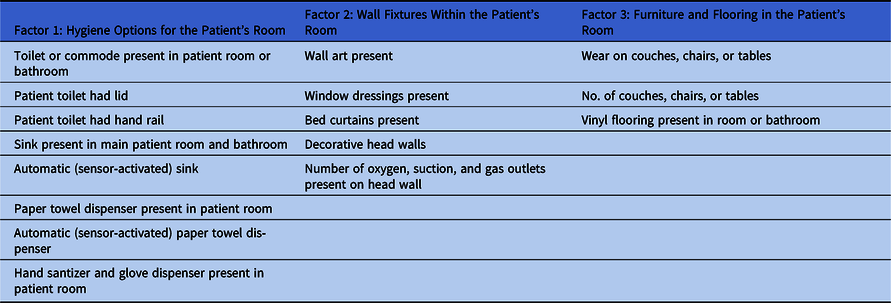
Because the number of structural room-level variables in the final survey was quite large, and many of them were highly correlated or measured similar characteristics of the hospital room environment (eg, ways to sanitize hands), we used PCA to group variables into “clusters” or “factors” based on their correlation and meaning. The PCA used the 46 structural hospital-room variables. Scree plots, a graphical representation of the amount of variation explained by each factor, were used to determine the number of factors to retain in the analysis. The first 3 factors with the highest eigenvalues corresponded to groups of variables that measured hygiene, wall fixtures, and furniture and flooring (Table 1); they accounted for 33.4% of variability among hospital rooms. Variables and factor loadings for the full PCA are shown in Appendix A (online). The fourth factor was composed of the variables indicating the type of computer (ie, fixed or mobile). Univariate analyses also showed a statistically significant relationship between HO-CDI and computer type, so for ease of interpretation, we developed a separate dichotomous variable and included this in the model. Other room variables that did not load into the first 3 factors, and were not significant in univariate associations with HO-CDI were not included in the final models.
Variables Included in 3 Factors Derived From Principal Components Analysis of Hospital Room Questionnaire Data

Factor loadings were extracted and used to create a weighted linear combination of variables; this factor score was then transformed into a z score so that model coefficient could be interpreted in terms of standard deviations. A higher value of each factor indicates that “more” of those features exist in a hospital room. For example, a higher factor score for hygiene indicates that more options for hygiene practices are available in the room, such as sinks, gloves, and alcohol dispensers. A higher value for wall fixtures means that more wall fixtures exist in the room, such as pictures, oxygen and suction valves, and a higher value for flooring and furniture corresponds to more furniture and more evidence of wear on flooring and furniture.
Statistical analysis
Descriptive summary statistics were calculated, and nonparametric Mann–Whitney U tests or χReference Balsells, Shi and Leese2 tests with a significance threshold of P < .05 were used to compare differences in individual patient characteristics and hospital-room characteristics between patients or rooms with HO-CDI patients and those with no HO-CDI patients. During descriptive analyses, we found almost no variation in some variables (eg, single vs double rooms, bathroom in room), and these were dropped from further analysis. Crude odds ratios (CORs) and 95% confidence intervals (CIs) were calculated to examine the association between each risk factor and the outcome of HO-CDI. A multivariable logistic regression model with hospital fixed effects was used to model the risk of HO-CDI as a function of patient and hospital room characteristics. Adjusted odds ratios (AORs) and 95% CIs were calculated for each covariate. We used general estimating equations with an exchangeable correlation matrix at the hospital-room level to adjust standard errors for clustering of patients within hospital rooms. Statistical modeling was done in the R software package (R Foundation for Statistical Computing, Vienna, Austria). Notably, this was an exploratory risk factor study; we did not aim to identify causal relationships between room factors and HO-CDI outcomes nor to develop a predictive model for HO-CDI. Therefore, we did not evaluate the predictive power of the model. Rather, a final multivariate model included all variables that showed some association in univariate models or were assumed necessary to control for patient-level risk factors or cohorting within the hospital.
This study was reviewed and approved by The Ohio State University Institutional Review Board (no. 2015H0424).
Results
The finalized hospital-room survey was conducted in 664 distinct rooms over 6 months of data acquisition. Several floors of the hospital had exact room configurations and furniture, flooring, and fixtures. Therefore, for an additional 142 rooms, these standard specifications were applied to bring the sample of hospital rooms to 806. Moreover, 535 rooms were linked to patients and used in the study sample. At the time of the survey, there were 1,404 inpatient beds in the entire OSUWMC, including hospital buildings and units we chose not to include in this exploratory survey. Using this as a denominator, our study represents 806 of 1,404 (57.4%) of all inpatient hospital beds.
Patient risk factors
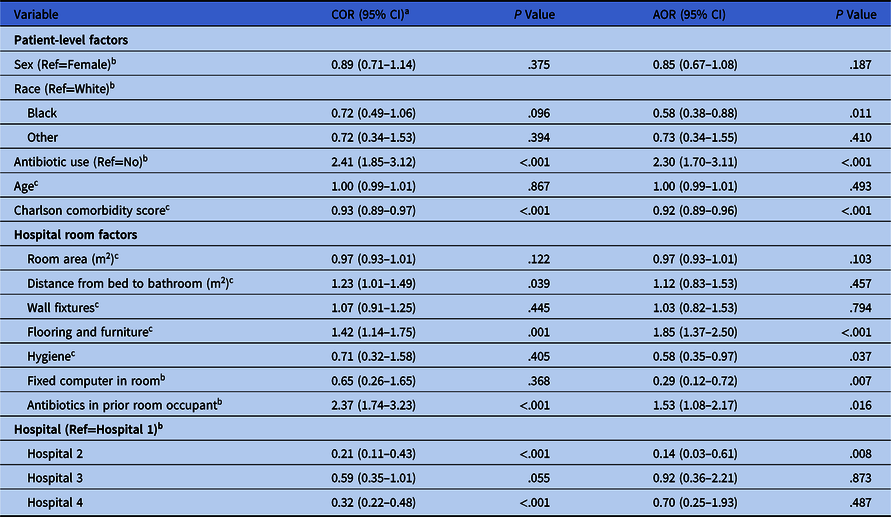
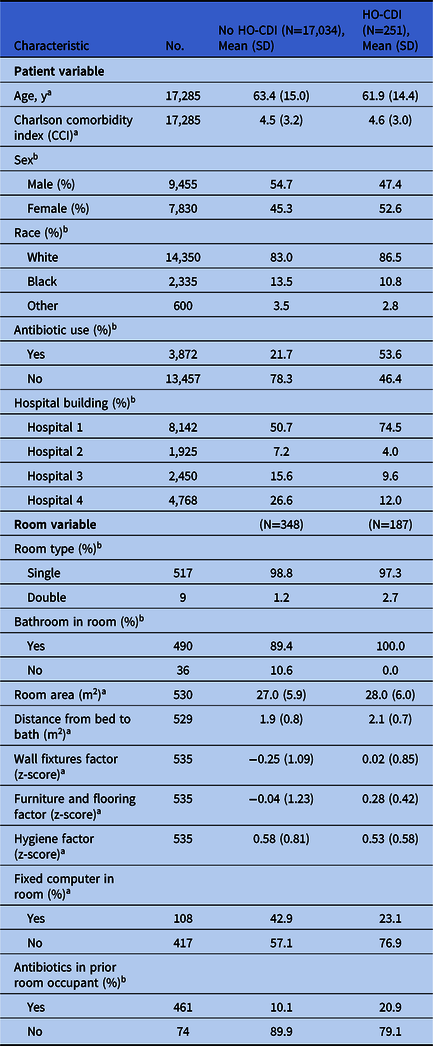
Over the 2 years of this study, a total of 256 cases of HO-CDI were identified in the hospital rooms surveyed. We included 17,285 patients who resided in the surveyed rooms. Of those, 17,034 did not have HO-CDI and 251 patients were diagnosed with HO-CDI. Overall, the groups were similar in age, sex and comorbidity index. There were no statistically significant differences between patients with and without HO-CDI, with the exception that patients with HO-CDI were more likely to have used antibiotics and had a lower Charlson comorbidity index score and were less likely to be of black race (Table 3).
Crude and Adjusted Odds Ratios and 95% Confidence Intervals for Logistic Regression Analyses of Hospital Room and Patient Risk Factors for HO-CDI

Note. HO-CDI, healthcare-facility–onset Clostridioides difficile; COR, crude odds ratio; AOR, adjusted odds ratio; CI, confidence interval; SD, standard deviation; GEE, generalized estimating equation.
a CORs were calculated using GEEs including fixed effects; the 95% CIs for the COR were calculated from robust standard errors which adjust for clustering of patients in rooms.
b Variable included as a categorical (0/1) variable.
c Variable included as a continuous variable.
Room risk factors
Table 2 indicates that rooms with patients with HO-CDI had a longer distance between the bed and the bathroom, a greater number of wall fixtures, more wear on furniture and flooring, and were also less likely to have a fixed computer in the room. In univariate analyses, which adjusted for clustering of patients in rooms (Table 3), the risk of HO-CDI was associated with prior occupant’s antibiotic usage in the room, a larger distance between the bed and bathroom, and a more wear on furniture and flooring. There were too few double rooms and rooms with nonattached bathrooms surveyed in the hospital to draw conclusions about the relationship between these architectural features and HO-CDI.
Characteristics of the Study Sample

Note. HO-CDI, healthcare-facility–onset Clostridioides difficile; SD, standard deviation.
a Variable included as a continuous variable.
b Variable included as a categorical (0/1) variable.
Multivariable model
In the multivariable model (Table 3), the only individual patient factor that increased odds of HO-CDI was antibiotic use by the current patient. The Charlson comorbidity score and black race were associated with a decrease in odds for HO-CDI.
Neither room area nor distance from bed to bathroom were significantly associated with HO-CDI in multivariate models. Flooring and furniture that showed signs of wear were statistically significantly associated with an increased odds of HO-CDI, as was antibiotic use in the prior room occupant of the patient who developed HO-CDI. Room factors associated with hand hygiene options were associated with reduced odds of HO-CDI, as was the presence of a fixed computer in the room. The hospital fixed effects were also statistically associated with the outcome of HO-CDI, indicating that differences in case mix across hospital buildings resulted in clustering of patients at greater risk for HO-COI in certain hospital buildings compared to others.
Discussion
In this study, we showed how combining results of a room survey with individual patient data and CDI surveillance data facilitated the investigation of hospital-room environmental risk factors and their association with the odds of developing an HO-CDI. Specifically, antibiotic use by the room’s former occupant and wear and tear on furniture were significantly associated with an increased odds of acquiring an HO-CDI. More hygiene options and a dedicated in-room computer were associated with lower odds of acquiring an HO-CDI.
Previous research has investigated the association of room characteristics with HO-CDI outcome. Jou et alReference Jou, Ebrahim, Shofer, Hamilton, Stern and Han15 performed a case–control study investigating the association between room square footage and acquisition of HO-CDI. Similar to our univariate findings, larger room size was associated with increased risk of HO-CDI.Reference Jou, Ebrahim, Shofer, Hamilton, Stern and Han15 Wilson et alReference Wilson, Jackson and Boyken16 showed that toilet flushing can contribute to hospital room contamination, highlighting the importance of toilet lids in hospital bathroom design. Vaisman et alReference Vaisman, Jula, Wagner and Winston17 investigated the association between multiple occupancy rooms and HO-CDI. Similar to our study, they did not find a significant association. Durant et alReference Durant18 assessed the association between patient reported cleanliness of rooms and facility HO-CDI rates and found an association, although the study did not look at reports of individual rooms. Our study is unique; with our methodology, we were able to assess the association of multiple room- and patient-level characteristics simultaneously.
Not surprisingly, well-known individual risk factors, such as antibiotic use in the current patient, were significant in our final multivariable model. However, few other individual risk factors, including age, were significantly associated with the outcome. Notably, a higher comorbidity score was actually associated with a lower odds of HO-CDI. This finding is surprising, and it may suggest that comorbidities are not driving transmission within the hospital when adjusted for other potential environmental and hand hygiene factors.
Our study is unique. We assessed risk for HO-CDI over a 2-year period in our institution, and we identified potential environmental risk factors through the use of a walk-through room survey. We leveraged internal surveillance data as well as comprehensive EHR data to develop a multivariable logistic regression model with our specific hospitals’ fixed effects to identify risk factors for HO-CDI. This is the first step toward our goal of creating models and applications to identify high-risk areas in our hospitals so that we can better target infection prevention efforts and inform room renovation and/or construction.
Our study has several limitations. In this exploratory study, we identified risk factors associated with HO-CDI acquisition, but these should not be presumed to be causative of HO-CDI. Although we included several previously known patient-level risk factors and accounted for building factors, we likely did not account for all potential confounding variables given the complexity of HO-CDI risk and hospital environments. For example, we did not include healthcare-worker networks to account for exposure from nonenvironmental sources. Additionally, we do not know the prevalence of asymptomatic carriage at our institution, and we did not directly assess the impact of asymptomatic carriage of HO-CDI acquisition. Although symptomatic patients are more likely to contaminate the environment, asymptomatic patients with C. difficile carriage have also been shown to contribute to contamination.Reference McFarland, Mulligan, Kwok and Stamm19,Reference Sethi, Al-Nassir, Nerandzic, Bobulsky and Donskey20 However, we did include a variable on antibiotic use by the prior occupant of the room. This finding likely reflects asymptomatic colonization leading to environmental contamination. Data were collected on >500 rooms; however, our hospital has >1,400 rooms. This study was exploratory, and we chose to survey only a subset of the rooms because we sought to determine which room-level risk factors were most important in relation to risk for HO-CDI. For future analysis, we plan to expand the hospital-room survey to our entire institution but to modify it to exclude a number of items that showed no association with HO-CDI in any of these current analyses. In addition, we did not confirm that each case of HO-CDI met the criteria for CDI with active diarrhea; however, our laboratory rejects formed stool for CDI testing. In our hospital, we encourage samples for CDI to only be sent if patients have >3 loose stools and are not on laxatives; however, it is possible that some of the cases were misclassified as HO-CDI. Finally, most of the data collected by this survey were objective; however, some (eg, quality of furniture) were subjective and may have differed among raters.
In conclusion, we used a room survey and EHR data to develop a model to identify risk factors for HO-CDI. These models can potentially be used to identify areas and aspects of the hospital room that may be associated with a higher risk for HO-CDI. These factors could be used to direct more intensive infection prevention efforts and inform renovation or construction.
Supplementary material
To view supplementary material for this article, please visit https://doi.org/10.1017/ice.2020.1307
Acknowledgments
We acknowledge the assistance of OSUWMC hospital epidemiologists, including Justin Smyer and Jennifer Flaherty, in developing and fielding the hospital room survey. The authors’ views do not necessarily represent the views of the Agency for Healthcare Research & Quality.
Financial support
This project was supported by the Institute for the Design of Environments Aligned for Patient Safety (IDEA4PS) at The Ohio State University, which is sponsored by the Agency for Healthcare Research & Quality (AHRQ grant no. P30HS024379).
Conflicts of interest
All authors report no conflicts of interest relevant to this article.