

Introduction
“They call Daule-Peripa … the Crown Jewel because it was a success! … It provides water for two provinces and energy for the entire national system, plus it is the hydraulic heart controlling the whole Guayas River basin.”
Former official of the Commission for the Study and Development of the Guayas River Basin (CEDEGE), June 27, 2014“Compadre, what do you think? … We are surrounded by water, drowning in water and we have no water, only mosquitos!”
Eighty-year-old peasant, July 5, 2014From the 1960s onward the Ecuadorian government built on its nationwide programs to develop mega-hydraulic infrastructure. Implementing large multipurpose dams on Ecuador’s coast has made it possible to provide services such as water supply for cities, flood control, and electricity, and to include new areas under irrigation in the lower Guayas River basin. At the same time, these projects also have had large negative socioenvironmental impacts (e.g., Reference TeránTerán 2005; Reference CorralCorral 2006; Reference Espinel, Herrera, Brassel, Herrera and LaforgeEspinel and Herrera 2008; Reference Castro and RuizCastro and Ruiz 2009; Reference Isch, Boelens and PeñaIsch, Boelens, and Peña 2012). Impacts caused by mega-dams are recognized not only in Ecuador and Latin America (e.g., Reference Duarte-Abadía, Boelens and Roa-AvendañoDuarte-Abadía, Boelens, and Roa-Avendaño 2015; Reference FearnsideFearnside 2016), but they have also received worldwide criticism (e.g., WCD 2000; Reference McCullyMcCully 2001; Reference KhagramKhagram 2004; Reference Sneddon and FoxSneddon and Fox 2008; Reference Baghel and NüsserBaghel and Nüsser 2010; Reference Hommes, Boelens and MaatHommes, Boelens, and Maat 2016). Rather than looking for ways to redress the problems, dominant hydrosocial networks constituted by technocrats, project designers, building companies, and financial institutions have yet again fostered mega-infrastructural initiatives, most of them self-identified as “progressive” (SENPLADES 2007, 2013; SENAGUA 2014).
In 2007, Rafael Correa took power in Ecuador under a flag colored by anti-neoliberalism, “Twenty-First-Century Socialism,” and Buen Vivir.Footnote 1 He strongly criticized past neoliberal regimes. This posture brought hope to those affected by previous mega-hydraulic projects and to local and indigenous communities, who have fought for a more inclusive government. However, critiques have increasingly challenged his and others’ Latin American progressive regimes and their new leftist stance (Reference Lang and MokraniLang and Mokrani 2011). One of the main critiques concerns these governments’ advocacy of new extractivism, which, contrary to the anti-neoliberal discourse, was highly dependent on the neoliberal oil and mining global market (Reference ZibechiZibechi 2011).Footnote 2 This article’s subject is relevant beyond the Ecuadorian case: regardless of socioenvironmental impacts, this controversial Latin American state-market model significantly financed a new boom of large dam constructions, legitimizing aggressive economic development, territorial transformation, and extractive industrialization in order to foster poverty reduction and “living well” (Reference Gudynas and AcostaGudynas and Acosta 2010). Given this neoliberal/anti-neoliberal conjuncture, there is an urgent need to critically explore past experiences as the basis for better understanding the paradigms of today’s national and regional mega-hydraulic boom.
This article uses a critical political ecology framework to deepen the conceptualization of disputed “hydro-social territories” (e.g., Reference Boelens, Hoogesteger, Swyngedouw, Vos and WesterBoelens et al. 2016; Reference Hommes, Boelens and MaatHommes, Boelens, and Maat 2016) in relation to the development, implementation, and impacts of mega-dams (e.g., Reference Baghel and NüsserBaghel and Nüsser 2010; Reference Hommes and BoelensHommes and Boelens 2017; Reference KaikaKaika 2006; Reference Sneddon and FoxSneddon and Fox 2008). It examines and expands empirical and conceptual comprehension of how the material, institutional, and discursive reconfiguration of hydrosocial territories de-patterns and repatterns hierarchical relations among humans and nonhumans (cf. Reference Duarte-Abadía, Boelens and Roa-AvendañoDuarte-Abadía, Boelens, and Roa-Avendaño 2015). By exploring the Daule-Peripa multipurpose dam, constructed under neoliberal governments, it contributes to a better understanding of mega-hydraulism as a sociotechnical construct from a repoliticized, contextual, and historical perspective. This article scrutinizes the dam’s socially and materially embedded politics and power relationships in order to also critically examine Latin America’s progressive governments’ discourses, practices, and paradoxes.
This case study is based on historical and ethnographic research within seven communities affected by the main reservoir of the Daule-Peripa scheme: Barraganete, Paloma de Salazar, El Mate, La Mina, Tres Gritos, Pescadillo, and Carlos Julio Arosemena (Map 1).Footnote 3 Participatory observation, forty-four semistructured interviews, literature review, and secondary sources (historical archives, newspaper articles, official reports) were the main data collection methods. We held twelve interviews with central-state officials, two with representatives of Barraganete local government, two with NGO action-researchers, twenty-five with local people affected by the dam, two with local peasant leaders, and one with a focal group in Paloma de Salazar. Our main selection criteria were based on the reconstruction of relevant (diagnostic and process-explicatory) life histories and geographical representativeness along the reservoir (Map 1). We interviewed in particular local leaders and other community members (men and women) who lived in the flooded area prior to construction of the dam. Once we had our first contacts in Barraganete, we applied snowball sampling to reach other local people in the remaining six communities, thus ensuring a wider and diverse range of views and experiences from different locations. During fieldwork (June–August 2014 and August–October 2015) interviews were conducted in Spanish, and most of them were recorded and transcribed. Research findings were presented and validated in a workshop with local families and researchers. Interviews and other collected data were classified and analyzed according to the two focal points of the research: how the technocratic logics governing the Daule-Peripa scheme reconfigured the hydrosocial territory, and how dam-affected communities have responded to this reconfiguration process. In this article we focus on the Daule-Peripa’s main reservoir area, but eventually we use illustrations from other hydraulic components to show power-laden inequities and Daule-Peripa’s failures.
Map 1 Location of Daule-Peripa dam, reservoir, and local communities. Elaboration: Karolien van Teijlingen.

The Contested Reconfiguration of Hydrosocial Territories and Their Sociotechnical Ensembles
A dialogue between political ecology and science and technology studies (in particular, social construction of technology, or SCOT) informs our analysis of mega-hydraulic schemes and conceptualization of hydrosocial territories. Political ecology fosters awareness about the ways in which power relations influence social and natural relations and generate social and ecological impacts. It builds on the notion that the social and the natural are inherently entwined. It claims that socioecological systems are intrinsically political, and that our ways of knowing and understanding them are delimited by and directed through political and economic processes (Reference RobbinsRobbins 2012, 20).Footnote 4 Linking this perspective with SCOT not only helps us to understand past social, natural, and technological complexities and transformation processes but equally the composition of the ingredients of the recent boom of dam development. Based on critiques of technological determinism and scientific positivism,Footnote 5 SCOT builds on a critical approach to understand the relation between society, nature, and technology. It concentrates on the social construction of technological systems and artefacts, as sociotechnical ensembles that enforce and are enforced by a particular political order (Reference WinnerWinner 1980; Reference LatourLatour 1990; Reference PfaffenbergerPfaffenberger 1990; Reference BijkerBijker 2007, Reference Bijker2015; Reference Bijker, Hughes and PinchBijker, Hughes, and Pinch 2012).Footnote 6 As Pfaffenberger (Reference Pfaffenberger1988, 244) states, “technology is humanized nature.” While challenging the idea that technology development is a linear and unidirectional social construction of transformed nature, we examine it as embedding a social and political vision. Consequently, society and technology mutually constitute each other, and therefore technology, when used in societal relationships, also expresses these social visions and fosters particular forms of life and societal transformation.
From this stance, mega-hydraulic projects are humanized nature—sociotechnical ensembles that construct and simultaneously are constructed by the society where they take place. In policy practice, they embed and express social and power relations, strategically mobilizing institutions, people, infrastructure, water flows, funds, and knowledge in patterns that are presented as technically universal, natural, and politically neutral (Reference Baviskar and BaviskarBaviskar 1995; Reference Hommes and BoelensHommes and Boelens 2017; Reference SwyngedouwSwyngedouw 2014). In Latin America’s everyday water governance this is expressed in how megaprojects reconfigure territories according to dominant discourses of high modernism, water efficiency, economic development, good governance, integrated water resource management, agricultural productivity and green energy production (Reference ScottScott 1998; Reference KaikaKaika 2006; Reference BijkerBijker 2007; Reference MolleMolle 2009; Reference Boelens and SeemannBoelens and Seemann 2014).
The region also witnesses how, in contrast, local communities’ livelihoods and development proposals in dam-affected areas tend to promote different practices and discourses, with divergent sociocultural, ecological, and political-economic representations of hydrosocial territoriality (e.g., Reference Orlove, Taddei, Podestá and BroadOrlove et al. 2011; Reference AndolinaAndolina 2012; Reference Duarte-Abadía and BoelensDuarte-Abadía and Boelens 2016; Reference Paerregaard, Stensrud and AndersenPaerregaard, Stensrud, and Andersen 2016). The latter commonly emphasize fundamental conditions of well-being and territorial values of autonomy and rootedness that contradict with mega-hydraulism (Reference EscobarEscobar 2006, Reference Escobar2008; Reference Hendriks, Boelens, Getches and Guevara-GilHendriks 2010; Reference Roa-GarcíaRoa-García 2014).
As a result, mega-hydraulic territorialization projects trigger conflicting discourses and practices. In order to explain such processes and interrelations we use the hydrosocial territory lens. As put by Boelens et al. (Reference Boelens, Hoogesteger, Swyngedouw, Vos and Wester2016, 2), hydrosocial territory is “the contested imaginary and socioenvironmental materialization of a spatially bound, multiscalar network in which humans, water flows, ecological relations, hydraulic infrastructure, financial means, legal-administrative arrangements and cultural institutions and practices are interactively defined, aligned and mobilized through epistemological belief systems, political hierarchies and a naturalizing discursive regime of representation.”
These territorial sociotechnical ensembles are dynamic and historically reproduced, with social and material boundaries that are constantly reconfigured (Reference BrighentiBrighenti 2010). Therefore, hydrosocial reconfiguration builds on previous territorialization processes embedded in particular social and political orders (Reference Budds, Boelens, Cremers and ZwarteveenBudds 2011; Reference BoelensBoelens 2014). Mega-hydraulic schemes deeply rearrange water control as well as all other aspects of everyday life (e.g., agricultural production, means of transport, access to health care and education). They unevenly distribute benefits and burdens among societal actors. Commonly, while emphasizing universalist progress and modernization, they tend to label vernacular production systems (peasants and indigenous communities) and valuation visions as “under-developed” or “backward” (Reference SwyngedouwSwyngedouw 2004; Reference BuddsBudds 2009; Reference Boelens, Hoogesteger and Rodriguez-de-FranciscoBoelens, Hoogesteger, and Rodriguez-de-Francisco 2014; see also Reference Paerregaard, Stensrud and AndersenPaerregaard, Stensrud, and Andersen 2016).
In this vein, recent mega-hydraulism also builds on and entwines with neoliberal thinking. The latter suggests that for solving water problems (e.g., water scarcity and security) it is necessary to increase incentives that allow for marketing water resources, water infrastructure, water services, and water knowledge, to improve their efficient and effective use. This in turn requires commodification and privatization of resources and thereby legitimizes deep policy changes, distributive transformation, and infrastructure development processes as if they were just neutral and technical interventions, aiming to assist water agencies in managing water resources and fighting crises (Reference Boelens and ZwarteveenBoelens and Zwarteveen 2005). While in neoliberal practice a strong market is supposed to be supported through an “enabling state,” and capital is prioritized over humans and nature, Latin America’s progressive and anti-neoliberal governments argued that the market should be subordinated to public state affairs, and humans and nature would have priority over capital. However, these governments’ extractive economies and their embeddedness in neoliberal global economies (e.g., Chinese companies and capital) falsified their anti-neoliberal claims (Reference Gudynas and AcostaGudynas and Acosta 2010). Furthermore, under this model the state captured indigenous and peasant vindication discourses, such as Buen Vivir, to promote poverty reduction and justify government’s capitalist developmental practices. Official Buen Vivir discourse facilitated the subtle entrenching of neoliberal institutions and principles, sacrificing vulnerable communities for the well-being of the nation’s majority.
In this sense, Latin America’s hydrosocial territorial reconfiguration projects represent contradictions and conflicts that go beyond disputes over water and land; they are also battles over discourses, knowledge, authority, rules, practices, and experiences. Dominant hydraulic knowledge reproduces itself within an epistemological belief system organized by technocrats, hydraulic experts, politicians, and financial institutions. In Latin American water governance practice, technocrats are key actors. They are public officials (often engineers or economists) with important influence on water policy making and implementation. As stated by Olson (Reference Olson2015, xiii), they “exercise[s] power by virtue of their technical knowledge,” and throughout the region it is common to witness how they render large dams as the materialization of “necessary” technical knowledge to solve “nature-caused” problems such as floods and droughts. Obviously, technocrats cannot be presented as a monolithic category; they are part of a heterogeneous epistemic community. But despite diversity, this epistemic community tends to deeply share a view that relates to the urgency of modernizing and transforming socioenvironmental contexts for the benefit of all, through the techno-managerial correction and improvement of nature.
These dominant imaginaries and materialized sociotechnical artefacts (dams) do not remain unchallenged (see, e.g., Reference Bebbington, Bebbington, Bury, Boelens, Getches and Guevara-GilBebbington, Bebbington, and Bury 2010; Reference RomanoRomano 2012; Reference Saldías, Boelens, Wegerich and SpeelmanSaldías et al. 2012). They are contested by alternative notions and knowledge acquired through the performance of contextualized practices and local experience. Or, as developed by Scott’s (Reference Scott1998, 311) metis concept, “local knowledge [is] embedded in local experience.” Reterritorialization practices based precisely on local knowledge about space and relations between society and nature are performed as individual or collective actions and involve acts of resistance, compliance, adjustment, and/or contestation. They are not necessarily based on overt contestation but may be low profile, performed by people who may not regard their actions as political (Reference KerkvlietKerkvliet 2009, 2392).
In order to analyze such struggles within Daule-Peripa’s territorial reconfiguration process, we use four interrelated levels of abstraction that constitute the echelons of rights (ERA) analytical framework (Reference BoelensBoelens 2008, Reference Boelens2015; Reference Zwarteveen and BoelensZwarteveen and Boelens 2014). This framework allows us to examine water conflicts and contradictions as manifested in tensions over resources such as water, land, capital, infrastructure, and technology; over the definition of rules, norms and rights; over the legitimate authority to generate, change, and/or impose the normative framework for the distribution of resources; and finally, at the most abstract level, over the discourses defending notions of truth and knowledge that inform policies and hierarchies in natural resource control.
The Case: Ecuador’s Daule-Peripa Multipurpose Hydraulic Scheme
The Daule-Peripa water use system began in the first half of the 1970s as a hydraulic utopia of international engineers and Ecuadorian technocrats who envisaged “correcting the imbalances of nature.”Footnote 7 According to CEDEGE (1995, 7): “The imperative was to plan hydraulic works to balance the insuperable potential of water-producing zones with the requirements of water-deficit zones. To achieve this balance, water use would be regulated, storing the surplus from the rainy season in order to supply water in the dry season.”Footnote 8 Along with this vision, construction of the different components of the hydraulic scheme began in 1982: the dam, its reservoir, and other water service infrastructure. The dam is located in the northern part of the Guayas River basin at the confluence of the Daule and Peripa Rivers, approximately 160 kilometers upriver from Guayaquil (Map 1). The reservoir floods approximately twenty-seven thousand hectares (TAMS-AHT-INTEGRAL 1980; CEDEGE 1995). The design, construction, and implementation of the entire Daule-Peripa scheme (dam, dikes, irrigation schemes, water transfer infrastructures) took approximately twenty years and cost a total of $1.5 billion (CAIC 2008).
Among the intended benefits were storing water to irrigate fifty thousand hectares of land in the lower Daule River valley (both banks); transferring water from the Daule River to the Santa Elena peninsula to bring another forty-two thousand hectares under irrigation; supplying potable water to Guayaquil and towns located along the banks of the Daule River and near the dam; controlling flooding in the lower valley; controlling the salinity of the Guayas and Daule Rivers; improving navigation on the Daule River; generating electrical energy, and transferring water to the province of Manabí to fill other reservoirs (CEDEGE 1985, 1995). As documented by its planners, this hydraulic dream was not implemented on empty land (Reference JenkinsJenkins 1979). Historical and recent efforts by peasant families to build individual livelihoods and collective territory configured what is today the geography of Daule-Peripa’s main dam and reservoir sites.
The Daule and Peripa Rivers: Configuration of a hydrosocial territory
Peasants agreed that the Daule and Peripa upper watersheds were strategically located: crossed by several rivers connecting rich subtropical forests with several medium-size coastal cities and the country’s main harbor, Guayaquil. Peasants who lived in dry areas (e.g., Manabí Province) were attracted by the agroecological characteristics and the agricultural potential of these forests and lands. They began to immigrate, forced by droughts and motivated by land reforms. When Daule-Peripa’s design studies started, the area still was predominantly a hardwood forest with a scattered presence of small peasants’ farms and a few haciendas. Soon after, however, peasants settled along the estuaries and tributaries of the Daule and Peripa Rivers, gaining access to land in different ways. Many of them formed cooperatives to acquire land through the incentive of governmental agrarian reform and colonization programs released in 1964 and 1973 (Reference Barsky, Furche and MizrahiBarsky, Furche, and Mizrahi 1982; Reference DittoDitto 1986). As a result, most small peasants had collective property titles granted by the state, while individual land possession (within those collectives) was only verbally recognized, according to local social agreements. As an elderly peasant from Carlos Julio Arosemena explains: “I joined the cooperative to collectively clear the land. There were about six hundred families. … We each set out our plots and divided up for each family to have from fourteen to sixteen hectares. We had community entitlements and individual possession, but no legal document.”Footnote 9 As this peasant testifies, land acquisition was a collective endeavor and individual possessions were not necessarily acknowledged by official rule patterns.
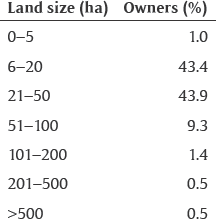
As peasants were reworking and territorializing the Daule and Peripa upper watersheds, local communities and farms were widely separated in terms of distance. Even today, barely 40 percent of the population in the reservoir area lives in towns, whereas 60 percent is scattered (SENAGUA 2010a). The area was mostly configured by small to medium-size farms (Table 1).

The Daule-Peripa hydrosocial territory was formed materially and socioeconomically by peasants interacting with nature through small-scale agriculture and extraction activities. Peasants historically have developed contextual modes of living with (and as part of) nature through vernacular knowledge, experience, and complex—not necessary harmonious—relations. One of peasants’ main activities after arrival was clearing secondary and primary forests to develop agrarian livelihoods (cf. Reference SotomayorSotomayor 1998). Peasants mainly grew rice, plantains, cotton, cocoa, coffee, corn, tangerines, and sugar cane. They complemented their production system with local-breed cattle, hogs, fishery, and small animal husbandry. Peasants and agricultural laborers also alternated between seasonal jobs and harvesting and gathering activities. They worked on their own lands and as agricultural laborers for others. As an eighty-year-old peasant from Barraganete explained: “I was a rubber-tapper. … I worked for my father. Four months a year I would tap rubber, and the rest of the year we would plant on our farm.”Footnote 10 Their main income came from marketing local products in nearby towns and in Guayaquil. While they sold local produce, scarce products were acquired in exchange, such as cooking oil, salt, and clothes. In the rainy season, rivers were the main thoroughfares for transporting agricultural and forestry products. Land routes were muddy and inaccessible. During the dry season, when river water levels were very low, dry land routes were an alternative. The rivers, estuaries, and natural springs were also sources of water for human consumption. The Daule and Peripa upper watersheds thus were patterned according to local, evolving practices and knowledge: land, tropical woods, and rivers were key for survival of local communities. These dynamics around local control and access to land and water, agricultural production, fishing, and marketing shaped the hydrosocial territory for years, only to be disrupted by the construction of the Daule-Peripa dam.
The technocratic reconfiguration of the Daule and Peripa’s hydrosocial territory
“The master key to regulating and controlling water’s behavior, bending it to human will …, will be the Daule-Peripa Dam.”
Comisión de Estudios para el Desarrollo de la Cuenca del Río Guayas, 1985In 1965, inspired by the Tennessee Valley Authority model and influenced by the Natural Resources Unit of the Economic Department of the Organization of American States (CEDEGE 1995), CEDEGE was created in Guayaquil as a regional entity with financial autonomy and a technocratic foundation to plan and manage the Guayas River basin. Due to its economic and political power it acquired broad authority to construct hydraulic infrastructure.Footnote 11 In the early 1970s team of consultants from the Inter-American Development Bank (IDB) prepared the regional development plan for the Guayas River basin, in which the Daule-Peripa multipurpose scheme figured as the key proposal. This plan justified the economic nexus between the IDB, CEDEGE, and the international consortium that later would engage with the Daule-Peripa studies (Reference OrellanaOrellana 2008). In 1976 the international consortium commissioned feasibility studies for the entire project and final design. The consortium also conducted its own environmental impacts report to back up its proposal (TAMS-AHT-INTEGRAL 1980). These studies were handed over to CEDEGE in 1980.
In 1982, soon after President Jaime Roldós was assassinated (Reference PerkinsPerkins 2005), the embryonic neoliberal government of Osvaldo Hurtado accepted a first IDB loan to construct the multipurpose scheme. The IDB’s requirement to approve the loan was an environmental impact assessment (EIA), which was elaborated by a questionably independent, internally IDB-hired consultant (Reference JenkinsJenkins 1979; Reference CorralCorral 2006). Despite the existence of these two EIAs, actual social and environmental impacts were overlooked, and local inhabitants were not adequately informed about the project. As an elderly peasant from Tres Gritos comments: “They fooled us. … An engineer came once with a survey questionnaire about how many of us lived here and what benefits we wanted, schooling, roadway, … they didn’t tell us anything clear about the dam. After a while, they told us that they were going to make the dam, which ruined us …, that was the trick …, they caught us by surprise.”Footnote 12 The final designs, furthermore, were so well concealed until the start of the construction phase that many farmers who had been displaced by the construction of other dams settled unknowingly in the zone to be flooded by the Daule-Peripa dam. They would be flooded once again.
The design phase was completed, yet those to be negatively affected at the dam site and other flooding areas remained largely misinformed. In the meantime, local elite investors acquired privileged information about development of other features of the multipurpose scheme. For instance, key information about future irrigation schemes in the arid lands of Santa Elena and other water development works flowed to local capitalist enterprises, which displaced local communities through making use of their privileged position (Reference HerreraHerrera 2005). A new hydrosocial network constituted by the state, private companies, local elites, and multilateral financing organizations started ordering the territory, following powerful interests and transnational corporate logics.Footnote 13
The IDB’s loan was the incentive to start the new phases: construction and implementation. CEDEGE hired the AGROMAN Company (Spain) to build the dam up through its completion in 1988.Footnote 14 CEDEGE and the building company proceeded according to their own rules and legal norms, disregarding local rules. It was decided, for example, that peasants who had settled along the river banks would only be compensated for their submerged crops, taking advantage of the fact that they held no legal document of their lands. As a dispossessed peasant from Pescadillo says: “I lost nineteen hectares …, they didn’t pay me for the land. They paid only for my crops. … I complained, but only owners with deeds got anything; those who only possessed their land were not paid one sucre. Further, since the water rose higher than they told us, another three hectares were lost without any payment.”Footnote 15 Staff of CEDEGE and the Ecuadorian Institute of Agrarian Reform and Colonization (IERAC) turned a blind eye to the 1964 and 1973 agrarian reform laws that stipulated that after five years of cultivation, a farmer would become the legitimate owner of the farmlands. In the end, peasants who had not approached IERAC’s offices to declare “effective possession” of the lands were denied land compensation. This remained an important issue under the Citizens’ Revolution (Revolución Ciudadana) government. Peasants who did not receive payments in the past faced the same problem during Correa’s administration.Footnote 16 As a National Water Secretariat’s (SENAGUA) staff member explained: “If they [peasants] have no titles, they are paid nothing!”Footnote 17 The legitimate right peasants had constructed over years was reduced to a small economic compensation or to no payment at all under state rule.
As flooding began, dominant power relations started to materialize in the reconfigured hydrosocial territory of Daule-Peripa. Filling the reservoir to reach the top level of eighty-five meters altitude took approximately three years. Nearly forty thousand hectares belonging to four thousand families were expropriated, and about one hundred thousand people, including expropriated families, were involuntarily isolated (Reference CorralCorral 2006; CAIC 2008; Reference DonosoDonoso 2009). The dam construction led to changes in water control and access. Before the flooding, local peasants at the dam site felt that using natural springs was the safest way to obtain drinking water. While this was already a precarious source in terms of quality and quantity, flooding made it worse. The few wells and springs of clean water that remained were submerged and polluted under the reservoir’s hundreds of coves.
Another problem was the isolation of many sites, making movement and transportation of people and animals more difficult. This relates to submerging transport routes and blocking communication points, but also to crucial ecological changes. For example, an assessment done by SENAGUA states that “over the entire water surface, aquatic weeds are floating in tight formations, blocking fishing and transport. In certain coves of the lake, water lily has made the reservoir unusable” (SENAGUA 2010b, 17). These results were confirmed by the Ecuadorian Electricity Corporation (CELEC-EP), currently in charge of the dam’s management, which revealed that approximately 41 percent of the water’s surface is covered by water lilies (CELEC-EP 2013). The overabundance proved to be a major problem as main water routes were blocked and thousands of families were kept isolated in artificial islands.
Daule-Peripa multipurpose scheme’s benefits: A hydraulic dream?
“The CEDEGE staff told us that we would be left with everything just nice, with wells, electricity, everything. But we got nothing—no promises were kept!”
Peasant woman from El Mate, July 7, 2014Almost thirty years have gone by since the Daule-Peripa dam was built. The reconfigured hydrosocial territory deprived dam-affected communities from control over and access to their water sources and their means of production and mobility. Regarding irrigation, only seventeen thousand hectares (the right bank of the Daule River) have a distribution and pumping system of which no more than eight thousand hectares are actually used, serving only three hundred users (Reference CorralCorral 2006). The other thirty-three thousand hectares (left bank) were planned but never developed. According to former CEDEGE staff, this was the peasants’ fault: “For the thirty-three thousand hectares, CEDEGE had begun the feasibility study, but got no further because there was a bad experience with the farmers on the right bank. When we told them the infrastructure is ready to use and now you have to pay, they claimed they were not going to pay anything, because the farmers did not ask CEDEGE to come.”Footnote 18 Moreover, the irrigation system implemented on the right bank is one of the most expensive in the country, costing the state $118 million—no less than $395,000 per user (CAIC 2008). Compared to other irrigation systems in the country, this investment was outlandish. To give an example, in the region an investment cost of $8,000 per user is already considered excessively high (SENAGUA/MAGAP 2013). The total cost of the irrigation system would further increase if we include all the components required to provide irrigation water. Something similar occurred in the Santa Elena peninsula, where no more than nine thousand hectares were being irrigated (MAGAP 2011). CEDEGE, however, defended this work, which attempted to “promote integrated human development … by suitably using natural resources, technology and infrastructure” (CEDEGE 1995, 5). As a former staff member explains: “The Daule-Peripa dam turned out really economical because technically the right site was chosen …, it needed no more than 250 meters dam-length to store all that water!”Footnote 19 Ironically, in the Santa Elena peninsula, most of the irrigated lands are now concentrated under ownership of large private landowners who dispossessed the community members. Collective rights systems were damaged. For instance, the community of Daular (former land owner), nowadays possess one hectare in the whole irrigation scheme, whereas the rest of the area is owned by private individuals or companies (MAGAP 2011).
Notwithstanding the fact that the Daule-Peripa megaproject is a main water source for the city of Guayaquil, the project also failed in its goal to provide equal water access for human consumption. In the context of neoliberal policies implemented during the 1990s, Guayaquil’s water supply was privatized and handed over to Interagua, which is a subsidiary of the International Water Services (Reference SwyngedouwSwyngedouw 1997, Reference Swyngedouw2004; CEDEGE 2002; Reference Carrillo, Bellettini and CoombsCarrillo, Bellettini, and Coombs 2007). Soon after privatization, water service was often cut off to low-income users, who could not afford the extremely high water tariffs, which were raised up to 188 percent (CAIC 2008). As a result of its elite-based practices, only middle- and upper-class neighborhoods with greater capacity to pay have access to water, while impoverished neighborhoods are left out. Moreover, to date none of the dam-affected communities have access to safe, treated water or to adequate electrical service. Despite the fact that one of the main goals of the Daule-Peripa Dam is to generate electricity with its 213 MW hydroelectric plant, communities living in the plant’s vicinity have limited or no access to electrical services (CRBM 2008). Not only is the electrical provision service questioned and controversial, the construction of the hydroelectric plant itself is highly contentious. The big-time beneficiaries were a few Italian financial institutions and construction companies that cleverly abused cooperation funds for development from the Italian government (CRBM 2008). Furthermore, improvements in navigation, tourism, and recreation were not achieved either. These illustrations show that the Daule-Peripa provides arguable benefits for some, while dam-affected communities suffered negative impacts. They depict how the hydraulic dream also is an economic failure and a harm for communities linked to the Daule-Peripa multipurpose scheme located far from the main mega-dam. In the following section, the complex struggles involved in the making and unmaking of the Daule-Peripa hydrosocial territory will be shown and analyzed as struggles over resources, rules, authority, and discourses.
Thirty Years of Local Struggles: De- and Reterritorializing the Daule-Peripa Hydrosocial Territory
Resources and rules
Struggles over resources and rules are the less abstract expression of water struggles but they play a major role in the de- and repatterning of Daule-Peripa’s hydrosocial territory. As rules change, control and access to resources change too, and vice versa. While dominant rulers implement (by force or not) norms (e.g., land access and use regulations, fixed schedules for people’s access to transport, centralized logic of water supply) according to their own notions of hydrosocial territoriality, local actors’ rules and access to resources are affected and reconfigured. Under these logics, the Guayas River basin and the Daule-Peripa project were declared strategic and of national interest.Footnote 20 This justified the “sacrificing of a few for the majority’s benefit,” clearly expressing (neo)liberal utilitarian expediency—the greatest happiness for the largest number of persons (Reference BenthamBentham 1988). The Citizens’ Revolution government did not differ much in this regard, as Correa stated during the inauguration of the nearby and Baba Dam: “An infrastructure of this magnitude … implies sacrifice. [It] is necessary for Buen Vivir and for the common good.” As commonly occurs with mega-hydraulic projects in Latin America, their basic philosophy fails to consider that the rights of local people are denied who, ironically, often happen to be the local majorities. This often leads to conflict and contestation. For example, while locally, land was considered an agricultural means to reproduce peasants’ livelihoods, for state agencies the land was barren and either meant to be flooded or to be used as the dam’s security area. Such newly imposed rules and norms imply altering access to resources, and they are challenged by local people.
In the face of negative social and environmental impacts, dam-affected communities have confronted their grim situation through individual and collective demonstrations and struggles. Dam-affected communities, grassroots organizations, and individuals in the Daule-Peripa region permanently strive for the creation of an alternative hydrosocial network that would allow them to obtain reparations and access to better living and working conditions.
The Daule-Peripa scheme’s struggles over control and access to resources mainly involve land, water, capital, and technology. During the first months after the flooding, CEDEGE and IERAC set up a temporary office at the dam site to pay economic compensation to those who had land titles. However, complaints and struggles began as more areas than expected were affected and the economic compensation process did not fulfill affected people’s expectations. A peasant whose lands were flooded in La Mina explains: “They told me that I should be glad that I would not be flooded. … I was at the level of seventy-two meters altitude. … They had topographic maps and claimed that the water would not reach me …, the people from CEDEGE never explained anything clearly, the water rose to its maximum height, and people were desperate; the employees of CEDEGE just came and told us: ‘We told you the water would rise and you had to leave before the water itself drove you out.’”Footnote 21
At the beginning complaints were raised individually, but soon after, groups of people traveled to government offices in Guayaquil or at the dam site to demand fair payment and recognition of the additional land that was flooded. Under pressure from collective protests, CEDEGE and IERAC mobilized their political and economic influences to offer local leaders high payments for their land, and important government positions. In exchange, local leaders would have to persuade other farmers to agree with government rules. As an elderly leader from Carlos Julio Arosemena comments: “The leaders were given jobs with good salaries, they [CEDEGE] told them they would make one hundred thousand sucres monthly, so they [leaders] sold us out but finally were thrown out of their jobs when everything was settled.”Footnote 22 Unfortunately, not much was achieved by most peasants, only those who had means to travel to the city or those who could afford to bribe technocrats made effective claims. As stated by an affected peasant from Pescadillo: “Some had to reach an agreement with a CEDEGE official. He would accelerate the payment process only if we shared part of our payment with him.”Footnote 23 This clearly shows a rent-seeking problem between affected local people and public officers.
At the time, the new hydrosocial hierarchies managed to persuade many of the local communities to accept their changed conditions. However, struggles persisted, and various local groups continued to claim their territory. In 1999, a regional peasants’ organization, Federación de Organizaciones Campesinas y Urbanas de Los Ríos (FOCUR), together with local leaders of affected communities, started to assess social impacts and to claim recognition and implementation of public services to repair damages caused by the dam. In addition, in 2005, a local leader joined several other communities to form the grassroots organization Fernán Sánchez Castaño. Both initiatives managed to attract attention from environmentalist and human rights nongovernmental organizations.Footnote 24 Nevertheless, bureaucratic and state agencies’ indifference has proven to be the most difficult barrier to bringing real reparations. Both collective organizations continue to denounce injustices caused by the dam, but they face strong governmental response, including criminalization of peasants.Footnote 25 During the last decade, it was even harder to fight against this due to the governmental discourse that claimed that the state was governed by the citizens—by the Citizens’ Revolution. In consequence, whoever was against the state was also against the people.
Despite hardship, individual acts of resistance or adaptation have accompanied these struggles. One strategy of dam-affected peasants is to cultivate and retake land that CEDEGE expropriated and paid for. Although they are officially “landless,” peasants continue to make a living by cultivating the land from which they were evicted. These practices gain strength during the dry season, when the water level of the reservoir decreases, making additional lands available. Farming practices also expand into lands reserved for the reservoir’s protection zone; however, CELEC-EP denounces them “illegal” and has sent military patrols to the area seeking to eradicate them. As stated by a CELEC officer: “This is state land and they [peasants] are occupying it illegally. … We had to intervene with the police.”Footnote 26 And as an elderly peasant from Carlos Julio Arosemena asserts: “They have acted violently. When I had fava beans and passion fruit planted, they sent eleven soldiers to cut it all down, because they said we could not plant on state land … they even threatened us with their guns. … Instead of helping agriculture, they come to take it away!”Footnote 27
Besides land struggles, access to water and its benefits remains a crucial point of struggle for local communities. Starting in the early days of the dam, stagnant waters in the reservoir began to smell bad and cause health problems due to eutrophication. One study reveals that the water at the Daule-Peripa dam’s spillway is highly polluted (SENAGUA 2010b). Moreover, during an interview, the director of the Barraganete Health Center said: “Water quality is poor, so most of the people we see have illnesses involving digestive and parasite diseases.”Footnote 28 These problems were denounced several times by local inhabitants in CEDEGE offices, but their requests remained largely unattended. As a partial solution CEDEGE drilled a few wells and arranged a deficient water supply through water-supply trucks (Reference AlvaradoAlvarado 2009). Local governments have built precarious water-supply systems that are highly unreliable. As a schoolteacher from El Mate comments: “We live in the twenty-first century. Can you believe that our town still does not have potable water?”Footnote 29 Local people obtain water by their own means. The most frequent sources are rainwater, water-supply trucks, subsidized bottled water from the Ministry of Health, a few remaining natural springs, and the dam’s reservoir.
Another niche of struggle is access to infrastructure or means for transport. Mobility became an important issue considering that, for instance, health care is largely absent in the communities. Even though CEDEGE offered to implement paved roads and adequate waterways, communities remained isolated without roads and impassable waterways. As dam-affected people were isolated, they learned how to build barges and kayaks as means of transport, and they again organized protests in CEDEGE’s offices at the dam site. As a result of protests, since 2008, CEDEGE provided a free-of-charge barge with only a daytime schedule. Transport of local communities largely depends on it, and during nighttime a local peasant provides this service with his own canoe. In another initiative, the members of a peasant family in El Mate organized themselves to build a floating bridge nearly 300 meters long over a branch of the reservoir. The family charges for crossing the bridge in order to operate and maintain it. Before the construction of the bridge El Mate was isolated, especially in the rainy season.
Another illustration of local coping strategies is how inhabitants of Barraganete cleared a road by themselves to improve mobility. Although the provincial government of Manabí started to open up a summer road to connect isolated Barraganete with the nearest reservoir harbor, it was abandoned soon after and remained an unfulfilled promise. A Barraganete villager took over the government’s abandoned machinery without permission and continued the unfinished work. Soon, many people joined the endeavor. In the end, the provincial government was forced to finish paving the road. Such evidence shows how local initiatives aim to cope with the new setting while modifying the hydrosocial territory.
These tensions are not only about resources and rules. They are also fundamentally battles over discourses and legitimate authority, which are structural to the reconfiguration of hydrosocial territories (see also Reference Zwarteveen and BoelensZwarteveen and Boelens 2014; Reference Hoogesteger, Boelens and BaudHoogesteger, Boelens, and Baud 2016).
Legitimate authority and discourses
Underlying the battle to reconfigure the hydrosocial territory are fierce efforts to alter forms of legitimate authority and discourses sustaining them. During this process, some frames of knowing and valuing are made superior over others. As depicted by the technocrat in charge of designing the Daule-Peripa initial proposal when referring to the main social and productive problems: “There is a predominance of empirical [nonscientific] land exploitation systems” (Reference OrellanaOrellana 2008, 44). Ecuador’s economic development through agricultural production, energy production, and modernity were the main arguments driving the Daule-Peripa multipurpose project. Since its conceptualization this project was promoted as the unique technical alternative that would bring progress to the country, or, as highlighted by El Universo newspaper: “There isn’t and won’t be in Ecuador a project of superior importance!”Footnote 30 Thus, the discursive influence of international policies and national experts on water management and territorial planning drove legal and institutional changes nationwide, which resulted in the establishment of CEDEGE and the construction of the Daule-Peripa scheme.Footnote 31 Backed up by these discourses, it was presented as “indispensable” and “natural” to have a governmental authority like CEDEGE with power to establish the rules about decision-making. Moreover, this gigantic project with its great demand for financing also made it “necessary” and “inevitable” to include an international consortium operating with global market logic. This megaproject, in consequence, is the sociotechnical ensemble of international discourses, financing institutions, and national governmental support.
Discourses were not only influential at national and institutional levels, but they also powerfully legitimated mega-hydraulic intervention at the local level: it would bring new roads, bridges, water supply, navigable rivers, and tourism to rural populations who had largely been forgotten. A local peasant from Pescadillo tells how discursive strategies connected with scientific knowledge actively used training tools about the benefits of the multipurpose system: “Why wouldn’t we believe them—they were engineers, who had studied abroad, they said. They even brought us a model showing how this would look like a paradise. They told us that tourists would come and we would sail around in yachts … they said we would be the best town in the country!”Footnote 32 Such discourse gained force in Ecuador’s mega-dams policy, which strategically applied a multitude of governmentality techniques and messages, such as stated on a billboard promoting a dam construction project in 2014: “The Chone multipurpose dam promotes the Buen Vivir of your community.”
While dominant discourses seem to be hegemonic, local communities have partly contested or overcome them based on local history, culture, knowledge, and practices. Agro-diverse farming, fishery, local labour, marketing relations, and sociocultural roots (e.g., Montubio cultureFootnote 33) are the legitimizing notions that support them.
Despite the fact that local notions of hydrosocial territoriality were underestimated by dominant discourses, dam-affected people continue to demand their rights based on vernacular normative and identity frameworks. Self-identification and determination as Montubio peoples of Daule-Peripa underpin their proposal. In 2008 Montubio peoples’ collective rights were recognized by the Constitution of Ecuador.Footnote 34 Based on this, in 2011, the Consejo de Pueblos Montubios Daule-Peripa (previously Fernán Sánchez Castaño) sued the Ecuadorian State, demanding socioenvironmental reparations, rights to control and access to natural resources, and the right to live in a healthful environment. Moreover, they allege that local Montubio communities have rights to be recognized as ancestral culture. Based on this self-identification, this Montubio organization claims governmental attention. Currently, the struggle of local organizations and individuals has three main goals. First, they demand the restitution of their rights through the government’s own rules of play by presenting lawsuits based on national and international legislation. Second, they seek the reconstruction of their own cultural practices and notions. And third, they aspire to raise awareness about their situation by building strategic alliances with local and national NGOs and critical academics.
Since the beginning, individuals and organizations have demanded reparations for the damages caused by contaminated water and dispossession from their homes and land. Along the way, local NGOs have offered support with training and organization building. From the outset, however, these peasant struggles have been weakened by a lack of economic resources and by the physical/psychological fatigue that affected inhabitants now have endured for almost thirty years.
Conclusions
Daule-Peripa shows how the discourse of green and modern development is used to cover up the imposition of technocratic water governance, reproducing scenarios of socioenvironmental injustice. It has profoundly altered hydrosocial territorial relations, resulting in the unequal distribution of socioenvironmental impacts and benefits among the different geographical areas and actors involved. After almost thirty years, the Daule-Peripa is still under reconfiguration, and dam-affected communities are still contesting their grim situation.
Within this context, this article shows that the development of the Daule-Peripa’s multipurpose scheme is not a linear, value-free, and static process. The hydrosocial territorial reconfiguration is a product of power-laden and sociotechnical ensembles that strategically mobilize knowledge (research on the importance of the Guayas River basin), institutions (creation of CEDEGE, IDB), money (external credits), infrastructure (the Daule-Peripa scheme), people (technocrats, international experts), and water flows (the Daule and Peripa Rivers), embedded in and supported by discourses of modernization, harmony, and national progress.
Using the “echelons of rights analysis” (ERA) enriches the analysis of Daule-Peripa’s hydrosocial territorial reconfiguration. It shows how the implementation of dams is not only a struggle over resources but also a battle over rules, authority, and discourses. While struggles over resources such as land and water are often more explicit and analyzed in dam development processes, struggles over the very ideas, norms, and legitimate authority that underpin them are implicit and often unspoken; at the same time, they are highly relevant for understanding why, for instance, the Daule-Peripa scheme was built in the first place and how it evolved. Despite the debatable benefits of this scheme, the critical analysis of this multipurpose dam unravels how building companies, financing agencies, water service provision companies, and rent-seeking public employees have been the big-time beneficiaries, while Guayaquil’s poorest households have been excluded from water access, thousands of inhabitants of the reservoir area lack adequate access to electrical services, and other sectors, such as the Santa Elena peninsula communities, have been dispossessed from their collective lands.
In mega-hydraulic reconfiguration processes, notions about the hydrosocial territory driven by the most powerful actors prevail, while territorial notions promoted by more vulnerable actors tend to be ignored. The former exclude the latter from the category of knowledgeable agents. Nevertheless, local people struggle individually and sometimes collectively. The new and evolving hydrosocial arrangements show that struggles are not always open conflicts around resistance but also come to life in everyday territorial politics. Thus, these struggles evidence hydrosocial territorial networks as dynamic and flexible entities. Dominant and technocratic webs may be powerful, but they are not hegemonic nor monolithic. Hydrosocial territory reconfiguration processes like Daule-Peripa’s illustrate the importance of recognizing other, alternative forms of development and their protagonists.
The article also manifests how mega-dam development triggers ongoing struggles and reterritorializing processes by both dam proponents and dam-affected individuals and collectives, which persist over time. In consequence, understanding mega-hydraulism requires a repoliticizing and historical perspective. The article sheds light on continuities and paradoxes between previous neoliberal regimes and current “progressive” governments concerning their stance toward mega-dam development. While the Correa government, in power until 2017, strongly criticized capital-over-human superiority as fundamental to the neoliberal époque, in water policy interventions it advocated for the same path in a covert way. Rather than redressing past socioenvironmental impacts, the Correa government devoted extractive industry revenues to further develop mega-hydraulic projects. Under an inclusive citizens’ government discourse it legitimized an interventionist agenda prioritizing capital over humans and nature. In consequence, the debate regarding mega-hydraulism in environmental policy practice in Latin America, challenging official Buen Vivir and post-neoliberal discourses, remains urgent—particularly in light of the recent, rapidly expanding development of new mega-hydraulic intervention projects that are transforming hydrosocial territories and territoriality notions within Ecuador and throughout the region.
Acknowledgements
We thank Michiel Baud and OLA (PhD Forum on Latin America) for the feedback provided on the first drafts. We thank the editors and anonymous reviewers for their insightful comments. We are also very grateful to the people affected by Daule-Peripa and the government officials who enabled this research by letting the authors into their homes, organizations, and activities. We give special recognition to the social movements and individuals that struggle against and live with Daule-Peripa’s negative impacts.


 Open access

