Introduction
In aging, even in the absence of pathological losses in cognitive functions, the decline in cognitive abilities (e.g. memory) can negatively affect older adults’ quality of life, social interactions, and engagement in cognitively stimulating activities. The development of interventions aiming to sustain older adults’ memory function is, thus, of considerable interest (Hertzog et al., Reference Hertzog, Kramer, Wilson and Lindenberger2008).
In the domain of episodic memory, it has been shown that older adults can increase their memory performance in the trained task (see the meta-analyses by Gross et al., Reference Gross2012; Reijnders et al., Reference Reijnders, van Heugten and van Boxtel2013) through instructions and training of mnemonic strategies. Furthermore, they can maintain this gain in memory performance over time (e.g. Stigsdotter-Neely, Reference Stigsdotter-Neely, Hill, Bäckman and Stigsdotter-Neely2000; Bottiroli et al., Reference Bottiroli, Cavallini and Vecchi2008). However, strategies are usually domain- or task-specific, thus, generally limiting transfer effects to tasks resembling the trained memory skills (Verhaeghen et al., Reference Verhaeghen, Marcoen and Goossens1992; Buschkuehl et al., Reference Buschkuehl2008). This pattern of findings has been attributed to different factors, such as rare use of the acquired strategies after the end of the training and in everyday life, because they usually require considerable effort (e.g. Verhaeghen et al., Reference Verhaeghen, Marcoen and Goossens1992).
Aside from strategies, the memory beliefs and motivational attitudes of older adults can also determine training success (e.g. Troyer, Reference Troyer2001; Hertzog et al., Reference Hertzog, Kramer, Wilson and Lindenberger2008). There is, indeed, evidence that an important aspect of interventions for older adults is the extent to which the training can change older adults’ motivation toward engaging in memory tasks, as well as their knowledge, perceptions, and implicit beliefs about their own cognitive functioning in general (i.e. their metacognition), and in particular, their memory functioning (i.e. metamemory). These aspects have been shown to influence memory performance of older adults, not only in laboratory settings, but also in everyday life (Bottiroli et al., Reference Bottiroli, Cavallini and Vecchi2008; Brehmer et al., Reference Brehmer2008). In comparison to younger participants, older adults report lower memory functioning and lower control of their memory – perceiving it as malfunctioning compared to when they were younger – and an altogether lower confidence in their own memory (e.g. West and Yassuda, Reference West and Yassuda2004). In turn, these negative beliefs can have an impact on the attitudes toward one's cognitive abilities and may cause lowering of self-efficiency, failures to use effective and appropriate mnemonic/cognitive strategies, increase dependence on others, leading to avoidance of memory tasks and a decrease in motivation – all possibly resulting in a considerable drop of performance (e.g. Troyer, Reference Troyer2001; Brehmer et al., Reference Brehmer2008).
Recently, Carretti et al. Reference Carretti, Borella, Zavagnin and De Beni(2011a) have demonstrated that metacognitive, more specifically, metamemorial aspects can mediate training-related gains and their maintenance. Nonetheless, as shown by the meta-analysis of Floyd and Scogin Reference Floyd and Scogin(1997), metacognitive and motivational changes cannot be modified without specific activities. Some studies have, therefore, proposed training programs, which include activities aimed at ameliorating these subjective variables (see Hertzog et al., Reference Hertzog, Kramer, Wilson and Lindenberger2008). Results of these trainings are encouraging, as they show improvement in episodic memory performance, metamemory, self-efficacy (Hertzog et al., Reference Hertzog, Kramer, Wilson and Lindenberger2008), and use of strategies (Cavallini et al., Reference Cavallini, Pagnin and Vecchi2003), as well as maintenance of gains acquired in some of these subjective measures (e.g. Hasting and West, Reference Hasting and West2009).
It is worth mentioning that, at least to our knowledge, cognitive training interventions are mainly offered to community-dwelling older adults, or people with mild cognitive impairment (MCI; Reijnders et al., Reference Reijnders, van Heugten and van Boxtel2013) or Alzheimer's disease (AD) (Piras et al., Reference Piras, Borella, Incoccia and Carlesimo2011). This is quite surprising considering (i) an ever-growing number of older adults, with no cognitive impairments, living in residential care settings, (ii) the evidence of cognitive training having a positive effect on slowing down of the age-related cognitive decline, and (iii) the role of the environment on cognitive functioning (e.g. Hertzog et al., Reference Hertzog, Kramer, Wilson and Lindenberger2008). There are, however, a few exceptions. Calero and Navarro Reference Calero and Navarro(2007) presented memory training programs to older adults from residences for the elderly people and to those in psychological attention services. Their results showed training-related gains, and their maintenance, in different cognitive measures independently of the cognitive status of the participant. However, no measures of subjective memory were assessed. Furthermore, training gains were not distinguished between participants living in residencies for the elderly people and those living in their homes.
Navarro et al. Reference Navarro, Menacho, Alcalde, Marchena, Ruiz and Aguilar(2009) also examined the efficacy of different types of training – a computer-based training (software use), a paper-and-pencil training (with exercises on strategy use), and a mixed-group training (combination of the above two) – with institutionalized older adults. They found an increase in objective and subjective memory scores, which depended on the type of training proposed and the number of training sessions. However, it should be noted that cognitive profiles of participants were not well defined, so it is unclear whether participants had a cognitive impairment or not. Furthermore, the authors did not evaluate maintenance effects. More recently, Carretti et al. Reference Carretti, Facchini and Nicolini(2011b) demonstrated that strategy instruction could enhance performance of older adults, with no cognitive impairment and living in residential homes, in a list recall task and in a subjective measure of well-being; interestingly, the gains of the trained group were maintained at a three-month follow-up. However, none of these two latter studies included metacognitive activities.
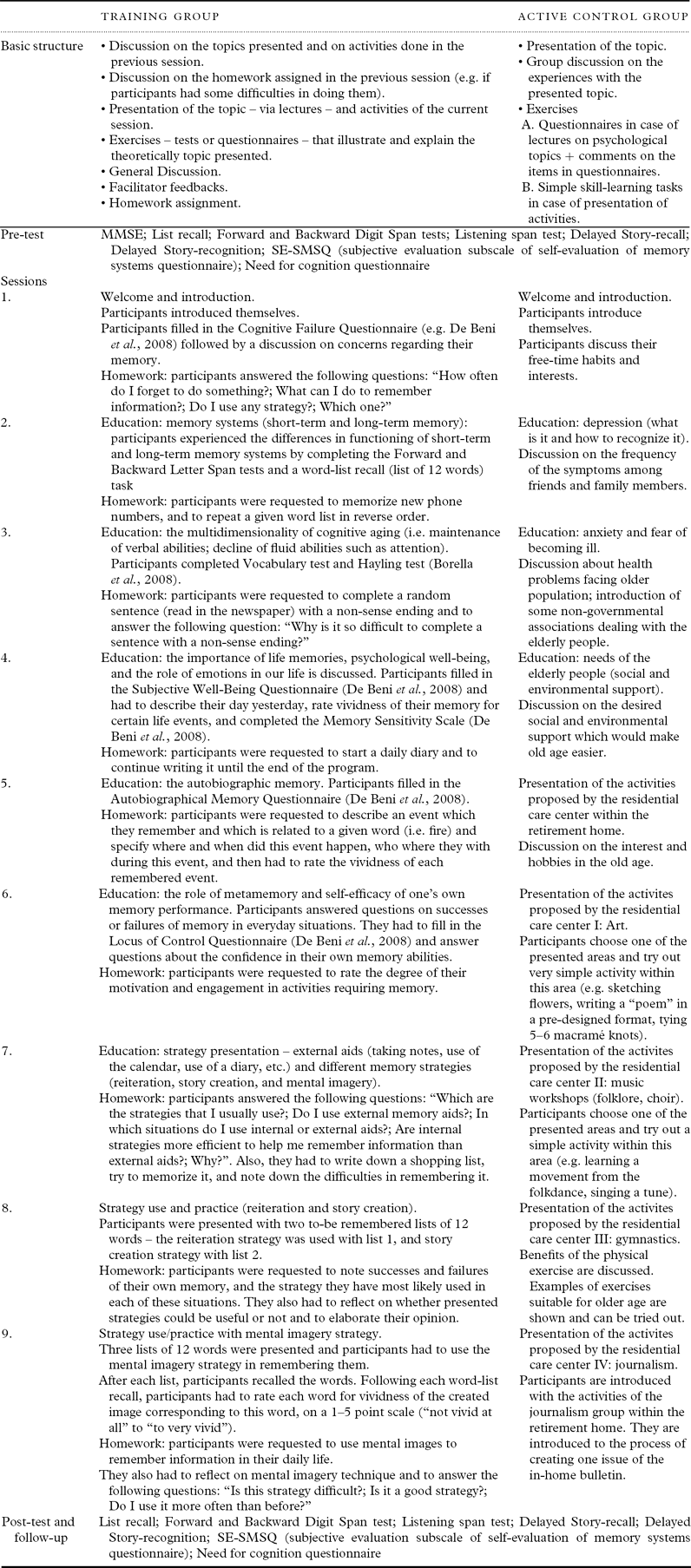
Thus, the aim of the present study was to assess the efficacy of a strategic and metacognitive group training (multifactorial training) in older adults with no cognitive impairment, living in a residential care setting. This training was modeled along the lines of the one proposed by De Beni et al. (Reference De Beni, Borella, Marigo and Rubini2008), which are described below (see also Table 1). In particular, we were interested in determining the efficacy of such a program in terms of: (i) specific effects on the practiced task, (ii) transfer effects on untrained cognitive tasks as well as on non-cognitive ones, assessing metamemory and motivational attitudes, and (iii) the maintenance of the gains at a seven-month follow-up. Transfer gains were examined using classical measures assessing short-term memory (STM), long-term memory (LTM), and working memory (WM; see Material section), commonly used when evaluating benefits of strategic training (e.g. Gross et al., Reference Gross2012). In addition, these tasks are intertwined with everyday life abilities; this is particularly the case for: (i) WM task, which is related to higher order cognitive abilities such as reasoning or problem solving (Borella et al., Reference Borella, Carretti and De Beni2008), (ii) LTM tasks, involved in the ability to recall stories, and (iii) subjective evaluation of memory and motivation – Need for cognition (NFC; Cacioppo and Petty, Reference Cacioppo and Petty1982), which is related to the way in which people deal with various cognitive tasks, social information, and experiences.
Training description for trained and control group

In line with the literature, we expected to see gains and their maintenance in the practiced task (Verhaeghen et al., Reference Verhaeghen, Marcoen and Goossens1992; Hertzog et al., Reference Hertzog, Kramer, Wilson and Lindenberger2008). Also, transfer and maintenance gains in STM (e.g. Buschkuehl et al., Reference Buschkuehl2008) and in LTM tasks were expected since these tasks involve the use of strategy (Stigsdotter-Neely, Reference Stigsdotter-Neely, Hill, Bäckman and Stigsdotter-Neely2000). In line with Carretti et al. (Reference Carretti, Borella and De Beni2007; Reference Carretti, Borella, Zavagnin and De Beni2011a), we expected – always as a result of the strategy use – a transfer effect and its maintenance in WM due to the possibly easier retrievability of LTM information in WM. These transfers and maintenance benefits should therefore be promoted by the strategy teaching and metacognitive activities presented within training sessions. Because of the contradictory results concerning the possibility of modifying some aspects of metacognition (e.g. Floyd and Scogin, Reference Floyd and Scogin1997; Carretti et al., Reference Carretti, Borella, Zavagnin and De Beni2011a), we explored whether training transfers to NFC and metamemory, and whether gains in these more subjective aspects can be maintained.
Methods
Participants
Participants were recruited during plenary sessions in one of the residential care centers in Zagreb. During these sessions, they were told about the two different programs. Our inclusion criteria were: a Mini-Mental State Examination (MMSE) score (Folstein et al., Reference Folstein, Folstein and McHugh1975) over 26, and Croatian as mother language. Our exclusion criteria (based on the semi-structured interview) were: a history of psychiatric or neurological diseases, brain disease such as encephalitis or meningitis; use of benzodiazepines in the previous three months; symptomatic cardiovascular conditions, breathing problems, or diseases causing cognitive impairments; visual, auditory, and/or motor impairments (see Crook et al., Reference Crook, Bartus, Ferris, Whitehouse, Cohen and Gershon1986); and health problems that could have precluded the attendance of the program.
The training was announced via the residential home newsletter and the announcement board in a residential care center in Zagreb and 51 volunteers applied. They all fulfilled the inclusion criteria. Since this particular residential care center consisted of two separate buildings (1 km apart), but with the same management, staff, and offered activities, we decided to assign recruited residents from building 1 (N = 31) to the trained group, and those from building 2 (N = 20) to the control group. This decision was made to better manage: (i) different time table of activities in the two buildings (activities were scheduled for different days of the week), (ii) participants preference to perform the activities in the building where they live, and (iii) reduce the chance of participants from two different groups discussing differences in the programs, something that might happened with participants living in the same building. None of the 51 participants dropped out during the study, so valid results (i.e. pre-test, post-test, and follow-up assessments) were available for all 51 participants.
The two groups did not differ in age (M ± SD – trained, 71.68 ± 2.93; control, 74.45 ± 7.10; F 1/49 = 1.30, p = 0.26), years of formal education (M ± SD – trained, 13.53 ± 2.73; control, 12.10 ± 2.91; F 1/49 = 3.17, p = 0.09), average MMSE score (M ± SD – trained, 28.70 ± 1.65; control, 28 ± 2.51; F 1/49 < 1, p = 0.38), and gender (trained, 21% male participants; control, 20% male participants).
Design
The study can be considered a single-blind study because only the participants were blind to the treatment condition.
Materials
Cognitive measures
Practiced task:
Immediate List Recall task. Two lists of 15 words, comparable in word length and imagery value, were prepared. Participants heard the list of audiotaped words presented at a rate of 2 sec per word. At the end of the presentation, participants were required to recall as many items from the list as they could. The final score corresponded to the total number of words recalled correctly.
Transfer tasks:
Short-term memory: Forward and Backward Digit Span tasks (De Beni et al., Reference De Beni, Borella, Marigo and Rubini2008). Series of digits were presented at a rate of 1 sec per digit, and participants were asked to repeat them in the same (Forward) or reverse (Backward) order. The series increased in length from three to nine digits in the forward task, i.e. from two to eight digits in the backward task. Each level contained two strings of digits. After two consecutive recall errors, the task was discontinued. A practice trial of two digits was given for each task before the test started. One point was given for each sequence correctly recalled. The final score corresponded to the total number of correct trials recalled (maximum score 14 for both tasks).
Working Memory: Listening span test – LST (Borella et al., Reference Borella, Carretti and De Beni2008). The task consisted of an increasing number of sequences of simple sentences (2, 3, 4, 5, and 6 sentences). The sentences were grouped into two sets, each composed of five sequences of different length, for a total of 20 sentences per set. Each sentence was separated from the subsequent one by an interval of 1.5 sec. Participants were instructed to listen to each sentence, judge its plausibility (state whether it is true or false), and retain the last word. At the end of each set, participants were required to recall final words of the sentences presented in the given sequence, following the correct order of the presentation. Two training trials preceded the task. The total number of final words recalled correctly, and in correct order, was considered the measure of the participant's WM capacity (score range is 0–20).
Long-term memory: Delayed Story-recall (adapted from Zarevski, Reference Zarevski1995). In this task, participants first listened to a brief text, a biographical sketch of a relatively well-known figure from Croatian cultural history (poet/sculptor). After the auditory presentation, they were given a sheet of paper with this same text to read it to themselves at their own pace, and to flip it over once they were done. This was followed by 30 m of solving up to three sets of the standard progressive matrices – SPM (Raven, Reference Raven1994). After 30 m, participants were given a booklet with ten questions concerning the information given in the text. Participants were given one point for every correct answer (score range is 0–10).
Delayed Story-recognition (adapted from Zarevski, Reference Zarevski1995). This test is a continuation of the story-recall task. After the administration of recall-questions, participants were given another booklet, containing the same ten questions as in the recall version of the task, only this time questions were given in a multiple-choice format (with one correct answer). Participants were given one point for every correct answer (score range is 0–10).
For each task, parallel versions were used at the pre-test and post-test. At the follow-up, pre-test version was presented. For the story recall, two different texts were constructed, equal in length (150 words each) and pre-tested for difficulty on an independent sample.
Motivational and metacognitive measures
Need for cognition – NFC (Cacioppo and Petty, Reference Cacioppo and Petty1982). The NFC scale measures “the tendency of an individual to engage in and enjoy thinking” (Cacioppo and Petty, Reference Cacioppo and Petty1982; pg. 116). It is composed of 34 statements about the satisfaction one gains from thinking (score range is 0–170).
Subjective evaluation subscale of self-evaluation of memory systems questionnaire – SE-SMSQ (Tonkovic and Vranic, Reference Tonkovic and Vranic2011). SMSQ is a 57-items scale which assesses the multidimensional construct of metamemory based on the memory systems framework. Following the aim of the present study, only the scores on the subjective evaluation subscale, composed of 13 items, were considered (score range is 0–65).
Participants’ task in NFC and SE-SMSQ was to rate the extent to which he/she agreed with each statement by using a five-point scale, ranging from (1) strongly disagree to (5) strongly agree.
Procedure
Participants attended 12 sessions, at a rate of one session per week; sessions 1 and 11 were the pre-test and post-test sessions (week before and week after the program itself), and session 12, seven months after the post-test, was the follow-up. In nine in-between sessions, the trained group attended the training, while the control group participated in alternative “activities” (see Table 1). Each group was divided into smaller groups, so the program was conducted in groups of six or seven participants. Sessions were conducted by the experimenter who moderated the discussions, explained activities, and managed the presentation of materials.
Training group
The training was administered in nine 90-m group sessions. Each session (see De Beni et al., Reference De Beni, Borella, Marigo and Rubini2008) had the same structure: first, homework and the main topic of the previous session were discussed – to share participants’ experiences and difficulties, followed by a new topic/theme. Feedback was given for all the completed activities and tasks, and participants were encouraged to take a positive attitude toward the tasks. Each topic was illustrated and elaborated with practical assignments (see Table 1). In session 1, after a welcome, the whole program was presented, and the participants introduced themselves. To present the theme about memory, participants filled in a questionnaire on memory failures and some general questions on aging. Group discussion was encouraged. In session 2, the theme was memory systems, where the participants completed tests of some memory abilities, such as STM tests. Age-related changes in memory were explained. In session 3, the topic was the “multidimensionality” of cognitive aging. In order to get a hands-on experience of the differential influence of aging on cognitive abilities (crystallized and fluid abilities, in particular), the participants completed tests assessing these aspects. Sessions 4 and 5 dealt with the importance of remembering autobiographical events, the role of emotions, psychological well-being, followed by tasks and questionnaires measuring these aspects. In session 6, group discussion on participants’ beliefs about memory in the old age and aging-related stereotypes was encouraged: metacognition, specifically metamemory, was presented and defined as a construct encompassing knowledge, perceptions, and beliefs about memory itself and about workings of memory systems in general. The interaction of metamemory and self-efficacy, i.e. the perceived ability to carry out memory tasks, and performance expectations in tasks requiring memory, were also discussed. Participants were then prompted to share their own experiences of situations in which their memory excelled or have failed them, and to further discuss how: (i) their knowledge and “beliefs” toward such situations can influence their performance, positively or negatively, and (ii) (negative) stereotypes about aging, dysfunctional beliefs, and misattributions can affect memory functioning. Participants were given a locus of control questionnaire and rated their confidence in own memory abilities. Furthermore, situations listed by participants as “memory successes” or “memory failures” were reinterpreted in a more functional manner.
In session 7, the experimenter presented external memory aids and taught different memory strategies (word-reiteration, story creation, and mental imagery), with respective examples (Gross et al., Reference Gross2012). In session 8, participants practiced memory strategies (words-reiteration and story creation) with different word lists. After each list, the participants checked their recall and discussed difficulties they might have experienced, as well as differences between the two strategies with the respect to their recall performance. In session 9, the participants practiced mental imagery strategy, again by using word lists, and after each word-list recall they were asked to rate the vividness of the images they have managed to create. The aim of these last two sessions, dealing with practicing of different strategies, was to show participants that memory recall performance can vary depending on the strategy used, and to illustrate that not all strategies are equally useful. Furthermore, these sessions stressed out the importance of motivation and effort put in the use of strategies – especially for the most difficult ones (mental imagery) – in tasks requiring memory.
Control group
The control group met with the experimenter, in smaller group sessions, for the same number of sessions as the trained group, and for approximately the same amount of time. Sessions 1, 11, and 12 were the same as for the trained group, while in the other sessions participants discussed various topics (such as needs and interests of the elderly people), and were presented with the different activities offered by the residential care center (see Table 1).
Results
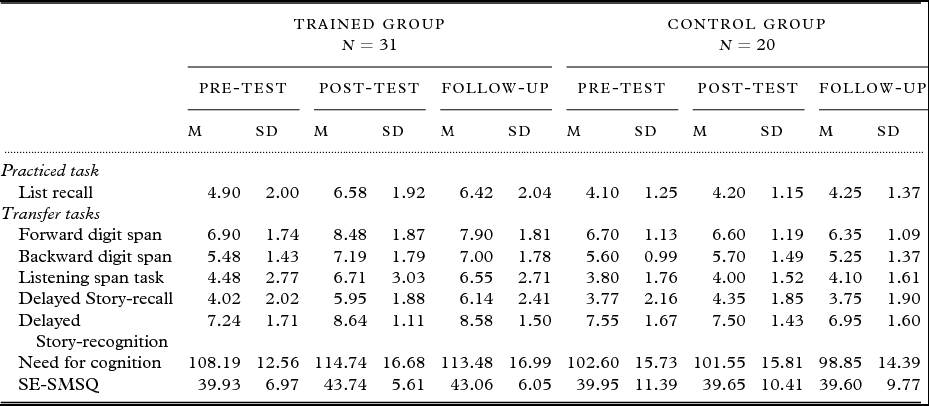
The two groups’ pre-test performance was compared by one-way ANOVA conducted separately for each of the baseline measures (pre-test measures), with Group (trained and control) as the independent variable. Results showed no significant pre-test differences between the groups on any of the measures (Immediate List Recall: F 1/49 = 2.55, p = 0.12; Forward Digit Span test: F 1/49 < 1, p = 0.65; Backward Digit Span test: F 1/49 < 1, p = 0.75; Listening span test: F 1/49 < 1, p = 0.33; Delayed Story-recall: F 1/49 < 1, p = 0.70; Delayed Story-recognition: F 1/49 < 1, p = 0.53; NFC: F 1/49 = 1.97, p = 0.17; SE-SMSQ: F 1/49 < 1, p = 0.10 (Table 2).
Descriptive data for pre-test, post-test, and follow-up by group
Note: SE-SMSQ = subjective evaluation subscale of self-evaluation of memory systems questionnaire.
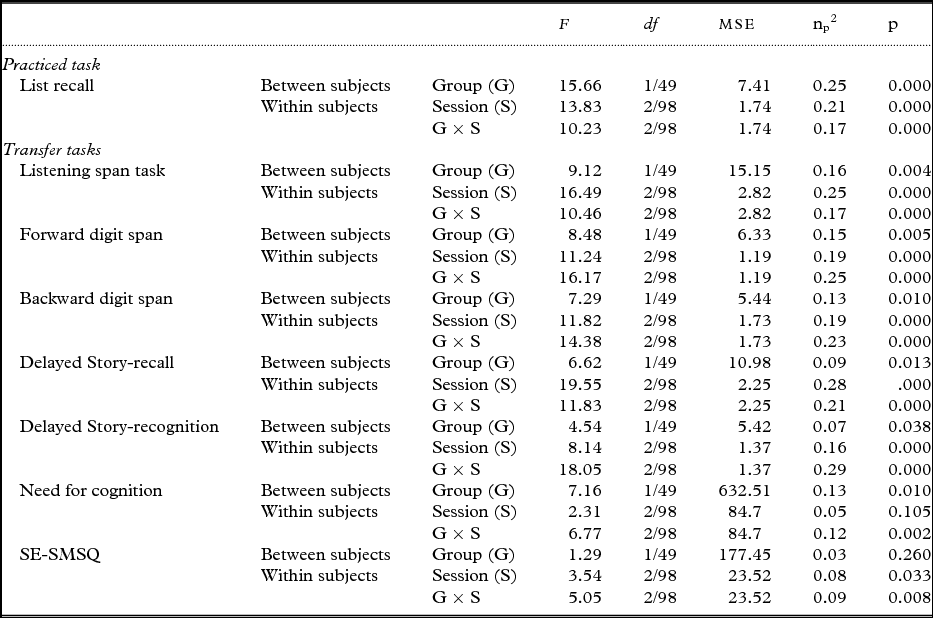
To assess the effects of training, the measures of interest were analyzed with a 2 (Group: trained and control) × 3 (Session: pre-test, post-test, and follow-up) mixed design ANOVA. Significant main effects and interactions were analyzed using pair-wise comparisons, with Bonferroni's adjustment for multiple comparisons. The α value was set at 0.05 for all statistical tests, and at 0.01 for the interactions.
Descriptive statistics are given in Table 2 and ANOVA results are summarized in Table 3.
Mixed design 2 × 3 ANOVAs results for the measures of interest, with Group (trained and control) as Between-subjects factor, and Session (pre-test, post-test, and follow-up) as repeated measure (N = 51) on the measures of interest
Note: SE-SMSQ = subjective evaluation subscale of self-evaluation of memory systems questionnaire.
Cognitive measures
Practiced task
Immediate List Recall. Results showed a main effect of group, with trained group performing better than control participants (MDiff. = 1.78, p = 0.000), and of session, with performance at post-test and follow-up (MDiff. = 0.08, p = 0.62) differing significantly from pre-test performance (MDiff. = −1.06, p = 0.000; MDiff. = −0.98, p = 0.000, respectively).
The group × session interaction was significant. Post hoc comparisons showed that trained participants’ performance improved consistently from pre-test to post-test (MDiff. = −1.68, p = 0.000), and from pre-test to follow-up (MDiff. = −1.52, p = 0.000), with no difference between the latter two. No significant difference was found within the control group across the sessions. The trained group outperformed the control group at both post-test (MDiff. = 2.38, p = 0.000) and follow-up (MDiff. = 2.17, p = 0.000).
Transfer tasks
Forward Digit Span task. Results showed a main effect of group, with trained group performing better than control group (MDiff. = 1.23, p < 0.05), and of session, with performance differing between all three measurement points – pre-test to post-test (MDiff. = −0.92, p = 0.000), pre-test to follow-up (MDiff. = −0.47, p = 0.019), and from post-test to follow-up (MDiff. = 0.45, p = 0.001).
The group × session interaction was significant: trained participants improved from pre-test to post-test (MDiff. = −1.58, p = 0.000), and from pre-test to follow-up (MDiff. = −1.00, p = 0.000), with a decrease in performance from post-test to follow-up (MDiff. = 0.58, p = 0.004). No significant difference was found within the control group across sessions. The trained group outperformed the control group at both post-test (MDiff. = 1.88, p = 0.000) and follow-up (MDiff. = 1.55, p = 0.001).
Backward Digit Span task. Results showed a main effect of group, with trained group performing better than control group (MDiff. = 1.04, p < 0.05), and of session, with performance at post-test and follow-up (MDiff. = 0.29, p = 0.104) differing significantly from pre-test (MDiff. = −1.08, p = 0.000; MDiff. = −0.78, p = 0.001, respectively).
The group × session interaction was significant: trained participants improved consistently from pre-test to post-test (MDiff. = −1.70, p = 0.000), and follow-up (MDiff. = −1.51, p = 0.000), with no difference between the latter two. No significant difference was found within the control group across sessions. The trained group outperformed the control group at both post-test (MDiff. = 1.49, p = 0.003) and follow-up (MDiff. = 1.75, p = 0.001).
Listening span test. Results showed a main effect of group, with trained group performing better than control participants (MDiff. = 1.94, p < 0.05), and of session, with performance at post-test and follow-up (MDiff. = 0.06, p = 0.79) differing significantly from pre-test (MDiff. = −1.43, p = 0.000; MDiff. = −1.37, p = 0.000, respectively).
The group × session interaction was significant: trained participants performed better at post-test (MDiff. = −2.22, p = 0.000), and follow-up (MDiff. = −2.06, p = 0.000) than at pre-test. The trained participants maintained their post-test performance at follow-up. No significant difference was found within the control group across sessions. The trained group outperformed the control group at both post-test (MDiff. = 2.71, p = 0.001) and follow-up (MDiff. = 2.44, p = 0.001).
Delayed Story-recall. Results showed a main effect of group, with trained participants performing better than control participants (MDiff. = 1.16, p < 0.05), and of session, with performance at post-test and follow-up (MDiff. = 0.12, p = 0.59) differing significantly from pre-test (MDiff. = −1.40, p = 0.000; MDiff. = −1.28, p = 0.000, respectively).
The group × session interaction was significant: trained participants performed better at post-test (MDiff. = −1.93, p = 0.000) and follow-up (MDiff. = −2.12, p = 0.000) than at pre-test, with no difference between the post-test and follow-up. No significant difference was found within the control group across sessions. The trained group outperformed the control group at both post-test (MDiff. = 1.60, p = 0.004) and follow-up (MDiff. = 2.39, p = 0.000).
Delayed Story-recognition. Results showed a main effect of group, with trained group performing better than control group (MDiff. = 0.83, p = 0.04), and of session, with performance at post-test and follow-up (MDiff. = 0.25, p = 0.09) differing significantly from pre-test (MDiff. = −0.83, p = 0.000; MDiff. = −0.58, p = 0.008, respectively).
The group × session interaction was significant: trained participants performed better at post-test (MDiff. = −1.40, p = 0.000), and follow-up (MDiff. = −1.33, p = 0.000) than at the post-test, and have maintained their post-test performance at follow-up. No significant difference was found for the control group across sessions. The trained group outperformed the control group at both post-test (MDiff. = 1.14, p = 0.002) and follow-up (MDiff. = 1.63, p = 0.001).
Motivational and metacognitive measures
Need for cognition. Results showed a main effect of group, with trained group performing better than control participants (MDiff. = 11.14, p < 0.05), but not of session.
The group × session interaction was significant: trained participants rated their NFC higher at post-test (MDiff. = −6.54, p = 0.000), and follow-up (MDiff. = −5.29, p = 0.000), with no difference between the two, than at pre-test. For the control group, no significant difference in NFC score was found across sessions. The trained group rated their NFC higher than the control group only at the follow-up (MDiff. = 14.63, p = 0.003).
Subjective evaluation of memory – SE-SMSQ (subscale of the self-evaluation of memory systems questionnaire). Only the main effect of session was significant: evaluations of the trained group have raised significantly only from pre-test to post-test (MDiff. = −3.80, p = 0.000). For the control group, no significant differences in subjective evaluation of one's own memory were found across sessions. There was no difference found in the evaluations of one's memory between two groups, neither at the post-test, nor at the follow-up.
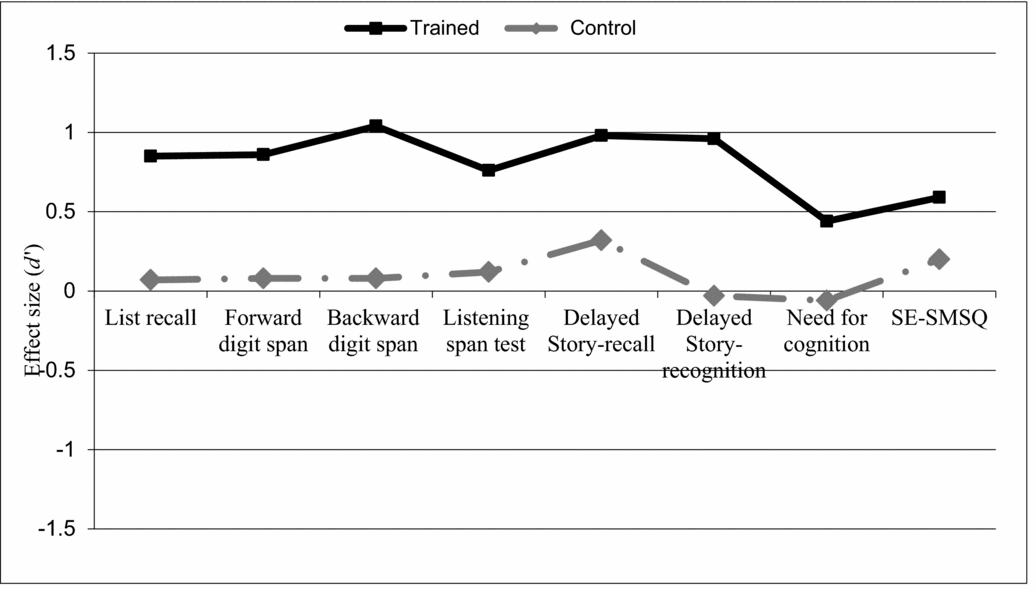
To analyze training gains and transfer effects from pre-test to post-test, and from pre-test to follow-up, Cohen's d (Cohen, 1988), expressing the effect size of the comparisons, was computed for within-subject data (see Morris and DeShon, Reference Morris and DeShon2002). In the trained group we found (see Figure 1): (i) large effect sizes for the Immediate List Recall (d = 0.85), Forward Digit Span (d = 0.86), Backward Digit Span (d = 1.04), Delayed Story-recall (d = 0.98), and Delayed Story-recognition (d = 0.96) tasks; (ii) medium for the LST (d = 0.76) and the subjective evaluation subscale of the SMSQ (d = 0.59), and (iii) small for the NFC (d = 0.44). In contrast, there were small to no benefits found in the control group (see Figure 1).
Effect sizes (Cohen's d) for pre- and post-test contrasts for transfer effects as a function of transfer measure and group (trained and control). Note: SE-SMSQ = subjective evaluation subscale of self-evaluation of memory systems questionnaire.
At the follow-up (compared to pre-test), benefits of the trained group remained about the same for the Backward Digit Span (d = 1.0), Delayed Story-recall (d = 0.94), Delayed Story-recognition (d = 0.84), LST (d = 0.75), and NFC (d = 0.44) tasks. However, the effect sizes changed from large to moderate for the Immediate word-list recall (d = 0.62), Forward Digit Span (d = 0.56), and from medium to small for SE-SMSQ (d = 0.49).
Discussion and conclusion
The potential efficacy of cognitive training can be of particular importance to gerontology and geriatrics because it is crucial to assess the feasibility of training interventions and their efficacy in sustaining cognitive functioning of older adults living in “protected” environment. Apart from a few exceptions (Calero and Navarro, Reference Calero and Navarro2007; Navarro et al., Reference Navarro, Menacho, Alcalde, Marchena, Ruiz and Aguilar2009; Carretti et al., Reference Carretti, Facchini and Nicolini2011b), the training studies have disregarded institutionalized older adults without cognitive impairment as a target population, mainly focusing on community-dwelling older adults and MCI or AD patients (e.g. Piras et al., Reference Piras, Borella, Incoccia and Carlesimo2011; Gross et al., Reference Gross2012; Reijnders et al., Reference Reijnders, van Heugten and van Boxtel2013). This study aimed at examining the benefits of a multifactorial memory training for older adults without cognitive impairment and living in residential care settings. In particular, the proposed training (see De Beni et al., Reference De Beni, Borella, Marigo and Rubini2008) combined teaching of strategies providing information about memory functioning and age-related changes in memory, as well as about the role of metacognition and motivation in using one's own mnemonic ability. Our main hypothesis was that the combination of strategies taught and metacognitive activities can promote transfer and maintenance effects. Specific training gains and transfer effects on different memory systems (STM, LTM, and WM), motivation (i.e. NFC), and metamemory were examined.
The results provided beneficial evidence of the presented multifactorial training in older adults living in the residential care center, confirming the results of several studies that have also proposed cognitive training in similar populations (Calero and Navarro, Reference Calero and Navarro2007; Navarro et al., Reference Navarro, Menacho, Alcalde, Marchena, Ruiz and Aguilar2009; Carretti et al., Reference Carretti, Facchini and Nicolini2011b). In line with our expectations, we indeed found an increase in word-list recall (criterion task) after the training, and this increase was maintained over time (e.g. Stigsdotter-Neely, Reference Stigsdotter-Neely, Hill, Bäckman and Stigsdotter-Neely2000; Bottiroli et al., Reference Bottiroli, Cavallini and Vecchi2008). This result confirms that older adults’ impairment in episodic memory is, at least to some extent, due to the reluctance of older adults to self-initiate the use of cognitive strategies (Dunlosky and Hertzog, Reference Dunlosky and Hertzog2001). Also, it shows that strategy use can improve their performance in cognitive tasks (Dunlosky and Hertzog, Reference Dunlosky and Hertzog2001; Carretti et al., Reference Carretti, Facchini and Nicolini2011b; Gross et al., Reference Gross2012), confirming the presence of a certain plasticity in aging (e.g. Calero and Navarro, Reference Calero and Navarro2007). Since the pattern of results in the trained group is very much different from the one in the active control group, it is reasonable to assume that the benefits found in trained participants can mainly be attributed to the training. Moreover, and in contrast to the majority of the training studies on episodic memory, which consider transfer effects (Stigsdotter-Neely, Reference Stigsdotter-Neely, Hill, Bäckman and Stigsdotter-Neely2000), we found transfer effects also to untrained tasks (STM, WM, and LTM – Story-recall and recognition) in this study as well. Even more important, these gains were maintained at the seven-month follow-up. It should be noted that the maintenance effects of transfer gains have been rarely assessed and found in literature on both the community-dwelling older adults (but see Bottiroli et al., Reference Bottiroli, Cavallini and Vecchi2008, who, however, did not have an active control group) and in the few studies involving institutionalized older adults (Navarro et al., Reference Navarro, Menacho, Alcalde, Marchena, Ruiz and Aguilar2009).
Nevertheless, all selected cognitive tasks involve the use of strategies, although to a somewhat different extent; the gains found could, thus, be attributed to the better strategic knowledge and its use (e.g. Ericsson and Delaney, Reference Ericsson, Delaney, Miyake and Shah1999). Strategic knowledge enables improvement in the encoding of information through the selection and use of more appropriate strategies, and by relying on the deep, meaning-based, processing of words and information to be recalled. The training may have thus facilitated the use of LTM retrieval mechanisms to improve episodic memory, STM, and WM performance (e.g. Carretti et al., Reference Carretti, Borella, Zavagnin and De Beni2011a). Of particular interest here is the gain in WM (also, in terms of effect size) that is in line with the results of Carretti et al. Reference Carretti, Borella and De Beni(2007). The possibility of increasing WM performance after the training is of high value for clinicians, since this mechanism is not only particularly sensitive to age-related decline, but also involved in different abilities related to everyday life.
Apart from teaching the strategies themselves, the structure of training itself could also have favored these benefits and their maintenance. Namely, in all of the sessions, the participants were given brief lectures on memory functioning, metacognition, motivation, and/or age-related changes in these domains. Also, they gained practical experience by: (i) performing cognitive or metacognitive tasks related to the topic presented with the idea to better understand the mechanisms influencing cognitive abilities and aging, (ii) using different strategies, and experiencing the differential memory improvement depending on the various strategies. Furthermore, in order to “experience the theory,” foster mastery and promote learning through effort (Carretti et al., Reference Carretti, Borella, Zavagnin and De Beni2011a). Assigned homework favored the use of these acquired strategies and skills in their daily life, and by doing so, it made these strategies and skills more automatized and less effortful. Furthermore, participants have practiced different memory strategies and gained hands-on experience of the simplest strategies not always being the most efficient – highlighting the importance of using the right strategies even if it requires more effort. The participatory nature of the group setting, due to vicarious experience (“if he/she can do it, I can do it, too”) and social stimulation (e.g. Hertzog et al., Reference Hertzog, Kramer, Wilson and Lindenberger2008), was an additional important factor underlying the success of the training (Gross et al., Reference Gross2012). The synergy of these aspects – metacognitive activities, learning of strategy, and group sessions – has probably played a major role in the success of this training, i.e. gains in cognitive measures and their maintenance. This latter interpretation can further be supported by the increase in the NFC ratings of the trained participants, from pretest to post-test (and follow-up), which indicated that they were more involved in intellectual activities. It is to note that the trained group reached higher NFC scores only at follow-up. This may indicate that more time is needed to change participants’ attitude related to the NFC, probably because of the strong impact and influence of aging stereotypes. Similarly, for the subjective evaluation of memory, improvement of the trained group was also found between pre-test and post-test only in the trained group. Despite the lacking difference between control and trained group for this measure, it is worth mentioning that the effect size for the trained group for this measure was medium, while it was small for control group. The fact that this improvement in metamemory was not maintained for trained group at the time of follow-up is in line with the literature, and confirms the difficulty in modifying metamemory (e.g. Bottiroli et al., Reference Bottiroli, Cavallini and Vecchi2008). It seems that more time and practice might be needed to produce stronger and more durable effects on subjective measures of cognitive functioning in older adults. For now, these results suggest the training schedule may have been too short to enable maintenance of all transfer effects.
In this sense, booster sessions could have had a positive effect for the maintenance of training benefit (Brehmer et al., Reference Brehmer, Li, Müller, von Oertzen and Lindenberger2007). Brehmer et al. Reference Brehmer, Li, Müller, von Oertzen and Lindenberger(2007) showed maintenance of the training benefit through re-presentation of mnemonic instructions in order to reactivate, not just learned strategies, but also the learned attitude. Although performance of the trained group on all cognitive tasks was always higher than in the control group, for some measures (word-list recall, Forward Digit Span, and story recall tests), the effect size at follow-up, at a descriptive level, changed from large to moderate. It is possible that re-practice of the strategies presented during training, and before the follow-up, could have favor the maintenance of the effect size of those measures.
Despite these interesting results, some limitations of the present study have to be acknowledged. First, it would be of interest in future studies to assess transfer effects for tasks in which it is not possible to apply mnemonic strategies (i.e. processing speed and attention measures), with the aim of re-confirming the training's efficacy and in an attempt of determining the “source” of the identified benefits of the training. Moreover, measures related to metacognitive and motivational aspects would have clarified the impact of the training on these aspects. However, we reasoned that longer pre-test, post-test, and follow-up sessions could have demotivated participation and interfered with the working routines of rest homes, limiting participants’ attendance. Nonetheless, this is the first study, which has, by proposing a multifactorial training, demonstrated not only the improvement in the practiced task, but also in transfer tasks, and their maintenance, in institutionalized older adults living in residential care center. It would also be of interest to replicate our results with institutionalized older adults with cognitive impairment (e.g. MCI) to determine whether this multifactorial training can positively affect cognitive performance and possibly delay the onset of dementia. In summary, present results suggest that cognitive training, which combines teaching of strategies with metacognitive activities, like the present one, can be a promising approach for older adults living in residential care settings in sustaining their cognitive functioning.
Conflict of interest
None.
Description of authors’ roles
Andrea Vranić designed the study, supervised the data collection, carried out the statistical analysis, and wrote the paper. Ana Marija Španić participated in data collection and assisted with data analysis. Barbara Carretti assisted with writing the paper. Erika Borella designed the study, supervised the data collection, assisted with data analysis, and wrote the paper.
Acknowledgments
None