BACKGROUND
In recent years the importance of the physical environment in the management of acutely disturbed patients in general adult psychiatric services has become the focus of much discussion. During the early stages of the evolution of PICUs there was concern that the standards of the environment were often neglected in the race to meet demands for beds with heightened security levels.
It was felt that the early development of PICUs was somewhat haphazard, indeed it was the view of Dix (2005) in the editorial introducing the Journal of Psychiatric Intensive Care that ‘many local NHS trusts commissioned units on the basis of convenience, often driven by misguided philosophies’.
The first notable report on the poor standards of intensive care wards by Zigmond (1995) described the general sense that PICUs were widely seen as ‘punishment wards’, lacking in homely items, with a general acceptance of a deteriorating ward environment. Guidance on design shortly followed, with Dix & Williams (1996) placing the importance of ‘homeliness’ of a ward alongside recommendations on ward layout and security. The report notes that items to promote an air of homeliness and therefore a relaxed atmosphere should not present a significant risk to safety.
In 1998, the Royal College of Psychiatrists set up a group to provide suggestions on best practice for design and planning of new adult acute inpatient units; this was summarized in the report ‘Not just bricks and mortar’ (Burns, Reference Burns1998). The group recognised that units that are pleasant to stay in and to work in positively affect patients and staff as well as giving out important messages on acceptable behaviour (Burns, Reference Burns1998). In 2000 The Kings Fund charity launched the project ‘Enhancing the Healing Environment’. The programme sought to guide and support local teams in working together with patients to improve therapeutic environments thereby promoting patient wellbeing and staff morale (Waller & Finn, Reference Waller and Finn2004).
The introduction of the UK Department of Health guidelines on the National Minimum Standards for General Adult Services in Psychiatric Intensive Care Units (PICU) and Low Secure Environments aimed to provide a framework for the delivery of high quality services (Department of Health, 2002). With respect to the physical environment, the Department of Health recommended that the design of any unit should maximise the primary functions of safety, therapy and security (Department of Health, 2002). The National Institute of Clinical Excellence (NICE) also made reference to the strong mitigating effects that the physical and therapeutic environment of inpatient settings can have on disturbed and violent behaviour (NICE guidelines, 2005).
Following on from the 2002 Department of Health guidelines, a survey was carried out to clarify whether the current physical environments of PICUs and LSUs met the set standards (Pereira et al. 2006). The survey was thought to be the first of its kind in establishing standards on PICUs. The authors outlined the potential of the therapeutic environment to accelerate or hinder recovery. Following the survey, the Department of Health invested a total of £160 million to address the shortfalls in standards. Recent recommendations continue to emphasise that a PICU should provide space and facilities for a homely environment in which a patient can spend the majority of their day (Dix & Page, Reference Dix, Page, Beer, Pereira and Paton2008).
In alignment with recommendations for providing a homely, less institutional environment in inpatient units, a number of changes to the furniture and fittings were proposed for a PICU in the Central and North West London NHS Foundation Trust (CNWL). Of these proposals, one was the idea to introduce metal cutlery in place of plastic, for the use of the patients in the ward dining area to improve the patients’ dining experience. There was concern that this cutlery could potentially be used as a weapon and could therefore compromise the safety of patients, staff and visitors on the ward.
A standard was sought by the team to guide decision making on this issue. However, there was found to be a real lack of general understanding, evidence, guidance, and therefore a lack of a ‘standard’, in relation to the clinical question, namely: ‘should our unit use metal cutlery'. At a local level, within the CNWL Trust, there was no clear policy or other guidance on the use of metal cutlery on wards. The 2005 NICE guidelines on the short term management of disturbed and violent behaviour in inpatient psychiatric settings and emergency departments provides general recommendations for ward environments but does not provide advice with regards to the specifics of furniture and fittings such as cutlery.
This led to thought regarding how this could be determined. A service evaluation was proposed to determine whether the standard should be ‘yes’ or ‘no’. Without a standard to be guided by or audited against, this work thus turned perforce into a ‘proof of concept' pilot. The pilot became a ‘first steps’ exercise seeking to identify a measure that would facilitate the setting of a standard.
It has been described previously, that perpetrator risk factors for patients and visitors in healthcare settings include mental health disorders and possession of weapons (Gillespie et al. 2010). In an earlier study looking into violence in healthcare settings, 11% of perpetrators used a weapon during violent attacks on workers (DuHart, Reference DuHart2001). Previous violence towards others or self and a previous forensic history have been identified as important risk factors from the history of a patient which may increase future risk of violence (Royal College of Psychiatrists, 1995, 1998). It has also been recognised that most assaults occurred during mealtimes and afternoons (Lanza et al. 1994). National crime statistics are in keeping with this literature; the House of Commons published a report expressing concern about the high recidivism levels of perpetrators of knife crime in the criminal justice system (House of Commons, 2009). In addition to concerns about the safety of others, metal cutlery could potentially be used in acts of self harm or to attempt suicide. Weapons have previously been identified as being associated with increased suicide risk in the inpatient setting (Mills et al. Reference Mills, Watts, Miller, Kemp, Knox, DeRosier and Bagian2010).
Based on this evidence it was therefore decided that the PICU population would be tested against history of weapon use as the measure. Knowing that past behaviour is the best predictor of future behaviour, including violence, meant that it was known at the outset that this measure had at least face validity.
AIM
The aim of this study was to carry out preliminary work in order to determine a ‘yes or no’ standard for the appropriateness of the use of metal cutlery on PICUs. This could be either taken as a whole or for particular definable sub-groups e.g. those whose populations have high rates of weapon use. This would be done through a service evaluation examining past weapon use of PICU patients compared to patients on an open ward. From data collected and examined, a decision could thus be made for this particular PICU. Having conducted a literature search, it would appear that this service evaluation is the first of its kind, so this is also intended to be an exploratory investigation.
METHOD
Patients’ histories were examined to ascertain their previous patterns of weapon use and identify any potential association or dissociation between this and the patient pathway i.e. PICU or non PICU (General Ward only).
A consecutive retrospective case note analysis looking for any documentation of previous weapon use in the last 30 admissions to a 14 bed psychiatric intensive care unit in CNWL in February 2010 and the last 30 admissions to a general adult admission ward at the same site was conducted. All available notes, including risk assessments and clinical notes were scrutinised. As the PICU was male only, comparisons were made with a male only sample from the general ward; females were excluded as were patients on the general ward who had previously been admitted to the PICU.
As well as looking at whether patients had a history of weapon use, the type of weapon used, the level of use (including possession, threat or actual use), the setting in which it was used, when a weapon was last used, the patient’s predominant mental disorder and compliance with medications, as indicated by a professional’s entry in notes, at the time of use were also investigated.
ETHICAL ISSUES
This project was submitted to the CNWL clinical audit department and reviewed by one of the Trust research and development leads. Both concluded that this project was a service evaluation and not research. Therefore it did not require research ethics committee approval at this preliminary stage.
RESULTS
The data obtained were discrete and binomial. The null hypothesis was that there is no association between patient pathway or ward type and history of weapon use. As our statistical test we mainly used Fischer’s exact test, rather than chi squared, because of the small sample size.
Of the 30 inpatients on the PICU in the sample, 19 had used weapons compared with 7 inpatients on the general ward. There was thus significant difference found between those on the PICU and those on the general ward (p = 0.0038). Of the 19 patients on the PICU with positive history, 23 weapon incidents were recorded; of the 7 patients on the open ward with positive history, 7 weapon incidents were recorded. This shows that some service users on the PICU had used weapons multiple times. In this sample, this was not the case on the open ward.
It was interesting to note that there was no significant difference between the wards in type of weapons used (p = 0.54; Fig. 1). Weapon use was associated with non improvised types of weapon, particularly bladed, on both wards. Data show that 19 out of 23 (83%) of instances on the PICU and 7 out of 7 (100%) on the general wards featured non-improvised weapons. There were four recorded incidents of improvised weapon use, all of which had occurred within the PICU population. They included use of part of a chair, part of door handle, a fork and a screwdriver.
Types of weapons used by service users on PICU and open wards

Interestingly, no difference was found between the wards in terms of number of threat and assault instances associated with weapons, which were classed as the highest level of weapon use (p = 0.18).
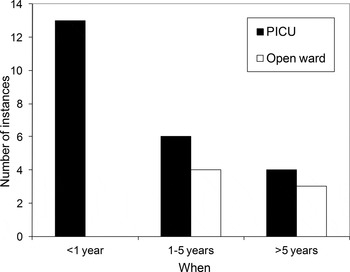
Significant differences between the wards with regards to when weapons were last used was observed (p = 0.014; Fig. 2). 13 of the 23 weapon use instances recorded by patients on the PICU had occurred within one year of the admission, compared with none of the seven such instances on the general ward.
When weapons were last used by service users on PICU and open ward

Of the PICU population, 8 (35%) of the recorded incidents of weapon use had occurred in the home setting, 12 whilst in public (52%), 1 occurred in an unknown setting and 2 had taken place in an inpatient setting (9%). On both occasions where weapon use had occurred during an inpatient admission, the type of weapon used was improvised out of fixtures and fittings from the ward, namely a chair and a door handle. Of the general ward population 4 of the 7 incidents occurred in public, 2 at home and 1 setting was unknown. None of the general ward patients had a history of weapon use whilst an inpatient.
The data of the timings of weapon use was in keeping with the data describing the mental disorder at the time on weapon use as recorded in the professional’s entries in the notes. When recording this data we took the fundamental disturbance in mental state as per the broad categories of ICD-10 e.g. psychotic, mood and personality disorders (World Health Organization, 1992). PICU patients with a weapon history were predominantly (18/23 cases) suffering from psychosis when they used the weapon compared to 2/7 on the open wards (p = 0.0001; Fig. 3). In 8 incidents the mental disorder at the time was unknown. Compliance with medication showed a similar trend: 12 PICU patients and 2 general ward patients were noncompliant.
Mental state at time of weapon use

DISCUSSION
In response to proposals to introduce metal cutlery for use on a PICU, this evaluation was initiated to clarify whether a history of weapon use might be used as a valid measure to determine future risk of weapon use in a PICU population. It was thought that this would help to inform and guide standardization of practice in relation to security questions such as the provision of metal cutlery. This could also serve as groundwork for further study in this unexplored territory.
Our evaluation was limited by a small study sample, which meant that not all of the results were statistically significant. Means of the data collection posed another limitation in that there was a tacit assumption of completeness of records. Where there was no mention of a history of weapon use in the patient records it was recorded that there had been no history. It is likely that even with accurate records, weapon use would still be underestimated as only a proportion of crime is detected and self reporting of crime is unlikely to be completely reliable.
For this preliminary stage of work it was deemed appropriate to concentrate on the patient records for obtaining data as the information could be readily and reasonably accurately ascertained. For further work it may be necessary to cross check this with carers and police in order to provide a ‘gold standard’ comparator to test for accuracy or criterion validity.
The most striking finding in this study was that a history of weapon use was significantly higher in patients admitted to the PICU as compared to patients on the general ward at this site. PICU patients who had a history of weapon use had also used the weapons on more occasions. 63% of the PICU patients had a history of weapon use as compared to 23% of patients on the general ward. This is particularly important if we take into account that previous violence and a previous forensic history is believed to signal increased future risk of violence (Royal College of Psychiatrists 1995, 1998).
Of particular interest to our study, we found that past weapon use in both the PICU and open ward patients were predominantly of bladed items. In light of this finding, added to the fact that patients in this unit are commonly transferred between the PICU and general wards we could ask whether metal cutlery is safe on any ward.
In addressing this question, it is important to note the finding that the majority of patients were suffering from psychosis at the time of past weapon use and were noncompliant with their medications. This is significant when dealing with the patient population in PICUs, given that here, patients are in an acutely disturbed and or violent phase of a serious mental disorder (Department of Health, 2002). Furthermore, we noted that the majority of patients on the PICU with a history of weapon use had been involved in incidents in the year leading up to the admission. In contrast to this, none of the general ward patients who had used a weapon had used one in the year leading up to the admission.
Knowing that past behaviour is the best predictor of future behaviour, including violence, meant that it was known at the outset that this measure had at least face validity. We also show that the measure has convergent validity because incidents of weapon use appear to coincide with episodes of acute illness within the PICU group, as well as divergent validity because, between groups, patients deemed to have lower levels of risk and disturbance, i.e. general ward patients, were found to have lower rates of weapon use. Note that we did not include PICU patients in the general ward group because we are interested here in the validity of the measure rather than the risk of weapon use per se on a general ward. Incidentally we might assume, though, that this would be proportionately less even if PICU patients were included because, as already mentioned, weapon use appears to co-associate with severity of illness for PICU patients.
The results obtained related to the population of the particular unit that was evaluated and were valid for this setting. This helped to clarify whether the decision should be ‘yes’ or ‘no’ with regards to introducing metal cutlery onto our PICU at the time of the evaluation. This work was thus successful in identifying a measure that was relevant and practical to measure against. It is not however felt in any way appropriate to postulate a blanket standard for all PICUs on the basis of this preliminary pilot. At this stage the suggestion that emerges is to monitor the unit population in terms of the forensic profile including in particular weapon use; collect and analyse data against this measure on your unit. A much larger (probably national) cohort study could corroborate the validity of the results, and consider the predictive characteristics, e.g. does a high rate of historical weapon use predict future weapon use on PICU, thence leading to more formalised guidance on this issue. We would also recommend collecting data on known risk factors for weapon use such as age and a history of illicit substance use in an attempt to control for confounding factors.
Having identified an appropriate measure the next task would be to consider what options are available to reduce the risk associated with cutlery use on the wards. The alternative to metal cutlery that we have suggested is toughened plastic cutlery or ‘safety cutlery’. There is a general lack of literature with regards to the risks of plastic cutlery, however the widespread use of plastic cutlery in the prison services and more recently, in commercial aviation to try to reduce risks of violent acts suggests that it is generally accepted that plastic cutlery is safer than metal cutlery. There have been only isolated reports in the media, of cases in which plastic items have been fashioned into weapons in hospital and prison settings. The most commonly used safety cutlery in hospital and prison settings is plastic cutlery made from polycarbonate. This toughened plastic has increased rigidity and is advertised as being durable, shatterproof and virtually unbreakable. Alternative safety features include blunted or rounded ends, and a reduced level of serration on the edge of knives.
Thus far we have only considered the environmental security aspect of a ward, in particular, cutlery. It is important however to consider the other two classical components of security: relational and procedural. Thus, the provision of a metal cutlery, by creating a more homely environment, might, it could be argued, be associated with improved security by enhancing the relational ‘atmosphere’ of the ward. With regards to procedural security, options would include greater staff supervision at mealtimes and a cutlery inventory before and after the meal, however, these measures might by themselves militate against the more homely effects of using metal cutlery.
Of course, there are inherent tradeoffs between the different aspects of security, for example, too much environmental security may lead to a deterioration in relational security thereby causing a lowering of security overall (Kennedy, Reference Kennedy2002). Our approach suggests a rational methodology to guide decisions about balancing the different elements of security for each individual PICU.
CONCLUSION
This study showed that patients on this PICU have a higher rate of weapon use than patients who have never been admitted to a PICU on the general ward that was evaluated. In particular it was noted that there is significant correlation between both acuity of condition and noncompliance with medication and weapon use. Non improvised particularly bladed weapons were most frequently used.
Partly based on the results of this audit, we concluded locally that the proposal to introduce metal cutlery to this inpatient unit, which had a population with a high level of disturbance could potentially compromise delivery of care in this setting. It could furthermore place patients, staff and visitors on this ward at a greater risk of violence. The decision regarding the question of whether to introduce metal cutlery onto the PICU in question was therefore ‘no’.
In view of the limitations of the study, this decision per se cannot and should not be generalised to all PICUs. However, we believe that as a general approach to setting standards and thresholds for risk management procedures on PICU this study and its findings merit further discussion and possibly wider application. If this approach were felt to be of value then further investigation using larger PICU samples and cohorts would be needed to more fully define the operating characteristics of any suggested risk measure including a history of weapon use, including critically the performance of the measure in terms of predictive validity. The establishment of a comprehensive national PICU database and network could provide the necessary infra-structure to research this and other key clinical and service questions. Such a database would enable the use of national controls at unit level, historical, naturalistic, or selected (random or non-random, stratified or unstratified), to assess the impact of any introduced service changes thereby closing the audit loop.
In the interim, our recommendation is to look carefully at your ward population and its risk profile before making any decision regarding security procedures. Within the limits of the study the measure used i.e. a documented history of weapon use was found to be practicable and valid. It could therefore serve to guide further work toward defining a robust and useable standard to inform what are often difficult decisions in relation to the proper balance of safety and therapy.
It is undisputed that a sensitively designed and homely ward environment has positive outcomes for both patients and staff. Key to this is striking a balance between providing a therapeutic setting with the least amount of restrictions thereby maintaining a degree of autonomy for the patients whilst keeping the wards safe. In the drive to make ward environments more homely, and therefore more therapeutic, careful consideration of measures used to achieve this is essential, as this should not compromise safety.
ACKNOWLEDGEMENTS
The authors would like to thank Dan Goad, CNWL Audit Department and Mohammed Al Rawi, Specialist Registrar.