Introduction
The Medical Reserve Corps (MRC) is a national network of volunteers who are organized in local community-based groups and supported by the Division of the Civilian Volunteer Medical Reserve Corps (DCVMRC) in the Office of the Surgeon General. More than 200,000 volunteers in almost 1000 units located in all 50 states and most territories are committed to strengthening public health; reducing vulnerabilities; improving local preparedness, response, and recovery capabilities; and building resilience in their communities. 1 Each MRC unit is unique and is shaped by many factors, including geography, local regulations, housing organizations, volunteer composition, mission, and community needs. Local health departments (LHDs) house 67% of MRC units, 2 and as LHDs and other local and state agencies across the nation continue to operate under reduced budgets, MRC units are increasingly called upon to provide surge support to allow the LHDs to meet their missions. The volunteers supplement staff resources and fill gaps in public health and emergency response services. The result is a collaboration that can keep a community healthy and prepared for large-scale disasters and emergencies.
The MRC provides a way to recruit, train, and activate volunteers, including medical and public health professionals and many other community members with necessary skills, such as interpreters and legal advisors. 3 Since its inception in 2002, MRC units and volunteers have played an important role in the response to different types of hazards, ranging from the spread of pandemic influenza to natural disasters.Reference Tosatto 4
The success of an MRC unit is dependent on the ability of its volunteers to respond in a timely and effective manner. Therefore, MRC volunteers need to be adequately trained in advance to respond swiftly to a local emergency. Homeland Security Presidential Directive (HSPD-8) defines preparedness as “the existence of plans, procedures, policies, training, and equipment necessary at the Federal, State, and local level to maximize the ability to prevent, respond to, and recover from major events.” 5 Additionally, the national public health preparedness standards provided to state and LHDs through the CDC’s Public Health Preparedness Capabilities suggest in Capability 15 that volunteers need to receive jurisdiction-defined training for their assigned responsibilities through training courses delivered by the jurisdictional health departments alone or in collaboration with other partners. 6
All MRC volunteers should participate in some form of orientation in order to best understand the system in which the MRC unit operates. In addition, volunteers should receive additional trainings that focus on different aspects of support, skill building, and preparation for deployment. 3 A volunteer training program is one of the critical factors for the success of the MRC. 7 Each MRC unit is encouraged to create and implement a training plan tailored to its community needs. This ensures that training goals and objectives are met and provides a step-by-step guide to prepare volunteers for deployment in response to emergencies. In 2007, a set of MRC Volunteer Core Competencies was developed for the network. 8 Even though MRC volunteers play different roles in their units, all volunteers should have a baseline level of knowledge and skills.
Earlier evidence suggested that participation in response training is associated with the preparedness of health care workers.Reference Chen, Hickner and Fink 9 - Reference Jeffrey 11 For example, physicians who received bioterrorism training tended to have a stronger sense of personal preparedness for outbreaks of an unknown but potentially dangerous illness.Reference Alexander and Wynia 10 Furthermore, when health care providers perceived benefits from training and drills, they felt prepared and were more willing to respond to a bioterrorism event.Reference Jeffrey 11 Similarly, training results in greater reported confidence and perceived capability, which are much needed elements in the effective use of MRC units.Reference Chandra, Kim and Pieters 12 Increased self-efficacy is a primary predictor of volunteers’ willingness to participate in public health emergency-related activities.Reference Errett, Barnett and Thompson 13 Sufficient and timely volunteer training can support risk management practices, promote response capabilities, and increase confidence in performing duties. Training is also critical for volunteer retention. 14
Various training tools have been developed to assist MRC units with their training programs. Since 2006, MRC Training Finder Real-Time Affiliate Integrated Networks (MRC-TRAIN), a learning management system with a centralized, searchable database of courses relevant to public health and emergency management, has been available to the MRC. MRC-TRAIN offers a customizable training curriculum for each unit. The MRC Factors for Success, developed by the DCVMRC, is a comprehensive set of programmatic elements that incorporate generally accepted practices of organizational development that can be used by MRC leaders to guide and gauge the development of their units. 7 In addition, an electronic Listserv is available for the MRC as an informal collaboration and resource sharing tool.
To date, there has been little published about the training among MRC volunteers across the nation. Given the potential of training to influence the attitude and behavior of volunteers and the performance of MRC units, this study aimed to assess the current status of MRC volunteer training and to examine the association between characteristics of MRC units and the provision of training.
Methods
Data Collection and Sample
Data from the 2013 Network Profile of the MRC (Profile) were collected by the National Association of County and City Health Officials (NACCHO). The Profile survey was the first national survey to gather data on structure, activities, and capacities of the MRC network. It was administered to active MRC unit leaders or designated alternates of 962 units across the country from April to May in 2013. A total of 837 MRC units responded, with a response rate of 87%. The study was based on organizational surveys; thus, it was exempt from full institutional review board review.
Measures
The MRC unit characteristics included in the analysis were jurisdiction population size (≤50,000, 50,001-500,000, >500,000), jurisdiction type (urban, suburban, mixed, rural/frontier, tribal), number of volunteers (≤50, 51-150, >150), whether more than one MRC unit serves the jurisdiction (yes/no), work status of the unit leader (full-time, part-time, volunteer), gender of the unit leader, whether the unit had participated in an emergency response in the past 12 months (yes/no), and whether the unit partnered with or deployed alongside another organization (yes/no).
Participants were asked whether their MRC had a training plan (yes/no). The training opportunities were assessed with a list of training courses (eg, basic life support, blood-borne pathogens). For each course, participants were asked to indicate 1) whether they offered this training and 2) whether this training was mandatory for their volunteers. To measure training collaboration, the participants were asked to indicate whether they had trained volunteers with each of the entities in a list (eg, American Red Cross, LHD).
Analyses
To obtain representative data, weights were generated on the basis of the strata of unit jurisdiction population size. Descriptive statistics were calculated for all MRC units. Bivariate analyses were conducted to examine the association between MRC features and the availability of a training plan. Multivariable logistic regression was used to assess the independent relationship between each key MRC characteristic and the presence of a training plan. Analyses were conducted by using Stata 12.1 with proper statistical weights to account for disproportionate response rates by size of the population in the MRC jurisdiction. All p-values were two-tailed, with values less than 0.05 considered statistically significant. Odds ratios (ORs) and 95% confidence intervals (CIs) were reported for the logistic regression model.
Results
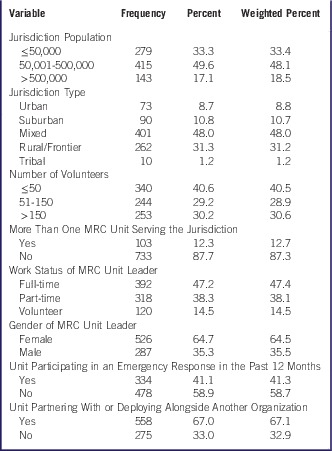
Table 1 presents descriptive statistics on the infrastructural characteristics of MRC units, whether they had participated in an emergency response in the past 12 months, and whether they had partnered with or deployed alongside another organization. About half of MRC units served jurisdictions with populations between 50,001 and 500,000. Nearly two-thirds (64.5%) of units had a female unit leader. Only 41% of units had participated in an emergency response in the past year, and 67% reported partnering with or deploying alongside another organization.
Characteristics of Medical Reserve Corps (MRC) Units

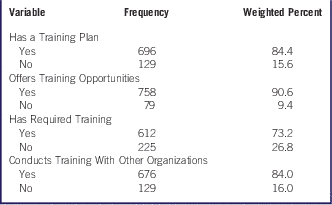
The percentages of MRCs having training plans, providing training, and collaborating with other organizations in training volunteers are presented in Table 2. Over 80% of MRC units had a training plan. Ninety-one percent of MRCs offered one or more training courses to volunteers, and 73% indicated requirements for mandatory training. Approximately 84% of MRC units collaborated with other organizations to conduct trainings.

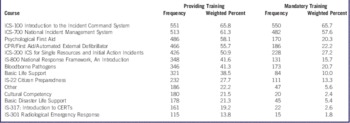
Table 3 presents the training courses provided and whether they were required. The most frequently offered trainings were “Introduction to the Incident Command System” (ICS) and “National Incident Management System,” which were also most likely to be mandatory for volunteers. Over half of MRC units also provided training through the courses “Psychological First Aid,” “CPR/First Aid/Automated External Defibrillator,” and “ICS for Single Resources and Initial Action Incidents,” but these courses were much less likely to be mandatory.
Medical Reserve Corps (MRC) Training (Weighted)Footnote a

a ICS indicates Incident Command System; CERT, community emergency response team.
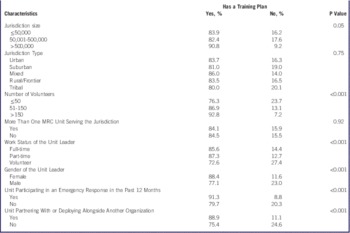
Table 4 shows the characteristics of MRC units that were significantly related to the likelihood of having a training plan. Overall, MRC units serving the largest jurisdictional size (>500,000) were more likely to have training plans than were MRC units serving small (≤50,000) or medium (50,001-500,000) jurisdictions. Similarly, MRC units with more volunteers (>150) were more likely to have a training plan. Some unit leadership characteristics were related to the existence of a training plan. In particular, units with female leaders or leaders with full-time or part-time work status were more likely to have a plan than were units with male leaders or leaders who were volunteers. In addition, having participated in an emergency response in the past year was significantly associated with having a training plan. MRC units that were partnering with or deploying alongside another organization were also more likely to have a training plan.
Characteristics of a Medical Reserve Corps (MRC) Unit Associated With the Existence of a Training Plan (Weighted)

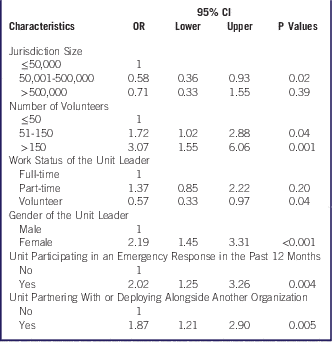
Table 5 presents the results of multivariable logistic regression for having a training plan. Only the MRC characteristics that were found to be statistically associated with having a training plan in the bivariate analysis in Table 4 were included in the model. After control for other independent variables, all factors included in the regression model remained statistically significant. Units with more volunteers (>150) were three times as likely to have a plan for volunteer training as were units with fewer volunteers (≤50). Compared to units with a full-time leader, those with leaders who were volunteers were only 0.57 times as likely to have a training plan. In addition, the odds of having a training plan was 2.19 times higher for units with female leaders than for units with male leaders. Units that had participated in an emergency response in the past 12 months were twice as likely to have a plan as were units not engaged in such activities.
Factors Associated with the Existence of a Training Plan (Weighted)Footnote a

a OR indicates odds ratio; CI, confidence interval.
Discussion
It is important for communities to have a cadre of ready and willing volunteers who are trained and capable of assisting in an emergency response. The findings of the present study suggest that an overwhelming majority of MRC units provide critical training to their volunteers prior to an emergency deployment. The high level of engagement in volunteer training may be attributed to the availability and easy accessibility of various MRC training resources. According to the MRC technical assistance series, each MRC unit may employ a different approach to training based on their own community needs and features. The aforementioned training tools available to the MRC (MRC-TRAIN, Factors for Success, and the MRC Listserv) foster virtual communities of practice and include sample training plans and a place to share training successes and challenges with their peers. Many MRC units have benefited from these tools and have used them to promote the overall volunteer capabilities and to share their training plans and resources with other MRC units. 15
A high percentage of MRC units are working with other organizations in conducting trainings for volunteers. One out of four MRC units conducted training with 6 or more partners. In particular, MRC units were most likely to collaborate with LHDs in providing training. Nearly two-thirds of MRC units that reported conducting training with other organizations indicated LHDs as their partners. Other most frequently mentioned partners were emergency management agencies and the American Red Cross. 2 Because MRC units are community-based, operate locally, and do not work in a stand-alone role,Reference Frasca 16 the collaborative efforts in volunteer training allow volunteers to be familiar with community needs and resources and better perform their function within their geographical areas. In addition, conducting training with other organizations can more effectively utilize scarce resources. It is possible that MRC units also receive guidance about training plans from other partner organizations.
Several MRC characteristics were associated with having a volunteer training plan. MRC units with fewer volunteers were less likely to have a training plan in place, which may have been due to fewer resources and less preparedness funding. Our findings also highlight the influential role of MRC leaders. Units with full-time or part-time leaders were more likely to have a training plan than were units with volunteers as leaders. In addition to developing volunteer relationships and capabilities, leaders also assume a number of other responsibilities such as identifying and pursuing financial and other resources, coordinating with local response partners, and maintaining the units’ organization. 17 All of these require a tremendous investment in time and effort, which may be particularly challenging for MRC leaders who are volunteering their time to run their MRC unit.
The relationship between MRC units with training plans and associated factors presents a unique opportunity for future application and research. The findings in this study show that the presence of training plans was three times as likely among units with a volunteer size that exceeded 150 volunteers, which may indicate that having a training plan in place could be used to better recruit and retain MRC volunteers. Although the Profile does not delve deeper into the retention and recruitment practices of volunteers for those with training plans, the literature supports that the training of volunteers should be viewed as an opportunity to build a sense of community among volunteers so as to enhance volunteer commitment and satisfaction.Reference Costa, Chalip and Green 18 Having a training plan might also convey the importance of volunteer work and provide organizational support to enhance the commitment of the MRC volunteers.Reference Boezeman and Ellemers 19
Furthermore, the study results indicated that MRC units that had participated in an emergency response in the past year more often had a training plan in place. As suggested by prior literature, emergency plans are usually reexamined after disastrous events, both natural and manmade.Reference Danna, Bernard and Jones 20 During emergency responses, gaps are identified and may encourage the need to improve future operations and strengthen the overall unit capabilities. Actual participation in an emergency response may highlight deficiencies and facilitate the development of a training plan for MRC units. This may also indicate the importance of participating in all-hazards exercises or drills to strengthen the MRC capabilities.
This is the first study to address the engagement of the MRC in training volunteers on a national level. The strengths of the study are its large sample size and its representation of the MRC population. This study also had certain limitations, however. The Profile data were self-reported by MRC units and NACCHO did not verify the accuracy of these data. Owing to the cross-sectional nature of the study design, causal inferences cannot be made. In addition, the survey did not collect information on resources that MRC units have for training, such as staffing and access to technology. These potential confounding factors were not controlled for in the analyses.
Conclusions
Unpredictable and fast-changing natural and manmade disasters require different competencies among emergency preparedness staff and volunteers. Developing effective training plans and courses and providing MRC volunteers with time and access to participate in training are critical in helping them achieve and maintain the skills needed to perform duties during emergencies. The locally based focus of each MRC precludes the one training plan fits all model for the MRC, but the training resources provided to each unit along with collaboration with partner organizations, supplies the MRC with tools and resources to train volunteers to be ready when called. Leadership and partnership play a positive role in facilitating the provision and implementation of training programs. MRC volunteers with adequate training are better equipped to strengthen public health; improve emergency preparedness, response, and recovery capabilities; and build the resiliency of their communities.
Acknowledgments
This study was supported by funding under Cooperative Agreement 5 MRCSG101005-04-00 and 5-MRCSG101005-03-00 with the Office of the Surgeon General.