Over the course of 66 poems, the poet admires the beloved, scolds the beloved, pines for the beloved, complains about the beloved, insults the beloved – and also offers introspective reflections and metaphorical tableaux that comment upon the situation in sarcastic but sometimes also profound ways. Rather than any of the individual poems, it is the cumulative effect of Heinrich Heine's Lyrisches Intermezzo as a whole that shocks, saddens, provokes and moves the reader, with such organizational devices as poetic pairings, carefully organized groups and especially striking juxtapositions that undercut or even entirely replace emotions from one poem to the next. Thus does the cycle convey the complexity of the poetic persona's contradictory emotional state, not to mention Heine's own conflicting attitude towards lyric poetry and the Romantic project: he overtly repudiates but simultaneously longs for a Romantic ideal he knows to be illusory. Indeed, it is the poet's skill at organizing his short poems into groups – what Norbert Altenhofer has called his ‘aesthetic of arrangement’ – that stands today as one of Heine's greatest poetic achievements.Footnote 1
What happens, then, when a composer alters Heine's fastidiously organized cycle? Nobody would dispute that when Robert Schumann selected 20 poems from the Lyrisches Intermezzo to create the song cycle he eventually titled Dichterliebe, he fundamentally altered Heine's poetic cycle. Thanks to Rufus Hallmark's pioneering research, the process by which Schumann selected the poems is well known: he began by setting the first seven poems in order, almost as though he were planning to set the entire cycle (as he did when he previously set a Heine cycle, for his Liederkreis, op. 24), but he then started skipping and reordering poems, composing the songs in essentially the same order as that in which they appear in the finished song cycle (though at one point he wrote out a list of potential poems, many of which he did not set, and he deleted four songs prior to publication).Footnote 2 While it has proved possible to reconstruct Schumann's process, we will never, however, know his intent in composing the songs; accordingly, the exact nature of his alterations to Heine's cycle – not to mention the meaning of Dichterliebe – remains open to debate.
In discussing Schumann's creative process, Hallmark speculated as to why the composer chose not to set some of the poems on his list, concluding that Schumann's intention was ‘to condense a drama from Heine's wide-ranging anthology of lyrics of frustrated and embittered love’.Footnote 3 The idea that Schumann consciously constructed a plot – that he made explicit a narrative only implied in Heine's cycle – has for decades been the most common view of Dichterliebe, appearing in programme notes and scholarly analyses alike. For instance, the scholars Barbara Turchin and Christopher Lewis have offered schematic diagrams of the song cycle's plot structure, using the plot as the starting point for their musical and hermeneutic analyses.Footnote 4
The long-standing assumption that Dichterliebe has a plot, and that this plot is crucial for unlocking the cycle's meaning, has been questioned by David Ferris as part of his larger project to reconceptualize the genre of the song cycle not as an organic, unified whole but as a Romantic fragment.Footnote 5 For Romantic writers such as Friedrich Schlegel, Novalis and other members of their circle at Jena at the turn of the nineteenth century, a Romantic artwork is never finished but is in a perpetual state of becoming.Footnote 6 The work is simultaneously and paradoxically both complete and incomplete; while the creator's task might be finished, the listener/reader/viewer must actively engage the work, enter into it and complete it by supplying his or her own interpretation. Ferris compellingly argues that since the individual lied is a fragment, the song cycle as a whole is also a fragment, with the fragmentary nature of each song emphasizing the larger gaps in the collection.Footnote 7 Accordingly, for Ferris, a song cycle is held together not by such unifying factors as a coherent key scheme, motivic relationships or even a concrete narrative, but rather by a flexible web of loose associations and the mere potential for the songs to interact with each other. So determined is Ferris to prove that narrative is not an important means of coherence for song cycles that he goes so far as to deny that Dichterliebe contains any narrative whatsoever.Footnote 8 Drawing upon the narratological distinction between the episodes presented in a narrative and the actual series of events from which the episodes are drawn, Ferris boils the plot of Dichterliebe down to a simple series of four events: ‘(1) the poet falls in love; (2) he and his beloved carry on a romance; (3) she ends the relationship; (4) she marries someone else’.Footnote 9
From this, he argues that the order in which the songs are presented in the cycle has little to do with this plot. Expanding upon Charles Rosen's influential interpretation of the postlude of the last song as a memory,Footnote 10 he interprets the entire cycle as a series of random memories, in which it is futile to attempt to find any narrative coherence.
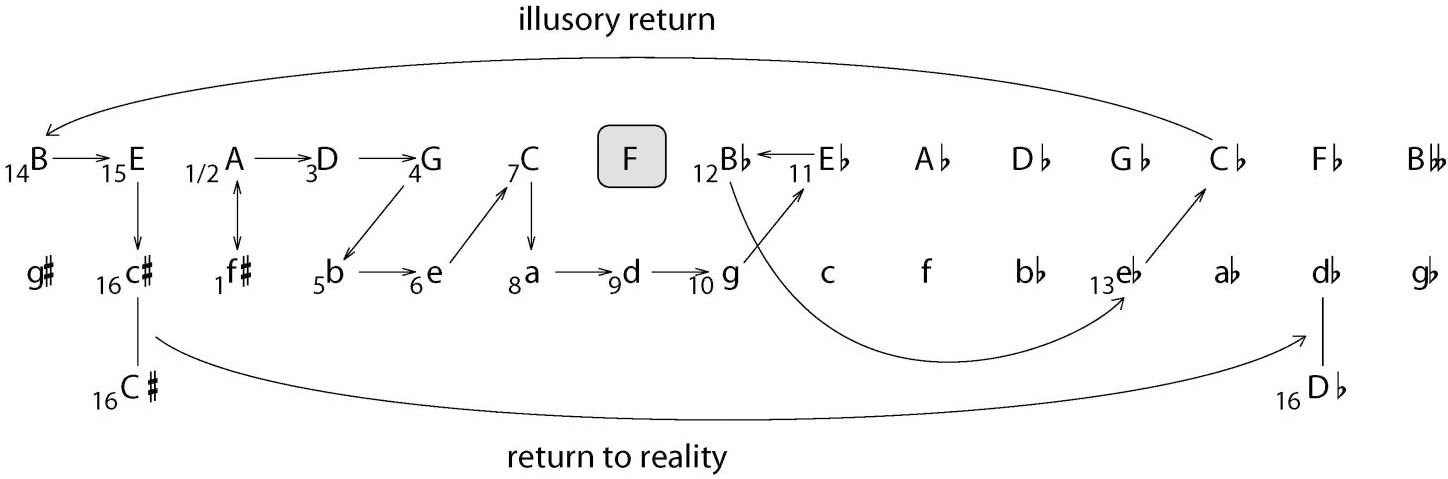
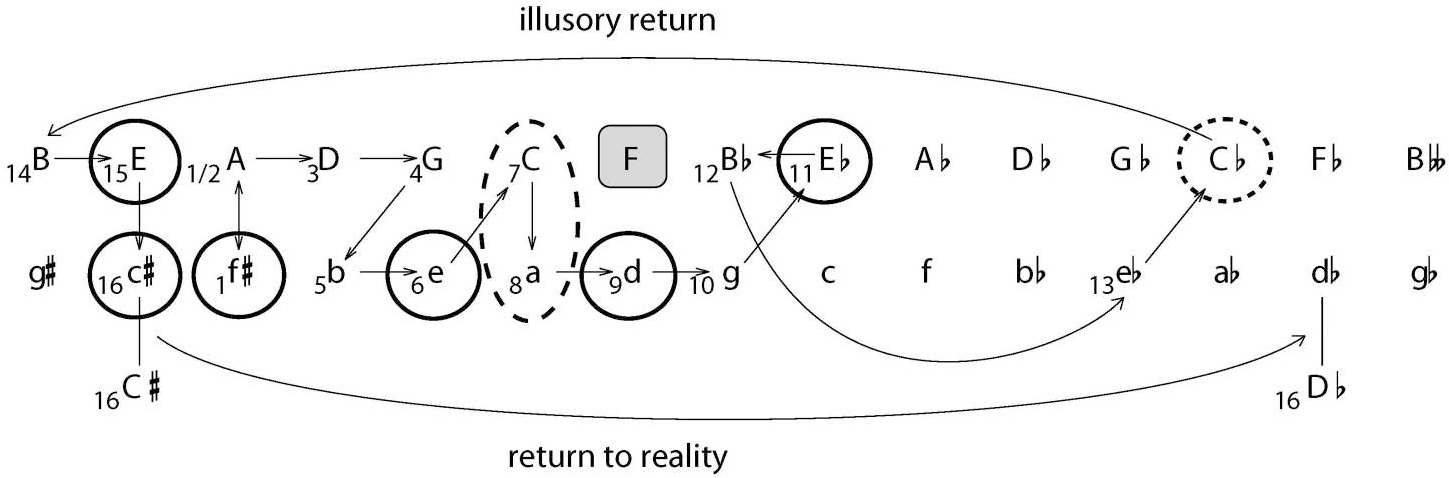
While I fully agree with Ferris about the fragmentary nature of the Romantic song cycle (and of Dichterliebe in particular), I cannot accept his wholesale dismissal of narrative in this cycle. Rather, I contend that in selecting, ordering and setting Heine's poems to music, Schumann created not a coherent plot but a coherent narrative discourse, and that this discourse is an important carrier of the cycle's meaning. In this regard, I am in agreement with Berthold Hoeckner, who in a 2006 article responded directly to Ferris's claims.Footnote 11 Although Hoeckner does not subscribe to the ideal of organic unity, he nevertheless finds tonal coherence in Dichterliebe by mapping the songs onto a sequence of keys inspired by the early nineteenth-century theorist Gottfried Weber (see Figure 1).Footnote 12 Hoeckner relates this ‘tonal path’ to the concept of narration, for in direct opposition to Ferris, he claims that Dichterliebe ‘is as much a story about love as it is about telling that story through song’.Footnote 13 Thus, for Hoeckner, the work is above all things a narrative: a narrative of the process of narration, in which the singer becomes a persona who is acting out the part of the poet, relating to the audience a story about his love.Footnote 14 Hoeckner's tonal path is thus the trajectory of the poet's emotions as he relates his doomed love story to us; the fluctuations along the major and minor axes reflect not the events in the story but the poet's emotional response to dredging up those events, with the songs in major keys corresponding to positive emotional states (or at least attempts at being cheerful) and those in minor keys reflecting negative emotions. The path is read as a journey from left to right, with each drop from a major key to a minor key representing what Hoeckner calls an ‘emotional crisis’ during the poet's telling of his tale; the most crushing crisis occurs during the harrowing plunge from the B♭ major of Song 12 to the E♭ minor of Song 13.Footnote 15
Berthold Hoeckner's ‘tonal path’ through Dichterliebe. Reproduced from Berthold Hoeckner, ‘Paths through Dichterliebe’, 19th-Century Music, 30 (2006–7), 65–80 (p. 80). © University of California Press Journals, <http://www.ucpress.edu/journals>. Used with permission.

Hoeckner's analysis has profoundly influenced my approach to Dichterliebe, but for me it does not tell the whole story, especially because it does not engage seriously with the concept of the Romantic fragment.Footnote 16 Viewing the work as a coherent whole need not, however, preclude an interpretation of it as a fragment; like many binary oppositions, that of whole versus fragment tends to crumble under close scrutiny. Accordingly, in this article I aim to provide a reading of Dichterliebe that considers it as both a tonally coherent whole and a Romantic fragment by demonstrating that what holds the work together is a distinct narrative voice. I shall do so by applying selected tools of narratology to Hoeckner's tonal path, not in order to deny the existence of narrative discourse (as does Ferris), but rather in order to show how an in-depth analysis of that very discourse offers a wealth of insights into the work. As I will argue, this approach illuminates such important issues as the different versions of the song cycle (with 16 and 20 songs respectively), the relationship between the voice and the piano, and (perhaps most significantly) an interpretation of the final postlude and of the cycle as a whole.
I
As I discussed in a recent article,Footnote 17 the application of narratology to the Romantic lied has been very rare in musicological literature, despite the fact that Edward T. Cone opened the door to a narratological approach to the lied in his pioneering monograph The Composer's Voice.Footnote 18 This lack of attention to the lied stems undoubtedly from the strong preference among music scholars for theorizing about narrative in non-texted music. When scholars do discuss narrative in texted music, moreover, they tend to focus on works with explicitly narrative texts, not the reflective lyric poetry typical of the lied.Footnote 19 Nevertheless, the lied and song cycle are well suited to narratological enquiry, for a number of reasons. For one thing, since the turn of the twenty-first century, literature scholars have explored in earnest the application of narratology to lyric poetry, introducing concepts and approaches that translate well to the lied.Footnote 20 For another thing, the fact that narratology depends on a careful study of the gaps in an artwork (focusing just as much on what is missing – what the text does not say – as on what is explicitly present in the text) makes it perfectly suited for the incomplete, ambiguous, gap-filled aesthetic category of the Romantic fragment. A narratological approach, in fact, can fruitfully highlight ambiguities and multivalent meanings in ways that other methodologies cannot. Finally, by transforming poetry into a genre that exists in its fullest form only through the active agency of singer and pianist, a lied introduces a crucial aspect of narration: performativity. A lied performance creates the very physical phenomenon of something being told, transforming the singer into a narrator and allowing us to accept the performance as a narrative text, in which sung poetry with instrumental accompaniment becomes the baseline of normal discourse.Footnote 21
Although music is a crucial aspect of the narrative discourse in a lied, in performing a narratological analysis of any such work I begin with the text itself, drawing upon both recent scholarship on narrative in lyric poetry and the terminology and concepts explicated by Mieke Bal in her influential overview of narratology.Footnote 22 Only after considering the poetry on its own terms do I take the music into account, seeking to elucidate how it enhances, clarifies, adds to or even undermines the narrative aspects of the poetry. In what follows, therefore, I shall first analyse Dichterliebe as a literary text, focusing primarily on two important narratological concepts: (1) voice and (2) the manner in which events are depicted in the cycle. Although it might seem counter-intuitive to regard Schumann's poetic cycle as a purely literary text, considering that his selection of the poems seems to have occurred simultaneously with the composition of the music, Schumann himself seems to justify this approach in the very first letter to Clara in which he mentions his lieder. On 16 February 1840 he wrote: ‘Here, my Clara, I'm enclosing a liedchen for you; I've just made it. First read the text well and then think of your Robert.’Footnote 23 In instructing Clara to read the text ‘well’ before playing the music, he seems to imply that his ideal audience members are already thoroughly familiar with the texts of his lieder before they listen to and think about the music. Throughout this discussion, I use Schumann's original 20-poem version of the cycle, not as an endorsement of that version or an argument in favour of it, but because as the composer's original conception of the work it must be taken into account. Although I may occasionally paint Schumann's compositional choices as deliberate decisions made for narrative purposes, I must stress that proving his intentions is not my goal, nor do I aim to offer the definitive interpretation of Dichterliebe.Footnote 24 Even if Schumann never consciously thought about the work's narrative elements (and even if my reading of the work were to turn out to be completely unrecognizable to him), narratology provides powerful tools and a defensible theory with which we can open up the work hermeneutically and offer aesthetically valid interpretations.
Voice
Voice is one of the most fundamental aspects of narratology. As the seminal narratologist Gérard Genette famously put it, to study voice in narrative is to answer the question ‘who speaks?’Footnote 25 On the surface, the concept is deceptively straightforward, as in most narrative texts all of the words are uttered by a single voice, that of the narrator; the performance of a song cycle, moreover, is obviously sung throughout by just one person. But even so, most narratives introduce voices in addition to the narrator's: other characters who either speak in quotation marks (direct speech) or whose words are paraphrased by the narrator (indirect speech). At these moments, the narrator temporarily yields the floor to the other character, who speaks at a second narrative level without actually displacing the narrator's voice.Footnote 26 Multiple voices can even be perceived in a narrative text in which the only agent is a narrator who also serves as the protagonist (as is typical in lyric poetry). This happens, for instance, when the narrator relates a past event and quotes words he uttered at the time. Although the quoted words are spoken by the same persona as the narrator, they nevertheless belong to the second narrative level, since they were originally spoken in the past. The speaker of the quoted words exists in a different time frame from the narrator and is thus a separate actor; the narrator tells us now what the other actor (who just happens to be himself) said previously.Footnote 27
Dichterliebe is dominated by the voice of its narrator-protagonist, the unnamed Poet;Footnote 28 in the 20 poems that comprise the original version, at only two moments do we hear any voice apart from his. These moments occur in Song 4, when the beloved utters ‘I love you’ in indirect speech (line 7), and in Song 12, when the flowers address the Poet in direct speech, asking him to forgive the beloved (lines 7–8).Footnote 29 Despite this almost exclusive focus on the Poet's voice, I contend that there are two distinct voices in the cycle, both of which stem from the same persona, in a situation directly analogous to that discussed at the end of the previous paragraph. These voices never appear together in a single poem; rather, each poem is uttered in its entirety by just one of them. The first voice is the narrative voice (whom I call the Narrator): the Poet speaking directly to the audience in ‘real time’ (or ‘narrating time’), an agent who is actively weaving a narrative out of the series of events that happened to him in the past. The second voice is the protagonist of the story (whom I call the Actor), who addresses not the audience but alternately his beloved and himself, speaking predominantly in the present tense, but a present tense that is now in the past, on the second narrative level (in what narratologists call ‘narrated time’).Footnote 30 The Poet's story is therefore not just narrated, it is recreated as a series of vivid flashbacks, flashbacks that are present-tense lyric moments not unlike those of other canonical song cycles, including Schubert's Die schöne Müllerin and Schumann's own Frauenliebe und -leben.Footnote 31 Dichterliebe presents nothing less than a song cycle within a song cycle, in which present-tense lyric moments are framed (and occasionally interrupted) by the narrative voice, thereby situating the lyric moments in the past.
The most common way for a narrator to be incorporated into a lyric cycle (or a novel or pretty much any narrative text, including modern movies and television shows) is for the work to be encased in a distinct narrative frame, with the narrator introducing the material in the first poem and then returning in the final poem to offer concluding thoughts.Footnote 32 Examples of poetic narrative frames of this type extend as far back as antiquity, and the technique flourished in the nineteenth century. Perhaps the best-known nineteenth-century example today, and one that would have been familiar to both Heine and Schumann, is Wilhelm Müller's Die schöne Müllerin, which begins with a prologue and ends with an epilogue (neither set by Schubert) in which a persona who is identified as ‘the poet’ speaks directly to the reader, introducing and commenting upon the story, while also explicitly distinguishing himself from the protagonist of the cycle, the miller lad.Footnote 33
Heine's Lyrisches Intermezzo also contains a narrative frame, though one that works in a different (and more complex) manner from that of Die schöne Müllerin. Like Müller, Heine introduces his cycle with an explicitly titled ‘Prolog’.Footnote 34 This prologue does not, however, refer directly to the poems that follow; rather, a narrating persona relates a story about a man who is initially called a knight but who in the last line is identified (by his location) as a poet:
| 1 | Es war mal ein Ritter trübselig und stumm, | Once upon a time there was a knight, woeful and silent, |
| 2 | Mit hohlen, schneeweißen Wangen; | with hollow, snow-white cheeks; |
| 3 | Er schwankte und schlenderte schlotternd herum, | he tottered and strolled around trembling, |
| 4 | In dumpfen Träumen befangen. | lost in gloomy dreams. |
| 5 | Er war so hölzern, so täppisch, so links, | He was so wooden, so awkward, so clumsy, |
| 6 | Die Blümlein und Mägdlein, die kicherten rings, | that the little flowers and maidens giggled around him |
| 7 | Wenn er stolpernd vorbeigegangen. | when he stumbled past them. |
| 8 | Oft saß er im finstersten Winkel zu Haus; | He often sat in dark corners at home; |
| 9 | Er hatt’ sich vor Menschen verkrochen. | he had slunk away from mankind. |
| 10 | Da streckte er sehnend die Arme aus, | Yearning, he stretched out his arms, |
| 11 | Doch hat er kein Wörtlein gesprochen. | yet he had not said even a little word. |
| 12 | Kam aber die Mitternachtstunde heran, | But then came the midnight hour, |
| 13 | ein seltsames Singen und Klingen begann – | and a curious singing and ringing began – |
| 14 | An die Thüre da hört er es pochen. | he hears knocking at the door. |
| 15 | Da kommt seine Liebste geschlichen herein, | Then his beloved comes sneaking inside, |
| 16 | Im rauschenden Wellenschaumkleide. | in a dress rustling like the foamy waves. |
| 17 | Sie blüht und glüht, wie ein Röselein, | She blooms and glows like a little rose, |
| 18 | Ihr Schleier ist eitel Geschmeide. | her veil is adorned with pure jewels. |
| 19 | Goldlocken umspielen die schlanke Gestalt, | Gold locks play about her slender figure; |
| 20 | Die Äugelein grüßen mit süßer Gewalt – | her little eyes greet him with a sweet power – |
| 21 | In die Arme sinken sich beide. | they sink into each other's arms. |
| 22 | Der Ritter umschlingt sie mit Liebesmacht, | The knight embraces her with all of love's strength, |
| 23 | Der Hölzerne steht jetzt in Feuer, | the wooden one is now aflame; |
| 24 | Der Blasse erröthet, der Träumer erwacht, | the pale one reddens, the dreamer awakes, |
| 25 | Der Blöde wird freier und freier. | the simple one becomes freer and freer. |
| 26 | Sie aber, sie hat ihn gar schalkhaft geneckt, | But she, she very mischievously teases him; |
| 27 | Sie hat ihm ganz leise den Kopf bedeckt | she very gently covers his head |
| 28 | Mit dem weißen, demantenen Schleier. | with the white, bejewelled veil. |
| 29 | In einen kristallenen Wasserpalast | To a crystal water palace |
| 30 | Ist plötzlich gezaubert der Ritter. | is the knight suddenly, magically whisked away. |
| 31 | Er staunt, und die Augen erblinden ihm fast, | He is astonished, and he is practically blinded |
| 32 | Vor alle dem Glanz und Geflitter. | by all of the gold and glitter. |
| 33 | Doch hält ihn die Nixe umarmet gar traut, | But the nymph holds him in a truly loving embrace; |
| 34 | Der Ritter ist Bräut'gam, die Nixe ist Braut, | the knight is the bridegroom, the nymph is the bride, |
| 35 | Ihre Jungfraun spielen die Zither. | her maidens play the zither. |
| 36 | Sie spielen und singen; es tanzen herein, | They play and sing; there is dancing all around, |
| 37 | Viel winzige Mädchen und Bübchen; | many little girls and boys; |
| 38 | Der Ritter, der will sich zu Tode freu'n, | The knight, he wants to rejoice until his dying day, |
| 39 | Und fester umschlingt er sein Liebchen – | and he embraces his beloved more strongly – |
| 40 | Da löschen auf einmal die Lichter aus, | then all at once the lights are extinguished, |
| 41 | Der Ritter sitzt wieder ganz einsam zu Haus, | the knight sits again all alone at home, |
| 42 | In dem düstern Poetenstübchen.Footnote 35 | in the gloomy poet's garret. |
While not as blatant as the prologue to Die schöne Müllerin, this poem serves the same basic function as Müller's. By means of that traditional opening for fairy tales – ‘once upon a time’ (though here slightly tweaked from ‘es war einmal’ to ‘es war mal ein’) – the reader is immediately alerted to the fact that a performance is beginning, that a fictional tale is being told. Moreover, because the prologue contains no first-person pronouns (it is told entirely by an external, non-perceptible narrator), when we do encounter the word ‘ich’ in Poem 1, we interpret the speaker of that poem not as the invisible narrating persona of the prologue but as the prologue's protagonist, the boorish knight-poet who dreams of marrying a beautiful water nymph before finding himself abandoned and alone.Footnote 36 Thus, not only does the prologue distinguish the voice of the narrator from that of the protagonist of the story, but in retrospect we also realize that it introduces the story by encapsulating its main theme of delusional lost love. Heine's prologue is then complemented by Poem 66, which – while not explicitly called an epilogue – brings back the narrator's voice by referring reflexively to the previous poems, thus drawing our attention to the fact that the performance of poetry we have been witnessing is now coming to an end.Footnote 37 Further confirming the presence of the narrative voice in this poem is the direct address to the audience as the second person plural ‘ihr’ in the last stanza.Footnote 38 However, because Poem 66 metaphorically connects the preceding poems to the narrator's own love and pain – the prologue's imperceptible narrator is now plainly perceptible, speaking about himself in the first person – the distinction between the narrator and the poetic protagonist is blurred, causing us to wonder if the narrator and the boorish knight-poet have not been one and the same persona after all.
Schumann's poetic cycle avoids the ambiguity created by Heine's narrative frame in that, like Schubert, he chose not to set the prologue, though Schumann did retain Heine's last poem as the final song of his cycle. Whereas Schubert's omission of the prologue and epilogue transformed his cycle into a series of immediate present-tense lyric moments in which the miller lad speaks on the first narrative level, Schumann's cycle still contains a distinct narrative frame. This frame is apparent in the juxtaposition of Songs 1 and 2. In Song 1, the Poet describes events that happened in the month of May: buds were bursting, birds were singing, love arose in his heart, he confessed his love. Notably, all of this is discussed in the past tense. Lines 2 and 6 even use the simple past tense (the ‘imperfect’), thereby emphasizing that the month of May in which the events occurred is separate from the time frame in which the Poet is currently speaking. In addition, the person to whom the Poet confessed his love is mentioned in the third person; the Poet's love is confessed not to ‘you’ but to ‘her’. This combination of simple past tense and third person gives the poem ‘strong narrativity’.Footnote 39 Accordingly, the voice we hear is that of the Narrator, speaking directly to us, the audience, in ‘real-time’ present tense, using a past tense that begins his tale with its own ‘once upon a time’. Although Song 2 is spoken by the same ‘ich’ as Song 1, the narrativity has disappeared completely: events are now described in the present tense (flowers are sprouting from tears, sighs are becoming a nightingale chorus), and the Poet speaks directly to the beloved, using the second person singular (‘and if you love me, little child’/‘Und wenn du mich lieb hast, Kindchen’; line 5). The Poet is no longer telling us about events that happened in the past; rather, he is speaking as the events are unfolding, actively participating in them. As in a cinematic flashback, we have been thrust back in time to that bygone month of May. No longer an audience to whom the Narrator speaks, we are now voyeurs, watching the Actor enact the very confession of love mentioned by the Narrator in the previous song. As Nicholas Marston has put it, ‘While in Song 1 the lover prepares to tell the story of his unhappy affair as a detached narrator, from Song 2 onward he is no longer narrating but living through these scenes from the past, as though the past had again become present.’Footnote 40
This is, however, Heine, so the matter is not quite as simple as Marston makes it out to be. In Song 3, the Poet is once again talking about rather than to the beloved, but he declares his love for her so exuberantly in the present tense that it is difficult to imagine that this is the Narrator speaking to the audience in our present time;Footnote 41 rather, it is more plausible to understand this as the Actor speaking in the past, during the heat of the love affair, addressing himself in a lyric utterance so typical of Romantic poetry. In Song 4, the Poet once again addresses the beloved using second person singular pronouns and present-tense verbs, but the situation is notably different from that in Song 2. Whereas in the earlier song the Poet was directly participating in a single event that was happening at that moment, in Song 4 he describes a series of events, all of which probably happened more than once: looking into her eyes, kissing her mouth and so on. This poem thus displays some narrativity, in that it uses a technique that Genette labels ‘iterative narrative’, in which events that occur repeatedly are represented by a singular occurrence in the text.Footnote 42 The Poet, then, is speaking in a ‘narrating time’ that is quite distinct from the ‘narrated time’ of the previous two poems. Likewise, Song 4a is also in ‘narrating time’, as the Poet tells the beloved about a dream he ‘recently’ (‘jüngst’) had about her. The discourse in Songs 4b and 5 then shifts to the future subjunctive tense. In Song 4b the Poet asks the beloved to embrace him and describes what will happen if she does, while in Song 5 he muses to himself about a metaphorical erotic encounter with a lily, which causes him to remember an event from the past (which now seems unlikely to be repeated): the beloved's kiss.Footnote 43
Then with Song 6 – the grandiose description of Cologne Cathedral and its painting of the Blessed Virgin Mary – things change:
| 1 | Im Rhein, im heiligen Strome, | In the Rhine, in the holy river, |
| 2 | Da spiegelt sich in den Well'n, | there is reflected in the waves |
| 3 | Mit seinem großen Dome, | with its great cathedral |
| 4 | Das große, heilige Köln. | the great, holy Cologne. |
| 5 | Im Dom da steht ein Bildniß, | In the cathedral there stands an image |
| 6 | Auf goldenem Leder gemalt; | painted on golden leather; |
| 7 | In meines Lebens Wildniß | in the wilderness of my life |
| 8 | Hat's freundlich hineingestrahlt. | it has shone kindly down on me. |
| 9 | Es schweben Blumen und Englein | Flowers and angels hover |
| 10 | Um unsre Liebe Frau; | around our Blessed Mother; |
| 11 | Die Augen, die Lippen, die Wänglein, | the eyes, the lips, the cheeks, |
| 12 | Die gleichen der Liebsten genau.Footnote 44 | they are exactly like my beloved's. |
Although the description is in the present tense, it is highly unlikely that the Poet is actually in Cologne observing the cathedral in ‘narrated time’, especially because he describes his viewing of the painting in the past tense, saying in line 8 that ‘it has shone kindly down on me’. To whom, moreover, is he giving this description? He does not seem to be talking to the beloved, since he mentions her in the last line in the third person. But neither does this seem to be a lyric utterance directed at himself (as in Songs 3 and 5). Were that the case, we would expect the Poet to respond emotionally to the scene, or at least to impart a personal reflection, but instead he maintains an objective distance, observing without explicit commentary. Since there is no obvious reason for the Poet to be addressing the poem to himself, this leaves the most reasonable possibility to be that he is speaking to the audience. This poem therefore displays strong narrativity; indeed, as has been theorized at length by narratologists, description in narrative texts – unless spoken by one character to another, in which case it needs to be motivated – is almost the sole responsibility of the narrator.Footnote 45
Song 6 is notably different from the other poems in another important way. It is the first poem in Schumann's cycle in which Heine's characteristic cynicism is expressed in a blatant, open manner. One way in which this comes through is in the style of the first stanza, especially the impure rhyme in lines 2 and 4 (‘Well'n’ / ‘Köln’) and the awkward close iterations of the words ‘große’ and ‘heilige’, which create a grandiose, turgid, almost stultifying tone that becomes even more absurd when one remembers that Cologne Cathedral, despite Heine's majestic description, was unfinished at the time he wrote the poem. A more blatant manifestation of Heine's sarcasm is the final line, an example of his characteristic technique of breaking the tone (Stimmungsbruch), in which the lofty image of the Blessed Mother is brought crashingly (and blasphemously) down to earth by likening her to the beloved. Although this is not the first Stimmungsbruch in the cycle, its effect is strikingly different from the ones encountered earlier, in Songs 4 and 4a. Whereas in those poems the technique emphasizes the Poet's emotional pain at his dawning realization that the beloved does not truly love him,Footnote 46 in Song 6 the Stimmungsbruch creates a mockery of Romanticism, exposing as delusion the idea that solace can be found in religion.
Song 6 thus seems to exist both on a different temporal plane from the preceding songs (the Poet is speaking in ‘real time’ to us, not in ‘narrated time’ to the beloved or himself) and on a very different emotional plane (the Poet is jaded and cynical, not hopeful, fearful or sorrowful). Despite the common ‘ich’ tying the poems of the cycle together, the speaker of Song 6 seems to have a completely different personality from the speaker of Songs 2–5, and this, I argue, is the crucial distinction between the Actor and the Narrator. Although the Actor's poems sometimes exhibit signs of narrativity, thereby making it clear that he is not always literally reliving the past, he nevertheless exists solely in the past temporal plane that began in that fateful ‘wunderschönen Monat Mai’.Footnote 47 The Actor consistently addresses only the beloved or himself, and his poems provide lyric expressions of genuine, heartfelt longing, painting him as a true Romantic hero akin to Goethe's Werther or Müller's miller lad. In contrast, the Narrator's poems always exhibit strong narrativity: they are never addressed to the beloved, and from Song 6 onwards, they drip with bitter sarcasm and irony. He has clearly changed considerably in the time that has passed since the events originally occurred. Songs 2–5 are thus all uttered by the Actor, and Song 6 constitutes the Narrator's first interruption.
Using these criteria, we can identify the Narrator's other interruptions as the following songs: Song 9, which presents a seemingly objective description of the beloved's wedding to another man but is told in a crass style with a Stimmungsbruch similar to that in Song 6, as the heavenly angels are dragged into the scene; Song 11, which encapsulates the cycle's plot with a folksy story uttered in the third person by a non-perceptible narrator; Song 12a, which features a perceptible first-person narrator who relates a shocking, grisly fairy tale, introducing it in the first stanza and wryly commenting upon it in the last two lines; and Song 15, a long description of the happy fairy-tale land that the Poet visits in his dreams, which ends with the starkly realistic (and therefore un-Romantic) recognition in the final line that the fairy-tale world is no more substantial than ‘vain froth’ (‘eitel Schaum’). The Narrator's disillusionment with Romanticism also comes through clearly in the song that serves as the final part of the cycle's outer frame, Song 16, which in addition to seeking to destroy the Poet's ‘old, evil songs’ (‘alten, bösen Lieder’) and the love and pain they represent, replaces the typical Romantic imagery encountered throughout the cycle (birds, flowers and so on) with monuments of everyday material, industrial life (the Heidelberg cask, the bridge at Mainz and so on).
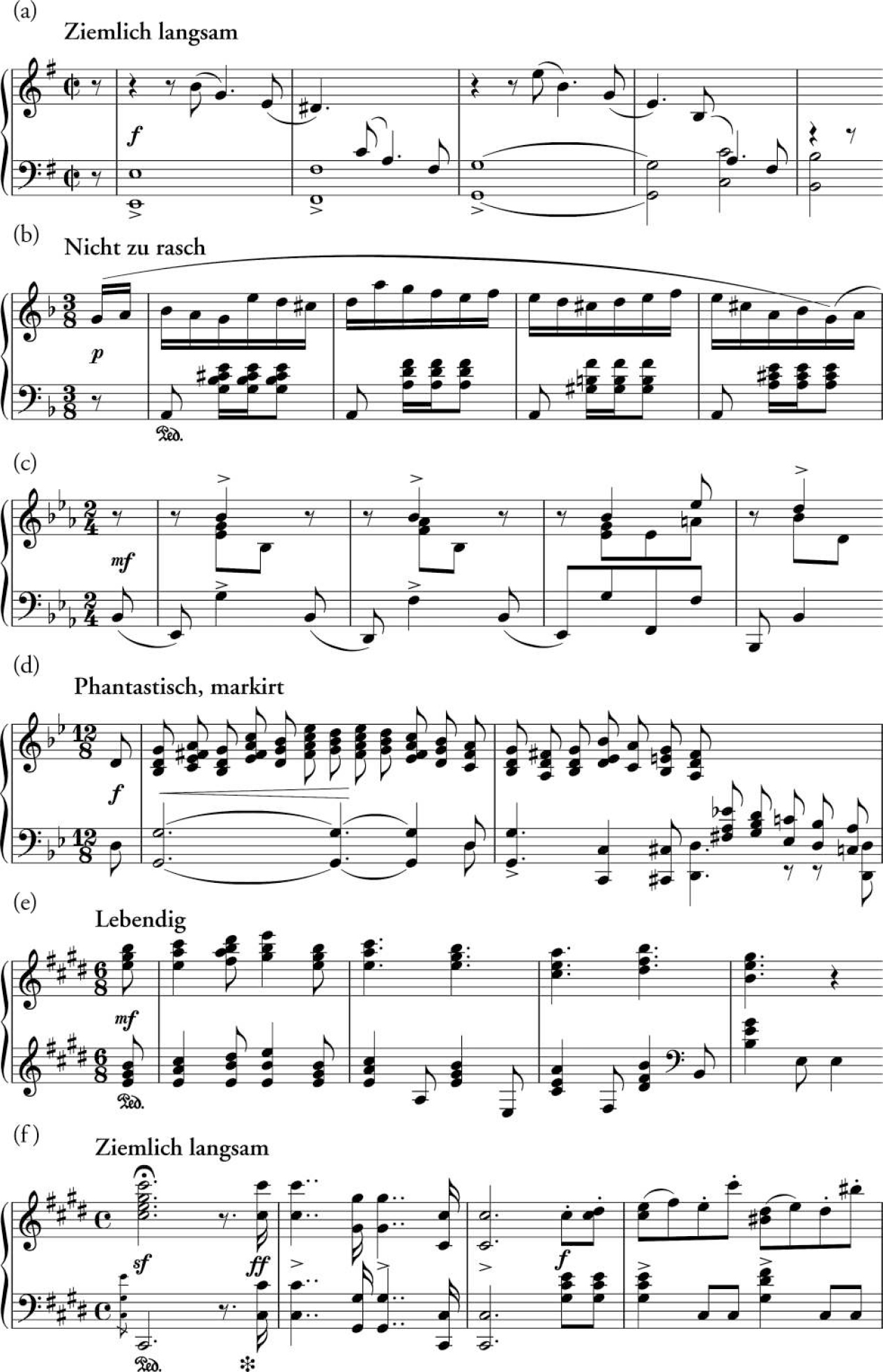
Admittedly, Heine's elusive, sophisticated and fluid poetic voice, which revels in obfuscating temporal and emotional planes (often introducing abrupt and confusing shifts of mood or tense within individual poems), makes it difficult to assert that the boundaries separating the Actor's voice from that of the Narrator are as clear and definitive as I present them here. Indeed, to insist too strenuously on such a clear division between the two voices would be to do a disservice to the open-ended, ambiguous aesthetic of the Romantic fragment. I must stress that what I am presenting here is entirely my own interpretation, and that I do not intend to close the door on the plurality of possibilities inherent in the work, including the possibility of voices beyond the two I have identified. Nevertheless, my distinction between Narrator and Actor becomes more defensible when we bring Schumann's music into the discussion, for the music of the Narrator's songs exhibits a self-conscious stylization that heightens the sarcastic effect and contrasts strongly with the Actor's songs. As can be seen in Example 1, in all of the Narrator's songs from Song 6 onwards the piano draws upon a recognizable stylistic trope and presents it in an overdone manner that heightens the sense of ironic parody (as is especially apparent in the ridiculously overlong postludes of Songs 6, 9, 11 and 12a). In most cases, the trope is related to the subject matter of the poem. For instance, the overblown image of Cologne Cathedral in Song 6 is complemented by unrelenting dotted rhythms in the piano, which, as Rosen has pointed out, evoke the French overture, creating a ‘parody of Baroque harmony and rhythm’ (see Example 1a).Footnote 48 The crass wedding dance described in Song 9 is mirrored by an equally crass waltz in the piano (see Example 1b); the innocent childish fantasy of Song 15 is accompanied by a blithe children's tune in compound metre (see Example 1e); and the funereal pomp of Song 16 is set to a plodding funeral march (until bar 44; see Example 1f). In the Narrator's other two songs, the tropes relate not to the subject matter but to the poetic genre. The objective folk tale of Song 11, for instance, is set to rollicking, major-mode music that imitates a folk song (see Example 1c), and the music of Song 12a takes its cue from the ballad-like features of the poem, offering a sarcastic parody of the typical ballad (see Example 1d). In Song 12a, Schumann uses many of the conventional musical features one expects in a ballad setting – a faux-folk opening in compound metre, a through-composed vocal line, recurring piano interludes and a contrasting postlude – but in an unmistakably over-the-top fashion; note especially the exaggerated piano part with heavy block chords in the right hand over octaves in the left.Footnote 49
Stylized piano accompaniments in the Narrator's songs. Opening bars of (a) Song 6, ‘Im Rhein, im heiligen Strome’; (b) Song 9, ‘Das ist ein Flöten und Geigen’; (c) Song 11, ‘Ein Jüngling liebt ein Mädchen’; (d) Song 12a, ‘Es leuchtet meine Liebe’; (e) Song 15, ‘Aus alten Märchen winkt es’; (f) Song 16, ‘Die alten, bösen Lieder’. All music examples are drawn from Robert Schumann, Dichterliebe: An Authoritative Score, ed. Arthur Komar (New York and London, 1971).

It is surely significant that the distinction between Actor and Narrator that I have observed in Dichterliebe is completely absent from Heine's Lyrisches Intermezzo, suggesting that the delineation of two characters with distinct personalities may have been a deliberate decision by Schumann. In many poems of the Lyrisches Intermezzo, for example, the poet addresses the beloved directly in a sarcastic, bitter manner (something that Schumann's Actor never does), and he also frequently insults her (which Schumann's Actor does only once, in Song 7, ‘Ich grolle nicht’, when he tells her that a serpent is eating her heart).Footnote 50 In Heine's Poem 16, for instance, the poet tells the beloved in a seemingly admiring manner that no poet can truly capture her beauty, only to add in the fourth and final stanza that it is also impossible for a poet to capture her false character. Heine also blurs the lines between voices by occasionally presenting a seemingly distant narrator who then speaks directly to the beloved. Examples include Poem 39, in which the poet narrates a story about his aimless, lovesick wanderings through the city, only in the fifth stanza to address the beloved; as well as Poem 51, in which the poet narrates the events of a philistine tea party in the third person, but in the fifth and final stanza addresses the beloved, telling her that she should have been there as she would have fitted right in. In some poems, the poet narrates directly to the beloved using the first person plural, as in Poem 43, in which he tells the beloved about a bitter-sweet boat ride the two of them shared, using only the imperfect tense. Defying any voice designation whatsoever are those poems that stand outside the narrative entirely in that they make no overt references to the beloved or the love affair.Footnote 51
In contrast, the most ambiguous poetic voice in Dichterliebe occurs in Song 14:
| 1 | Allnächtlich im Traume seh’ ich dich, | Every night in dreams I see you |
| 2 | Und sehe dich freundlich grüßen, | and see your friendly greeting, |
| 3 | Und lautaufweinend stürz’ ich mich | and loudly weeping I throw myself |
| 4 | Zu deinen süßen Füßen. | at your sweet feet. |
| 5 | Du siehst mich an wehmüthiglich, | You look at me sadly |
| 6 | Und schüttelst das blonde Köpfchen; | and shake your blond little head; |
| 7 | Aus deinen Augen schleichen sich | from your eyes sneak |
| 8 | Die Perlenthränentröpfchen. | the pearl-like tear droplets. |
| 9 | Du sagst mir heimlich ein leises Wort, | You secretly tell me a quiet word |
| 10 | Und giebst mir den Strauß von Zypressen, | and give me a branch of cypress. |
| 11 | Ich wache auf, und der Strauß ist fort, | I wake up, and the branch is gone, |
| 12 | Und's Wort hab’ ich vergessen.Footnote 52 | and I've forgotten the word. |
According to my criteria explained above, this poem should be spoken by the Actor, both because the Poet speaks directly to the beloved and also because on the surface the emotions expressed are tender, wistful and sentimental. Nevertheless, a number of features argue in favour of assigning the poem to the Narrator. For one thing, the poem exhibits narrativity; in contrast to Song 4a, in which the Actor merely describes the beloved's face as it appeared in his dream, in this poem the Poet actually tells a story, relating the events in his dream and his experience upon waking.Footnote 53 In addition, the Poet's seemingly genuine emotions are expressed in poetry that is deliberately bad, with excessively long compound words (‘Perlenthränentröpfchen’), precious, unnecessary diminutives in the second stanza, and cloying, almost ridiculous internal rhymes in the first stanza (‘ich dich’, ‘ich mich’ and especially ‘süßen Füßen’). The language imparts a sarcastic edge, undermining the emotional sincerity and marking it as unmistakably Heine's.Footnote 54 This poem occupies a liminal space in Schumann's series of three dream poems, between the Actor's anguished Song 13, in which his dreams about the beloved cause him to weep bitterly, and the Narrator's Song 15, in which he is able to dismiss his Romantic fantasies as meaningless illusion. As such, the ambiguity of voice serves as a transition from Actor to Narrator at the crucial moment in which the Narrator takes over as the sole voice for the remainder of the cycle, and it is ultimately up to the performers to decide whether the song should be performed as a sincere utterance by the Actor or a biting commentary by the Narrator (or something in between).
Events
The identification of two distinct voices in Dichterliebe is directly related to my interpretation of the cycle's sequence of events. When analysing the events of a narrative, the classic narratological method is to recognize the existence of two distinct layers: (1) an underlying series of events (which Bal labels the ‘fabula’) and (2) the specific ordering and presentation of those events in the discourse (which Bal labels the ‘story’).Footnote 55 Bal's terminology differs from that used in many narratological studies, in which the term ‘story’ refers to the underlying series of events, and the selection and ordering of the events is called the ‘discourse’.Footnote 56 I prefer Bal's nomenclature because it more accurately captures the essence of narrative: using the term ‘story’ for ‘the thing told’ conveys the essential truth that all aspects of the narrative derive only from the discourse itself, rather than originating from an ideal (in the Platonic sense) ‘ur-story’ that exists independently of the narrative text.Footnote 57 Instead of existing prior to the story or in binary opposition to it, the fabula must be extracted from the story through the process of interpretation.Footnote 58 When analysing a poetic cycle, these narrative layers can be discerned within individual poems,Footnote 59 and/or the cycle can be considered as a whole, with each poem comprising an individual moment within the story. While an analysis of the events within the individual poems of Dichterliebe would bear fruit, I shall for reasons of space concern myself here only with the latter approach.
To most listeners, the fabula of Dichterliebe comprises only the tale of the Actor's failed love affair, as in Ferris's analysis of the plot discussed above. It is important to recognize, however, that there is more to the fabula than that. After all, as Hoeckner claims, Dichterliebe ‘is about telling that story through song’, which means that the Narrator's telling of the tale, the process of narration itself, constitutes its own fabula, in which the Narrator's ‘narrating time’ becomes, through its re-enactment by the singer, ‘narrated time’.Footnote 60 Indeed, since Hoeckner's tonal path relates not so much to the events of the Actor's fabula as to the Narrator's emotions while telling the events, the fluctuations along the path (as a representation of the Narrator's emotional journey) are in essence the substance of the Narrator's fabula.Footnote 61 Dichterliebe thus presents embedded fabulas, in which the Narrator's fabula serves as the vehicle through which we learn the embedded fabula of the Actor's love affair.Footnote 62 Such embedded fabulas are common in narrative texts in many media. The archetypal example, discussed by Bal, is One Thousand and One Nights. Although it is the fantastical stories that most capture the reader's imagination, it cannot be forgotten that those stories would not exist were it not for the primary fabula in which Scheherazade must keep telling stories in order to postpone her execution by her jealous husband.Footnote 63 Embedded fabulas of this type are also common in the modern cinema. The title of Rob Reiner's 1987 film The Princess Bride, for instance, may derive from the fabula of the romance between Westley and his beloved Buttercup (played by Cary Elwes and Robin Wright), but one of the most enduring messages of the film derives from the narrative frame in which the Grandfather (Peter Falk) reads the story to his Grandson (Fred Savage), whose emotional growth by the end of the movie constitutes a fabula of its own. Nor was Heine a stranger to the embedded fabula; perhaps one of the most famous examples from his pen is his celebrated poem about the Loreley (the second poem of Die Heimkehr), in which a perceptible first-person narrator relates the story of a sailor's death on the Rhine while simultaneously undergoing an emotional journey from uncertainty to realization.Footnote 64
Dichterliebe differs from One Thousand and One Nights and The Princess Bride in that whereas Scheherazade and the Grandfather exist in completely different worlds from the embedded fabulas they relate,Footnote 65 Schumann's Narrator is telling a tale about himself. The embedded fabula of the Actor's love affair is thus clearly related to the Narrator's fabula and exists in a chronological relationship to it, making it possible to disembed the two fabulas and interpret them as one continuous fabula in which a single agent, the Poet, serves as the protagonist. I have done precisely this in Table 1, which presents side by side my analysis of the story and fabula in Dichterliebe, treating the two fabulas as a single continuous narrative. The left-hand column lays out the story, delineated song by song, with the flashbacks (or to use Bal's term, ‘retroversions’) indicated with italics.Footnote 66 The right-hand column lays out the fabula, with every event (no matter how inconsequential) accounted for. A narratological analysis, however, cannot concern itself with every minuscule event without getting bogged down in unnecessary details and losing all meaning; accordingly, it is crucial for the analyst to identify the most significant events in the fabula. Bal calls these ‘functional events’, and she defines them as those that enact a significant change as the result of either an actor's decision or a confrontation between actors.Footnote 67 I have therefore placed in bold the functional events – the moments in which the Poet makes a decision (to fall in love, to renounce his love), as well as those in which the Poet and the beloved interact. Events in italics in the fabula column are those that must be inferred from the story but are not treated directly.
| Dichterliebe, the story | Dichterliebe, the fabula |
| (items in italics are retroversions; numbers in parentheses refer to songs in the cycle) | (items in italics must be inferred from elements of the story; items in bold are functional events) |
| Narrator begins to speak; tells us he fell in love in May (1). | Poet falls in love in May. |
| Actor confesses his love to the beloved (2). | Poet confesses his love to the beloved. |
| Actor delights in his love (3). | Poet delights in his love. |
| Beloved and Poet kiss (may have happened earlier). | |
| Beloved says, ‘I love you’ (may have happened earlier). | |
| Actor distrusts the beloved (4, 4a, 4b). | Poet distrusts the beloved. |
| Beloved breaks Poet's heart (exact timing is unclear). | |
| Actor remembers kissing the beloved (5). | Poet remembers kissing the beloved. |
| **The following items are in an indeterminate order** | |
| Narrator describes Cologne Cathedral (6). | Poet is in Cologne and remembers the beloved. |
| Poet denounces the beloved. | |
| Poet wallows in unrequited love (including in the summer). | |
| Actor denounces the beloved (7). | Beloved marries another man. |
| Actor wallows in unrequited love (8). | Poet dreams about the beloved. |
| Poet dreams about a happy fairy-tale land. | |
| **The following items are in a definite order** | |
| Poet begins to speak, narrating the fabula. | |
| Poet describes the Cologne Cathedral. | |
| Narrator describes the beloved's wedding (9). | Poet describes the beloved's wedding. |
| Actor mopes in the ‘wooded heights’ (10). | |
| Narrator summarizes the fabula (11). | Poet summarizes the fabula. |
| Actor mopes in the garden in the summer (12). | |
| Narrator compares his love to a gruesome fairy tale (12a). | Poet compares his love to a gruesome fairy tale. |
| Actor mopes in a carriage on a sunny day (12b). | |
| Actor dreams about the beloved (13, 14). | |
| Narrator describes a dream of a happy fairy-tale land (15). | Poet describes a dream of a happy fairy-tale land. |
| Narrator renounces his love (16). | Poet renounces his love. |
| Narrator remembers moping in the garden in summer (16post). | Poet remembers moping in the garden in summer. |
Note: The Poet, the Narrator and the Actor are all the same person. The Narrator is a perceptible character-bound narrator of the first level. The Actor is a character-bound narrator of the second level, who is quoted in direct speech by the Narrator. The title of the cycle acts as a non-perceptible external narrator, allowing us to interpret the act of narrating as a fabula.
Separating the functional events from the other events in the fabula column reveals that my identification of the basic plot is, perhaps not surprisingly, very similar to Ferris's, although I expand Ferris's second item (‘He and his beloved carry on a romance’) into three distinct events, and I add an event at the end, perhaps the most important functional event in the entire cycle: ‘Poet renounces his love.’ My comparison of the fabula and the story gives credence to an interpretation of the cycle as a Romantic fragment. It clarifies, for instance, Ferris's point that the events of the fabula ‘are scarcely mentioned in any explicit way’,Footnote 68 and it also highlights the truly random ordering of the Actor's story. Most of the functional events cannot be chronologically ordered; we can only be sure that the beloved said ‘I love you’ and that she and the Poet kissed before Song 4. The exact moment when she broke the Poet's heart is impossible to determine; I have placed it before Song 5 because of the Actor's use of the word ‘einst’ in that song, but we cannot know for certain that the Poet's heart is broken until Song 7. A whole spate of events, including the significant functional event of the beloved's marriage to another man, cannot be placed in any definite order whatsoever; we can only say with certainty that these events occur before the Narrator begins to speak to the audience. Moreover, one of these events – the Poet's wallowing in unrequited love – is split up into no fewer than four moments scattered throughout the story (Songs 8, 10, 12 and 12b). Even such a basic element as the time span of the fabula cannot be ascertained; the only chronological placers we get are that the fabula begins in May (Song 1) and that at one point it is summer (Song 12), but we can never know whether the summer event happens within a few months or within a few years of the May event. All of these points emphasize the many gaps in the story and the crucial need for the listener actively to put the pieces together, fill in the gaps and participate in the construction of meaning; the story thereby conforms to the definition of a Romantic fragment.
But not all is random and unordered, for whereas the Actor's fabula is certainly presented in a fragmentary, incoherent manner, the Narrator's fabula is not. Indeed, by recognizing the narrative discourse in Dichterliebe and acknowledging the presence of embedded fabulas created by two distinct actants, not only can we identify the last functional event, but also it becomes possible to discern some logic behind the ordering of the story, at least in the songs spoken by the Narrator. It is undoubtedly significant, for instance, that the Narrator's first two interruptions (Songs 6 and 9) seem to occur in close proximity to the most devastating functional events: the end of the relationship and the beloved's marriage.Footnote 69 This betrays a specific narrative strategy: rather than relive the most painful events via retroversions, at these moments the Narrator chooses to distance himself from them (in the modernist, not the Romantic, sense) by asserting his sarcastic presence in the here and now.Footnote 70 This strategy of coping with tragedy by distancing himself from the past continues in the next three appearances of the narrative voice (Songs 11, 12a and 15), in each of which the Narrator spins a tale. These tales follow a logical progression, tracing a trajectory in which the Narrator moves further and further away from his tragic story: beginning with an encapsulation of real-life events in Song 11, he becomes more abstract in Song 12a by telling a gruesome fairy tale as a metaphorical description of his painful love, and then finally in Song 15 he escapes completely with his description of an innocent, child-like fantasy.
Schumann's creative process suggests that he may have consciously crafted the Narrator's discourse, for nearly all of the Narrator's songs are ordered differently from Heine's cycle, thereby indicating that Schumann chose carefully where to place them.Footnote 71 After setting the first seven poems in Heine's order (as Songs 1–4, 4a, 4b and 5), the next song Schumann set was Song 6, the Narrator's first interruption. This is the eleventh poem of the Lyrisches Intermezzo, making this the first time in the creative process that Schumann skipped poems. Of all the poems in Schumann's cycle, moreover, the only ones that appear out of Heine's order are the Narrator's: Songs 8 and 9 use Poems 22 and 20 respectively; Songs 10 and 11 use Poems 41 and 40 respectively; and Songs 12 and 15 use Poems 46 and 44 respectively.Footnote 72 All of the Actor's songs, in contrast, appear exactly in Heine's published order. Even if Schumann's reordering of the Narrator's poems was not done deliberately for narratological reasons, it nevertheless cannot be denied that despite the fragmentary nature of the cycle as a whole, Dichterliebe coheres as a logical narrative discourse, governed by a Narrator who tells stories in an effort to distance himself from his pain.
II
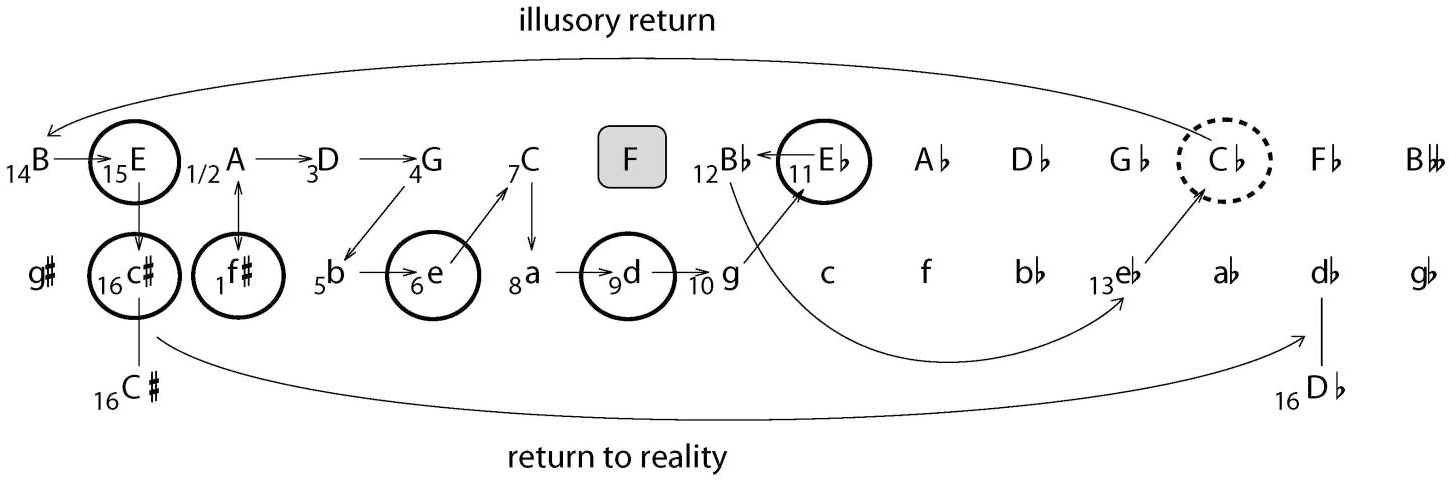
Dichterliebe is not, of course, a purely literary work; in fact, as mentioned above, Schumann's process of selecting and ordering the poems seems to have occurred simultaneously with his composition of the music, which means that the music must be an integral part of the narrative discourse. We have already seen how the music helps distinguish the Narrator's songs from the Actor's. We can further grasp the close integration – indeed, the inseparability – of the cycle's musical and narrative structures by examining the placement of the Narrator's songs on Hoeckner's tonal path, for just as the Narrator's interruptions serve as coping devices, so too do they appear at critical junctures of the upward and downward movements on the path (see Figure 2).
Placement of the Narrator's songs on Hoeckner's tonal path (the dashed line indicates ambiguity of voice). Reproduced with alterations from Berthold Hoeckner, ‘Paths through Dichterliebe’, 19th-Century Music, 30 (2006–7), 65–80 (p. 80). © University of California Press Journals, <http://www.ucpress.edu/journals>. Used with permission.

The Narrator's first appearance after Song 1 occurs immediately after the first ‘emotional crisis’, the first drop from the major to the minor axis (from G major to B minor). Upon sinking into depression during the telling of Song 5, in Song 6 the Narrator pushes the Actor aside, snaps out of his retroversion, and offers an ironic commentary on the beloved. This then seemingly steels the Narrator's resolve for his first attempt to combat his depression by jumping up to the major axis, to the C major of Song 7. Significantly, the Narrator's next appearance then occurs at precisely the parallel moment, immediately after the next drop to minor in Song 8. This time, however, the next song stays on the minor axis; the Narrator seems to be experiencing difficulty in returning to major, so his third interruption (Song 11) introduces a new strategy for dealing with his depression, in that he appears during the very song that he uses to leap from minor to major. Notably, Hoeckner describes Song 11 as a ‘new attempt to pull himself out’ of depression,Footnote 73 and Marston has highlighted the return to the major mode after three consecutive songs in the minor (the ‘most extended passage of minor-key writing in Dichterliebe’) as a significant moment, coinciding with ‘an important development in the poetic narrative’.Footnote 74 Indeed, Song 11 is precisely when the Narrator's songs switch from describing his situation directly to commenting on it obliquely through the telling of tales. This change in strategy may explain why the pattern of the Narrator's interruptions breaks down at this point; with the exception of the anomalous Song 12a (discussed below), we do not hear the Narrator again until after the devastating drop to E♭ minor in Song 13, a moment so traumatizing that it stands as the Actor's last unambiguous appearance for the remainder of the cycle.Footnote 75 This close relationship between the cycle's tonal and narrative structures is but one insight offered by my narratological analysis. As the following sections argue, further consideration of Schumann's music sheds light on many aspects of Dichterliebe and also offers possible answers to some of the cycle's thorniest enigmas.
16 versus 20 songs
Commentators have long wondered why Schumann chose to remove four songs from his cycle just before its publication in 1844. The motivations for this decision are far from clear, but Hoeckner has provided reasonable suggestions by mapping the four deleted songs onto his tonal path, arguing that Schumann's deletions ‘streamlined the tonal path and tightened the narrative progression’.Footnote 76 If we add to this the Narrator's expressive and dramatic function on the tonal path, we gain additional insight into Schumann's removal of Song 12a. In analysing the tonal path of the original 20-song version, Hoeckner has convincingly interpreted Songs 12a and 12b, which hover around G minor and B♭ major respectively, as the Poet ‘hitting a wall’;Footnote 77 that is, after his unprecedented move backwards on the major axis from E♭ major to B♭ major, he realizes the impossibility of continuing in this direction towards F major and, in Hoeckner's words, ‘gets stuck’. Given that up to this point the Narrator has always emerged after a negative move on the path, it seems unusual that in Song 12a he now appears after a positive move; also problematic is that his interruption in Song 12a does not contribute to any forward movement along the path. Despite the logical trajectory of the Narrator's tales in Songs 11, 12a and 15, the placement of Song 12a within the cycle as a whole serves no dramatic purpose and is not in keeping with the function of the Narrator's other interruptions (including his final emergence in Song 15). It is thus possible that Schumann removed Song 12a in an effort to clarify the function of the narrative voice. The deletion of this song, moreover, destroys the effect of ‘hitting a wall’, and it also puts two adjacent songs in the same key, something that happens nowhere else in the cycle; this may explain why Schumann removed Song 12b in addition to Song 12a.
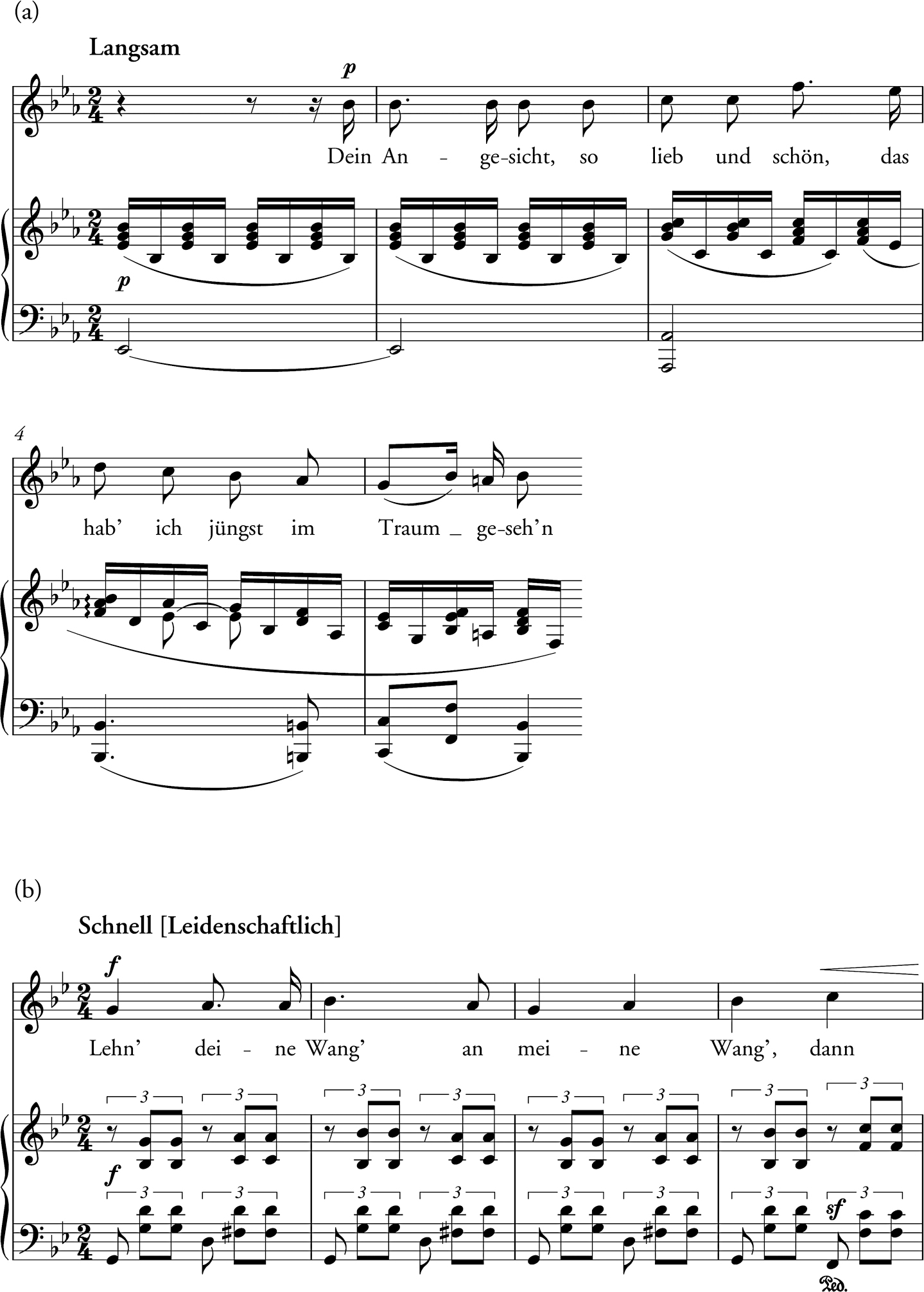
Different musical considerations provide insight into Schumann's removal of Songs 4a and 4b. Ferris has pointed out that the first five songs of the published 16-song version form a discrete group; the songs are bound together by similar musical elements, including a soft dynamic, similar vocal range and piano accompaniments that avoid or obscure the tonic in the opening bars.Footnote 78 After this discrete group, the sixth song, with its forte dynamic, solidly stated tonic, and texture and range that contrast completely with the opening songs, is a startling musical disjunction. This is entirely appropriate for the Narrator's first interruption, aurally signalling the emergence of the bitter Narrator after the Actor's heart-felt retroversions. Songs 4a and 4b, however, fit uncomfortably into the group of their surrounding songs (see Example 2): Song 4a (which otherwise matches the others in tone) opens with a solid I–IV–V–I progression in the first six bars (see Example 2a), while the impetuous forte of Song 4b steals Song 6's thunder as the first musical disjunction in the work (see Example 2b). It thus seems possible that Schumann removed these songs to highlight the contrasting nature of Song 6, thereby emphasizing the Narrator's first interruption. As with Songs 12a and 12b, deleting just one of the songs would have destroyed the logic of the tonal path, for without Song 4b's G minor to loop back to Song 4, Song 4a is stranded way down the tonal path on E♭.Footnote 79
Opening bars of (a) Song 4a (‘Dein Angesicht, so lieb und schön’) and (b) Song 4b (‘Lehn’ deine Wang’ an meine Wang’’).

Voice–piano relationship
My narratological analysis also offers insight into a much discussed aspect of Schumann's compositional practice in the lied: the complex relationship between the voice and the piano. Perhaps one of the most influential writers on this issue has been Cone, who in The Composer's Voice posited that the vocal and the piano music of a lied represent two separate creative personae.Footnote 80 Nearly 20 years later, however, Cone changed his mind and, using Dichterliebe as his test case, argued that voice and piano together constitute ‘a unitary vocal–instrumental protagonist that is coextensive with the persona of the actual composer of the song’.Footnote 81 It is this unitary model that I follow, though I am in full agreement with Hoeckner's later modification of Cone's single-voice conception, in which, drawing upon the Romantic hermeneutics of Novalis, he posited that the poetic text, singing voice and piano can potentially be heard as ‘separate entities’, as ‘different artistic “selves” inhabiting the same creative consciousness’.Footnote 82 This idea of different selves coexisting within a single persona finds a direct correspondence in my splitting of the Poet into Narrator and Actor, and indeed it is in this respect that narratology can illuminate the voice–piano relationship.
I contend that throughout the cycle the piano serves as an indication of focalization; that is, its music expresses the point of view from which the story is seen. As Bal has explicated in detail, perspective is one of the most multifaceted aspects of narrative discourse.Footnote 83 Just as the events of a fabula can be narrated by one of the characters (as in Dichterliebe, in which the Poet tells us his own story) or by an agent that does not participate in the fabula (as in the embedded fabulas of One Thousand and One Nights and The Princess Bride), so too can those events be presented either through the eyes of any of the characters or through the eyes of an agent that exists outside the fabula. The narrator and focalizer, moreover, need not reside in the same agent. Even when the narrator is speaking, we may perceive the events through the eyes of one of the characters, just as the narrator may serve as focalizer while a character is speaking.
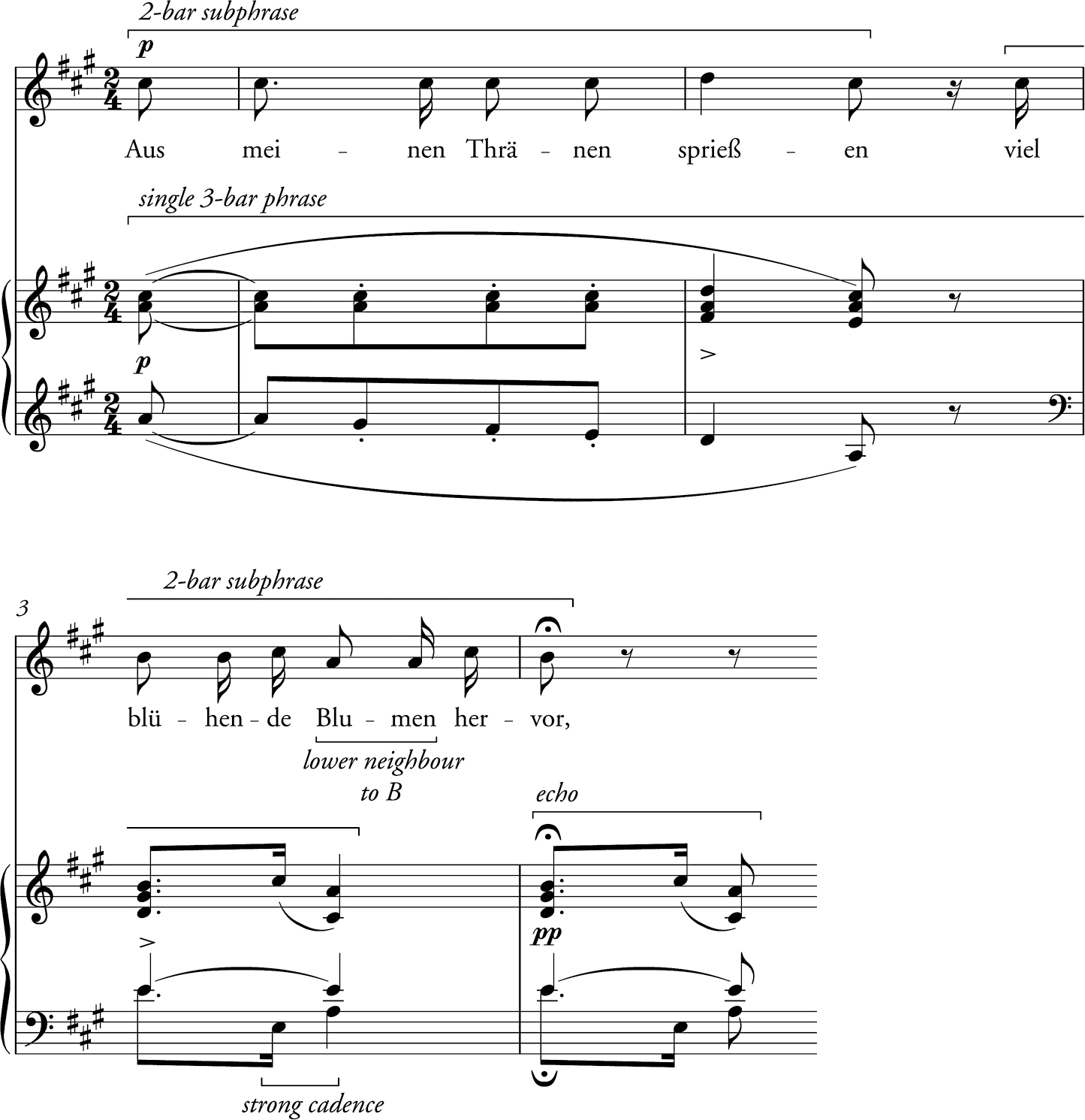
By claiming that the piano's music serves a focalizing function, I do not intend to imply that the singing voice never contributes to focalization, just that the piano serves as the primary means through which focalization is perceived. Throughout much of Dichterliebe, the focalizer and the speaking voice coincide: in the Actor's songs the piano generally provides a sincere expression of the emotions expressed during the retroversion, while in the Narrator's songs the piano contributes to the ironic distancing, especially through the stylized accompaniments discussed above. In these cases, the poetry, the piano and the vocal line combine to present a single agent that serves as both voice and focalizer. The manner in which the piano helps indicate focalization can be further explained through a comparison of the different ways in which the voice and the piano conflict in the first two songs of the cycle. In Song 1, the singer and the piano famously cannot settle upon a key; while the singer cadences in A major, the piano gropes for an F♯ minor cadence that never comes. This conflict provides the Narrator's perspective, alerting us right from the start of the cycle that despite the singer's gentle, lyrical tone and the seemingly optimistic nature of the text, a deep irreconcilable conflict lies at the root of the story.Footnote 84 Whereas in the first song the voice and piano are continuously pulling in opposite directions, in Song 2 they both work towards the same goal (a four-bar phrase), but they cannot seem to agree as to the best way to do so: as Ferris has pointed out, the voice sings two balanced two-bar subphrases, but the piano accompaniment consists of a single three-bar phrase followed by an echo (see Example 3).Footnote 85 This conflict can be interpreted entirely from the Actor's perspective, reflecting not the Narrator's ironic subtext but rather the Actor's naive uncertainty and hesitation as he embarks on his first functional interaction with the beloved.
Voice and piano conflict in Song 2 (‘Aus meinen Thränen sprießen’), bars 1–4. Analysis based on David Ferris, Schumann's Eichendorff Liederkreis and the Genre of the Romantic Cycle (Oxford, 2000), 41–2.

Although for the most part the focalizer and the speaking voice coincide throughout the cycle, there are moments when this is not the case. This introduces significant and meaningful complications to the allocation of songs between Narrator and Actor, for although I interpret each song as being spoken by just one of the two voices, the other agent is nevertheless sometimes present in the guise of focalizer. Perhaps the most famous example is Song 7, ‘Ich grolle nicht’. On the one hand, the words of the poem must stem from the Actor; because the Poet freely admits throughout the cycle (including in the very next song!) that the beloved caused him deep pain and loss, it would not make sense for the Narrator to proclaim in such a determined manner in the present tense that he has nothing to complain about. On the other hand, this is the song that many listeners point to as the most overtly ironic musical setting in the cycle, pointedly belying the truth behind the sentiment through its overdone piano part (insistent block chords over octaves, as in Song 12a) and its very tonality (an insincere C major – no wonder this song is immediately followed by a drop to minor on the tonal path!). This contradiction can be reconciled if we accept that in this song we are viewing the Actor's past denunciation of the beloved from the present-tense perspective of the cynical Narrator: the Actor may not have realized at the time how ridiculously he was behaving, but the Narrator certainly knows that now, and the piano accompaniment makes sure that we cannot miss it.Footnote 86
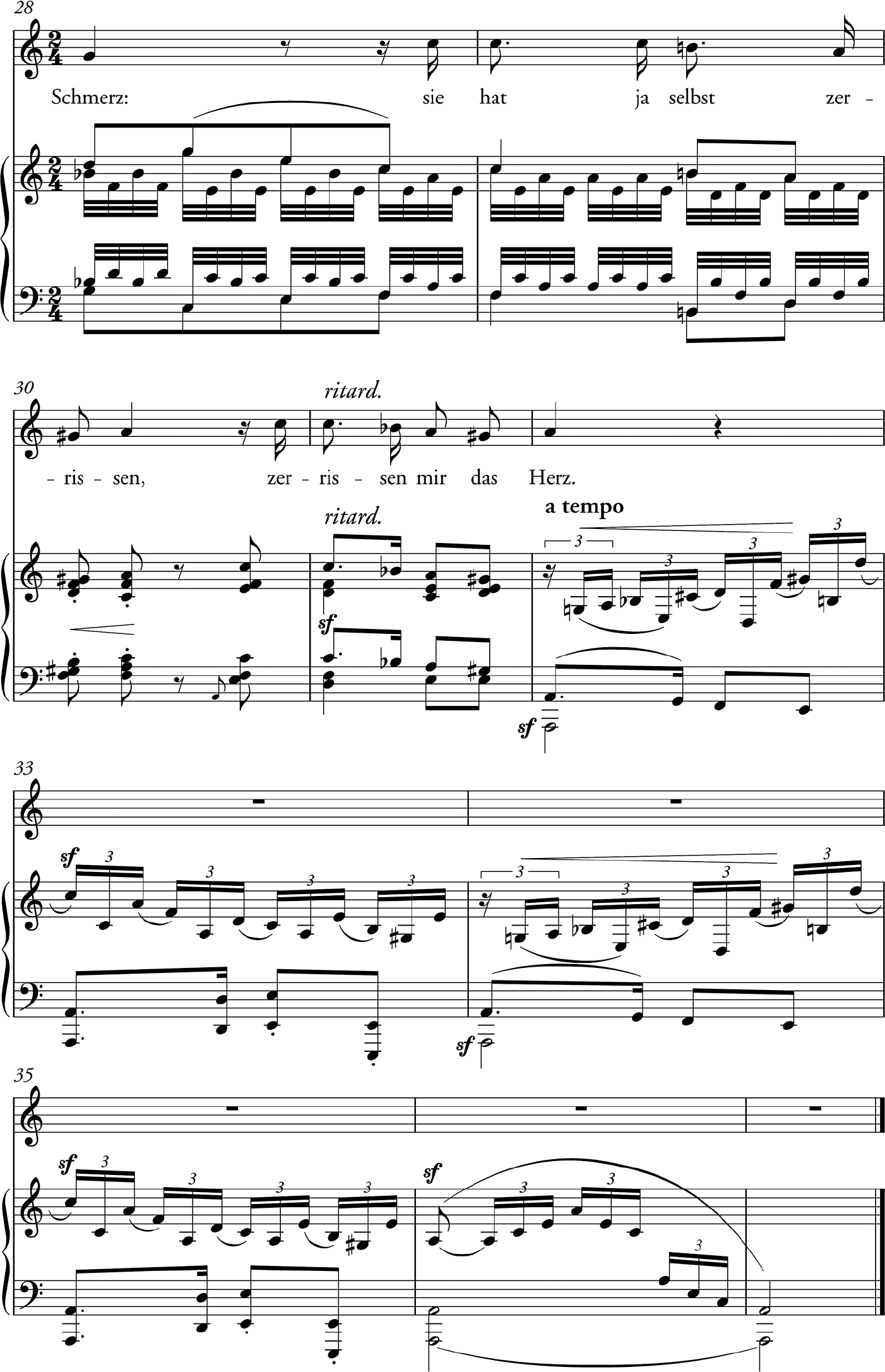
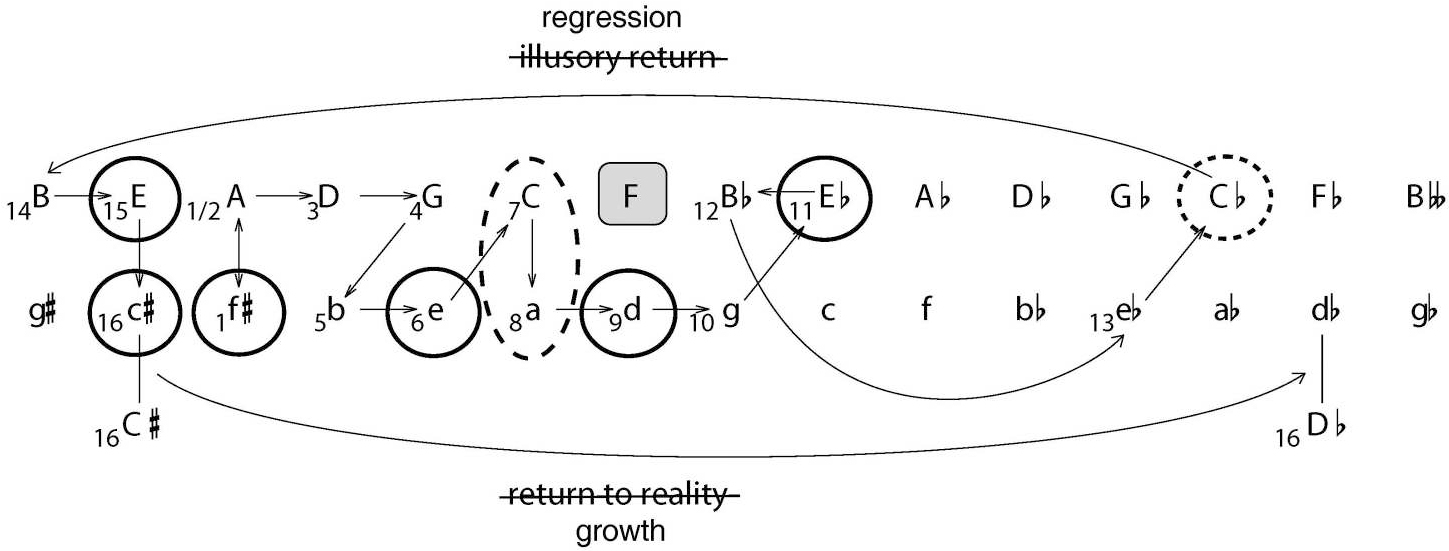
In Song 7, the presence of the Narrator as focalizer is apparent already in Heine's poem, owing to the immediate repetition of the opening three words at the end of the second line. Schumann's setting famously exaggerates the repetition, thus using the music to heighten the contrast between voice and focalizer. In the very next song, the piano introduces a focalizing agent that is not otherwise implied by the text alone. The shocking, contrasting postlude of Song 8 (see Example 4) has been universally described as a response to the final two lines of the poem (‘she herself has broken, has broken my heart’), yet such a sudden – one might even say violent – shift in mood, from tear-filled longing to white-hot rage, is not necessarily congruent with the image of someone who is nursing the fresh pain of a broken heart, nor does it follow logically from the message of the poem, which implores nature for consolation. This postlude can make sense, however, if we consider it a sudden intrusion of the Narrator as focalizer: upon explicitly mentioning for the first time in the cycle that it was the beloved who broke his heart, the Narrator breaks through the veil and wordlessly expresses his present anger at the beloved (an anger implied by the bitter sarcasm of Songs 6 and 9), regardless of how he may actually have been feeling at the time represented by the retroversion.Footnote 87 The postlude is thus an example of what I have previously called (following Peter Hühn) a ‘discourse event’: an event that happens not on the level of the fabula (an exterior occurrence that the narrator relates) but on the level of the story (an event that happens to the narrator during the course of telling the tale).Footnote 88 In this case, the process of relating the memory of his heart being broken causes such a dramatic shift in the Narrator's mood that he temporarily usurps the floor from the Actor and presents his own point of view, without verbally displacing the Actor's voice. Taking the Narrator's presence as focalizer in Songs 7 and 8 into account, we can now return to Hoeckner's tonal path (Figure 3) and see that when viewed in conjunction with the emergence of the narrative voice in Songs 6 and 9, the Narrator's presence is even more pronounced during the crucial moment in which the Poet deals with the crisis of the end of the relationship, thus reinforcing the idea that the Narrator's interruptions throughout the cycle serve as coping strategies.
Contrasting postlude of Song 8 (‘Und wüßten's die Blumen, die kleinen’), bars 28–37.

Presence of the Narrator as focalizer (indicated with dashed line) on Hoeckner's tonal path. Reproduced with alterations from Berthold Hoeckner, ‘Paths through Dichterliebe’, 19th-Century Music, 30 (2006–7), 65–80 (p. 80). © University of California Press Journals, <http://www.ucpress.edu/journals>. Used with permission.

The final postlude
The idea of the piano's music as an indication of focalization plays directly into the last aspect of the cycle to be considered in this article: the significance of the postlude to Song 16 and (along with it) an interpretation of the cycle as a whole. It is now generally accepted among scholars (following Rosen) that the final postlude presents a memory, but commentators have never agreed as to the significance of this recollection of Song 12. The majority of interpretations focus on the words of the flowers in the earlier song and hear the end of the cycle as a move towards reconciliation, a softening of Heine's biting sarcasm. We can begin to hear the final postlude in a new light, however, by noting that whereas Song 12 was presented entirely in the Actor's voice (if, that is, we consider the flowers an imaginative extension of the Actor's persona), Song 16 is entirely in the Narrator's voice. The postlude in its first incarnation, then, is a moment in the past, viewed from the Actor's perspective.Footnote 89 That moment, moreover, is one in which the Actor is characterized (in line 8) as a ‘sad, pale man’ (‘trauriger blasser Mann’), unable to be consoled by the flowers pleading with him to forgive the beloved and soon to plunge into the deepest depths of despair of the entire story.Footnote 90 In Song 16, in contrast, that same postlude becomes part of our ‘real-time’ present tense, part of the Narrator's ‘narrating time’ rather than the Actor's ‘narrated time’. A moment from the Narrator's past – still seen from the Actor's point of view – is now very much alive in the present, after the story has ended and, very significantly, after the Narrator has performed his last functional event: the resolute and defiant decision to bury his songs and, along with them, his ‘Liebe’ and ‘Schmerz’.Footnote 91 One of the most painful moments of the story comes unbidden by the Narrator. It is another discourse event, a powerful unspoken memory that exposes the façade of the Poet's renunciation of love. Whereas in Song 8 the Narrator's focalizing intrudes upon the Actor's voice, here at the end of the cycle it is the Actor's perspective that impinges upon the Narrator's voice, completely negating the Narrator's claim that he can bury his painful past.
At this point, perhaps the most obvious question is why the Narrator remembers Song 12, a question for which there is no definitive answer. Indeed, the recurrence of Song 12's postlude is one of the most ambiguous moments in the work, the meaning of which is entirely open to speculation – like a true Romantic fragment, it is subject to as many interpretations as there are listeners and performers. Perhaps by remembering a moment in which he could not forgive the beloved, the Poet recognizes (and accepts?) that reconciliation and forgiveness are impossible; or, in a more optimistic vein, perhaps because the postlude does not replicate Song 12 exactly but extends and develops the original material, the implication is that the Poet is able to use the memory for positive ends and to achieve what the Actor could not. Ultimately, the exact meaning of the memory does not matter. In fact, I would go so far as to say that it does not even necessarily matter that the material that returns is from Song 12.Footnote 92 What matters instead is Schumann's decision to recollect one of the Actor's songs at this moment in the work, and the ensuing commentary that it makes upon Heine's poetry. After acknowledging Heine's sarcasm throughout the cycle with the stylized accompaniments of the Narrator's songs, the return of one of the Actor's songs at the end of the cycle breaks the Narrator's bitter tone with a genuine expression of uncontrollable longing, thereby celebrating the very Sehnsucht that Heine's poetry ostensibly seeks to deny.
Here I part ways with Hoeckner's interpretation of the end of Dichterliebe. In a brilliant hermeneutic move, Hoeckner interprets the B major tonality of Song 14 as the enharmonic equivalent of C♭, claiming that at this point the Narrator creates the illusion of returning ‘to a place before the beginning’,Footnote 93 that is, of emotionally retreating to a time before he began relating the story and descending into depression. Proceeding from the aural ambiguity of enharmonic keys and the interpretative uncertainty created when the listener cannot distinguish between C♯ and D♭, Hoeckner has proposed a multivalent reading of the end of the cycle, claiming that Dichterliebe exists simultaneously as a ‘closed circle’ (in which the Poet returns to the beginning – C♯ – and compulsively, obsessively repeats the same story, wallowing in melancholy) and as an ‘open cycle’ (in which the Poet ‘forgives and forgets’ in D♭; that is, he mourns, heals and moves on into the realm of G♭ and B♭♭).Footnote 94 The Poet, that is, is faced with the choice between illusion and reality (between Romantic dreaming and modern realism), and (Hoeckner claims) Schumann's music blurs the distinction between the two, never actually making the decision. Hoeckner thus sees Schumann's music as perfectly mirroring Heine's aesthetic; it exposes the ‘wound’ that paralyses the poet and ultimately prevents him from either denouncing or embracing Romanticism entirely.
Hoeckner's interpretation relies on the assumption that when Schumann decided to transpose the final postlude to D♭ major after initially sketching it in C♯, he did so for specific hermeneutic reasons and not simply as a notational convenience for the performer. While I subscribe to that assumption, I cannot subscribe to a second assumption upon which Hoeckner's interpretation depends: that Schumann intended Dichterliebe to be heard primarily by listeners who had no access to the score. When Schumann began composing lieder in earnest in 1840, the genre was just beginning to find a place in the public concert hall, and the idea of performing an entire song cycle in public was completely unheard of. When Julius Stockhausen began performing Schubert's and Schumann's song cycles in their entirety in the mid-1850s, the concerts were met with bewilderment in the press for his novel and daring programming.Footnote 95 When writing and publishing Dichterliebe, then, Schumann undoubtedly had in mind intimate domestic audiences, groups of friends who could look at and discuss the score, especially when it came to people who would listen to and contemplate the work as a whole. And while he surely would have known that many listeners would be amateurs who were ignorant of musical notation, this was not his ideal audience. As he and Clara frequently discussed in their letters, his true audience consisted of the Kenner – those ‘in the know’ who would not only listen attentively but also study the score and think deeply about the music.Footnote 96 Even though it is now widely accepted that an important motivation for Schumann's turn to song in 1840 was to build an audience and sell music,Footnote 97 this does not mean that he ignored the Kenner. In fact, Clara hinted at such when she remarked in a letter of 14 March 1840 in response to receiving some of Robert's songs, ‘Many thanks for the lieder; they surprised me; they are quite unique. You will need good singers who are capable of understanding them. I showed them to Truhn yesterday and he liked them very much, but I don't think he can appreciate their great beauty.’Footnote 98 Considering that musically educated Kenner constituted Schumann's ideal audience, the visual appearance of his music as a material object assumes great significance, a significance upon which Schumann capitalized frequently in his small-scale genres, especially his music for solo piano. This is, after all, the composer who included unplayable ‘Sphinxes’ in the score of Carnaval, as well as such verbal hints and puzzles as the indication ‘(Papillon?)’ over a veiled musical quotation in the ‘Florestan’ movement of the same work.Footnote 99 In light of this, Schumann's transposition of the final postlude of Dichterliebe to D♭ cannot have been a mere notational convenience but takes on vast significance, with the D♭ key signature itself – and not just its aural ambiguity with C♯ – an important carrier of meaning.
We can perhaps uncover that meaning by thinking of the keys of C♯ and D♭ on Hoeckner's tonal path not as signifiers for ‘closed’ and ‘open’ (or ‘illusion’ and ‘reality’) but as representations of the Narrator's emotions and state of mind. When the final song begins in C♯, the implication is that the Narrator is emotionally in exactly the same spot he was in when he started telling the story. He has not moved forward; there has been no growth. He can now (so he claims) bury his songs, destroy his pain and resolutely assert that they have had no effect on him. Yet Schumann made the conscious decision not to end the song in C♯. With this aurally indistinguishable but nevertheless very real change of key, the unbidden, unspoken memory asserts not only the impossibility of renouncing Romanticism but also the very Romantic notion that baring one's soul through poetry and music – even when done sarcastically – has the power to transform the artist. I thus propose replacing Hoeckner's labels of ‘illusory return’ and ‘return to reality’ with ‘regression’ and ‘growth’ (see Figure 4). The Narrator has not necessarily forgiven and forgotten, but neither is he wallowing compulsively in melancholy. The sorrow is still there, but it has been transfigured, moving the Narrator (even if against his will) to a new state of being. More than just a celebration of Sehnsucht, then, Dichterliebe can also be read as a testament to the transformative power of art and of the Romantic project, even for the unwilling, recalcitrant Heine.
‘Regression’ and ‘growth’ instead of ‘illusory return’ and ‘return to reality’ on Hoeckner's tonal path. Reproduced with alterations from Berthold Hoeckner, ‘Paths through Dichterliebe’, 19th-Century Music, 30 (2006–7), 65–80 (p. 80). © University of California Press Journals, <http://www.ucpress.edu/journals>. Used with permission.