Introduction
There is general agreement among those who study the acquisition of Romance languages, and many of those who have tried to learn one, that object clitic constructions are particularly difficult to master. In the case of French, this appears to be true for all learner populations that have been investigated, including monolingual first language learners (Hamann, Rizzi & Frauenfelder, Reference Hamann, Rizzi and Frauenfelder1996; Jakubowicz & Rigaut, Reference Jakubowicz and Rigaut2000), bilingual first language learners (Müller, Crysmann & Kaiser, Reference Müller, Crysmann and Kaiser1996; Müller & Hulk, Reference Müller and Hulk2001; Pérez-Leroux, Pirvulescu & Roberge, Reference Pérez-Leroux, Pirvulescu and Roberge2009), internationally adopted children (Gauthier, Genesee & Kasparian, Reference Gauthier, Genesee and Kasparian2011), children with Specific Language Impairment (Jakubowicz, Nash, Rigaut & Gérard, Reference Jakubowicz, Nash, Rigaut and Gérard1998; Paradis, Reference Paradis2004), as well as child and adult second language (L2) learners (Herschensohn, Reference Herschensohn2004; White, Reference White1996). Protracted development of object clitic constructions has also been observed in learners of other Romance languages, including Italian (Bottari, Cipriani & Chilosi, Reference Bottari, Cipriani, Chilosi, Powers and Hamann2000; Tedeschi, Reference Tedeschi2009) and Spanish (e.g., Bedore & Leonard, Reference Bedore and Leonard2001; Castilla & Pérez-Leroux, Reference Castilla and Pérez-Leroux2010). There is less agreement, however, on what accounts for this widely attested difficulty with object clitics. The goal of this paper is to contribute new evidence relevant to this question. We present an empirical study of child L2 learners of French, designed to clarify the extent of the difficulty with object clitics in both expressive and receptive language use, and to investigate potential contributions of a cognitive factor beyond the language faculty, namely working memory capacity. The inclusion of L2 learners of different L1 backgrounds (Chinese and Spanish) allows us to address the role of the first language, an additional factor that may contribute toward L2 learners’ difficulty with object clitics (Hamann & Belletti, Reference Hamann and Belletti2006; White, Reference White1996), but one that has never been directly tested in previous work. The conclusions we will draw pertain first and foremost to L2 learners, yet are not necessarily limited to this population. We will show that limitations in working memory capacity are a significant factor in L2 learners’ omission of direct object clitics in production. This finding suggests that working memory limitations may be at least partially responsible for the difficulties with this grammatical property experienced by other learner populations as well, in particular those known to have more limited processing capacity, such as children with Specific Language Impairment (SLI). Thus the findings from the study that we present here hold the promise of leading to a unified explanation of the difficulty with object clitics observed across various learner populations.
Object pronominalization in French, Spanish and Chinese
When an argument denotes a referent that is salient in the discourse, either through previous mention or visual presence, it is typically expressed as a pronoun. This is illustrated in (1) with an example from English, a language which requires referential pronouns to be expressed overtly (note the ungrammaticality of (1b)).
(1)


In other languages, pronominalization may be realized through the omission of the relevant argument, a phenomenon that is assumed to involve an empty category in the underlying syntactic representation of the clause (e.g., Huang, Reference Huang1984). This is illustrated in (2) with an example from Chinese, which allows both overt (2a) and null (2b) referential pronouns in subject and object position.
(2)

In the Romance languages, object pronominalization is typically realized through a clitic construction, involving a clitic preceding the inflected verb, while the canonical postverbal argument position remains phonetically empty ((3a) for French, (4a) for Spanish). Following current syntactic analyses, we assume that the underlying syntactic represention of a clause like (3a) contains an empty category (pro) in the complement of V, the canonical argument position (Grüter, Reference Grüter2009; Roberge, Reference Roberge1990; Sportiche, Reference Sportiche, Rooryck and Zaring1996). Unlike in Chinese, however, this empty category must be licensed by an overt preverbal clitic in both French (3a) and Spanish (4a). In the absence of the clitic, null objects in this configuration typically render the sentence ungrammatical (3b, 4b).Footnote 1
(3)
(4)


Confining ourselves to simple transitive clauses such as those in (2) through (4), which constitute the focus of the present study, we can thus summarize the relevant cross-linguistic differences as follows. First, both French and Spanish use a clitic construction to express a pronominalized direct object. For the simple transitive clauses under consideration here, the manifestation of this construction can be considered the same in the two languages. Moreover, neither French nor Spanish allow referential null objects.Footnote 2 Second, all three languages allow for the canonical (postverbal) object position to remain phonetically empty in a transitive clause under certain circumstances. The languages differ, however, in the definition of these circumstances. In French and Spanish, the canonical object position may typically remain empty only in the presence of a preverbal clitic. No such restriction exists in Chinese, nor are we aware of Chinese having any element or construction that could be considered analogous to a preverbal object clitic.
Object clitics and null objects in L2 French
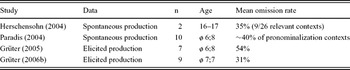
The acquisition of object clitic constructions by both child and adult L2 learners of French has been investigated in several previous studies. These studies have produced the convergent finding that the consistent production of object clitics starts considerably later in L2 development than that of other functional categories, such as subject clitics or determiners (e.g., Adiv, Reference Adiv and Andersen1984; Herschensohn, Reference Herschensohn2004; White, Reference White1996). A specific focus in several previous studies has been on the placement of the clitic within the clause (Duffield, White, Bruhn de Garavito, Montrul & Prévost, Reference Duffield, White, Bruhn de Garavito, Montrul and Prévost2002; Granfeldt & Schlyter, Reference Granfeldt and Schlyter2004), a property that one might expect to be particularly difficult to acquire for learners whose L1 has object pronouns in the canonical, postverbal object position, as in English. Interestingly, however, although occasional errors of clitic misplacement, with the clitic wrongly appearing in a postverbal position, have been reported (Adiv, Reference Adiv and Andersen1984; Grandfelt & Schlyter, Reference Granfeldt and Schlyter2004; Selinker, Swain & Dumas, Reference Selinker, Swain and Dumas1975), the frequency of this error generally appears to be low (Paradis, Reference Paradis2004; Rogers, Reference Rogers2009; White, Reference White1996; cf. Hamann & Belletti, Reference Hamann and Belletti2006). Instead, several studies have shown that the most frequent error involving object clitics does not involve their placement, but their omission (5), a phenomenon similar to what has been observed in the first language acquisition of French (see Grüter, Reference Grüter2006a, for a review). A summary of omission rates appears in Table 1. This summary reports on previous L2 studies, including work by Paradis (Reference Paradis2004) and Grüter (Reference Grüter2005, Reference Grüter, Grantham, Shea and Archibald2006b) with six- and seven-year-old anglophone learners of Quebec French in Montreal, and by Herschensohn (Reference Herschensohn2004), who investigated two teenaged-learners of (European) French in the U.S. In all of these studies, omission rates in relevant (pronominalization) contexts were substantial, varying roughly between 30% and 55%. In line with these findings, Prévost (Reference Prévost2006) presented an analysis of longitudinal data from two anglophone child L2 learners of French, illustrating a clear developmental relationship between object omission and object clitics: for both children, the incidence of illicit null objects decreased dramatically right around the time when object clitics first emerged in their production.
(5)

Frequency of object omission in previous L2 studies.

The convergent finding that object pronominalization in L2 French is often realized through (illicit) object omission rather than the target clitic construction raises two partially related questions:
(i) What is the source of this error?
(ii) What is the underlying representation of utterances like those in (5)?
In what follows, we consider three possible responses to these questions: the mis-setting of a potential null object parameter (Towell & Hawkins, Reference Towell and Hawkins1994), the absence of positive transfer from the L1 (White, Reference White1996), and clitic omission as a result of processing constraints (Prévost, Reference Prévost2006).
Parameter mis-setting
In the spirit of earlier approaches to subject omission in L2 acquisition (e.g., White, Reference White1985), Towell and Hawkins (Reference Towell and Hawkins1994, p. 137) suggested with regard to object omission that
one possibility is that learners initially hypothesize, on the basis of the absence of phonetically specified pronouns in this [ = the postverbal] position, that French has object pro . . . Null objects are permissible within UG, and languages vary parametrically as to whether V0 licenses object pro or does not license object pro.
A similar parameter mis-setting approach was proposed by Müller and colleagues for simultaneous bilinguals (Müller et al., Reference Müller, Crysmann and Kaiser1996; Müller & Hulk, Reference Müller and Hulk2001). To account for the elevated proportion of object omission in the Romance language of Romance/Germanic bilingual children, these authors proposed that the bilingual children's grammars sanction referential null objects of the Chinese type. Indeed, a learner of French will find plenty of evidence in the input for the hypothesis that French allows null objects: in typical clitic constructions such as (3a), which are frequent in both spoken and written French, the canonical, postverbal object position remains phonetically empty. Based on this evidence, it appears plausible that the learner may hypothesize that French allows referential null objects. Yet the real generalization the learner needs to make about French is the following: a null object, i.e., an empty postverbal object position, is allowed if and only if there is a clitic in preverbal position. In other words, the learner must establish a biconditional relation between a property P, “null objects are allowed”, and a property Q, “there is a clitic in preverbal position”, i.e., P ↔ Q. Note, moreover, that the two properties the learner needs to relate to arrive at this generalization concern two non-adjacent positions in the clause. This is not an easy task. It would therefore not be surprising to find a dissociation between P and Q in acquisition, that is, a learner may acquire P before Q, or vice versa. Towell and Hakwins’ proposal presents precisely such a scenario, namely one where the learner has acquired P (“null objects are allowed”), but not its biconditional relation to Q (“if and only if there is a clitic in preverbal position”).
Under a parameter mis-setting hypothesis, the underlying representation of utterances like those in (5) would be equivalent to that of a null object construction in a language that allows referential null objects, such as Chinese (Huang, Reference Huang1984) or Portuguese (Raposo, Reference Raposo, Jaeggli and Silva-Corvalan1986). This leads to a straightforward prediction with regard to L2 learners’ performance on a receptive task. Given that learners who omit objects in production are assumed to do so due to the fact that their grammars contain a convergent syntactic representation of referential null objects – as do the grammars of Chinese and Portuguese, among many others – these learners are predicted to accept null objects on a receptive task by relying on this same representation. This prediction was put to the test by Grüter (Reference Grüter, Grantham, Shea and Archibald2006b). In this study, a group of anglophone learners of French (n = 9) completed both an elicited production task as well as a truth-value judgment task designed to investigate the availability of referential null objects in learners’ grammars. Results indicated that despite a mean omission rate of 31% in production, learners consistently rejected interpretations requiring a referential null object, suggesting that their interlanguage grammars did not sanction referential null objects of any kind. Grüter (Reference Grüter, Grantham, Shea and Archibald2006b) took this finding to be preliminary evidence against a parameter mis-setting account of object clitic omission in production. The study presented here will further support this conclusion.
(Absence of) L1 transfer
Both White (Reference White1996) and Prévost (Reference Prévost2006) discussed the potential role of L1 transfer in the context of their analyses of object clitics in the speech of anglophone learners of French, and concluded that the role of transfer in this case was minimal. As White pointed out, English differs from French in that it does not instantiate an accusative clitic projection. She argued that in cases like these, where a property of Universal Grammar (UG) has not been activated in the L1, this property will still be part of the initial L2 grammar, albeit with unspecified properties: “[t]he unspecified properties can interact immediately with the L2 input, with the result that the L2 acquisition path will be close to that found in L1 acquisition for the properties in question” (White, Reference White1996, p. 363). A corollary of this account is that in cases where the relevant property is activated in the L1, the L2 acquisition path should differ from that found in L1 acquisition. In those cases, we would expect transfer of the relevant property from the L1 into the L2 initial state grammar. Thus, if the L2 also instantiates this property, L2 learners should demonstrate target-like performance of this property from early on. In the case of object clitics, then, we predict that when both L1 and L2 have object clitics, learners will perform in target-like manner, even at early stages in L2 development.
Somewhat surprisingly, there exist almost no empirical data that speak to this prediction, since virtually all published studies on object clitics in L2 acquisition have involved native speakers of languages such as English, Swedish or German, which do not have preverbal object clitics. The only exception known to us is a longitudinal case study of an Italian-speaking boy (Lorenzo) who started learning French at the age of 2;4 years (Belletti & Hamann, Reference Belletti and Hamann2004; Hamann & Belletti, Reference Hamann and Belletti2006). As Hamann and Belletti (Reference Hamann and Belletti2006) noted, Lorenzo produced object clitics from his earliest recordings at 3;5, in contrast to another child L2 learner of French whose L1 was German (Elisa), whose acquisition of object clitics was shown to be protracted. These observations suggest that L1 transfer does have a role to play in the L2 acquisition of object clitics, and call for a more systematic investigation of a learner group whose L1 has object clitics of a similar nature to those in French. We address this gap in the literature by including a group of Spanish-speaking learners of French in the present study.
A view of the L2 initial state as defined by full transfer from the L1 (e.g., Schwartz & Sprouse, Reference Schwartz and Sprouse1996) leads us to make a further prediction relevant to the acquisition of object pronominalization in L2 French. Specifically, we predict that object (clitic) omission in L2 French will be more frequent in the speech of learners whose L1 allows referential null objects (e.g., Chinese), due to transfer of null objects from the L1 into these learners’ initial French interlanguage grammar. If null objects are indeed transferred at the level of syntactic representations, these learners are predicted to accept null objects in a receptive task. We test this prediction by including a group of Chinese-speaking learners of French.
Processing limitations
As Prévost (Reference Prévost2006, p. 277) observed, however, a transfer-based account is unable to provide a satisfactory explanation for what appears to be the most frequent clitic-related error in the speech of anglophone learners of French, namely object (clitic) omission: “Given that object pronouns occur postverbally in English, then English speakers learning French should be expected to produce object pronouns in the same position in the target language – but not to drop them.” In light of this concern, Prévost turned to processing difficulty as a potential explanation for object clitic drop in child L2 French. Appealing to the notion of computational complexity developed by Jakubowicz and colleagues (Jakubowicz, Reference Jakubowicz2003; Jakubowicz & Nash, Reference Jakubowicz and Nash2003; Jakubowicz et al., Reference Jakubowicz, Nash, Rigaut and Gérard1998), Prévost hypothesized “[a]ssuming that (preverbal) object clitics require computational operations that go beyond the simple projection of the canonical object position, the heavy processing load required by the presence of these semantically deficient elements would result in almost systematic omission initially” (Prévost, Reference Prévost2006, p. 276). This is an interesting hypothesis, especially in light of the fact that errors involving object clitic omission are also observed in children learning French as a first language until at least age four (Pérez-Leroux, Pirvulescu & Roberge, Reference Pérez-Leroux, Pirvulescu and Roberge2008), that is, during a period when children's memory and processing capacities are still under development, and quantitatively and/or qualitatively different from those of adults (Gathercole, Pickering, Ambridge & Wearing, Reference Gathercole, Pickering, Ambridge and Wearing2004; Trueswell, Sekerina, Hill & Logrip, Reference Trueswell, Sekerina, Hill and Logrip1999). At the same time, there is considerable independent evidence suggesting that processing is typically more costly in a second compared to a native language. This is seen perhaps most clearly in reaction-time studies, where L2 learners’ mean reaction times on a wide variety of processing tasks are typically slower than those of native speakers, regardless of any other effects that may be observed (e.g., Hopp, Reference Hopp2010; Scherag, Demuth, Rösler, Neville & Röder, Reference Scherag, Demuth, Rösler, Neville and Röder2004). Thus, Prévost's appeal to processing limitations as a crucial factor underlying object clitic omission could provide a natural explanation for why this phenomenon is observed in both first and second language acquisition.
Prévost's hypothesis appears attractive, especially in light of its potential to provide a unified account of object clitic omission across learner groups. Yet, to date, there has been no empirical evidence of a relation between object clitic omission and processing limitations, although the prediction that arises from Prévost's hypothesis is clearly testable: if processing limitations constitute a significant factor underlying object clitic omission, frequency of object clitic omission in a production task should be inversely related to an independent measure of processing capacity. We test this prediction by including two independent measures of working memory, alongside expressive and receptive measures targeting object clitics.
A point that remains somewhat unclear under Prévost's hypothesis is the syntactic representation underlying utterances with a missing object (clitic), such as those in (5) above. In his review of the account by Jakubowicz and colleagues for child French, Prévost refers to these authors’ assumption that children resort to null objects when processing limitations prevent them from producing the computationally more complex clitic construction (Prévost, Reference Prévost2006, p. 267). Yet the exact nature of these null objects remains unclear, both in Jakubowicz and colleagues’ proposal for L1 and Prévost's proposal for L2. The assumption appears to be that these null objects are present at a representational level, that is, at a level underlying both language production and comprehension. If this is true, then whatever the exact nature of these null objects may be, we would expect them to be available to the learner in both language production and comprehension. More specifically, learners could be expected to have these null objects available when interpreting a sentence with a potentially transitive verb but no overt object. In other words, they should be able to generate interpretations requiring referential null objects in a receptive task.
Summary of predictions
The following predictions arise from the theoretical approaches previously discussed:
• Prediction 1: A parameter mis-setting approach, as well as (presumably) Prévost's processing-based account, predicts that learners who omit objects in production will also accept null objects in a receptive task.
• Prediction 2: A transfer-based account predicts that (a) Spanish-speaking learners will perform better than Chinese-speaking learners on clitic-related tasks in French, and (b) Chinese- but not Spanish-speaking learners will accept null objects in a receptive task.
• Prediction 3: A processing-based account predicts that frequency of object clitic omission will be negatively correlated with performance on independent measures of processing capacity.
The empirical study presented in the following section was designed to address these predictions.
The study
Participants
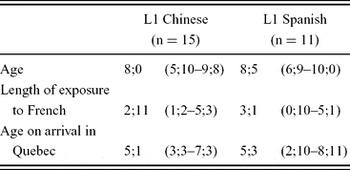
A total of 32 children participated in this study. Data from six participants (five Spanish-speaking, one Chinese-speaking) were excluded from the analysis due to exposure to French before age two (n = 2), failure to follow instructions (n = 2), or a record of receiving services from a speech-language pathologist (n = 2). Thus analyses are based on data from the remaining 26 participants. All of these were school-aged children from immigrant families in Montreal (Canada), 15 from China, and 11 from Spanish-speaking countries in Central and South America (Argentina, Chile, Mexico, Peru, Uruguay). All except two mothers indicated having a college degree. A descriptive overview of the two participant groups is presented in Table 2. At the time of testing, participants’ mean age was 8;2 years (SD = 1;3), and their mean length of exposure to French, calculated as time from arrival in Quebec, was 3;0 years (SD = 1;5). Independent-sample t-tests reveal no significant differences between the two groups for age (t(24) = –.83, p = .42), length of exposure to French (t(24) = –.37, p = .71), and age on arrival in Quebec (t(24) = –.29, p = .78). Only children who were aged 2;10 years or older at the time of arrival in Canada were included in the analysis. As no parents indicated that their child had received substantial exposure to French before arriving in Canada, these children can be considered successive, rather than simultaneous, bilinguals. According to parental report, none were fluent in a language other than French and their L1 (Chinese/Spanish), with the exception of one child in the Chinese group, who was reported to be fluent in both English and French. Thus French can be considered these children's second (rather than third) language. All participants were attending school within the French school system in Montreal at the time of testing, thus receiving ample exposure to French in their daily lives. Only children with no record of language or cognitive delays were included in the final sample.
Participant information (means and ranges, in years).

Stimuli and procedure
Participants were visited at their homes by a French-speaking research assistant for an approximately one-hour testing session. During this session, participants completed four tasks, described in more detail below: an expressive and a receptive task targeting object clitics and null objects, as well as two measures of working memory.
Object clitics: Elicited production
The elicited production task was designed to elicit utterances with a pronominalized direct object. The task consists of a picture story about a little girl and her dog. The experimenter reads the accompanying script while sharing the pictures with the participant. The script is interspersed with questions addressed to the participant, 16 of which are designed to elicit a response containing a direct object whose referent is already established in the discourse, thus creating a context where the object is encoded most felicitously by means of a pronoun. An example is provided in (6).
(6)

The task was audiorecorded, and later transcribed by the experimenter as well as an independent second transcriber.Footnote 3
Object clitics: Truth-value judgments
The truth-value judgment (TVJ) paradigm was created to test which meanings children can and cannot assign to potentially ambiguous sentences (Crain & McKee, Reference Crain, McKee, Berman, Choe and McDonough1985; Crain & Thornton, Reference Crain and Thornton1998). We employed this method to investigate whether learners posit referential null objects in their interpretation of French sentences, using a task introduced by Grüter (Reference Grüter2006a). The task relies on the potential ambiguity of verbs that enter a causative/inchoative alternation, such as monter “to climb up”/“to make something go up”, illustrated in (7) and (8).
(7)
(8)


Note that there are no overt morphological or syntactic differences between (7), (8a) and (8b) beyond the presence or absence of a direct object (clitic). Thus, in a grammar that allows referential null objects, (7) should become ambiguous: in addition to the inchoative/intransitive interpretation, the causative/transitive interpretation should also become available, provided a context where a referent for a potential null object is prominent in the discourse. In other words, if referential null objects are available, (7) should be able to receive the interpretation of (8b), namely, “Dora is pulling it [= a previously mentioned object] onto the rock”. Precisely this ambiguity is indeed observed in European Portuguese, a language with preverbal object clitics that also allows referential null objects (Costa & Lobo, Reference Costa, Lobo, Pires and Rothman2009).
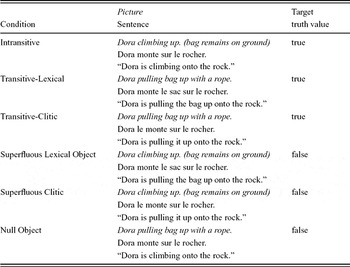
The TVJ task was constructed using four causative/inchoative verbs that give rise to this potential ambiguity: monter “to climb up”/“to make something go up”, descendre “to climb down”/“to lower something”, plonger “to dive”/“to plunge something”, and sortir “to go out”/“to make something go out”. Each verb is presented in six conditions, summarized and illustrated in Table 3. In the Intransitive Condition, an utterance without an overt object is presented together with a picture illustrating the intransitive use of the verb. Responses in this condition indicate whether participants accept the intransitive/inchoative use of the verb. In the Transitive-Lexical Condition, an utterance with a postverbal lexical object is presented coupled with a picture illustrating the transitive use of the verb, in order to establish that participants also accept the transitive/causative use of the verb. In the Transitive-Clitic Condition, an utterance with a preverbal clitic is presented together with a picture illustrating the transitive use of the verb. Responses in this condition indicate whether participants understand a preverbal clitic as referring to a previously mentioned object. In the Superfluous Lexical Object and the Superfluous Clitic Conditions, an utterance containing a postverbal lexical and a preverbal clitic object, respectively, is presented paired with a picture illustrating the intransitive action. The expected judgment in both cases is “false”. These two conditions test for an overall “yes”-bias, that is, children's general tendency to say “yes” when they are unsure (see Crain & Thornton, Reference Crain and Thornton1998, p. 213). Finally, the Null Object Condition constitutes the crucial experimental scenario: by pairing a sentence without an overt object with a picture illustrating the transitive action, it establishes whether the learner allows referential null objects. The expected judgment based on a target French grammar is “false”. If, however, the learner's grammar allows referential null objects, these items are expected to be judged “true”.
Summary of experimental conditions in the TVJ task.

It is important to take into consideration that in order for object pronominalization to be felicitous, it is crucial that the referent of the object be mentioned in the immediately preceding discourse. For this purpose, the picture paired with the test sentence is always preceded by another picture showing the agent of the clause doing something to a potential object. Figure 1 illustrates an item in the Null Object Condition as well as the picture immediately preceding it. During the presentation of the preceding picture, the experimenter, a puppet (see below) and the participant talk about what they see in the picture. Immediately before moving on to the next picture and the test sentence, the puppet, who is introduced as somewhat forgetful, will say something to draw attention to the potential object once again. For instance, in the scenario depicted in Figure 1, the puppet might say something like: “Wait, what does Dora have with her?”, to which participants typically provide the correct answer (“A backpack”). If they do not respond to the puppet's question, the experimenter supplies the answer. In both cases, the potential object is mentioned in the utterance immediately preceding the test sentence, thus making object pronominalization in the test sentence felicitous.
Examples of preceding and experimental picture in the Null Object Condition (verbal stimulus: Dora monte sur le rocher “Dora is climbing onto the rock”).

Sentences were presented orally by a puppet (a snail) operated by the experimenter. The participants’ task was to reward the puppet for a true statement about the picture by feeding him his favorite food (cucumber), and to punish him for “saying something silly” by putting a lemon in his mouth. The 24 (4 verbs × 6 conditions) test items were presented to each participant in one of two semi-randomized orders. Responses for each item were recorded by the experimenter on a scoresheet.
Working memory: Non-word repetition span
Non-word repetition span was assessed as a measure of verbal working memory. At the time of testing, no fully standardized non-word repetition task was available in French. Thus we used the task presented and described in Poncelet and Van der Linden (Reference Poncelet and Van der Linden2003), following the guidelines for administration outlined in their paper. The task consists of two lists of non-words with French syllable structure. In the first list, all items are comprised of consonant-vowel (CV) syllables (e.g., /bɔ.fœ.nɑ /), and range from two to eight syllables in length, with three items of each length. In the second list, all syllables have a CCV structure (e.g., /vlø.plɔ.sku/), and items range in length between two and six syllables, with three items of each length. The two lists were administered consecutively. Each item was read once by the experimenter, and the participant was asked to repeat it. Responses were audiorecorded, and later transcribed by the experimenter as well as an independent second transcriber.Footnote 4
Working memory: Backward digit recall span
As a more complex memory measure associated with both the central executive and phonological loop components of working memory (Gathercole et al., Reference Gathercole, Pickering, Ambridge and Wearing2004), the backward digit recall task from the Working Memory Test Battery for Children (WMTB-C, Pickering & Gathercole, Reference Pickering and Gathercole2001) was administered in a direct translation of the English original. In this task, participants are presented with spoken sequences of digits (e.g., 8 1 4), and asked to recall these sequences in reverse order (4 1 8). Sequences range from two to seven digits in length, with six items of each length. The task is terminated after three errors with items of the same length. Practice trials are given to ensure participants understand the concept of “reverse”. Responses for each item were recorded by the experimenter on a scoresheet.
This task was administed to all participants in French, their L2. In order to explore the extent to which L2 proficiency may affect performance on this task, a subset of participants, i.e., those in the Spanish-speaking group, also completed a version of this task (with different items) in their L1. The order in which the two tasks (French, Spanish) were administered was counterbalanced between subjects.
Results
Elicited production
Responses were coded as falling into one of four categories, illustrated with examples in (9): (a) responses containing a preverbal accusative object clitic, including cases where the clitic was incorrectly marked for gender and/or number, (b) responses containing a postverbal direct object referring to a discourse-prominent referent that should have been pronominalized, (c) responses with a finite transitive verb lacking a direct object, and (d) none of the above. Responses of type (d) accounted for 12% of the data overall, and include missing and untranscribable responses, responses where the two transcribers did not agree on the presence or absence of a clitic, as well as utterances with an unambiguously intransitive usage of a verb (e.g., elle joue “she is playing”), verbs requiring a genitive or dative object, utterances consisting solely of a nonfinite verb (e.g., brosser “brush”), and utterances with a direct object denoting a referent not previously in the discourse (e.g., elle brosse son poil “she is brushing his fur”). None of these, whether grammatically correct or not, provide evidence regarding the acquisition of accusative object pronominalization, and thus are excluded from further analysis.
(9)

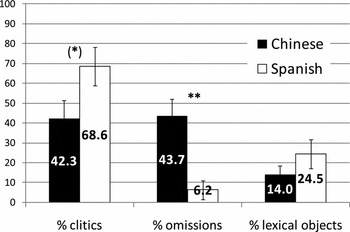
Based on the remaining data, proportion scores were calculated for each response type (a-c) and participant. Group means for each response type are shown in Figure 2. Results indicate that children in the Spanish group produced somewhat more clitics than those in the Chinese group (68.6% vs. 42.3%, t(24) = –1.97, p = .06), and omitted them significantly less often (6.2% vs. 43.7%; t(24) = 3.53, p = .002). Overall, only 2 out of 11 children in the Spanish group omitted any clitics at all, while 13 out of 15 children in the Chinese group omitted at least one. No significant group difference was found in the proportion of postverbal lexical objects (24.5% vs. 14.0%; t(24) = –1.31, p = .2). An analysis of errors in gender and/or number marking on the clitics supplied by both groups further revealed that morphological errors were prevalent in the Chinese group, affecting 25% of all clitics supplied, but rare in the Spanish group (4%). These findings illustrate that the production of accusative object clitics in L2 French was considerably more target-like in the Spanish- compared to the Chinese-speaking learner group, despite the overall similarity between the two groups in terms of their experience with French.
Mean proportion of response types per group in elicited production. Error bars represent standard errors of the means. ** p < .01, (*) p < .1

Truth value judgments
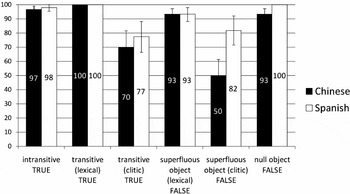
Mean proportions of expected judgments were calculated for each participant and condition. Group means for each condition are shown in Figure 3. In both groups, performance was at ceiling (≥97%) in the Intransitive and the Transitive (Lexical) conditions, indicating that participants correctly accepted both the intransitive and the transitive usage of the alternating verbs used in the experiment. Learners in both groups consistently (93%) rejected items with a superfluous lexical object, suggesting that no strong overall yes-bias was present. Crucially, both Chinese- and Spanish-speaking learners also consistently rejected items in the Null Object condition (93% and 100%, respectively), indicating that interpretations requiring a referential null object were not available to learners in either group.
Mean proportion of correct judgments per condition and group in the truth value judgment task. Error bars represent standard errors of the means.

While performance in the four conditions reported so far was virtually categorical, this was not the case for the remaining two conditions, both of which involve utterances with an object clitic. In the Transitive (Clitic) condition, the mean proportion of “true” judgments was 77% (Spanish) and 70% (Chinese) respectively, while items in the Superfluous Clitic condition were correctly rejected at rates of 82% (Spanish) and 50% (Chinese) only. In other words, it appears that (some) learners in both groups failed to accept utterances with a clitic in a transitive context, and failed to reject the same utterance in an intransitive context. This pattern of performance would be explained if a learner simply ignored preverbal clitics, which would render the utterance intransitive, and thus “false” in a transitive context (as presented in the Transitive (Clitic) condition), and “true” in an intransitive context (as presented in the Superfluous Clitic condition). Correlational analyses reveal that performance in these two conditions was correlated (Spearman's r = .63, p = .001), indicating that the depressed peformance in the two conditions is due to the same subgroup of learners. Moreover, performance in each of these conditions was correlated with proportion of clitics produced in the elicited production task (Transitive (Clitic) condition: Spearman's r = .38, p = .056; Superfluous Clitic condition: Spearman's r = .66, p < .001), as well as length of exposure to French (Transitive (Clitic) condition: Spearman's r = .57, p = .003; Superfluous Clitic condition: Spearman's r = .67, p < .001). These results indicate that learners with more limited French proficiency performed more poorly on both receptive and expressive measures specifically targeting object clitics, suggesting that they had not yet fully acquired preverbal clitic constructions in French. Importantly, however, the ceiling performance observed in the Null Object condition indicates that even this subgroup of learners with incomplete acquisition of the clitic construction did not posit referential null objects in a potential pronominialization context, providing evidence against even an early stage in L2 development where learners assume that French allows referential object pro.
Non-word repetition
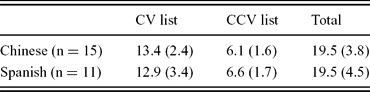
The task was scored for total number of items correct in both lists (CV, CCV), following the criteria provided by Poncelet and Van der Linden (Reference Poncelet and Van der Linden2003). Results from both learner groups are shown in Table 4. Independent samples t-tests reveal no significant differences between the two groups for performance on either list, nor overall (all ps > .4). Correlational analyses show that total number of items correct on this task did not correlate with chronological age (r = –.06, p > .7), yet was significantly related to length of exposure to French (r = .473, p = .01). These results are consistent with findings from the literature showing that non-word repetition span in a second language is at least partially reflective of experience and proficiency in that particular language, and cannot be taken as a direct index of language-independent working memory capacity (French & O'Brien, Reference French and O'Brien2008; Thorn & Gathercole, Reference Thorn and Gathercole1999).
Mean number of items correct on the non-word repetition task. Numbers in parentheses indicate standard deviations.

Further correlational analyses were conducted to test whether non-word repetition span was related to frequency of object omission in production. As omissions were extremely rare in the Spanish group (M = 6.2%, see above), these analyses were restricted to the Chinese group. In this group, the first-order correlation between non-word repetition span (total items correct) and frequency of object omission in production was not significant (r = –.09, p > .7), nor were partial correlations controlling for chronological age and length of exposure to French (all ps > .4).
Backward digit span
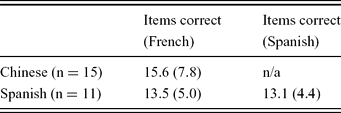
Results from both learner groups are shown in Table 5. An independent samples t-test indicates that the two groups performed comparably on this task conducted in French, their L2 (t(24) = –.76, p > .4). Correlational analyses reveal that performance on this task was significantly related to chronological age (r = .39, p = .05), but not to length of exposure to French (r = .23, p > .2), a finding that suggests that backward digit recall span may be less prone to language-specific experiential factors than non-word repetition span. This interpretation receives further support from the performance of children in the Spanish group, who completed this task in both French and Spanish (with order of presentation counterbalanced between subjects). Performance in the two languages was strongly correlated (r = .86, p = .001), and mean scores in the two languages, shown in Table 5, were not significantly different from each other (t(10) = .59, p >.5).
Mean number of items correct on the backward digit recall task. Numbers in parentheses indicate standard deviations.

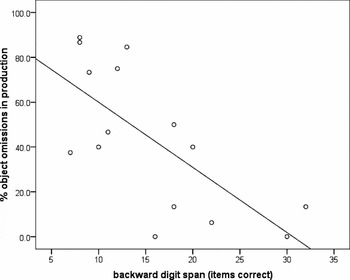
Further correlational analyses were conducted to test whether backward digit recall span was related to frequency of object omission in production. Again, due to the low frequency of omissions in the Spanish group, these analyses are confined to the Chinese group. A strong negative correlation, illustrated in Figure 4, was found between backward digit recall span and frequency of object omission in production (r = –.70, p = .003), indicating that children with lower backward digit recall span omitted object clitics significantly more often. In a regression model, this relation remained significant after controlling for chronological age and length of exposure (β = –2.947, t(11) = –2.948, p = .013), with backward digit recall span explaining 34% of the variance in frequency of object omission.
Scatter plot of backward digit recall span (number of items correct) against proportion of object omission in elicited production in the Chinese group (n = 15).

Discussion
With regard to the first of our three predictions, the parameter mis-setting approach, as well as Prévost's processing-based account, predicted that learners who omit objects in production should accept null objects in a receptive task. The present findings do not support this prediction. Learners in both groups consistently rejected items in the Null Object condition of the truth value judgment task, suggesting that they did not posit a referential null object in the interpretation of a French sentence where such a null object would have made the sentence true in the context provided. The finding that a transitive interpretation requiring a referential null object was consistently unavailable to learners in both groups indicates that their French interlanguage grammars do not comprise referential object pro. Based on the present findings, we cannot entirely exclude the possibility, however, that there existed an earlier developmental stage during which the interlanguage grammar did contain object pro. Yet recall that not all learners in this study were at ceiling in the conditions of the truth value judgment task containing utterances with object clitics, nor did all learners consistently produce object clitics in production. Thus, clearly not all learners in the present study were at a stage in L2 development where object clitic constructions have been fully acquired. Nevertheless, none of them appeared to posit referential null objects. Moreover, object omission in production was frequent, at least in the Chinese group. Given the results from the Null Object condition in the truth value judgement task, the omissions produced by these learners require an explanation other than an underlying object pro in their L2 grammar.
The second prediction, derived from transfer-based accounts, was (a) for Spanish-speaking learners to perform better than Chinese-speaking learners on clitic-related tasks in French, and (b) for Chinese- but not Spanish-speaking learners to accept null objects in a receptive task. As for (a), results from the elicited production task revealed clear group effects, with Spanish-speaking learners producing more and omitting fewer object clitics than their Chinese-speaking peers matched for age and length of exposure to French.Footnote 5 These findings support prediction 2, and indicate an important role for positive transfer in the L2 acquisition of object clitic constructions. The asymmetry between the two learner groups observed in the production data was only partly reflected in the results from the truth value judgement task. Performance in both groups was somewhat depressed in the two conditions involving utterances with object clitics (Transitive (Clitic) and Superfluous Clitic conditions). In both conditions, the performance of the Spanish group was somewhat better than that of the Chinese group, yet these differences were not statistically significant, possibly due to insufficient statistical power in this task.
While the results from the present study, particularly those from elicited production, provide evidence for the role of positive transfer in the L2 acquisition of clitic constructions, no evidence was found for negative transfer of referential null objects from L1 Chinese to L2 French. This finding is unexpected under “full transfer” accounts, whereby the entire L1 grammar is assumed to constitute the L2 initial state (Schwartz & Sprouse, Reference Schwartz and Sprouse1996, inter alia). Under a full transfer account, a Chinese-speaking learner's initial state French interlanguage should comprise referential null objects. Moreover, the positive evidence required for learners to abandon such referential null objects is at best scant: while French only allows the overt realization of object clitics, Chinese allows both null and overt realizations of object pronouns, thus giving rise to a potential superset–subset relation between L1 and L2. Such scenarios have been argued to make convergence on the subset logically impossible (Crain, Ni & Conway, Reference Crain, Ni, Conway, Clifton, Frazier and Rayner1994; Wexler & Manzini, Reference Wexler and Manzini1987), and in empirical work, have been shown to give rise to learners’ protracted adherence to transferred L1 options, and continued failure to restrict the L2 grammar to the target options even in learners of more advanced proficiency (e.g., Grüter, Lieberman & Gualmini, Reference Grüter, Lieberman and Gualmini2010; Trahey & White, Reference Trahey and White1993).Footnote 6 Thus, although we cannot entirely exclude the possibility that learners in the Chinese group had initially transferred referential null objects from their L1 and subsequently restructured their interlanguage grammar to disallow them, it would seem rather surprising to find that virtually all of them, some with no more than 14 months of exposure to French, had successfully abandoned this property in the course of L2 development. We therefore take the finding that learners in the Chinese group did not posit referential null objects in their interpretation of French sentences to indicate that this property was never transferred from the L1.Footnote 7 This suggests a potentially more general restriction of the full transfer hypothesis, tentatively stated in (10).
(10) L1 transfer is limited to overt material, and does not extend to empty categories.
This hypothesis raises immediate questions regarding the status of other empty categories in L2 acquisition, including null subjects. While previous evidence from production and grammaticality judgments have been taken as evidence for transfer of null subjects (e.g., White, Reference White1985), we do not know of any studies investigating whether learners use referential null subjects in their interpretation of sentences in the L2. An experiment using precisely such an interpretive task with first language learners of English was recently presented by Orfitelli and Hyams (Reference Orfitelli, Hyams, Chan, Jacob and Kapia2008). Studies employing tasks such as these with L2 learners would be required to further investigate the hypothesis stated in (10), a desideratum for future research on the extent and potential limitations of L1 transfer in L2 acquisition.
Finally, our third prediction, following from Prévost's (Reference Prévost2006) proposal, was for a negative correlation between frequency of object clitic omission in production and performance on independent measures of processing capacity. Two such measures were included in the current study, non-word repetition span as a measure of verbal working memory, and backward digit recall span as a measure of the central executive component of working memory. Regression analyses revealed backward digit recall span as a strong predictor of frequency of object omission in production in the Chinese learner group. This finding lends support to our third prediction, and presents the first empirical evidence for Prévost's proposal linking object omissions in production to processing limitations. At the same time, we found no relation between non-word repetition span and object omission. Yet consistent with previous studies, our findings indicated that performance on the non-word repetition task was related to cumulative experience with the language in which the task was conducted, in this case, French. These results suggest that object clitic omission may be related less to experience-related verbal working memory in the L2, and more to factors pertaining to general cognitive resources, such as central executive functions.
To sum up, several novel findings have emerged from the present study. It provided the first quantitative evidence for the facilitative effect of positive transfer in the L2 acquisition of object clitic constructions. At the same time, it provided evidence against the (negative) transfer of referential null objects. Neither the Chinese- nor the Spanish-speaking learners of French in this study showed any signs of using referential null objects in the interpretation of potentially ambiguous sentences in French. This leads to the conclusion that object clitic omission in L2 production is unlikely to be due to an underlying grammatical representation involving null objects of the Chinese or Portuguese type. Yet this means that our initial question remains unanswered: what is the source of object clitic omission in production? We return to this question in the next section, drawing on the new evidence presented here suggesting that object clitic omission in production is related to processing capacity limitations.
The source of object omission in production
The present study has shown evidence of a relation between frequency of object (clitic) omission in production and working memory span, a finding that supports Prévost's hypothesis that object omission is due to processing capacity limitations. Prévost suggested that these processing limitations interact with computational complexity at the level of syntactic representations, referring specifically to a proposal by Jakubowicz and colleagues (Jakubowicz & Nash, Reference Jakubowicz and Nash2003) that child learners of French resort to referential null objects when processing constraints prevent them from producing a clitic construction. This suggestion entails that referential null objects are part of the learners’ grammars, and can be called upon when the need arises. Yet the results from the truth-value judgment task presented here speak against this: when presented with a context illustrating a transitive event (e.g., Dora pulling a bag up onto a rock) and a potentially ambiguous utterance lacking an overt object (e.g., Dora monte sur le rocher), learners appeared unable to posit a referential null object, indicated by their consistently judging these utterances “false”. This finding suggests that referential null objects are not part of learners’ interlanguage grammars, and thus cannot be used as an explanation for object clitic omission in production. It appears, then, that object drop is a phenomenon limited to language production. In the remainder of this section, we outline a proposal of how object clitic omission may arise as a result of limited processing capacity during the course of grammatical encoding, a specific stage in models of language production.
To this end, we employ a psycholinguistic model of syntax in language production introduced by Ferreira (Reference Ferreira and Wheeldon2000). Ferreira presented a detailed model of syntactic encoding, combining key aspects of psycholinguistic models of language production, such as incrementality of processing, with an independent set of formal approaches to grammatical structure known as Tree Adjoining Grammar (TAG; Frank, Reference Frank2002, Reference Frank2006; Joshi, Levy & Takahashi, Reference Joshi, Levy and Takahashi1975; Joshi & Schabes, Reference Joshi, Schabes, Rozenberg and Salomaa1997). Within TAG frameworks, clausal structures are built through the rule-governed combination of independently derived pieces of grammatical structure, called “elementary trees”, which consist of an extended projection of a single lexical head. Thus an elementary tree headed by a verb may (but must not) project up to a CP level, while an elementary tree headed by a noun typically projects up to the DP level. Importantly, the operations involved in the projection of elementary trees are assumed to be different from those governing the combination of elementary trees into larger syntactic units. While the projection of elementary trees may involve the operations Merge and Move as in Chomskian approaches (Frank, Reference Frank2002), the combination of elementary trees into larger clausal structures is governed by two separate operations: substitution and adjoining. The substitution operation combines two elementary trees by inserting one into a peripheral node of the other, as illustrated in (11), with the requirement that the root of the substituted elementary tree match the label of the substitution site.
(11)

While substitution combines two elementary trees at their periphery, the adjoining operation inserts one structure into another, with the additional requirement for the inserted structure to have a foot node with a label identical to that of its root. This is illustrated in (12) with the derivation of a raising structure, a classic example of adjoining in TAG.
(12)

Drawing on this basic architecture, Ferreira (Reference Ferreira and Wheeldon2000) proposed a model of how these operations are executed during sentence production in real-time, that is, incrementally from left to right, a question that TAG formalisms themselves do not speak to. Within this model, the syntactic encoding of a simple transitive clause in an SVO language such as English or French proceeds in the following steps, illustrated in (13). First, the elementary tree for the subject is retrieved, projecting up to DP. Second, the elementary tree for the verb is retrieved, projecting up to an extended verbal projection. Third, given these two compatible elementary trees, the first combinatory process can take place, combining the two through the substitution operation. At this point, following Ferreira's model, the contiguous string consisting of the subject and the verb is already passed on to the next component in the production system, the phonological encoder, in line with key architectural properties of the language production system, parallel processing and incrementality (Bock & Levelt, Reference Bock, Levelt and Gernsbacher1995; Levelt, Reference Levelt1989). Importantly, this entails that the first part of the clause, up to and including T, can no longer be modified by syntactic encoding after this point.Footnote 8 Finally, the elementary tree for the object is retrieved, and substituted into the appropriate terminal node in the extended verbal projection, thus completing syntactic encoding of the clause.
(13)

Let us now consider these processes in the case of a clause with an object clitic construction, such as Sophie le brosse “Sophie is brushing him”. While the elementary trees for the subject and the verb are the same as in (13), the elementary tree required for the clitic construction is somewhat more complex. The solution adopted here is that of a multi-component tree set (see Joshi & Schabes, Reference Joshi, Schabes, Rozenberg and Salomaa1997), whereby the elementary item retrieved from the lexicon consists of a set containing two or more tree fragments, in this case, one projected by the preverbal clitic, the other by the empty nominal (pro) to be substituted into the postverbal argument position (14).Footnote 9 Next, let us consider the incremental construction of this clause. As in the previous case, we begin with the retrieval of the subject DP. Second, the tree set for the clitic construction is retrieved. Note that at this point, no combinatorial processes can take place, as neither elementary tree offers a substitution (or adjoining) site for the other. Thus all elements must be kept active in working memory, while the final elementary tree, namely the verb and its extended projection, is retrieved. Only now can elements be combined, starting with the substitution of the subject into the appropriate terminal node of the verbal projection. At this point, only the left-most part of this projection, consisting of the subject alone, can be passed on to the phonological encoder, since adjoining of the clitic at a site preceeding the verb has yet to take place. Next, the first element of the clitic set is adjoined into the verbal projection, that is, inserted at the appropriate node within the verbal projection (leaving unspecified, for present purposes, the exact label and position of the adjoining site). At this point, the contiguous string consisting of the clitic and the verb can be passed on to phonological encoding, while syntactic encoding is completed by the substitution of the second element of the clitic set, the projection of pro, into the complement of V, thus satisfying the argument requirements of the verbal projection.
(14)

When comparing the incremental syntactic encoding of a clause with a postverbal lexical object (13) and one with a preverbal clitic construction (14), the latter can be seen as more complex in (at least) two ways. First, it involves adjoining as well as substitution. Ferreira (Reference Ferreira and Wheeldon2000, p. 304) raised the point that “substitution might be easier than adjoining because it requires less effort to simply attach a tree to the bottom of another tree than to actually insert a tree into the middle of another.” If this intuition is correct, the syntactic encoding of a sentence with a preverbal clitic construction could be seen as requiring more effort than that of a clause with a postverbal object. Second, the clause with the clitic construction requires keeping more elements concurrently active in working memory than the construction with a lexical object. In particular, in the case of a postverbal object construction, the subject and the verbal elementary trees can be combined immediately after retrival of the latter, and large parts of the combined structure can be passed on to phonological encoding, even before the object is retrieved. In the case of a clitic construction, by contrast, all three elementary trees must be retrieved and held active before any combinatorial processes can take place. And even after the first operation (substitution of the subject) has occurred, only a small part of the structure (the subject alone) can be passed on. While this comparison does not rely on a fully precise metric of processing complexity, it nevertheless illustrates how the incremental encoding of a sentence with a clitic construction leads to a temporarily more crowded syntactic workspace than the encoding of a sentence with a postverbal object.
Let us thus consider what may occur when this workspace is restricted and cannot meet the storage demands required during the encoding of a clause with a clitic construction. Recall that once the subject is substituted into its argument position, only the subject alone – without the verb, unlike in clauses with a postverbal object – can be passed on to phonological encoding, as the clitic still needs to be adjoined at a site to the left of the verb. Suppose, however, that at this point, workspace capacity has reached its limits, putting the system under pressure to pass more material on to the next component. In consequence, rather than passing on only the subject, it may instead pass on the string consisting of both subject and verb, just as in clauses with a postverbal object. As a result, the first tree fragment in the clitic set can now no longer be adjoined into the verbal projection, since its adjoining site is no longer available. The second part of the set, however, the projection of pro, can still be properly substituted, thus fulfilling the argument requirements of the verbal projection. This course of events will result in the final representation shown in (15), a clause with a null postverbal object and no clitic, in other words, exactly the kind of object omission error we observe in learners’ speech.
(15)

In sum, adopting Ferreira's (Reference Ferreira and Wheeldon2000) psycholinguistic model of incremental syntactic encoding, we have presented an explicit account of how object clitic omission may arise in the course of the production process. We propose that capacity limitations in the syntactic workspace or “syntactic buffer” – a component proposed by Levelt (Reference Levelt1989), and adopted by Ferreira (Reference Ferreira and Wheeldon2000), designed to temporarily hold activated grammatical units before they can be syntactically integrated – at a crucial juncture during syntactic encoding may lead to the premature discharge of syntactic structure needed to adjoin the clitic projection. As a consequence, the clitic projection can no longer be adjoined into the extended verbal projection. Assuming that unintegrated structure is unpronounceable at the phonetic interface, the clitic will thus not be part of the phonetic realization of the clause. The (clitic-less) clause itself, however, is syntactically well-formed, with all argument requirements fulfilled, suggesting that it will not violate any interface conditions. Thus nothing should prevent it from being pronounced – albeit without a clitic and without an overt lexical object.
Conclusion
In this paper, we have addressed a number of factors, both linguistic and non-linguistic, hypothesized to be involved in the widely attested difficulty with object clitic constructions in the acquisition of Romance languages, focussing specifically on the acquisition of French by child second language learners. Several novel findings have emerged from the empirical study presented here. First, we observed a facilitative effect of positive transfer: although both groups had similar experience with French, the Spanish-speaking learners performed better than the Chinese-speaking learners on clitic-related tasks. This finding suggests that the Spanish-speaking learners were able to transfer grammatical representations and processing routines relevant to object clitic constructions from L1 Spanish to their L2 French. This constitutes the first quantitative evidence that we are aware of from a scenario where both L1 and L2 have object clitics. Second, we found no evidence of learners positing referential null objects in French, even if their L1 allows them. This finding constitutes evidence against a parameter mis-setting account (Towell & Hawkins, Reference Towell and Hawkins1994). It also suggests that transfer of grammatical representations from the L1 may be limited. In particular, we have argued that our results provide evidence against the transfer of referential object pro, and have raised the hypothesis that L1 transfer may be limited more generally to overt grammatical elements. Future research, in particular on subject pro, is needed to further investigate this hypothesis. Third, findings from our Chinese-speaking learners of French have shown a significant negative correlation between frequency of object omission in production and backward digit recall span as an independent measure of working memory. This is precisely what is expected under the account proposed by Prévost (Reference Prévost2006), who attributed difficulties with object clitic constructions to processing limitations. Our findings present the first empirical evidence in support of Prévost's proposal.
The findings from the present study led to the conclusion that object clitic omission in child L2 French cannot be attributed to referential null objects in the learners’ interlanguage grammars. Instead, we have argued that illicit object drop is a phenomenon limited to language production. Employing Ferreira's (Reference Ferreira and Wheeldon2000) psycholinguistic model of syntactic encoding using Tree Adjoining Grammar, we have presented an explicit proposal of object clitic omission as a production-specific phenomenon conditioned by limitations in working memory capacity. This proposal captures the production-specific weaknesses with object clitic constructions observed in the child L2 learners of French who could not transfer representations and processing routines relevant to object clitics from their L1. To what extent this proposal will extend more broadly to the difficulties with object clitics attested in various other learner populations is an empirical question. Our proposal makes two clear predictions. It expects (i) an asymmetry between expressive and receptive skills, that is, omission of object clitics in production, yet rejection of referential null objects in a receptive task; and (ii) a negative correlation between frequency of object omission in production, and performance on an independent measure of processing capacity. In the present study, backward digit recall span, a measure associated with both verbal and non-verbal components of working memory (Gathercole et al., Reference Gathercole, Pickering, Ambridge and Wearing2004), but not non-word repetition span, a more exclusively verbal memory measure, was found to correlate with object omission in production. These outcomes suggest that future work is required to determine more precisely the specific measures of working memory that are best suited to assess the capacity limitations in the syntactic workspace hypothesized here. It also remains for future work to test the predictions that arise from our account with other learner groups, and thus to determine whether this account may indeed present a unified explanation for the difficulty with object clitic constructions attested across learner populations.