INTRODUCTION
Benthic gastropods are without doubt one of the best known of the higher groups of marine benthic animals in Scandinavia, both taxonomically and as regards distribution (see e.g. Høisæter, Reference Høisæter2009). While a number of questions remain concerning small and morphologically diverse species groups, the distribution of the larger and more conspicuous members of the class is supposedly well known. In addition to faunistic investigations around the coast of Norway and western Sweden, a growing number of biologically knowledgeable underwater photographers have contributed to our knowledge. Thus it was quite unexpected when the fairly large and colourful ovulid Xandarovula patula (Pennant, 1777) was found during three separate collecting trips in 2009 and 2010. In August 2009 six specimens were taken from five dredge hauls at a locality in the Swedish part of the Skagerrak (approximately 58°21′N). Then in June and again in November 2010 a total of three specimens were found in dredge samples from the Norwegian west coast (approximately 60°27′N).
MATERIALS AND METHODS
In Sweden the snails were found when the University of Gothenburg, in collaboration with the Swedish Species Information Centre, arranged a sampling cruise using their research vessel, RV ‘Skagerak'. The cruise was arranged to investigate the shallow sea banks along the Swedish west coast from the south of Gothenburg to the area west of Smögen by request from the Swedish Environmental Protection Agency. Here the sea bank ‘Svaberget/Det grunda’ was particularly interesting as most of its hard substrate is dominated by a cover of the octocoral Alcyonium digitatum Linnaeus, 1758. A small sample, using a rectangular dredge (25×50 cm opening) from 55 to 20 m depth, could contain 5 to 10 l of Alcyonium. Together with A. digitatum, the brittle stars Ophiocomina nigra (Abildgaard, 1789) and Ophiothrix fragilis (Abildgaard, 1789) were also present in large numbers. In all thirty-five hauls were taken.
When sorting the material brought on deck a small pinkish gastropod was observed among the Alcyonium in five of the hauls. These were subsequently identified as Xandarovula patula. In the material collected from one of the stations (SK 247) there was also an empty shell of X. patula measuring 15 mm in shell length.
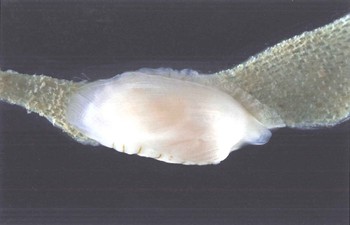
A live specimen of X. patula about 10 mm long was photographed aboard the ship in a small aquarium, using a Canon D60 with 100 mm EF Macro USM lens on a piece of the bryozoan Flustra foliacea (Linnaeus, 1758) (Figure 1).
Xandarovula patula with almost white shell collected 25 August 2009 from the Swedish west coast, photographed aboard the ship in a small aquarium. Size approximately 10 mm. Photograph: Matz Berggren.

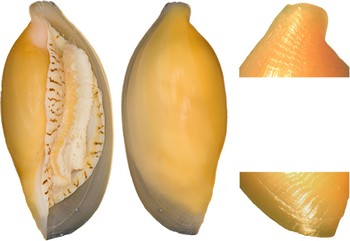
On the west coast of Norway, one year later in June 2010 X. patula was found in one of five dredge hauls taken by the RV ‘Hans Brattström' at Svelgen Bridge, an often visited dredging locality in Øygarden, Hordaland County. This specimen (Figure 2) was collected from a depth of 10–20 m. The bottom substrate was rocky, with small stones, large shell fragments and small colonies of A. digitatum. The hydroid Tubularia indivisa Linnaeus, 1758 was also among the more conspicuous organisms present. Another two specimens of X. patula were found in two dredge hauls at the same locality during a field course in November 2010. The largest of these were 16.8 mm long.
A 14.3 mm long specimen of Xandarovula patula from Norway. Right hand side shows structural details of the apical and basal parts of the shell. Photograph: Jon Anders Kongsrud and Tore Høisæter (details).

The Swedish specimens are all deposited in the Gothenburg Natural History Museum, while two of the Norwegian specimens are deposited in the Zoological Museum of the University of Bergen. The third Norwegian specimen is lost.
RESULTS AND DISCUSSION
Xandarovula patula has so far not been reliably reported from Scandinavian waters. The species, long known as Simnia patula (Pennant) (e.g. Fretter & Graham, Reference Fretter and Graham1981; Graham, Reference Graham1988; Rowley, Reference Rowley2008; Reijnen et al., Reference Reijnen, Hoeksema and Gittenberger2010), was in 1973 transferred to Xandarovula Cate, Reference Cate1973 (see Cate, Reference Cate1973; Dolin & Ledon, Reference Dolin and Ledon2002; CLEMAM, 2010; Gofas, Reference Gofas2011). This change of generic placement is of some importance as Dolin & Ledon (Reference Dolin and Ledon2002) proposed that Simnia and Xandarovula belong to different subfamilies and are therefore not particularly closely related. The taxonomic disparity between Simnia and Xandarovula is accepted by Fehse (Reference Fehse2007), who places Simnia in the subfamily Simniinae, and Xandarovula in Ovulinae. In spite of this Lorenz & Fehse (Reference Lorenz and Fehse2009) apparently do not accept the genus change for ‘Simnia' patula, the type species of Xandarovula. We understand that the decision hinges on the interpretation of the type specimen of Simnia nicaeensis Risso, 1826, type species of Simnia. This specimen is illustrated in Schilder (Reference Schilder1932), and we agree with Dolin & Ledon (Reference Dolin and Ledon2002) and the CLEMAM editor (as well as one of the referees, but as opposed to Schilder, Reference Schilder1932) that this specimen is a juvenile of the well known species Simnia spelta (Linnaeus, 1758), therefore making Simnia Risso 1826 an older name for Neosimnia Fischer, 1884 and leaving Xandarovula valid for species congeneric with X. patula.
The shell (Figure 2), maximum reported length 22 mm (see however Graham, Reference Graham1988, who cites 15 mm as maximum length), is convolute, elongate–oval, thin, polished and drawn out into apical and basal canals; juvenile shells (<4 mm long) have a short visible spire Fine sculpture of low strap-like spiral striae, most distinct near the apical and basal parts of the shell. The aperture is curved, wider below the parietal bulge of the last whorl; the apical canal is short, the basal canal is wide and bordered on the left by a ridged columella. The shell colour may be yellow, whitish or sometimes pink. The mantle, which covers the shell when the animal is feeding is yellow to whitish with brown or reddish brown lines and spots (see Figures 1 & 2).
As with all members of the family, Xandarovula patula is regarded as an obligate predator of various cnidarians. It is known to prey on Alcyonium digitatum and, more rarely, on A. glomeratum (Hassall, 1843) (Rowley, Reference Rowley2008). It has however also been collected from the gorgonian Eunicella verrucosa (Pallas, 1766) and the hydroid Tubularia indivisa (Jeffreys, Reference Jeffreys1867; Lebour, Reference Lebour1932; Fretter, Reference Fretter1951; Fretter & Graham, Reference Fretter and Graham1981; Rowley, Reference Rowley2008). Of these only A. digitatum and T. indivisa are known from Scandinavian waters where they are common and widespread. The association with Tubularia is however not very well documented, apparently based solely on Jeffreys (Reference Jeffreys1867: 408) ‘Mr. Horace Marryat found it living among tufts of Tubularia indivisa in the Gouliot caves at Sark, at low water.' We have not been able to find any further documented references. We therefore assume that A. digitatum is the substrate in Scandinavia on which X. patula is likely to be found.
Xandarovula patula is seemingly confined to the north-eastern Atlantic, with its main distribution along the coasts of Ireland and south-western England with scattered records from western British coasts as far north as the Orkneys, and the Atlantic coasts of France (Fretter & Graham, Reference Fretter and Graham1981). There are only few and imprecise records from further south along the coasts of Spain and Portugal (Rolán, Reference Rolán1983). It has, however been recorded from as far south as the Cape Verde Islands (two specimens from 300 m; photograph in Rolán, Reference Rolán2005). Dolin & Ledon (Reference Dolin and Ledon2002) indicate that X. patula also occurs in the western Mediterranean. A related species, X. aperta (Sowerby G.B. II, 1849) is found in the western Mediterranean (Dolin & Ledon, Reference Dolin and Ledon2002, as X. purpurea Risso, 1826; see CLEMAM, 2010).
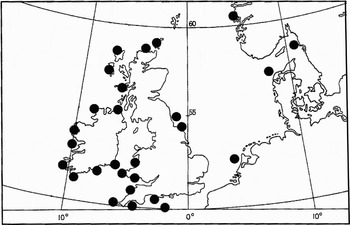
Jeffreys (Reference Jeffreys1867) reported it (as Ovula patula) from the coasts of Dorset, Devon and Cornwall, the Channel Islands, the Irish coast, and the south-western coast of Scotland. Later it has been reported from northern Scotland, the Orkneys and a couple of localities on the northern North Sea coast of England (Rendall, Reference Rendall1936; Fretter & Graham, Reference Fretter and Graham1981; Seaward, Reference Seaward1990; Rowley, Reference Rowley2008). Most recently the species has been reported from the Dutch part of the North Sea (Reijnen et al., Reference Reijnen, Hoeksema and Gittenberger2010). Xandarovula patula has been found regularly by Belgian fishermen in the Danish part of the North Sea, 15 miles west of Hanstholm at a depth of 65 m among stones. It was found at a specific locality (57°10′N 7°50′E) one or two specimens each time every year since 2005 (Jean-Paul Kreps, personal communication). According to Dr Kreps it was not known from the Danish part of the North Sea before 2005. These records are summarized in Figure 3.
Records of Xandarovula patula from the English Channel and northwards based on information from Seaward (Reference Seaward1990), Rowley (Reference Rowley2008) and BioMar data from Ireland (http://www.habitats.org.uk/marinelife/biomarspecies.asp?item=w7320). Black dots (•) denote all the known records, including the new Scandinavian and North Sea records (each dot may include more than one specimen per location).

Lorenz & Fehse (Reference Lorenz and Fehse2009) reported X. patula from Norway, but give no supporting documentation. There is another unverified record from Norway online: http://www.gastropods.com/Taxon_pages/Class_GASTROPODA.shtml. We have not been able to trace the origin of these two. Thus the records reported here represent the first fully documented ones from Scandinavian waters*.
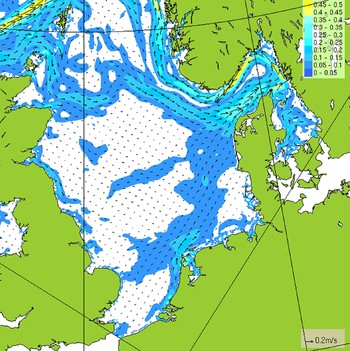
While Lebour (Reference Lebour1932) states that X. patula is common trawled in Plymouth waters, other authors report it as uncommon in British waters (e.g. Fretter & Graham, Reference Fretter and Graham1981; Graham, Reference Graham1988). The species is however regarded as probably under-recorded (Rowley, Reference Rowley2008). The tidal currents around the British Isles transport warm Atlantic water along the western side of the isles and join the North Atlantic drift around the Orkney and Shetland Islands. An arm of these surface water masses then drifts down the Scottish and British east coast before it turns towards Denmark and the Skagerrak (Figure 4). According to Lebour (Reference Lebour1932) ‘Simnia’ must have a long larval life, as she noted that the late larvae lived for several weeks in a plunger jar without losing the velum. Drifting larvae of X. patula could therefore be transported in these water masses north to the west coast of Norway or east to the Swedish area of the Skagerrak where they would find a suitable habitat for settling. This transport pattern could also explain the records for the east coast of Britain. The immigration to the Skagerrak coast could of course also have taken a different route, passing across the southern North Sea north of Denmark and across the Skagerrak in the Jutland current to the Swedish west coast. Here it meets the north-going Baltic surface current that will transport planktonic larvae up the Swedish west coast. At the location where this species was found (Svaberget) is probably the first suitable locality for settling for many larval forms. In this location more rare species have also been found in high numbers for Swedish waters, such as the hairy crab Pilumnus hirtellus and the seven-armed starfish Luidia ciliaris. With the confirmed, persistent, population in the Danish part of the North Sea this immigration route to Sweden is a possibility.
Map showing the current patterns found around the British Isles, the North Sea and the Skagerrak (courtesy John Albretsen).

Several lines of evidence indicate that the species has invaded Scandinavian waters during the last decade, and is now established in at least two localities. The fact that the species, in spite of being large (for a Scandinavian gastropod) and with a very characteristic appearance, has not been reported from any locality in Scandinavia before, and that it was for the first time recorded from the North Sea locality west of Hanstholm in 2005, suggests that the invasion to Scandinavia is a fairly recent phenomenon, while the fact that large specimens have been found twice (in two consecutive years) at the Norwegian locality and in several dredge hauls at the Swedish one, argues for an established population at both sites. The records reported in this note may therefore be taken as evidence of a successful expansion of the distribution of this species over recent years.
This report is the first published record of a species of the family Ovulidae from Scandinavian waters, and an addition to the distribution list of Høisæter (Reference Høisæter2009).
ACKNOWLEDGEMENTS
We are grateful to Olivier Caro who brought our attention to the Danish records via his excellent online mollusc photographs (http://www.idscaro.net/sci/01_coll/index.htm), and to Jean-Paul Kreps at the Royal Belgian Institute of Natural Sciences for providing the detailed information on the species in the Danish part of the North Sea. The finding of this species in the Bergen area was made possible by the participation of T.H., C.S. and H.T.R. in a dredging excursion with RV ‘Hans Brattström', organized by the Marine Biodiversity research group of the Department of Biology. Thanks to Professor Henrik Glenner, who graciously presented us with the specimens found in November, and to Jon Anders Kongsrud for taking the photographs (Figure 2). J.-A.S. wishes to express thanks to Matz Berggren for inviting him to participate in the cruise with RV ‘Skagerak' and also to the rest of the cruise participants for their enthusiasm in sorting the many samples. John Albretsen is thanked for letting us use his map showing the current patterns of the North Sea and the Skagerrak. Elizabeth Platts is warmly thanked for commenting on the manuscript and for amending the English. Two anonymous referees suggested a number of relevant and most useful changes to the manuscript.
*Note added in proof.
Recently we have become aware of two online photographs of a specimen of Xandarovula patula from Norwegian waters, photographs that somehow have evaded the most commonly used search engines. These photographs (at http://www.espenrekdal.no/) are of excellent quality, well documented, and prove that the species was present in Norwegian waters in 2003. They also extend the northern distributional limit of the species to Trondheimsfjorden (roughly 63°30'N), and expand the list of host species to include the plexaurid alcyonacean Paramuricea placomus (Linnaeus, 1758). Judging from the photographs, the length of the specimen is close to 20 mm. The photographer (Espen Rekdal, personal communication) has since 2003 observed the species several times in the same general area of Øygarden as reported in our note above. In this general area the host species was always Alcyonium digitatum.