In recent years, microorganisms, especially bacteria, resistant to many antibiotics have been causing infections that are difficult to treat. It is estimated that, in Europe, some 25,000 people die of severe bloodstream infection (sepsis) caused by resistant bacteria every year. The increase in the prevalence of these resistant bacteria has been accompanied by stagnant development of new antibiotics. Bacterial infections that are no longer treatable with antibiotics are already quite prevalent in countries such as India and Greece, and there is a real threat that such infections will increasingly occur elsewhere. Many have voiced their concerns about this global problem. For instance, the Chief Medical Officer in the United Kingdom, Dame Sally Davies, FRS, has described the rising risk of antibiotic resistance as a bigger threat than global warming and has warned that the population could be facing an ‘apocalyptic scenario’. In a collaborative paper in the Lancet by Dr Jean Carlet et al., it was phrased as follows: ‘We have watched too passively as the treasury of drugs [antibiotics] that has served us well has been stripped of its value. We urge our colleagues worldwide to take responsibility for the protection of this precious resource. There is no longer time for silence and complacency’.Reference Carlet, Collignon, Goldmann, Goossens, Gyssens, Harbarth, Jarlier, Levy, N’Doye, Pittet, Richtmann, Seto, van der Meer and Voss1 In this paper we describe this problem in greater detail and discuss the steps that have been proposed by the European Academies Science Advisory Council, EASAC.2
Historical Background
Early in the 20th century, Paul Ehrlich aspired to develop a ‘therapia magna sterilisans’, and his discovery the arsenic compounds Salvarsan and Neosalvarsan for treatment of syphilis meant the start of the era of antimicrobial treatment.
Shortly before the Second World War, the prognosis of patients with life-threatening bacterial infections such as pneumococcal pneumonia and bacterial meningitis changed, because sulphonamides became available as antibacterial drugs. The sulphonamides were not effective against many other bacterial infections and were not free of serious side effects, but nevertheless they were a major step forward. The sulphonamides as antibacterial drugs were discovered by Gerhard Domagk, at IG Farbenindustrie in Germany. He was searching whether chemical dyes were useful as antibacterial drugs, based on the notion that these substances stained bacteria as well as tissues. In fact, it was not the dye part of the molecule but the sulphonamide part attached to it that appeared to be the active component.Reference Domagk3
If Domagk had not done his primary experiments in vivo in mice, he would not have discovered the antimicrobial action of Prontosil. This was because Prontosil is a pro-drug, which only after being metabolised in vivo would become an active antibacterial drug.Reference Lesch4 For that reason, Jacob and Heidelberger in 1915 missed the antibacterial effect action of the sulphonamides.Reference Comroe5
In the late 1920s, Alexander Fleming had already made his serendipitous discovery of penicillin,Reference Fleming6 a product of the mould Penicillium. This discovery did not lead to extensive use of the substance for treatment, with the exception of the local treatment of bacterial conjunctivitis.Reference Selwyn7 Rubin, in his description of the early years of antibiotics, gives a number of explanations as to why Fleming did not translate his finding to clinical use.Reference Rubin8
Fleming was intrigued by his observation because of his interest in lysis of bacteria and because staphylococci were known to be notoriously resistant to lysis. Even if he had the desire to provoke interest in penicillin, his superior, Almroth Wright, was strongly against the idea of any therapeutic value of penicillin and expressed his disfavour to Fleming.
It still took Florey and Chain great efforts during the Second World War to develop penicillin (benzylpenicillin, penicillin G) further as a potent antibiotic that really changed the prognosis of patients with serious bacterial infections.Reference Chain, Florey and Gardner9
After this relatively slow start, the development of benzylpenicillin was followed by a rapid and enormous development of very effective antibiotics in the decades after the war. Most of the antibiotics that came to the market were based on natural substances, products made by fungi and bacteria in the soil.10 Chemical modification of these compounds led to drugs with improved pharmacological properties (such as resorption after oral administration). Since the antibacterial effect of the penicillins is due to their interference with the synthesis of the bacterial cell wall, they were remarkably free of toxicity for the mammalian cell, which lacks a cell wall (the mammalian cell only has a cell membranes to contain its cytoplasm). This so-called selective toxicity and the impressive antibacterial potency of the effect of the penicillins largely explain their success.
When the sulphonamides and penicillins came into clinical use, it was immediately apparent that not all bacterial infections responded. This was found to be due to natural resistance to the drug(s). Soon, however a more serious problem emerged: use of these drugs led to the appearance of more resistant bacteria; even bacteria that had been susceptible originally were seen to acquire resistance.
Antimicrobial Resistance
Regarding the action of antibiotics, we distinguish between those compounds that kill bacteria at concentrations that can be attained in the human body, the bactericidal drugs, and those that only inhibit the proliferation of bacteria, the bacteriostatic drugs. The penicillins are typical examples of bactericidal drugs.
When a microorganism is not killed or not inhibited in its proliferation by an antibiotic at concentrations that can be reached in the human body, the microorganism is not susceptible to the drug and we speak of antimicrobial resistance. Antimicrobial resistance is based on at least one of the following mechanisms.
(1) The antibiotic cannot reach the target where it exerts its potential action. This may be due to a barrier, such as a cell wall that cannot be passed.
(2) The antibiotic is inactivated, for instance while it is broken down by an enzyme (such as a β-lactamase, the enzymes capable of hydrolysing the β-lactam ring structure of the penicillins)
(3) The target is insensitive to the antibiotic, for instance because the antibiotic is not able to bind to it.
(4) The antibiotic is pumped out of the bacterial cell before it can reach the target.
Some of these mechanisms may represent intrinsic properties of the bacterium, but they may also develop during exposure to antibiotics.
The vast potential of bacteria to proliferate with generation times of less than an hour for many species, allows them to undergo rapid evolution. Random mutations in the bacterial DNA may dramatically change their ability to survive in the presence of an antibiotic. The chance that this occurs is greatest when the ambient antibiotic concentrations are low. Often more than one mutation is necessary to create full resistance. Bacteria are not only able to adapt to the antibiotic pressure in this way, they also possess mechanisms of horizontal gene transfer, most often between members of the same strain, but sometimes also between different bacterial species. A detailed discussion of these mechanisms is beyond the scope of this article.
The Race between Resistance and Antibiotic Development
The first microorganism that posed a resistance problem was Staphylococcus aureus, a skin bacterium that causes wound infections (e.g. after surgery) and other serious suppurative infections. Some S. aureus strains were able to produce penicillinase, the prototypic β-lactamase able to hydrolyse penicillin and make it inactive.Reference Abraham and Chain11
The response of both academia and industry was to search for other antibiotic compounds in soil, and soon a series of antibiotics were found (see Figure 1, upper part). It also appeared possible to chemically modify the penicillin molecule to make it resistant to the penicillinase of S. aureus.
The time line of antimicrobial drug discovery and the emergence of resistant microorganisms. For the various antimicrobial drugs only the approximate year of discovery of the prototype is indicated. That means that all the numerous derivatives of, for instance, the penicillins and cephalosporins are not depicted. R means resistance. ESBL=Extended-spectrum beta-lactamase; VRE=Vancomycin-resistant enterococcus; VISA=Vancomycin-intermediate resistant Staphylococcus aureus; VRSE=Vancomycin-resistant Staphylococcus epidermidis; KC=Klebsiella carbapenemase; NDM-1=New Delhi Metallo-beta-lactamase.

In the years that followed, new resistant microorganisms emerged, especially within the Gram-negative12 microflora. Most Gram-negative bacteria were not very susceptible to the penicillins, but they were to some of the antibiotics that were discovered in the early days (like streptomycin, chloramphenicol and tetracyclines).
From Figure 1, it can be discerned that antibiotic discovery and development kept a rather close pace with the emergence of resistance between 1945 and the mid-1980s. In those days a series of pharmaceutical companies (Beecham Research Laboratories, Eli Lilly, Lederle, Bristol Meyers, Mycopharm, Lepetit, to name a few) flourished and regularly produced new antibiotics. There was a kind of naive trust that industry could outsmart the microbes.
Losing the Race
The simplest answer to the question how the global antimicrobial resistance crisis emerged is: by overuse and misuse of antibiotics.Reference Levy13 Antibiotics exert selection pressure, which means that they will kill the microorganisms that are susceptible and thereby promote overgrowth of resistant ones.
Irrespective of the molecular mechanisms by which antibiotic resistance arises, the major determinant of antimicrobial resistance is the amounts of antibiotic to which the microbes are exposed in a system. In other words, the more antibiotics that are used, e.g. in a hospital, the larger the number of resistant microorganisms that will appear.
Antibiotics are overused and misused because they are – as Dr Calvin Kunin coined them – ‘drugs of fear’.Reference Kunin14 For this reason, many physicians still use antibiotics for viral and self-limiting infections, to err on the safe side. There are important social, cultural and behavioural aspects involved in antimicrobial prescribing. An overview can be found in Hulscher et al.Reference Hulscher, Grol and van der Meer15
Over-the-counter availability of antibiotics is most probably a major contributor to the emergence of resistant microorganisms in many parts of the world. So far, this problem has been handled poorly.
Since the end of the Cold War, there has been a steep rise in antimicrobial resistance in the eastern European countries that had been long devoid of sophisticated antibiotics. It is suspected that massive and indiscriminate use of modern antibiotics in these countries led to the induction of antimicrobial resistance. Overuse and misuse of antibiotics not only occurs in human medicine, but also in veterinary medicine and in agriculture. Large-scale use of antibiotics for ‘growth promotion’ of livestock, a practice not supported by good science, was common in many countries until some 10 years ago.Reference Dibner and Richards16 Other questionable practices, such as preventive treatment of fertilised eggs with quinolones, have contributed to infections with resistant microorganisms in humans.Reference Endtz, Ruijs, van Klingeren, Jansen, van der Reyden and Mouton17 Even in plant breeding, antimicrobial drugs are applied that have led to antimicrobial resistance. The widespread use in plant breeding of the azole class of antifungal drugs are the source of azole-resistant Aspergillus fumigates, a fungus that causes life-threatening infections in patients with severely impaired host defence mechanisms.Reference Vermeulen, Lagrou and Verweij18
A second reason for the crisis has to do with the stagnant development of new antibiotics. In the 1980s gradually the innovative power seemed to wane, leading to a ‘discovery void’ after 1985. A number of explanations can be given.
(1) Most antibiotics that were developed in those days were modifications of existing antibiotics that belonged to a rather limited number of classes (penicillins, cephalosporins, aminoglycosides). New natural sources were not found (but neither intensively searched for).
(2) Too much effort was put in later years in antibiotics with a single target, and this has led to rapid development of resistance and failure of the compound.Reference Silver19
(3) The genomic era had started, and the vision was that if the human genome and the genomes of the major pathogenic bacteria would be known, major new selective drug targets would be found just by comparing these genomes. Major investments were done to embark on this genomic approach. Tragically, no new drugs emerged in this way.
(4) Over the past 40 years the duration of average antibiotic treatment has diminished remarkably. While in the 1950s and 1960s, it was customary to treat even simple infections for 2 weeks, the duration of treatment for many infections became shorter and shorter during the decades that followed: from 10 days to 7 days to 5 days and occasionally 3 days now. This means that the revenues from such treatments also diminished and strongly contrasts with chronic treatments for hypertension, elevated cholesterol, cardiac failure, diabetes and also for infection caused by human immunodeficiency virus (HIV). The low returns on investment of antibiotic drug development have caused many pharmaceutical companies to abandon this field.
(5) Another reason, which is difficult to prove, might be the mergers of pharmaceutical industries that have occurred. This may have led to less innovative power.
Multi-resistant Microorganisms
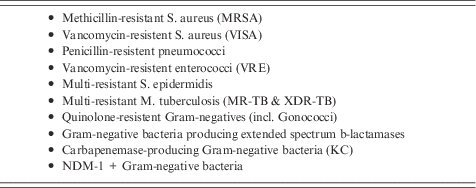
Over the past decades, the number of microorganisms that are resistant to multiple antibiotics has risen considerably. A list of these microorganisms is given in Table 1.
The most important resistant microorganisms.
The most threatening are those bacteria that cannot be treated anymore with any drug. A major example is those Gram-negative bacteria that carry the gene that encodes for NDM-1 (New Delhi Metallo-β-lactamase-1). Infections caused by these bacteria, which originate from India, are largely untreatable.Reference Kumarasamy, Toleman and Walsh20
Antibiotic Stewardship
Since antimicrobial resistance is reversible to quite some degree, when the selection pressure of the antibiotics is removed, it is a logical step to try to limit antibiotic usage as much as possible. This kind of prudent use of antibiotics is also referred to as antibiotic stewardship.Reference Gould and Van der Meer21 In such stewardship programmes, a variety of techniques are applied to limit antibiotic usage and at the same time to ensure that those patients that need antibiotics are treated optimally. That means a choice of adequate antibiotics that exert as little selection pressure as possible, at the right dose, administered in the right way, with a treatment duration that is not too long and not too short.Reference Van der Meer and Gyssens22
The EASAC Report ‘Tackling Antimicrobial Resistance in Europe’ (2007)
Concerned about the magnitude of the problem and the threat for the citizens of the world, in 2007 the European Academies Science Advisory Council (EASAC) issued a report on antimicrobial resistance.23 The recommendations made in this report, which stressed the importance of coordinated action, can be briefly summarised as follows.
(1) Develop novel diagnostics
(2) Strengthen the science base
(3) Support industry’s innovation in drug development
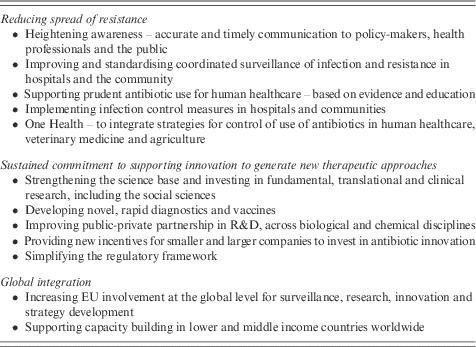
This was followed by more EASAC publications on the same subject and by other relevant activities of academies of science. In 2011, EASAC published a report entitled European public health and innovation policy for infectious disease.24 In Table 2, the recommendations from EASAC to the EU, based on the 2011 and 2007 reports are given.
Recommendations from EASAC to EU.
In 2013, the Leopoldina and the Academy of Sciences Hamburg published a report ‘Antibiotics research: problems and prospects’,25 the G8 Science academies adopted a statement ‘Drug resistance in infectious agents – a global threat to humanity’26 and the InterAcademy Panel (IAP) and the InterAcademy Medical Panel (IAMP) issued a statement ‘Antimicrobial resistance – a call for action’. 27
During those years, antimicrobial resistance was discussed regularly in the EASAC Bureau and Council, as well as in EASAC Biosciences Steering Panel. It was felt that the stagnant development of new drugs was still insufficiently explained and also that entirely new approaches were necessary. To try to tackle these problems, EASAC, with great support from the Leopoldina, the Royal Netherlands Academy of Arts and Sciences (KNAW) and the Volkswagenstiftung, organised a meeting in Schloss Herrenhausen in Hannover. Some 30 scientists convened and had in-depth discussions, dealing with the following questions: What are the functions of antibiotics in natural environments? What are the opportunities for alternative approaches to innovation, for example based on virulence modulation or immune stimulation? How might pathogen-specific pathways be targeted? Can host cell targets be found to inhibit intracellular bacterial infection? Are there new delivery systems that can capitalise on developments in emerging technologies?
The meeting yielded a series of relevant answers, which have been compiled in the statement ‘Antimicrobial drug discovery greater steps ahead’ 28 and have been summarised in an editorial comment in Nature Reviews Drug Discovery.Reference Van der Meer, Fears, Davies and Ter Meulen29 For a detailed account, the reader is referred to these papers. Here we will limit ourselves to a concise description of the major findings and recommendations. Surprisingly, it became clear during the meeting that there are obstacles in almost all steps of the drug discovery and development process (‘the pipeline’). These obstacles as well as the potential solutions are depicted in Figure 2.
Problems and solutions in antimicrobial drug discovery and development.
The following recommendations were made.
(1) Support basic research.
It is a misconception that the natural resources for new antibiotics are exhausted. There are plenty of new ideas in academia and there are many potential untapped sources (e.g. insects, extremophiles and plants). Currently the field is not particularly attractive for young researchers and certain essential disciplines such as medicinal chemistry have been neglected.
(2) Install EU platforms for compound identification, lead optimisation and characterisation.
As already alluded to under (1) above, new natural product sources should be intensively explored. Mechanisms to activate silent genes and culturing hitherto non-culturable microorganisms are other areas that may yield new antibiotics.30 The rules of penetration of a potential drug into the bacterial cell need renewed attention, informed by research. Further it was advised to capitalise on pro-drugs and new delivery systems. In addition, off-target effects should be identified and trancriptomics should be used to obtain insight into modes of action. Combinatorial approaches should be employed to find new leads.
(3) Address bottlenecks in pre-clinical and early clinical development.
A major bottleneck is the lack of expertise and resources to progress interesting agents into animal models to reach proof-of-principle stage and attract industry attention. As already mentioned, medicinal chemistry expertise to optimise lead generation is scarce in academia and there is also a relative lack of skills for evaluation of drug metabolism and toxicity.
The question is whether the EU should strive for a centralised EU institution to solve these problems. Alternatively, the EU could strongly stimulate interdisciplinary expert networking devoted to antimicrobial drug development. In the same vein, consortia of clinicians should be developed to facilitate faster recruitment to clinical trials.
In addition, it is important to find new funding sources for preclinical as well as clinical drug development.
(4) Optimise EU partnerships for research and strategy.
EU initiatives like the Innovative Medicine Initiative (IMI)31 and Joint Programming Initiative (JPI)32 are important, but their focus should really be on new drug development and it is crucial that industrial commitment is ensured. There is a serious risk that these funds are too much diluted, and that the available money is too limited for the purpose of discovery and development of new antibiotics.
It is also recommended that researchers, funders, regulators and others convene to tackle the investment and translational research issues.
(5) Rethink regulatory frameworks.
If we want faster antibiotic innovation, this requires changes in regulatory frameworks: more flexibility is needed (e.g. simpler requirements for new antibiotics with a narrow spectrum, and for drugs that meet critical needs).
(6) Raise public awareness.
The public should be made aware of the global threats of antimicrobial resistance and the risk that already. at this time, some infections cannot be treated with antibiotics. The public should be educated in prudent use of antibiotics, to aid in the preservation of efficacy of the available antibiotics. Citizens should be encouraged to support research and innovation. They should also be made aware that drug development necessitates the use of animals in research.33
Finally it is important that citizens become aware that it will not be possible to develop new antibiotics without side effects.
Follow Up of the EASAC Report on Antimicrobial Drug Discovery
EASAC organised a follow-up meeting in Brussels in December 2014.34 Here, the Chief Medical Officer in the UK, Dame Professor Sally Davies, and the former Chief Scientific Advisor of the European Union, Professor Anne Glover, participated, as well as representatives of the Innovative Medicine Initiative, the EU Directorate General for Research and Innovation, academia, the Wellcome Trust, European Federation of Pharmaceutical Industries and Associations (EFPIA) and the pharmaceutical industry. There was unanimity that a collective international strategy to combat antimicrobial resistance is needed. The EASAC report was considered to be timely and very much welcome. It was stressed that the EU has to continue its leadership and intensify its support of global efforts. It was agreed, as stated by EASAC, that academia needs to engage in drug discovery, but that multiple drug development competencies (for example, expertise in medicinal chemistry, ability to run GMP facilities or engagement with regulatory authorities) are lacking.
Representatives from IMI and from industry recognised the current market failure, but hoped that economic returns can be anticipated when current initiatives on business models, such as those from IMI, deliver. The Wellcome Trust is looking into a new strategic initiative to try to help to overcome the current crisis. It was also felt that the Ebola crisis can serve as a template to design further antimicrobial resistance work – based on the lessons learnt for coordination, data sharing, accelerating new products, and involving collaboration among governments, charities, regulators and companies to enable delivery of innovative products and services.
A lay summary of the EASAC Statement, entitled ‘New antimicrobial drugs: why we need them and how we can get them’, was published to coincide with the Brussels discussion event.35
Other Actions
Internationally there is increasing awareness of the sense of urgency regarding antimicrobial resistance. As examples the following activities are noteworthy. Recently, the report by O’Neill, which was commissioned by the UK Government, was published estimating major public health and economic burdens unless the problems are tackled.36 These results are important input for the G20 discussions.
Together with the Commonwealth countries, the UK will set up laboratory twinning to improve diagnosis and surveillance worldwide. In addition, the UK recently reinstalled the national Longitude Prize, to create cheap, accurate, rapid and easy‐to‐use tests for bacterial infections. The USA recently announced a similar prize and so has the European Commission.
In November 2013, President Obama requested the President’s Council of Advisors on Science and Technology (PCAST) for advice how best to combat the threat of antibiotic resistance. In September 2014, PCAST advised the US government to take steps to improve surveillance of the rise of antibiotic‐resistant bacteria, to increase the longevity of current antibiotics, and to increase the discovery rate for new antibiotics and other interventions.37 President Obama is seeking $1.2 billion in his 2016 budget request to fight antimicrobial resistance.
The World Health Organisation also gives high priority to the problem. There is a recent WHO publication ‘Antimicrobial resistance: global report on surveillance 2014’38 and the WHO Global Action Plan on antimicrobial resistance was launched at the World Health Assembly in May 2015.
The Science Academies of the G7 have recently formulated their advice to the G7. The combat of antimicrobial resistance is a key component of this advice.39
Concluding Remarks
In this paper we have depicted the global antimicrobial resistance crisis from a historical perspective. We discussed the slow start of the discovery and development of antibiotics in the first half of the previous century, the subsequent development of a large number of antibiotics during the second half of that century, a development that could keep up with the emergence of resistant microorganisms. These resistant organisms were and are the consequence of the action of antibiotics that are often misused. During the last 15 years of the 20th century, however, the discovery of new antibiotics came to a halt, while more and more resistant pathogens appeared. EASAC is one of the organisations that is actively engaging with this global crisis. It is EASAC’s firm belief that the solutions have to come from science and it is clear that time is running out. Immense collective international efforts are needed to tackle the crisis.
Jos W.M. van der Meer, MD PhD FRCP(Lon) FRCP(Edin) FIDSA MAE, is emeritus professor of medicine at Radboud University Medical Centre, Nijmegen, the Netherlands. He is the current president of EASAC, the European Academies Science Advisory Council. He is a former vice-president of the Royal Netherlands Academy of Arts and Sciences, KNAW. He was one of the founders of the Dutch Working Party for Antibiotic Policy (SWAB) and of the European Study Group on Antimicrobial Policy (ESGAP).
Robin Fears, PhD, is Scientific director of the Biosciences Programme of EASAC.
Volker Ter Meulen, MD PhD MAE, is emeritus professor of virology at the Julius Maximilians University of Würzburg, Germany. He is a current co-chair of the InterAcademy Partnership and chair of the Biosciences panel of EASAC. He is a former president of EASAC, and former president of the German National Academy of Sciences Leopoldina.