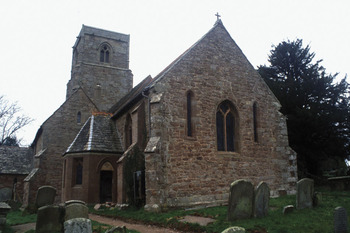
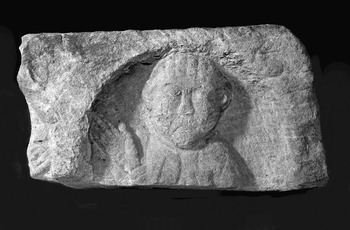
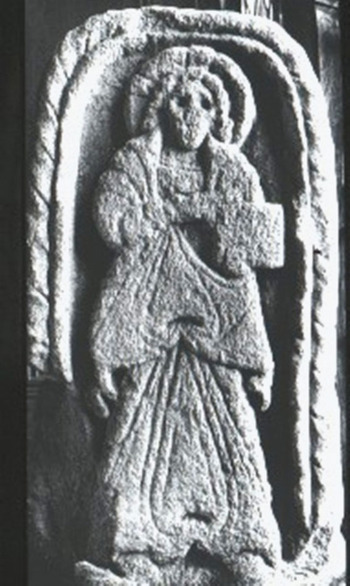
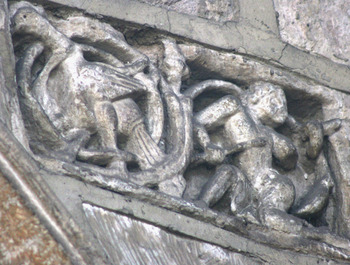
In the nineteenth century, during works being undertaken on the south-facing elevation of the chancel of the church of St John the Baptist, Upton Bishop, near Ross-on-Wye (fig 1), a red sandstone figural carving was discovered (fig 2). At that time it was reset into the wall alongside two medieval carvings, but it was subsequently removed to the church itself, and has recently been subject to conservation work, during which time the opportunity was seized to undertake a laser scan of the sculpture. This facilitated the production of very detailed high-quality images of the carving, and afforded the writer an opportunity for a close examination of the piece before it was returned to the church.
Church of St John the Baptist, Upton Bishop, Herefordshire. Photograph: John Hunt

The Upton Bishop figural sculpture. Photograph: Richard Bryant

The carving comprises the upper torso and head of a figure, with its right hand raised, set within an architectural niche. The stone is damaged, so that the lower part of the body is lost, but there is sufficient remaining to establish that there was another niche on the right-hand side of the figure (the viewer’s left) that was also occupied by a figure, in this case with a raised left hand. In both cases the palms of the hands face outwards.
The overall length of the ‘carved face’ is 400mm, while the block is 190mm deep and 210mm high. The depth of the cut in this relief carving is 35mm at the arcade, but there is no undercutting. The rear of the stone has evidence of tooling, but not for display purposes. There are indications to suggest that the stone stood proud of the wall into which it was set by some 22mm, but this need not have any bearing on its original position or function. The upper right-hand corner of the stone is rounded rather than square, but again it is difficult to determine if this represents its original condition or a subsequent remodelling. Despite first appearances, the quality of the carving is fairly good – this is best seen in the articulation of the raised hand – but the positioning of the stone in the south wall of the chancel has meant that the piece has been subject to the effects of weathering.
In 1932 the Royal Commission, in its volume on Herefordshire,Footnote 1 identified this as part of a Roman tombstone. The Roman attribution was generally accepted,Footnote 2 until Martin Henig, FSA, challenged the dating in 1993 and suggested that it was more probably a Romanesque carving of the twelfth century.Footnote 3 It is that divergence of opinion that prompted this review, and in particular its consideration of the proposal that the Upton Bishop sculpture might be linked to the Herefordshire School of sculpture.
Style, iconography and patronage
Sculpture is usually dated by one or both of two main approaches. Stylistic and iconographic analysis, based on comparisons and known contexts, is perhaps the most widely used approach but – and particularly in a medieval context – an examination of the patronage context might also be instructive, as applied, for instance, in the study of the Herefordshire School of sculpture at Alveley in Shropshire.Footnote 4
In the case of Upton Bishop the second approach is problematic. The tenure of the manor can certainly be established. Domesday Book confirms that the manor, assessed at seven hides, was a possession of the church of Hereford and had a population in the vicinity of 160 people. Among these was a priest, which might suggest that there was a church here by this date. Reference is also made to the existence of a hay (haia), or hedged enclosure, at Upton Bishop. Such enclosures are common in West Midland counties, being enclosures into which game was driven for capture. In Shropshire, for instance, they are frequently associated with the capture of roe deer. The presence of a hay here is suggestive of a role in livestock management – whether for hunting or for other purposes – and that may be an indication of the social and economic prominence of the manor within the locality.Footnote 5 The manor remained in the hands of the church, being recorded in 1242–3 as a vill of five hides held by the bishop, and again in 1316 as being in the lordship of the Bishop of Hereford.Footnote 6
Even given this background, a patronage-based approach is difficult to apply here, not least because we are dealing with a single stone rather than an assemblage and because we cannot assume that the sculpture is actually in situ, in the sense that Upton Bishop is the site for which it was originally intended. Consequently, in order to establish its probable date, and its place in the cultural history and artistic development of the south-western Midlands, it is most appropriate to consider the Upton Bishop stone from the standpoint of its stylistic and iconographic features.
The characteristics of the upton bishop sculpture
Architectural setting
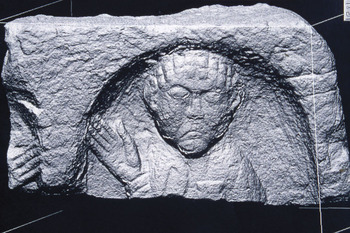
The two figures are set within a round-headed recess or niche, forming an arched architectural frame (fig 3); incised lines on the frame to the right of the figure may represent an attempt to define the top and bottom edges of a capital but, if so, there are no indications of another to the left and there is nothing that attempts further articulation of the frame. Of course, it is difficult to discount the possibilities that any such features have either been weathered away, or alternatively, had been present as painted details.
Scanned image of the Upton Bishop figural sculpture. Photograph: John Hunt; © Upton Bishop Parochial Church Council

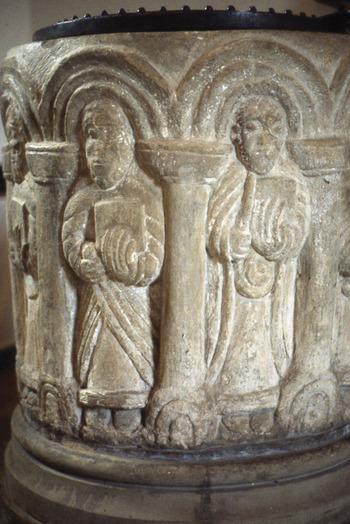
Arcade settings are widely found within the Romanesque repertoire of both the Herefordshire region and further afield, and may occur in a variety of contexts. At Alveley, two stones,Footnote 7 250mm high, displayed paired figures within an arcaded frame, articulated by capitals just above shoulder height, very similar to examples at Brinsop, suggesting that they were originally voussoirs, although Thurlby prefers to see these stones as a part of a frieze.Footnote 8 Commonly, arcaded settings are also found on fonts. The font in the church of St George at Orleton is a case in point (fig 4). Dated to c 1150–60,Footnote 9 this is decorated with a continuous arcade of nine bays, each of which is further articulated by a double order, and by the depiction of capitals and column bases. Within each of these bays is the figure of an Apostle, each of whom holds a book in his left hand and all of whom carry a short object (perhaps a candle) in their right hand, except for St Peter, who holds keys in his right hand. The font in Hereford Cathedral may well have provided the inspiration for this form of decoration;Footnote 10 here, the now-defaced standing figures set within the arcades seem to have been holding books or, as suggested by Hamer for Orleton,Footnote 11 the folds of their tunics. However, the use of arcades on fonts is widely practised and many other examples may be cited, including Burghill,Footnote 12 Mitcheldean and Newnham-on-Severn.Footnote 13
Orleton font (Herefordshire): detail of architectural arcade. Photograph: John Hunt

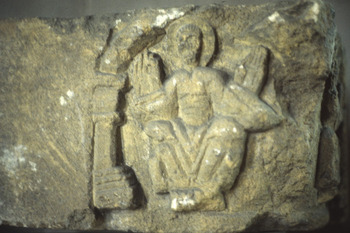
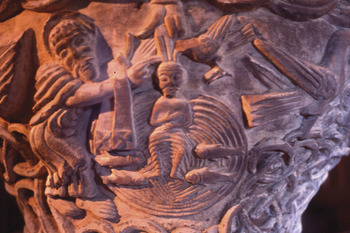
In the case of Hereford Cathedral there is also a further context for such architectural settings. Preserved in the choir is one of the most important sculptural groups from early twelfth-century England. These capitals, from the east arch of the presbytery (replaced in Cottingham’s restoration), pre-date the work of the Herefordshire School and may be put at around 1107–15. Within this group, one scene (discussed further below) is the seated figure of Christ, haloed and with both hands raised. The figure is placed within an architectural arcade of one order, but clearly articulated by the presence of a capital and column base (fig 5).
Seated figure of Christ, Hereford Cathedral, on capitals dating to the early twelfth century. Photograph: John Hunt

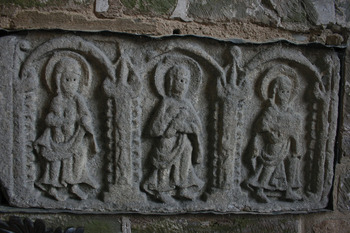
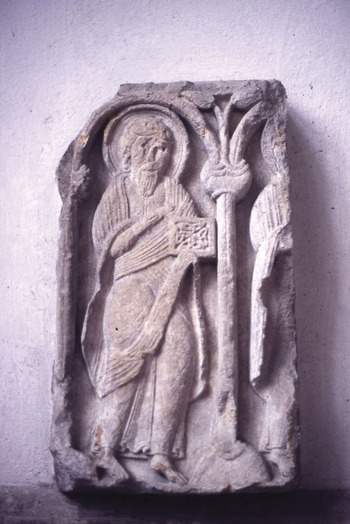
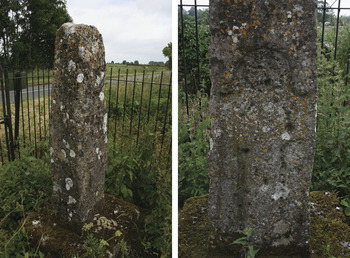
Arcade settings are not restricted to the twelfth-century Romanesque repertoire. They may also be instanced in pre-Conquest Mercia, the most celebrated examples being those at Breedon on the Hill (fig 6), which may be placed alongside material from Castor (fig 7), Fletton and Peterborough as part of a group of friezes and panels of architectural sculpture dating to before the early tenth century.Footnote 14 The Corpus of Anglo-Saxon Stone Sculpture attributes these figural panels to the eighth century,Footnote 15 although Lang, observing that continental and oriental developments had an impact on architectural sculpture in Mercia, offered a dating of 775 to 825.Footnote 16 The figures in the arcades have generally been identified as Apostles and associated with a box sarcophagus, perhaps derived from antique sarcophagi, and suggestive of a continuing fashion for the use of stone sarcophagi in the Mercian east Midlands and south Yorkshire into the eighth and ninth centuries. However, Lang has challenged this interpretation,Footnote 17 noting that on two of the Breedon fragments the Apostles move from left to right, while on the fragmentary third panel they move right to left. For Lang, this raised difficulties in the reconstruction of a sarcophagus, in addition to which he doubted the appropriateness of the iconography to a sarcophagus. Given a trend in Northumbria and Mercia to emulate early Christian traditions of the Mediterranean region, Lang has favoured presbyteries and baptisteries as a more convincing context for the origin of these stones. Taking the model of the baptistery in Ravenna, he postulates that the Breedon panels are the remnants of a baptistery erected in the Mediterranean manner. Thus, we might envisage the east wall of a baptistery dominated by an altar cross or carving of Christ, flanked by panels of Apostles moving left or right, towards the central focus of the assemblage.
Figural panel depicting Apostles, Breedon on the Hill, Leicestershire. Photograph: John Hunt

Figural panel, Castor, Cambridgeshire. Photograph: John Hunt

Architectural settings may also be found closer to Herefordshire. At Deerhurst there is a representation of the Virgin with Christ on a shield, above the arch in the central wall of the tower, of perhaps late eighth- or early ninth-century date.Footnote 18 There is also the famous Lechmere Stone from Hanley Castle in Worcestershire, a stone carving, 490mm high, depicting a frontally placed, standing figure of Christ within an arch, dated to the early ninth century.Footnote 19 Although this stone is generally described as a grave marker, Bryant has questioned this,Footnote 20 suggesting that it was probably designed to serve as a carved icon sitting on an altar or a flat-topped tomb.
Architectural settings were also commonplace in pre-Conquest manuscripts, often framing figures and the canon tables, as in the Book of Cerne (818–30), the late seventh-century Lindisfarne Gospels and many others. The importance of manuscript drawings as models for the sculptor is well established. Finally, architectural settings are also a well-established feature of classical Roman art, as for instance in the elegant ivory carving on the reliquary casket now in the Museo dell’Età Cristiana at Brescia, representing Old and New Testament scenes and dated c 330–60.Footnote 21 Such settings also figure prominently in the relief decoration of sarcophagi, mainly of fourth-century date,Footnote 22 and undoubtedly the tombstones of Roman Britain provided numerous examples of such usage.Footnote 23
Facial features
The facial characteristics of the Upton Bishop figure are dominated by the striated or braided treatment of the hair (presumably an imitation of classical hair-types), the large oval, bulbous eyes and the broad wedge-shaped nose, set within a fairly full face. Several of these are features that may be generally recognized from Roman contexts, as in the carved head on the tombstone of Lucius Octavius Martialis, a soldier of the XXth Legion, recently recovered during excavations in London Road, Gloucester.Footnote 24
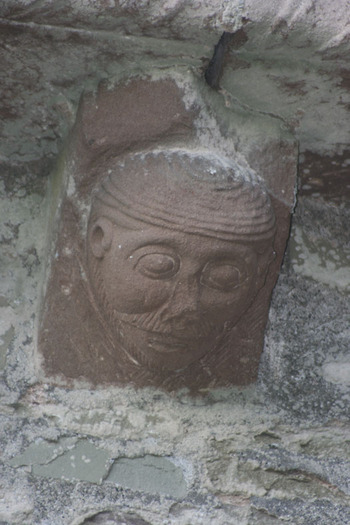
In advancing a twelfth-century date for the Upton sculpture, it was perhaps inevitable that Henig should seek to affiliate the piece to the Herefordshire School of sculpture, claiming this on the basis of the stylization of the ear, with its ‘C-shaped’ profile. This kind of detail appears, for instance, on the Kilpeck corbels (fig 8), and on the Stretton Sugwas Samson. Of itself, this is not particularly persuasive; yet, if we consider the face of the figure being baptized on the Castle Frome font (fig 9), there are echoes of the Upton face, and it is not dissimilar in its proportions, although the hair is certainly different. While these similarities are not sufficient to support Henig’s contention, there is certainly an affinity to be considered.
Human head, possibly that of the patron, at Kilpeck, Herefordshire. Photograph: John Hunt

Detail of the baptism of Christ, Castle Frome font (Herefordshire). Photograph: John Hunt

A little earlier in date (c 1107–15), the seated Christ in Majesty on the Hereford Cathedral capitals exhibits a striated treatment of the hair, while, within this same group of carvings, may be found a depiction of a flying angel, recalling its Anglo-Saxon precursors in such instances as the New Minster Charter and the Bradford on Avon rood. This figure also has striated hair and large bulbous eyes (although they are more circular than oval) and a broad flattened nose. Although certainly not a direct parallel, the proportions are again not dissimilar and there is a resonance between the Hereford Cathedral and Upton Bishop figures.
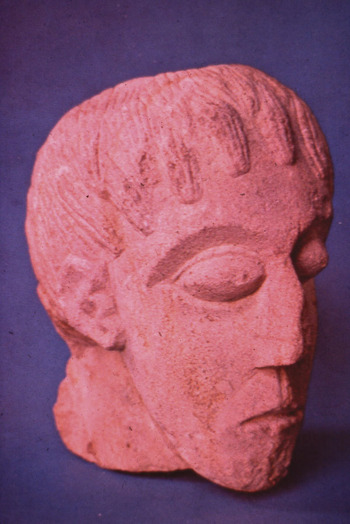
Some of these facial characteristics also appear on an oolitic limestone head recovered in 1934 from the Bon Marché site in Gloucester, characterized by oval, bulbous eyes, and attributed to a Romano-British date in the mid-first century ad (fig 10). This piece has subsequently been reassessed and reattributed to the twelfth century, perhaps originating as a corbel.Footnote 25 The characteristics of this carving certainly recall aspects of the Herefordshire School stylizations: the shape of the head, eyes and overlapping locks are like those on the figure of the Baptist on the Castle Frome font, the eyes and the ears of the saints on the Kilpeck chancel arch and the ears on the St Giles Hospital tympanum.Footnote 26
The Bon Marché head, Gloucester. Photograph: Society of Antiquaries

However, pre-Conquest comparisons are also available. From outside the Herefordshire region, particularly striking are some items within the corpus of Irish metalwork. Two examples will suffice, both dated to the eighth century. From St John’s, Rinnagan, near Athlone, Co Westmeath, there is a copper-alloy (formerly gilt) Crucifixion plaque, thought to have been the decoration for a book cover. The figures are here characterized by full faces with flat noses and large oval eyes. The hair is rendered quite distinctively, although not in the same way as at Upton Bishop, but the heavy, crescent-shaped upper lip is a striking feature of both pieces. Similar features may also be noted on a face decorating a probable eighth-century crook, made of copper-alloy, glass and enamel, found at Helgö in Sweden.Footnote 27
Comparisons may also be made with closer Mercian connections, such as the prayer book known as the Book of Cerne, produced perhaps in either Worcester or Lichfield between 818 and 830.Footnote 28 The manuscript includes Evangelist miniatures, such as that depicting the portrait and symbol of St Luke.Footnote 29 Here, in both the drawing of St Luke and of the bull, the distinctly oval eye-sockets that underlie the Upton Bishop eyes are present, although in a manuscript drawing the round pupil of the eye is shown, off-setting the effect. The Upton Bishop figure’s eyes might also have been given greater definition by painted pupils; there is nothing to suggest insets of any kind.
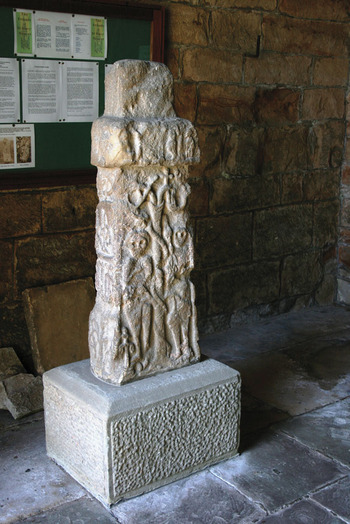
Still closer is Newent, in Gloucestershire, about 8km from Upton Bishop. Preserved in the porch of Newent Church is part of a cross shaft that was found in the churchyard in 1907 (fig 11).Footnote 30 Particularly prominent on this substantial fragment is a representation of Adam and Eve standing on either side of the Tree of Knowledge (which served as a typological link to the Cross), around which a serpent is entwined.Footnote 31 Cramp has pointed to similarities between the Newent shaft and the depiction of plants at Breedon on the Hill in Leicestershire. These links are further emphasized by the shared iconography of the Newent and Breedon cross shafts, both of which depict the Sacrifice of Isaac as well as Adam and Eve.Footnote 32 The figure of the Newent Abraham has been particularly singled out for comparison with Upton Bishop (fig 12).Footnote 33
Adam and Eve, Newent cross shaft (Gloucestershire). Photograph: John Hunt

Abraham, Newent cross shaft. Photograph: Richard Bryant

There are certainly similarities in the general shape of the face (although Newent is slightly longer in proportion), and particularly in the treatment of the lower jaw and chin (perhaps also in the treatment of the ear). It is difficult to ascertain what impact weathering might have had on the Newent cross shaft, but the heavy, crescent-shaped upper lip of the Upton Bishop carving is less obvious here, and the treatment of the head is also different, in that the Newent Abraham appears to wear a head-covering and seems more accomplished than the treatment of the Upton head. While the shaping of the nose on the two sculptures appears similar, the treatment of the eyes is rather different, the Newent Abraham having rounded, hollowed-out eyes, rather than the oval and bulbous eyes that characterize the Upton Bishop figure. Bailey has suggested that the deep-cut eyes on the Newent cross shaft were intended to accommodate ‘sparkling settings’ – jewels, glass or metalwork.Footnote 34 Perhaps the more shallow, sunken eyes of the Newent Abraham also originally accommodated insets of some kind. The Newent cross shaft has generally been dated to the first half of the ninth century, a date recently confirmed by Bryant’s fieldwork for a forthcoming volume of the Corpus of Anglo-Saxon Stone Sculpture.
The attire
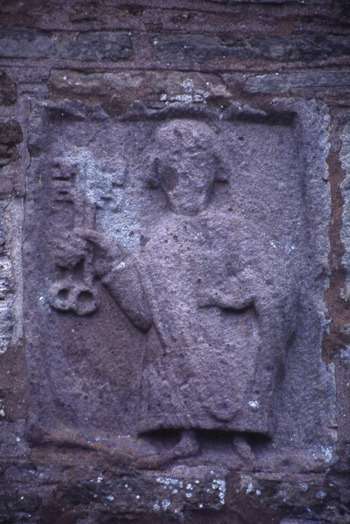
Very little remains of the clothing on the Upton Bishop figure, apart from the shoulders and the cuff on the raised arm. The details that do survive are none too clear, but Henig felt able to conjecture that the figure was of a cleric wearing a long garment. It has been suggested that the treatment of the clothing and body has its closest Herefordshire parallel in the eleventh-century figure of St Peter at Bromyard,Footnote 35 which has been claimed by Taylor and Taylor to be of pre-Conquest date, but is not in situ.Footnote 36 The keys confirm that the Bromyard piece represents St Peter, and his general stance is, so far as we can tell, not dissimilar to Upton Bishop. St Peter appears to be dressed as a priest. The facial modelling of the Bromyard sculpture has largely been lost to weathering, but there is sufficient to demonstrate that these details differed from those on the Upton Bishop sculpture.
The Bromyard St Peter is not haloed, and he holds a book in his left hand, as might be expected in representations of an Apostle. There are traces of a feature on the Upton Bishop carving in this area that suggest something is being held by the figure. It is possible that it represents the top part of a book, although it could equally be a cup or chalice. Scrolls sometimes take the place of books and therefore the possibility that this feature represents the top of a scroll cannot be discounted either.Footnote 37
One clothing detail that we do have on the Upton Bishop figure is the cuff, along with the fine treatment of the raised hand. The cuff is marked by a double cut to produce a banded effect, although of the same size as the sleeve itself. There are hints of a similar treatment at Bromyard, but only in the most general sense, where it is perhaps more of a hem. A closer comparison may be found in the portrait of David in the Durham Cassiodorus, a figure that may well have Roman antecedents.Footnote 38
Another detail is revealed on the scanned image of the sculpture (see fig 3), which shows that there is an angular feature at the right shoulder, though its intent is not clear. It may have been a means of articulating the figure, or simply the result of weathering, but it is more likely to be part of an over-garment that may be seen covering the figure’s shoulders from the neck, but apparently not joining up or fastened at the front.
Figures wearing over-garments are familiar from manuscripts and other sources. In the Book of Kells,Footnote 39 the Angel and Christ (in the Temptation scene) both have a garment draped over their shoulders, as do the figures of the Apostles in the Christ in Majesty in the early eighth-century Codex Amiatinus (fol 769b). The carved figure of Christ on the early ninth-century Lechmere Stone also wears a high-collared shawl or cloak-like garment draped over his shoulders. Although a familiar garment in a general sense, these do not reflect in detail the attire of the Upton Bishop figure. Closer in detail – although not precisely so – are some of the figures depicted on the early tenth-century Monasterboice South Cross (Louth, Ireland). These include the figure of Christ being arrested by two soldiers,Footnote 40 and, rather closer, the figure of Christ in the Traditio Legis scene in the panel below the Crucifixion, where Christ commits the new law to St Paul and the keys of the Heavenly Kingdom to St Peter.Footnote 41
Noting the suggestions made by Henig, one might recall the symbol of Matthew in the Book of Durrow (c 680), interpreted as a man in a monk’s cowl.Footnote 42 Although this is not a direct parallel to the Upton Bishop figure, the similarities lead this writer to concur with Henig’s view that the Upton Bishop figure is probably dressed as a priest.
An Orans figure?
Another of the most distinctive features of this sculpture is the raised right hand. How might this gesture be interpreted? It is possible that the hand is simply raised in salutation, but there are other interpretations to consider. First, that the hand is raised in blessing, though the fingers are not articulated in a way that obviously conveys this action. A second possibility is that the figure represents a Christian worshipper in orans, an early form of Christian prayer, a suggestion that is given greater weight when it is remembered that there is a second hand in the adjacent niche, suggesting a pair of figures, their hands raised in pairs, palms outwards. This gesture can be instanced throughout the late Roman world, including Britain, where just such a scene is depicted on the west wall of the Christian house-church at Lullingstone villa, with six figures displayed on a painted frieze, each in its own space defined by intervening columns, and seemingly offering an enticing parallel to what might be envisaged at Upton Bishop.
Although the substantive Upton Bishop figure only has one arm (the right) raised, this is not necessarily an objection, as the sixth figure of the Lullingstone group also raises only one hand. However, it is a different hand – the left – which might deliberately signal that the gesture is something other than a blessing. The final Lullingstone figure, while a part of the scene, is also clearly different from the other five. There are, therefore, significant differences between Upton Bishop and Lullingstone.
Although widely found in a late Roman context, orantes may also be found in the post-Roman world, including Britain. This means that the stance alone cannot be regarded as a diagnostic feature for dating purposes. Examples, dating from the ninth to eleventh centuries, have been catalogued for Brecknockshire, Caernarvonshire and Glamorganshire.Footnote 43 These may well reflect traditional models, drawn ultimately from the Roman world, rather than depicting the survival of an early form of ritual, but, whatever the case, it is not impossible that such models might also have been known to later sculptors working in the Herefordshire region.
Nor are these later instances confined to the pre-Conquest period, at least in terms of their outward appearance, if not their actual meaning. Turning again to the Hereford Cathedral capitals, the seated figure of Christ, traditionally described as a Christ in Majesty,Footnote 44 has two figures, both nimbed and each within an arcade, one of which is bearded. Thurlby has suggested that the figures represent God the Father and God the Son.Footnote 45 Both have their arms raised, palms outwards, and are described as ‘orant figures’ by Zarnecki.Footnote 46 A similar observation might also be made of the scene in the initial to Psalm 109 in the early fourteenth-century Ormesby Psalter, which informed Thurlby in his interpretation of the Hereford capitals.Footnote 47 These examples suggest that the subject was known to Anglo-Saxon art.Footnote 48
Placing the upton bishop sculpture in context
The twelfth century?
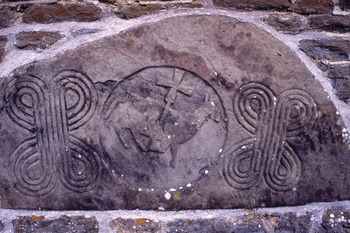
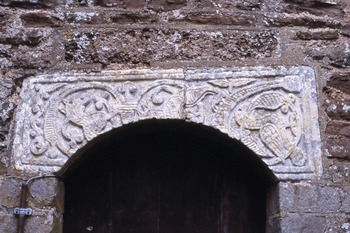
Where does the Upton Bishop figure fit in the pre- and post-Conquest sculptural traditions of the Herefordshire area? Does the Upton Bishop figure have possible twelfth-century parallels? Henig has proposed a twelfth-century date for the Upton Bishop figure, associating it with the Herefordshire School of sculpture. An outstanding example of Romanesque regional sculpture, the Herefordshire School developed out of a blend of influences, including the Anglo-Norman traditions to be found in the area, themselves drawing on Anglo-Saxon traditions. It is broadly the case, however, that Anglo-Norman figural work was absent from the region prior to the twelfth century. What there is may be illustrated by such examples as the Bromyard St Peter and the Agnus Dei figures at Preston (near Dymock) and at Byton (fig 13).Footnote 49 Most churches had sculpture of only ‘mediocre quality’,Footnote 50 employing repetitive geometric motifs, mainly on lintels. There is not much to suggest that the precocious talent evident on the Hereford Cathedral capitals had any wider impact on the region, although it was certainly a source that the Herefordshire School was able to draw upon.
Agnus Dei, Byton, Herefordshire. Photograph: John Hunt

The earliest of the sculptural groups is the Bredwardine group,Footnote 51 represented in the lintels of c 1100 at Bredwardine, Letton and Willersley;Footnote 52 they are decorated with flat geometrical patterns and poorly developed figure sculpture, including what Zarnecki thought to be a Christ in Majesty on the north doorway at Bredwardine, and carved heads within circles on the south doorway at Letton, together with what may be two zodiac symbols.Footnote 53
Another post-Conquest sculptural tradition, characterized by carved tympana, is represented by the Bromyard group,Footnote 54 also referred to as the Dymock School of sculpture, and dated by Gethyn-Jones to c 1090–1100.Footnote 55 As the two names suggest, the work of this group may be found in the font in Bromyard Church or the south tympanum at Dymock. Downward curving leaves either side of a central stem is a typical motif, and there is also a fondness for the use of spirals. Such figure carving as may be found at Moccas and Weston-under-Penyard tends to be crude.Footnote 56
However, it is also to this group that the St Peter carving at Bromyard might be attributed (fig 14), although its dating is a matter of debate. While Taylor and Taylor were persuaded to give it a pre-Conquest pedigree, Clapham considered this prospect and rejected it, while Gethyn-Jones favoured a late eleventh- or early twelfth-century date, perhaps as a survival from an earlier church.Footnote 57
St Peter, Bromyard, Herefordshire. Photograph: John Hunt

While not constituting a group as such, the work represented in the sculptures in the churches of St Giles at Aston and at Byton should not be overlooked. The simulated archivolt at Aston, with animals carved on the tympanum, dates to around 1130; a central Agnus Dei is flanked by symbols of the Evangelists (although they are incomplete) and incorporates other scenes, including a pair of birds. This work is characterized by the flatness of its execution, carved on two planes, and appears to be an instance of a gifted sculptor developing the approaches found at Byton, although here in a tympanum that may be dated to c 1080–90, for which the Anglo-Saxon ancestry is far more evident, particularly in the incised knot ornament.Footnote 58
Until the emergence of the Herefordshire School, the most precocious of local styles was clearly that represented in the Hereford Cathedral capitals. Zarnecki has dated these to c 1080–95,Footnote 59 largely on the possibility of associating the patronage of this workshop with Bishop Robert of Lorraine, although there is no direct evidence.Footnote 60 The association of the building with Bishop Reynhelm, of which the capitals are an integral part, effectively undermines this suggested earlier dating and points to c 1107–15 as more probable.Footnote 61 Hereford Cathedral was at the heart of religious life in the diocese and was therefore well placed to play an influential role in the artistic patronage of religious buildings in the region. While this may be observed in the case of the Herefordshire School, it is perhaps surprising that this earlier workshop under the patronage of the bishops did not have a wider impact.
Some of the capitals are historiated, having subjects that include the Annunciation, the Harrowing of Hell and the Christ in Majesty already discussed. Although Biblical subjects are common in the French Romanesque, they are less so in England at this point, and so the Hereford scheme is all the more notable. Indeed, as Thurlby observes, it is possible that this is the route by which such material made its way into the repertoire of the Herefordshire School.Footnote 62 Certainly this group of sculptures influenced the work of the Herefordshire School.
With a style and monumental quality of their own, the carving on these capitals presages the work of the Herefordshire School while building on Anglo-Saxon traditions. The flying angel is a good example, and, apart from the obvious comparisons with Bradford on Avon, Winterbourne Steepleton and the New Minster Charter, Zarnecki has further elaborated on the indebtedness of this piece to the Winchester School manuscript tradition, arguing that such manuscript sources most probably inspired the Hereford capitals.Footnote 63 At the same time, the treatment of the hair and the large bulbous eyes are features of the Herefordshire School that appear to be part of a local tradition that has some resonance with the Upton Bishop carving. The Hereford Harrowing of Hell scene might be compared with a carving of the same subject on a slab in Bristol Cathedral of c 1050, both of which also betray links with the Winchester school.Footnote 64
In the Annunciation and Christ in Majesty scenes there is a stronger move away from these past traditions, with the bulky and solid proportions that one associates more readily with the Romanesque. None the less, manuscript models are again likely, in the form of the Hereford GospelsFootnote 65 and the Hereford Troper,Footnote 66 both of which are indebted to late Ottonian schools, but look forward to the twelfth-century Romanesque.Footnote 67
Within two decades of the carving of these capitals the Herefordshire region had nurtured one of the most dynamic and accomplished of the regional Romanesque styles to emerge in twelfth-century England with a rich and well-developed sculptural repertoire.Footnote 68 The School’s rich and exuberant style was born of a fusion of local traditions (mixed with those of western France and Italy) and Anglo-Saxon, Anglo-Scandinavian and Celtic traditions. It is characterized by generally fine execution, well-developed and varied iconography and relatively elongated figures with good and full modelling, wearing garments with ribbed draperies and having faces with bulbous eyes.
It will be evident from this brief review that the Upton Bishop stone does not find a ready context within the traditions of Romanesque sculpture in the Herefordshire region. In terms of its iconography, stylistic details and carving technique, a Romanesque attribution is difficult to sustain. It is clearly very different from the flat and incisive style encountered at Aston and Byton, while at Bredwardine, Bromyard and their associated sites figure sculpture tends to be largely absent or feeble in character. It is with the workshops responsible for the Hereford Cathedral capitals and the programmes of the Herefordshire School that post-Conquest figure sculpture reaches real levels of competence. Although the Upton Bishop stone is of relatively good quality, and monumental in character, it fails to convince as a product of either of these workshops. While there is a certain resonance with both workshops in the treatment of the facial characteristics, there are also clear differences, in that the face is fuller and the treatment of the eyebrows differs. More significantly, the Upton figure is not so deeply carved or well modelled as the figures of these two workshops. The iconography is also problematic, without any clear Romanesque parallels. Had only the principal figure survived on the Upton stone, it would undoubtedly have been interpreted as an Apostle, but considered alongside its neighbour, this interpretation is more suspect, leaving the probability that these are orantes. While orantes figures may be found within Romanesque and later work, including the Hereford capitals, the manner adopted at Upton Bishop is unfamiliar in a Romanesque context.
There is also the question of what specific setting might give rise to such a figure? It has obviously been set within a wall for some time, and while it lends itself to interpretation as part of a frieze, it does not necessarily follow that this was the original purpose. A frieze is quite possible, but the subject is difficult to place within Romanesque iconography. However, there is also the possibility that it is a fragment from some other item. Two possible options occur here. First, although there is no evidence of any ‘curvature’, it may be a fragment from a font. At 190mm thick, the depth of the stone challenges this interpretation but does not dismiss it. However, the lack of clear iconographic parallels is a more serious challenge. A second possibility is that it represents a panel from something like a sarcophagus. The thickness of the stone might again be thought problematic, but such possibilities are moving us into the consideration of pre-Conquest origins for the piece.
An Anglo-Saxon sculpture?
While a Romanesque attribution for the Upton Bishop stone may be rejected, it has been argued that there are clear points of resonance with post-Conquest figural sculpture. This requires some explanation. That the Bon Marché head might initially be accepted as Romano-British, and then radically re-dated to the twelfth century, provides circumstantial recognition that there are likely to have been some long-standing traditions in the Herefordshire region that informed the developing medieval styles. Does this offer a more persuasive context for the Upton Bishop sculpture? If it is possible to demonstrate that the Upton stone is of Anglo-Saxon date, then the similarities with post-Conquest work might be explained as the transmission of certain earlier and local stylistic trends.
To date, the corpus of Anglo-Saxon figural sculpture from Mercia is not well known, although it is anticipated that the West Midlands volume for the Corpus of Anglo-Saxon Stone Sculpture, now in preparation, will do much to address this shortcoming. However, in the case of Herefordshire, fewer than twenty pieces of sculpture have so far been identified, of which only two (not including the Upton Bishop stone) carry figures.
Western Mercia has produced figural sculpture from between the eighth and eleventh centuries. These include some remarkable pieces, such as the Wormington Crucifixion (Gloucestershire) (fig 15), now set in the east wall of the south aisle of the church, and dated to the late tenth or early eleventh century. This carving of the crucified Christ has occasioned some debate regarding the details of the depiction. A little over forty years ago Harold Taylor interpreted the unusual form of Christ’s head as being that of a lamb shown in profile, rather than a human head, but it is now generally accepted, as Elizabeth Coatsworth argues, that the Wormington Christ has a tilted human head with an incorrectly placed forked beard.Footnote 69
Crucifixion, Wormington, Gloucestershire. Photograph: John Hunt

Clearly the late Anglo-Saxon sculptural tradition in Mercia has some rich veins within it, and other carvings have also prompted debate. As in the case of Bromyard St Peter, the three sculptures at Daglingworth have prompted differences of opinion. All appear to be the work of a single craftsman, comprising a Crucifixion, a Christ in Majesty and St Peter. It is telling of the nature and quality of these carvings that Kendrick felt inclined to date these to the twelfth century, but Taylor and Taylor clearly associated these sculptures with the fabric of the building, leaving no doubt that they should be dated to the early eleventh century.Footnote 70 If the figure of Christ in Majesty is considered, we find a seated figure of Christ whose right hand is raised in blessing while in his left hand he holds a Cross. The modelling of the face on each of these figures has similarities, some of which recall details observed on the Upton Bishop face. The Daglingworth faces are characterized by large and prominent oval eyes, and broad, wedge-shaped noses, but their heads are rather narrower than in the case of Upton Bishop, nor do they have the same prominent chins (fig 16).
Head of Christ, Daglingworth, Gloucestershire. Photograph: John Hunt

With regard to the earlier sculpture of the region, it is to Breedon on the Hill that scholars have often turned to illustrate Mercian sculpture, here dating from the late eighth century, where plant scroll is the dominant motif but figural sculpture is also present. This sculpture is characterized by high relief carving and full undercutting. Figure sculpture is fairly common in eighth-century eastern Mercia (for example, the Hedda Stone, Peterborough; Castor and Fletton, Northamptonshire; Wirksworth, Derbyshire), and while western Mercia has not yet produced such a coherent group of figural sculptures, it is incontrovertibly the case that figural sculpture was also a part of the West Midlands repertoire.
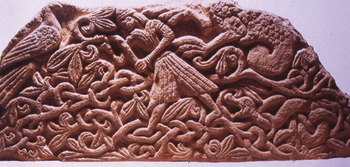
Attention is generally drawn to an emerging style, closely related to continental art, which proved influential throughout the ninth century, but in which human figures do not feature;Footnote 71 certainly it may be found in sculpture, metalwork and manuscripts. Early examples of this style, dating from c 800, include the Cropthorne cross head (Worcestershire) and the Acton Beauchamp cross-shaft fragment (Herefordshire) (fig 17), decorated with animals and plant scrolls. The similarities between the two carvings are striking, as shown in the birds with the same head forms and large spread claws, and the dog-like quadrupeds with the same pointed ears, eyes and jaws. The accompanying plant scroll is also closely comparable and suggests overall that both carvings were the product of one hand – perhaps a peripatetic sculptor moving between two closely related ecclesiastical institutions. It is likely that the same sculptor worked on the Wroxeter cross shaft, and the same style has also been found at Gloucester. It is possible that these reflect a series of such monuments across the region.Footnote 72
Former cross shaft, Acton Beauchamp, Herefordshire. Photograph: John Hunt

However, by the time that this style was taking hold in the West Midlands there was already a figural sculptural tradition in the region. For instance, the Lypiatt Cross, near Bisley, Gloucestershire (fig 18), depicts four tall figures, each in the lower panel of the face, standing below a round-headed arch, and apparently representing a unified scene interpreted by Bryant as Christ the Teacher, supported by the Evangelists. Despite the damage caused by weathering, it is clear that this was an accomplished carving, with stylized but graceful features; their similarity to the Northumbrian crosses of Ruthwell and Bewcastle has led to an eighth-century dating; furthermore, it has been associated with a possible minster church at Bisley.Footnote 73
Cross shaft, Lypiatt, Gloucestershire. Photograph: John Hunt

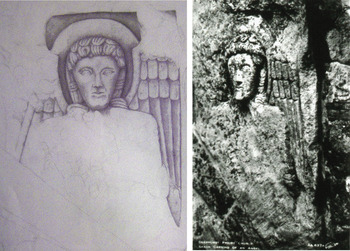
Another Gloucestershire minster church, Deerhurst St Mary, offers further examples of figural sculpture in Mercia, here dating to the early ninth century. The devotional image of the Virgin carving set into the central wall of the tower has been discussed above, perhaps functioning as a protective amuletic carving set over the entrance to the church.Footnote 74 For our present purposes, however, more significant is the carving of the angel, set high up on the external south side of the former polygonal apse (fig 19).
The Deerhurst angel (Gloucestershire). Drawing: Richard Bryant; © Richard Bryant and the Friends of Deerhurst Church 1992. Photograph: from an undated postcard in the possession of the author

The winged angel, convincingly identified by Bailey as an archangel that, with its lost companions, once stood guard over the church and its community, is carved in high relief and is in a rather different style from the figurative panel of the Virgin and Child. Integral with the pilaster strip framing the apse, this places the carving in the late eighth or early ninth century. Previously, it had been believed that this carving should be assigned a tenth-century date, but Bailey, informed by drawings and photographs from the recent conservation process, has argued that there is no difficulty in finding analogues that would permit an early ninth-century date for the panel.Footnote 75 Particular attention is drawn to the similarities in facial characteristics – the ‘modelled, full face, large-eyed type with triple-tied hair, wedge-shaped nose and prominent chin’ – with the figure of St Michael on the Mortain Casket,Footnote 76 which also dates to the late eighth or early ninth century.Footnote 77 However, the closest parallels are to be found in the Evangelist portraits and the Matthew symbol in the Book of Cerne, with large staring eyes, hair forms that reflect classical types, and wedge-shaped noses and prominent chin. These similarities have led Bailey to see, in both the figural art of the Deerhurst angel and in the Book of Cerne, a western Mercian version of a late eighth- and early ninth-century classical revival.Footnote 78 Many of these facial characteristics at Deerhurst and in the Book of Cerne have a strong resonance with the Upton Bishop stone, although the latter is rather cruder by comparison, and the Upton face is less elongated. However, the prominent chin, treatment of the nose, similarities in representing the eyes and the probable imitation of classical hair types are all significant points of comparison.
Two further examples of early ninth-century sculpture should be recalled, given their relative proximity to Upton Bishop. The Lechmere Stone (fig 20) presents Christ with a rather gaunt, almost skull-like face, large, round, staring eyes (the orbits originally filled with a substance of dark blue colour) and a prominent chin, in this case apparently emphasized by a pointed beard. The figure is standing and holding a book in his left hand, while his right hand rests on top of the book rather than being raised in blessing.Footnote 79 The Breedon figure-style has been associated with this work,Footnote 80 while the particular facial characteristics depicted on the Lechmere Stone – only very generally and partially shared with the Upton carving – suggest an affinity with the Peak District crosses.Footnote 81
The Lechmere Stone, Hanley Castle, Worcestershire. Photograph: Society of Antiquaries

The Newent cross shaft has been described by Rosemary Cramp as ‘very Breedon-like’, in terms of its treatment of foliage and a shared iconography – that is, the combination of Adam and Eve and the Sacrifice of Isaac.Footnote 82 The long-legged animal at Newent also compares with the Breedon creatures, but it is uncertain whether or not it has been derived directly from the Leicestershire site. However, it is not improbable that sculptural influences spread westwards from Breedon on the Hill and elsewhere. The facial characteristics of Abraham have already been described above and general similarities noted between the Newent and Upton carvings. Richard Bryant, in particular, has emphasized these similarities, to the extent that he suggests that the two carvings could have been produced by the same hand.Footnote 83 Although this writer is not fully persuaded of this argument, it is the case that the Upton Bishop figure displays a number of characteristics, general and specific, that have been instanced in several works dated to the early ninth century.
What context might have prompted or accommodated such a sculpture as that at Upton Bishop? Keith Ray has recently reviewed the current archaeological context for the early Church in Herefordshire,Footnote 84 and has argued for a fourth-century Romano-British date for the sculpture, suggesting that it might hint at the presence of a Christian community, perhaps associated with the nearby iron-working centre, 3.2km to the north, at Ariconium.Footnote 85 However, it has been argued here that a more credible date for the Upton Bishop carving lies around the late eighth or early ninth centuries, 400 years or so later. Clearly, a context other than that proposed by Ray should be sought. We are relatively poorly informed about the Anglo-Saxon minster system, particularly the smaller examples of this phenomenon, and this has recently been recognized as a necessary research theme for Herefordshire. Identifying such places is problematic. It was suggested above, on the basis of the description of the manor in the Domesday Book, that Upton Bishop might have been a place of local prominence. Arguments have also been advanced suggesting Anglo-Saxon origins for the present church,Footnote 86 while Parsons has suggested that Upton Bishop may reasonably be regarded as an ‘early church’, on the basis of the Domesday Book reference to a priest.Footnote 87 This may have a bearing on the role played by Upton Bishop in the area, but caution is necessary. A more certain minster site has been argued for Linton, only some 2.45km to the south east of Upton Bishop.Footnote 88 It is impossible to say if the Upton Bishop stone originated in this place or elsewhere, but a possible minster site is an attractive option. As to the purpose of the stone, the possibility of a sarcophagus panel cannot be overlooked, despite its thickness, but a frieze – a well-established feature of the pre-Conquest repertoire – seems a more probable provenance. The orantes iconography within an arcaded setting would be consistent with either interpretation. To these may be added a further suggestion of Richard Bryant, that the Upton Bishop stone formed part of a trapezoid cross base, similar to that found at Auckland St Andrew in Co Durham.Footnote 89
Continuity and revival
A fundamental observation of this review has been the apparent longevity of a number of the stylistic traits that characterize the Upton Bishop carving, in so far as they have a resonance that spans from the Roman to the Romanesque. Without doubt, the twelfth-century Herefordshire School of sculpture was to inherit and incorporate a number of these traits – elements that clearly reach back to the eighth century, if not earlier. It is certainly well known that the School drew deeply on Insular traditions, but it is perhaps not always recognized how early these were, and that in some cases they may be traced to the late seventh century.
The emergence of a sophisticated building tradition in England by the late seventh century is well known, as illustrated by excavation and the surviving fabric of sites such as Monkwearmouth and Jarrow, and reflected in the part played by Benedict Biscop and others in promoting the ‘Roman manner’.Footnote 90 Integral to these developments was the appearance of architectural sculpture, and, possibly, of free-standing sculpture as well, although this is generally held to be an innovation of the eighth century.Footnote 91 Interlace, vine scroll and inhabited vine scroll were all a part of this early repertoire. These motifs remained integral to the Anglo-Saxon artistic tradition, not only in sculpture, but in other media as well, particularly manuscript decoration and metalwork, and consequently formed a significant element in the Anglo-Saxon cultural inheritance of post-Conquest artists.
However, more precise instances of transmission may also be demonstrated. Built into the north porch and vestry at Jarrow (a basilica dedicated in 685) are panels of decorative sculpture that date to the late seventh century.Footnote 92 These fragments of a decorative frieze include birds in plant scroll, and a panel which Cramp has described as a ‘hunter in a plant scroll’.Footnote 93 In the top, left corner of the panel there are also the paws and traces of the head of a ‘gripping beast’, similar to that found on the west face of the Bewcastle Cross.Footnote 94
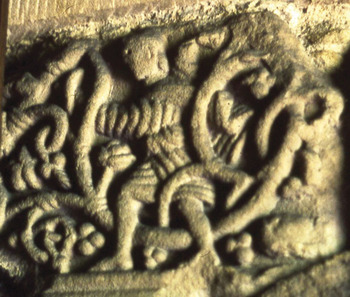
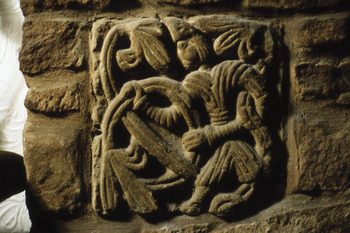
The Jarrow ‘hunter’ panel (fig 21) is composed around a figure that is moving from the viewer’s right to left, entwined by the plant scroll through which he is struggling and pushing his way. It is a matter of speculation as to how this figure related to the ‘gripping beast’, and what other elements might have been present in the original frieze. However, it is a dynamic scene, full of movement and purpose, with the figure moving through the foliage as the main focal point of the scene. The similarities between this panel and the work of the Herefordshire School are immediately striking if compared with the tympanum from All Saints Church at Billesley (Warwickshire) (fig 22) or with the ‘Man-in-foliage’ fragment from Alveley (Shropshire) (fig 23).Footnote 95 There are differences in detail: the Jarrow figure, for instance, does not wear the Phrygian cap or helmet of its later counterparts and the stances of the figures differ, but the overwhelming sense is one of similarity: of a figure pushing its way through the foliage in which it is engulfed. Even the characteristic ribbed or fluted garments of the Herefordshire School figures may be seen to have their precursor in the garments of the Jarrow figure. So similar are these figures that it seems probable that the Herefordshire School sculptors were drawing either on the Jarrow panels as a source, or on other pieces that were themselves ‘descendants’ of the seventh-century repertoire.
‘The Hunter’ figure, Jarrow (Tyne and Wear). Photograph: John Hunt

The tympanum, Billesley (Warwickshire). Photograph: Society of Antiquaries

The ‘Man-in-foliage’ scene, Alveley (Shropshire). Photograph: John Hunt

The transmission of these ideas, while generally presumed, can sometimes be ‘signposted’. For example, the birds-and-plant scroll found at Jarrow, with a strong emphasis on the central stem, reappears at Otley (West Yorkshire), although the foliage is different and there are now birds and small quadrupeds inhabiting the scene. A clear development of this is seen in the decoration of a shrine panel, dating to the early ninth century, at Jedburgh (Roxburghshire), or the cross-shaft fragment from Croft-on-Tees (North Yorkshire), also of ninth-century date.Footnote 96
The transmission of the figure-in-foliage motif must have occurred in a similar way. Details, such as the tendency towards ribbed garments, may be found elsewhere as well. They are hinted at in the scene depicting Mary Magdalene washing the feet of Christ on the Ruthwell Cross, datable to around the second quarter of the eighth century.Footnote 97 Arguably this represents the sculptors’ way of representing the manuscript painters’ approach to depicting garments, as in the portrait of King David the Warrior in the Durham Cassiodorus.Footnote 98 The same ribbed style also lies behind the figure shown on the cross-shaft fragment from Codford St Peter, Wiltshire, which has been variously dated: Tweddle has argued a late eighth- or early ninth-century date, whereas Wilson argued that it should be placed ‘firmly in the tenth century – and perhaps quite late in that century’.Footnote 99 Although not used to depict garments, a ‘ribbed technique’ is applied to the quadrupeds on the early ninth-century cross head from Cropthorne in Worcestershire.Footnote 100
The precise transmission of the man-in-foliage motif is less easily ‘signposted’. Vine scrolls and inhabited vine scrolls are a principal feature in the fragments of carved friezes that survive at Breedon on the Hill, dated to the late eighth century. Together with birds and animals, some of the panels portray men, including horsemen. Among the human beings are those – such as the kneeling warrior (fig 24), and another kneeling figure who grabs a strand of the vine – who form a part of the inhabited vine scroll, but there is nothing here that clearly or directly derives from the Jarrow panel.Footnote 101 While we must suppose that there were sculptural ‘repetitions’ and developments of the Jarrow scene in sufficient details for the iconography to survive some five centuries, they await identification – if they have survived. No doubt, in this instance, manuscript art could have played a part; if so, these too await identification. The depiction of Women at the Sepulchre in the Benedictional of Archbishop Robert effectively has figures emerging from the acanthus foliage of the lower border,Footnote 102 but this is not a parallel for the Jarrow scene; rather, it simply illustrates the fact that figures might appear ‘inhabiting’ foliage in manuscript art, where in fact, the decorated initial would have lent itself better to the man-in-foliage motif. This is a matter of speculation. At best, we can only suppose that the seventh-century design was perpetuated somewhere as sculptural and/or manuscript art, as a result of which it contributed to local traditions.
Figural sculpture, Breedon on the Hill. Photograph: John Hunt

Similarly, in the western Midlands, the Upton Bishop figural sculpture seemingly draws on local traditions, some of which are classical in origin, while others are consistent with Irish, as well as English, traditions. Underlying Roman origins are apparent from the face depicted on the Gloucester tombstone of Lucius Octavius Martialis, where we see – in the treatment of the hair, the oval eyes, the wedge-shaped nose and the prominent forehead – characteristics that are not only echoed in Upton Bishop, but which clearly have a resonance over several centuries. Certainly present locally in the early ninth century, they were being drawn upon in the twelfth century. Less certain is whether the twelfth-century adoption of these characteristics represents a continuity of features inherent in a local tradition dating back to the early ninth century and earlier, or whether it represents a conscious revival of an earlier but discontinued style. The impression of this review suggests the former.
Conclusions
The Upton Bishop sculpture has stylistic traits that have led scholars, at different times, to attribute to the carving both a Romano-British and a twelfth-century Romanesque affiliation. While the inspiration is Roman, this writer would concur with Martin Henig that the Upton Bishop stone is unlikely to be Roman. Although the style of the hair, some of the facial characteristics and the apparent iconography might be consistent with such a date, parallels and context are lacking. The stone is too thick to be a tombstone, and would also be unwieldy as a sarcophagus panel. More telling is the fact that sarcophagi do not adopt this form, particularly in the Cotswold region, where they tend to be plain. Carved sarcophagi do occur in some areas, such as York, but they are very different from what is envisaged at Upton Bishop. If not a sarcophagus, what context would Roman Britain offer for such a piece? Although screens have been found in London and Bath, they bear no resemblance to the Upton Bishop stone, while large-scale sepulchral contexts of the kind found in the Rhineland are not known in Britain, and certainly are not expected in the vicinity of Kenchester. It is clearly possible to speculate, but the outcome of this review has been to confirm Henig’s impression and to offer a secure alternative dating for the carving.
That alternative dating, however, is not twelfth-century Romanesque. While there are stylistic traits that have a resonance with Romanesque sculpture in Herefordshire, it is argued that the carving is neither of that date, nor a product of the Herefordshire School of sculpture.
Neither Romanesque nor Roman, this review has demonstrated that the Upton Bishop carving may be credibly dated to the Anglo-Saxon period. This opinion has been reached by both the ‘negative’ process of eliminating other possibilities, and the ‘positive’ process of identifying a range of parallels or analogies that give credibility to the proposed date. Similarities to Irish metalwork, particularly of the eighth century, have been noted. Irish activity and influence in western Britain are well attested, and items such as book covers or fittings may easily have found their way into the area, to provide portable models that might be translated into local stone carving. Still more persuasive, however, are the comparisons that may be drawn with works such as the Book of Cerne, the Deerhurst angel panel and the Newent cross shaft, all of which are dated to the early ninth century. This range of similarities and comparisons prompts a date of c 800 for the Upton Bishop sculpture.
It is also important that this carving has, at different times, been attributed to Romano-British, Anglo-Saxon and post-Conquest dates, as it illustrates very clearly the longevity of some of the characteristics that define this carving. These include traits that are of classical origin but which may have been further embedded in the local sculptural repertoire as a result of a late eighth- and early ninth-century classical revival, as suggested by Richard Bailey. These stylistic traits, and others, were to exert an influence in the Herefordshire area before the Norman Conquest, but also contributed to the maturing post-Conquest Romanesque styles. In short, the Upton Bishop sculpture, like the works with which it has been compared, contributed to a local tradition that was transmitted over at least three centuries to help shape the style of the Herefordshire School.
Finally, and of particular importance, it is the case that Anglo-Saxon figural sculpture is rare in Herefordshire. The dating of the Upton Bishop carving to c 800 represents a significant addition to the corpus of known pieces.
Abbreviations and Bibliography
- Abbreviations
- BL British Library, London
- CUL Cambridge University Library
- RCHME Royal Commission on the Historical Monuments of England
- Manuscript sources
- BL, ms Cotton Caligula A. xiv
- Bodleian, Douce 366, fol 147v
- Cambridge, Pembroke College, ms 303
- CUL, ms LI.1.10 (Book of Cerne)
- Rouen, Bibliothèque municipale, ms Y.7, fol 21v
Acknowledgements
Thanks are due to Professor Malcolm Thurlby, FSA, Dr Roger White, FSA, and Dr Keith Ray, FSA, for discussing with the writer aspects of the Upton Bishop sculpture, but particular acknowledgement and grateful thanks are due to Richard Bryant, FSA, who so generously shared with the author his own thoughts on the Upton Bishop sculpture and made available several photographs collected in connection with his preparation of a forthcoming volume of the Corpus of Anglo-Saxon Stone Sculpture. Naturally, any errors are the responsibility of the author alone.