Introduction
The personality disorders are associated with pervasive and generally severe social dysfunction, both in cross-section and over time (Daley et al. Reference Daley, Burge and Hammen2000; Hill et al. Reference Hill, Fudge, Harrington, Pickles and Rutter2000; Skodol et al. Reference Skodol, Gunderson, McGlashan, Dyck, Stout, Bender, Grilo, Shea, Zanarini, Morey, Sanislow and Oldham2002, Reference Skodol, Pagano, Bender, Shea, Gunderson, Yen, Stout, Morey, Sanislow, Grilo, Zanarini and McGlashan2005; Seivewright et al. Reference Seivewright, Tyrer and Johnson2004; Zanarini et al. Reference Zanarini, Frankenburg, Hennen, Reich and Silk2005). Some differences in the levels of dysfunction associated with each of the DSM disorders have been identified; however, the findings have not provided consistent evidence of specific links between personality disorder type and social dysfunction. Furthermore, the nature of the association between personality disorders and social dysfunction remains unclear. It may represent impairment resulting from the effects of inflexible maladaptive traits, such as those represented in the Five-Factor Model (FFM; Widiger & Frances, Reference Widiger, Frances, Costa and Widiger2002). Alternatively the core deficits associated with the personality disorders may entail social processes. That is, they may result from a lack of competencies required to meet the specific demands posed by interpersonal functioning. Indeed, a tally of the DSM-IV (APA, 1994) personality disorder diagnostic criteria indicates that a majority of the diagnostic criteria are essentially social: 45% refer to interpersonal behaviour, 23% to cognition, 20% to affect, and 12% to other categories of behaviour (Pilkonis & Meyer, Reference Pilkonis and Meyer2001). For example, avoidant personality disorder is characterized by a combination of social inhibition and a preoccupation with the perceived or anticipated unfavourable judgement of others.
The notion that personality disorders are inherently social phenomena is consistent with theory and data from diverse literatures. First, development of personality is in many respects the development of the child as a social organism. Infant attention is drawn to social stimuli in the first hours of life. Children learn rapidly the different skills required in a wide range of social interactions, and they become adept at determining the resources available in those interactions (Trevarthen & Aitken, Reference Trevarthen and Aitken2001). Second, a specific network of regions in the adult cerebral cortex is activated during social perception and social cognition tasks (Johnson et al. Reference Johnson, Griffin, Csibra, Halit, Farroni, de Haan, Tucker, Baron-Cohen and Richards2005). Social understanding and performance result from the activity of these dedicated social brain systems and are not simply the by-products of other (non-social) personality traits. Third, deficits and biases in social information processing are key to a number of childhood psychiatric disorders associated with lifelong disabilities. Autistic children have a profound deficit in understanding the meanings and intentions of others' behaviours, and conduct problems are associated with biased attributions of the causes of others' behaviours (Dodge et al. Reference Dodge, Pettit, Bates and Valente1995; Johnson et al. Reference Johnson, Griffin, Csibra, Halit, Farroni, de Haan, Tucker, Baron-Cohen and Richards2005). Fourth, the capacity to regulate emotions, and particularly to alleviate distress, within close relationships is core to attachment security, which is associated with a wide range of developmental outcomes over periods of up to 20 years (Sroufe, Reference Sroufe2005). Similarly, disrupted attachment processes are thought to be central to at least one of the DSM personality disorders, borderline personality disorder (BPD; Levy, Reference Levy2005). Fifth, when set against considerable instability of personality disorders, impaired social functioning shows substantial stability over time, particularly among individuals with personality disorder (Skodol et al. Reference Skodol, Pagano, Bender, Shea, Gunderson, Yen, Stout, Morey, Sanislow, Grilo, Zanarini and McGlashan2005). Similarly, Seivewright et al. (Reference Seivewright, Tyrer and Johnson2004) reported that personality disorder in anxious and depressed patients predicted social dysfunction 12 years later, and concluded that their results ‘give support to those who argue that the essential element of personality disorder is social dysfunction’ (pp. 107–108).
Processes in social development relevant to personality disorders
As informed by the literature on children's social development, we focus on two inter-related areas of social behaviour: the organization of behaviours within distinct social domains, and coordination of behaviours across those domains. ‘Social domain’ refers to an arena of social interactions and relationships, with its own distinctive rules (algorithms), expectations and behaviours (Bugental, Reference Bugental2000). In adult life, for example, two social domains are romantic relationships and work relationships, and normative social functioning calls for an understanding of how to organize one's behaviour within each.
An early conclusion from attachment research was that, within social interactions, the key is not the frequency or intensity of behaviours but the way they are organized (Rutter, Reference Rutter1987). That is, a child's attachment to a parent could not be characterized from the frequencies of behaviours, such as crying or smiling, but from the organization of those behaviours in relation to the behaviours of the parent (Sroufe & Waters, Reference Sroufe and Waters1977). In adult life, behaviours and emotions are organized in different ways in different social domains. For example, the processes underpinning romantic relationships are not the same as those in friendships or wider social interactions (Hill et al. unpublished observations).
In addition, the individual's capacity to maintain a demarcation of emotional expression and behaviours appropriate to different social domains appears to be central to personality development. Studies of children who have been exposed to gross disruptions in care-taking document one important way in which the modular organization of social relating may be disrupted (Chisholm, Reference Chisholm1998). O'Connor et al. (Reference O'Connor, Marvin, Rutter, Olrick and Britner2003) found that children adopted after early experiences in Romanian institutions were more likely than non-institutionalized children to show disinhibited attachment behaviours such as behaving in an indiscriminately friendly manner, treating strangers as if they were attachment figures, and failing to check back in with parents in anxiety-provoking situations. Thus, disorganized social behaviour is seen in children following adverse experiences that could predispose to personality disorder.
This social domain framework suggests two principal ways in which different types of disorder may be manifested. First, if the organization of the different domains involves different capabilities, limitations in those capabilities may provide the basis for different personality disorders. For example, attachment insecurity and unstable intimate relationships are prominent in BPD (Agrawal et al. Reference Agrawal, Gunderson, Holmes and Lyons-Ruth2004; Levy, Reference Levy2005; Hill et al. unpublished observations). Avoidant personality disorder (APD), in contrast, may arise primarily from concerns about rejection in more general social interactions. Second, some disorders may be characterized by a breakdown in the overall organizational structure of different domains. This is implied by clinical accounts of BPD indicating that intense relational patterns are displayed readily and early in treatment (Bradley & Westen, Reference Bradley and Westen2005), suggesting a low threshold for the activation of attachment processes outside of established attachment relationships. Recent findings from a study of borderline features in children are also consistent with disruption of domain organization in BPD. Crick et al. (Reference Crick, Murray-Close and Woods2005) assessed ‘friend exclusivity’ as an index of inappropriate intensity in friendships, using items such as ‘it bothers me if my friend hangs out with other kids even when I am busy’. In a prospective study of a general population sample of 10- to 11-year-olds over 1 year, friend exclusivity predicted borderline features at follow-up, after accounting for baseline depression and other aspects of the children's relationships. Thus, early borderline features were associated with relationship characteristics that are a hallmark of romantic relationships, but not generally seen in friendships, consistent with a breach in the demarcation of social domains.
Innovations in measuring social dysfunction
To examine these questions, the Adult Personality Functioning Assessment (APFA; Hill et al. Reference Hill, Harrington, Fudge, Rutter and Pickles1989, Reference Hill, Fudge, Harrington, Pickles and Rutter2000) was developed. In brief, the APFA is an investigator-based interview that enquires about functioning over substantial periods of time in up to six domains: work, romantic relationships, friendships, non-specific social interactions, negotiations, and day-to-day coping. It was important also that the APFA assess functioning in relation to the way behaviours are organized within different social domains. For example, romantic relationships typically unfold and evolve over extended periods of time, and so they need to be assessed over lengthy periods.
In this paper we report on the Revised Adult Personality Disorder Functioning Assessment (RAPFA), which includes several additional features, including detailed descriptions of the distinctive features of each domain based on consideration of over 500 APFAs conducted in previous studies (Hill & Stein, Reference Hill and Stein2002). We have also added a new ‘domain disorganization’ (DD) scale that reflects the extent to which the demarcation between, and organization within, each domain is undermined.
Our specific hypotheses in this study were as follows:
(1) As measured by the RAPFA, social domain dysfunction within each domain will be greater in patients with personality disorders than in psychiatric patients without personality disorders.
(2) BPD will be associated with more severe romantic relationship dysfunction than APD.
(3) DD will be associated specifically with BPD.
Method
Sample
Patients from 21 to 60 years old were solicited from the general adult out-patient clinic at the Western Psychiatric Institute and Clinic (WPIC), Pittsburgh, PA. Patients with psychotic disorders, organic mental disorders and mental retardation were excluded, as were patients with major medical illnesses that influence the central nervous system and might be associated with organic personality change (e.g. Parkinson's disease, cerebrovascular disease, seizure disorders).
Our primary research focus was interpersonal functioning in patients with BPD, and the goal was to recruit three groups: patients with BPD, patients with APD, and patients suffering from Axis I disorders (primarily depression and anxiety) but no personality disorder. Comparisons with patients with APD allowed us to control for the presence of any personality disorder per se; given the fearful, inhibited and isolative characteristics of APD patients, however, we expected their interpersonal worlds to be different from those of patients with BPD, who are more engaged, expressive and reactive. Comparisons with patients with no personality disorder (no-PD) allowed us to control for psychopathology in general. Announcements describing the study and the characteristics of BPD, APD and levels of social functioning indicative of no-PD were posted in the clinic. Patients interested in participating contacted the research staff directly and were pre-screened by phone. Participants received US$140 for completing the assessments described here. They were paid a total of US$300 for completing the entire study protocol, which included self-report scales, a computerized facial perception task, and a week of twice daily social interaction and mood recordings using ecological momentary assessment methodology.
In determining the sample size, we anticipated that good discrimination would be achieved if a hypothesized index of BPD dysfunction measured in the RAPFA were present in 2/3 of those with BPD and in 1/3 of those with APD, representing an odds ratio (OR) of 4. To achieve a power of 0.80 with α set at 0.05, calculations revealed that 27 subjects would be required in each group. We aimed for somewhat greater numbers to allow several predictor variables to be examined jointly. The sample consisted of 116 patients. The average age of the group was 37.9 years (s.d.=10.5), and 87 of the patients were women (75%). The majority were white (86, 74%); of the minority patients, the largest percentage was African American (27 of 30, 90%). In terms of marital status, 59 patients (51%) were single and never married, 30 (26%) had suffered some marital disruption (i.e. they were separated or divorced), 25 (22%) were currently married or committed to a long-term domestic partner, and two (2%) were widowed. A large percentage of the sample had educational attainments beyond high school (83% with some vocational or college training), but the level of financial deprivation was high: 45% of the participants reported annual household incomes of less than US$10 000, and 63% less than US$20 000. Administrative data regarding the gender, minority status, age groups and educational attainment of the patients in the out-patient clinics where recruiting took place indicate that the current sample has a similar proportion of women, minorities, and patients aged 36 to 65 years. The current sample has a slightly higher proportion who have at least a high-school education.
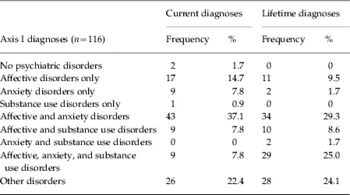
During the first assessment session (see the procedures section), all patients were administered SCID-I (First et al. Reference First, Spitzer, Gibbon and Williams1997b) to identify current and lifetime diagnoses on Axis I. Table 1 summarizes the diagnoses present in the sample. As Table 1 illustrates, the most prevalent current diagnoses were combinations of affective and anxiety disorders (n=43; 37%), followed by complex presentations (‘other disorders’) that included eating, somatoform, dissociative and sexual disorders together with more common affective, anxiety and substance use disorders (n=26; 22%).
Current and lifetime Axis I diagnoses

Best-estimate diagnostic procedures
Diagnostic assessments at intake required a minimum of three sessions with every patient, and each session lasted 2 hours or more. Session 1 included the administration of SCID-I (First et al. Reference First, Spitzer, Gibbon and Williams1997b) and other measures of current symptomatology. In session 2, a detailed social and developmental history was taken, using a semi-structured interview, the Interpersonal Relations Assessment (IRA), developed for this purpose (Heape et al. Reference Heape, Pilkonis, Lambert and Proietti1989). During session 3, SCID-II (First et al. Reference First, Gibbon, Spitzer, Williams and Benjamin1997a) was administered.
Following the intake evaluation, the primary interviewer presented the case at a 3-hour diagnostic conference with colleagues from the research team. A minimum of three judges participated. All available data (historical and concurrent) were reviewed and discussed at the conference, and each clinician voted independently about the presence or absence of a personality disorder. Judges were given access to all data that had been collected: current and lifetime Axis I information, symptomatic status, social and developmental history, and personality features acknowledged on the Axis II interviews. For the present purpose, the key measures that emerged from the best-estimate consensus were (a) the overall decision about the presence versus absence of a personality disorder, (b) the specific DSM-IV diagnosis assigned, and (c) a rating on the Global Assessment of Functioning (GAF) Scale. During the diagnostic conference, a checklist of the Axis II criteria for all PDs was completed by consensus, with each item rated absent (0), present (1), or strongly present (2). Despite our best efforts at telephone screening, some participants did not meet criteria for BPD or APD but did meet criteria for other PDs, and these subjects were assigned to an ‘other PD’ (OPD) group. These subjects were omitted from analyses of categorical PD groups, but they were included in dimensional analyses. The total sample included 46 BPD patients, 27 APD patients, 25 patients with no PD, and 18 patients with other PDs.
The RAPFA
Social dysfunction was measured using the RAPFA by a second interviewer who was blind to the results from the diagnostic assessments. Like the APFA, this interview enquires about functioning over the previous 5 years in six domains of work, love relationships, friendships, non-specific social interactions, negotiations and coping. Negotiations and coping were not included in this study. This is an investigator-based measure, in which the interviewer uses flexible questioning to obtain adequate information and makes ratings on the basis of detailed rating rules, a dictionary of examples, and training. The interviews are audio-recorded, and detailed reports are prepared from the tapes. The APFA has good inter-rater reliability and subject-informant agreement (Hill et al. Reference Hill, Harrington, Fudge, Rutter and Pickles1989, Reference Hill, Fudge, Harrington, Pickles and Rutter1995), and pervasive dysfunction in the APFA is associated with personality disorder (Hill et al. Reference Hill, Fudge, Harrington, Pickles and Rutter2000). In this study RAPFA level scores in all four domains correlated significantly and negatively with GAF scores. The correlation coefficients ranged between −0.65 and −0.71.
Ratings are made in each domain on a scale from 1–9, where ‘1’ reflects a high level of adaptation and ‘9’ very poor functioning over the rating period. Ratings are also made of the predominant type of dysfunction: discordant, avoidant, asymmetrical, or other (unstable). The RAPFA also includes ‘dysfunction scales’ that assess more specific interpersonal processes, such as whether the respondent repeatedly intensifies romantic relationships where problems are already evident. These scales will be reported in a subsequent paper.
The dysfunction scales also identify processes that are taken into account when rating domain disorganization (DD). Domain organization refers to the accurate identification by the individual of the demands of the domain and the expectations that each participant in the domain can have of one another, the appropriate level of emotional expression and its intentionality for the domain, and the extent of intimacy and emotional resources to be found in the domain. Disorganization is identified (a) where the balance of the components in one or more domains is markedly disrupted (domain incompleteness), (b) where processes that are appropriate in one domain appear in another (domain boundary violation), and (c) where the balance of intensity or intimacy across the domains is skewed. DD is rated on a 0–6 scale. Zero is rated where there are no markers for DD, 1–2 where there are some markers but no convincing examples, 3–4 where there are definitely some relevant features but there are also aspects of functioning in which domain clarity is preserved, and 5–6 where most or all functioning lacks domain clarity. The scale is designed to be dichotomized at the 2 versus 3 threshold for the presence of definite features of DD.
RAPFA ratings of the severity of impairment in each domain, main type of dysfunction, and specific dysfunctions were made in a second consensus conference in Pittsburgh. Each conference included a minimum of three judges (the RAPFA interviewer and two other members of the research team) who were different from the judges in the diagnostic case conference and were also blind to the results of the Axis I and II diagnostic assessments and conference. The construct of DD was developed and refined during the course of the study by the Liverpool team (J.H., H.H., N.B.) who then rated DD retrospectively from the written reports generated by the Pittsburgh group, blind to all of their ratings.
Studies of inter-rater reliability were performed in both Pittsburgh and Liverpool. In Pittsburgh, 10 cases throughout the course of the study were rated by an average of seven judges. The intraclass correlation coefficient (ICC) for ratings of overall severity in the domain of work was 0.90; romantic relationships, 0.87; friendships, 0.82; and non-specific social contacts, 0.75. In Liverpool, 25 vignettes were rated by three judges for DD, and the ICC was 0.79. Once the concept of DD was adequately operationalized, the Pittsburgh team incorporated this rating into its consensus conferences for the final 42 participants. The inter-site (Pittsburgh versus Liverpool) correlation for DD on these cases was 0.82.
Variables and analyses
Diagnostic systems treat psychopathology as a categorical entity. It is evident, however, that in many instances there are no natural thresholds demarcating disorder from absence of disorder (Pickles & Angold, Reference Pickles and Angold2003). Although DSM-IV specifies different disorders as categories, the advantages of considering personality disorders dimensionally are becoming increasingly apparent (Daley et al. Reference Daley, Burge and Hammen2000; Widiger & Frances Reference Widiger, Frances, Costa and Widiger2002; Skodol et al. Reference Skodol, Pagano, Bender, Shea, Gunderson, Yen, Stout, Morey, Sanislow, Grilo, Zanarini and McGlashan2005; Zanarini et al. Reference Zanarini, Frankenburg, Hennen, Reich and Silk2005). Therefore, our analyses included both PD dimensions and categories.
Dimensional scores reflecting the severity of each PD were computed by summing the scores (range 0 to 2) of the individual criteria. As the focus of the study was the comparison between BPD and APD (and in order to reduce the number of analyses), three scales were generated: total BPD features, total APD features, and the sum of the criteria from the remaining DSM Axis II disorders (total OPD features). A score of 8 or 9 reflecting no adequate functioning over the rating period was used as a measure of extreme social dysfunction in each RAPFA domain. Individuals with total RAPFA scores of 22 and higher were rated as having high overall dysfunction. This threshold, like the one used previously with the APFA based on six domains (Hill et al. Reference Hill, Harrington, Fudge, Rutter and Pickles1989), ensures that most individuals scoring positively will have substantial dysfunction in the majority of the domains. The sample was divided into younger (39 or younger) and older (40 or older) groups based on the median age of participants.
Analyses first compared the mean social dysfunction scores of the PD groups using analysis of covariance (ANCOVA), including covariates associated with the outcome variable in simple analyses. Associations between PD scores and social dysfunction were examined first in correlations, and then jointly in multiple linear regression models. Specificity in associations between PD symptom scores and social dysfunction was examined domain by domain, entering the three PD dimensional scores jointly and examining the unique variance explained by each of the PD symptom scores (APD, BPD and OPD) controlling for the remaining two PD symptom scores. Associations between PD symptoms and DD were first examined using correlations. In testing for specificity, we took account of correlations between DD and RAPFA dysfunction and between DD and non-BPD symptoms, and conducted hierarchical linear regression entering RAPFA dysfunction in the first step, correlated non-BPD symptoms in the second step, and BPD symptoms in the third step. The interaction between age group and the DD binary variable predicting BPD symptoms was examined in ANCOVA, controlling for overall RAPFA dysfunction.
Results
Associations between sociodemographic variables, social dysfunction and DSM disorders
There was a substantially greater proportion of women in the BPD than the APD group [(OR) 8.4, 95% confidence interval (CI) 2.4–30.1, p<0.001]. Being female was associated with higher mean BPD symptoms (mean difference 3.6, 95% CI 1.6–5.6, p<0.0001) and male with APD symptoms (mean difference 2.3, 95% CI 0.5–4.1, p=0.011). Gender was not associated with social dysfunction or with DD and so it was not included in multivariable analyses. Of the 29 men in the sample, only four were diagnosed with BPD. It was not therefore possible to check whether the pattern of findings was similar in males and females. However, analyses of the female subgroup are presented for comparison with the whole sample.
There were no differences in racial origin (white versus non-white) or educational level (high school only versus some college versus college graduate) between the no-PD, APD and BPD groups, or in mean PD symptoms. There were no associations of racial origin and educational level with social dysfunction or DD, so racial origin and educational level were not included in the multivariable analyses.
The women in the sample were younger than the men (mean difference 5.6, 95% CI 1.2–10.0, p<0.05), and the BPD participants had a lower mean age than the remainder of the sample (mean difference 4.5, 95% CI 0.6–8.4, p<0.05). The BPD symptom total was correlated with age (r=−0.27, p<0.01). Non-specific social interaction functioning improved with age (r=−0.28, p<0.01) but there were no other associations between functioning and age. Nonetheless, age was entered as a covariate in all multivariable analyses of social dysfunction and of DD.
The type of dysfunction varied by age. In the younger group (age 39 years and younger), 41% of those rated with romantic dysfunction were predominantly avoidant in contrast with 62% in the older group (OR 0.43, 95% CI 0.20–0.92, p<0.05). The difference was particularly marked in the BPD group. Within the younger BPD participants, 9/30 (30%) had overall avoidant romantic dysfunction in contrast with 10/16 (63%) in the older group (OR 0.3, 95% CI 0.07–0.92, p<0.05). A similar effect was seen in friendships. Across the sample as a whole, avoidant dysfunction increased from 66% in the younger group to 89% in the older group (OR 0.23, 95% CI 0.08–0.70, p<0.01), and this was due to the difference in the BPD group in which avoidant dysfunction rose from 48% to 88% (OR 0.13, 95% CI 0.03–0.76, p=0.01). Taken together, these findings suggested that the nature of social dysfunction in BPD changes with age and so associations between BPD symptoms and DD were compared between the younger and older groups.
Given the use of a clinical sample, there were high rates of Axis I disorders in all of the groups. The overall rate of current or previous DSM major depression was 70%, and of a current or previous DSM anxiety disorder 77%, with no differences between the groups. Thirty-seven per cent of the sample had current or previous DSM alcohol abuse or dependence, with a greater proportion in the BPD group than the remainder of the sample (29% v. 50%; OR 2.5, 95% CI 1.2–5.4, p<0.05). Axis I disorders were not associated with social dysfunction, nor with DD, and so were not included in the multivariable analyses.
Bivariate associations between principal variables
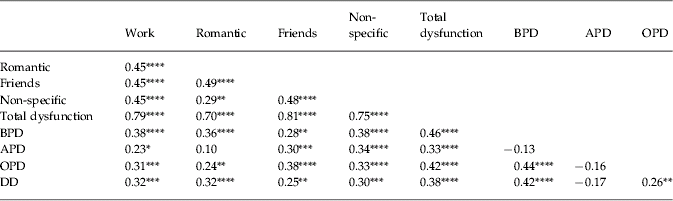
There were moderate correlations between scores in each of the RAPFA domains, and scores in each of the domains were highly correlated with total RAPFA scores (Table 2). PD symptom scores were correlated with most of the social dysfunction scales. DD was moderately correlated with social dysfunction and with BPD and OPD symptom scores.
Associations between social dysfunction, DSM personality disorder symptom scores and domain disorganization (DD)
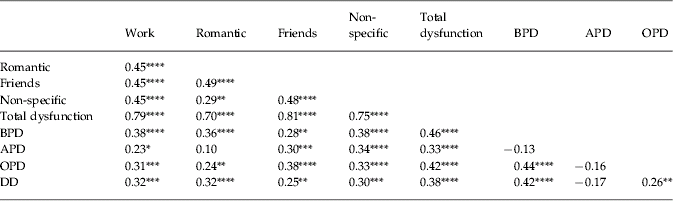
BPD, Borderline personality disorder; APD, avoidant personality disorder; OPD, other personality disorders. APD nor BPD.
The correlations are Pearson's r.
**** p<0.0001, *** p<0.001, ** p<0.01, * p<0.05.
Comparison of social dysfunction in the no-PD, APD and BPD groups
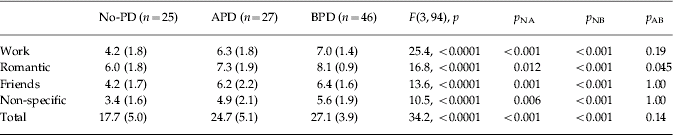
The mean social dysfunction scores of the APD and BPD groups were higher than the no-PD group in each of the domains (Table 3). The total RAPFA social dysfunction score was elevated in both of the PD groups. Patients with total RAPFA dysfunction scores of 22 and higher were substantially more likely to receive a DSM Axis II diagnosis than those below (OR 16.2, 95% CI 5.4–49.1, p<0.0001; females, OR 17.5, 95% CI 4.9–62.1, p<0.001). Social dysfunction was greater in the BPD group than the APD group in each domain but the difference was statistically significant only for romantic dysfunction. This difference was evident also in a separate analysis of females (p=0.009). There were very similar numbers with extreme scores (scores of 8 or 9 on the nine-point scale) for social dysfunction in the BPD and APD groups in each of the domains except for romantic relationships. In the BPD group, 39/46 (85%) had extreme romantic dysfunction compared to 15/27 (56%) in the APD group (OR 4.5, 95% CI 1.5–13.5, p<0.01). The difference was similar when only females were considered (OR 3.2, 95% CI 1.4–7.3, p<0.01).
Comparison of mean RAPFA scores in the no-PD, APD and BPD groups
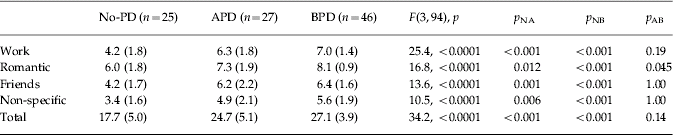
RAPFA, Revised Adult Personality Disorder Functioning Assessment; no-PD, no personality disorder; APD, avoidant personality disorder; BPD, borderline personality disorder; p NA, no-PD v. APD; p NB, no-PD v. BPD; p AB, APD v. BPD.
Unadjusted means are shown. The p values are for post-hoc pairwise comparisons using the Bonferroni statistic in a multivariate analysis of covariance controlling for age.
Specificity of associations between personality disorder symptom scores and social dysfunction
When controlling for age, unique proportions of the variance in work dysfunction were predicted by BPD symptoms (R 2=0.12, β=0.42, p<0.001) and APD symptoms (R 2=0.06, β=0.25, p<0.01). Only BPD symptoms predicted romantic dysfunction (R 2=0.11, β=0.40, p<0.001). The variance in friendship dysfunction was predicted by OPD symptomatology (R 2=0.04, β=0.24, p<0.05), APD (R 2=0.08, β=0.29, p<0.01) and BPD (R 2=0.03, β=0.22, p<0.05). Age (R 2=0.05, β=−0.24, p<0.01) and both APD (R 2=0.14, β=0.39, p<0.001) and BPD (R 2=0.07, β=0.31, p<0.001) made independent contributions to non-specific social interactions dysfunction. Results of analyses for females are: work BPD symptoms (R 2=0.08, β=0.34, p<0.01), APD symptoms (R 2=0.01, β=0.16, p=0.1); romantic BPD symptoms (R 2=0.12, β=0.37, p<0.01); friends OPD symptoms (R 2=0.15, β=0.25, p<0.05), APD symptoms (R 2=0.06, β=0.27, p<0.01), BPD symptoms (R 2=0.02, β=0.19, p=0.1); non-specific age (R 2=0.05, β=−0.19, p<0.05), APD symptoms (R 2=0.12, β=0.39, p<0.001), BPD symptoms (R 2=0.05, β=0.29, p=0.01).
Domain disorganization
DD scores ranged between 0 and 6 with mean 2.2 (s.d.=1.7) and median 2. DD was correlated with dysfunction in each of the domains and with total social dysfunction (Table 2). DD was most strongly correlated with total social dysfunction and so subsequent analyses considered whether DD was associated with PD diagnosis and symptoms over and above associations with the overall level of social dysfunction reflected in the RAPFA total score.
Patients with BPD had higher mean DD scores than those with APD and those with no personality disorder, but patients with APD did not have elevated scores compared to the no-PD group (Table 4). These differences remained significant after controlling for total social dysfunction scores.
Comparison of mean domain disorganization scores in the no-PD, APD and BPD groups

No-PD, No personality disorder; APD, avoidant personality disorder; BPD, borderline personality disorder; df, degrees of freedom; p NA, no-PD v. APD; p NB, no-PD v. BPD; p AB, APD v. BPD.
Unadjusted means are shown. The p values are for post-hoc pairwise comparisons using the Bonferroni statistic in analysis of covariance controlling for age.
Results controlling for total RAPFA (Revised Adult Personality Disorder Functioning Assessment) dysfunction as well as age are shown in italics, and for females only in bold italics.
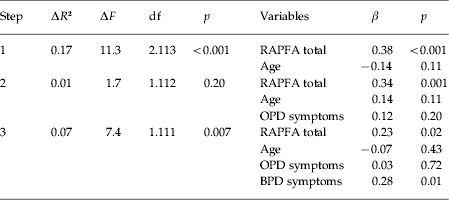
DD scores were correlated with BPD symptoms (r=0.42, p<0.0001) and OPD symptoms (r=0.26, p<0.01). The association of DD with BPD symptoms was stronger in the younger group [below median age r=0.51, p<0.0001, above median age r=0.25, p=0.06; z score for the difference in correlations=1.60, p=0.054 (one-tailed)]. BPD and OPD symptoms were examined jointly in hierarchical linear regression entering first RAPFA total and age, then OPD symptoms, and finally BPD symptoms (Table 5). BPD symptoms significantly improved the fit of the model predicting DD after accounting for RAPFA total, age and OPD symptoms, and OPD symptoms no longer contributed significantly once BPD symptoms were included (females, BPD symptoms: ΔR 2=0.07, β=0.29, p=0.02). When the same analysis was conducted including only the patients below the median age of 39 years, the contribution of BPD symptoms was somewhat stronger than for the sample as a whole (BPD symptoms ΔR 2=0.08, β=0.34, p=0.017).
Prediction of domain disorganization from borderline personality disorder (BPD) symptom scores after accounting for RAPFA total
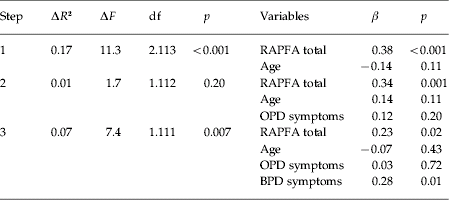
RAPFA, Revised Adult Personality Disorder Functioning Assessment; OPD, other personality disorder; df, degrees of freedom.
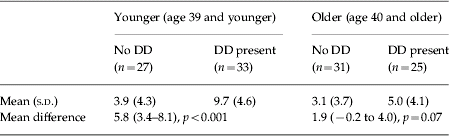
The associations between DD and BPD symptoms in the younger and older participants were compared using binary variables based on the presence of some clear evidence for DD (2–3 threshold) and on the median age of the sample (39–40 threshold) (Table 6). The interaction between DD and age was significant (p<0.026), consistent with there being a stronger association between DD and BPD symptoms in the younger than the older group.
Associations between domain disorganization (DD) and BPD symptoms in the younger and older age groups
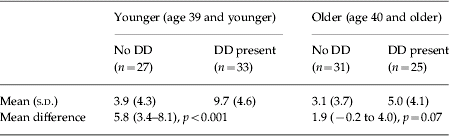
BPD, Borderline personality disorder; s.d., standard deviation.
The mean differences and values of p were obtained from independent groups t tests. DD ‘present’ was based on a 2–3 threshold for DD scores. In ANCOVA controlling for total RAPFA social dysfunction, there was a DD (absent – present) by age group interaction, F(1, 111)=5.1, p=0.026.
Discussion
Social dysfunction assessed over 5-year time-periods, without reference to abnormal personality traits, and independently of assessments of personality pathology, was strongly associated with DSM personality disorder. Both APD and BPD were associated with high levels of social dysfunction in four social domains and total overall dysfunction. BPD was associated with more severe romantic dysfunction than APD. BPD individuals aged 40 years and above, the median age of the sample, had more avoidant romantic and friends dysfunction than those below age 40. This suggested that, with age, borderline functioning becomes increasingly associated with social isolation.
In analyses of DSM PD dimensions, only BPD symptoms predicted romantic dysfunction. Taken together with the elevated scores for romantic dysfunction in the BPD group, this supports a specific link between BPD and romantic dysfunction, consistent with a role for attachment processes in BPD. However, BPD symptoms were also associated with work and non-specific dysfunction and, to a lesser extent, friends, suggesting that there are processes operating in BPD additional to those relevant to romantic dysfunction. APD symptoms were associated with work, friendships and non-specific social interactions but not romantic dysfunction, supporting processes associated with less intimate relationships in this disorder.
Lack of demarcation of behaviours and emotional expression between social domains and marked disparities of functioning within domains were assessed in a new domain disorganization (DD) scale. Inter-rater reliability for DD was good, and DD was associated specifically with BPD, and with BPD symptom scores. Although this was evident across the whole sample, the effect was stronger among those under 40 years of age than in the older BPD participants, many of whom had withdrawn from the social interactions in which DD is seen.
Strengths and limitations
The study assessed patterns of social dysfunction that might be expected to index personality functioning, that is functioning over substantial periods of time assessed using examples of behaviours. The social dysfunction interviews were conducted and rated completely independently of the PD interviews and ratings, thus permitting a robust estimate of the associations between the two. The recruitment of a clinical sample in which the rates of Axis I disorders were very similar in the PD and no-PD groups ensured that any differences found were not confounded by Axis I disorders. A clinical sample also has limitations in that it is open to referral biases and therefore may not be generalizable to the wider population. The use of lengthy interviews in which participants are encouraged to describe intimate aspects of their lives may have biased the sample towards those who lacked close confidantes in their social network. Furthermore, the sample included a substantial proportion of patients with high levels of economic deprivation. There was a wide age range and this brought advantages and disadvantages. The range reflected the ages of patients attending psychiatric services and was in that respect representative of those services, highlighting the need to cater for older as well as younger individuals. The age range also allowed us to examine for age effects, but at the same time reduced statistical power in the subgroups above and below the median.
Implications
Our results have several implications. At the most basic level, they support the utility of the RAPFA as a tool for assessing social dysfunction and DD in personality disorder. More broadly, our data support an interpersonal conception of personality disorder that focuses on dysfunction within and across social domains and highlight the need for further research in this area. Our results are consistent with previous findings that social dysfunction may show more stability over time than personality disorder diagnoses or traits (Seivewright et al. Reference Seivewright, Tyrer and Johnson2004; Skodol et al. Reference Skodol, Pagano, Bender, Shea, Gunderson, Yen, Stout, Morey, Sanislow, Grilo, Zanarini and McGlashan2005), and with our previous report that a social dysfunction and trait-based personality disorder measures identify similar groups (Hill et al. Reference Hill, Fudge, Harrington, Pickles and Rutter2000).
It is noteworthy that we found specific links between BPD and severe dysfunction in the romantic domain. This contrasts with previous, well-controlled research with substantial sample sizes that have failed to find such links, despite theory-based predictions (Daley et al. Reference Daley, Burge and Hammen2000; Skodol et al. Reference Skodol, Gunderson, McGlashan, Dyck, Stout, Bender, Grilo, Shea, Zanarini, Morey, Sanislow and Oldham2002; Zanarini et al. Reference Zanarini, Frankenburg, Hennen, Reich and Silk2005). It may be that measures such as the APFA or the RAPFA, which characterize repeated patterns of function and dysfunction over sustained periods of time, are most appropriate to assessing social dysfunction in the personality disorders.
The study also provides some preliminary indications of the ways in which predominantly temperamental and predominantly relational hypotheses may be integrated. Even if specific associations between romantic dysfunction and BPD are confirmed, it is unlikely that insecure or even unresolved/cannot classify attachment will adequately explain the severity and extensiveness of dysfunction in BPD. The ideas underpinning the concept of DD presented in this paper suggest that the key is not only problematic attachment processes in romantic relationships but also disruption of the partitioning of different kinds of emotional processes and relating, across different types of relationships. This may have its origins in an inappropriate expression of attachment needs in relationships that are not equipped to meet them, but there could be other explanations. For example, the same phenomenon could be caused by difficulties in regulating negative emotions in settings where their expression is not readily accommodated.
It is intended that the domain-based hypothesis should also generate novel research questions. We illustrate this in three ways. First, as outlined earlier in the paper, a domain-based organization of social life is established early in childhood. Failures to demarcate domain-based expressions of emotions and behaviours may be identifiable as early manifestations of a risk for BPD ahead of overt symptoms. Similarly, the search for early environmental risks for BPD might usefully identify the ones that tend to undermine domain clarity. Second, studies of known risk factors may be linked to the domain hypothesis. For example, heightened emotional intensity in response to negative stimuli and slow return to baseline are thought to be central to BPD functioning (Linehan, Reference Linehan1993). However, several studies have failed to demonstrate increased sensitivity to negative stimuli in experimental procedures (Herpertz et al. Reference Herpertz, Kunert, Schwenger and Sass1999; Arntz et al. Reference Arntz, Appels and Sieswerda2000). The domain hypothesis predicts that non-BPD individuals will react to negative stimuli differently depending on social context and that BPD may be associated with impaired modulation of emotional reactivity depending on social domain. This implies a need for studies to take account of the social domain in which stimuli are presented in investigating emotional reactivity. Third, according to the domain hypothesis there are specific links between personality dysfunction and social support. Different degrees and types of social support are found in different kinds of relationships and interactions. Thus, an individual's social supports are in part a function of their capacity to appraise accurately the emotional resources that are available in different social domains. We predict that relationship instability and strong negative emotions in BPD will arise where an individual anticipates an intensity or type of support that is not generally found in a domain, and experiences rejection or disappointment based not on an absolute lack of support but on a shortfall compared to the mistaken anticipation.
Finally, our findings may also be useful for treatment development. In principle, one should be able to teach the rules and manner in which behaviour is organized in distinctive social domains. Such a model can be used as the lens through which an individual examines his or her own interpersonal deficits in order to promote change. Stein et al. (Reference Stein, Allen and Hill2003) described the development of a psycho-educational protocol based on the APFA domains in which the distinctive features of each domain are outlined as a basis for group discussion. Early experience using the protocol with patients with BPD suggests that it can be helpful to review the underlying rules of each domain, and to consider the consequences of disorganization of domain structures.
Acknowledgements
This research was supported by grant R01 MH56888 (to P.A.P.) from the National Institute of Mental Health, Bethesda, MD, USA. Initial development of the RAPFA was supported by the Child and Family Center of the Menninger Clinic. We particularly acknowledge the substantial contribution to the development of the RAPFA made by Dr Helen Stein and Kristina Wheat.
Declaration of Interest
None.