INTRODUCTION
The problems currently facing the environment (for example conservation, sustainable use of ecosystems, climate change, pollution and maintenance of biodiversity) are complex and dynamic (Tainter Reference Tainter1988; Turner et al. Reference Turner, Clark, Kates, Richards, Mathews and Meyer1990; Gunderson & Holling Reference Gunderson and Holling2002; Folke et al. Reference Folke, Hahn, Olsson and Norberg2005; MacMynowski Reference MacMynowski2007). A range of approaches to better understand this complexity have been proposed, and usually include advocating some form of integration of the expertise, methodologies, or philosophical and/or epistemological perspectives from different research disciplines and/or stakeholder knowledge (Soulé Reference Soulé1985; MA [Millennium Ecosystem Assessment] 2005; Kates et al. Reference Kates, Clark, Corell, Hall, Jaeger, Lowe, McCarthy, Schellnhuber, Bolin, Dickson, Faucheux, Gallopin, Grubler, Huntley, Jager, Jodha, Kasperson, Mabogunje, Matson, Mooney, Moore, O'Riordan and Svedin2001; Evely et al. Reference Evely, Fazey, Pinard and Lambin2008).
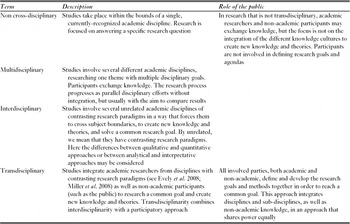
A number of different terms can be used to indicate different degrees of integration of types of knowledge, disciplinary bases or stakeholder involvement. Within the academic literature this knowledge integration is commonly referred to as multidisciplinary, interdisciplinary or transdisciplinary approaches (Table 1). Cross-disciplinarity is used as an overarching term that encompasses these different forms (Tress et al. Reference Tress, Tress and Fry2005b).
Definitions of different forms of cross-disciplinary research (from Tress et al. Reference Tress, Tress and Fry2005a).

Not all research into environmental issues needs to be cross-disciplinary. Nevertheless, a cross-disciplinary research approach is likely to assist in understanding the complex dynamics of many key environmental problems in a socioecological context. Such research can: (1) provide new perspectives on complex, dynamic problems (Bammer Reference Bammer2005; Tress et al. Reference Tress, Tress and Fry2005a, Reference Tress, Tress and Fryb; Graybill et al. Reference Graybill, Dooling, Shandas, Withey, Greve and Simon2006; Reich & Reich Reference Reich and Reich2006); (2) provide a more holistic view of a problem that is better suited to targeting the underlying drivers and processes of both wider environmental and specific conservation issues (Tress et al. Reference Tress, Tress and Fry2005a, Reference Tress, Tress and Fryb); (3) assist in the selection of more appropriate research methodologies (Kinzig Reference Kinzig2001; Evely et al. Reference Evely, Fazey, Pinard and Lambin2008); (4) provide greater flexibility in research approach and implementation (Newell Reference Newell2001; Bruce et al. Reference Bruce, Lyall, Tait and Williams2004); and (5) facilitate production of new information and insights that would not have been achieved by single disciplinary or epistemological perspectives alone (Miller et al. Reference Miller, Baird, Littlefield, Kofinas, Chapin and Redman2008).
With increasing incentives for cross-disciplinary research and collaboration it is unsurprising that the number of papers published that define themselves as being cross-disciplinary is increasing (Tress et al. Reference Tress, Tress and Fry2005a, Reference Tress, Tress and Fryb). Yet, despite this trend, there is still much confusion in academia about what cross-disciplinary research is, how this research is carried out, how it can be evaluated and what its contribution to both peers and practitioners is as compared to a single disciplinary approach (Tress et al. Reference Tress, Tress and Fry2005a). This can create confusion around the nature of the problem under investigation, the scale of analysis (genome, population, landscape or ecosystem) or the level of complexity (deterministic, stochastic or chaotic) (Westley et al. Reference Westley, Gunderson and Holling2002). The lack of a clear and common understanding about the nature of cross-disciplinary research means that new cross-disciplinary projects, centres and institutes are unable to evaluate the effectiveness of a specific cross-disciplinary approach, or identify problems and successes in implementation. Providing greater clarification of what cross-disciplinary research in conservation consists of, and whether a common definition for different forms of cross-disciplinary research can be used, is an important first step towards evaluating and improving the effectiveness of such work.
A potential outcome of cross-disciplinary research is the stronger linkages it may build, not only between researchers but also between researchers and non academic practitioners (see Table 1). This can have beneficial outcomes such as: (1) increasing the relevance of the research to practice and policy (O'Fallon & Dearry Reference O'Fallon and Dearry2002); (2) improving the research focus by clarifying the focus of research (Sutherland et al. Reference Sutherland, Armstrong-Brown, Armsworth, Tom, Brickland, Campbell, Chamberlain, Cooke, Dulvy, Dusic, Fitton, Freckleton, Godfray, Grout, Harvey, Hedley, Hopkins, Kift, Kirby, Kunin, Macdonald, Marker, Naura, Neale, Oliver, Osborn, Pullin, Shardlow, Showler, Smith, Smithers, Solandt, Spencer, Spray, Thomas and Thompson2006); (3) improving learning/adapting as a result of the research process (Fazey et al. Reference Fazey, Fazey and Fazey2005a; Reed Reference Reed2008); and (4) facilitating the uptake of research results and encouraging best practices (Carlsson & Berkes Reference Carlsson and Berkes2005). Within the research process, involving practitioners can enhance scientific understanding and increase project sustainability (Colding & Folke Reference Colding and Folke2001; Stringer et al. Reference Stringer, Prell, Reed, Hubacek, Fraser and Dougill2006; Reed Reference Reed2008; Fazey et al. Reference Fazey, Evely, Latham, Kesby, Wagatora, Hagasua, Christie and Reed2010). As a result, the contemporary idea of sustainability places a similar emphasis on the participation of stakeholders and the wider community as it does on environmental, social and economic integration (Pullin et al. Reference Pullin, Knight, Stone and Charman2004; Dovers Reference Dovers2005; Stringer et al. Reference Stringer, Prell, Reed, Hubacek, Fraser and Dougill2006; Reed Reference Reed2008). Public participation within research ensures relevance to real-world problems and is thought to encourage the uptake of research results by industry or other end-users (Bruce et al. Reference Bruce, Lyall, Tait and Williams2004; Fazey et al. Reference Fazey, Evely, Latham, Kesby, Wagatora, Hagasua, Christie and Reed2010).
This paper provides the first analysis of environmental conservation research that defines itself as cross-disciplinary. We ask three main questions in relation to environmental conservation: (1) what are the characteristics of current cross-disciplinary research in environmental conservation? (2) can a standard definition for different types of cross-disciplinarity be used? and (3) if we use a standard definition what may the potential impacts of different types of cross-disciplinary research be on colleagues and practitioners? The paper is based on an evaluation of environmental conservation research papers that define themselves as cross-disciplinary and questionnaire responses from the authors of those papers. The results are discussed in relation to the questions they raise about the current incentives and disincentives for cross-disciplinary research in conservation and for broader environmental issues.
METHODS
Overview
The research included three key stages: (1) identification of cross-disciplinary conservation research; (2) review of the research papers identified (using three separate reviewers to ensure consistency); and (3) a questionnaire sent to authors of the articles identified (n = 96) to determine whether they felt they had correctly classified their papers in relation to the different forms of cross-disciplinary conservation research, and to determine the impact of the papers (as perceived by the authors).
Identification and inclusion of research publications
As we were specifically interested in looking at how research in the academic literature classified their cross-disciplinary work, our research involved articles classified as cross-disciplinary within the conservation literature. Searches were conducted on 20 March 2007 on the online database search service Web of Science (v 4.3). The search term used was ([interdisciplinar* OR multidisciplinar* OR cross-disciplinar* OR transdisciplinar*] AND [Conservation]). Of the 393 papers identified in the initial search, 96 were directly related to environmental conservation research (i.e. they provided information on the scientific and technical means for the protection, maintenance and restoration of life on this planet, including species, ecological and evolutionary processes, and the environment). These papers were used for further analysis.
Assessing the characteristics of cross-disciplinary papers in conservation
In order to identify the characteristics of current cross-disciplinary research within the field of conservation, Anna Evely (AE), Emily Lambert (EL) and Sarah Allen (SA) asked numerous questions of each publication. These included the number of authors involved in the publication, the disciplines of each author, and how many methods of data analysis or collection were used. Questions were identified through the examination of key texts (Stokols et al. Reference Stokols, Fuqua, Gress, Harvey, Phillips, Baezconde-Garbanati, Unger, Palmer, Clark, Colby, Morgan and Trochin2003; Bruce et al. Reference Bruce, Lyall, Tait and Williams2004; Lawrence & Després Reference Lawrence and Després2004; Tress et al. Reference Tress, Tress and Fry2005a) and by reading a selection of 50 papers from those identified in searches. Each paper was reviewed twice: once by AE, and once by a separate reviewer (EL or SA). Cohen's kappa coefficient of concordance (ranging between 0 and 1) was used to assess the agreement between reviewers. In general, kappa values of 0.60 or higher are taken to reflect agreement (Landis & Koch Reference Landis and Koch1977). Agreement between reviewers ranged from 0.8 to 0.9 (see Appendix 1). Where results differed between reviewers, consensus was achieved through discussing the paper. Further to this review process, we also asked the first or corresponding author of each paper about his/her level of disciplinary integration when working on their project.
Reclassification of papers to establish whether a standard definition can be used
To assess whether a standard definition can be applied to cross-disciplinary research, we asked the first or corresponding authors to redefine their papers according to the definitions put forth by Tress et al. (Reference Tress, Tress and Fry2005a; Table 1) and compared these with how reviewers redefined the same papers. Cohen's kappa coefficient of concordance was used to assess the agreement between the authors' and the reviewers' reclassification of the papers.
Identifying what the impacts of the papers were on peers and practitioners
Lead or corresponding authors of papers were asked in a questionnaire to assess whether they thought their papers had (1) high impact, (2) moderate impact, (3) neither moderate nor low impact, (4) low impact and (5) no impact on colleagues and practitioners. We then conducted a bibliometric analysis (removing self citations) to compare average citations per year across categories of cross-disciplinary research (multidisciplinary, interdisciplinary, transdisciplinary and non cross-disciplinary) to validate authors' perceptions of their impacts on colleagues. Similarly, we compared non-academic web citations (such as blogs, conservation e-magazines and websites) for each article in order to validate authors' perceptions of their impacts on practitioners. Multinomial logistic regression was used to assess which type of reclassified cross-disciplinary research was associated with the perceived impacts on the above groups, as well as to compare citation rates. To select the best-fitting model, we compared simple models to those that included all explanatory variables. The significance of the explanatory variables was assessed using forward stepwise selection, and the distributional fit of the variables was assessed graphically. Odds ratios were used to measure effect size. Changes in Akaike Information Criteria (AIC; Akaike Reference Akaike1974) and likelihood ratio tests helped guide model simplification. We report models with the lowest AIC. When interpreting models the overall significance of all analyses were undertaken with the statistical software R (R Development Core Team 2008) and the package nnet (Venables & Ripley Reference Venables and Ripley2002).
RESULTS
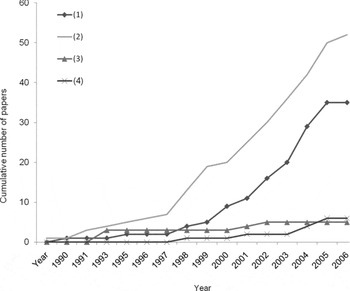
The use of cross-disciplinary terminology in conservation literature has increased dramatically since the late 1990s (see Fig. 1). Of the 96 papers considered and originally classified by authors, 35.4% had been classed as multidisciplinary, 53.1% as interdisciplinary, 5.2% as transdisciplinary and 6.3% had confused terms and defined their work as both interdisciplinary and multidisciplinary.
Cumulative number of types of cross-disciplinary papers published between 1990 and early 2007. Identified using Web of Science (1) multidisciplinary papers; (2) interdisciplinary papers; (3) papers that provided both the terms interdisciplinary and multidisciplinary to describe their article; and (4) transdisciplinary papers.

Response rate
Of the 96 questionnaires sent to the authors of cross-disciplinary papers, 57 were returned (59% response rate). To determine non-response bias, we carried out a binary logistic regression comparing respondents and non-respondents with the original classification of their papers. We found no difference in disciplinary classification between respondents and non-respondents (χ2 = 3.34, df = 1, p ≈ 0.08).
What are the characteristics of current cross-disciplinary research?
How many authors and disciplines were involved in cross-disciplinary research?
Half of the papers had one to three authors (52%). The proportions of papers with differing amounts of authors were: one 21%, two 16%, three 16%, four 13%, five 10%, and greater than five authors 24%. Thirty-two per cent of papers involved authors from a single discipline background (as judged by their affiliation), 37% from two disciplines and 18% from three disciplines. The remaining 14% had authors from three or more disciplines.
How closely did authors work together?
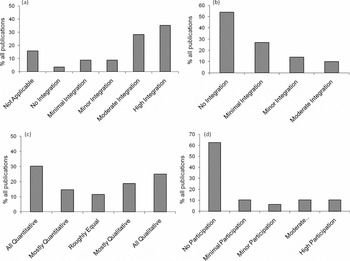
Asked about their level of integration when working on their paper, 35% of authors of multi-author papers stated that they had many meetings and workshops, and worked with the team in a highly-integrated manner. Thirty per cent stated that they worked in a moderately-integrated manner, with approximately equal author involvement in less-regular meetings and workshops. The remaining 35% worked in an only slightly-integrated manner, characterized by a discussion at the outset and minimal (or no) contact following this discussion (Fig. 2a).
Percentage of all publications expressed by (a) different levels of integration of author contribution (n = 57) (as stated by main or corresponding authors in the questionnaire; not applicable relates to sole author articles); (b) degree of integration of the methods used (n = 96); (c) type of data collected (n = 96); and (d) degree of inter-disciplinary participation (n = 96)

How many methods were used for data collection, analysis, or presentation, and how integrated were the methods from different disciplines?
The number of methods used for data collection varied between one and 12. For example, Aswani and Lauer (Reference Aswani and Lauer2002) used five different methods of data collection in their work, including participant observation, interviews, participatory mapping, sampling (fieldwork) and species inventory; 36% of articles used two methods of data collection. Most studies carried out had no statistical analysis of data (47%), or had only one method of data analysis (32%). Most articles did not integrate the methods of different disciplines (53%) (Fig. 2b), and no articles showed high integration (i.e. going beyond separate disciplines and seeking to create new cross-disciplinary knowledge or theories). Thus, we graded the paper by Aswani and Lauer (Reference Aswani and Lauer2002) as moderate; it was characterized by a mix of methods common to different disciplines that were integrated within the project to create a map, which combined results from the local people with those from on-the-ground research. Thirty per cent of articles were quantitative in content (Fig. 2c), and 12% of the articles had a roughly equal balance between quantitative and qualitative data. Such a rough analysis of qualitative and quantitative data provides an insight into the world views that underpin the research taking place. For example, philosophies of subjectivism (roughly characterized by qualitative data) and positivism (roughly characterized by quantitative data) differ in their perspectives of what constitutes social reality (see Evely et al. Reference Evely, Fazey, Pinard and Lambin2008). As a result, it is much more likely that cross-disciplinary research teams form that have similar philosophies; it is less common that those with differing world views will strike a balance between philosophies in order to collaborate.
How much was public participation a part of the research?
The majority of papers involved no public participation (63%). Of the papers that did involve such participation (37%), all four categories of participation were represented in similar proportions: (1) minimal participation (10%), involving practitioners solely for the purpose of obtaining data that would be otherwise unavailable or inaccessible, and/or for testing data or methodologies; (2) minor participation (7%), considering practitioners' views, concerns and knowledge (in this category, practitioners are limited to the research community, academics, professionals and official agencies); (3) moderate participation (10%), incorporating the views, concerns and knowledge of a wide range of practitioners (including the general public); and (4) high participation (10%), going beyond the extractive process of eliciting views and actively seeking to facilitate and empower practitioners and/or to build the capacity for practitioners to undertake analysis and management.
Summary
The results suggest that current environmental conservation research defining itself as cross-disciplinary is not particularly integrative. Research categorized as being cross-disciplinary by authors generally involved few authors from a small number of disciplines, with little integration. It was rare that authors worked with others from disciplines of a different philosophical grounding. Few research projects (34%) involved engagement with practitioners.
Can a standard definition be used in cross-disciplinary research?
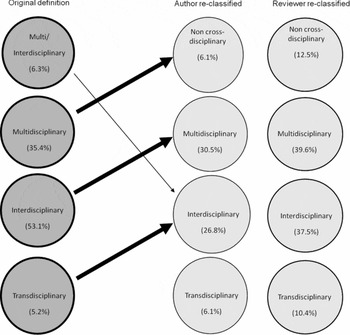
A reclassification of papers by authors (Table 1) was similar to the independent classification of papers by the reviewers (Cohen's kappa = 0.71). Reviewers classified 12.5% of papers as non cross-disciplinary, 39.6% as multidisciplinary, 37.5% as interdisciplinary and 10.4% as transdisciplinary (Fig. 3). Authors tended to reclassify papers that were multidisciplinary as non cross-disciplinary, or they retained their definition as multidisciplinary. Most interdisciplinary papers were reclassified as multidisciplinary and transdisciplinary papers were reclassified as interdisciplinary. The multi/interdisciplinary papers were classified by authors as either non cross-disciplinary or interdisciplinary (Fig. 3). The consistency between how reviewers and authors reclassified papers suggests that the definitions are sufficiently clear to be used to classify projects consistently.
Comparison between how papers were originally classified and how authors and reviewers reclassified the papers (according to the Tress et al. Reference Tress, Tress and Fry2005a definition). Thick arrows indicate that the majority of papers were reclassified by authors. Thinner arrows indicate an almost equal split between papers reclassified from this category. The percentage of papers falling within each sample is indicated.

What are the impacts of a cross-disciplinary research approach on colleagues and practitioners?
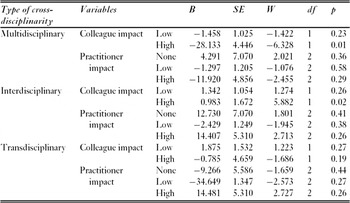
We found a significant difference between type of cross-disciplinarity and impact on colleagues (χ2 = 17.11, df = 6, p = 0.09) and practitioners (χ2 = 20.64 df = 9, p = 0.01). Transdisciplinary papers, as redefined, were perceived by authors to have the lowest impact on colleagues, while papers which were non cross-disciplinary were perceived to have the highest impact (see Table 2). Authors' perceptions of their impacts on colleagues were confirmed by bibliometric analysis comparing the average number of citations per year for each paper (m). We found that transdisciplinary papers (m = 1.5) generated significantly fewer citations per year than those which were non cross-disciplinary (m = 3.9) (χ2 = 12.11, df = 1, p < 0.001). We found transdisciplinary and interdisciplinary papers to involve significantly more public participation than multidisciplinary and non cross-disciplinary papers (χ2 = 47.42, df = 3, p < 0.001). Authors' perceptions of their papers' impacts on practitioners, suggested that transdisciplinary and interdisciplinary papers had a higher impact on practitioners than papers that were multidisciplinary or non cross-disciplinary (Table 2). Although this was more difficult to validate, we evaluated author perception of practitioner impact via web citations of papers. We found that transdisciplinary papers (m = 1.4) generated significantly more web citations than those that were non cross-disciplinary (m = 0.15) (χ2 = 25.09, df = 1, p < 0.001).
Multinomial logistic regression of relationships between perceived impact of the study and how papers were reclassified. Responses to low, high or none are included in the model due to their contribution to the overall significance of the model. Both Practitioner and Colleague impact are ordinal variables. All variables are compared to the reference category ‘Non cross-disciplinary’.

The results suggest that research which gains recognition from peers does not necessarily have a strong impact on practice, and vice versa.
DISCUSSION
Can a standard definition be used in cross-disciplinary research?
Cross-disciplinary research is difficult to put into practice (Dovers Reference Dovers2005; Tress et al. Reference Tress, Tress and Fry2005b), not least owing to a lack of clear definitions, which makes it difficult to evaluate what has gone before and challenging to build on this knowledge. Yet many challenges to evaluating and improving cross-disciplinary research could be reduced by clarifying the terms used by authors when defining their studies. Agreement on a standard set of definitions would result in advancing and improving the quality of cross-disciplinary research, not only in conservation, but also for environmental research as a whole. The definitions used in this paper are simple and clear enough to be effectively used by research councils, organizations and individuals as starting points for explaining what is meant by different cross-disciplinary terms.
While a unitary set of definitions may be impossible, some common definitions are feasible. There are limitations to the definitions we have used, which do not adequately define single disciplinary studies that engage practitioners (such as anglers, hunters and citizen scientists) in defining research goals. There are many adaptive management studies which rely on practitioners to help define research objectives, yet in practice, are often multidisciplinary in approach. Therefore, other definitions (for example those advanced by Bammer Reference Bammer2005) should be investigated as an alternative.
What are the impacts of a cross-disciplinary research approach on colleagues and practitioners?
Historically, there has been a distinct lack of studies that attempt to investigate the validity of the claims made for public participation in the research process (Webler Reference Webler1999; Beierle Reference Beierle2002; Brody Reference Brody2003; Blackstock et al. Reference Blackstock, Kelly and Horsey2007), with the few attempts focused on evaluating the process rather than the impact (for example Renn et al. Reference Renn, Webler and Wiedemann1995; Rowe & Frewer Reference Rowe and Frewer2000; Beierle Reference Beierle2002). Our results indicate that studies that were transdisciplinary were perceived by their authors to have the highest impact on practitioners and had more associated web citations, suggesting that the impact of transdisciplinary papers transcends academia and reaches a wider audience.
In attempting to evaluate the potential impact of cross-disciplinary research on practitioners, we found a direct link between public participation in the research process (transdisciplinary or interdisciplinary studies) and an increased impact of interdisciplinary or transdisciplinary studies on practitioners. In order for research to have any real impact on solving environmental problems, it must be accessible to practitioners (Fazey et al. Reference Fazey, Salisbury, Lindenmayer, Maindonald and Douglas2004; Pullin et al. Reference Pullin, Knight, Stone and Charman2004). However, current studies show that research is time-consuming to locate, access and read (Pullin et al. Reference Pullin, Knight, Stone and Charman2004). If accessed by practitioners, academic papers may already be outdated (considering that publication of conservation research typically takes 3.9 ± 0.13 years following the last year of data collection; Fazey et al. Reference Fazey, Salisbury, Lindenmayer, Maindonald and Douglas2004) and may not be relevant to management (Kareiva et al. Reference Kareiva, Marvier, West and Hornisher2002; Fazey et al. Reference Fazey, Fischer and Lindenmayer2005b). Our results indicate that when practitioners take a more active role in the research process, research is more accessible and practitioners are more likely to use the research and adapt their management strategies accordingly.
The results also suggested that paper that were not cross-disciplinary had the highest impact on colleagues and transdisciplinary papers the lowest. This could be for a number of reasons. For example, those which were transdisciplinary or interdisciplinary particularly tended to be aimed at solving a specific problem, and hence they might have been less broadly relevant and cited less. It may also be because the rewards and incentives in academia promote and reinforce discipline-based research. Academic institutions are still almost entirely organized around discipline-based structures, and although funding agencies are increasingly emphasizing cross-disciplinary research, the work of most academics is evaluated through discipline-based mechanisms. The incentives to step across boundaries between disciplines are therefore very limited.
Articles that are highly cited are generally systematic reviews and meta-analyses that use rigorous scientific methods for collecting, appraising and/or synthesizing information (Ioannidis Reference Ioannidis2006). Based on the Tress et al. (Reference Tress, Tress and Fry2005a) definitions, it is apparent that studies which are interdisciplinary or transdisciplinary are more likely to focus on applied problems than projects that are multidisciplinary or non cross-disciplinary. Ioannidis (Reference Ioannidis2006) also found that the disciplinary background of the paper had some effect on the paper's impact, with social science research less likely to have a high impact on peers than that from within the natural sciences. Therefore papers that integrate different social sciences may be at a disadvantage when rated according to citation metrics. This may be due to a slow acceptance of novel forms of research within the academic community, combined with the tendency within university curricula to emphasize discipline-led technical proficiency at the expense of more cross-disciplinary ‘policy-oriented’ problem solving (Clark Reference Clark2001). Until recently, this discipline-led culture was reinforced throughout an academic career at conferences, in courses, during the peer review process for publication and within the system of rewards (including tenure) (Daily & Ehrlich Reference Daily and Ehrlich1999; Reich & Reich Reference Reich and Reich2006). It is likely that this culture trains academics in the evaluation of good single discipline research, but not in the evaluation of good cross-disciplinary research. As such, academics may be judging papers on disciplinary content rather than by their level of integration and novelty. In the absence of a clear definition by which to evaluate a study, it may be the case that the more familiar single-discipline content is most likely to be endorsed as good evidence and, as such, to be cited.
Ways forward for cross-disciplinary research
(1) Academics are responding to the calls for greater cross-disciplinary collaboration but, with the exception of a few studies, much of the current research falls short of integrating disciplinary methods at any depth or involving participants outside of academia. This paper therefore suggests: The need to clearly define different forms of cross-disciplinary research in order to facilitate evaluation and ensure that credit for research of a high standard is given where it is due; the Tress et al. (Reference Tress, Tress and Fry2005a) definitions are a useful starting point for the creation of such definitions, although other definitions may work equally well.
(2) Greater incentives be put in place to encourage cross-disciplinary research where it is thought to be important (for example for conservation, development and education.).
(3) Teaching of cross-disciplinary courses be encouraged within universities, as well as greater collaboration between university departments, as a means to facilitate the dissolution of rigid university structures. Curriculum reform at the University of Aberdeen (UK) and University of Melbourne (Australia) has already begun to address such issues for undergraduates. For example, at the University of Aberdeen, the sixth-century courses (6CCs) are specifically designed to consider and contrast different approaches to knowledge and different methods of enquiry with a focus on building students' skills in examining real-world problems. In the University of St Andrews (UK), the sustainable development undergraduate programme similarly draws on interdisciplinary modules, with the aim of providing students with the higher-order critical thinking skills and flexible epistemological thinking necessary to address complex sustainability-related issues. This also requires staff to engage more deeply in addressing different epistemological and philosophical differences. Furthermore, the United States National Science Foundation's (NSF) Integrative Graduate Education and Research Traineeship (IGERT) programmes aim to stimulate interdisciplinary training and collaboration at the graduate level.
CONCLUSIONS
As more complex cross-disciplinary projects are initiated, with ever increasing numbers of researchers, the need to address the challenges put forward in this paper becomes more pressing. Despite the early recognition of the need for cross-disciplinary research in conservation (Soulé Reference Soulé1985; Jacobson & Robinson Reference Jacobson and Robinson1990), there has been relatively little progress towards true integration. While cross-disciplinary research may improve understanding of complex systems and problems, it is important that cross-disciplinary research becomes better defined to enable its evaluation, and its likely demonstrable impact on practitioners. Such evaluation is imperative to justify the extra time it takes to establish an effective cross-disciplinary working team as compared with traditional collaboration within disciplines. Although explicitly defining cross-disciplinary research approaches may advance the efficiency and effectiveness of cross-disciplinary research, significant challenges associated with integrating philosophical and epistemological perspectives, world views and terminologies must be addressed (Evely et al. Reference Evely, Fazey, Pinard and Lambin2008; Miller et al. Reference Miller, Baird, Littlefield, Kofinas, Chapin and Redman2008).
ACKNOWLEDGEMENTS
We gratefully acknowledge the key contributions made to this paper by a wide variety of people, whose inputs helped us in identifying the implications of this work. Many thanks for the contributions and comments made by the members of Aberdeen Centre for Environmental Sustainability (URL http://www.aces.ac.uk/), in particular those made by Professor Steve Redpath, Dr Rene Van der Wal and Dr Mark Reed. Dr Alex Douglas provided statistical support. This work was funded by the University of Aberdeen.