Caffeine as a Habitually Consumed Psychostimulant
Caffeine is by far the most widely used of all psychoactive drugs.Reference Fredholm, Bättig, Holmén, Nehlig and Zvartau3 It has been estimated that some 70% (or more) of the adult population on earth every day consume caffeine in sufficient amounts to affect their brain and behaviour. It is clearly interesting to consider why caffeine is so widely used. It is also noteworthy that global consumption has developed in just a few hundred years.Reference Fredholm, Bättig, Holmén, Nehlig and Zvartau3
One possible explanation might be that caffeine is strongly addictive (like other psychostimulant drugs, including cocaine and amphetamine). This, however, does not seem to be the case. A strongly addictive drug can alter the life of the afflicted individual and alter life preferences, so that, for example, the search for the drug takes precedence over sex, food and family. The famous Caffee cantata of Johann Sebastian Bach, ‘Schweigt stille, plaudert nicht’, BWV 211, appears to suggest that this is the case:
Ei! wie schmeckt der Coffee süße,
Lieblicher als tausend Küsse,
Milder als Muskatenwein.
Coffee, Coffee muß ich haben,
Und wenn jemand mich will laben,
Ach, so schenkt mir Coffee ein!
However, in the real world this does not happen. Instead the major reason why caffeine is listed among ‘addictive’ drugs is that it can produce mild abstinence symptoms upon rapid cessation. The symptoms include headache, listlessness and tiredness, and tend to occur in some 70% of abstaining caffeine consumers and to vanish well before one week after cessation of intake. Therefore, some caffeine use may be due to prevention of abstinence rather than choice of positive outcomes. Nevertheless, this can hardly explain the widespread use.
In both laboratory animals and man, the actions of caffeine are biphasic (Figure 1). In lower doses, caffeine is predominantly stimulatory, which in animals is manifested by, for example, increased locomotion and by things such as positive place preference. There is also evidence for weak antidepressant effects and some cognitive enhancement (especially cognitive flexibility).Reference Wei, Singer, Coelho, Boison, Feldon, Yee and Chen4 In higher doses, however, there are several negative effects, including increased anxiety, dysphoria, and confusion. Interestingly, there are major differences between individuals and animal strains when these negative effects start to appear. Therefore, the dose window available is variable, as is the maximal level of stimulation that can be achieved (Figure 1). It appears, for example, that non-pregnant women in general tolerate much higher caffeine doses without untoward effects than do the same women when pregnant.
Schematic representation of the biphasic effects of caffeine. In all individuals low doses cause a behavioural stimulation. Higher doses, by contrast, have behaviourally depressant effects. This means that caffeine consumption is self-limiting as individuals aim to avoid the negative high-dose effects. Note also that there are major individual differences in the amount of caffeine needed to achieve the negative effects. Also note that in the absence of adenosine A2A receptors the positive effects are markedly reduced or eliminated.

Stimulant Effects of Caffeine are due to Adenosine Antagonism
It seems that caffeine exerts these two types of effects by widely different mechanisms. It is still not clear what mechanism(s) underlie the ‘inhibitory’ actions, but several lines of evidence suggest that adenosine receptor antagonism is the cause of the low dose effects. I will not go through all the evidence for this, and most of the older data have been summarized.Reference Fredholm, Bättig, Holmén, Nehlig and Zvartau3 It was shown during the 1970s that caffeine acted as an inhibitor of the actions of adenosine, and at about the same time there was evidence that adenosine acted on specific receptors. More recently, we and others have used genetically modified animals to show that most of the known low-dose effects of caffeine are abolished in mice that do not have one or more of the adenosine receptors.Reference Wei, Singer, Coelho, Boison, Feldon, Yee and Chen4–Reference Lazarus, Shen, Cherasse, Qu, Huang, Bass, Semba, Fredholm, Boison, Hayaishi, Urade and Chen6 Other strong lines of evidence are provided by the demonstration that several actions of caffeine can be mimicked by adenosine receptor antagonists that are structurally unrelated to caffeine.
What is Adenosine and What Does it Do?
Adenosine is a purine nucleoside (a purine base coupled to the sugar ribose) that is a building block of RNA and a component of several important molecules, including the cellular energy currency adenosine triphosphate (ATP). Most cellular work depends on the use of ATP, which gives off a quantum of usable energy when one of the phosphates is eliminated, to form adenosine diphosphate, ADP. The ADP can be used to generate more energy and then adenosine monophosphate, AMP, is formed. AMP can be further broken down to adenosine. When the cell has abundant energy supplies and performs little work, the process essentially goes into reverse. Thus, ATP and adenosine form the opposite ends of the biological energy spectrum: ATP is very energy rich, adenosine very energy poor. Hence, adenosine can be used as a signal of a relatively energy deficient state, and it appears that it is in fact often so used.
Adenosine acts on four distinct and evolutionarily well-conserved receptors. They are denoted A1, A2A, A2B and A3. Caffeine acts as an antagonist in the concentrations achieved after consuming a few cups of coffee at the first three of these receptors. Thus, any one of these three could be the sought after target for the action of coffee (or tea or cola drinks) sought by billions of consumers. Obviously a drug, such as caffeine, that acts as an antagonist cannot give much of an effect if the receptor(s) on which it acts is(are) being stimulated by a receptor agonist. In the present case, caffeine cannot be expected to have an effect due to adenosine receptor antagonism unless the receptors are being simulated by endogenous adenosine.
It is therefore interesting to note that A1, A2A and A3 receptors are all activated by adenosine in the concentrations seen already under basal conditions (namely 20–200 nmoles/L). By contrast, the A2B receptor may require considerably higher levels of adenosine. Such concentrations may be present locally under special circumstances, but not all the time. Therefore, the A2B receptor may not be the most likely target for caffeine effects under basal conditions. The potency of adenosine as a stimulant is higher when the number of receptors is high. Thus, adenosine is likely to activate receptors, particularly where they are very abundant. This again makes the A1 and A2A receptors the most likely to be activated by endogenous adenosine. Since we noted above that caffeine inhibits all the receptors except the A3 receptor, there is strong evidence that the likely targets for caffeine are brain A1 and A2A receptors.
Regulation of Sleep-wakefulness
All organisms with a central nervous system appear to require sleep. It is one of the significant questions in physiology why this is so. An important model assumes that there are two interlinked processes that control sleep: (1) a circadian rhythmic control that originates in the pacemaker neurons in suprachiasmatic nucleus; and (2) a process of ‘sleep pressure’ that increases the longer an individual stays awake and which is reduced by sleep. The second mechanism assumes that some aspect of wakefulness leads to the production of some substance(s) that induce sleep. It is near at hand to assume that wakefulness is more metabolically demanding than sleep and that there is a link between metabolism and sleep pressure. There are indeed intriguing links between sleep and metabolism. For example there is epidemiological as well as experimental evidence that disturbed sleep can lead to the so-called metabolic syndrome with risks for both diabetes and cardiovascular disease.Reference Gangwisch7
It is with regard to this, the second of the proposed processes, that there is interest in caffeine and in adenosine. There clearly is an interest in finding a means to abate the sleepiness that results from a long wakefulness, especially under boring circumstances. Caffeine is one of the means by which people try to combat such sleepiness, e.g. during long driving sessions. The interest in adenosine derives from the above mentioned link between caffeine and adenosine, and also from the fact that adenosine has some of the characteristics of a putative sleep substance.Reference Huang, Urade and Hayaishi8, Reference Porkka-Heiskanen9
The first experimental support for a sleep substance came from the work of Kuniomi Ishi mori. In his seminal publication, IshimoriReference Ishimori10 stated that ‘the cerebral matter of sleep-deprived animals contains a potent hypnogenic substance … A special substance … is gradually produced [during waking] … and induces the so-called state of drowsiness, and finally causes natural sleep.’ Since the work of Mathieu-Levy and RadulovackiReference Mathieu-Levy11, Reference Radulovacki, Miletich and Green12 there has been much interest in the possibility that adenine compounds, especially adenosine, can at least partly fulfil the role of such a sleep substance.
Adenosine Increases During Wakefulness and can Induce Sleep
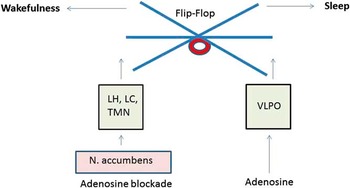
One reason why there has been an interest in adenosine is obviously that it is a metabolic endpoint and that conditions of relative energy deficiency are associated with increased adenosine levels, as noted above. Indeed, there is evidence that sleep deprivation does lead to increased levels of adenosine, and that sleep then reduces the adenosine content in brain.Reference Porkka-Heiskanen, Strecker, Thakkar, Bjorkum, Greene and McCarley13 This increase occurs in parts of the brain that are known to be of importance in the regulation of sleep-wakefulness. For example, the neurons that have their cell bodies in the bottom of the brain and send their processes up to the cortex to maintain alertness (using acetylcholine, noradrenaline and histamine as their transmitters) are blocked by adenosine. By this blockade the individual decreases wakefulness. Another way that adenosine can induce sleep is to impinge upon and activate a critically important centre in the lower part of the brain (called the ventrolateral preoptic area, which acts, among other things, to reduce the activity in the previously mentioned neurons that cause activation) and induce sleepReference Saper14 (Figure 2).
Scheme to illustrate the actions of adenosine on sleep and wakefulness. As discussed in detail elsewhere,Reference Saper14 sleep and wakefulness constitute a flip-flop mechanism that is controlled, on the one hand, by neurons in the ventrolateral preoptic area (VLPO) and, on the other, by numerous cell groups in lateral hypothalamus (LH), locus coeruleus (LC) and the tuberomamillary nucleus (TMN) as well as other sites. It is known that adenosine can stimulate VLPO via activation of A2A receptors. However, adenosine blockade by caffeine causes wakefulness not by blocking this mechanism but instead A2A receptors in nucleus accumbens. Thus, two opposing actions of a stimulator and an inhibitor of the same molecular entity can take place in different parts of the brain.

Caffeine Induces Wakefulness by Blocking Actions of Adenosine
It was expected that the alerting actions of caffeine are due to the ability of caffeine to block the actions of adenosine, since, as briefly mentioned above, this is the cause of many other actions of the stimulating alkaloid. To definitely prove this contention we generated mice that lack one or more of the adenosine receptors that are known targets for caffeine. We used the technique of homologous recombination in embryonic stem cells that was awarded a Nobel Prize in Physiology or Medicine in 2007 to achieve this. After careful breeding of the ‘knock-out mice’ we were able to do the test. We found that the alerting effect of caffeine in mice was completely eliminated in mice that did not have any adenosine A2A receptors.
On the other hand, and somewhat to our surprise, the mice that lacked one or more of the adenosine receptors had a completely normal sleep-wakefulness cycle. There are two ways to interpret this: (1) adenosine does not play any role at all in normal sleep and wakefulness, thereby negating all the work alluded to above; or (2) since sleep is such an important physiological process an animal that lacks one of the means to ensure correct sleep regulation has to develop alternative strategies to compensate for the loss. It is known from several other studies that such compensations can occur and are very important. Most physiologically important processes do exhibit a multitude of overlapping regulatory mechanisms so that when one fails we can still cope quite adequately. We believe sleep is one such process, and we tend to favour the explanation of compensation.
Whatever the final explanation may prove to be for the normal sleep in adenosine receptor knock-out mice, the fact remains that the alerting effect of caffeine was completely lost. It is important to note that other alerting stimuli and drugs were quite unaffected. Therefore, it was not a general defect but a very selective loss of the effect of caffeine.
The Stimulatory Effects of Caffeine are very Precisely Located
We may now ask where in the brain the effect of caffeine is exerted. The adenosine A2A receptors, on which it acts, are found throughout the brain. However, in most areas there are only very few receptors, and only in the so-called basal ganglia is the density of receptors high.Reference Fredholm, Bättig, Holmén, Nehlig and Zvartau3 Only where the number of receptors is high does basal adenosine have the chance to cause significant receptor activation. The ‘basal ganglia’ is the collective name for a number of connected structures in the frontal part of the brain and located below the cerebral cortex. It is a region that is very rich in the neurotransmitter dopamine, and has been shown to be important in the integration of sensory input and motor output. A failure of dopamine neurotransmission here leads to Parkinson's disease. This region is also very important in motivational behaviours. However, the basal ganglia are not commonly associated with regulation of sleep-wakefulness.
We decided to check if the adenosine receptors acted upon by caffeine were located in the basal ganglia or elsewhere, and also test which part of the basal ganglia was involved. To achieve this, several different techniques were used.Reference Lazarus, Shen, Cherasse, Qu, Huang, Bass, Semba, Fredholm, Boison, Hayaishi, Urade and Chen6 First, we used a variant of the knock-out technique. By homologous recombination, a part of the A2A receptor gene was flanked by sequences (LoxP) that are intact in the absence of the enzyme Cre that will induce the recombination (and therefore the knock-out). One could then mate the mice that had the genetic modification with other mice that express the Cre-enzyme only in some of the cells in the body. Specifically, we used a combination of mice that ensured that the offspring had the A2A receptors deleted only in the basal ganglia and nowhere else. When caffeine was given to such mice there was no increase in wakefulness – therefore locating the site of action to the basal ganglia.Reference Lazarus, Shen, Cherasse, Qu, Huang, Bass, Semba, Fredholm, Boison, Hayaishi, Urade and Chen6
In order to further pinpoint the site of action of caffeine we used a variant of the knock-out technique. In the genetically modified mice a virus that expressed the Cre-enzyme was injected in selected parts of the brain. This enabled even more selective knock-out, and with this technique we could narrow down the site of action to the nucleus accumbens. The other, larger, parts of the basal ganglia did not mediate the actions of caffeine on wakefulness.Reference Lazarus, Shen, Cherasse, Qu, Huang, Bass, Semba, Fredholm, Boison, Hayaishi, Urade and Chen6
The localization could be brought even further, but this required using a somewhat larger animal than the mouse, namely the rat. Since the knock-out technique is not readily available for the rat, another approach was used. In 2006, Andrew Fire and Craig Mello received the Nobel Prize in Physiology or Medicine for discovering that short stretches of ribonucleic acid (RNA) could, with remarkable selectivity, inactivate specific genes, by so called RNA interference. We injected a virus that expressed an RNA inactivating the A2A receptor in different parts of the rat brain and found that caffeine responses were lost when the virus had been injected in a part of the nucleus accumbens called the shell.Reference Lazarus, Shen, Cherasse, Qu, Huang, Bass, Semba, Fredholm, Boison, Hayaishi, Urade and Chen6
Concluding Remarks
With these sophisticated molecular techniques we have therefore been able to show that caffeine causes wakefulness by acting on a specific molecule on one type of cell in one very circumscribed part of the brain. By acting here, these few neurons increase their activity, and this is sufficient to cause a complete flipping over of the delicate balance between sleep and wakefulness (Figure 2). Intriguingly, the action of caffeine is to block actions of adenosine and adenosine can induce sleep. However, adenosine does not necessarily cause sleep by acting in the shell part of nucleus accumbens, but in other places. Thus, the place to trigger the switch from wakefulness to sleep is different from the place that triggers the reverse switch, even though the molecular machinery is the same (albeit operated in the opposite directions). Whenever we discover something about how the brain (and our mind/behaviour) works, the complexity and sophistication is amazing!
Acknowledgement
I want to thank my many collaborators, in particular Drs Michael Lazarus, Yoshihiro Urade and Osama Hayaishi from Osaka, Jiang-Fan Chen from Boston, Detlev Boison from Portland, Tarja Porkka-Stenberg from Helsinki and Per Svenningsson from Stockholm.
Bertil B. Fredholm was born in 1943, studied at Karolinska Institutet, and became professor of Pharmacology there in 1977. His scientific work has focused on adenosine receptors and the actions of caffeine. It has resulted in some 600 publications cited more than 27,000 times. He has been chairman of the Department and of the Nobel Committee for Physiology or Medicine, and has been active in many societies. He is now senior professor and maintains a small laboratory.