Introduction
The term “executive function” encompasses a variety of cognitive operations, including inhibition of automatic responses, fluency, abstraction, sequencing, planning, reasoning, strategy shifting, multi-tasking, selective attention, and resistance to interference (Chan, Shum, Toulopoulou, & Chen, Reference Chan, Shum, Toulopoulou and Chen2008). With so many available options, it is probably safe—although not necessarily enlightening—to assert that patients with multiple sclerosis (MS) have deficits in executive function (Brassington & Marsh, Reference Brassington and Marsh1998; Drew, Starkey, & Isler, Reference Drew, Starkey and Isler2009; Drew, Tippett, Starkey, & Isler, Reference Drew, Tippett, Starkey and Isler2008; Fischer et al., Reference Fischer, Foley, Aikens, Ericson, Rao and Shindell1994; Foong et al., Reference Foong, Rozewicz, Quaghebeur, Davie, Kartsounis, Thompson and Ron1997, Reference Foong, Rozewicz, Davie, Thompson, Miller and Ron1999; McIntosh-Michaelis et al., Reference McIntosh-Michaelis, Roberts, Wilkinson, Diamond, McLellan, Martin and Spackman1991; Rao, Reference Rao1996; Ryan, Clark, Klonoff, Li, & Paty, Reference Ryan, Clark, Klonoff, Li and Paty1996; Zakzanis, Reference Zakzanis2000).
One of the most frequently studied operations on which this assertion rests is planning, which is commonly evaluated with spatial assembly tasks such as the Tower of Hanoi and Tower of London (TOL). Studies using such tasks usually report two principal types of outcome measures: a point score reflecting the number of problems the participant solved (“planning performance”) and an average latency score based on the length of time the participant took to formulate a solution before actually launching the first move on each problem (“planning time”). Throughout the MS literature, there is good agreement with respect to planning time. All studies that have included this measure report slower planning times for MS patients than controls (Arnett et al., Reference Arnett, Rao, Grafman, Bernardin, Lucetta, Binder and Lobeck1997; Denney, Gallagher, & Lynch, Reference Denney, Gallagher and Lynch2011; Denney, Hughes, Owens, & Lynch, Reference Denney, Hughes, Owens and Lynch2012; Denney, Lynch, & Parmenter, Reference Denney, Lynch and Parmenter2008; Denney, Lynch, Parmenter, & Horne, Reference Denney, Lynch, Parmenter and Horne2004; Denney, Sworowki, & Lynch, Reference Denney, Sworowski and Lynch2005; Foong et al., Reference Foong, Rozewicz, Quaghebeur, Davie, Kartsounis, Thompson and Ron1997), and in some of these studies (Denney et al., 2004, Reference Denney, Gallagher and Lynch2011, 2012), the disparity in planning times for patients and controls tends to become greater as the problems increase in difficulty.
The inconsistencies in the literature involve planning performance. Lower point scores for MS patients have been reported by several investigators (Arnett et al., Reference Arnett, Rao, Grafman, Bernardin, Lucetta, Binder and Lobeck1997; Foong et al., Reference Foong, Rozewicz, Quaghebeur, Davie, Kartsounis, Thompson and Ron1997, Reference Foong, Rozewicz, Davie, Thompson, Miller and Ron1999; Lazeron, Rombouts, Scheltens, Polman, & Barkhof, Reference Lazeron, Rombouts, Scheltens, Polman and Barkhof2004), but all of our studies (Denney et al., 2004, 2005, Reference Denney, Lynch and Parmenter2008, 2011, 2012) have failed to show a difference in the point scores of MS patients and controls. Furthermore, Drew et al. (Reference Drew, Tippett, Starkey and Isler2008) found that the mean point score for a large sample of MS patients on the Tower Test of the Delis–Kaplan Executive Function System (Delis, Kaplan, & Kramer, Reference Delis, Kaplan and Kramer2001) was equal to that of the sample on which the test was normed.
Our most recent study (Denney et al., Reference Denney, Hughes, Owens and Lynch2012) examined whether past failures to find MS-related deficits in planning performance were due to ceiling effects stemming from tower tests that were too simple and patient samples that were too often composed of individuals with relapsing-remitting disease. Regarding the latter point, we noted a study by Arnett et al. (Reference Arnett, Rao, Grafman, Bernardin, Lucetta, Binder and Lobeck1997) that showed deficits in planning performance to be limited to patients with chronic progressive MS and also a meta-analysis of the literature by Zakzanis (Reference Zakzanis2000) that concluded frontal-executive deficits in general to be more characteristic of patients in this later stage of MS.
Despite using a version of the TOL with a larger number of more difficult problems, limiting scoring to success or failure on the first attempt on each problem rather than permitting “partial credit” for solutions after the first attempt, confining scoring to the ten most difficult problems, and comparing the scores for relapsing remitting (RRMS) and secondary progressive (SPMS) patients, we still could find no evidence of diminished planning performance for MS patients relative to that of healthy controls. As in previous studies, however, patients exhibited slower planning times than controls, with the disparity again increasing with problem difficulty (Denney et al., Reference Denney, Hughes, Owens and Lynch2012).
A careful examination of previous tower studies suggests that the two common outcome measures on this task may be linked; that is, the inconsistency of findings with respect to planning performance may be attributable to procedural differences impacting the time allowed for planning. Where explicit limits are imposed on the time available to solve each problem, patients tend to exhibit poorer performance than controls—owing to the slower pace they adopt when going about the task of planning. For example, Arnett et al. (Reference Arnett, Rao, Grafman, Bernardin, Lucetta, Binder and Lobeck1997) permitted participants only 2 min to complete each of the nine problems in their version of the Tower of Hanoi and found that the MS patients in their study solved fewer problems than controls. These investigators expressed concerns over the impact that the time limit may have had on participants’ performance, and in a subsequent study (Arnett, Higginson, & Randolph, Reference Arnett, Higginson and Randolph2001), they eliminated time limits on the problems composing their revised tower task.
The most stringent time limit was used in an fMRI-adapted version of the TOL (Lazeron et al., Reference Lazeron, Rombouts, Scheltens, Polman and Barkhof2004). This test consisted of 12 easy and 12 difficult problems. Participants were shown two arrangements of blocks (starting and goal display), but instead of making moves themselves, they chose one of two numbers designating the minimum number of moves necessary to transform the starting display into the goal display. Participants were allowed only 40 s to respond to each problem. Patients had lower scores than healthy controls on the easy problems; no difference was observed for the hard problems, due to floor effects. As a result of this time restriction, patients’ poorer performance might again derive from a deficit in processing speed, rather than one directly involving planning ability per se.
The present study was designed as an explicit test of this possibility by manipulating the time permitted for solving a set of tower problems and, therefore, the burden on participants’ speed of information processing. MS patients and healthy controls completed the TOL under either an untimed condition like that used in our previous studies or a timed condition in which stated limits were placed on the times allowed to solve each problem. We fully expected that the restriction on time would adversely affect the planning performance of both patients and controls, but more importantly, the impact on patients would be greater than on controls. Thus, the main hypothesis of the study centered on the interaction between group and condition—with no apparent difference in the planning performance of patients and controls in the untimed condition, but lower performance for patients than controls in the timed condition. A secondary issue involved whether the restricted time condition would adversely affect planning performance to a greater extent for SPMS patients than for RRMS patients. Although some (Arnett et al., Reference Arnett, Rao, Grafman, Bernardin, Lucetta, Binder and Lobeck1997; Zakzanis, Reference Zakzanis2000) have suggested that deficits in executive function are more evident in SPMS patients, we found no differences between the two subtypes on the more challenging version of the TOL used in our previous study (Denney et al., Reference Denney, Hughes, Owens and Lynch2012). Therefore, we did not hypothesize differences between RRMS and SPMS patients in either planning time or performance in the present study.
Methods
Participants
Thirty-nine patients with definite MS (Polman et al., Reference Polman, Reingold, Banwell, Clanet, Cohen, Filippi and Wolinsky2011) and 43 healthy controls were recruited for this study. All patients were diagnosed with relapsing-remitting (N = 24) or secondary-progressive (N = 15) MS of at least 1 year duration and were under the care of the same board-certified neurologist (SGL) at the University of Kansas Medical Center. Disability was rated by the neurologist using the Disease Steps scale (Hohol, Orav, & Weiner, Reference Hohol, Orav and Weiner1995). Patients were excluded if they had any of the following: relapse of MS symptoms within the past 30 days; neurological disorder other than MS; history of drug or alcohol abuse; history of traumatic head injury; premorbid psychological disorder; current use of narcotic or benzodiazepine drugs; visual acuity deficit greater than 20/50 (corrected); impaired color vision; or insufficient cognitive ability to provide informed consent or understand the study instructions—based on the clinical judgment of their attending neurologist. Healthy controls were recruited from the same metropolitan area as the patients and met the same exclusionary criteria. In addition, controls were required to be free of any serious and chronic medical conditions and to be following no ongoing medication regimens other than birth control, vitamin/mineral supplements, and low-dose aspirin.
Patients and controls were randomly assigned to one of two conditions, according to whether they were to complete that Tower of London with no restriction upon the time to solve each problem (Untimed Condition: 20 patients, 22 controls) or with time limits placed on each problem (Timed Condition: 19 patients, 21 controls). The two conditions are described more fully in the next section.
Measures
The Tower of London
The TOL was originated by Shallice (Reference Shallice1982) and developed further by Krikorian (Krikorian, Bartok, & Gay, Reference Krikorian, Bartok and Gay1994). The computerized version designed for this study used the upper portion of the screen to display a model consisting of three colored disks arranged on three pegs. The lower portion of the screen displayed the three colored disks in a different arrangement on the pegs. The task was to move the disks in the lower display so they matched the arrangement in the upper display and to do so using a specified number of moves. Participants dictated each move they wished to make, stating first the color of the disk and then the number of the peg to which it was to be moved; the experimenter used the computer mouse to execute each move according to the participant's direction. Three sample problems (two 1-move problems and one 2-move problem) were used to introduce the task and acclimate the participant to the verbal method of responding; each sample problem was repeated until solved successfully. Sixteen test problems were then presented, graduated in difficulty, with three 2-move (2M), three 3-move (3M), five 4-move (4M), and five 5-move (5M) problems. The number of moves allowed for each problem was announced before displaying the problem so that silence prevailed once the problem was presented. This was important because the computer covertly recorded the length of time between the display of the problem and the participant's announcement of the color of the first disk to be moved (“planning time”). Two display boxes were located in the upper right hand corner of the screen. One showed the number of moves allowed on the current problem. The other kept a running tally of the number of moves the participant had used.
The untimed condition conformed to the usual way in which the TOL has been administered in all of our prior studies (Denney et al., 2004, 2005, Reference Denney, Lynch and Parmenter2008, 2011, 2012). No restriction was placed on the amount of time the participant was allowed to solve each problem. Only the number of moves was limited as described above. If the participant exceeded the permitted number of moves, the computer terminated the problem and the experimenter proceeded to introduce the next problem.
The timed condition imposed a time limit on each problem, varying according to the number of moves required to solve the problem: 7 s for 2M problems, 12 s for 3M problems, 17 s for 4M problems, and 22 s for 5M problems. These limits were based on an analysis of the solution times from a previous study of MS patients involving the same “untimed,” 16-item version of the TOL (Denney et al., Reference Denney, Hughes, Owens and Lynch2012). At the beginning of the task, participants in the timed condition were told, “The time limits are based on an average solution time from a previous study; working within the time limit should be challenging, but not impossible. There should be sufficient time for planning and executing each of the problems.” Furthermore, in the timed condition, both the number of moves and the time limit were announced before the start of each problem. Finally, in addition to the two boxes showing the number of moves allowed and the number of moves used on the problem, two other boxes were also located in the upper right hand corner of the screen. One showed the time limit for the problem, and the other displayed a second-by-second countdown of the time remaining on the problem. If either the time limit or the permitted number of moves was exceeded, the computer terminated the problem and the experimenter proceeded to introduce the next problem.
For both conditions, the computer recorded the planning time and the total solution time for each problem and also whether the problem was solved correctly. The principal outcome measures were the mean planning time averaged across all 16 problems and the total number of problems solved correctly. The computer also recorded mean planning times separately for the 2M, 3M, 4M, and 5M problems comprising the test.
Other measures
Participants’ levels of fatigue and depression were assessed using the Fatigue Severity Scale (FSS; Krupp, LaRocca, Muir-Nash, & Steinberg, Reference Krupp, LaRocca, Muir-Nash and Steinberg1989) and the Center for Epidemiologic Studies—Depression Scale (CES-D; Radloff, Reference Radloff1977).
Procedure
This study was approved by the Human Subjects Committee at the University of Kansas Medical Center. Eligible MS patients were initially introduced to the study during the course of their regular appointments in the MS Clinic. Controls were recruited through various community contacts. Testing sessions lasted approximately 15–25 min. For half the participants, the FSS and CES-D were collected before the TOL; for the other half, these tests followed the TOL.
Results
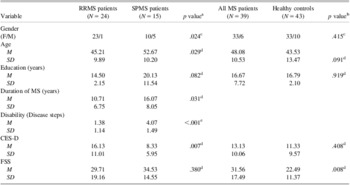
Table 1 shows the demographic information for all participants. Separate statistical tests were used to compare MS patients versus controls and to compare RRMS patients versus SPMS patients. Patients and controls did not differ significantly in gender, age, years of education, or depression; however, patients reported significantly greater fatigue than controls (t(80) = 2.76; p = .008). Also, as would be expected, patients with SPMS were older (t(37) = 2.27; p = .03), had longer disease duration (t(37) = 2.24; p = .03) and higher Disease Steps ratings (t(37) = 6.39; p < .001) than patients with RRMS. Despite these differences, RRMS and SPMS patients performed similarly on the TOL. There were no significant differences between the two subtypes in total point scores (RRMS: M = 10.4, SD = 2.5; SPMS: M = 10.6, SD = 2.5; t(37) = 0.22; p = .83) or in mean planning times (RRMS: M = 7.5; SD = 4.8; SPMS: M = 9.3; SD = 6.7; t(37) = 1.00; p = .32). Accordingly, the TOL data for the two groups of MS patients were combined in subsequent analyses comparing patients and controls.
Demographic and disease-related characteristics of patient and control groups

Notes. RRMS = relapsing-remitting multiple sclerosis; SPMS = secondary progressive multiple sclerosis.
CES-D = Center for Epidemiologic Studies – Depression scale; FSS = Fatigue Severity Scale.
aBased on independent comparison of RRMS versus SPMS samples.
bBased on independent comparison of MS patients versus healthy controls.
cFisher's exact test.
dIndependent sample t-test.
eMann-Whitney U-test.
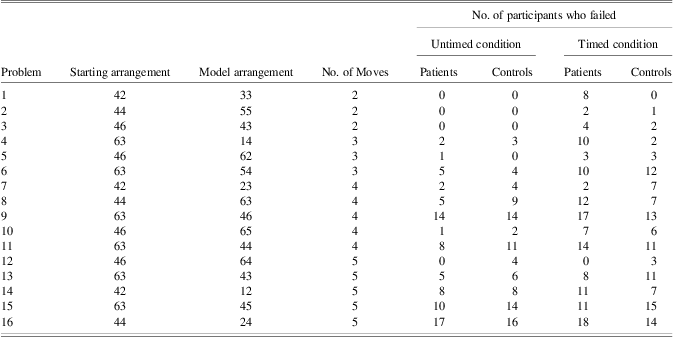
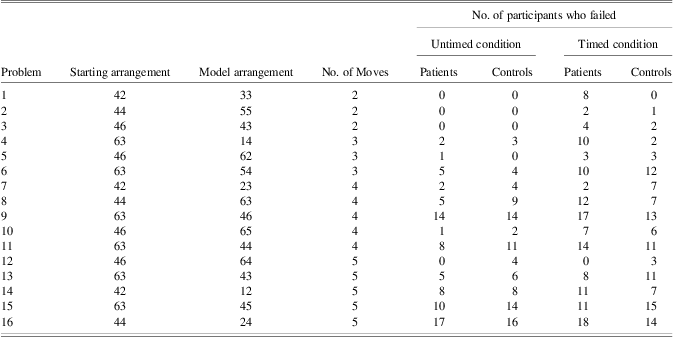
Berg and Byrd (Reference Berg and Byrd2002) pointed out that all 36 possible positions for the TOL could be represented by a hexagonal problem space, with each position designated by a 2-digit code designating the color permutation (10's position) and the spatial arrangement (1's position) of the disks on the pegs. The codes for starting position and solution position (i.e., model to be emulated) for each of the 16 problems used in the current version of the TOL are presented in Table 2, along with the minimum number of moves for each problem. The table also gives the number of patients and controls in each condition who failed to solve each of the 16 problems.
Performance on the 16 items of the Tower of London
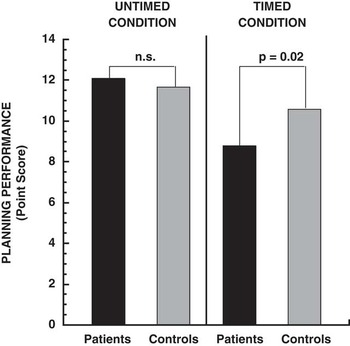
Total point scores were unrelated to fatigue scores (r = −.10; N = 82; p = .38), and, therefore, the difference between patients and controls in level of fatigue was not expected to confound the findings with respect to point scores. Nevertheless, these scores were initially examined using a 2 (Group) × 2 (Condition) analysis of covariance with fatigue serving as a covariate. As expected, fatigue was not found to be significant (p = .31) and did not affect the outcome with respect to the other factors, and, therefore, it was excluded. The final analysis of the point scores was conducted as a 2-way factorial analysis of variance (ANOVA). The main effect for Group was not significant (F(1,78) = 2.43; p = .12); although the main effect for Condition was significant (F(1,78) = 25.55; p < .001; ηp 2 = .25), with lower point scores occurring in the timed condition. More importantly, the Group × Condition interaction was also significant (F(1,78) = 6.33; p = .014; ηp 2 = .08). Paired comparisons applied to this interaction revealed that patients performed significantly worse than controls in the timed condition, but no difference occurred between these groups in the untimed condition. This interaction is illustrated in Figure 1.
Total point scores on the Tower of London across conditions.

Mean planning times on the 2M, 3M, 4M, and 5M problems were examined using a 2 (Group) × 2 (Condition) ×4 (Problem Difficulty) mixed factorial analysis. As in the case of the total point scores, this analysis was first performed with fatigue serving as a covariate. However, here again, fatigue was not significantly related to overall planning times across the 16 problems of the TOL (r = .20; N = 82; p = .08), nor was it a significant covariate (p = .26) when included in the analysis. As such, the final analysis was performed as an ANOVA without the covariate. Mauchly's test indicated that the assumption of sphericity had been violated (χ 2(5) = 120.3; p < .001), and, therefore, outcomes involving the within-subjects variable (Difficulty) were evaluated using corrected degrees of freedom based on the Greenhouse-Geisser estimate of sphericity (ε = .614). Significant main effects for all three factors and significant two-way interactions for Group × Condition and for Condition × Difficulty were all qualified by a significant three-way interaction (F(1.84, 143.75) = 3.50; p = .036; ηp 2 = .04).
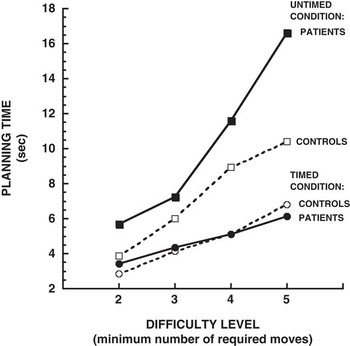
The interactions between groups and difficulty levels for the timed condition and for the untimed condition are illustrated in Figure 2. Inspection of these plots reveals that the timed condition attenuated planning times for all problems, thus indicating that 2 (Group) × 4 (Difficulty) ANOVAs should be performed separately for the participants in each condition. When this analysis was applied to the participants in the timed condition, the only significant finding was a main effect for Difficulty (F(1.92, 72.70) = 43.96; p < .001; ηp 2 = .54) due to longer planning times being used for more difficult problems. Neither the main effect for Group (p = .94) nor the Group × Difficulty interaction (p = .22) was significant. When the same analysis was performed on participants in the untimed condition, the results replicated those reported by Denney et al. (Reference Denney, Gallagher and Lynch2011). Here again, longer planning times occurred for more difficult problems (F(1.84, 73.44) = 32.73; p < .001; ηp 2 = .45). But also, patients exhibited significantly longer planning times than controls (F(1,40) = 5.39; p = .025; ηp 2 = .12), and this disparity between the two groups tended to increase as the problems became more difficult (F(1.84, 73.44) = 2.69; p = .08; ηp 2 = .06).
Mean planning times on the Tower of London by problem difficulty.

Discussion
By now, deficits in information processing speed are a widely acknowledged feature of MS (Bergendal, Fredrikson, & Almkvist, Reference Bergendal, Fredrikson and Almkvist2007; De Sonneville et al., Reference De Sonneville, Boringa, Reuling, Lazeron, Adèr and Polman2002; DeLuca, Chelune, Tulsky, Lengenfelder, & Chiaravalloti, Reference DeLuca, Chelune, Tulsky, Lengenfelder and Chiaravalloti2004; Denney & Lynch, Reference Denney and Lynch2009; Lengenfelder et al., Reference Lengenfelder, Bryant, Diamond, Kalmar, Moore and DeLuca2006; Macniven et al., Reference Macniven, Davis, Ho, Bradshaw, Szabadi and Constantinescu2008; Reicker, Tombaugh, Walker, & Freedman, Reference Reicker, Tombaugh, Walker and Freedman2007). These deficits have been demonstrated on a variety of explicitly timed tests, generally formatted as either reaction time measures or rapid serial processing measures (Hughes, Denney, & Lynch, Reference Hughes, Denney and Lynch2011). In addition, MS patients and healthy controls have been compared on covertly timed tests in which the cognitive operations demanded are more complex, the emphasis centers on accuracy of performance, and the timing of responses is not an obvious feature of the task. Computer-adaptations of tests usually afford opportunities to record various response times to the test items without the participant's awareness. MS patients have been shown to also perform more slowly on a variety of these covertly timed measures (Denney et al., Reference Denney, Gallagher and Lynch2011). The longer planning times consistently exhibited by MS patients on tower tests are one such example.
The results of the untimed condition in the present study replicated the findings of these previous tower studies. When allowed unrestricted time to work on each problem, patients apportioned a longer period of time to planning compared to the controls and the disparity between the two groups tended to increase with problem difficulty. Nevertheless, in this untimed condition, patients and controls solved the problems with equal accuracy. The novel finding of the present study occurred in conjunction with the timed condition. When time restrictions were imposed, patients’ performance was adversely affected and their planning scores were significantly lower than those of controls. It must be emphasized that the core result of this study centers on the significant Group by Condition interaction for planning scores. All participants performed less successfully when solution times were restricted. The important finding is that this condition adversely affected the planning performance of MS patients significantly more than the controls.
A series of studies by Deluca and his colleagues (Demaree, DeLuca, Gaudino, & Diamond, Reference Demaree, DeLuca, Gaudino and Diamond1999; Leavitt, Lengenfelder, Moore, Chiaravalloti, & DeLuca, Reference Leavitt, Lengenfelder, Moore, Chiaravalloti and DeLuca2011; Lengenfelder et al., Reference Lengenfelder, Bryant, Diamond, Kalmar, Moore and DeLuca2006) have sought to disentangle deficits in processing speed from those of working memory by manipulating the time allotted for performing on items of serial processing tasks similar to the Paced Auditory Serial Addition Test. When MS patients were allowed additional time on such items, the difference between their performance and that of controls was reduced (Leavitt et al., Reference Leavitt, Lengenfelder, Moore, Chiaravalloti and DeLuca2011; Lengenfelder et al., Reference Lengenfelder, Bryant, Diamond, Kalmar, Moore and DeLuca2006) or eliminated entirely (Demaree et al., Reference Demaree, DeLuca, Gaudino and Diamond1999). These studies led DeLuca et al (Reference DeLuca, Chelune, Tulsky, Lengenfelder and Chiaravalloti2004) to propose the Relative Consequence Model, suggesting that at least some of the deficits exhibited by MS patients in various cognitive domains stem from a more fundamental problem with information processing speed. The Group by Condition design of the present study, with the condition factor incorporating some manipulation of the time allowed for working on the cognitive task in question, is an especially appropriate design for investigating the Relative Consequence Model. As in the present study, the test of the model lies with the interaction. Similar designs have been used extensively in the cognitive aging literature, again for the purpose of demonstrating the impact of processing speed on elderly individuals’ higher-level cognitive operations (e.g., Salthouse, Reference Salthouse1996).
The time manipulation used in the series of working memory studies was opposite to that of the present study where time restrictions were imposed rather than relaxed. Regardless of direction, however, time manipulations serve to augment our understanding of the contribution of diminished processing speed in the cognitive problems exhibited by MS patients. Other investigators have suggested that deficits in information processing speed may be implicated in MS patients’ impaired performance in sentence comprehension (Grossman et al., Reference Grossman, Robinson, Onishi, Thompson, Cohen and D'Esposito1995), verbal memory (Litvan, Grafman, Vendrell, & Martinez, Reference Litvan, Grafman, Vendrell and Martinez1988) and story recall (Arnett, Reference Arnett2004). These suggestions are worthy of additional examination using studies that incorporate time manipulations in their design.
Another issue that warrants study concerns the impact that results from merely heightening the salience of time as a relevant feature of the task on which patients are performing. Probably the most important shortcoming of the present study is that the untimed and timed conditions differ in time salience as well as in actual time allotted. Planning time was recorded in a completely unobtrusive way on the computerized version of the TOL, and nothing in the untimed condition suggested that time was a relevant feature of participants’ performance on the task. The timed condition, however, contained numerous indications of its relevance by announcing the allotted time interval at the start of each problem and showing the interval decrease over the course of the problem. It will be important to determine the extent to which differences in time salience and perhaps the emotional changes they engender are responsible for MS patients’ diminished performance, even absent of actual time restrictions. Two previous tower studies (Foong et al., Reference Foong, Rozewicz, Quaghebeur, Davie, Kartsounis, Thompson and Ron1997, Reference Foong, Rozewicz, Davie, Thompson, Miller and Ron1999) may be relevant here. Although neither study imposed time restrictions, the investigator used a stop watch to time various components of the participant's response, rather than unobtrusively recording these intervals with the assistance of a computerized program. In both of these studies, MS patients achieved lower planning scores than controls. The importance of time suggested by the use of the stop watch may have been sufficient to bring about this difference.
Critical thinking is crucial when considering which aspects of performance on a cognitive task are best aligned with the construct being examined. Of the two types of measures typically derived from tower tests, point scores would seem to be the better choice as an index of participants’ basic competence at mentally evolving an effective sequence of steps to solve a problem. However, the results of the present study show that this performance measure is affected by the time made available for planning and possibly even by the salience of time as a relevant feature of the task at hand. As in all cases in neuropsychological testing, assessment of the construct is dependent on how the task is operationalized. MS patients have consistently been shown to have notable deficits in information processing speed, and in light of this established finding, neuropsychological tests that impose time restrictions or depend upon response time measures to assess the construct for which they were designed are particularly vulnerable to misinterpretation when applied to these patients. The present results also suggest that more successful outcomes may accrue to MS patients when they are permitted (or allow themselves) additional time to evolve solutions on tasks requiring the mobilization of executive functions. Similarly, caregivers should be aware that deficits in processing speed are an inherent feature of MS and should adjust the pace of their care accordingly, with the understanding that patients are often cognitively capable of handling a variety of tasks when afforded the simple assistance of sufficient time.
Acknowledgments
This research was unfunded and the authors have no financial or other conflicts of interests to report. A paper based on this research was presented at the 28th Annual Congress of the European Committee for Treatment and Research in Multiple Sclerosis (ECTRIMS), Lyon, France, October 12, 2012.