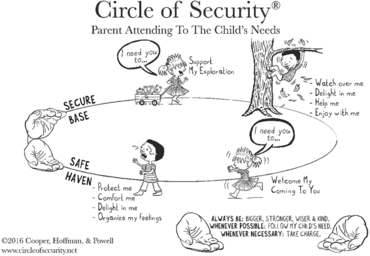


The Circle of Security (COS) model was developed by clinicians to help caregivers become more attuned and responsive to their children’s attachment needs. The model uses a visual map of children’s attachment and exploration to support parents in identifying the relational needs of their children (see Figure 1). The model was first formally used in a 20-week intensive group intervention, and research shows that it fosters attachment security in parent-child dyads (Hoffman, Marvin, Cooper, & Powell, Reference Hoffman, Marvin, Cooper and Powell2006; Powell, Cooper, Hoffman, & Marvin, Reference Powell, Cooper, Hoffman and Marvin2014). There have been a number of other iterations of the program, including the more broadly distributed COS-Parenting (COS-P), a DVD-based program (Cooper, Hoffman, & Powell, Reference Cooper, Hoffman and Powell2009; Coyne, Reference Coyne2013). However, unlike the 20-week program, COS-P does not allow for individualised assessment and intervention. Powell and colleagues (Reference Powell, Cooper, Hoffman and Marvin2014) discussed the potential for the 20-week model to be used with individual dyads, and recently, a protocol has been developed (Andrews & Coyne, Reference Andrews and Coyne2018). This protocol retains the individualised assessment and treatment from the original intensive group intervention and integrates psychoeducation from the COS-P program.
The Circle of Security: Parent attending to the child’s needs. Note: Reproduced with permission of Cooper, Hoffman, Powell LLC.

To date, the COS model has primarily been used with parents of children up to 4 or 5 years old. A meta-analysis of the various COS interventions included parents of children up to 6 years old (Yaholkoski, Hurl, & Theule, Reference Yaholkoski, Hurl and Theule2016). The results showed a medium effect size for the efficacy of the intervention for child attachment security, quality of caregiving and reduction of caregiver depression, in addition to a in addition to a significant, large effect for improved caregiver self-efficacy. However, it is acknowledged that this meta-analysis had significant limitations (including small sample sizes, lack of follow-up data, and not differentiating between the various iterations of COS).
While attachment relationships are developed in infancy, children continue to have attachment needs in middle childhood and beyond (Kerns & Brumariu, Reference Kerns, Brumariu, Cassidy and Shaver2016). This article details the use of the COS individual intensive intervention with a mother of an 8-year-old child who presented with behaviours atypical of her chronological age and potentially consistent with a range of developmental disabilities.
Method
Client Description
Deborah Davies (a pseudonym, with other identifying details of this case altered) is a woman in her late 40 s and mother of 8-year-old Jessica. She also has a 10-year-old son, Thomas. Deborah separated from the children’s father when Jessica was a toddler.
Referral Question
Deborah originally sought therapy for Jessica due to difficulties managing her ‘raging meltdowns’ and defiance at home. She described that Jessica ‘never does anything she doesn’t want to do’ — for example, she ‘kicks and screams and refuses to get out of bed when it comes time for school’. Deborah said that she found Jessica’s lack of respect for authority (particularly in terms of having a ‘smart mouth’ and ‘back-chatting’) very distressing. Deborah also expressed concern about Jessica’s ability to maintain attention and concentrate at school. Deborah had engaged with a number of health professionals throughout Jessica’s life, who had variously discussed that Jessica had symptoms of autism spectrum disorder, oppositional defiant disorder and attention deficit disorder, though she had not been formally diagnosed with any particular disability or mental health condition. Deborah felt she had had limited ‘success’ with these health professionals. Jessica’s therapist reported that Jessica did not engage well in therapy, often refusing to participate or even enter the building. Jessica’s therapist observed that quality time with her mother was a key motivator for Jessica, but reported that this was difficult for Jessica and Deborah to negotiate. Jessica’s therapist therefore recommended that Deborah be referred to the COS intervention. The process of the intervention was explained to Deborah, who gave her informed consent for assessment and treatment.
Assessment
Deborah and Jessica were assessed using a modified version of Ainsworth’s Strange Situation Procedure (SSP), as per the Circle of Security Individual protocol described by Andrews and Coyne (Reference Andrews and Coyne2018). Given Jessica’s age, the timing of each episode was increased — the two separations were extended to 12 minutes and 15 minutes respectively and free play/reunion episodes were extended to 5 minutes each. This assessment allows the primary relational struggle (‘linchpin struggle’) to be identified and targeted in treatment. The linchpin struggle may exist on either the top of the Circle (encouraging exploration), bottom of the Circle (supporting connection), or with the hands on the Circle (being an available caregiver who is in charge of the relationship; see Figure 1).
Throughout the SSP, Deborah and Jessica were observed to have difficulty negotiating both exploration and reconnection. Jessica was observed to avoid directly showing her needs for enjoyment with, or comfort from, Deborah, and at times to take charge of the relationship. Deborah was seen at times to abdicate from her role as parent, becoming ‘weak’. For example, Deborah encouraged, almost pleadingly, for Jessica to ‘be little’ with her and play tea-sets. There were also moments when Jessica engaged in some role-reversed/controlling behaviours, calling commandingly after Deborah as she left the room ‘Come back here Davies’. Therefore, for this dyad, the linchpin struggle was identified to be the hands on the circle.
Deborah also completed the Circle of Security Interview (COSI), a semi-structured interview developed by the COS originators, which is designed to elicit information about the caregiver’s state of mind, including the caregiver’s ‘Core Sensitivity’ (Powell et al., Reference Powell, Cooper, Hoffman and Marvin2014). There are three Core Sensitivities — Esteem Sensitive (primarily concerned with intimacy and vulnerability), Safety Sensitive (primarily concerned with intrusion), and Separation Sensitive (primarily concerned with abandonment). For more detail on the Core Sensitivities, please see the work of Poulsen and Coyne (Reference Poulsen and Coyne2017).
Based on her responses to the COSI, Deborah was hypothesised to be Esteem Sensitive. She described that she often felt criticised and rejected by Jessica and humiliated by her behaviour. She also explained her fears of upsetting Jessica in terms of an imagined audience (e.g., ‘I worry what the neighbours/other parents/teachers think if Jessica is misbehaving or disrespectful’). Deborah described how she experienced her parents as very critical and ‘authoritarian’, and that although she was aspiring to be ‘authoritative’ in her relationship with Jessica, she often found herself operating as her parents did.
As per the COS Intensive Treatment Protocol, five learning goals were developed based on the linchpin struggle and Deborah’s hypothesised Esteem Sensitivity. The goals (as written from Deborah’s perspective) were:
1. Jessica needs me to be bigger, stronger, wiser and kind. She needs me to take charge when necessary in a bigger, stronger, wiser and kind way and to be responsive to her bids for closeness.
2. When Jessica is unsure of my bigger, stronger, wiser and kind presence, she miscues me by acting as though she is in charge, or as though she does not need our relationship.
3. When Jessica needs me to be bigger, stronger, wiser and kind, I misdirect her by becoming weak and passive, or by becoming mean. (While Deborah was not observed to be ‘mean’ in the SSP, during the COSI she described times where she was frightening to Jessica by using, or threatening, physical punishment.)
4. I become weak or mean as a way of managing my fear that if I become bigger and stronger (and wise and kind) Jessica will react in a way that I cannot manage.
5. When I am able to take charge in a way that is bigger, stronger, wiser and kind, and be available to Jessica when she needs closeness, Jessica will seek relationship with me, all around the circle.
Intervention
The intervention followed the protocol outlined by Andrews and Coyne (Reference Andrews and Coyne2018) with a few minor modifications as detailed below. The individual protocol follows the basic rhythm of the original group intervention — sessions of psychoeducation are followed by sessions of tape review (where the parent watches selections from the SSP), repeated in three phases over 12 weeks. The first two sessions of psychoeducation introduce the key elements of the Circle graphic (see Figure 1) and communicate the importance of secure attachment. From the second session, each session begins with a story from the parent of a time when they have observed ‘the circle’ in their interactions with their child (a ‘Circle Story’). Before the first tape review, parents are also taught that children can ‘cue’ (show their attachment needs directly) or ‘miscue’ (hide their true need by indirectly signalling or behaving in a way that indicates they are having a different need). Following the first tape review, sessions 5 and 6 introduce the concept of procedural memory (known as ‘Shark Music’) and the ways this impacts on caregiving. Also introduced is the idea that when Shark Music causes struggle in the relationship (rupture), this can be repaired through relational connection (repair).
Each phase of tape review consists of four or five clips selected from the SSP. The way the therapist presents each clip is informed by both the treatment goals and the caregiver’s Core Sensitivity. The clips show the dyad negotiating the linchpin struggle, both successfully and unsuccessfully. Clips are presented so as to allow the therapist to create a holding environment for the caregiver to view the clips in a state of vulnerability, rather than defence.
Phase One
The first tape review was designed to help Deborah observe Jessica’s attachment needs (‘Circle Needs’) and how she was communicating these (cueing and miscuing), with particular focus on needs around the linchpin (‘Hands’). Throughout the COS protocol, tape reviews begin with a ‘softening’ clip, designed to elicit the caregiving instincts of the parent. In this case, a section of the second separation was selected. It showed Jessica ‘playing’ with Deborah’s phone (though it cannot hold her attention) and watching (with disappointment) as the stranger returns. On first watching this clip, Deborah commented that it was very unusual to see Jessica distracted from the phone (rather than by the phone). When watching Jessica’s disappointed reaction when the stranger (and not Deborah) returns to the room, Deborah was able to identify that Jessica’s distraction was likely because she was on the ‘lookout’ for Deborah. Deborah expressed that it was meaningful to see how much her daughter tracked, and was impacted by, her comings and goings. She reflected that she generally felt her presence had a negative impact as Jessica often commented that she is a ‘mean’ and ‘bad’ parent.
The ‘softening’ clip was followed by an ‘underutilised linchpin capacity’ clip, that is, a moment showing the parent successfully meeting a need on the Circle that they generally struggle to observe and meet. For Deborah, this clip was taken from the book-reading segment of the SSP, where Jessica threw one of the toys and Deborah took charge, calmly asking her to respect the property. With support from the therapist, she was able to see that this was a positive example of her taking charge in a way that was ‘Bigger, Stronger, Wiser and Kind’ and that by doing so, she was demonstrating to Jessica that she is big and strong enough to provide protection and safety.
The third clip is referred to as ‘Shark Music Minor’ because it shows the dyad’s linchpin struggle at a manageable intensity. It tends to be the most emotionally provocative clip in the first review. This clip was selected from the first reunion when Jessica miscues that she has not been longing for Deborah but instead suggests that she has been happy exploring the phone. During the review, Deborah was able to observe Jessica’s reaction to her absence and her need for comfort, which allowed her to clearly see the miscue as she re-entered the room and her own response to the miscue (asking about the phone). After watching the clip Deborah saw Jessica’s need for comfort, saying ‘It would have been nice to give her a hug’.
The fourth clip is designed to be a celebration of success in the relationship. In this case, the clip was selected from the second reunion when Jessica and Deborah discussed Jessica’s difficulties at school. On viewing this clip, Deborah said that she felt that because Jessica articulated her feelings clearly, she was able to see her need and help organise them. When viewing it for the second time, Deborah recognised that this is her ‘go-to’ way of comforting Jessica — organising her feelings by talking through the problems. She recognised that she has difficulty sitting with emotions and often too quickly moves to the practicalities of the problem, leaving Jessica without comfort or containment. This in turn can cause Jessica to ‘act out’ and reject Deborah’s help, which activates Deborah’s ‘Shark Music’, leading to rupture in the relationship.
Phase Two
The focus of the second tape review was for Deborah to recognise this pattern of acting out as a response to needs for containment and soothing. The ‘softening’ clip was taken from the first separation when Jessica lost interest in play and eventually left the room looking for Deborah. Watching this clip, Deborah immediately saw Jessica’s need for her, recognising that she looked ‘lost and confused’ and needed help to organise these feelings.
The second clip was an ‘under-utilised capacity with success’ clip, which shows the parent meeting the linchpin need. This clip showed Deborah scaffolding the separation by touching Jessica and offering some explanation for her exit. When watching this clip, Deborah recalled feeling uncomfortable about leaving as she was concerned Jessica would ‘have a tantrum’. With support, she was able to see the role of her touch and verbal reassurance in organising Jessica’s feelings. Upon second viewing, Deborah reflected that she had felt concerned leaving Jessica feeling unsettled as she senses that Jessica often blames Deborah for her distress. With support from the therapist, Deborah was able to identify that when Jessica needs her feelings organised, her miscue is to take charge of Deborah by acting aggressively, demeaning her, or refusing to comply with her instructions (i.e., the presenting concern).
The third and fourth clips were viewed only in the second session of the review as the therapist chose to spend additional time processing Deborah’s circle story in the first session. The third clip, ‘Shark Music Major’, shows a more intense and direct example of the linchpin struggle. For Deborah, the clip selected came from the second separation when Deborah told Jessica that she was leaving and Jessica tried to take charge, saying in a commanding tone ‘Come back here Davies’. Deborah then became concerned about how Jessica may escalate and so chose to exit the room quickly. After watching this clip Deborah accurately observed that she and Jessica had been having a nice moment of closeness and that when it came time to separate Jessica tried to take control. The therapist supported Deborah to recognise Jessica’s need in this moment (for organising of feelings), and the broader need of taking charge. It was helpful for Deborah to see how Jessica’s controlling behaviour misrepresents her true need for comfort and help regulating her feelings.
The fourth clip aims to show ‘Struggle with Success’, representing the strongest example of the parent’s capacity to meet the linchpin need. In this case, this was the second reunion when Deborah returned to the room and went to Jessica who leans in for a cuddle. When reviewing the clip, Deborah recognised that Jessica then miscues by moving out of the cuddle and talking about the phone to avoid speaking about uncomfortable feelings. Deborah reported that she herself often deflects or changes the topic when uncomfortable. This was a significant shift in Deborah’s representation of Jessica — as she had typically seen this behaviour as Jessica rejecting her care.
The final celebration clip showed Deborah and Jessica enjoying one another’s company, giggling and engaging in lots of positive physical contact. It also showed Jessica hitting Deborah on the head with a book, and Deborah managing this by calmly asking her to stop and moving the book away while continuing to read the book and engage with Jessica. Deborah reflected that they were both feeling happy and connected in this moment, even when she ‘took charge’.
Phase Three
The clips for the third tape review were selected from a modified SSP (with only one separation and no stranger) recorded after the second tape review. There is flexibility in the number of times this third review is shown, depending on client need. In this case it was presented over two sessions. Deborah showed progress in taking charge and being bigger, stronger, wiser and kind in this second filming. The softening clip showed moments of mutual delight as Deborah and Jessica shared a bubble-blowing activity together. After both viewings, Deborah expressed that it was a nice moment of being ‘in sync’ with one another.
The second clip is selected to show the vulnerability in the dyad that continues to promote insecurity. In this case, the clip was taken from the pack-up section of the taping. Deborah struggled to take charge for some time but eventually went to Jessica and directed her to a specific task, and followed Jessica’s interest in separating the ‘big kids’ toys from the ‘little kids’ toys. When viewing this clip, Deborah immediately commented that Jessica’s resistance to direction was very familiar. She recognised that her Shark Music was playing, as it often does when Jessica is defiant (and even more so in the presence of onlookers).
This was a particularly long clip, so to ‘aid digestion’, it was cut into three sections for the second viewing. The ability to modify clips based on the parent’s engagement with them is a key strength of this individual protocol. The first section showed Deborah struggling to get Jessica to stop blowing bubbles and start packing up. After watching the clip Deborah said that she had been caught off guard by Jessica’s desire to stay and play. She also reflected that she had felt some frustration at the time because when she was a child she would never have dared to say ‘no’ to an authority figure. She went on to describe that ‘[I] always have that tug of war inside of me, trying to balance that sense of setting rules without going into that old authoritarian stuff…. It’s really fragile stuff for me.’ The therapist supported Deborah to see this as a part of the struggle of balancing ‘Bigger and Stronger’ and ‘Kind’. Deborah went on to explore Jessica’s ‘no’ as a miscue, which hid her true need for organising her feelings of disappointment.
The second section of the clip showed Jessica drawing faces with her breath in the mirror while Deborah packed up the toys. Deborah threatened to take the phone away unless Jessica helped, to which Jessica responded, ‘Look at this’ (the picture she had drawn). Deborah then said, ‘Don’t do that please. Come and help, I’ve asked you to do something please.’ Jessica then made a comment about having a sore chin, to which Deborah replied, ‘Oh, we’ll have a good look at it in a minute. First, help me pack this up.’ After watching the clip, Deborah said that she could see herself struggling to read Jessica’s miscues as she was so focused on the pack-up (and Jessica’s resistance). Deborah reflected that on watching it back, she could see now that Jessica’s ‘look at this’ comment was a pull for connection and said she saw Jessica as saying, ‘I don’t want to finish playing with my mum, we were playing with bubbles and having a good time.’ Similarly, she said that in the moment she saw Jessica’s ‘Look at my sore chin’ comment as an avoidance tactic, but now sees that it may have been a pull for comfort, and a need for connection. She said she could see herself meeting this need ‘briskly’ before directing Jessica to the task of packing up. These comments demonstrate the shift Deborah had made in her attitude towards and understanding of Jessica’s ‘misbehaviour’. She was now able to see this ‘misbehaviour’ as a miscue for Jessica’s true need, her need for Deborah as a ‘bigger, stronger, wiser and kind’ presence.
The third section of this clip showed Jessica and Deborah discussing the sorting of the ‘big kids’ and ‘little kids’ toys and negotiating how they are to be put away. As they are doing this, Jessica put her hand on Deborah’s back. After watching the clip Deborah said that she came up with the idea of being a ‘toy tester’ when Jessica did not want to come into the clinic. She said she recognised that Jessica enjoys being given a task or responsibility. She also said that she was touched by the way Jessica seeks out physical connection with her. These reflections demonstrate that Deborah was able to see that when she is able to take charge in a bigger, stronger, wiser and kind way, Jessica seeks relationship with her in a positive way.
The third clip was held over to the second viewing as the therapist chose to spend additional time processing Deborah’s circle story and the first two clips. The clip was selected from the separation episode and showed Deborah’s newfound competence. It showed Deborah carefully explaining to Jessica that she was leaving, and touching Jessica on the shoulder to ensure she had her attention. She responded calmly when Jessica says ‘I can’t do this [sorting the toys] without you’ by saying ‘I’ll be back to help you’. When Deborah left the room, Jessica called out for her several times before occupying herself with the toys. After viewing the clip, Deborah immediately recognised that she had cued into Jessica and responded to her bottom of the circle needs. She saw that Jessica’s cue for help was actually a miscue and that her true need was for comfort.
The final clip in the phase 3 tape review is termed a ‘celebration of competency’ clip. In this case, the clip was taken from the reunion. The clip begins by showing Jessica engaged with the puzzle. When Deborah returned she went straight to sit by Jessica, rubbed her back and said, ‘Wow, did that feel like a long time.’ Jessica continued with the puzzle but engaged with Deborah verbally, saying that it felt like a ‘million years’ had passed. After both viewings, Deborah said that she felt proud watching the clip. She said that she was more mindful of checking in with Jessica’s emotions and that although she miscued by continuing with the puzzle, she remembers seeing something in her face that caused her to cue in and give her the back rub. She went on to say, ‘That’s a nice little clip … I just need to do a whole lot more of it, without being too tough on myself.’
Discussion
This case study shows the successful use of this COS Individual protocol. The modified SSP indicated that Deborah and Jessica were developing a more organised relationship and moving towards security. Furthermore, Deborah reported feeling more confident in her parenting, and in particular her responses to Jessica’s externalising behaviours. As is highlighted above, Deborah’s understanding of Jessica’s attachment needs, her confidence in meeting these needs, and her representations of Jessica grew through the treatment process.
These outcomes extend the existing literature by demonstrating the application of the protocol described by Andrews and Coyne (Reference Andrews and Coyne2018) to a parent of a child in middle childhood with a complex case presentation. It is acknowledged that the generalisability of these results are unknown. The results are further limited by the lack of quantitative outcome measures and the absence of a post-intervention SSP and the lack of formal coding of the initial SSP. A number of strengths should also be noted — this case study provides an in-depth portrayal of the clinician’s actions and rich insight into using the COS model to work with a specific case issue, and highlights the key skills used in treatment. Further research is required to investigate the broader application of this COS Individual protocol.
Summary and Implications
This case study demonstrates that this COS Individual protocol can be successfully used with parents of children in middle childhood. It also provides an example of the model being used in a complex case presentation with a child who may have met criteria for a range of developmental difficulties.
Author ORCIDs
Ellen Andrews 0000-0001-5527-3135
Acknowledgments
I would like to acknowledge Joe Coyne and Brooke Poulsen for their support in the development of this paper.
Financial Support
This research received no specific grant from any funding agency, commercial, or not-for-profit sectors.
Conflicts of Interest
None.