In 1859, after the death of his mistress, a slave named Mat Fine was taken to the Jefferson, Kentucky, County Court House “in the inventory of Lucy Fine's estate as her property.” There, he was inventoried along with her other possessions. Only a few years later, just after the Civil War, Fine returned to the local court house as a defendant in a civil case over the money his former mistress had left him in her will. There he stood before the civil court, as a person, rather than a piece of property, boldly laid out the terms of the will, and claimed his portion. Both the local court and state supreme court ruled in his favor.Footnote 1
In the years following the Civil War, thousands of former slaves like Mat Fine litigated civil cases in state courts throughout the South. Other African Americans, who had been free before the Civil War, also participated in civil suits in Southern courts. At times, the cases of such black litigants reached state supreme courts on appeal. Black litigants participated in over 600 civil cases in eight Southern appellate courts between 1865 and 1920.Footnote 2 Approximately one third of these civil cases took place between black litigants; the other two thirds took place between white and black litigants.Footnote 3 A systematic examination of the civil cases between white and black litigants reveals that black Southerners continued to assert the legal rights they gained during Reconstruction long after Reconstruction had ended. African Americans not only litigated civil cases against whites in the highest level of Southern courts; they often won these cases. Between 1865 and 1920, appellate judges decided in favor of black litigants in the majority of cases between whites and blacks.Footnote 4 Even after African Americans had lost many of their other rights, the courts remained a possible avenue for justice for some black Southerners.
These findings challenge historians' understanding of the experiences of African Americans in the post-Reconstruction South and their conceptions of the role of the judiciary during this time. Historians have asserted that between the close of Reconstruction in 1877 and the start of the twentieth century, black Southerners largely lost the ability to exercise their formal political and legal rights.Footnote 5 The courts, in particular, are seen as playing a key role in this loss of rights, as they decided landmark decisions upholding disfranchisement and segregation at the turn of the century. Historians have generally based their conclusions about the loss of legal rights on a limited sample of cases, celebrated cases, anecdotal evidence, and the records of criminal cases.Footnote 6 In particular, historians have focused on cases dealing specifically with issues of race, including suits over segregation, racial classification, and black–white liaisons. They have largely ignored or merely skimmed the surface of the many other civil cases involving black Southerners that continued in a steady stream from the end of the Civil War through the Jim Crow years.Footnote 7
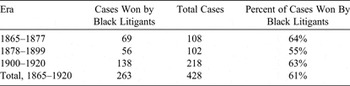
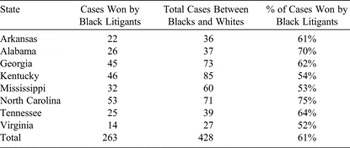
Appellate Civil Cases Between Whites and Blacks Won By Black Litigants.

My comprehensive study of appellate civil cases suggests that the loss of legal rights was not as complete as scholars have believed. Even as federal and state courts made important rulings upholding discrimination at the end of the nineteenth and beginning of the twentieth centuries, state courts continued to allow black Southerners to litigate—and win—certain kinds of civil cases. Black people found success litigating civil cases that appealed to basic underlying legal principles, such as property and tort law, rather than cases dealing directly with race. Throughout the South, African Americans litigated—and won—cases against whites over contracts, wills, transactions, and personal injuries.
This article investigates how black people succeeded in litigating civil cases against whites in state courts in the Reconstruction and post-Reconstruction South. In the pages that follow, I demonstrate that the structure of the legal system played a central role in allowing African Americans to litigate and win certain kinds of cases in the post-Reconstruction era. In particular, the reliance of judges on precedent facilitated many of African Americans' civil suits. However, the system of precedent also favored certain types of cases over others and failed to prevent the increasing discrimination and segregation occurring throughout the South. I argue, too, that African Americans played key roles in their own and other black people's suits. By hiring attorneys, testifying before the court, and at times winning their cases, black Southerners asserted their rights as citizens. White lawyers, judges, jury members, and witnesses also played an important part in black people's legal access and successes in the courts, while also shaping and limiting the kinds of cases black Southerners litigated.
My conclusions are drawn from an analysis of state supreme court cases in eight Southern states between 1865 and 1920. The states chosen for the study—Alabama, Arkansas, Georgia, Kentucky, Mississippi, North Carolina, Tennessee, and Virginia—represent the upper and lower South as well as border states. I conducted a thorough search of state supreme court cases involving black litigants on the electronic database, Lexis-Nexis. After eliminating criminal cases, I sorted the remaining 618 civil cases by state and topic and noted if the cases involved a white litigant. Next, I visited archives in the eight states, where I examined the surviving case files in their original manuscript form. Whereas the surviving records of cases that were heard only by lower courts are generally brief and often do not include testimony, the records of appellate cases frequently include full transcripts of the lower court proceedings, petitions, and testimony, as well as appeals to appellate courts and the courts' decisions. My examination of appellate case files, therefore, allowed me to analyze the proceedings of both the lower and higher courts.
The patterns evident in appellate cases have great significance, even if such suits are not representative of trials that only reached local courts, or of the many disputes never heard by the courts at all. Certain types of cases—including suits involving the largest amounts of money and cases involving white lawyers and white witnesses—were more likely to be appealed. Cases involving African Americans that reached appellate courts after the Civil War also received greater consideration than cases that remained in lower courts, and judges undoubtedly gave heightened attention to factors such as precedent, as the decision in the case could set a precedent of its own. Nevertheless, only if local courts heard these kinds of cases could such suits have reached appellate courts. Furthermore, by hearing these cases at the appellate level, Southern courts demonstrated that African Americans could exercise their legal rights by appealing to longstanding legal principles and by gaining the support of white jurists, witnesses, and jury members.
The Decision to Litigate a Case
The black litigants who turned to the courts in the weeks, months, and years after the Civil War often had little formal preparation for such an endeavor. Even the African Americans who would be most successful in their legal journeys, eventually gaining a hearing of their case before a state's highest court, usually had very little formal education; most signed their names on court documents with a solitary “x.” Many had lived part of their lives as slaves or were the children of former slaves. At a time when white men dominated the legal arena, almost half of these black litigants were women.Footnote 8 If these black litigants appeared exceptional in any way, it was in their ability to draw on long-term ties with local whites to gain the support of white lawyers and witnesses. But even the whites most sympathetic to a black litigant's cause generally did not consider them equals; other whites wished that they had never been freed, and sought to recreate the conditions of slavery in the postwar South. Despite the obvious disadvantages they faced in the courtroom, black Southerners seized their new legal rights. More often than not, black Southerners were the parties bringing such cases to court. They appear as plaintiffs in the majority of Southern appellate civil cases against white litigants throughout the period from 1865 to 1920. As black Southerners' other rights eroded, the percentage of these cases instigated by them increased.Footnote 9
Black Southerners had different reasons for turning to the courts. In many cases, however, their experiences in the antebellum South must have shaped their view of the courts. Potential black litigants also must have drawn on their knowledge of their new rights as citizens when making decisions to litigate cases against white Southerners. Before the Civil War, the citizenship of free blacks had often been questioned. Slaves had been denied citizenship altogether. As African Americans served as parties to cases before the passage of the Fourteenth Amendment in 1868, they laid claim to the equal rights of citizens, despite the fact that they had not yet been formally guaranteed these rights. After 1868, black people reinforced their new federal and state rights as citizens by continuing to participate in legal action.Footnote 10 In the first decades after the Civil War, their cases sometimes specifically referred to these new rights. A group of former slaves in Mississippi, for example, claimed in their 1872 suit that recent acts of the state and federal governments and amendments to the United States Constitution had freed them, made them citizens, and given them the ability to inherit property.Footnote 11 Whether they specifically referred to their new rights or not, the very act of bringing a case demonstrated knowledge of their rights to own property and serve as litigants, and their ability to exercise these rights.
Black Southerners also seem to have litigated suits in the postwar period based on a hope that the courts could be a legitimate avenue of justice. Not all African Americans viewed the courts as a realm in which they could gain a fair trial. Letters to the Freedmen's Bureau from former slaves protested their inability to gain justice in Southern courts. A committee of freedpeople writing the Bureau in 1867, for example, complained, “as the Civil Courts are now managed in this County Freedmen can obtain very little justice.”Footnote 12 Other African Americans maintained hope that the courts might be used to protect their rights. After he was defrauded of his property, one black plaintiff explained, “I came on then to see if I could get any rights in court.”Footnote 13 Litigants like this knew that the courts might not decide in their favor, even if they had the law on their side. But some black Southerners, such as this plaintiff, believed that there was a possibility that the courts might decide in their favor.Footnote 14
Such hope was not unfounded. The actions of the Freedmen's Bureau in giving freedpeople opportunities to bring claims before Bureau or army provost courts, and in helping freedpeople gain access to state courts during Reconstruction, undoubtedly influenced the views of black litigants.Footnote 15 In addition, black Southerners' role in shaping the postwar legal system likely played a part in their attitudes toward the courts. After the Civil War, black people in states such as Kentucky participated in conventions advocating for the right to testify in court against whites.Footnote 16 In certain states, such as Virginia, black citizens served in constitutional conventions that drafted new articles for the judiciary, and blacks voted to ratify state constitutions. Black citizens helped choose judges in states where judges were popularly elected, and black state legislators participated in choosing judges in other states.Footnote 17 African Americans also saw their neighbors and acquaintances litigating cases in the postwar South and, at times, winning. They read about such suits in black newspapers, which, like other newspapers of the time, had lengthy articles about celebrated cases as well as coverage of less famous suits.Footnote 18 These experiences clearly provided some black people with enough hope in the judicial system to pursue a case.
Obtaining a Lawyer
Even if black Southerners believed that the legal system offered the possibility of justice, they generally needed a lawyer to pursue a case. With little money, many black Southerners found themselves without the resources to engage legal services. In cases that did not offer the prospect of a significant award, this obstacle could be insurmountable. A group of freedpeople wrote the Freedmen's Bureau in 1867, for example, that “the Freedmen are too poor to employ Lawyers to present their claims.”Footnote 19 Less often, black litigants participated in suits without the aid of lawyers, a move that certainly put them at a great disadvantage.Footnote 20 The number of appellate cases involving black litigants suggests, however, that gaining a lawyer was certainly possible.
In a society based on connections and reputation, African Americans often asked for attorney recommendations from people they trusted, or hired local lawyers whom they knew. Abner Lattimore testified that Mr. Jenkins, the clerk of the superior court, told him “that I had better got a lawyer.” He reportedly replied to Jenkins “that I would not get one until I could see Col Bynum for fear that I would do something wrong.”. Lattimore not only asked Bynum for advice, but successfully persuaded Bynum himself to act as his lawyer.Footnote 21 Relying on long-term connections thus helped black Southerners find local lawyers to represent them.
Black Southerners often hired white lawyers in the more lucrative civil trials, whereas in criminal trials, particularly in the lower courts, they sometimes employed black lawyers. The number of black lawyers remained relatively small in the half century after the Civil War, constituting less than 2% of the total number of lawyers in the eight states examined. Black lawyers encountered many difficulties during this time, including the misgivings of other black people, who understandably believed they would achieve a more favorable outcome with a white lawyer.Footnote 22 In litigating civil cases against whites in higher courts, African Americans seem to have been particularly reluctant to employ black lawyers. In almost every case examined, the lawyers at the higher-court level appeared to be white.Footnote 23 In the local trial of her case against a former master, for example, Tennessee freedwoman Caroline Deberry used both a white lawyer and a black lawyer to represent her. During the appeal in the state supreme court, however, only the white lawyer represented Deberry.Footnote 24 This freedwoman likely decided that her case had a better chance on appeal if presented by a white lawyer.
Multiple factors, including the type of case, the facts of the case, a desire for financial gain, a sense of paternalism, their ideas of professionalism, and personal agreement with black political aims, could play a part in white lawyers' decisions to take on black clients. First, the type of case influenced this decision, as evidenced by white lawyers' frequent representation of black clients in civil cases involving white men's wills. Lawyers most likely relied on their knowledge of other similar cases involving black litigants, concluding that if such cases could win, the case at hand might prove successful also. The amount of money involved in a case frequently played a part in the decisions of lawyers as well. In civil cases, a percentage of the award often motivated lawyers to represent black clients. During and after Reconstruction, the civil cases African Americans managed to appeal to state supreme courts—like the cases appealed by their white counterparts—usually involved significant sums of money or considerable amounts of property.Footnote 25 Money, therefore, played a substantial role in gaining capable representation and appealing a case. Some white lawyers also seem to have been influenced by paternalism, as they took on lower-class black litigants and spoke of their clients in a patronizing manner. Like judges, they sometimes saw themselves as members of an elite class of whites who would protect vulnerable African Americans. Others acted partially out of a sense of professionalism and respect for the law. At times, white lawyers went much farther, making radical claims on behalf of black litigants.Footnote 26 A few lawyers even claimed in economic disputes between former masters and former slaves that freedpeople should be reimbursed for their transactions or work as slaves in the antebellum South.Footnote 27 Whatever these lawyers' approach or their reasons for representing black clients, their actions were crucial in providing black people access to the highest state courts, even after they had lost many other rights.
The multiple factors that led white lawyers to take on black litigants can be seen in the example of one white Georgia lawyer. Mark H. Blandford represented black litigants in three appellate cases involving bequests from former masters, in 1873, 1879, and 1880. Blandford's decision to take multiple cases involving white men's wills suggests the significance of the type of case in his representation of black clients. In addition, financial compensation probably played an important part in Blandford's decision to take on these clients. All three cases involved large amounts of money, and according to the freedpeople's petition in the 1873 case, they agreed to give Blandford and his law partners one half of their former master's estate in exchange for their legal services.Footnote 28 Blandford also belonged to the Southern elite and may have acted partly out of paternalism. A former captain in the Confederate Army and a member of the Congress of Confederate States, Blandford owned property and real estate valued at over $10,000 in 1870 and employed two live-in black domestic servants. Accounts of Blandford's law career, and his later ascension to become a justice of the Supreme Court of Georgia, suggest that he possessed a deep sense of professionalism as well.Footnote 29 All of these factors—the kind of case, the potential financial compensation, a sense of paternalism, and his professionalism—likely contributed to Blandford's decision to represent multiple groups of black litigants.
The practice of taking black clients appears to have been widespread, rather than limited to a handful of specialized lawyers. Although it was not uncommon for a law firm or lawyer to represent black litigants in two or three appellate cases, lawyers rarely represented black clients in their state's highest court more than three times. More often, a white lawyer represented only one black litigant in an appellate case during his entire career.Footnote 30 Blandford's practice does not seem to have been focused on working with black litigants, for example, even though he represented two different groups of black litigants in three appellate cases. As evidenced by accounts of his life he had a thriving legal practice among whites.Footnote 31
Black litigants themselves played key roles in persuading attorneys that their cases had merit, and could be won. Only by winning a civil case could lawyers expect to see a significant payout. Before taking a case, therefore, lawyers questioned possible clients carefully about the details of potential suits. An 1885 manual by a Georgia lawyer, John C. Reed, explains that during their first meeting, clients often named likely supporting witnesses, mentioned where relevant documents were located, and explained the background of cases.Footnote 32 The fact that cases brought by black Southerners continued to appear in civil courts suggests that black clients used these interviews to persuade lawyers that they had winning cases. No doubt their ability to produce white and black witnesses, along with their own command of the facts, influenced lawyers' decisions.
Types of Cases Litigated by African Americans in Southern Appellate Courts
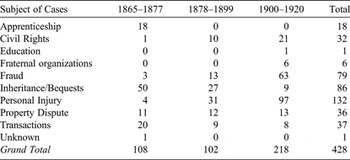
As black litigants entered the courtroom, the strength and type of their legal claims played crucial roles in determining the outcome. African Americans found Southern courts more likely to hear certain kinds of civil cases between black and white litigants. Between 1865 and 1899, as Table 2 shows, most appellate cases between black and white litigants arose from disputes over bequests to former slaves, economic transactions or property dealings, or the apprenticeship of black children.Footnote 33 Often, these cases involved established rules of property and inheritance and did not explicitly involve issues of race.
Kinds of Appellate Civil Cases between White and Black Litigants.
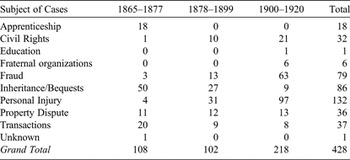
In the three-and-a-half decades after the Civil War, slightly more than one third of appellate cases between black and white litigants in the courts examined (seventy-seven cases) involved disputes over wills or trusts.Footnote 34 Frequently, former masters or mistresses had directed in their wills that a portion of their slaves should be emancipated and given funds or property upon their death. If the testator had died before the Civil War, black litigants often had not received the bequest, and attempted to claim it in court after the war.Footnote 35 In other cases, slave owners made wills leaving bequests for their slaves before the conclusion of the Civil War, but failed to change their wills after the war ended. When such slave owners died after the war, white heirs challenged their wills by claiming that slaves' emancipation canceled the bequests. Freedpeople responded with their own legal challenges of conditions that required them to migrate to the North or to Liberia to receive bequests.Footnote 36
In 1856, for example, the will of wealthy Georgia slaveholder Francis Walker emancipated his formerly enslaved children and their four mothers upon condition of their immigration to Liberia, and directed all of his property to be used to settle them in Liberia. Walker's brother carried out the deceased slaveholder's last request, arranging for the slaves to be emancipated and relocated to Liberia in 1859.Footnote 37 Sent to Liberia only 2 years before the outbreak of the American Civil War, the former slaves probably followed the war across the ocean with intense interest. They had a personal stake in events in the United States as, according to their later court case, their former master's brother Moses Walker failed to disburse the majority of the funds left for them to use in Liberia. Taking note of the new rights of black Americans, one of the former slaves, William Walker, decided to sue his former master's white relatives (his own cousins) in a Georgia court. In 1878, William Walker borrowed money to sail to the United States, and represented himself and the other mixed-race descendants of Francis Walker in a lawsuit seeking to obtain Francis Walker's property from their white cousins. His case rested upon an appeal to his white father's will. In his petition, Walker's lawyer cited portions of the will that directed all of the testator's estate to be used to settle his former slaves in Liberia, and, during the trial, the lawyer introduced a copy of the will into evidence.Footnote 38
Another one third of appellate cases between white and black litigants from 1865 to 1899 (sixty-eight cases) involved disputes over transactions or property dealings.Footnote 39 Whereas slaves had had few realms to petition when they took part in independent transactions of food or livestock, freedpeople could now appeal to new sources of justice when they came into economic conflict with white employers or landowners. These suits drew on general rules about property and contracts and cited decisions from suits litigated by white southerners. In 1873, for example, black sharecropper Moses Summerlin brought a case against a white landowner, William Smith. Summerlin explained in his testimony that Smith had refused to pay him his portion of the crop, as outlined in the contract, justifying himself with the claim that the sharecropper had produced only half of the crop he would have produced if he had worked more diligently. Under slavery, an accusation of laziness would most likely have led to a beating for the accused slave, with no opportunity for an explanation. Only a few short years later, freedpeople could now defend their actions in a court of law. Summerlin responded to Smith's allegations of idleness by testifying: “That he cultivated Said land in a farm like manner except about three weeks, where it fell back a little owing to the fact of the death of plaintiffs wife: that he was then troubled, and could not well tend to the farm.” Summerlin also appealed to the terms of the contract, testifying that although the white landowner was obligated by the contract to help him cart the crop, “he asked Defendant three times for a wagon to haul cotton and defendant refused and that he asked several times for a wagon to haul corn and was refused.” To back up these claims, the freedman's lawyer introduced the contract itself into evidence.Footnote 40 Although labor contracts frequently limited black Southerners' mobility and choices, the presence of a written contract in their negotiations could also facilitate the litigation of claims such as this in Southern courts.Footnote 41
As the political and racial atmosphere of the United States South shifted at the end of the nineteenth century and segregationa and disfranchisement began to be written into law, the civil cases black people were able to litigate—and win—against white neighbors, former masters, merchants, and employers changed.Footnote 42 Whereas earlier appellate cases had frequently involved wills or economic transactions, African Americans now most often brought cases against white Southerners for defrauding them of property or sought damages for personal injury from large corporations or towns. Of the 218 higher-court cases that black people litigated against whites between 1900 and 1920, 29% involved fraud and 44% involved personal injury.Footnote 43
Rather than directly challenging segregation and disfranchisement, such cases took advantage of the courts' continuing respect for property rights and the increasing nation-wide claims of personal injury.Footnote 44 Perhaps most importantly, the very nature of these cases presented African Americans at their most vulnerable, emphasizing their inequality from their white counterparts. Likely it was precisely because these suits highlighted black people in particularly dependent, vulnerable positions that they gained traction in southern courts when other cases during this time period often did not.
Sixty-three civil cases involving fraud took place between black and white litigants in Southern appellate courts between 1900 and 1920. Many of the fraud cases that reached appellate courts involved young, elderly, or female litigants. Because of their age and gender, these litigants made especially strong claims that they had been defrauded and needed assistance from the courts.Footnote 45 Usually, these cases involved alleged attempts to cheat black landowners out of their property. In many cases, black property-owners did not mean to sell their land at all. Often, they believed that they were signing a loan agreement or a mortgage, or paying back taxes to redeem land that had been foreclosed. Only later did they discover that they had put their mark to a document deeding away their property.Footnote 46 In other cases, white land agents or neighbors made direct threats to black landowners, threatening them with violence or other repercussions if they did not sell. One black plaintiff in Arkansas, Young Hobbs, claimed that a local white merchant said he would kill him if he did not deed his 160 acres of land to the merchant's wife.Footnote 47 A smaller number of fraud cases in appellate courts between 1900 and 1920 involved black plaintiffs who sold their property for a sum they later claimed was too low. In these cases, white neighbors and moneylenders often pressured black property-owners into selling their land at extremely low prices by telling them they were about to lose their land due to an imminent lawsuit. Other whites played on black landowners' fears that their land would be sold for taxes.Footnote 48
In 1906, for example, 21-year-old Lurena Roebuck inherited 80 acres of Alabama land. She soon encountered a barrage of threats to her land. First, two neighbors as well as a white man in a neighboring town laid claims to different portions of her land. They had bought “tax titles” to the land when Ellard's family did not pay the taxes on time, and if the taxes were not paid, they could gain the land itself. Aware of these neighbors' challenges to her title, a white man named John Leonard approached Roebuck and asked if she would sell him 20 acres. Under pressure and unable to read well, she signed the papers he presented to her, only to find out later that the papers deeded her entire 80 acres to him for $35, when the land was worth approximately $2400. Upon realizing the circumstances, Roebuck confronted Leonard, and asked him to take the money back in return for her land. When Leonard refused to return her money, Roebuck hired a lawyer and initiated a case in civil court. In the end, Roebuck won her case at both the local and state levels, and the court invalidated the deed.Footnote 49
In addition to fraud cases alleging financial harm, many of the civil suits litigated between blacks and whites in Southern appellate courts in the Jim Crow South involved personal injury. During the first two decades of the twentieth century, ninety-seven appellate-level personal injury cases involving African American litigants took place across eight states.Footnote 50 Although the racial discrimination and segregation of the Jim Crow South often influenced their cases, these black litigants usually sought compensation only for their own injuries, rather than challenging racially discriminatory practices themselves. In the vast majority of such personal injury suits, black litigants sought financial compensation for bodily injuries on railroads or streetcars. Less often, African Americans sued a city for physical injury, claiming that dangerous roads or sidewalks had led to injury, or sought damages from telegraph companies, when such companies did not deliver messages in time.
In litigating such cases, African Americans took part in a national trend of growing tort litigation, spurred by the increasing number of railroad-related injuries in the second half of the nineteenth century. The new issues created by modernization in America, particularly the injuries inflicted by railroads, led in the second half of the nineteenth century to the growth of tort law, a previously relatively undeveloped branch of law. As a result, more people successfully sued railroads, and railroads began to give greater attention to passenger safety.Footnote 51 These types of cases also frequently targeted corporations for which many white Southerners had little sympathy. By the end of the nineteenth century, many white Southerners deeply resented powerful transportation carriers and the Northern investors who largely owned them. Cases litigated by African Americans highlighting the way the railroad killed, maimed, and severely injured passengers, employees, and passersby spoke to this resentment.
Other personal injury cases litigated by African Americans took place against fellow Southerners or Southern-owned companies, but like railroad suits, fed into a fear of increasing modernization or highlighted situations that white citizens also sought to remedy. Ellen Bland, for example, litigated a suit against the city of Mobile, Alabama, after falling through a foot-bridge leading from the street to the sidewalk. One of the planks had not been nailed down, and it slipped out of place as Bland stepped onto it. She sued the city of Mobile for $1,000, and when she lost in the lower court, appealed her case in 1904 to the Supreme Court of Alabama.Footnote 52 Although Bland lost the appeal, the relevance of her suit to the local white community can be seen in a May 1905 newspaper article, which explained, “Many of the business people in Water Streets…are up in arms because of the conditions existing in the asphalted paving in that territory. Holes of all sizes have appeared in many of the blocks in the district from time to time and the board of public works, which has absolute charge of the territory, is now the brunt of the blame.”Footnote 53 As this article reveals, citizens of Mobile sought to improve the conditions of their streets. Bland's suit over a dangerous footbridge along the road spoke to this concern.
The very nature of personal injury cases also led them to be brought by injured and widowed African Americans who appealed to white paternalism, rather than showing blacks in an equal position to the white people or white-owned companies they met in court. Although the personal injury suits of black litigants sometimes resulted from segregated facilities and racial discrimination, they threatened white Southerners less than suits directly addressing civil rights. As a result, as black Southerners lost important civil rights suits and found themselves less able to litigate other kinds of suits, they litigated personal injury suits in larger numbers.
The Participants in the Trial
A diverse cast of characters, including litigants, lawyers, judges, jury members, and witnesses, shaped the initial trials of African Americans and contributed to their outcomes. In the three-and-a-half decades immediately after the Civil War, African Americans faced their former masters or their masters' heirs in approximately half of the appellate cases examined.Footnote 54 In many other cases, the white litigants had served as their employers after the Civil War. As the nineteenth century came to a close, the opposing litigants became more likely to be powerful corporations, but still sometimes employed the black litigant or one of the litigant's family members.
Accustomed to a position of power over the black Southerners involved, white litigants often went to great lengths as they attempted to defeat African Americans in court. In a number of cases, they tried to turn the fact of emancipation to their advantage by arguing that freedom nullified freedpeople's claims to property or bequests from their former masters. White litigants also accused freedpeople of disloyalty to their former masters, thus capitalizing on the fears of white jurors in the post-emancipation South. In other cases, white heirs argued that a testator had not been compos mentis when leaving money to former slaves or black employees or that the former slaves had exercised undue influence. White litigants attacked the character of black women with particular vigor, making allegations about their sexual relations and accusing them of negligence.Footnote 55
African Americans also encountered rampant corruption by white litigants and more subtle exercises of influence by prominent persons over the proceedings. In one early twentieth-century case, a Mississippi testator bequeathed his entire estate to his black female servant. When the woman employed a white attorney to represent her in the probating of the will, however, she was pressured to drop the case. More blatantly, outright witness-tampering appears to have taken place in an 1866 Georgia suit. As he questioned witnesses, the black litigants' lawyer hinted that the opposing white litigants made an arrangement to release a witness from debt if the witness managed to overturn the will; further, he suggested that the white litigants offered a large sum of money “for testimony to break the will.”
Another black litigant, Mary Ray, discovered a more subtle type of corruption in her 1892 case against the county commissioners, as an uncommon number of legal impediments appeared in her path. She succeeded in moving her trial to a neighboring county because of the enormous influence of the commissioners in her own county, but had difficulty obtaining a hearing in the new location, despite repeated attempts to do so. Although her witnesses had been available to testify during previous terms, upon finally obtaining a trial, her witnesses did not appear. When her case finally came to trial in Orange County in August 1891, Ray brought these problems to the judge's attention, stating that during the last three terms of court she had not been able to get a trial “for causes beyond her control” and noting that the witnesses' “absences were by no procurement of her own.”Footnote 56 As white litigants marshaled all their resources to fight the claims of black litigants, they inadvertently revealed how seriously such cases threatened them.
Even as white litigants worked with their lawyers to defeat African Americans in court, other white lawyers crafted African Americans' legal strategies and coached them on what to say in their testimony. A lawyer's commitment to his clients, skill, and knowledge of the law could mean the difference between a successful or unsuccessful case. Although black litigants' lawyers usually represented them well in higher court cases, at times lawyers did not act in the best interests of their clients.Footnote 57 In most appellate cases, however, lawyers played an important part in the legal access and victories of black litigants. Some jurists, in fact, publicly recognized the role of lawyers in allowing black Southerners access to the courts. Georgia jurist John Reed wrote in 1885 about the influence of Georgia lawyers on African Americans' cases: “When the courts of Middle Georgia in which we practiced were reopened after the late war, it was useless to submit the case of a negro to a jury of the whites…But the [legal] profession stood by their clients faithfully….The leading members of the bar spoke out unanimously on all fit occasions advising a better course. At last this persistence began to tell. The tide turned perceptibly in 1870, and after a while it was no wonder to see a negro obtain his due from a jury of his former masters.”Footnote 58 As they assisted black litigants in bringing claims against white Southerners, lawyers aligned themselves—even if temporarily and solely for monetary reasons—with African Americans' quest for full citizenship. At the same time, black litigants' dependence on white lawyers at the appellate level—and no doubt to a large extent at the local level as well—limited their legal action. Black litigants could only litigate the cases that white lawyers were willing to take on. Moreover, their legal strategies were shaped by these lawyers. Certain kinds of cases probably came before courts less frequently, then, because they did not have the support of white lawyers.
Despite the importance of legal counsel, the outcome of black litigants' civil cases went beyond the actions of often elite, white lawyers. In the first three decades after the Civil War, ordinary white Southerners testified both for and against black people, suggesting that the greater complexity in Southern race relations that these cases revealed was not limited to members of the legal profession. The willingness of white witnesses to testify on behalf of a black litigant affected the success of suits, providing certain cases with an edge before a jury or judge and perhaps preventing cases without such witnesses from receiving full consideration. The high proportion of cases that reached Southern state supreme courts between 1865 and 1900 in which white witnesses testified on behalf of black litigants suggests the importance of such testimony.
Many of these whites held discriminatory attitudes toward blacks as a whole, but testified in favor of individuals whom they had known for many years. Often local storeowners, planters, or relatives of their former owners who had known the freedpeople for years, these white witnesses provided evidence for a variety of reasons. Some testified because of their own economic interests or as part of a family or community feud. Others had long-term connections with the black litigants. In cases in which black litigants had blood ties to white witnesses, personal history played an especially important role.Footnote 59 Cases in the first three decades after the Civil War therefore reveal the ways in which personal, long-term relations between white and black Southerners could temporarily supplant ingrained patterns of discrimination. By the turn of the century, as relations between white and black Southerners became increasingly impersonal, these ties weakened and white Southerners became less likely to testify in favor of blacks with whom they had longstanding connections.
Other white members of black litigants' communities did not participate in cases with former slaves as willingly. These white Southerners generally did not have a choice in their participation. Before court cases, an officer of the court usually delivered a writ of summons to the defendant. Court officers delivered similar subpoenas to witnesses to appear and testify before the court.Footnote 60 By using the power of the state to summon white Southerners to participate in court cases against them, African Americans demonstrated their ability to harness government authority in their dealings with local white people. As authorized officers summoned reluctant white people to appear in court cases with black litigants, African Americans showed local whites a measure of power in the postwar South.
African American litigants and witnesses also influenced legal proceedings in Southern courtrooms. In a number of the appellate cases examined here, black litigants testified during the local trial. Other members of the black community, including family members, friends, and acquaintances, also frequently testified as witnesses in the initial trial of such suits. Such testimony appeared relatively unthreatening to whites because, as one white observer explained in a newspaper article in 1865, “With white judges, intelligent white jurors, a proper estimate will always be placed upon negro testimony.”Footnote 61 Despite such statements, the trial transcripts reveal a respect for blacks' words often missing from other areas of Southern life. Lawyers' decisions in both civil and criminal cases to frequently call black witnesses to the stand demonstrates their calculations that black testimony would help their cases. In addition, juries at times decided verdicts based on black testimony, even when such testimony contradicted that of white witnesses.Footnote 62
The testimony of black litigants and witnesses, although shaped by lawyers, required choices on their part. As they testified, black litigants and witnesses frequently made decisions about what to say based on their knowledge about race relations in their communities and, at times, their understanding of relevant law and the facts of the case. In a number of cases, African Americans worked with their lawyers to appeal to the racial biases of white judges and juries, changing their strategies as the racial climate in the United States South shifted. During the three-and-a-half decades after the Civil War, black people's suits often appealed to long-term relationships with members of the white elite, including their former masters.Footnote 63 Frequently, this language was crafted by lawyers, but at times freedpeople emphasized their loyalty and obedience to their former masters in their testimony.Footnote 64 In an 1881 Kentucky case, for example, the elderly black litigant, Minta Simmons, testified that she remained with her former master “from the time she was freed to his death and performed her duties faithfully.” Simmons further added, “that they were a good and affectionate master and mistress to her and always treated her well and kindly and she can never think or speak of them but with the love and respect which their behavior to her demands.”Footnote 65 By shaping their cases in this way, black litigants and their lawyers recognized the biases of the white judges and juries who would decide their cases.
From 1865 to 1920, black litigants also capitalized on long-term alliances with local white people, including many members of the elite, to persuade white men and women to testify in their favor. Victoria Monroe, for example, capitalized on her prewar relationships with white members of her community to enhance her 1879 and 1880 suits. Although a number of local white people testified against Monroe in the two trials, several white men, including her half-brother, testified in her favor. Victoria's blood ties apparently played a significant part in the support she gained in the white community.Footnote 66
As the nineteenth century closed and violations of African Americans' rights became even more commonplace, black people discovered new limitations to the kinds of cases they could successfully litigate. Working within these altered race relations and courtroom limitations, black litigants and their lawyers used new tactics to shape their cases. Many black litigants now invoked the nostalgia of white Southerners for the slave South by emphasizing in themselves qualities that white Southerners had attempted to inculcate in their slaves, such as loyalty and ignorance.Footnote 67 In a 1907 Alabama fraud case, for example, the 81-year-old black plaintiff, Andrew Carpenter, testified that he had trusted the white defendant, J.W. Abercrombie. As he attempted to prove that the white man had defrauded him by telling him that he was signing a mortgage when he was actually deeding away his property, Carpenter emphasized, “I do not know anything about the significance of deeds and mortgages, or legal papers.”Footnote 68 Elderly, young, or female black litigants proved especially skillful at executing this strategy of vulnerability, as shown by the high number of appellate cases involving such litigants in the first decades of the twentieth century.
Black litigants also often shaped their testimony to strengthen the legal basis of their claims. In fraud cases, for example, the very claims of ignorance that appealed to white southerners' paternalism also helped establish a legal claim of fraud. According to the law, it was difficult to bring a case of fraud if both parties in the transaction stood on an equal footing. When two people of equal understanding and intelligence made a contract, they were both supposed to exercise proper care and diligence to make sure they got a fair deal. Only if one of the parties had significantly less knowledge or mental capacity that impaired the person from fully understanding the contract would the courts become involved and rescind the contract.Footnote 69 As a result, in case after case, black litigants framed their suits to show a “cunning” white speculator defrauding an “ignorant” black landowner. Often, black litigants made it a point to emphasize their inability to read or understand financial documents. Lurena Roebuck characterized her reading and writing abilities as “not much” and emphasized her lack of business or real estate knowledge, stating, “I have never had any experience in business affairs. I know nothing about land numbers. I do not know how many acres of land there are in quarter sections…This is the only transaction of land I have ever had.”Footnote 70
Similarly, in personal injury suits, the law required plaintiffs to demonstrate that they had suffered an injury that caused them pain and loss of income.Footnote 71 Often the injuries that black litigants had received were so severe that black litigants met the legal basis of a personal injury suit – and presented themselves as weak and helpless – merely by stating their situation. One such plaintiff, Elizabeth Franklin, testified that after her injury, “I suffered severe pain, it would almost take my breath away.”Footnote 72 Some litigants went further, performing the roles that they thought white judges and juries would view most favorably. As Belle Boston testified about her railroad accident, the court reporter noted, she “ripped her sleeve and exposed her arm, showing to the jury the cuts and scars on both sides and over her elbow joints, which she said was caused by the car wheel running over her arm.”Footnote 73
Throughout the period between 1865 and 1920, some black litigants and witnesses also used their growing knowledge of legal procedure to help execute the most effective strategies at trials. Case files hint that lawyers coached litigants and witnesses on legal procedure and that black participants acquired relevant knowledge in the course of negotiating the legal process.Footnote 74 At times, African Americans initially made unsophisticated legal decisions, learned from their mistakes, and then rectified their errors through additional litigation. For example, a former slave named Emily Thomas went to court over a bequest from her former master (and father) in 1886. The state supreme court eventually decided the case in her favor, but her lawyer had persuaded her to sign an unfavorable contract in which he would receive $5,000 from the principal of the settlement as well as all of the interest from the settlement. Realizing her mistake, Thomas rectified the error by employing a new lawyer to represent her in a case against her former attorney.Footnote 75 Thomas's initial experiences in court helped her gain the knowledge of the law that led her to bring the second case.
At other times, black litigants demonstrated a more fully developed understanding of legal procedure. The 1890 North Carolina case of Mary Ray, a daughter of former slaves, reveals a woman especially skilled in her ability to maneuver within a complex and biased legal system. Ray's testimony suggests that she learned through discussions with her lawyers and as she experienced the legal process. When the Commissioners of Durham County attempted to prevent Ray and her family from inheriting property that her father had received from his former master, they brought their case to court multiple times.Footnote 76 Mary Ray and her lawyers also attempted to make the circumstances of the trial as favorable as possible for her suit. Ray realized that her case faced many obstacles. In addition to claiming the land on which the county courthouse and jail were built, she brought suit against the county commissioners, some of the most important local public figures. During the initial 1890 trial, she attempted to remedy this situation by testifying in an “Affidavit for Removal.” Here Mary Ray requested a change of venue, testifying that “she cannot obtain justice in this Cause in said county” because of the interested nature of local leaders and judges. She then astutely summed up what she was up against: “That besides being gentlemen of marked personal influence and magnetism in said county, around which many interests are drawn and adhered, they as such Commissioners have under the law the control & supervision of the Jury system as well as all other official matters appertaining to the affairs of the County.” She concluded her request by expanding the charges of bias to include all the taxpayers and potential jurors in the county, explaining that they had an interest in deciding against her to prevent additional taxes. As Ray's affidavit demonstrates, she understood the powerful forces aligned against her. Instead of resigning herself to the loss of land, Ray worked with her lawyers to pursue a legal solution, a change of venue.Footnote 77
Like black litigants, black witnesses also sometimes drew on legal knowledge as they testified in the courtroom. In an 1892 Virginia case, an elderly white man's oral gift of personal property to his daughter by his former slave depended upon the testimony of Fanny Coles, the daughter's black companion and the only uninterested witness to the father's oral gift. Coles' deposition fills 60 pages and includes, according to the opposing lawyer's account, “a surprising minutiae of detail.” Under cross examination, Coles testified that the white father told his daughter that this property was “to be hers in case of his death” and “that he was then in his right mind, but that he was apprehensive that he would then shortly die.” Her phrasing in this matter was crucial, as a nuncupative (oral) will would be valid only if accompanied by the assertion that the person giving the gift expected shortly to die.Footnote 78 Although her testimony contradicted that of a number of white witnesses, her extended deposition led to victory for her friend in the Virginia Supreme Court.Footnote 79 Because of the extraordinarily large amount of money at stake—over $200,000—details of the case appeared in at least six newspaper articles in at least four different newspapers throughout Virginia.Footnote 80 At least one newspaper noted Coles' role in winning the case. The Times, a white newspaper published in Richmond, reported that Coles “was on the witness stand for six hours and it was through her evidence which the finest legal talent in Virginia could not successfully assail, that the case was won.” The newspaper further described Coles' words in court as “the most convincing and consistent testimony” in the trial.Footnote 81 This type of newspaper coverage suggests that black litigants and witnesses could use their developing knowledge of the law to bolster their legal causes and support their own claims for full citizenship.
The Decision in the Local Trial
After a civil case's initial trial, a jury or a lower-court judge decided the outcome. During Reconstruction, approximately two thirds of these appellate cases involving black and white litigants had been originally heard by a lower-court judge and only about one third of these cases were originally tried by a jury. The number of jury cases gradually increased over the following decades. By the period from 1900 to 1920, over half of these appellate cases had been initially heard by a jury and slightly more than one third had been ruled on by a lower-court judge.Footnote 82 These differences appear to be the result, in large part, of changes in the types of cases involving black litigants during these different eras. Probate and apprenticeship cases, which made up many of the cases involving black litigants in the three-and-a-half decades after the Civil War, were more likely to be decided in the lower courts by a judge. In contrast, juries often decided personal injury and fraud cases, which made up most of the cases involving black litigants between 1900 and 1920. As the types of cases involving black litigants shifted, the likelihood of a judge or jury deciding the lower-court trial changed as well.
Throughout the entire period from 1865 to 1920, Southern judges were almost exclusively white and usually came from wealthy families.Footnote 83 During Reconstruction, some Southern judges aligned themselves with the Republican Party; in Georgia, for example, at least four appellate judges seem to have broken with the Democratic Party.Footnote 84 By the end of Reconstruction in 1877, many Republican-leaning judges had been replaced, although others stayed in office into the 1880s. However, the Redeemer Era judges often did not stray as far from the policies of their Reconstruction predecessors as one might expect, instead continuing to follow precedent and respecting some basic rights of black citizens.Footnote 85
The lack of genuinely competitive judicial elections provided the Southern judiciary a measure of independence from the political currents of the time and the ability to rule in favor of black litigants in certain kinds of cases.Footnote 86 Even more significant, because of the conservative nature of the system of law, judges relied heavily on precedent and often followed the earlier decisions of judges in the United States North and South as well as those of English courts. To diverge from precedent in a case involving a black litigant would have consequences for the many other similar cases involving only white litigants.Footnote 87 Judges also took pride in their knowledge and execution of the law, and deciding against precedent in a black person's case would have undermined this professionalism.Footnote 88
In inheritance cases involving black and white southerners, for example, judges often cited precedents from antebellum case law or English common law to justify their decisions. In an 1872 Mississippi case, in which the higher court ruled that the former slaves did not have to go to Liberia to gain property left to them, the judge cited precedents relating to the ability of emancipated slaves to inherit in the antebellum South and papists' ability to inherit property in England. The judge also noted earlier inheritance cases involving only white southerners.Footnote 89 Even when they cited no precedents, judges drew on the established legal understanding about these topics. In particular, judges throughout the South concurred that the intent of the testator was central to interpreting a will.Footnote 90 The importance of intention in such cases led judges to decide that if a testator wanted his slaves to inherit his property and had only mandated emigration to Liberia to comply with existing law, the freedpeople could inherit without relocating. Following this logic, a Mississippi Supreme Court judge wrote, “When it can be ascertained, effect will be given to the intention of the testator…It is apparent upon the face of the will under consideration, that there were in the mind of the testator two paramount purposes, to which he gave clear and decisive expression, viz.: the freedom of his slaves, and their pecuniary benefit.” The judge then concluded that these two purposes could be carried out by allowing the freedpeople to inherit without relocating.Footnote 91
In addition, in suits litigated by black litigants over transactions or property dealings, judges often relied upon general rules of property and contracts. Frequently, judicial opinions mentioned the race of black litigants only in passing, and largely resembled judgments on similar matters brought by white plaintiffs against other whites. By regarding African Americans as parties to whom the general laws of property and contracts applied, judges performed a potentially radical action. Furthermore, the reliance of judges on these legal principles provided black litigants an opportunity to gain a real hearing of their economic disputes.Footnote 92 In an 1899 Kentucky suit, for example, the black heirs of an elderly African American disputed a transaction that the deceased woman had supposedly entered into before her death. The state supreme court judge wrote in ruling for the black heirs, “It has been repeatedly held by this court that the object of the state…was to place the decedent and his live antagonist upon a perfect equality, and inasmuch as the decedent could not speak or testify of the transaction,” the other party could not either.Footnote 93 At times, judges also defended their opinions by listing previous suits over property and contracts that had pitted white litigants against each other. In the 1899 Kentucky opinion, for example, the judge gave numerous precedents from other cases in which the transaction in question had been between a living person and a person since deceased. These precedents were not confined to the state of Kentucky, or even to the South, but included cases from the New York Court of Appeals, the supreme court of Texas, the supreme court of Florida, as well as the Kentucky appeals court.Footnote 94
Southern judges also sometimes manifested a class-based paternalist mentality, seeking through their rulings to protect especially vulnerable African Americans from lower classes of whites. By ruling in favor of black people who presented themselves as vulnerable, white judges demonstrated their own character and worked to maintain the myth of a white elite that sought the best interests of the black underclass.Footnote 95 In their opinions in fraud cases, for example, judges emphasized the differences between black and white Ssoutherners, frequently describing black litigants as “ignorant” and using the supposed disparity of intelligence as their rationale for deciding in favor of black litigants. An Arkansas judge described one female black litigant as “young, inexperienced as to value of real estate and densely ignorant,” and a Tennessee judge compared an elderly black landowner, whom he described as an “ignorant negro of very infirm mental capacity,” with the white defendant, “a man of intelligence.”Footnote 96 An Alabama judge made the racial differences between the litigants even more central to his discussion of the black litigants' vulnerability, writing, “The purported grantee was a prominent, intelligent, and influential member of the dominant race. The purported grantor was an illiterate negro and in failing health.”Footnote 97 In case after case, judges invoked these supposed differences to rule that fraud had taken place. Although proofs of ignorance had an important legal basis in proving fraud, their choices to hear an especially large number of these cases suggests that these cases also aligned with their own beliefs about race relations in the South.
Unlike judges, white jury members often were not members of the elite class.Footnote 98 Between 1865 and 1890, white jury members sometimes served next to blacks on Southern juries. Although evidence points to the vast majority of juries still being composed primarily or completely of whites, in some cases, two or more black people served on a jury together.Footnote 99 As racial discrimination increased, however, juries became almost exclusively white. But even as judges' politics changed and juries became whiter, black Southerners continued to win cases in the lower courts. Throughout the period from 1865 to 1920, black litigants in appellate courts had won 68% of the time before juries at the lower-court level and 41% of the time before lower-court judges.Footnote 100 Although this finding is not representative of all lower-court cases, it suggests that black litigants succeeded in gaining favorable verdicts from members of their communities sitting on juries as well as from elite white judges. The willingness to give some African American civil suits serious consideration was not isolated to the jurists of the Southern legal system, then, but also manifested itself in verdicts rendered by ordinary white Southerners participating on juries.
Appealing a Case
If black Southerners did not win a lower-court trial, they had to decide whether to accept the decision or to appeal to a higher court (or, less often, to try to gain a new trial without appealing). Undoubtedly, the vast majority of cases went unappealed. In many cases, black litigants probably did not have the resources or legal basis to litigate their cases beyond the lower-court level. Others continued litigation after opposing parties appealed verdicts in the black litigant's favor. Some black litigants and their lawyers did decide to continue their cases, however, by appealing to Southern state supreme courts during the Reconstruction, post-Reconstruction and Jim Crow periods.Footnote 101 Choosing to appeal a case demonstrated a belief by white lawyers and their black clients that they had a valid point of law to appeal.Footnote 102 Money most likely also played a part in the decision. If they won their case at the next level, black litigants would receive disputed property, a large sum of money from a will, or damages for a death or injury. The losing party in a case also generally had to pay the costs of the case, including the lawyer's fees, which many black litigants could not afford.Footnote 103 Underneath these prosaic economic and legal reasons, African Americans' decisions to challenge lower courts had far-reaching implications. Their actions demonstrated that they were not bound by local authority, but could appeal to a higher governmental entity. Moreover, such an action showed that they would not submit to often discriminatory verdicts. The willingness of white lawyers to take part in these challenges made their appeals even more significant.
The state supreme courts to which African Americans appealed made the final decision on cases involving matters of state law. These courts generally consisted of panels of three to six judges. Most often, between 1865 and 1920, the state's citizens elected appellate judges, usually to terms of approximately 8 years. In Georgia and Virginia, however, the legislature elected appellate judges for most or all of this time, and in Mississippi the governor appointed appellate judges for much of this period.Footnote 104 To appeal to their state's highest court, the appellant's counsel sent a bill of exceptions to the higher court, laying out the alleged errors of the lower court. In some states, an error of “fact” could be appealed, while in other states, only an error of “law” was grounds for an appeal.Footnote 105 During the higher court proceedings, no new testimony was introduced. At times, the lawyers appeared before the state supreme court to read briefs or answer questions. In large part, however, the judges relied on the transcript from the lower court to decide the case.Footnote 106
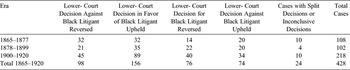
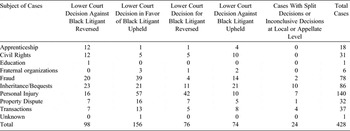
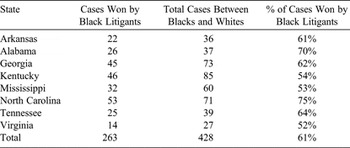
After hearing the case, the higher court judges issued their decision. Although often unanimous, at times individual judges dissented from the court's decision.Footnote 107 The decisions themselves further expose heterogeneity in the legal process. During Reconstruction, from 1865 to 1877, blacks received favorable rulings in 64% of the cases involving white and black litigants in Southern state supreme courts. Their success in civil cases in the Reconstruction period paralleled their revolutionary access and leadership in county, state, and federal government during this time. However, in the two decades after Reconstruction, from 1878 to 1900, black litigants continued to win, achieving a favorable ruling in 55% of their appellate suits. Even more surprising, from 1900 to 1920, during the height of segregation and disfranchisement, black litigants won 63% of their cases against whites in Southern state supreme courts.Footnote 108 Overall, during the period of 1865 to 1920, as shown in Tables 3 and 4, the Southern state supreme courts examined upheld lower-court decisions favoring African Americans in 36% of cases, reversed lower-court decisions against African Americans in 23% of cases, reversed lower-court decisions for African American litigants in 18% of cases, and upheld lower-court decisions against African American litigants in 17% of cases. In the remaining cases, the lower- or higher-court decisions were split or inconclusive.Footnote 109 Despite variation among different states, this pattern took place throughout the South. In all eight states examined, as Table 5 demonstrates, black litigants won more than 50% of the time in appellate cases against white litigants during the period 1865 to 1920.Footnote 110
Decisions of Appellate Courts in Civil Cases Between White and Black Litigants.
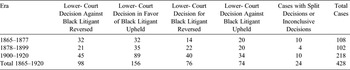
Decisions of Appellate Courts in Civil Cases Between White and Black Litigants, Divided by Subject, 1865–1920.

Appellate Civil Cases Between Whites and Blacks in the Eight States Examined, 1865–1920.
These legal victories were often not unmitigated triumphs. Frequently African Americans did not receive the full amount of damages or the entirety of a bequest they sought. As I have shown, African Americans often had to portray themselves as unequal to white litigants to gain access to the courts at the end of the nineteenth and beginning of the twentieth century. Some African Americans found these costs worth paying, however, during a time when the white establishment had almost completely shut them out of other government arenas. Even though their legal successes had limitations, they remained important for existing at all.
Black Litigants' Ability to Win Cases
Clearly, although the post-Reconstruction Era was a time of great violence and discrimination against African Americans, African Americans continued to exercise their rights in the courts even after losing other formal political rights. A number of factors worked together to allow black Southerners to litigate and win civil cases. The strength of specific legal claims played an important part in the courts' decisions, but the loss of other rights in the years following Reconstruction, regardless of the United States Constitution, as well as the often conflicting decisions of lower and higher courts, point to other factors as well.
The evidence presented here demonstrates that in the post-emancipation South, the nature of the legal system and the laws it sought to uphold at times worked to the advantage of black litigants. Judges' desire to rule according to the established body of law allowed certain civil cases over property, contracts, and torts to receive favorable hearings. Frequently, such cases aligned black Southerners with the property rights or testamentary freedom of their former masters. Other cases, however, put the rights of black litigants in direct opposition to the interests of their former masters or other local whites. In part because of these cases' basis in the same core legal principles as cases brought by white litigants, southern courts remained one of the few public arenas to which black southerners maintained access to power during the worst years of Jim Crow.
The legal system is also made up of individuals, all of whom brought their own experiences and perspectives to these cases. At times, the actions of these participants come as no surprise; at other times, the participants did not act in the ways one might expect. Some former masters litigated suits against their former slaves, but others testified in favor of freedpeople and against white neighbors and friends. White lawyers occasionally attempted to defraud their black clients, yet at other times they made radical claims on behalf of African Americans. Black people themselves made grave financial errors due to illiteracy or ignorance, only to correct these mistakes later by asserting their legal rights as citizens and litigating suits in their states' highest courts. Often, the participants in postwar court cases drew not only from their immediate interactions, but also from decades of experiences with one another and with the law. Whether they acted to aid or obstruct black people's suits, litigants, lawyers, jurists, and witnesses played crucial roles in shaping the proceedings and outcomes of these cases. Even as they worked within a legal system of strict rules and procedures, they brought their own experiences, networks of connections, and opinions with them into the courtroom.
Direct and Indirect Consequences of Cases
These suits did not stem the rising tide of racial discrimination and segregation against black Southerners, nor did they halt the loss of voting rights for black men. The formal, precedent-bound nature of the legal system that allowed African Americans to make claims against whites also made the courts an unwieldly vehicle at this time for bringing about larger change. However, these suits had consequences in the lives of the individuals involved, and for other black and white people who observed or read about them.Footnote 111 When black litigants won, direct actions followed, as they took possession of property, regained custody of a child, or obtained damages. At times the court rulings must not have been executed at the local level, but evidence points to many rulings being enforced. The very fact that white Southerners appealed such cases to their state's highest court demonstrates that they took the rulings of the courts seriously and expected that they would be executed.Footnote 112 Moreover, some cases came to the lower and higher courts multiple times, in a few instances as many as three times in each court. By appealing the court's decision in favor of a black litigant, white Southerners demonstrated that they could not achieve their purpose without a favorable ruling.Footnote 113
Just as important, these cases had indirect consequences. Black people in the community recognized their own legal power as they watched and read about their black neighbors and acquaintances bringing suits against local whites and, at times, gaining favorable verdicts. Newspapers with predominantly black readership gave the most coverage to suits involving overt issues of race, such as those testing the legality of railroad segregation or challenging voter registration practices. However, black newspapers also reported celebrated criminal cases involving blacks and civil suits between whites and blacks and, at times, local suits between white and black members of the community.Footnote 114 The fact that these suits continued to be brought in large numbers to higher courts in the years after the Civil War provides evidence that black Southerners took note of other black people's victories and followed their example by bringing cases of their own. As black Southerners watched others bring such cases, they also passed down knowledge of the rights they had gained during Reconstruction, and their continuing ability to exercise some rights through the courts. Such suits kept alive the hope that racial progress could be achieved in the courtroom.
These suits also provided evidence to white Southerners of the possibilities open to black people in the post-Civil War South. Although they had been interacting in new ways with African Americans since the Civil War, a trial legitimated new legal relations. Some whites gained knowledge about the legal standing of black people through first-hand experiences in the courtroom, whereas other whites read about suits between black and white litigants in local newspapers and watched as their neighbors or acquaintances participated in such suits.Footnote 115 For white Southerners after the Civil War, black people's legal action sometimes came as a surprise. In the years immediately following emancipation, for example, white-owned newspapers reported about black witnesses and jurors in tones of astonishment.Footnote 116 As time passed, however, white-owned newspapers reported criminal and civil cases involving black litigants as a matter of fact, next to other kinds of court cases. Although newspapers frequently noted the race of blacks in criminal suits and in celebrated civil cases, articles about civil appellate cases involving black and white litigants generally did not include the race of the litigants, noting only the key legal points of the decision. Such coverage demonstrates the way in which white Southerners came to accept the ability of black litigants to bring certain civil cases to Southern courts.Footnote 117 The extensive efforts of white Southerners to defeat black litigants in court also testifies to their acknowledgement of black people's legal power and the power of a legal system that sometimes recognized their rights. As white litigants fought these claims, they exposed the threats such cases posed to them.
White lawyers and judges also took note of cases in which black litigants won. Lawyers undoubtedly considered prior victories by African Americans as they decided whether to take on new claims. Likewise, in their opinions, judges mentioned previous cases dealing with similar topics that involved black litigants. In a July 1873 Georgia Supreme Court ruling about the ability of former slaves to inherit bequests without relocating to Liberia, a justice wrote that the freedpeople's ability to gain their legacies while remaining in the United States South “is not an open question in this Court” and then cited two 1869 cases on the same subject that his court had decided in favor of the former slaves. This justice saw the question of whether black litigants could recover bequests tied to emigration as a matter already settled by common law.Footnote 118 One-and-a-half years before the July 1873 ruling, however, in January 1872, Democrats had regained control of the Georgia state government. This justice cited Reconstruction precedents, then, after Reconstruction had ended in his state.Footnote 119 The cases of black litigants therefore could have an effect on future rulings of Southern courts even as the political situation in the South shifted.
In the years that followed the five-and-a-half decades examined here, new legal strategies would be used and new advocates for African Americans' rights took up their cause. In 1909, the newly established National Association for the Advancement of Colored People (NAACP) began to pursue a strategy of civil rights litigation in the courts. In the 1940s, the United States Justice Department began to prosecute particularly egregious cases of involuntary servitude and other labor violations against African Americans. These cases would culminate in a series of important court decisions that opened the way for enormous progress on civil rights in the 1950s and 1960s.Footnote 120 Throughout these years, African Americans often complained about the courts, but many continued to recognize that—although flawed—the legal system remained one of their best options to uphold their rights. The unbroken tradition of civil litigation between white and black Southerners that began after the Civil War played an important part in their view of the courts as a possible avenue for justice.