Introduction
Multiple sclerosis (MS) is a disease in which the myelin that insulates axons of the central nervous system (CNS) is damaged. Because myelin is vital to the rapid conduction of neural impulses, the loss of myelin results in the disruption of these impulses so neuronal transmission slows or never reaches its target. The disease process also results in a loss of axons and neurons. MS is associated with a variety of sensory and motor symptoms, neuropsychiatric disorders, and cognitive deficits. Estimates of the frequency of cognitive dysfunction in MS range from 40% to 60% of patients (Benedict et al., Reference Benedict, Cookfair, Gavett, Gunther, Munschauer, Garg and Weinstock-Guttman2006; Rao, Leo, Bernardin & Unverzagt, Reference Rao, Leo, Bernardin and Unverzagt1991). Previous research shows that a large number of cognitive processes are affected in MS, including information processing speed, working memory, learning, memory, and executive functioning.
Slowed processing speed has been proposed as the primary deficit in MS such that inefficiencies in more complex mental abilities are a consequence of slower processing (Relative Consequence Model: DeLuca, Chelune, Tulsky, Lengenfelder, & Chiaravalloti, Reference DeLuca, Chelune, Tulsky, Lengenfelder and Chiaravalloti2004). Research examining this hypothesis has used mixed-course samples. Because the prevalence and nature of cognitive deficits may differ between MS subtypes (Amato et al., Reference Amato, Portaccio, Goretti, Zipoli, Hakiki, Giannini and Razzolini2010), results could potentially be affected by the cognitive status of one or more disease types versus another. One objective of the present study was to investigate the relations between processing speed and the cognitive functions that are often impaired in MS for individuals with early relapsing-remitting MS. The focus on early relapsing-remitting MS was chosen because physical disability may be mild for many individuals in this subgroup and in some cases cognitive difficulties can be the most severe symptom (Ruggieri et al., Reference Ruggieri, Palermo, Vitello, Gennuso, Settipani and Piccoli2003). Also, these individuals are typically attempting to maintain their pre-morbid employment status and, thus, are susceptible to the disability that results from cognitive difficulties (Benedict et al., Reference Benedict, Wahlig, Bakshi, Fishman, Munschauer, Zivadinov and Weinstock-Guttman2005; Clemmons, Fraser, Rosenbaum, Getter, & Johnson, Reference Clemmons, Fraser, Rosenbaum, Getter and Johnson2004; Julian, Vella, Vollmer, Hadjimichael, & Mohr, Reference Julian, Vella, Vollmer, Hadjimichael and Mohr2008; Simmons, Tribe, & MacDonald, Reference Simmons, Tribe and McDonald2010). Finally, this group is typically targeted for disease modifying therapies. If we wish to evaluate the effectiveness of therapies for cognitive difficulties, it is important to understand the nature of cognitive dysfunction in this group and to identify the assessment tools most useful for detecting and monitoring cognitive difficulties at this stage of the disease.
Furthermore, we sought to investigate these relations while addressing methodological flaws identified to limit previous research evaluating relations between processing speed and other cognitive abilities [i.e., constructs not operationalized successfully, inadequate statistical methods, and failure to examine other potential mediators (Demaree, Frazier, & Johnson, Reference Demaree, Frazier and Johnson2008)]. First, operational confounds were minimized by using multiple measures of the constructs under study and by emphasizing the common, construct-relevant variance among different measures through the use of structural equation modeling. Structural equation modeling also offers an appropriate method for evaluating the mediational hypothesis that slowed processing speed is the mechanism by which MS impairs cognitive functioning. Finally, processing speed was operationalized using measures less likely to be confounded by other intellectual abilities and individual differences than what has been used in previous research.
The conceptualization of processing speed adopted in the present study was the rate at which elementary cognitive operations are executed (Kail & Salthouse, Reference Kail and Salthouse1994). Salthouse (Reference Salthouse1996) advised that tasks assessing processing speed should be simple enough such that performance is not overly influenced by the individual's knowledge or other cognitive abilities besides processing speed, but not so simple that the task measures only sensory and motor processes and not the duration of relevant cognitive operations. The majority of the research that has reported significant relations between processing speed and higher-order cognitive processes in MS (e.g., DeLuca, Baarbieri-Berger, & Johnson, Reference DeLuca, Barbieri-Berger and Johnson1994; DeLuca, Gaudino, Diamond, Christodoulou, & Engel, Reference DeLuca, Gaudino, Diamond, Christodoulou and Engel1998; Litvan, Grafman, Vendrell, & Martinez, Reference Litvan, Grafman, Vendrell and Martinez1988) operationalized processing speed using some variation of the Paced Auditory Serial Addition Task (PASAT; Gronwall, Reference Gronwall1977). A major drawback of using the PASAT in this manner is that successful execution of the task requires numerous cognitive functions besides processing speed and individual differences such as mathematical ability and strategy use may also influence performance (Tombaugh, Reference Tombaugh2006). Therefore, associations found between performance on this task and measures of other cognitive abilities cannot be ascribed specifically to processing speed.
In the present study, processing speed was assessed using three tasks that meet Salthouse's (1996) criteria: simple, choice, and semantic search reaction time from the Computerized Tests of Information Processing (CTIP; Tombaugh & Rees, Reference Tombaugh and Rees2008)]. The three reaction time tasks are easy enough that healthy participants and neurological patients consistently achieve perfect or near-perfect accuracy and individual differences in intelligence, education, knowledge, and strategy use do not influence performance (Reicker, Tombaugh, Walker, & Freedman, Reference Reicker, Tombaugh, Walker and Freedman2007; Tombaugh, Rees, Stormer, Harrison, & Smith, Reference Tombaugh, Rees, Stormer, Harrison and Smith2007; Wojtowicz, Berrigan, & Fisk, Reference Wojtowicz, Berrigan and Fisk2012). The three tasks index cognitive processing to different degrees, with previous research conducted with individuals with traumatic brain injury and MS supporting this claim (Reicker et al., Reference Reicker, Tombaugh, Walker and Freedman2007; Tombaugh et al., Reference Tombaugh, Rees, Stormer, Harrison and Smith2007; Wojtowicz et al., Reference Wojtowicz, Berrigan and Fisk2012). In these studies, patients responded significantly slower than controls on each task and, moreover, the reaction times of the groups became more divergent as task difficulty increased. To allow comparisons with existing research, the PASAT was administered; however, it was not included in the structural equation models because of the issues noted above. Similarly, the Symbol Digit Modalities Test (SDMT; Smith, Reference Smith1991) was administered because it has frequently been used in previous MS research but it was decided a priori to exclude this task from the structural equation models because of evidence that performance is affected by variability in working memory and learning/memory in addition to processing speed (Benedict et al., Reference Benedict, Cookfair, Gavett, Gunther, Munschauer, Garg and Weinstock-Guttman2006; Forn et al., Reference Forn, Belenguer, Belloch, Sanjuan, Parcet and Avila2011).
A second objective of the present study was to examine whether working memory contributes to the deficits in other cognitive functions experienced by individuals with early relapsing-remitting MS. Working memory is defined as the active maintenance of information in the face of ongoing processing (Conway et al., Reference Conway, Kane, Bunting, Hambrick, Wilhelm and Engle2005). Along with processing speed, working memory is one of the most frequently documented areas of cognitive difficulty in MS (Lengenfelder et al., Reference Lengenfelder, Bryant, Diamond, Kalmar, Moore and DeLuca2006). Working memory was investigated as a potential mediator in the present study because, similar to processing speed, working memory ability is predictive of higher order cognition in the general population on a wide variety of complex tasks such as reading comprehension, mathematics, episodic memory, problem solving, and reasoning (see Conway et al., Reference Conway, Kane, Bunting, Hambrick, Wilhelm and Engle2005; DeStefano & LeFevre, Reference De Stefano and LeFevre2004; McCabe, Roediger, McDaniel, Balota, & Hambrick, Reference McCabe, Roediger, McDaniel, Balota and Hambrick2010). Thus, it seems possible that the working memory deficits associated with MS could yield difficulties in other cognitive abilities. Because there is evidence to suggest that central executive dysfunction is the primary working memory impairment in MS (Arnett et al., Reference Arnett, Higginson, Voss, Bender, Wurst and Tippin1999; D'Esposito et al., Reference D'Esposito, Onishi, Thompson, Robinson, Armstrong and Grossman1996; Diamond, DeLuca, Kim, & Kelly, Reference Diamond, DeLuca, Kim and Kelly1997; Lengenfelder, Chiaravalloti, Ricker, & DeLuca, Reference Lengenfelder, Chiaravalloti, Ricker and DeLuca2003; Parmenter, Shucard, & Schucard, Reference Parmenter, Shucard and Schucard2007), measures that primarily assess this component of the working memory system were used in the present research.
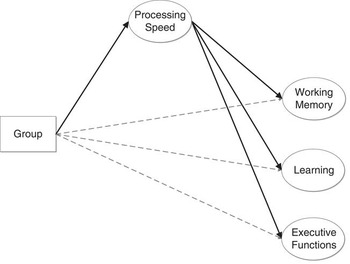
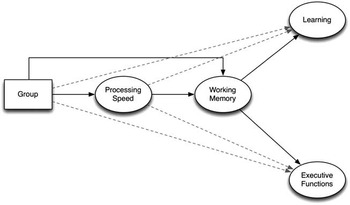
Because the present study is concerned with the mediational hypotheses of whether processing speed and working memory are a mechanism by which MS diminishes other cognitive functions, the structural equation models include an independent variable representing presence or absence of MS (group), a mediator variable representing processing speed or working memory, and dependent variables representing other cognitive functions frequently impaired in MS (learning, executive functioning). The evaluation of relations between each of processing speed and working memory and the other cognitive functions for the MS patients alone is not sufficient because significant findings would be expected for everyone, regardless of neurological status, and would not inform us if these relations are responsible for the diminished abilities of MS patients. Thus, direct effects of the presence of MS on the potential mediators (processing speed, working memory) and the other cognitive functions were estimated as well as indirect effects of the presence of MS on the other cognitive functions via the potential mediators. This pattern is shown in Figure 1 for the Original Relative Consequence Model, with processing speed as the mediator, and in Figure 2 for the Expanded Relative Consequence Model, with working memory as a mediator.
Structural model tested to evaluate the Original Relative Consequence Model of cognition in multiple sclerosis. The solid lines represent the relations hypothesized to be significant and the dashed lines represent the relations hypothesized to be nonsignificant.

Structural model tested to evaluate the Expanded Relative Consequence Model of cognition in multiple sclerosis. The solid lines represent the relations hypothesized to be significant and the dashed lines represent the relations hypothesized to be nonsignificant.

Methods
Participants
Seventy adults (57 females, 13 males) with relapsing-remitting MS (McDonald, Compston, & Edan, Reference McDonald, Compston and Edan2001) and disease duration ≤ 10 years were recruited from regular visits to the MS Clinic of the Ottawa Hospital. Individuals with a history of neurologic disease or injury other than MS, drug or alcohol abuse, or psychiatric disorders other than depression were excluded from participating in the study. Fifty-three MS participants were receiving disease-modifying therapy at the time of testing. The sample was characterized by mild physical disability (Kurtzke, Reference Kurtzke1983), on average (Table 1).
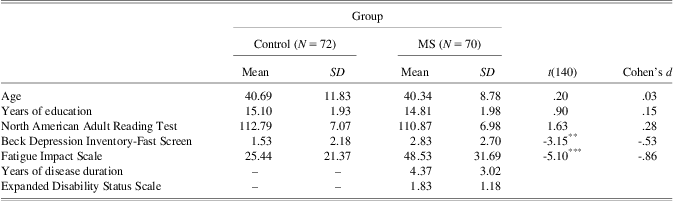
Characteristics of the groups
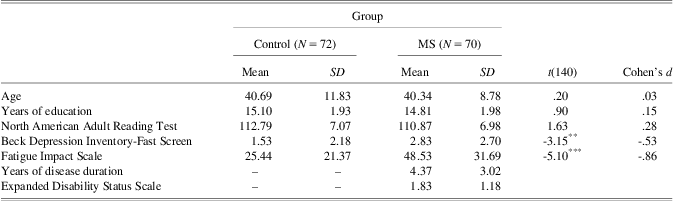
Note. **p < .01; ***p < .001.
Seventy-two control volunteers (59 females, 13 males) meeting the same exclusion criteria were recruited through advertisements. Participants were compensated for parking expenses and control volunteers recruited through university classes received course credit for participating in the study. All participants provided informed consent following procedures approved by the Ottawa Hospital and Carleton University Research Ethics Boards.
Materials
Information Processing Speed
Computerized Test of Information Processing (CTIP; Tombaugh & Rees, Reference Tombaugh and Rees2008)
The CTIP includes a: (1) Simple Reaction Time task where participants are asked to press the space bar as soon as a single “X” appears in the center of the screen, (2) Choice Reaction Time task where participants are presented with either the word “DUCK” or “KITE” on each trial and are asked to press the right key (“?”) or the left key (“Z”), respectively, and (3) Semantic Search Reaction Time task where participants are asked to decide if a word belongs to a semantic category. On each trial the name of one of four categories (weapon, furniture, bird, or fruit) is presented at random on the screen for 2.5, 3.0, 3.5, or 4.0 s. The category name remains on the screen while another word appears below and participants are instructed to press the right key (“?”) if the word represents a member of the category and to press the left key (“Z”) if it does not. Each task includes 10 practice trials and 30 test trials.
Working Memory
Reading span
The task was based on recommendations of Conway et al. (Reference Conway, Kane, Bunting, Hambrick, Wilhelm and Engle2005) and stimuli from Engle (Reference Engle2005). The background task requires participants to read aloud a sentence presented on a computer screen and verify whether the statement makes sense while the primary task requires them to keep track of single letters appearing to the right of each sentence. At the end of each block of trials, participants are instructed to try and recall all of the letters that were presented in that block. Blocks consist of 2, 3, 4, 5, or 6 trials and block size is pseudo-randomly ordered throughout the task. Three practice blocks are administered before the test blocks. The total number of letters recalled in the correct serial position is summed across blocks and recorded. Reading span tasks are a widely used measure of working memory capacity in the field of cognitive psychology and have been proven to be reliable and valid (See Conway et al., Reference Conway, Kane, Bunting, Hambrick, Wilhelm and Engle2005 for a review).
Letter-number sequencing subtest from the Wechsler Memory Scale-III (Wechsler, Reference Wechsler1997)
Increasingly longer sequences of intermixed letters and numbers ranging in length from two to eight stimuli are presented verbally. Participants are asked to first repeat the numbers starting with the lowest in the series and then the letters in alphabetical order. For example, if presented with the series “6-F-2-B” the correct response would be “2-6-B-F.” If a subject responds incorrectly for all three trials of one length, the test is discontinued. The total number of correct trials is recorded.
Learning
Immediate recall list learning subtest from the Learning and Memory Battery (Schmidt & Tombaugh, Reference Schmidt and Tombaugh1995)
On each of five learning trials, participants are asked to recall a list of 15 words. Each word belongs to a different semantic category. After the first trial, only the words that were missed the time before are read but the examinee is still instructed to repeat as many of the 15 words as they remember (selective reminding procedure). If the examinee cannot recall all of the words then a cued recall trial is administered for the missed words (e.g., “Which word was a type of color?”). Correct free recall responses are summed across trials to form the total Free Recall score. Correct cued recall responses are summed across trials and added to the Free Recall score to form the Free Recall + Cued Recall score. The Free Recall scores were analyzed in the present study.
Immediate recall from the Brief Visuospatial Memory Test-Revised (Benedict, Reference Benedict1997)
On each of three learning trials, participants are presented with a matrix of six simple geometric figures for 10 s. Participants are then asked to draw the figures as accurately as possible and in the same location as they remember seeing them. Between zero to two points is allotted for each figure based on the accuracy and placement of the drawing. Points are summed across trials to form a total learning score.
Logical Memory-I subtest from the Wechsler Memory Scale-III (Wechsler, Reference Wechsler1997)
Two short stories are presented verbally; each is composed of 25 units or ideas and the second story is presented twice. After each presentation, examinees are immediately asked to recall as many details as they can. One point is awarded for each idea that is correctly recalled and points are summed across trials.
Executive Functions
Sorting subtest from the Delis-Kaplin Executive Functions Systems (Free Sort Only; Delis, Kaplan, & Kramer, Reference Delis, Kaplan and Kramer2001)
Two sets of stimulus cards each consist of six cards of different shapes, with a single word printed in the center. Participants are asked to sort the cards into two groups of three cards each and then to describe how they formed the groups. Participants are allowed four minutes for each card set and are asked not to repeat sorts. The number of correct target sorts completed was recorded and summed across the two card sets.
Phonemic verbal fluency from the Controlled Oral Word Association Test (Benton & Hamsher, Reference Benton and Hamsher1976)
Examinees are asked to say as many words as possible beginning with “F,” then “A,” and finally “S.” A 60-s interval is used for each letter and the number of correct responses is summed across the three trials.
Paced Auditory Serial Addition Task (PASAT; Gronwall, Reference Gronwall1977)
A modified version of the test allowing computer administration was used. Participants are presented with a series of 61 single digit numbers auditorally and are instructed to add each number to the one immediately preceding it and to say the sum aloud. The examiner enters participants’ responses using the numeric keypad and the program tallies the number of correct responses occurring within the 3-s interstimulus interval. Because of well-known practice effects associated with the PASAT (Tombaugh, Reference Tombaugh2006), a run-in procedure recommended in the Multiple Sclerosis Functional Composite manual was used (Cutter et al., Reference Cutter, Baier, Rudick, Cookfair, Fischer, Petkau and Willoughby1999).
Symbol Digit Modalities Test (Smith, Reference Smith1991)
At the top of the test form, individuals see nine different symbols paired with the numbers 1 through 9. For the practice and test items, participants are required to say the number corresponding to each symbol on the test form. The number of correct responses produced within 90 s is recorded.
Data Analysis
The data were evaluated for violations of statistical assumptions using generally accepted methods and any violations that were identified were corrected accordingly. Group comparisons were made using independent samples t tests for the demographic and observed cognitive variables and using a χ2 test for sex. Structural equation modeling analyses were conducted using Amos 18.0 (Arbuckle, Reference Arbuckle2009) and maximum likelihood estimation was used to estimate all parameters. Because the structural equation models aim to assess relations among latent factors, it is critical that the measurement of each latent construct is psychometrically sound. Thus, an important preliminary step was to first evaluate the validity of the measurement model. Accordingly, a confirmatory factor analysis was performed assessing the relations between the observed variables and the latent factors. Following evaluation of the measurement model, the hypothesized structural models were analyzed. Several fit indices were used to evaluate the models [χ2 test statistic, comparative fit index (CFI), root mean square error of approximation (RMSEA)]. Bias-corrected bootstrap confidence intervals were used to estimate 95% confidence intervals for all structural model parameters. Tests of significance were based on unstandardized estimates; however, standardized coefficients are also presented and discussed to describe the results of the structural equation model fully. If processing speed or working memory serve as mediators of other cognitive deficits in MS, the indirect effects of group membership on the dependent cognitive factors will be significant.
Results
Characteristics of the Groups
The proportion of females and males was similar between the groups, χ2 (1, N = 142) = .006, p = .937. The groups did not differ on age, education, or estimated intelligence although the MS participants exhibited more symptoms of depression and fatigue (Table 1). Accordingly, depression and fatigue were accounted for by adding these variables to the final structural models used to examine the relations among group membership and the cognitive factors.
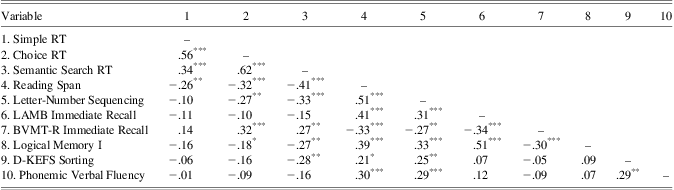
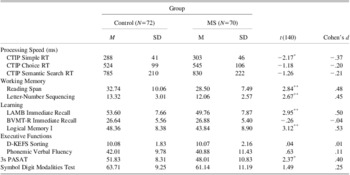
Descriptive statistics for the observed cognitive variables are presented in Table 2. MS patients responded more slowly than controls on the processing speed tasks, although group differences were not significant for the choice and semantic search tasks. There were no significant differences between the groups on the executive functioning tests. Thus, the MS patients exhibited deficient working memory and learning whereas processing speed and executive functioning were unimpaired.
Comparisons between the groups on the observed variables

Note. *p < .05; **p < .01; ***p < .001. The significant result for Simple RT was not observed with depression and fatigue accounted for using an analysis of covariance (p = .085). All other significant results remained.
CTIP = Computerized Test of Information Processing; LAMB = Learning and Memory Battery; BVMT-R = Brief Visuospatial Memory Test-Revised; PASAT = Paced Auditory Serial Addition Task.
MS patients made fewer correct responses than controls on the PASAT and SDMT, although group differences were only significant for the PASAT (Table 2). When the commonly used criterion of a score more than −1.5 SDs below the mean of the control group was applied, 21.4% of patients were impaired on the PASAT and 12.9% were impaired on the SDMT.
Structural Equation Modeling
Measurement model
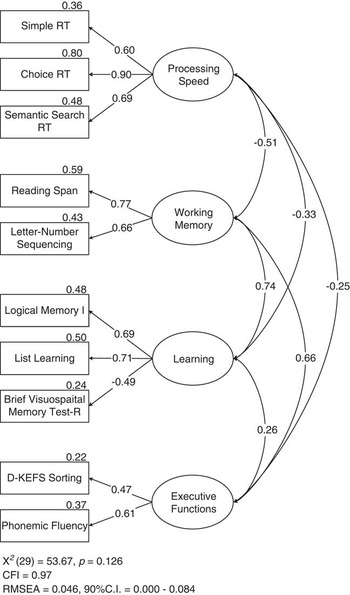
Figure 3 illustrates the measurement model, specifying the relations between the observed variablesFootnote 1 and the hypothesized latent factors. The model fit the data well, χ2(29) = 37.83, p = .13; CFI = .97; RMSEA = .046, 90% CI = .000–.084. All parameter estimates were significant at p < .05, except for the covariance between processing speed and executive functioning and between learning and executive functioning (p = .076, .098, respectively). The standardized residuals and modification indices did not identify any areas of misspecification in the model requiring adjustment. Figure 3 includes the standardized coefficients; all loadings were significant and, furthermore, the majority of loadings were high suggesting convergent validity.
Measurement model showing standardized solution. The numbers above the single-headed arrows correspond to standardized regression coefficients. The numbers above the observed variables correspond to squared multiple correlations. The numbers above the double-headed arrows correspond to correlations. Error terms are not shown. All path estimates were significant except for the covariance between processing speed and executive functioning and between learning and executive functioning (p = .076, .098, respectively). RT = reaction time; D-KEFS = Delis-Kaplin Executive Functions Systems.

Original Relative Consequence Model
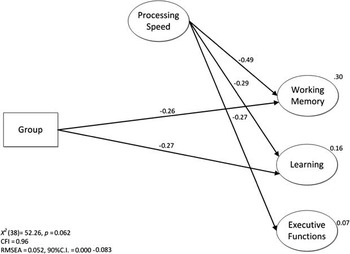
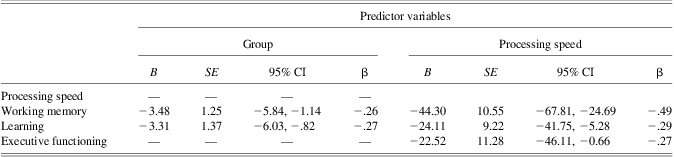
Figure 1 illustrates the structural model used to test the hypothesis that processing speed functions as a mediator between the effects of MS and other cognitive functions. Because it seemed logical to assume the individual cognitive functions would be related, correlated disturbance terms for the factors without direct effects on one another were also included in the structural models. Four path estimates did not meet the criterion for significance: the direct effects of group on processing speed and executive functioning, the direct effect of processing speed on executive functioning, and the covariance between the disturbance terms associated with learning and executive functioning. Thus, these paths were removed from the final model.Footnote 2 The final model fit the data well, χ2(38) = 52.26, p = .062; CFI = .96; RMSEA = .052, 90% CI = .000–.083. The final model including standardized coefficients is illustrated in Figure 4. Table 3 presents the estimated coefficients, standard errors, and confidence intervals for the effects included in the final model. In sum, the hypothesis that processing speed is a mediator of the MS-related effects on other cognitive functions in early relapsing-remitting MS was not supported because of the absence of a significant direct effect of group membership on processing speed. The relations were unaffected in an additional analysis that accounted for depression and fatigue.
The final Original Relative Consequence Model including standardized coefficients. The numbers above the arrows correspond to standardized regression coefficients. The numbers to the right of the dependent factors correspond to squared multiple correlations. Error terms and associated correlations are not shown. All path estimates are significant; nonsignificant paths have been removed.

Path coefficients and confidence intervals for the final Original Relative Consequence Structural Model
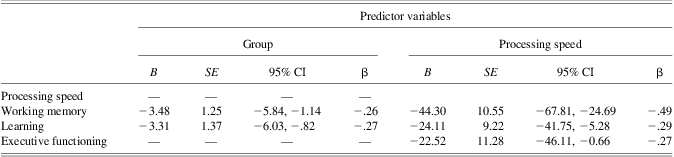
Note. B = unstandardized coefficient; SE = standard error; 95% CI, 95% confidence interval; β, standardized coefficient; —, nonsignificant and removed from final model.
Expanded Relative Consequence Model
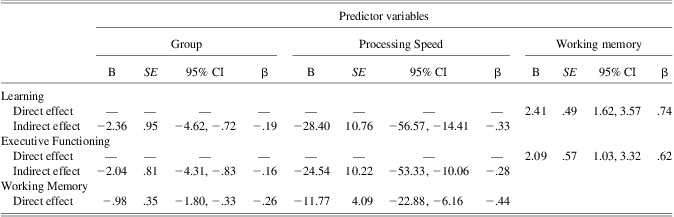
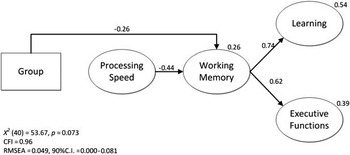
Figure 2 illustrates the structural model used to determine if working memory mediates the deficits that MS patients show in other cognitive functions. With working memory assigned as a mediating factor, six path estimates did not meet the criterion for significance: the three direct effects of group on the cognitive factors other than working memory, the two direct effects of processing speed on the cognitive factors aside from working memory, and the covariance between disturbance terms for learning and executive functioning. These paths were removed from the final model except for the covariance between the disturbance terms of the learning and executive functioning factors because this path did approach significance (p = .087) and removing it actually resulted in slightly poorer fit. The final model fit the data well, χ2(40) = 53.67, p = .073; CFI = .96; RMSEA = .049, 90% CI = .000–.081. The final model including standardized coefficients is illustrated in Figure 5. Table 4 presents the estimated coefficients, standard errors, and confidence intervals for the effects included in the final model.Footnote 3 In sum, the findings support the hypothesis that working memory plays a mediating or intervening role in the MS-related effects on cognitive functioning in early relapsing-remitting MS. The relations were unaffected in an additional analysis that accounted for depression and fatigue.
Path coefficients and confidence intervals for the final Expanded Relative Consequence Structural Model
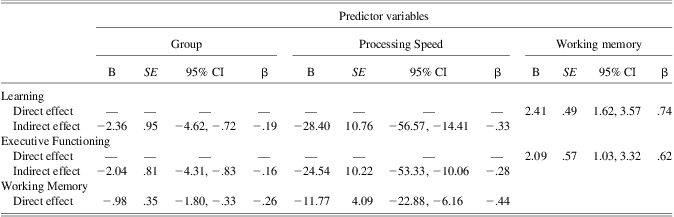
Note. B, unstandardized coefficient; SE, standard error; 95% CI, 95% confidence interval; β, standardized coefficient; —, nonsignificant and removed from final model.
Discussion
The primary goal of the study was to test two models of the relation between MS and cognitive functioning for individuals with early relapsing-remitting MS. The results of the Original Relative Consequence Model indicated that group membership did not predict processing speed in the present sample, and thus, processing speed could not play any mediating role in the MS-related effects on other cognitive functions. In contrast, group membership did predict working memory and learning such that the presence of MS was associated with poorer ability. Furthermore, a role for working memory as a mediating or intervening factor for cognitive functioning in early relapsing-remitting MS was supported by the results of the Expanded Relative Consequence Model. Through reduced working memory ability, MS was associated with worse learning and executive functioning abilities. In contrast to the results of the Original Relative Consequence structural model, the direct effect of group on learning was not significant when working memory was assigned as a mediator. This finding is strong evidence for the mediating role of working memory in the relation between MS and learning.Footnote 4 Because a direct effect of group membership on executive functioning was never observed, the significant indirect path between group and executive functioning indicates that working memory functions as an intervening variable. Specifically, the deleterious effect of MS on working memory is partially transferred to executive functioning but it was not sufficient to produce a significant between group difference (Hayes, Reference Hayes2009).
In contrast to numerous other studies (e.g., Archibald & Fisk, Reference Archibald and Fisk2000; Demaree, DeLuca, Guadino, & Diamond, Reference Demaree, DeLuca, Gaudino and Diamond1999; Denney, Lynch, Parmenter, & Horne, Reference Denney, Lynch, Parmenter and Horne2004; Lengenfelder et al., Reference Lengenfelder, Bryant, Diamond, Kalmar, Moore and DeLuca2003, Reference Lengenfelder, Chiaravalloti, Ricker and DeLuca2006), the participants did not experience significant cognitive slowing. Processing speed may be more impaired in individuals with more severe MS or longer disease duration. Patients with relapsing-remitting MS exhibit milder processing speed deficits than those with other forms of the disease (Benedict et al., Reference Benedict, Cookfair, Gavett, Gunther, Munschauer, Garg and Weinstock-Guttman2006; De Sonneville et al., Reference De Sonneville, Boringa, Reuling, Lazeron, Ader and Polman2002; Huijbregts, Kalkers, de Sonneville, de Groot, & Polman, Reference Huijbregts, Kalkers, de Sonneville, de Groot and Polman2006; Potagas, et al., Reference Potagas, Giogkaraki, Koutsis, Mandellos, Tsirempolou, Sfagos and Vassilopoulos2008), and short disease duration is associated with more subtle cognitive deficits as well (Deloire et al., Reference Deloire, Salort, Bonnet, Arimone, Boudineau, Amieva and Brochet2005). Other studies have also used different measures of processing speed that are more likely to be confounded with other cognitive abilities, thereby increasing the likelihood of finding significant group differences. Although our chosen processing speed tasks may have decreased the likelihood of observing group differences in comparison to more complex processing speed measures (Chiaravalotti et al., 2003; Parmenter et al., Reference Parmenter, Shucard and Schucard2007), this approach helps to avoid the mistake of attributing significant findings resulting from confounds of higher-level cognitive abilities to processing speed. Thus, the absence of impaired processing speed in the present sample may reflect a combination of: (1) a homogeneous sample of patients with relapsing-remitting MS and short disease duration, and (2) use of processing speed measures that are relatively less confounded by other cognitive abilities. Given the absence of impaired processing speed in the present sample, the results should not be generalized to MS patients who do experience substantial cognitive slowing. For such individuals, it is possible that speed may contribute to deficits in other cognitive functions. Consistent with previous research (Fry & Hale, Reference Fry and Hale1996; Kail, Reference Kail2006), the results of the Original Relative Consequence Model showed that processing speed was a significant predictor of working memory and learning for all participants regardless of neurological status. Therefore, it seems likely that cognitive slowing would impede working memory and learning abilities for those MS patients with impaired processing speed.
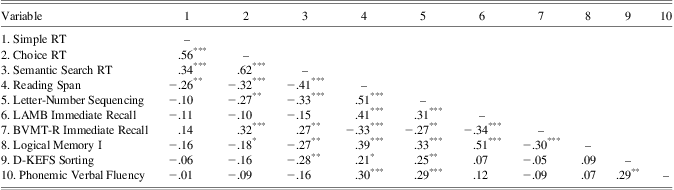
Although the reaction time tasks were considered to be relatively less confounded than other measures that have been used, there is no such thing as a pure measure of processing speed. The correlations of the reaction time tasks with some of the other types of variables (Appendix A) may have arisen because of the influence of additional cognitive functions. Although the correlations may also reflect that processing speed is a general ability that influences performance on many different types of tasks (Salthouse & Madden, Reference Salthouse and Madden2008). Regardless, although some relations with other types of variables were observed, the reaction time tests were more strongly correlated with one another. Thus, the latent processing speed factor identified in the structural equation models will predominantly represent the common processing speed variance among the reaction time measures while the influence of other cognitive abilities will be minimized. The results of the measurement model are consistent with this interpretation because a factor identified by the reaction time tasks emerged that was independent and differentiable from the other cognitive factors and it was not necessary to allow any of the reaction time tasks to cross-load on the other factors.Footnote 5
The PASAT and SDMT were also administered in the present study and the proportion of patients identified as impaired on these two measures is similar to other samples of patients with early relapsing-remitting MS (Glanz et al., Reference Glanz, Holland, Gauthier, Amunwa, Liptak, Houtchens and Weiner2007; Portaccio et al., Reference Portaccio, Amato, Bartolozzi, Zipoli, Mortilla, Guidi and De Stefano2006). Group comparisons revealed that the MS patients performed worse than controls on the PASAT whereas the groups were comparable on the SDMT. Thus, tests that are termed processing speed measures in the neuropsychological literature may form a continuum according to the extent that performance draws on multiple cognitive functions, with the CTIP existing toward one end, the PASAT at the other, and the SDMT falling somewhere in between. In support of this notion, there is evidence that the PASAT requires greater working memory capacity than the SDMT (Forn et al., Reference Forn, Belenguer, Belloch, Sanjuan, Parcet and Avila2011). This may explain why the MS patients in the present study performed worse than controls on the PASAT but were comparable on the SDMT. Although the multifactorial nature of tasks like the PASAT and SDMT contributes to their sensitivity to general cognitive dysfunction and to their utility as screening measures, any attempt to attribute performance to a single cognitive process, such as speed of information processing, is unwarranted.
Although working memory impairment has been acknowledged as a fundamental cognitive deficit for patients at later stages of the disease course, there are reports that only processing speed is impaired in early stages (Archibald & Fisk, Reference Archibald and Fisk2000; DeLuca et al., Reference DeLuca, Chelune, Tulsky, Lengenfelder and Chiaravalloti2004). However, our results are consistent with other studies reporting reduced working memory ability in patients with relapsing-remitting MS (Gmeindl & Courtney, Reference Gmeindl and Courtney2012; Parmenter et al., Reference Parmenter, Shucard and Schucard2007). Working memory demands draw upon a distributed network of brain regions (Baddeley, Reference Baddeley2003; Wager & Smith, Reference Wager and Smith2003; Woodward et al., Reference Woodward, Cairo, Ruff, Takane, Hunter and Ngan2006). Thus, working memory ability will be related to both the integrity of the cells comprising the relevant brain regions as well as the connections that allow the regions to function together as a network. Similar to processing speed, working memory performance in MS has been associated with magnetic resonance imaging (MRI) correlates of white and gray matter damage (Covey, Zivadinov, Shucard, & Shucard, Reference Covey, Zivadinov, Shucard and Shucard2011; Foong et al., Reference Foong, Rozewicz, Quaghebeur, Davie, Kartsounis, Thompson and Ron1997; Sepulcre et al., Reference Sepulcre, Masdeau, Pastor, Goni, Barbosa, Bejarano and Villoslada2009). Such pathology is present even from the earliest stages of the disease (Audoin et al., Reference Audoin, Guye, Reuter, Au Duong, Confort-Gouny, Malikova and Ranjeva2007, Reference Audoin, Zaaraoui, Reuter, Rico, Malikova, Confort-Gouny and Ranjeva2010; Chard et al., Reference Chard, Griffin, Rashid, Davies, Altmann, Kapoor and Miller2004; De Stefano et al., Reference De Stefano, Matthew, Fillipi, Agosta, DeLuca, Bartolozzi and Smith2003; Riccitelli et al., Reference Riccitelli, Rocca, Pagani, Martinelli, Radaelli, Falini and Filippi2012). Therefore, it is plausible that working memory deficits can exist for individuals with early relapsing-remitting MS.
In conclusion, the results of the present study suggest that the previously held perception of the pattern and sequence of cognitive deficits in MS may be incorrect. Clinicians and researchers need to consider the possibility that working memory may be impaired in MS and may contribute to dysfunctional cognition early on. Furthermore, clinical and research assessments should include valid measures of working memory ability for all patients. Although the focus on a relatively homogeneous group of individuals with relapsing-remitting MS is a strength of the present study, the homogeneity of the sample also means that the results should not be generalized to all stages and subtypes of MS. Instead, researchers should examine the relations that exist at other disease stages. For patients with more severe forms of MS, it is expected that processing speed will be significantly slowed and that the disease will affect working memory processes in two ways, first, indirectly by slowing cognitive processing and second, directly by affecting the neurological substrates of the working memory system (i.e., Figure 2).
The final expanded Relative Consequence Model including standardized coefficients. The numbers above the arrows correspond to standardized regression coefficients. The numbers to the right of the dependent factors correspond to squared multiple correlations. Error terms and associated correlations are not shown. All path estimates are significant; nonsignificant paths have been removed.

Acknowledgments
We thank the participants in this study for their time and effort. We also thank the staff of the MS Clinic at the Ottawa Hospital for their help with participant recruitment. This study was financially supported by the Multiple Sclerosis Society of Canada. Dr. Rees is a co-author of the CTIP and receives a small annual royalty for its use. The other authors have no conflicts of interest to disclose.
Product Moment Correlations Of Observed Variables For The Overall Sample