Introduction
Cochlear implantation has revolutionized the management of severe to profound hearing loss, offering individuals the opportunity to regain auditory function and improve their quality of life.Reference Yoon1 However, the extent to which residual hearing influences the outcomes of cochlear implantation remains a topic of ongoing research and debate. Residual hearing, defined as any remaining natural auditory function prior to implantation preserving the ability to respond to some sounds, varies widely among candidates for cochlear implantation and presents a unique challenge in predicting post-implantation outcomes.
In recent years, criteria for cochlear implantation has expanded with simultaneous development of strategies to preserve residual hearing.Reference Biever, Kelsall, Lupo and Haase2 Understanding the effect of residual hearing on cochlear implantation outcomes is crucial for optimizing patient selection criteria, counselling, and rehabilitation strategies. While some studies suggest that residual hearing may positively influence speech perception and overall implantation success, others indicate that it may have limited impact or even pose challenges during the adaptation process. Not much studies have tracked and compared the growth of patients with and without residual hearing receiving cochlear implant.
This research aims to comprehensively investigate the relationship between residual hearing and cochlear implantation outcomes through a multi-dimensional analysis. By examining factors such as audiometric profiles, speech perception abilities, subjective parent experiences, and long-term language outcomes, this study seeks to provide valuable insights into the complex interplay between residual hearing and cochlear implantation success.
Materials and methods
Study design
The study, conducted at the Department of Otorhinolaryngology and Head Neck Surgery and RUAS (Rehabilitation Unit for Audiology and Speech Pathology) at tertiary centre employed an ambispective observational design to investigate the effect of residual hearing on cochlear implantation outcomes. Prelingually deaf patients undergoing evaluation in the preoperative period were considered for inclusion. All participants received hearing aid amplification and hearing, speech, and language rehabilitation therapy prior to cochlear implantation consideration. Cochlear implantation was pursued if no improvement was observed with conventional therapy, and if parents were committed to auditory and speech rehabilitation for their child.
Participant groups
The study included 48 participants between 3–8 years of age with prelingual onset of SNHL. Prospective Group included 29 patients meeting the criteria who underwent unilateral cochlear implantation between March 2022 and March 2023, comprising 10 patients with residual hearing and 19 patients without residual hearing. Retrospective Group, for studying the long term outcomes, included 19 respondents who underwent unilateral cochlear implantation between January 2019 and January 2022, comprising 9 patients with residual hearing and 10 patients without residual hearing. Patients with post-lingual onset of hearing loss, device failure or surgical site infection compromising use of the implant were excluded.
Procedures
Preoperative workup including detailed history-taking with relevant investigations was conducted. Postoperative assessment at different time intervals was done using the tools mentioned (Table 1).
Outcome Measuring Tools

Criteria for residual hearing included presence of any one of the following:
1. Presence of response to loud sounds
2. Aided audiogram within the banana curve
3. PTA/FFA threshold less than 90dB
4. Vth peak on ABR noticed till 100dB threshold
Statistical analysis was done using R version 4.3.0 (R Foundation for Statistical Computing, Vienna, Austria) . Continuous variables were summarised as median and interquartile range as appropriate. Wilcoxon rank sum test was applied to analyse and compare the outcome variables such as auditory, speech, language and communication performance scores.
Pearson’s chi-squared test was applied to find out any association of various outcome predictors like age at implantation, history of neonatal infections, inner ear anomalies and hearing aid use with residual hearing. p-value of less than 0.05 was considered statistically significant.
Results and analysis
Clinical characteristics
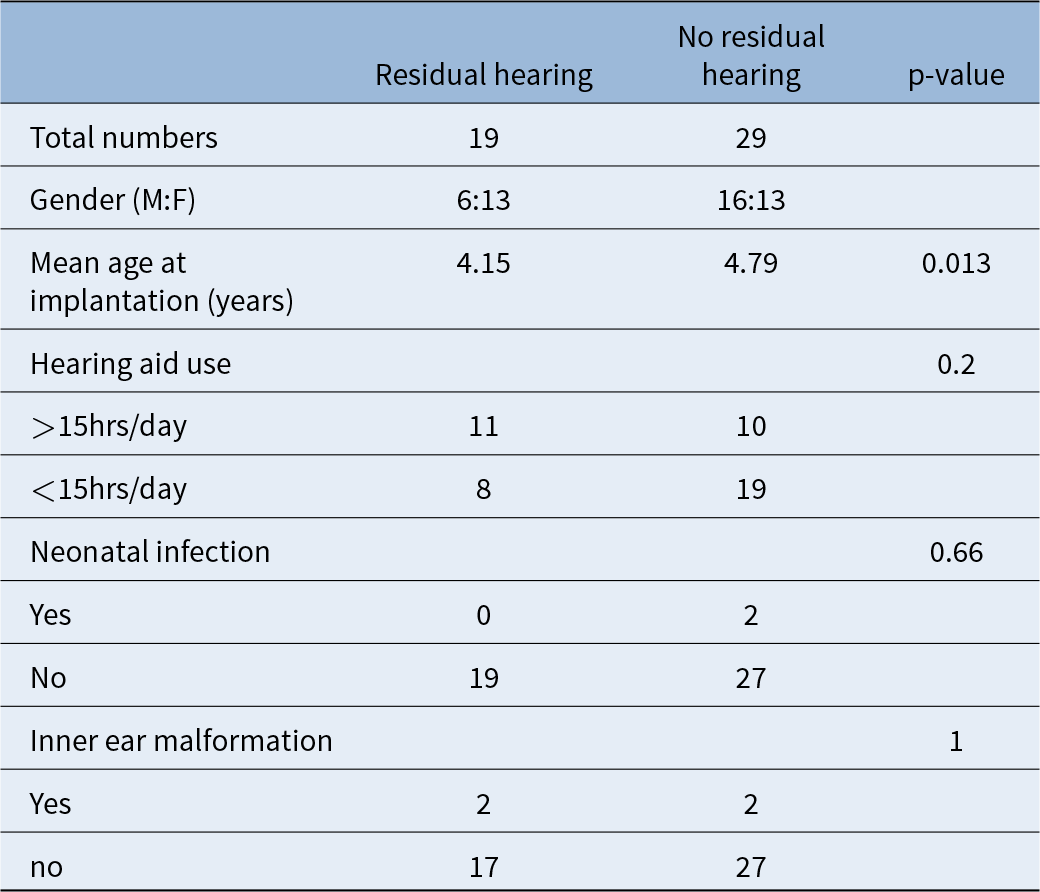
The age range of participants at the time of surgery was 3-7 years with mean ages in two groups as shown (Table 2). Most of the participants were found to have idiopathic sensorineural hearing loss. Other etiologies identified are depicted in the diagram (Figure 1). Previous studies have highlighted neonatal infections and inner ear anomalies as significant prognostic factors for cochlear implant outcomes.Reference Hashemi, Rajati, Yousefi, Ghasemi, Tayarani and Tale3 In the RH group, 6.89% had a history of neonatal infection, while none in the no RH group did. Inner ear anomalies were found in 10.52% of patients in the RH group and 6.89% in the no RH group (Table 2).
Distribution of Etiologies.

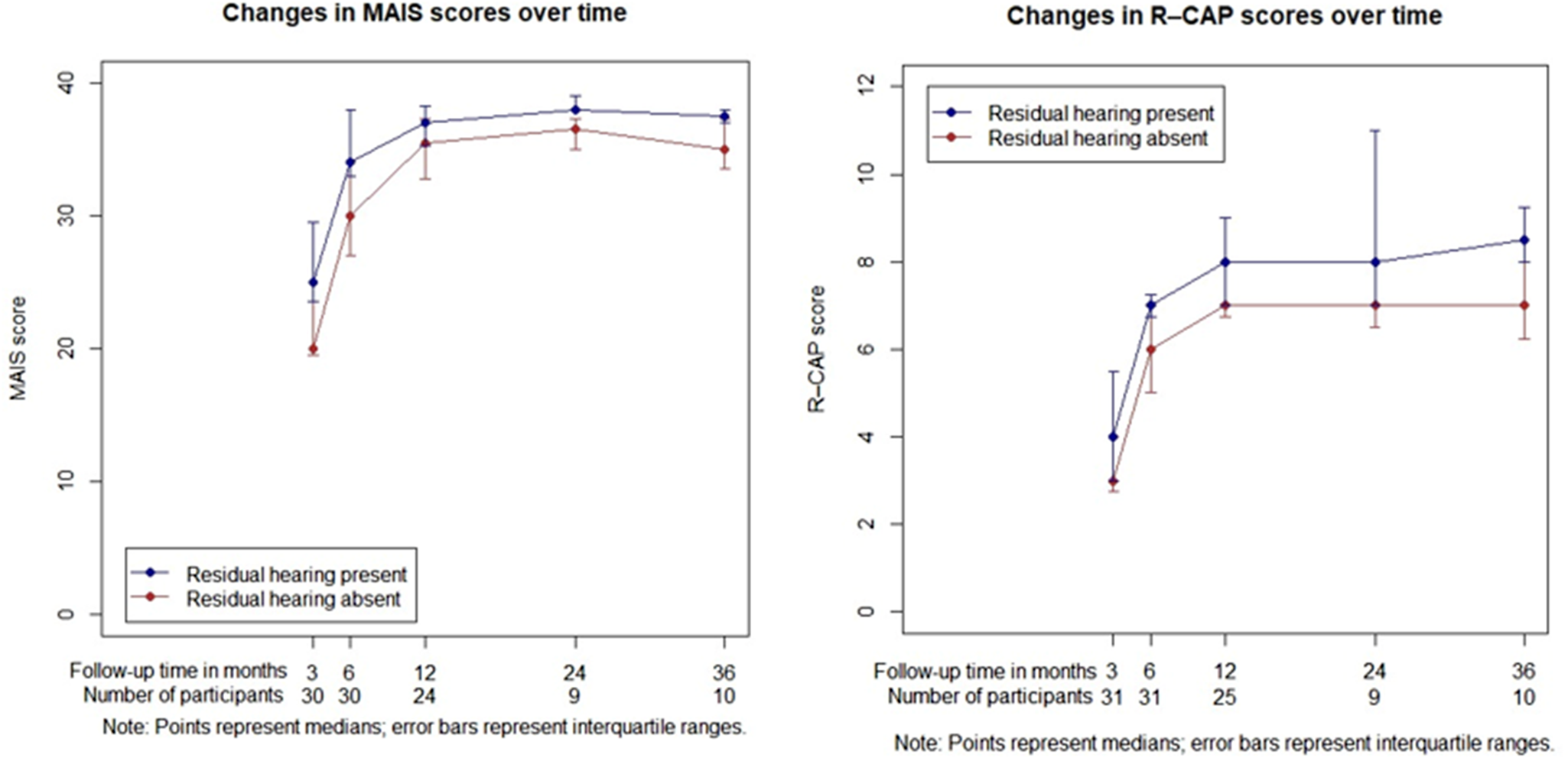
Changes in MAIS and R-CAP scores over time.

Clinical Characteristics

A relatively larger proportion of patients in the group with residual hearing (11 of 19) used hearing aids for more than 15 hours per day compared to group without residual hearing (10 of 29) (Table 2). Due to poor satisfaction with hearing aid use in pre-operative period, none of the children used hearing aid in contralateral ear post unilateral cochlear implantation.
Outcome measures in various domains were assessed at various intervals post-cochlear implantation.
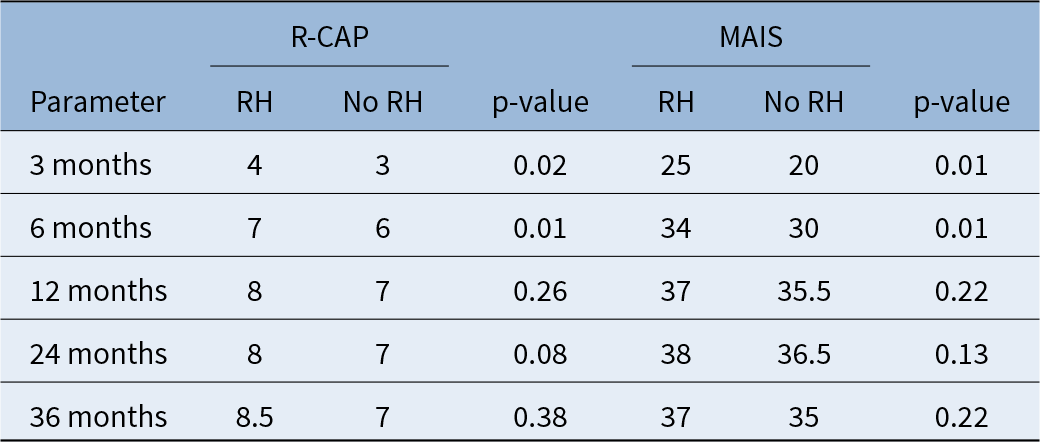
Auditory and speech perception performance was recorded at 3, 6, 12, 24, and 36 months post-implantation. At 3 and 6 months, patients with residual hearing achieved significantly higher scores compared to those without residual hearing in either domain (Figure 2). Although scores were slightly better in patients with residual hearing at later intervals, the difference was not statistically significant (Table 3).
Auditory and Speech Perception outcome scores

MAIS = Meaningful Auditory Integration Scale; R–CAP = Revised–Categorical Auditory Performance; RH = residual hearing.
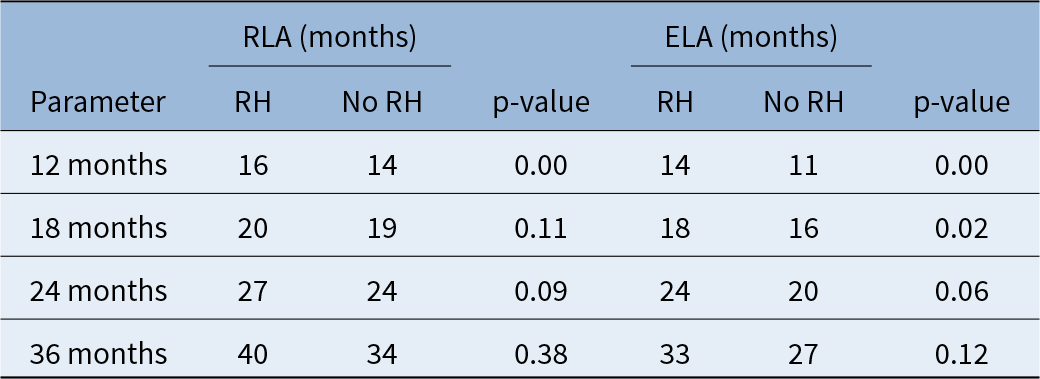
REELS scores were used to assess receptive and expressive language ages. Gradual development of language over a period of 3 years was noticed in both the groups with no closure of gap between the language age and chronological age (Figure 3). Patients with residual hearing had significantly better receptive language ages (RLA) at 12 months and expressive language ages (ELA) at 12 and 18 months (Table 4). Differences were not significant at other time intervals despite the scores being better in the candidates with residual hearing.
Changes in RLA and ELA in relation with chronological age.

Receptive and Expressive Language development scores

ELA = expressive language ages; RH = residual hearing; RLA = receptive language ages.
Parental satisfaction scores were significantly higher in patients with residual hearing at 3, 6, 12 and 36 months post-implantation (Figure 4).
Changes in Parental Satisfaction over time.

Discussion
Our study followed cochlear implant candidates over a three-year period, comparing outcomes between those with and without residual hearing. Both groups showed marked improvements in auditory, speech, language, and communication skills over time. The findings highlight the trajectory of recovery and adaptation in cochlear implant recipients and provide valuable insights into the influence of residual hearing on these outcomes.
In line with previous research, our study found that both groups exhibited rapid improvements in auditory and speech perception during the first year post-implantation. This initial improvement is consistent with the findings of Gordon etal who also observed significantly better speech perception performance till 12 months post implantation.Reference Gordon, Twitchell, Papsin and Harrison4 Candidates with residual hearing showed better early outcomes, as expected, given their pre-existing auditory capabilities. However, this advantage did not persist beyond the first year, with both groups showing comparable scores by the end of the study period. This pattern mirrors the findings of Ying Li et al., who similarly reported that while residual hearing initially enhanced performance, the gap between groups narrowed as auditory skills plateaued over time.Reference Li, Zhou, Jin, Zheng, Zhang and Liu5 A systematic review conducted by Chiossi JSC etal accessed 6 studies that showed better speech perception outcome in children with residual hearing till 12 months post implantation.Reference Chiossi and Hyppolito6
The initial boost in auditory perception likely contributed to the higher parental satisfaction scores observed in both groups during the first year. Parental satisfaction, a key measure in assessing the perceived success of cochlear implantation, was high in both groups but was especially pronounced in candidates with residual hearing. This suggests that early improvements in auditory perception are critical in shaping parental perceptions of success, even though the differences between the two groups diminished over time.
Unlike auditory and speech perception, language and communication skills developed more gradually across the three-year period. While both groups made significant progress, neither reached age-appropriate levels by the end of the study. The work of Gerard et al. also noted a gradual improvement in communication skills over time but in contrast to our study significant difference was observed between the RH and without RH group till 3 years post implantation thereafter which the gap disappeared.Reference Gérard, Deggouj, Hupin, Buisson, Monteyne and Lavis7 Some studies have also shown residual hearing as significant predictor of language outcome at later than 3 years.Reference Nicholas and Geers8
The slower progression of language development in our study may reflect differences in rehabilitation protocols or variations in the characteristics of the study population. While auditory perception improves relatively quickly after implantation, language acquisition is a more complex process that requires not only the ability to hear sounds but also the development of cognitive and communicative skills. It is possible that factors such as the intensity of speech therapy, the quality of the rehabilitation environment, and family engagement in the rehabilitation process contributed to the slower language development observed in both groups.
Despite the diminishing differences in language outcomes between the two groups, parental satisfaction remained higher in candidates with residual hearing throughout the study. This finding contrasts with some previous studies, which suggest that as outcomes converge, satisfaction tends to equalize. The sustained higher satisfaction in the residual hearing group could be attributed to parental expectations set by the early improvements seen in their children. It is possible that parents of children with residual hearing may perceive the early gains as a sign of long-term success, even if the performance gap between groups eventually narrows.
• Residual hearing is a less commonly studied factor in determining the outcomes post cochlear implantation and hence its role remains debatable.
• Pre-lingually hearing-impaired candidates with residual hearing have shown better outcomes compared to those without residual hearing but the results for growth rates in various domains and short and long-term outcomes have been variable.
• Our study showed rapid early improvement in auditory and speech perception outcomes but gradual development in language in both the candidates with and without residual hearing.
• Residual hearing influenced only short-term outcomes, while the long-term outcomes beyond 1 year of implantation were found to be comparable in both the groups.
Conclusion
Our study contributes valuable insights into the outcomes of cochlear implantation in paediatric patients with and without residual hearing. Over a three-year period, we observed significant improvements in auditory, speech, language, and communication skills in both groups, highlighting the efficacy of cochlear implantation as a means of promoting development in children with severe to profound hearing loss.
While initial differences in outcomes were observed between groups with and without residual hearing, particularly in auditory and speech perception, these distinctions diminished over time. Our findings suggest that candidates without residual hearing can achieve performance levels comparable to those with residual hearing within a relatively short period post-implantation, challenging the notion that residual hearing significantly influences long-term outcomes.
Furthermore, parental satisfaction remained high throughout the study period, reflecting the overall success of cochlear implantation in enhancing the quality of life for both children and their families. However, continued efforts are needed to educate parents about the importance of ongoing rehabilitation to optimize language and communication development in cochlear implant recipients.
Overall, our research underscores the importance of early intervention and comprehensive rehabilitation in maximizing the benefits of cochlear implantation. Further studies with larger sample sizes and longer follow-up periods are warranted to corroborate our findings and refine clinical practices, ultimately improving outcomes for paediatric cochlear implant recipients.
Acknowledgements
The authors thank Dr. Sindhura Thanneru.