Introduction
Previous research has demonstrated that methods that capitalize on preserved cognitive functions to compensate for memory impairment, such as vanishing cues and errorless learning, may be more successful in individuals with neurological damage than traditional cognitive strategies including semantic elaboration and visual imagery (Glisky, Reference Glisky2004; Wilson & Kapur, Reference Wilson and Kapur2008). The relative success of these methods provides a clear message: strategies that incorporate cognitive or memory mechanisms that are spared in neurological damage may be particularly effective.
Patient studies have revealed that knowledge of oneself is preserved in at least some memory-impaired individuals with neurological damage (Cermak & O'Connor, Reference Cermak and O'Connor1983; for a review, see Klein and Gangi, Reference Klein and Gangi2010; Rathbone, Moulin, & Conway, Reference Rathbone, Moulin and Conway2009). Although numerous studies have demonstrated robust benefits of self-referential strategies in healthy individuals (Rogers, Kuiper, & Kirker, Reference Rogers, Kuiper and Kirker1977; for a review, see Symons & Johnson, Reference Symons and Johnson1997), little research has focused on the mnemonic effect of self-referential processing in memory-impaired populations. However, recent studies have demonstrated benefits of self-referential encoding strategies in individuals who have compromised memory function including individuals with neurological damage (Marquine, Reference Marquine2009). Therefore, in contrast to traditional cognitive strategies, self-referential strategies may be particularly effective in memory-impaired individuals for at least two reasons: First, self-referential strategies typically generate substantial mnemonic enhancements, and second, memory mechanisms related to the self may be intact in many individuals with neurological damage.
In an effort to uncover a mnemonic strategy that capitalized on self-referential processing, we developed a technique that we called “self-imagination”—or the imagination of an event from a realistic, personal perspective (Grilli & Glisky, Reference Grilli and Glisky2010). In that study, we found that all 14 memory-impaired individuals demonstrated a mnemonic advantage for self-imagination in recognition memory in comparison to semantic elaboration—what we have called the self-imagination effect (SIE)—and similar results were found in the healthy controls. Additional findings from Grilli & Glisky (Reference Grilli and Glisky2010) revealed that the magnitude of the SIE was not influenced by memory functioning as measured by the General Memory Index (GMI) of the Wechsler Memory Scale (WMS-III; Wechsler, Reference Wechsler1997) or by subjective ratings of imagery vividness, although benefits of semantic elaboration were smaller in individuals with poorer memory functioning. Based on those findings, we posited that the advantage of self-imagination in recognition memory may be attributable to mnemonic mechanisms related to the self, and self-imagining may be a very effective mnemonic strategy in individuals with neurological damage.
Although the results from Grilli & Glisky (Reference Grilli and Glisky2010) were promising, questions remained regarding the utility and mnemonic mechanisms of self-imagining. For instance, although the previous study measured recognition memory after a short delay (i.e., 2 min), demands on memory in everyday life usually involve fewer environmental cues and longer delays. Furthermore, the previous study did not include an “other-imagining” encoding task, and therefore could not rule out the possibility that the SIE was partly attributable to person processing in general and not the self per se. Similarly, although imagery ratings were not significantly correlated with the SIE, the extent to which the SIE could be explained by benefits of simple visual imagery was not directly assessed.
The present study had two principal aims: (1) to investigate further self-imagination as a valid strategy for memory enhancement in individuals with neurological damage using a cued recall task and a longer delay, and (2) to investigate several alternative explanations for the mnemonic mechanisms underlying self-imagining. On the basis of our previous study (Grilli & Glisky, Reference Grilli and Glisky2010), we predicted that self-imagining would result in greater cued recall than visual imagery, semantic elaboration, and other-imagining. We predicted further that the advantage of self-imagining over the other encoding strategies would not be dependent on memory functioning.
Methods
Participants
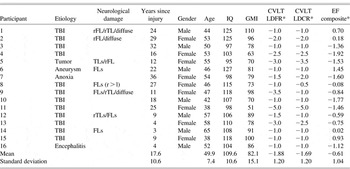
Sixteen individuals, ages 38 to 65 (7 male/9 female), with neurological damage of mixed etiology (12 with traumatic brain injury [TBI]) participated in the study. Individuals were recruited from the pool of participants in our laboratory, 11 of whom participated in a previous study (Grilli & Glisky, Reference Grilli and Glisky2010). All participants had a self-reported decline in memory functioning related to their brain injury and were at least 1 year post-trauma. Table 1 shows the demographic information and neuropsychological test measures.
Descriptive characteristics for individuals with neurological damage

Note. TBI = traumatic brain injury; r = right; l = left; FL = frontal lobe; TL = temporal lobe; CVLT = California Verbal Learning Test; LDFR = Long delay free recall; LDCR = Long delay cued recall; EF = Executive functioning; * = data represent z-scores.
Neuropsychological Measures
Participants were administered neuropsychological tests to measure intellectual function (North American Adult Reading Test; Spreen & Strauss, Reference Spreen and Strauss1998), memory function (Wechsler Memory Scale III [WMS-III] and California Verbal Learning Test [CVLT], Delis, Kramer, Kaplan & Ober, Reference Delis, Kramer, Kaplan and Ober1987), and executive function. All participants’ GMIs were at least 1 standard deviation below their IQs. Furthermore, in all participants except for participant 8, both the long delay free and cued recall scores from the CVLT were at least 1 standard deviation below their age- and gender-corrected mean. Patients also completed a group of tests designed to measure executive functions associated with prefrontal cortex. Because encoding and retrieval strategies depend at least partly on prefrontal brain regions and many of our participants had damage to these areas, we wanted to assess whether impaired executive function might also affect their ability to benefit from self-imagination. We therefore constructed a composite measure of executive function based on five tests previously found to cluster together in factor analysis (Glisky, Polster, & Routhieaux, Reference Glisky, Polster and Routhieaux1995; Glisky, Rubin, & Davidson, Reference Glisky, Rubin and Davidson2001) and hypothesized to reflect some aspects of executive function associated with working memory (Glisky & Kong, Reference Glisky and Kong2008). These tests included Modified Wisconsin Card Sorting Task (WCST) (Hart, Kwentus, Wade, & Taylor, Reference Hart, Kwentus, Wade and Taylor1988), Mental Control (WMS-III), Mental Arithmetic from the Wechsler Adult Intelligence Scale – Revised (WAIS-R) (Wechsler, Reference Wechsler1981), the FAS test of word fluency (Spreen & Benton, Reference Spreen and Benton1977), and Digit Span Backwards (WMS-III). The composite score for each individual represents the unweighted average of the Z-scores for the five tests. Z-scores were based on published normative data for each neuropsychological test.
Individuals completed the neuropsychological testing when they initially enrolled in our laboratory with 12 of the patients tested within 2 years of participating in the present study. All individuals were at least 1.5 years post-injury at time of testing and were deemed to be cognitively stable at that time.
Materials
Experimental stimuli were 64 object–location word pairs which were separated into 4 lists of 16 matched on concreteness, imageability, and length. The object words were selected through the MRC Psycholinguistic Database Version II (Coltheart, Reference Coltheart1981) and were previously rated on concreteness and imageability (on scales ranging from 100 to 700). Object words were rated as highly concrete with a mean concreteness rating of 597.05 and highly imageable with a mean imageability rating of 589.72. Object words were matched with unique spatial locations that, based on pilot testing, were rated as moderately related to the objects. Examples of word pairs are “crown–museum” and “typewriter–attic.” Word pairs were randomly mixed for each participant and presented visually on a HP laptop computer with DMASTR DirectX (DMDX; Forster & Forster, Reference Forster and Forster2003).
Procedures
Participants provided written informed consent before taking part in the study, and all data were collected in compliance with regulations of the University of Arizona Institutional Review Board. The study was divided into two sessions administered 1 week apart. Each session was approximately 60 min in duration and consisted of two study-test phases, one for each encoding condition. To limit carry-over effects, the first study phase in each session was either a visual imagery or a semantic elaboration encoding condition and the second study phase was either another-imagining or a self-imagining encoding condition. Word pairs were counterbalanced across encoding conditions, and encoding conditions were counterbalanced across sessions such that visual imagery and semantic elaboration were paired with other- and self-imagining an equal number of times. Each study phase consisted of 16 target word pairs presented between two primacy and two recency buffer word pairs and was preceded by three practice trials so that participants were fully informed of the nature of the memory test.
Target word pairs were presented one at a time in the middle of the screen for seven seconds before a “beep” signaled the conclusion of the trial. In the visual imagery study phase, participants were instructed to form a visual image of the object in the spatial location and maintain the visual image for the remainder of the trial. In the semantic elaboration study phase, participants were instructed to generate a sentence that incorporated the object and spatial location in a meaningful way and to say the sentence aloud. In the other-imagining study phase, participants were instructed to imagine with as much detail as possible Arnold Schwarzenegger interacting with the object in the spatial location. Participants were encouraged to imagine the event realistically and as though it could actually take place. Arnold Schwarzenegger was selected for the other-imagining task because he is generally well known for his roles in a variety of contexts (i.e., actor, politician, and athlete) and he has experienced a relatively high degree of exposure in multiple media outlets for the past several decades. All participants were able to form a vivid visual image and demonstrate general knowledge of Arnold Schwarzenegger. In the self-imagining study phase, participants were instructed to imagine themselves interacting with the object in the spatial location. Participants were encouraged to imagine the event from a realistic, personal perspective by including thoughts, feelings, and sensory experiences that they themselves might have if they were actually interacting with the object in the spatial location. In all encoding conditions, the instructions appeared on the top of the screen for each trial, and in the visual imagery, other-imagining, and self-imagining study phases, participants were encouraged to close their eyes to assist in image construction, but this was not mandatory.
Each study phase was followed by 2 min of counting backward followed immediately by a cued recall test for the 16 target word pairs presented in the study phase. Object words were presented visually as cues and participants had to recall aloud the spatial location word that was paired with each object word. These short delay cued recall tests were self-paced such that participants had as much time as they needed to name the location word or say that they could not remember. Responses were recorded by the experimenter, but no feedback was provided. After completion of the short delay cued recall test for the second study phase in a session, participants were engaged in a 30-min computerized trivia game, which required participants to answer multiple-choice general knowledge questions. The trivia game was followed by a long delay, self-paced cued recall test for the 16 target word pairs that were from the first study phase and then the 16 target word pairs that were from the second study phase. Instructions for the long delay cued recall tests were the same as the short delay tests.
Results
Effects of Encoding Conditions and Delay on Cued Recall in Individuals with Neurological Damage
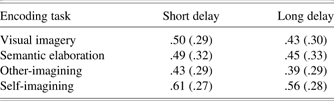
Table 2 shows mean cued recall performance for the brain-injured individuals. A 4 (encoding condition) × 2 (delay) repeated measures analysis of variance (ANOVA) revealed a significant effect of encoding condition, F(3,45) = 5.05; p < .01; η2 = .25; a significant effect of delay, F(1,15) = 22.84; p < .001; η2 = .60; and no interaction, F < 1. Subsequent contrasts revealed that self-imagining enhanced cued recall more than visual imagery, F(1,15) = 11.09; p < .01; η2 = .43; semantic elaboration, F(1,15) = 6.36; p < .05; η2 = .30; and other-imagining, F(1,15) = 17.94; p < .001, η2 = .55. In addition, semantic elaboration performance did not differ from visual imagery or other-imagining, both Fs < 1; nor did visual imagery differ from other-imagining, F(1,15) = 2.69; p = .12. Furthermore, participants showed a decline in performance across the 30-min retention interval that did not differ as a function of encoding condition.
Mean proportion correct in short (2 min) and long (30 min) delayed cued recall (and standard deviations) in the visual imagery, semantic elaboration, other-imagining, and self-imagining conditions

Relation of SIE to Neuropsychological Functioning
Pearson product-moment correlations were performed to examine whether the SIE was correlated with memory functioning as measured by GMI scores, with IQ, or with executive functioning as measured by the composite score. The SIE was derived by averaging performance (i.e., collapsed across short and long delayed cued recall) in the other three encoding conditions (i.e., other-imagining, semantic elaboration, and visual imagery) and subtracting it from performance based in the self-imagining condition. GMI scores were non-significantly correlated with the SIE, r = −.34, p = .19, indicating that the advantage of self-imagining over the other encoding conditions was not attenuated by severity of memory impairment. In fact, similar to our previous study (Grilli & Glisky, Reference Grilli and Glisky2010), the negative correlation suggested that the SIE was slightly larger in individuals with poorer memory functioning. The SIE was not significantly correlated with IQ, r = .05, p = .85; or executive functioning, r = −.04, p = .89.
Discussion
The findings from the present study provide new evidence that self-imagining elicits a robust advantage over and above other encoding strategies and that this benefit occurs irrespective of memory functioning and in a cued recall memory task. Although the rate of decline in self-imagining was not significantly different from the other encoding strategies, the advantage of self-imagining was preserved after a relatively long, 30-min delay. Therefore, although additional research is necessary to explore further the feasibility of implementing self-imagining in memory rehabilitation, these results indicate that self-imagining had an advantage over other cognitive strategies, even in individuals with relatively poor memory functioning.
The present study also sheds some light on the potential mnemonic mechanisms of the SIE, and calls into question several possible explanations for the advantage of self-imagining. Indeed, although self-imagining may involve a visual imagery component and elaborative processing, the mnemonic advantage of self-imagining appears not to be attributable solely to either of these cognitive processes. Furthermore, the present results indicate that self-imagining provides benefits beyond those that might be associated more generally with person processing. Instead, the findings from the present study suggest that the advantage of self-imagining over these other strategies may be a result of encoding and retrieval mechanisms related to the self, which may be preserved in individuals with neurological damage. Of course, further research is necessary to explore more directly the mechanisms underlying the SIE and to address alternative explanations. For example, the present study cannot rule out the possibility that the advantage of self-imagining may be related to intimate knowledge of a person and not the self per se. Furthermore, the effect of including personal thoughts, feelings, and sensory experiences remains unclear since the other-imagining instructions did not require participants to simulate Arnold Schwarzenegger's thoughts and feelings.
Conclusions
The present study further validates self-imagining as a method for improving memory in individuals with neurological damage. However, only 16 individuals with neurological damage were tested, memory impairment was variable among participants, and a majority of the individuals in the present study experienced their neurological damage from TBIs. In addition, 11 of the individuals from the present study participated in Grilli and Glisky (Reference Grilli and Glisky2010), and we, therefore, cannot rule out the possibility that these results may reflect some idiosyncrasy of the sample of patients. However, we think this is not likely given the fact that we have demonstrated similar benefits in healthy controls (Grilli & Glisky, Reference Grilli and Glisky2010).Footnote 1 Nevertheless, additional research is needed to replicate the SIE in a different sample of patients and to investigate whether benefits of self-imagining are experienced by individuals with brain injuries of different etiologies. The findings from the present study, however, are promising and suggest that self-imagination may provide a particularly effective method for memory rehabilitation.
Acknowledgments
This research was supported by National Institute on Aging Grant AG14792. The authors have no conflicts of interest.