INTRODUCTION
Sovereignty is a defining characteristic of the contemporary international system, but it is often contested.Footnote 1 Numerous secessionist movements around the world are pursuing their own states, while a number of established states fear external intervention, or losing their territory to internal secession. The Israeli-Palestinian conflict is arguably the world's highest profile conflict over sovereignty and statehood. Although this conflict has been analyzed from many angles, this article studies it from a different perspective through an analysis of the determinants of decisions by United Nations member states whether to recognize Palestine and/or Israel as sovereign states, and whether to support an upgrade in Palestine's status at the United Nations.
Many analysts believe that whether or not an aspiring state will join the club of nations depends on “the situation on the ground.” According to this argument, if the aspirants to statehood exercise control, they are likely to be universally recognized as an independent state. By contrast, if their opponents defeat them militarily, their claim to independence is likely to remain unrecognized. The case of the Israeli-Palestinian conflict is problematic for the “facts on the ground” perspective. Israel is firmly in control of its (pre-1967 borders) territory, and yet more than 30 countries do not recognize it as an independent state. Palestinian authorities do not independently control the territory they claim for a Palestinian state, but the Palestinian claim to statehood is recognized by more than a 100 United Nations member states. If not the facts on the ground, what explains why some countries recognize Israel but not Palestine, and vice versa?
The goal of this article is to develop a coherent set of theory driven expectations regarding this decision, and then to examine these predictions in the context of the Palestinian-Israeli conflict, where the issue of international recognition has not been systematically scrutinized, to the best of our knowledge. Israel and Palestine are important cases for the question of international recognition, since Israel is a United Nations member with the largest number of non-recognitions from other United Nations member states, and Palestine is the United Nations non-member with the largest number of recognitions by United Nations members. A paired comparison of these cases provides extensive variation under two different circumstances: that of an aspiring state that enjoys widespread recognition (Palestine) and that of an established state that lacks universal acceptance (Israel). Moreover, recognition decisions regarding Palestine and Israel should be studied together, we suggest, because they are interrelated: e.g., a country's decision to recognize Palestine may lower the likelihood that that country will recognize Israel, and vice versa.
The relevance of contested recognition issues is not limited to Palestine and Israel. Cases around the world — from Abkhazia, Crimea and Kosovo to Taiwan and Western Sahara — suggest that the problem of contested recognition imbues a growing set of locations around the world, but we limit our aims in this analysis to understanding the case of Palestine and Israel, and leave the question of generalizability to future research on contested recognition. In studying international recognition, past studies have focused on the great powers, but there are at least two reasons that it is crucial to examine the recognition decisions of all countries. First, although great powers can influence other countries, the process of becoming a member state of the United Nations involves securing approval of two-thirds of United Nations General Assembly members.Footnote 2 Not surprisingly, aspiring states actively lobby other countries, both large and small, for their recognition (Rich Reference Rich2009). This implies that the recognition decisions of even “small states” matter. Second, examining the recognition decisions of all states allows us to assess broader questions about how states balance the demands of their allies, adversaries and domestic political constraints (Gvalia, Siroky, Lebanidze and Iashvili Reference Siroky, Lebanidze and Iashvili2013).
In the next section, we develop a simple conceptual framework to study international recognition decisions. We elaborate arguments about how religious institutions and transnational religious affinities influence the decision to extend or withhold recognition, and show how these claims relate to other expectations in the literature. We next present our data and methods to test four observable implications of the theoretical framework, and then discuss our main findings. The last section summarizes the article's contribution to this growing field and considers the implications of this study for future research.
RELIGION AND RECOGNITION: DOMESTIC AND TRANSNATIONAL MECHANISMS
We posit two levels at which religion may shape recognition decisions — domestic religious institutions and transnational religious affinities. Religious institutions vary in the degree to which they regulate religious life in a given country. States that heavily regulate religion may do so because of a perceived vulnerability to domestic threats from groups adhering to other religions. When a non-core group that is culturally (ethnically and/or religiously) distinct successfully challenges another state, extending recognition to the aspiring state may set a precedent and embolden non-core groups at home. Previous scholarly work has found that “demonstration effects” can play a significant role in stimulating secession; that is, one key region's separatist actions tend to encourage other regions to behave similarly (Hale Reference Hale2000). States that perceive themselves as vulnerable to non-core groups, both religious and ethnic, should therefore prefer to keep Pandora's Box closed by withholding recognition from aspiring states abroad and emphasizing the principle of territorial integrity (Zartman Reference Zartman1966, 109). This claim extends the theory of domestic vulnerability, which argues that nation-states facing threats from secessionists at home will be less likely to support secessionists abroad, for fear of legitimizing the act of secession and sending mixed signals to domestic audiences and minority groups at home (Touval 1972; Jackson and Rosberg Reference Jackson and Rosberg1982; Herbst 2000; but see Saideman Reference Saideman1997; Reference Saideman2001; Reference Saideman2002; Reference Saideman2007).
While the original “domestic vulnerability” thesis was applied to external support for secessionists, which often takes clandestine forms that the public does not directly observe, recognition is a distinct form of external support that is directly observable to the public in the recognizing state. Recognition decisions may send a relatively clear signal to domestic audiences (Coggins Reference Coggins2011; Walter Reference Walter2006). Applying this argument to the study of international recognition, we theorize that countries facing such a threat will be less likely to recognize an aspiring state for fear of setting a precedent that would embolden aggrieved groups at home.
Extending parts of this logic from ethnicity to religion, we suggest that states that heavily regulate religion will tend to demur from extending recognition to all identity-based minority groups in other states. Many states feel threatened by non-core religious groups, especially those that proselytize, independently of whether they are vulnerable to ethnic secessionists.Footnote 3 Some states heavily regulate religious proselytization within their territory, and punish transgressors — both through official, governmental mechanisms, such as laws that restrict proselytization, and via informal, socially enforced norms. Other states adopt a relatively tolerant approach toward religious diversity.
Governments that perceive a need to restrict proselytization may be responding to real, perceived or anticipated threats from a minority group (ethnic or religious) group in order to restrict that group's potential influence. For example, China regulates Islam in Xinjiang province, including administrative controls of religious teachings and the distribution of religious materials, and requires that individuals in charge of scripture classes support both the Communist Party leadership and the “unity of all nationalities and the unification of the motherland.” The activities of Falun gong, which the Chinese authorities brand as a sect, are also highly regulated and restricted in China (Potter Reference Potter2003). Horowitz (Reference Horowitz1985, 222) argues that groups whose sense of group worth is threatened will sometimes seek to impose the religion most members of that group identify with on others, and to formalize it as the country's official religion.
Such concerns are of course not the only determinant of why some countries engage in extensive religious regulation. Previous research has linked economic development, regime type and Islam with religious regulation (Fox Reference Fox2006). Other scholars argue that population size and the adherence rate to the main religion affect the likelihood that a state will adopt an official state religion (McCleary and Barro Reference McCleary and Barro2005). However, all else equal, countries with institutions that strictly regulate religion are less likely to recognize an aspiring state, we suggest, primarily because of the signal it would send and the precedent it might set.Footnote 4
Restrictions on religious freedom are also contrary to the status quo values in much of the developed world, and the question of whether and to what extent religious regulation is compatible with democracy is subject to a lively debate (Brathwaite and Bramsen, Reference Brathwaite and Bramsen2011; Driessen Reference Driessen2010; Fox Reference Fox2007; Sarkissian Reference Sarkissian2012). Freedom of religion is a fundamental value of the United States that is built into its institutional design, and regulation of religion may be viewed as undemocratic and inconsistent with such values. Countries that strictly regulate religion may thus oppose United States foreign policy on issues where the United States has taken a prominent position.
When the United States is in favor of recognizing an aspiring state (e.g., Kosovo or Israel), we expect countries that heavily regulate religion to be less likely to extend recognition, since both the anti-United States and the vulnerability mechanisms point in the same direction. For example, we expect countries that heavily regulate religion will be inclined not to recognize Israel, in part, because the United States is a strong supporter of Israel (the anti-status quo dimension of religious regulation), and because of a general tendency to withhold recognition in recognition disputes (the vulnerability dimension of religious regulation). When the United States is against recognizing an aspiring state (e.g., Palestine or Abkhazia), we do not expect a strong relationship between regulation of religion and the likelihood of recognizing an aspiring state, since the two mechanisms push in opposite directions. These arguments therefore lead us to predict that states with more religious regulation will be associated with a lower likelihood of recognizing Israel, but neither more nor less likely to recognize Palestine or vote for a change in its status at the United Nations.
Recognition decisions are unlikely to be independent, since the Israeli-Palestinian conflict is highly polarizing, and thus many countries see a need to choose a side by recognizing one side but not the other. If that is true, then these decisions should be conceived of and modeled jointly. According to our data, while 90 countries have recognized both Palestine and Israel, 101 countries have only recognized one and not the other (32 countries only recognize Palestine, 69 countries only recognize Israel). This interdependence leads us to posit the first hypothesis about the impact of a state's religious regulation on its recognition decisions.
Hypothesis 1:
States that heavily regulate religion are more likely to recognize only Palestine and less likely to recognize only Israel.
We also argue that religion shapes recognition decisions through transnational mechanisms. Countries that share a dominant religious identity may tend to support one another in international relations, all else equal (Sandal and Fox 2004; Ellis Reference Ellis2010). Religious affinity has also been shown to affect international involvement in civil wars (Carment, James, and Taydas 2006). Fox, James, and Li (Reference Fox, James and Li2009) argue that countries are more likely to intervene in civil wars on behalf of their co-religionists who are fighting a group or a state of a different religion. Further, they argue that this tendency is particularly pronounced for predominantly Muslim states, which rarely intervene on behalf of non-Muslim groups.
Our argument here is not that transnational religious ties necessarily trump other concerns, but that countries assist co-religionists when the cost of support is relatively low. Specifically, in regard to recognition disputes, we expect that Muslim countries will be more likely to support a Muslim group in conflict with a non-Muslim group.Footnote 5 However, when the two sides in the dispute cannot be distinguished along religious lines, we do not expect transnational religious affinity to have an effect. For example, we would not expect religious affinities to shape recognition decisions when both sides involved are majority Muslim (e.g., Morocco and the Sahrawis in the dispute over Western Sahara). Further, we do not rule out the possibility that states where the majority religion is Buddhist, Christian, or another religion, act in similar ways. For example, in the case of Kosovo, the influence of other transnational religious ties (e.g., Christian Orthodoxy) would be worth examining (Castles 1994; cf. Therborn 1994).
In short, our claims about the influence of transnational religious ties are context-dependent and probabilistic. In the context of the Israeli-Palestinian conflict, religion is a clear marker of the two sides, and we therefore expect majority Muslim countries to be more likely to back the Palestinians and less likely to back Israel. Since Israel is the world's only country where Jews are the majority, but there are many countries in which Muslims is the majority, Palestine (unlike Israel) benefits diplomatically from the presence of other nations with a shared dominant religious tradition.Footnote 6 We are not implying that the interests of the Palestinians are the only or the primary concern of governments in majority Muslim countries. Kuwait expelled about 300,000 Palestinians, for example, after liberation from Iraqi occupation (Kapiszewski Reference Kapiszewski2001). All else equal, however, we anticipate that the more Muslims are a majority, the more the country will tend to back Palestine and oppose Israel in the Israeli-Palestinian conflict.
Hypothesis 2:
The greater the proportion of Muslims in a country, the more likely the country is to recognize only Palestine and the less likely it is to recognize only Israel.
SITUATING THE ARGUMENT IN THE LITERATURE
Having described our main conjectures, we now situate these arguments within the scholarly literature on international recognition, and show how we build upon it in our analysis. We begin with research that focuses on the role of great powers and alliances. Coggins (Reference Coggins2011), for example, has shown that the preferences of great powers help determine the fate of aspiring states. The recognition decisions of great powers systematically shape the recognition decisions of other countries for two primary reasons. First, great powers can utilize the extensive economic, military, and diplomatic resources at their disposal to influence less well-endowed states by offering them selective benefits. In addition to rewards, great powers can punish other states for going against their preferences. Second, since many countries do not have a direct interest in a recognition dispute, matching the recognition position of a great power may be a relatively low cost method to curry favor with great power patrons, to receive pecuniary and other benefits and to avoid the implied costs of contravention.
The United States is arguably the foremost great power in the world today (Wohlforth 1999; Jervis 2009; Legro Reference Legro, Ikenberry, Mastanduno and Wohlforth2011; Monteiro Reference Monteiro2014; Mirilovic and Ollapally, Reference Mirilovic, Ollapaly, Nau and Ollapally2012). United States preferences and values, especially democracy, religious freedom, and free markets, profoundly shape the contemporary international system. Religiously liberal and economically developed countries are thus more likely to support the United States position, which typically favors the status quo (Paquin Reference Paquin2010), than countries with lower gross domestic product per capita or those that heavily regulate religion. Many states that heavily regulate religion are dissatisfied with an international order that values religious tolerance. States that restrict religious freedom, like autocracies that restrict political rights, may also be concerned with the possibility of external “humanitarian” interventions.
The United States is widely acknowledged to be the world's most important supporter of Israel. In terms of recognition issues, the United States was the first country to recognize Israel, and it strongly backed Israel's application for United Nations membership. Although recent United States presidents have embraced the two-state solution to the Israeli-Palestinian conflict, the United States has not recognized Palestine as a state and has threatened to veto it in the United Nations Security Council (Zunes 2012). United States allies and countries satisfied with the international status quo are more likely to be in accord with the United States position (recognize Israel and not recognize Palestine), and countries dissatisfied with the status quo are more likely to adopt the opposite position (recognize Palestine, and not recognize Israel).
The traditional view of international recognition, identified as “the decisive relative strength argument” in Coggins (Reference Coggins2011), is that variation in recognition behavior is driven by “the situation on the ground.” If the aspiring state controls the territory which it claims, the argument goes, other states will recognize it. If the aspiring state fails to control the territory that it claims, than other states will not recognize it. Insofar as states more or less agree on these facts, then the two cases analyzed in this article (and others around the world) demonstrate the strengths but also the limitations of this line of argument. While Israel, which controls the situation on the ground more than Palestine, is more widely recognized than Palestine, the difference is not as great as one might suppose. Palestine has been recognized by more than 120 United Nations member states, even though the Palestinian Authority does not fully control much of the territory that it claims. Meanwhile, Israel has been fully in control of its territory for decades, but 32 United Nations member states do not recognize it. The partial recognitions of Kosovo, Abkhazia, Taiwan, and other political entities indicate that the “facts on the ground” tell only part of the story.
Another prominent argument is that recognition decisions are driven by the choices of great powers, and that great powers tend to coordinate their recognition (or non-recognition) choices: recognition by one great power increases the likelihood of recognition by other great powers (Coggins, Reference Coggins2011, 451–453). Coggins (Reference Coggins2011, 453) posits in one of her hypotheses that “[o]nce one Great Power has granted recognition, the others are more likely to do so,” and concludes that this hypothesis is the one most strongly supported by the data (Coggins Reference Coggins2011, 471).
Empirically, the Palestine case is problematic for the great power convergence argument, since Palestine has not been recognized by the world's most powerful state — the United States — but has been recognized by the world's second most powerful state, China, and by other powers (Brazil, India, Russia). Great powers have not converged in this case, and this situation has persisted for decades — indicating a need for an alternative explanation of recognition decisions. Finally, we test the claim in Maoz (Reference Maoz1989) that richer countries exhibit a pro-status quo bias and are reluctant to admit new members to the club of sovereign states.
Our analysis examines and expands these lines of research. It unpacks how religion influences recognition decisions and shows how it operates through both domestic institutions and transnational affinities. To the best of our knowledge, the analysis below offers the first large-N, cross-national empirical test of the influence of religion on recognition decisions using new data on almost every state's decision to withhold or extend recognition in two prominent cases of contested recognition. Before proceeding to the analysis, we provide some brief background on the Israel-Palestinian conflict as it relates to recognition.
THE ISRAELI-PALESTINIAN CONFLICT
After the end of World War I, Palestine was governed as a British Mandate (Yoffie Reference Yoffie2011). After World War II, attempts to resolve the status of British Palestine were initiated at the newly created United Nations, and the United Nations General Assembly resolution No. 181 called for the partition of the British Mandate of Palestine to create a Jewish state and an Arab state (Eden Reference Eden2013). Israel declared independence in 1948; it secured admission to the United Nations as a member state in 1949 (Dowty Reference Dowty2005; Yoffie Reference Yoffie2011). The armies of several Arab states were defeated in two wars against Israel, in 1947 and in 1967, which led to several million Palestinian refugees (Sayigh Reference Sayigh2000). Following the 1967 war, Israel took control of the West Bank and Gaza. In 2005, Israel left Gaza and closed Jewish settlements that were established there. Gaza remains under an Israeli blockade, and a number of Jewish settlements remain in the West Bank.
The Palestinian leadership declared the independence of Palestine in 1988 (Eden Reference Eden2013). Under the leadership of Mahmoud Abbas, the Palestinians have adopted a strategy of intensifying their efforts to upgrade the status of Palestine at the United Nations (Diker Reference Diker2010). In November 2012, the status of Palestine was upgraded to that of a “non-member observer state” of the United Nations with the passage of United Nations General Assembly resolution No. 67/19. The resolution refers to the pre-1967 borders, which have served as the focal point for a future Palestinian state (Cerone Reference Cerone2012).
The two-state solution and the Israeli-Palestinian conflict are frequently at the top of the international agenda. The key issues of contention include the future status of Jerusalem (i.e., whether Jerusalem would be divided with East Jerusalem as the capital of the Palestinian state) and the status of Palestinian refugees (i.e., whether and, if so, to what extent they would be allowed to return to Israel). Proposals for a one-state solution are no longer prominent. Although some in the Arab world have advocated it, a majority of both Israelis and Palestinians are now opposed to this idea (Ron Reference Ron2011).
The case for the recognition of Palestine centers on the right of nations to self-determination, and on previous international agreements (e.g., United Nations General Assembly resolution No. 181) that call for a Palestinian state. The Palestinians and their supporters also point to alleged human rights violations committed by Israel to justify their claim for the recognition of Palestine. The Palestinian case has attracted substantial international support, notably from Arab and/or majority Muslim states, but also from other states, including Brazil, China, India, and Russia.
The case against recognizing Palestine states that a negotiated settlement with Israel should come first. The Israelis and their supporters claim that a premature recognition of Palestine would undermine the peace process by removing the incentive for the Palestinians to compromise and by emboldening unrealistic Palestinian demands. They also argue that the failure of the Palestinian authorities to prevent terrorist groups from attacking Israeli civilians undermines the case for an independent Palestinian state (Schaefer and Phillips Reference Schaefer and Phillips2011). The United States is the key great power supporter of Israel; France, Germany, and the United Kingdom have also recognized Israel, but not Palestine.
The pro and anti-recognition positions described above are of course generalizations that reflect some of the most prominent arguments made by the two sides. On both sides, there is a political spectrum with alternative ideas (e.g., some leaders on the Israeli right are skeptical that a two-state solution ever will or should be implemented; the statute of Hamas calls for the destruction of Israel). Yet the broad contours of the debate, as outlined above, describe the structure of the contemporary conflict and current dispute over the recognition of Palestine.
Whether or not Israel should be recognized is less controversial, for Israel is already a member state of the United Nations. Whereas 32 members of the United Nations do not recognize Israel, 70 United Nations members do not recognize Palestine. With this background on the conflict, we now proceed to the description of the evidence and methodology.
DATA DESCRIPTION AND METHODS
The analysis utilizes a new dataset that the authors constructed on the recognition of Palestine and Israel.Footnote 7 As previously argued, these outcomes are not likely to be independent of one another, and thus a single dependent variable that measures whether a country has recognized only Palestine, only Israel, or both and utilizes a multinomial modeling approach is more appropriate than separate binary logit models.Footnote 8 Given that not a single country did not recognize either Israel or Palestine, but many countries that have recognized both, we created a dependent variable with three categories: recognition of only Palestine (32 countries), only Israel (69), or both (90). The multinomial approach is also preferable to the ordered approach because it allows us to examine how the hypothesized covariates differentially influence the pro-Palestine and pro-Israel camp relative to a “neutral position” of recognizing both entities. It is also preferable because some readers might not easily find a clear order among the three categories — e.g., recognizing Palestine is not more than recognizing Israel, or vice versa. Finally, we provide an additional analysis that examines the same model's ability to predict whether or not a country voted in favor of Assembly resolution No. 67/19 to grant Palestine non-member state observer status at the United Nations in late 2012.Footnote 9
To operationalize our key theoretical constructs, we collected data from a variety of publicly available sources. To measure the concept of religious regulation, we use an indicator of the extent to which religion is regulated with an additive index from the Association of Religion Data Archives (ARDA), a prominent source for scholars interested in the study of religion that has been subjected to extensive verification (Finke and Adamczyk Reference Finke and Adamczyk2008). The first component of the additive index is the Government Regulation of Religion Index (GRI). The GRI varies on a scale from 0 to 10, with 0 being the least regulation. GRI measures the extent to which the government allows freedom of religion, the extent to which foreign and other missionaries are allowed to operate, and the extent to which proselytizing and conversion are allowed or restricted. The second measure is the Social Regulation of Religion Index (SRI). The SRI also varies on a scale from 0 to 10, with 0 being the least regulation. SRI measures social attitudes toward “non-traditional” faiths, and toward whether the citizens are willing to tolerate proselytizing by members of those faiths in their country. Building on the notion that both formal and informal politics matter and often interact (Hale Reference Hale2011), we develop an index for the regulation of religion, which is the sum of GRI and SRI for a given country.
The measure of religious affinity with Palestine is the percentage of the population of a country that is Muslim. The source for the religion variables is ARDA using the most recently available year, 2012. As controls, we include three variables – gross domestic product per capita, membership in the Arab League and domestic vulnerability to secession. The measure of economic development is the gross domestic product per capita for the year 2010. The source for this indicator is the World Development Indicators. The source for domestic vulnerability to secession is an indicator variable (called SEPX) for whether each state has an active domestic secessionist movement using the most recent data from Minorities at Risk.Footnote 10
Membership in the Arab League is coded from the institution's main website. This relatively sparse specification is selected following Achen's (Reference Achen2002) and Occam's principles (Ariew Reference Ariew1976). Multi-collinearity is minimized with this smaller set of variables, and the interpretation of effects is more plausible. We also discuss several robustness checks using additional explanatory variables.
DATA ANALYSIS AND DISCUSSION
Why are some countries more likely than others to recognize Palestine or to deny recognition to Israel? In this section, we address these questions using multinomial logistic regression models estimated with Maximum Likelihood. The dependent variable has three categories — “Recognize only Palestine,” “Recognize only Israel,” or “Recognize Both” (a fourth category for “Recognize Neither” was unnecessary because there were no countries that recognized neither). The multinomial model provides two sets of coefficients, each set for the effect of the predictors on recognition of Palestine and Israel, relative to the base category of recognizing both Palestine and Israel.
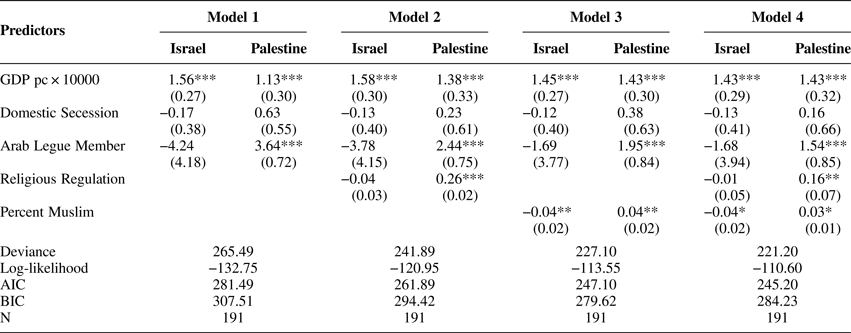
Table 1 presents the results of the analysis. We find that countries with more religious regulation were significantly more likely to only recognize Palestine, while countries with less religious regulation were less likely to only recognize Israel, but the effect for Israel was not statistically significant. As regards the second hypothesis on transnational Islam, we find that countries with a greater proportion of Muslims were considerably more likely to only recognize Palestine and significantly less likely to only recognize Israel. Arab League members were also much less likely to recognize only Israel, but were not significantly more likely to recognize only Palestine, though the sign was in the anticipated direction.
Multi-nominal models of recognition of Israel and Palestine
Recognition of palestine and Israel. Multinomial Models. Base – Recognition of Both

Significance codes: 0.0001‘***’, 0.001‘**’, 0.01‘*’, SEs in Parenthess
Notes: Variables labeled “10000” have their coefficients and standard errors multiplied by 10000 in order to show effects that were not visible at two decimal places. VIF and Tolerance results are the same as in Table 1 because the model specifications are the same. Robustness checks on Model 4 included adding variables for membership in the EU and similarity of voting patterns in the United Nations to the United States voting patterns. The EU was a negative significant predictor of recognizing just Israel relative to recognizing both. It was not a significant predictor of recognizing just Palestine and the SE on the coefficient was highly inflated. The similarity of voting patterns in the United Nations to the United States voting patterns was a significant negative predictor of just recognizing Palestine, but was not a significant predictor of recognizing just Israel, relative to both. Yet neither variable considerably improved the overall model fit, and did not change any of the main results, which led us to exclude these variables from the final model.
It is important to underscore that the multinomial model examines the determinants of the decision to recognize Palestine but not Israel, and of Israel but not Palestine, relative to recognizing both of them, which is the modal category. In this context, regulation of religion is an unambiguous predictor of preferring to recognize Palestine but not Israel.
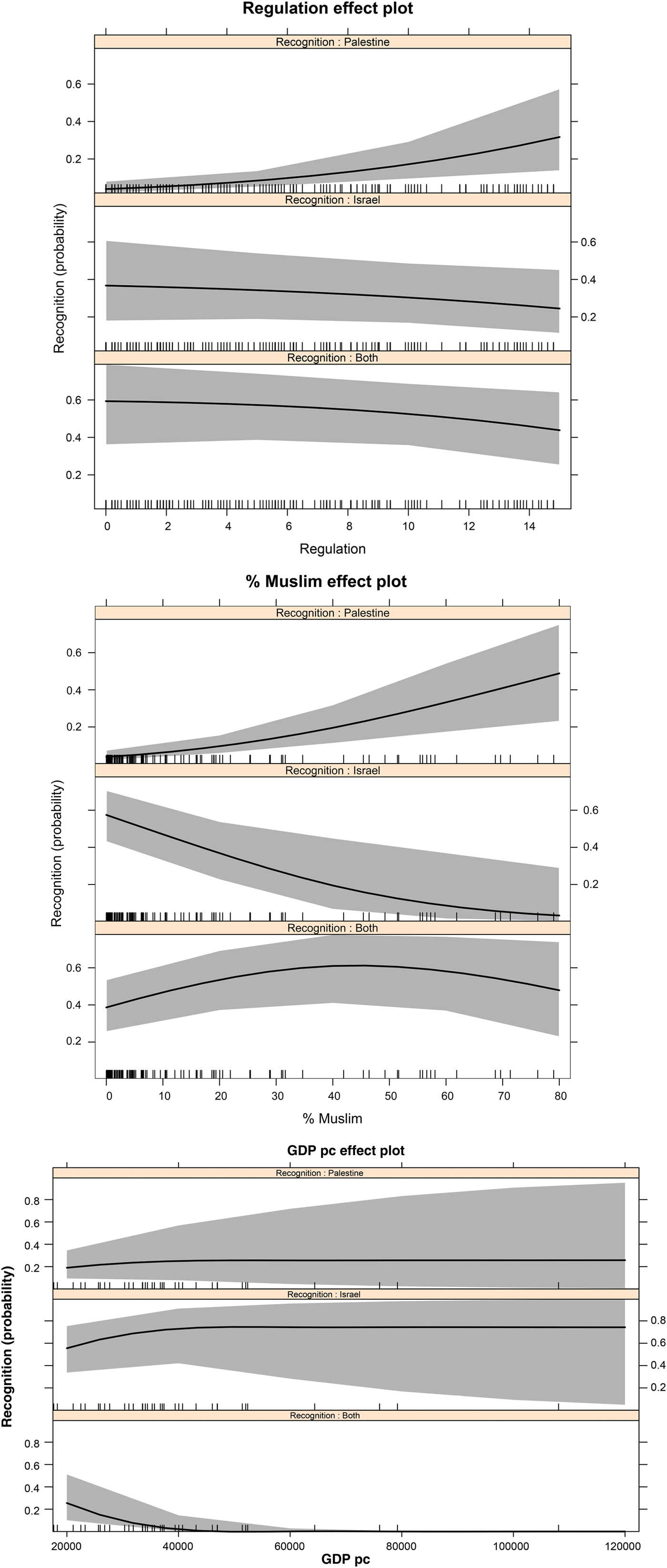
To illustrate the substantive effects of these factors, we graph the predicted probabilities of the outcome (recognition) given various values of the continuous predictors (see Fig. 1) and dichotomous predictors (Fig. 2) from the fourth multinomial model in Table 1. The first figure shows three panels for every continuous variable using 95% confidence intervals. On the top is the probability of recognizing Palestine, which is displayed on the y-axis from 0.0 to 1.0 with ticks at 0.2, 0.4, and 0.6. The middle panel shows the probability of recognizing Israel and the bottom panel shows the probability of recognizing both Israel and Palestine, which is the baseline category in the multinomial models, and is also displayed along the y axis. The first graph shows the effect of religious regulation on the probability of recognizing only Palestine, only Israel or both.
Predicted probability of recognition for given values of significant continuous predictors from multi-nominal regression model (Table 1, Model 4).

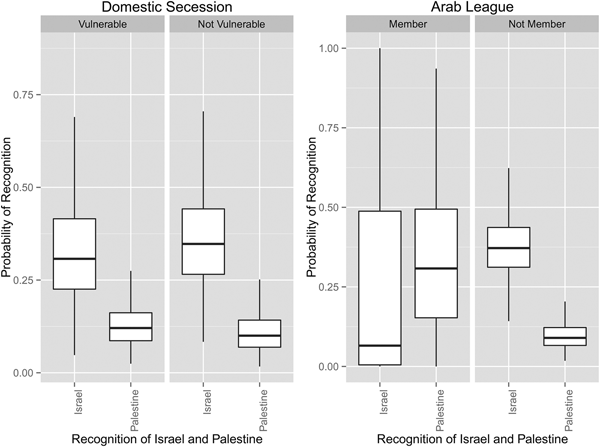
Predicted probability of recognition for given values of categorical predictors from multi-nominal regression model (Table 1, Model 4).

Holding all other variables constant at their mean (and mode for binary variables), the results indicate that countries which heavily regulate religion have a 35% higher probability of recognizing only Palestine, a 20% lower probability of recognizing only Israel and a 15% lower probability of recognizing both countries, compared to countries with the lowest levels of religious regulation. In the second panel, we observe that Muslim majority countries had a 50% higher probability of recognizing only Palestine and a 60% lower chance of recognizing only Israel, compared to countries in which Muslims are a small minority. In the third panel, we can see that poorer countries were more likely to recognize both Palestine and Israel than to recognize only one of them alone, though the effect of gross domestic product per capita is also substantively small, especially for recognizing Palestine.
Figure 2 shows the predicted probability of recognition (of Palestine and Israel, separately) for various values of the categorical predictors, again using 95% confidence intervals. The first categorical predictor displayed on the left panel is “Domestic Secession,” and the box plots show the interquartile range (25–75th percentile) of the predicted probability of recognizing only Israel (on the left) and only Palestine (to its right) for countries that are vulnerable to domestic secession. In the right panel, the same probabilities are depicted for countries that are not vulnerable to secession at home. We see that domestically vulnerable countries were only slightly more likely to only recognize Palestine and slightly less likely to only recognize Israel than countries without a significant threat of secession at home, and that the substantive effect sizes were modest and not statistically significant. Turning to the right panel, which depicts the predicted probability of recognition for members in the Arab League, we find that members of the Arab League had a predicted probability of recognizing only Palestine that was about 20% greater than non-members, and a predicted of recognizing only Israel that was about 35% lower than non-members.
Finally, we mention several robustness checks that we conducted to see whether the results held after including potentially omitted variables. The first concerns great power influence. Although it is clear that the great powers have not converged on the recognition of Palestine, and thus a different explanation is needed, we consider whether indicators of a pro-United States position — such as NATO alliance membership, European Union membership and similar voting patterns in the United NationsFootnote 11 — seem to have a significant influence on a country's probability of recognizing Palestine or Israel. There may also be differences between Shia and Sunni countries with respect to the Israel-Palestine conflict, though majority Shia countries such as Iran provide considerable support to Palestine, which is predominantly Sunni. Our robustness checks indicate that NATO, the European Union, and the similarity with United States voting in the United Nations are usually not significant predictors. Moreover, their inclusion does not alter the previously reported results, and does not add to the model's explanatory power or statistical fit. We also re-estimated the models after removing majority Shia countries, but it did not make a difference in the reported results. The final models therefore do not include these additional variables in the specification.
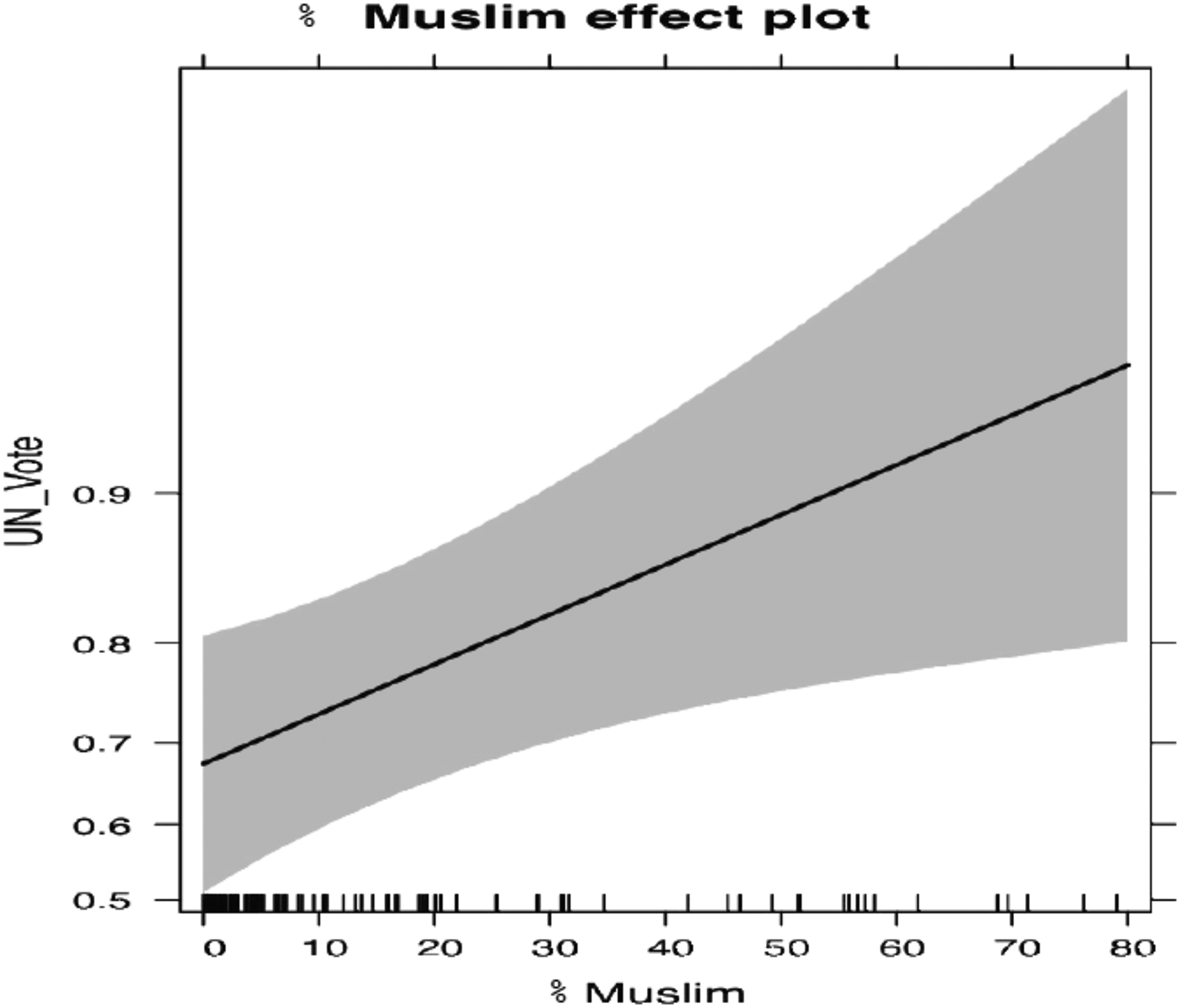
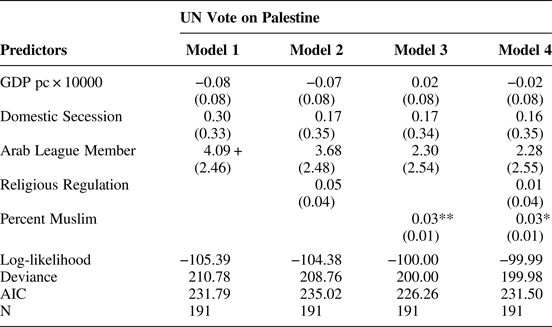
Our final analysis focuses on the recent United Nations vote about Palestine (United Nations General Assembly resolution No. 67/19). Table 2 and Figure 3 show the results. Transnational religion ties were fundamental in shaping voting patterns. Countries with a greater percentage of Muslims were much more likely to support the resolution. Religious regulation had no discernible effect on the probability of voting in favor or against the United Nations resolution, however.
Predicted probability of the United Nations vote on Palestine given values of significant predictors (Table 2, Model 4).

Explaining the United Nations vote on Palestinian statehood

Significance codes: 0.001‘**’, 0.01‘*’, 0.05 ‘ + ’, SEs in parenthess
Notes: Variables labeled “10000” have their coefficients and standard errors multiplied by 10000 in order to show effects that were not visible at two decimal places. VIF and Tolerance results are the same as in Table 1 because the model specifications are the same. Robustness checks on Model 4 included adding variables for membership in the EU and similarity of voting patterns in the United Nations to the United States voting patterns. Neither was statistically significant and neither improved the model fit.
Rich countries were less likely to cast a positive vote on upgrading Palestine's status at the United Nations, but this effect was not statistically significant. When voting on recognition, however, rich countries were more likely to recognize Palestine or Israel relative to recognizing both Israel and Palestine. Why are the determinants of voting to admit Palestine as a non-member at the United Nations different from the determinants of deciding whether to recognize Palestine? That is, why would a country recognize Palestine, but not vote for the United Nations resolution; or why would a country vote in support of the United Nations resolution, but not recognize Palestine? We speculate that this discrepancy may be due to differences in the strategic setting. Most notably, extending recognition to Palestine may be a more consequential decision than voting to grant non-member status at the United Nations.Footnote 12 The United Nations may allow some states an opportunity in a high profile forum to appear sympathetic to the plight of Palestinians.Footnote 13
CONCLUSION
The international recognition of new states is a fundamental question in political science that remains under-theorized. Although the Israeli-Palestinian conflict is arguably the world's highest profile conflict, the issue of international recognition has not been systematically studied in this context, to the best of our knowledge. With some notable exceptions in recent years that have focused on the role of the great powers, empirical work on this problem is also relatively sparse (Siroky Reference Siroky, Pavković and Radan2011). This article presents an explanation for international recognition decisions in cases of contested recognition that is focused on how religion shapes international recognition decisions, and situates it within existing scholarship and the context of the Israeli-Palestinian conflict. The theory emphasizes the role of religious affinities, and suggests that transnational religious ties among Muslim majority states shape recognition decisions. At the domestic level, the theory builds on the logic of domestic vulnerability, and posits that states that heavily regulate religion tend to avoid extending recognition to aspiring and de facto states.
Using new data on international recognition in the case of Israel and Palestine to test these hypotheses, the analysis finds evidence that countries with a greater proportion of Muslims, and with more religious regulation, were respectively 50% and 35% more likely to recognize Palestine — and were 60% and 20% less likely to recognize Israel, relative to recognizing both Israel and Palestine. These findings contribute to a growing body of literature concerned with the origins of external support for secessionist movements and the determinants of international recognition decisions. Although there are numerous factors that could influence international recognition decisions, we focus here on how religion exhibits a powerful influence on recognition decisions at both the transnational and the domestic level.
While we believe this study represents an important contribution to our understanding of international recognition, at least in the highly salient case of Palestine and Israel, we also wish to acknowledge its limitations that we hope will be addressed in future research. Primary among these is that the two cases studied here may not be representative of the population of sovereignty disputes. As a result, it remains for future research to determine whether the two-level explanatory framework proposed here, which focuses on transnational linkages (religious and ethnic) and domestic vulnerability (also religious and ethnic), is applicable to a growing set of cases of contested recognition.