Introduction
Over the last two decades, a multitude of studies have investigated how bilinguals can contain their speech production within one language, a process known as bilingual language control (e.g., Costa & Santesteban, Reference Costa and Santesteban2004; Gollan & Ferreira, Reference Gollan and Ferreira2009; Meuter & Allport, Reference Meuter and Allport1999; Philipp & Koch, Reference Philipp and Koch2009). The functional locus of this process, though, has received far less attention, which might be due to the general assumption that language control operates on the lemma level (e.g., Costa & Santesteban, Reference Costa and Santesteban2004; Green, Reference Green1998; Meuter & Allport, Reference Meuter and Allport1999). The aim of the current study was therefore to demonstrate the important role of phonology in bilingual language control by manipulating phonological overlap in language switching.
Phonological overlap in monolingual and bilingual settings
The influence of overlap of phonological segments (e.g., cl ock – cl oud) has been investigated with a wide variety of paradigms. One marked paradigm that has implemented this manipulation is the picture–word interference paradigm (PWI). In this task, a picture and a superimposed written word are presented to participants. The goal is to name the picture as fast as possible, while ignoring the written word. Typically, the data shows that the picture is named faster when there is phonological overlap (PO) between the target word and the distracter word, such as in the example above (e.g., Bi, Xu & Caramazza, Reference Bi, Xu and Caramazza2009; Meyer & Schriefers, Reference Meyer and Schriefers1991; Schriefers, Meyer & Levelt, Reference Schriefers, Meyer and Levelt1990), than when there is no phonological overlap (NPO). This pattern has also been found with auditory distracters (e.g., Hantsch, Jescheniak & Schriefers, Reference Hantsch, Jescheniak and Schriefers2009) and in a cross-language variant of the PWI (e.g., Costa, Miozzo & Caramazza, Reference Costa, Miozzo and Caramazza1999; Hermans, Bongaerts, de Bot & Schreuder, Reference Hermans, Bongaerts, de Bot and Schreuder1998). The cross-language PWI task differs from its monolingual variant by presenting the distracter word in another language than the picture is named in (e.g., English pi g and German Pi lz “mushroom”). So far, this phonological facilitation effect has been seen as a priming effect of the target phonological representations (e.g., Starreveld, Reference Starreveld2000).
The influence of PO within a trial has also been investigated with the on-line form preparation paradigm (Meyer, Reference Meyer1990). In this paradigm, phonological encoding is investigated by presenting participants with a set of word pairs. These pairs can either overlap phonologically or not. During the testing phase one word of the pair is presented, which requires the participant to produce the other word. Several studies have shown shorter reaction times when there is PO than when there is NPO within the word pairs, both in a monolingual (e.g., Meyer, Reference Meyer1990, Reference Meyer1991; Roelofs, Reference Roelofs1998) and bilingual context (e.g., Roelofs, Reference Roelofs2003).
A similar facilitation effect was observed by Damian and Dumay (Reference Damian and Dumay2009). In this study, participants had to name an object and the color of the object on the same trial. There was either PO between the object and the color (e.g., green goat), or NPO (e.g., yellow goat). Results indicated that facilitation occurred due to PO between the object and the color (see also Damian & Dumay, Reference Damian and Dumay2007; Dumay & Damain, Reference Dumay and Damian2011). Yet, when participants had to name the color and the object on subsequent trials, PO caused interference (see also Sullivan & Riffel, Reference Sullivan and Riffel1999; Wheeldon, Reference Wheeldon2003).
One relevant account (Sevald & Dell, Reference Sevald and Dell1994) for this interference effect assumes that when words with a large PO are selected on subsequent trials, this will reactivate the word of the previous trial through feedback loops from the phonological representations to the lemma level (e.g., Bernolet, Hartsuiker & Pickering, Reference Bernolet, Hartsuiker and Pickering2012; Costa, Roelstrate & Hartsuiker, Reference Costa, Roelstraete and Hartsuiker2006; Dell, Reference Dell1988). In turn, the word of the previous trial will also activate the phonological representations that are not shared by the word in the current trial and thus cause interference (for different accounts of this finding, see Damian & Dumay, Reference Damian and Dumay2009).
Taken together, PO seems to have a large impact on both monolingual and bilingual language production. This impact can consist of facilitation when prime and target are presented at the same time, whereas interference occurs when the prime and target are presented in subsequent trials.
Language switching
The present study investigated the effect of PO on language switching. In language switching, bilingual participants are required to produce words in two or more languages. By contrasting trials that use the same language as the previous trial (repetition trials) against trials that require another language as the previous trial (switch trials), performance costs, known as switch costs, can be obtained (e.g., Declerck, Koch & Philipp, Reference Declerck, Koch and Philipp2012; Meuter & Allport, Reference Meuter and Allport1999; Verhoef, Roelofs & Chwilla, Reference Verhoef, Roelofs and Chwilla2009). These switch costs are considered a marker for language control (e.g., Christoffels, Firk & Schiller, Reference Christoffels, Firk and Schiller2007; Green, Reference Green1998).
Furthermore, switch costs are found to be asymmetrical across languages, with larger switch costs during first language (L1) production than during second language (L2) production (e.g., Macizo, Paolieri & Bajo, Reference Macizo, Paolieri and Bajo2012; Meuter & Allport, Reference Meuter and Allport1999; Philipp, Gade & Koch, Reference Philipp, Gade and Koch2007; for reviews see Bobb & Wodniecka, Reference Bobb and Wodniecka2013; Koch, Gade, Schuch & Philipp, Reference Koch, Gade, Schuch and Philipp2010). However, asymmetrical switch costs could not be observed in all language switching studies. Symmetrical switch costs have been found with balanced bilinguals (Costa & Santesteban, Reference Costa and Santesteban2004; Costa, Santesteban & Ivanova, Reference Costa, Santesteban and Ivanova2006) and unbalanced bilinguals (e.g., Christoffels et al., Reference Christoffels, Firk and Schiller2007; Declerck et al., Reference Declerck, Koch and Philipp2012; Gollan & Ferreira, Reference Gollan and Ferreira2009). Given this unclear pattern of results, the interpretation of asymmetrical switch costs is still under debate.
One interpretation of language switch costs in general, and asymmetrical language switch costs in particular comes from Finkbeiner, Almeida, Janssen and Caramazza (Reference Finkbeiner, Almeida, Janssen and Caramazza2006) and relies on response availability. According to this interpretation, switch trial responses are rejected when they become available for production too soon. The idea behind this is that switch trials are supposed to be difficult, and thus fast responses are probably going to be erroneous. To protect themselves against mistakes, participants will be suspicious of responses that are relatively fast when being in this difficult context (i.e., switch trials). Since L1 production is typically easier – and thus faster – than L2 production, L1 switch trials are responded to more slowly due to the initial response being rejected to a larger degree for being too fast, relative to L2 trials. In turn, asymmetrical switch costs should occur.
Another interpretation of language switch costs and their asymmetry relies on persisting, reactive inhibition between languages in the inhibitory control model (ICM; Green, Reference Green1998; see also Meuter & Allport, Reference Meuter and Allport1999). In the ICM, language switch costs can be accounted for by assuming that when a certain language has to be produced on a trial (n−1), the non-target language will be inhibited. When the previously inhibited language is required for production (i.e., switch trial) on the next trial (n), the inhibition that was exercised on trial n−1 will persist into trial n and thus needs to be overcome. This is not the case when producing in the same target language on trial n−1 and trial n (i.e., repetition trial). Hence, it should be harder to switch between languages than repeating the same language due to persisting inhibition in switch trials.
Furthermore, unbalanced bilinguals have more experience with language production in L1 than L2, which results in a larger L1 activation than L2 activation. Thus, L2 production requires relatively stronger inhibition of the more dominant L1 than inhibition of L2 during L1 production. As a consequence, it is relatively more difficult to switch from L2 to L1, since a relatively larger amount of persisting inhibition has to be overcome, than when switching from L1 to L2. As regards the locus of this inhibitory language control, Green (Reference Green1998) assumed that this inhibition process occurs at the lemma level. Accordingly, later processes, like phonological encoding, should have no influence on language control.
The role of phonology in language switching
Results in line with the assumption that language control mainly operates on the lemma level, with no influence of phonology (e.g., Green, Reference Green1998), have been reported recently (Declerck, Philipp & Koch, Reference Declerck, Philipp and Koch2013). Declerck et al. (Reference Declerck, Philipp and Koch2013) observed no switch cost difference between words that consisted solely of phonemes that occur in both languages, and words that contained language-specific phonemes. This result seems to indicate that differences in phonological aspects of the stimulus words (i.e., language-specific vs. language-unspecific phonemes) have no effect on language switching.
Yet, there are also a number of studies that can demonstrate an influence of phonological characteristics of words on language switching. Christoffels et al. (Reference Christoffels, Firk and Schiller2007), for example, found an influence of cognate status on language switch costs. Cognates are words with a similar etymological background in two or more languages, which often co-occur with a large PO (e.g., English hat – German Hut “hat”). These authors investigated, among other effects, the influence of cognates on language switching by contrasting pictures that depict cognates vs. pictures that depict non-cognates. The results revealed that the faster production of cognates than non-cognates (e.g., Costa, Caramazza & Sebastian-Galles, Reference Costa, Caramazza and Sebastian-Galles2000; Hoshino & Kroll, Reference Hoshino and Kroll2008) was substantially larger for repetition trials than for switch trials.
Using a set-up similar to Christoffels et al. (Reference Christoffels, Firk and Schiller2007), but presenting written words instead of pictures, Filippi, Karaminis and Thomas (Reference Filippi, Karaminis and Thomas2014) found larger switch costs for cognates relative to non-cognates (see also Thomas & Allport, Reference Thomas and Allport2000). This switch cost pattern is similar to that found in the numerical data of Christoffels et al. (Reference Christoffels, Firk and Schiller2007) for L1 (cognates: 51 ms; non-cognates: 33 ms) and L2 (cognates: 67 ms; non-cognates: 41 ms). Note, however, that the pattern in Christoffels et al. (Reference Christoffels, Firk and Schiller2007) was not confirmed by statistical analysis. Furthermore, Filippi et al. (Reference Filippi, Karaminis and Thomas2014) also found an influence of phonology on asymmetrical switch costs. More specifically, they observed a larger switch cost asymmetry with cognates relative to non-cognate naming.
Recent evidence for the influence of phonology on language switching has also been observed by Declerck et al. (Reference Declerck, Koch and Philipp2012). This study contrasted digit naming against picture naming in a language switching context. The results revealed that language switch costs were smaller for digits than pictures. An additional picture set, with pictures depicting cognates, revealed that the switch cost difference between digits and pictures was due to a significant proportion of the digits being cognates, since no switch cost difference was found between pictures depicting cognates and digits. This pattern, however, is the opposite of the pattern found by Christoffels et al. (Reference Christoffels, Firk and Schiller2007) and Filippi et al. (Reference Filippi, Karaminis and Thomas2014), which may be due to Declerck et al. (Reference Declerck, Koch and Philipp2012) using only cognates or non-cognates within a block. Christoffels et al. (Reference Christoffels, Firk and Schiller2007) and Filippi et al. (Reference Filippi, Karaminis and Thomas2014), on the other hand, presented both word types intermixed within the same block.
Taken together, although Declerck et al. (Reference Declerck, Koch and Philipp2012), Christoffels et al. (Reference Christoffels, Firk and Schiller2007) and Filippi et al. (Reference Filippi, Karaminis and Thomas2014) found different effects of cognates on language switching, these studies concur in indicating that cognates, and thus PO within words, can have an influence on language control. Declerck et al. (Reference Declerck, Philipp and Koch2013), on the other hand, found no effect of language-specific phonemes on language switching.
Outline of the present study
The aim of the present study was to investigate the influence of phonology on language switching further by manipulating phonological characteristics across words. More specifically, we investigated words of which the first two phonemes were identical to those of the previously produced word (e.g., dr ill – dr ess) and contrasted this against words which did not have an overlap of the first two phonemes (e.g., ch erry – b one) in a language switching setting.
This manipulation increases the scope of previous language switching studies that investigated phonology, which solely manipulated phonological characteristics within trials (i.e., cognate status and language-specific vs. language-unspecific phonemes). This difference is important, since research on phonology has indicated that manipulations within and across trials can have a very different impact (e.g., Damian & Dumay, Reference Damian and Dumay2009).
Investigating phonological characteristics across trials is also interesting in a language switching setting, since it allows us to specify two (asymmetrical) switch cost accounts. With respect to Finkbeiner et al.'s (Reference Finkbeiner, Almeida, Janssen and Caramazza2006) switch cost account, we argue that switch trials should become harder with PO, since PO across trials makes production more difficult (Damian & Dumay, Reference Damian and Dumay2009; Sullivan & Riffel, Reference Sullivan and Riffel1999; Wheeldon, Reference Wheeldon2003). According to this account, during switch trials with a PO, fewer fast initial responses should occur and thus be rejected. Put differently, PO should lead to a decrease of reaction time in switch trials and thus, to a decrease of switch costs. Furthermore, we assume that this would be proportionally less so for L2 switch trials, since L2 switch trials are already harder than L1 switch trials. Hence, making L2 switch trials even harder should have a relatively smaller impact, which in turn would decrease asymmetrical switch costs.
The switch cost account postulated by Green (Reference Green1998), on the other hand, would assume no influence of PO on switch costs or their asymmetry, since persisting inhibition from trial n−1 causes switch costs and the switch cost asymmetry in trial n. However, when looking at PO vs. NPO from trial n−1 to trial n, the critical manipulation is not present on trial n−1 but on trial n and thus the languages and switch costs should not be affected differently on trial n. Yet, this account could explain a difference in (asymmetrical) switch costs after the PO. Put differently, once trial n−1 has influenced trial n due to PO, a difference in trial n+1 could be explained with this account. To this end, we also investigated whether the asymmetrical switch costs were influenced in trials following PO or NPO trials.
Method
Participants
The 16 participants (14 female, mean age = 22.3 years) were native Germans and spoke English as their second language. On average they had started learning English at the age of nine and had 10.8 years of formal English education. Their self-rated scores of spoken English, with one being “very bad” and seven being “very good”, had a mean of 5.4.
Apparatus and stimuli
To instruct participants which language to use, cues were implemented that consisted of colored rectangles (160 × 106 pixels), which were presented in either green or blue in the center of the screen. The color-cue to language assignment was counterbalanced across participants.
Furthermore, there were 48 pictures (300 × 300 pixels) for which the object name had to be produced either in German (L1) or English (L2; see Appendix for an overview of the responses), depending on the language cue. Each picture was presented twice during each of the four blocks (i.e., once in each language).
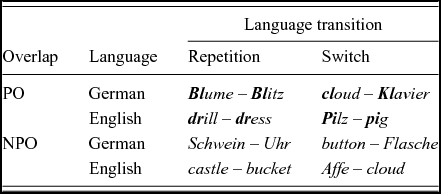
There were two conditions in this experiment within each block, the first being that the first two phonemes of the current word did not correspond with the previous word (NPO), whereas in the other condition the first two phonemes of the current word were identical to the first two phonemes of the word on the previous trial (PO; see Table 1 for examples of NPO and PO combinations). The assignment of pictures to these two conditions was done pseudo-randomly, so that in three quarters of the trials there would be NPO, whereas in the other trials there would be PO. Hence, out of the eight times a picture was presented throughout the experiment, it would occur on average six times in an NPO trial and twice in a PO trial. This also means that all pictures were used in both the NPO trials and the PO trials within the experiment. Another restriction was that, whereas pictures always occurred twice in a block (i.e., once in German and once in English), they would not occur twice in the PO condition within a block.
Examples of phonological overlap (PO).

To reduce any other phonological influence, the amount of cognates was kept to a minimum. Furthermore, the words had an average frequency of 53.1 per million in German and 74.0 per million in English (Baayen, Piepenbrock & Gulikers, Reference Baayen, Piepenbrock and Gulikers1995). The average amount of syllables per word was 1.2 in German and 1.4 in English.
The trials were presented using E-prime, and the speech-onset times were registered using a voice-key. All errors were marked by the experimenter in a subject file.
Procedure
Prior to the cued language switching task, there was a brief explanation of the task, which emphasized both speed and accuracy. To help the participants throughout the experiment, a card was put in front of them indicating the color-cue to language assignment, which was held constant throughout the experiment.
During each trial, a cue was presented for 500 ms and followed by a stimulus, which did not disappear until a response was registered. Following the response onset there was a response-to-cue interval of 400 ms.
To get the participants acquainted with the task, a practice block of 40 trials was administered prior to the experimental blocks, using stimuli that were not implemented in the experimental blocks. There were four experimental blocks, consisting of 96 trials each. The sequence of blocks was counterbalanced across participants. There was an equal amount of language switches and repetitions across trials and an equal amount of L1 and L2 trials in each block. The same restrictions concerning target language and language transition were put on both the NPO condition and the PO condition.
Design
Two pre-planned contrasts were carried out. In the first contrast, we set out to investigate the influence of PO from trial n−1 to trial n on language switching (phonological overlap contrast). In this contrast, the independent variables were overlap (NPO vs. PO from trial n−1 to trial n), language (L1 vs. L2) and language transition (switch vs. repetition from trial n−1 to trial n).
In the second contrast (persisting phonological overlap contrast), we analyzed trials that occurred after trials with or without PO. Put differently, in the previous analysis we analyzed the phonological influence from trial n−1 to trial n. In this second contrast, the influence on the subsequent trial (which is thus labeled trial n+1) is investigated, with the restriction that only NPO trials were put in the analysis.Footnote 1 To this end, the independent variables were previous trial type (whether the previous trial n had NPO vs. PO), language (L1 vs. L2) and language transition (switch vs. repetition from trial n to trial n+1). In both contrasts, the dependent variable was reaction time (RT).
Results
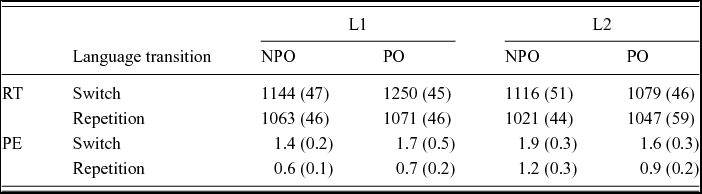
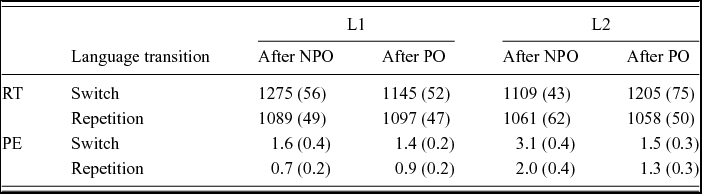
The first trial of each block (1.0%) and the error trials (1.2%), which constituted the production of a wrong concept and/or production in the wrong language, were excluded from RT analyses, as were trials following an error trial. Furthermore, for the calculation of RT outliers, RTs in all trials were z-transformed per participant, and trials with a z-score of −2/+2 were discarded as outliers (4.0%). No statistical analysis was performed on the error rates, due to the very low amount of errors. The error rates are displayed in Tables 2 and 3.
Overall RT in ms and percentage of errors (PE) of the phonological overlap contrast (SD in parentheses) as a function of language (L1 vs. L2), overlap (NPO vs. PO from trial n−1 to trial n), and language transition (switch vs. repetition from trial n−1 to trial n).

Overall RT in ms and percentage of errors (PE) of the persisting phonological overlap contrast (SD in parentheses) as a function of language (L1 vs. L2), previous trial type (the previous trial (i.e., trial n) had NPO vs. PO), and language transition (switch vs. repetition from trial n to trial n+1).

Phonological overlap contrast
An analysis of variance (ANOVA) of the RT data revealed significant effects of overlap (F(1, 15) = 5.31; p < .05; ηp 2 = .261), with PO (1112 ms) being slower than NPO (1086 ms, see Table 2); of language (F(1, 15) = 13.07; p < .01; ηp 2 = .466), with L1 (1132 ms) being slower than L2 (1066 ms);Footnote 2 and of language transition (F(1, 15) = 35.12; p < .001; ηp 2 = .701), with switch trials (1147 ms) being slower than repetition trials (1050 ms).
The interaction between language transition and language was also significant (F(1, 15) = 5.45; p < .05; ηp 2 = .266), indicating a switch cost asymmetry with larger switch costs for L1 (130 ms) than for L2 (64 ms). The interaction between language and overlap was significant (F(1, 15) = 15.71; p < .01; ηp 2 = .512), with slower reaction times for L2 (1068 ms) than L1 (1103 ms) during NPO and slower reaction times for L1 (1161 ms) than L2 (1063 ms) during PO. However, there was no significant interaction between language transition and overlap (F < 1), which is in line with Green's switch cost account (Reference Green1998), but not with Finkbeiner's account (Reference Finkbeiner, Almeida, Janssen and Caramazza2006).
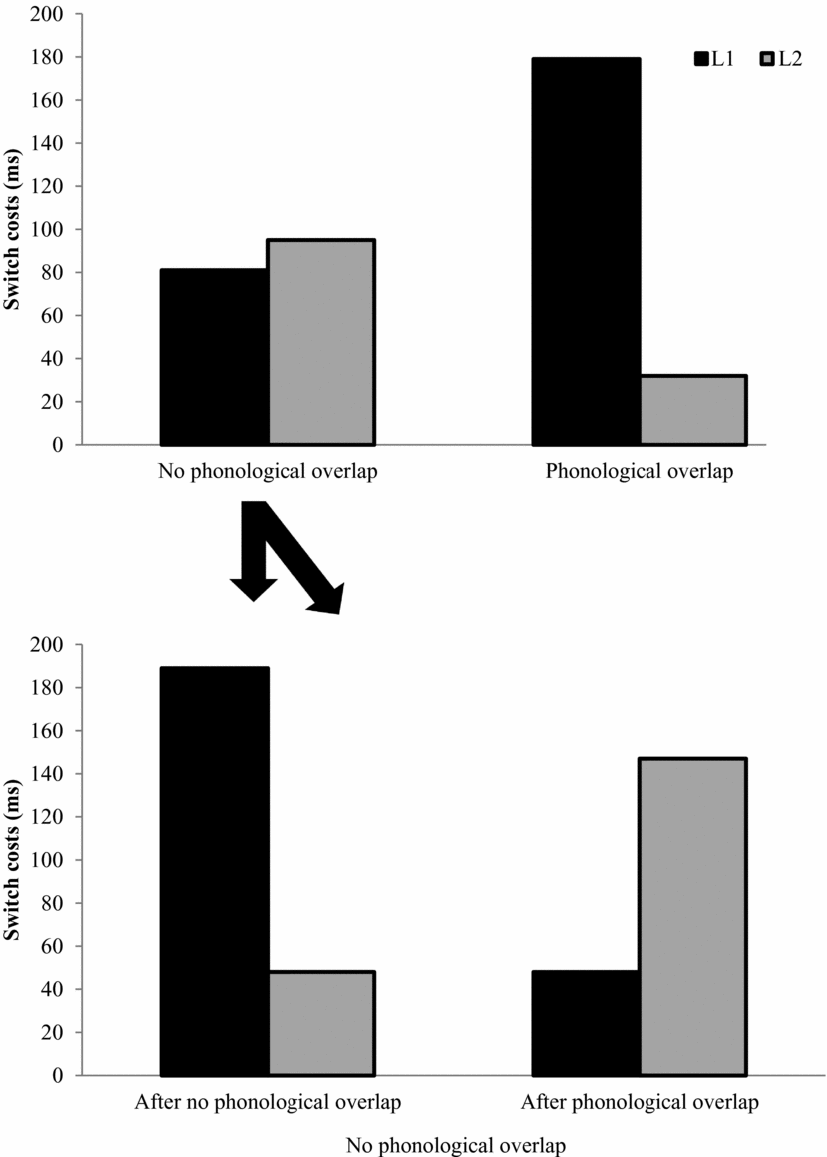
Theoretically most importantly, the three-way interaction was also significant (F(1, 15) = 16.06; p < .01; ηp 2 = .517), indicating a change in the switch cost asymmetry as a function of PO vs. NPO. More specifically, similar L1 (81 ms) and L2 (95 ms) switch costs occurred in the NPO condition, whereas L1 switch costs (179 ms) were larger than L2 switch costs (32 ms; see Figure 1) in the PO condition. Separate t-tests revealed that switch costs were symmetrical in the NPO condition (t(15) = 0.44; ns.), whereas switch costs were asymmetrical in the PO condition (t(15) = 4.28; p < .01). The three-way interaction also stimulated us to compare the effect of NPO vs. PO on L1 and L2 switch costs separately. The results showed that L1 switch costs were increased due to PO (t(15) = 3.20; p < .01). On the other hand, there was a numerical, albeit not significant, trend towards a decrease of L2 switch costs with PO (t(15) = 1.74; p = .102).
The top panel shows switch costs (in ms) of the whole data set as a function of language (L1 vs. L2) and overlap (PO vs. NPO). The bottom panel shows switch costs (in ms) of a subset of the data (only NPO trials) as a function of language (L1 vs. L2) and type of NPO trial (after NPO vs. after PO).

Persisting phonological overlap contrast
An ANOVA of the RT showed no overall difference between NPO trials that followed an NPO trial and NPO trials that followed a PO trial (F(1, 15) = 2.12; ns.; ηp 2 = .124). Language was also not significantly different (F(1, 15) = 3.55; ns.; ηp 2 = .191), whereas language transition was significant (F(1, 15) = 25.66; p < .001; ηp 2 = .631), with switch trials (1184 ms) being slower than repetition trials (1076 ms, see Table 3).
The interaction between the previous trial type and language transition was not significant (F < 1). However, there was a significant interaction between the previous trial type and language (F(1, 15) = 8.63; p < .05; ηp 2 = .365), with trials that followed an NPO trial being slower in L1 (1182 ms) than in L2 (1058 ms), whereas trials that followed a PO trial were slower in L2 (1131 ms) than in L1 (1121 ms).
Importantly, there was also a significant three-way interaction (F(1, 15) = 16.97; p < .001; ηp 2 = .531), with larger L1 switch costs (189 ms) than L2 switch costs (48 ms) in trials that followed an NPO trial, whereas L2 switch costs (147 ms) were larger than L1 switch costs (48 ms; see Figure 1) in trials that followed a PO trial. Separate t-tests revealed that switch costs were significantly asymmetrical in trials that followed an NPO trial (t(15) = 3.23; p < .01). A trend was found towards reversed asymmetrical switch costs for trials that followed a PO trial (t(15) = 1.96; p = .069).
Discussion
In the current study, we set out to investigate the influence of PO from one word to the next in language switching. On a broader level, this study aims to explore the influence of phonology on language control.
As regards the data pattern of the current study, the influence of PO on switch costs per se, and the asymmetry of switch costs, were taken into account. While no overall switch cost difference was found by manipulating PO, the switch cost asymmetry was affected in that asymmetrical switch costs were observed with PO (larger L1 switch costs than L2 switch costs), whereas symmetrical switch costs were found with NPO from the previous to the current trial. When further splitting the latter trials, asymmetrical switch costs were observed in NPO trials following an NPO trial, whereas reversed asymmetrical switch costs were observed in NPO trials following a PO trial (numerically larger L2 switch costs than L1 switch costs).
The most important observation of the present study certainly is that an influence of phonology on language switching was observed. Thus, on a theoretical level, the results of the current study – together with those found by Filippi et al. (Reference Filippi, Karaminis and Thomas2014), Declerck et al. (Reference Declerck, Koch and Philipp2012) and Christoffels et al. (Reference Christoffels, Firk and Schiller2007) – indicate that phonology plays an important role during bilingual language control (see also Gollan, Schotter, Gomez, Murillo & Rayner, Reference Gollan, Schotter, Gomez, Murillo and Rayner2014). This is an important observation because the role of phonology in bilingual language control has been largely neglected so far.
Further, the present study demonstrated an influence of phonology on the switch cost asymmetry rather than on switch costs themselves. Therefore, we turn to different interpretations of the language switch cost asymmetry and discuss them in light of the current results.
Finkbeiner et al. (Reference Finkbeiner, Almeida, Janssen and Caramazza2006) assume that asymmetrical language switch costs are due to a difference in response availability. In general, this account assumes that fast responses in L1 switch trials are rejected at first because they are too fast to be a correct response in a relatively difficult context (i.e., switch trial). This is also the case for L2 switch trials, but to a lesser extent, since L2 trials are not as “easy”, and thus initial responses are assumed to be slower than in L1 trials. In turn, L1 switch costs are considered to be larger because of the higher rate of rejected initial L1 switch trial responses.
Since the current study shows that PO across trials increases interference (see also Damian & Dumay, Reference Damian and Dumay2009; Sullivan & Riffel, Reference Sullivan and Riffel1999; Wheeldon, Reference Wheeldon2003), it should be harder to produce switch trials in the PO condition than in the NPO condition. Consequently, the likelihood of L1 switch responses being rejected at first should decrease, which should lead to smaller L1 switch costs with PO than NPO. L2 switches should also get harder due to PO. According to the response availability account, this should reduce the amount of times that a first L2 switch trial response gets rejected, which should lead to smaller L2 switch costs. Moreover, we assumed that L2 switch costs should be decreased to a lesser extent because of PO relative to L1 switch costs. This hypothesis was based on L2 trials generally being harder than L1 trials, which would make the impact of PO considerably less extensive.
Our results show that there is a numerical trend towards smaller L2 switch costs due to PO, which would be in line with the assumptions of Finkbeiner et al.'s (Reference Finkbeiner, Almeida, Janssen and Caramazza2006) response availability hypothesis. Yet, this difference was not significant. Furthermore, our data pattern even provides evidence against their switch cost account, since it was mainly L2 switch costs that decreased, not L1 switch cost. Most importantly, L1 switch costs did not decrease, but increased due to PO. This finding cannot be explained within the framework of Finkbeiner et al.'s (Reference Finkbeiner, Almeida, Janssen and Caramazza2006) account.
Moreover, the response availability account fails to explain the difference in asymmetrical switch costs in the persisting phonological overlap contrast. There seems to be no reason why lexical selection or phonological encoding should be different for trials after a PO trial vs. trials after an NPO trial, unless some kind of persisting activation/inhibition is involved. Finkbeiner et al. (Reference Finkbeiner, Almeida, Janssen and Caramazza2006) did not assume any persisting effect to explain asymmetrical switch costs. Thus, the asymmetrical switch cost difference that was observed between the two trial types contradicts the assumptions of Finkbeiner et al.'s (Reference Finkbeiner, Almeida, Janssen and Caramazza2006) switch cost account.
To summarise, while the response availability account (Finkbeiner et al., Reference Finkbeiner, Almeida, Janssen and Caramazza2006) could explain faster L2 switch trials because of PO, it cannot explain why L1 switch trials are slower when there is PO across trials. This account can also not explain the asymmetrical switch cost difference observed in the persisting phonological overlap contrast. Consequently, the response availability account cannot be used to explain the influence of phonology on asymmetrical switch costs in the present study.
The second account, which is derived from the ICM (Green, Reference Green1998), relies on persisting, reactive inhibition between languages (see also Meuter & Allport, Reference Meuter and Allport1999). This account assumes that due to a larger initial activation of L1 relative to L2, L1 has to be inhibited more strongly than L2 so that more inhibition will have to be overcome to switch back to an L1 trial and thus cause larger L1 than L2 switch costs. This process occurs at an early stage (i.e., the lemma level), so that later processes like phonological encoding should have no influence on language control.
Thus, at the first sight, the persisting inhibition account seems to be ill-suited to explain phonological influences on language control. Furthermore, it has to be noted that the ICM, and thus the persisting inhibition account, assume persisting inhibition from trial n−1 to cause the switch cost asymmetry in trial n. Therefore, no difference in switch cost asymmetry should have occurred due to PO from trial n−1 to trial n, since on trial n−1 no direct manipulation occurred. Put differently, the manipulation in the phonological overlap contrast occurred at trial n (i.e., PO or NPO with respect to trial n−1), which entails that persisting inhibition of the non-target language should not be different from trial n−1 to trial n for PO trials and NPO trials.
However, we could look at the data from another point of view. Because no manipulation has occurred from trial n−1 to trial n, we could interpret the observed asymmetrical switch cost pattern in PO trials as the standard pattern, in terms of larger L1 than L2 activation and reactive inhibition (see interpretation above for larger L1 than L2 switch costs with persisting inhibition).
The symmetrical switch costs in trials with NPO could then be explained as a function of the previous trial type (see persisting phonological overlap contrast). NPO trials (trial n+1) following an NPO trial (trial n) resulted in larger L1 switch costs than L2 switch costs, and thus showed the same asymmetrical switch cost pattern as observed in PO trials (which also followed NPO trials in the vast majority of cases). This is also in line with the ICM, since no influence of PO occurred on trial n to influence trial n+1.
In contrast, NPO trials (trial n+1) that followed PO trials (trial n) showed a reversed data pattern with larger L2 switch costs than L1 switch costs (see Figure 1). In these trials, the PO from trial n−1 to trial n had a persisting influence on trial n+1 so that the standard asymmetrical switch cost pattern was reversed. These two opposite patterns of asymmetrical and reversed asymmetrical switch costs in the two different types of NPO trials may have cancelled each other out and thus resulted in symmetrical switch costs in NPO.
Our data therefore indicate that it is not the PO from trial n−1 to trial n that influenced the switch cost asymmetry. Rather, the effect is due to a persisting influence that is caused by PO in the current trial that affects the subsequent trial (i.e., trial n+1). This notion of a persisting influence is in line with Green's (Reference Green1998) asymmetrical switch cost account.
To explain the reversal of the switch cost asymmetry in NPO trials following a PO trial, we refer to Green's (Reference Green1998) account on the one hand, and to Sevald and Dell's (Reference Sevald and Dell1994) account for PO effects across trials on the other. Green's (Reference Green1998) account assumes that larger L1 switch costs than L2 switch costs (i.e., typical asymmetrical switch costs) are observed due to a larger L1 than L2 activation on the previous trial and consequently larger reactive inhibition of L1 than L2. According to Sevald and Dell (Reference Sevald and Dell1994), PO will cause previously activated words to be reactivated to a certain degree through feedback loops (e.g., Bernolet et al., 2012; Costa et al., Reference Costa, Roelstraete and Hartsuiker2006; Dell, Reference Dell1988). More specifically, the overlapping phonological representations reactivate the previously activated lemma so that interference on the lemma level is increased. In turn, all phonological representations of the previous word will also be reactivated, so that interference between phonological representations increases.
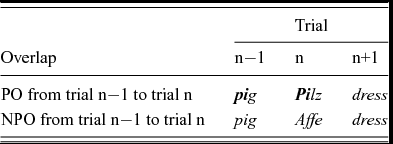
Because PO mainly affected switch trials, we focused on these trials when explaining the present findings.Footnote 3 We assumed that lemmas from trial n−1 (e.g., pig; see Table 4 for examples) and consequently also their phonological representations would be strongly reactivated during PO trials (e.g., English pi g – German Pi lz “mushroom”), but not during NPO trials (e.g., English pig – German Affe “monkey”). Hence, through feedback loops between the lemma level and phonological representations, more between-language interference occurs both at the lemma level and also at the level of phonological representations during PO trials than during NPO trials (cf. Sevald & Dell, Reference Sevald and Dell1994). Yet, and most importantly for the reversal of the switch cost asymmetry, this additional interference during PO trials (trial n) would be larger for L1 trials than for L2 trials.
An example of NPO trials (trial n+1) following either PO (upper line) or NPO (lower line).

Put differently, more L2 interference would occur than L1 interference. This is because L1 lemmas are more highly activated than L2 lemmas on trial n (e.g., Green, Reference Green1998) so that also the corresponding phonological representations of the L1 lemmas are activated to a higher extent. Consequently, phonologically overlapping L2 lemmas from trial n−1 (e.g., pig) would be reactivated to a higher degree by these phonological representations and thus cause more between-language interference during L1 production on trial n than reactivated L1 lemmas from trial n−1 during L2 production on trial n. In turn, in this condition, the conflicting L2 lemmas need to be more strongly inhibited than L1 lemmas on trial n and more persisting inhibition of L2 would have to be overcome in trial n+1 (e.g., dress) than persisting inhibition of L1, which would result in a reversed asymmetrical switch cost pattern with larger L2 switch costs than L1 switch costs.
This explanation assumes that phonological representations influence the activation of lemmas through feedback loops (e.g., Bernolet et al., 2012; Costa et al., Reference Costa, Roelstraete and Hartsuiker2006; Dell, Reference Dell1988), which in turn have an impact on language control. Since the ICM assumes that language control occurs at the lemma level, our explanation would be in line with it. However, in addition we assume that phonology can influence language control through feedback loops from the phonological representations to the lemmas.
In sum, the current study illustrates that language control was influenced by manipulating the phonological characteristics between words. Specifically, the switch cost asymmetry was influenced by phonological characteristics of words across trials. This is a clear indicator that language control can be influenced by processes that occur in the late stages of production. Consequently, the role of phonology and phonological feedback loops should be considered more extensively in future models of bilingual language control.
Appendix. Responses in German and English