N-chlorotaurine, the N-chloro derivative of the amino acid taurine, is the main long-lived oxidant produced by human leucocytes during inflammation (Grisham et al. Reference Grisham, Jefferson, Melton and Thomas1984). Its functions are first to save the oxidation capacity of originally formed hypochlorous acid, which is detoxified by reaction with taurine (HOCl+taurine→N-chlorotaurine+H2O) (Weiss, Reference Weiss1989). Second, it has been shown to down-regulate proinflammatory cytokines and therefore it may be involved in termination of inflammation (Kontny et al. Reference Kontny, Grabowska, Kowalczewski, Kurowska, Janicka, Marcinkiewicz and Maslinski1999; Park et al. Reference Park, Levis, Quinn, Park and Schuller-Levis2000; Marcinkiewicz, Reference Marcinkiewicz2003). Third, it has broad-spectrum antimicrobial activity (Nagl & Gottardi, Reference Nagl and Gottardi1996; Nagl et al. Reference Nagl, Lass-Floerl, Neher, Gunkel and Gottardi2001) and may contribute to inactivation of pathogens in vivo (Nagl et al. Reference Nagl, Hess, Pfaller, Hengster and Gottardi2000).
Synthesis of the pure crystalline sodium salt of N-chlorotaurine (NCT, ClHN—CH2—CH2—SO3—Na, molecular weight 181·57 g/mol; Gottardi & Nagl, Reference Gottardi and Nagl2002) facilitated investigations on its suitability as an antiseptic in human medicine. As a mild oxidant, tolerability of 1% aqueous NCT solution by human and animal tissue is very good.
This was proved in the rabbit and human eye (Nagl et al. Reference Nagl, Miller, Daxecker, Ulmer and Gottardi1998) and also data indicating efficacy in infectious conjunctivitis are available (Romanowski et al. Reference Romanowski, Yates, Teuchner, Nagl, Irschick and Gordon2006). In external otitis in man NCT was more effective than a standard medication (Neher et al. Reference Neher, Nagl, Appenroth, Gstottner, Wischatta, Reisigl, Schindler, Ulmer and Stephan2004a) and a pilot study in chronic rhinosinusitis demonstrated good tolerability (Neher et al. Reference Neher, Fischer, Appenroth, Lass-Floerl, Mayr, Gschwendtner, Ulmer, Gotwald, Gstöttner, Kozlov and Nagl2005). Treatment of purulently coated crural ulcers with NCT caused significantly less pain and was less toxic than chloramine T, the standard for decades in our University hospital (Nagl et al. Reference Nagl, Nguyen, Gottardi, Ulmer and Höpfl2003). There is a realistic chance to eradicate bacteria from the urinary bladder with NCT irrigations as shown in three patients suffering from inflammation with omniresistant Pseudomonas aeruginosa (Unterberger et al. Reference Unterberger, Spiss, Brandauer, Engelhardt, Pfausler, Kampfl, Schmutzhard, Nagl, Fille and Gottardi2001).
Transtympanal injection of 0·1%, 1% and 10% NCT into the middle ear of mice did not cause damage to the inner ear (Neher et al. Reference Neher, Nagl, Schrott-Fischer, Ichiki, Gottardi, Gunkel and Stephan2001). The same was true for guinea pigs where 10 μl of 1% and 0·1% were injected repeatedly into the middle ear via an implanted catheter system (Neher et al. Reference Neher, Nagl, Prieskorn, Mitchell, Brown, Schrott-Fischer and Miller2004b). Local administration of NCT inhibited septic arthritis by Staphylococcus aureus in a mouse model (Verdrengh & Tarkowski, Reference Verdrengh and Tarkowski2005). In a further study Swiss mice tolerated up to 1 ml of 1% NCT upon intraperitoneal injection (P Hengster and M Nagl, unpublished observations).
Because of these positive results NCT seems to be of advantage for topical treatment of infections in both human and veterinary medicine. Mastitis of cattle is a frequent disease caused mainly by streptococci, staphylococci and Escherichia coli (Bradley, Reference Bradley2002; Hogan & Larry, Reference Hogan and Larry2003; Janosi & Baltay, Reference Janosi and Baltay2004). The resulting loss of milk is a major issue for the dairy industry (Ruegg, Reference Ruegg2003). Treatment with antibiotics has two major problems. First, antibiotics cause residues in milk and meat for a certain period (Ruegg, Reference Ruegg2003). Second, their broad application may provoke antimicrobial resistance (Pengov & Ceru, Reference Pengov and Ceru2003; Denamiel et al. Reference Denamiel, Llorente, Carabella, Rebuelto and Gentilini2005). As an antiseptic, the oxidizing reaction mechanism of NCT is unspecific, and development of resistance of microorganisms against millimolar concentrations of chloramines is unknown (Dychdala, Reference Dychdala2001). Furthermore, NCT does not decompose to toxic compounds, but to taurine and chloride (equation 1) and no signs for systemic resorption have been observed in the above mentioned clinical studies.

It was the aim of this pilot study to test the tolerability and pharmakokinetics of NCT in the healthy bovine udder after intramammary administration.
Materials and Methods
Chemicals
Pure NCT as a crystalline sodium salt (molecular weight 181·57 g/mol; Gottardi & Nagl, Reference Gottardi and Nagl2002) was dissolved in sterile and pyrogen-free distilled water to concentrations of 2·0%, 1·0% and 0·1% (110, 55 and 5·5 mm). Purity of NCT was verified by iodometric titration and spectrophotometry (Gottardi & Nagl, Reference Gottardi and Nagl2002). Solutions were prepared immediately before application. Sterile and pyrogen-free 0·9% NaCl was applied for control.
Stability of NCT in cow milk in vitro
NCT was dissolved in fresh, unpasteurized milk pooled from the milking of 8 cows in the morning, to a final concentration of 0·01% (0·55 mm), 0·1% (5·5 mm), 1% (55 mm), or 2% (110 mm). Samples were incubated at 20°C and 35°C. After incubation times of 15 min, 60 min, 4 h, 8 h, 1 d, 2 d, 3 d, 6 d, 7 d and 8 d, aliquots of 0·5 ml were removed. Oxidation capacity was determined by iodometric titration with 0·1m-sodium thiosulphate at a pH of 2–3 (adjusted with acetic acid) applying the automatic titration assembly TIM900 from Radiometer (Copenhagen, Denmark). Three independent experiments with fresh milk samples were performed. Samples were free of mastitis pathogens.
Bactericidal activity of NCT in cow milk in vitro
Staph. aureus ATCC 25923 and Esch. coli ATCC 11229 were grown for 16 h in tryptic soy broth (Merck, Darmstadt, Germany) at 37°C to (1–5)×109 colony forming units (cfu)/ml. Bacteria were washed twice, diluted tenfold and resuspended in saline. They were further diluted 100-fold (40 μl to 3·96 ml) to (0·5–5)×106 cfu/ml in milk samples containing 1%, 0·1% or 0·01% NCT. After incubation times of 1, 3, 5, 10, 20 and 30 min at 20°C or 37°C, aliquots of 100 μl were removed and mixed with 900 μl of 0·6% sodium thiosulphate (reagent grade, Merck) solution to inactivate NCT. Quantitative cultures of adequate dilutions in saline were performed on tryptic soy agar (Merck) using an automatic spiral plater (model WASP, Whitley, Shipley, UK) and cfu were counted after incubation at 37°C for 48 h (detection limit 100 cfu/ml taking into account both plates). Controls without NCT were performed in parallel. From four to eight independent experiments were performed.
Cows and application of the test medication
Animal tests were performed according to the ‘Principles of animal care’ and approved by the Austrian Federal Government of Science and Research (BMBWK-68.205/0101-BrGT/2005). Six healthy cows were used. The Brown Swiss dairy cows were kept in a tied housing system at the Teaching and Research Farm Kremesberg of the University of Veterinary Medicine. The six animals ranged in age from 3 to 8 years (median 5; mean value 5·4, sd 2·0 years). The cows were recorded monthly for somatic cell count (SCC) by periodic measurements of the Austrian Breeding Association. For the determination of SCC, 20 ml of milk per quarter were measured by a fluoro-optoelectronic method (Fossomatic, Hillerød, Denmark) as described by Schmidt-Madsen (Reference Schmidt-Madsen1975). SCC of the cows in the two months before the beginning of the study were between 5000 and 40 000 cells/ml. Therefore, it can be concluded that there were no infections of the udder. In addition, cultures on mastitis pathogens were performed at the baseline and during the study (see below).
The cows were bedded on straw and fed silage (grass and maize), hay and concentrate according to milk yield. The average milk yield of the herd (70 cows) was around 6100 kg per lactation in 2004. The animals were examined clinically before the beginning of the study, paying special attention to udder health. They were milked twice daily at 6·00 and 18·00.
Cows were treated twice daily (at 9·00 and 15·00) for 5 d in total with the test (NCT) and control (saline) medication. Solutions were applied to two diagonal udder quarters of each animal in a randomized and blinded manner e.g., NCT left anterior and right posterior, saline right anterior and left posterior in the first animal, and vice versa in the second one. Single doses of 100 ml per quarter were injected by intramammary instillation using 50-ml syringes with the appropriate adaptor subsequent to disinfection of the teats with 70% ethanol. Two cows each received 2%, 1% and 0·1% NCT, respectively. Originally, both cows with the highest dose were planned to receive 5%, but the dose was reduced to 2% after the first application because of discomfort experienced by one animal (see Results).
Evaluation of pharmakokinetics and tolerability
Before the beginning of the irrigations, milk, urine and blood samples were removed for baseline investigations of all parameters mentioned in the following, including microbiology. The time point was approximately 8·00 on day 1.
Quarter milk samples for microbiological examination and determination of SCC from test and control quarters were removed at 10, 20, 30 min and hourly for a period of 5 h after the applications in the morning. Morning samples were collected immediately before regular milking time as described by Baumgartner (Reference Baumgartner2005). Blood samples from the jugular vein as well as urine samples were taken daily at 14·00 (5 h after dosing).
For evaluation of pharmakokinetics the oxidation capacity in the milk samples was measured quantitatively with analytical chlorine test strips (Merckoquant, Merck, Darmstadt, Germany). Taking into consideration that NCT is continuously degraded in milk so that the samples could not be stored, this method proved to be suitable. Reliability down to 300 μm-NCT was tested before with milk samples to which defined amounts of NCT had been added. Since NCT is inactivated immediately in blood, the decay products taurine and chloride were determined in serum. Taurine was analysed by ion-exchange chromatography (ninhydrin reaction along a pH gradient) and HPLC (AminoTac, JLC-500/V, Jeol). Urine was tested for taurine, calibrated with creatinine concentration to exclude a bias of different osmolarity.
To objectify local irritation induced by the lavages, SCC was determined daily in milk from samples taken in the morning before milking and before dosing,. Bacterial examination was conducted according to the NMC (1999) recommendations (National Mastitis Council, 1999). Briefly, 0·01 ml of each quarter was plated onto Columbia blood agar and incubated at 37°C for 24 h and 48 h. Bacterial genera were determined by colony morphology and haemolysis. Staph. aureus and coagulase-negative staphylococci (CNS) were differentiated testing the Clumping factor (Staphytect Plus, Oxoid, Basingstoke, UK). Cows were milked every day in the morning before application of NCT and in the evening 2 h after the second application, and the milk performance was evaluated.
The udder was assessed upon milking for changes of consistency i.e., induration and warming judged by palpation, and for signs of inflammation i.e., asymmetria and redness judged by inspection. Changes of the mammary gland and secretion were defined as subclinical mastitis (isolation of a mastitis pathogen, SCC >150 000 cells/ml and no visible signs of the disease) and clinical mastitis cases (Schroeder, Reference Schroeder1997). Clinical mastitis was classified as either mild or severe. Occurrence of flakes or clots in the milk and slight swelling of the infected quarter was defined as mild clinical mastitis. Occurrence of abnormal secretion, hot and swollen quarter or udder, fever, rapid pulse, loss of appetite, dehydration and depression was defined as a severe clinical mastitis case. Clinical status by veterinary medical examination was performed daily, and the behaviour of the cows (defence position, vocalizing, food uptake) was monitored to detect discomfort caused by the study medication.
Statistical analysis
Student's paired t test was used to test for statistical significance of paired measurements i.e., stability of NCT in milk in vitro, numbers of leucocytes in the milk, milk performance between single days. One-way analysis of variance (ANOVA) and Dunnett's multiple comparison test were applied for comparison of three or more groups of measurements. Repeated measures ANOVA and adjustment of the baseline in experiments with repeated withdrawal of aliquots from the same sample (bactericidal activity testing of NCT in vitro) was done in addition, for which the results were the same. P values of <0·05 were considered significant.
Results
Stability of NCT in cow milk in vitro
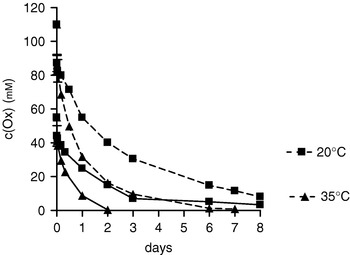
Depending on the temperature oxidation capacity of 1% (55 mm) and 2% NCT could be detected for a few days (Fig. 1). A decrease to 20% was measured after 1 d at 35°C and after 3 d at 20°C (P<0·01 between both temperatures). When 0·1% or 0·01% NCT were added, the whole oxidation capacity was consumed within 1 min.
Stability of 2% (dotted lines) and 1% (full lines) NCT in cow milk in vitro. Oxidation capacity c(Ox) at 20°C (-■-) and 35°C (-▲-). Mean values±sd of three independent experiments.

Bactericidal activity of NCT in cow milk in vitro
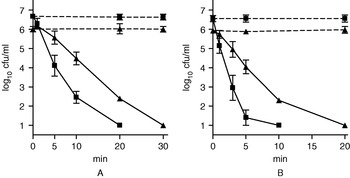
Viability of bacteria was not influenced in milk without additives. However, both Staph. aureus and Esch. coli were reduced by 1% NCT in milk by (4–5) log10 cfu after few minutes (Fig. 2). As expected, killing was more rapid with increasing temperature (P<0·01, Student's paired t test and ANOVA). Esch. coli was slightly more susceptible than Staph. aureus (P<0·01, Student's paired t test and ANOVA). Concentrations of 0·1% and 0·01% NCT did not show microbicidal activity. Inactivation controls, in which bacteria were added to milk containing 0·1% NCT and 0·6% thiosulphate, did not show reduction in cfu with (0·7–1·6)×103 cfu/ml at time zero and (0·8–1·3)×103 cfu/ml after 30 min.
Bactericidal activity of 1% NCT in cow milk in vitro against Esch. coli (-■-) and Staph. aureus (-▲-) at 20°C (A) and 36°C (B). Controls without NCT are shown as dotted lines. P<0·01 between test and control samples for all incubation times. Mean values±sem of four to eight independent experiments.

Pharmakokinetics in vivo
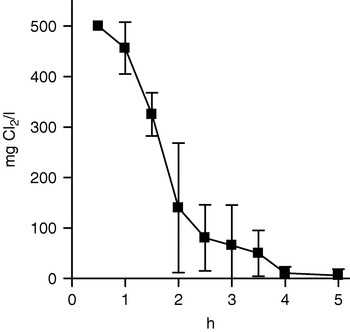
Oxidation capacity was detectable in the milk of test quarters depending on the concentration of NCT. Activity of 2% and 1% NCT similarly decreased to zero within 2–5 h (Fig. 3), while 0·1% NCT was detectable for 15–20 min (in one case only low oxidation capacity was present for 2 h on day 5 with 0·1% NCT, data not shown). As expected, in control quarters no oxidative capacity was found. Similarly, no NCT could be detected in urine samples.
Decrease of oxidation capacity expressed as mg Cl2/l in the milk in vivo after injection of 100 ml NCT into the udder. Mean values±sd of animals no. 1–4 which were treated with 2% (animal no. 1 and 2) and 1% NCT (animal no. 3 and 4). There were no differences between 2% and 1% NCT so that the values have been summarized in a single curve.

To evaluate any systemic resorption of the study medication, the taurine concentration was measured in serum. Mean values±sd of all six cows were 260·8±37·1 μmol/l at the baseline, 65·3±17·4 on day 3, and 62·7±13·5 on day 5 (P<0·01 for days 3 and 5 compared with the baseline, Student's paired t test). There were no differences between the different treatment groups. The high baseline values can be explained by intestinal resorption from the concentrate feed that the cows received in the morning. Samples on days 3 and 5 were taken in the afternoon and were within the normal range of taurine levels. This was confirmed by additional samples taken from two untreated cows that were not fed the concentrate, showing taurine serum concentrations (μmol/l) of 48·2 and 68·5 at 8·00, 51·7 and 68·2 at 10·00, 53·3 and 71·9 at 12·00 and 53·0 and 57·8 at 14·00.
Similarly, chloride levels did not increase in serum with 118±7·4 mmol/l at the baseline, 101·8±6·5 on day 3 (P<0·01) and 107·8±5·7 on day 5 (P>0·05 compared with the baseline, Student's paired t test, mean values±sd for 6 cows). In addition, the taurine concentration did not increase in the urine with values of 177±219 at the baseline, 153±149 on day 3, and 123±91 on day 5 (mean values±sd for 6 cows, P>0·1 compared with the baseline, Student's paired t test). Again, there were no differences between the different treatment groups.
Tolerability
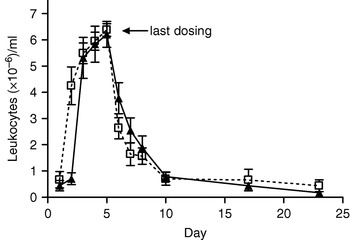
The number of leucocytes in the milk as a sensitive measure for irritation increased as expected during the treatment in both test and control quarters of all cows (Fig. 4). The increase occurred 1 d earlier in all NCT quarters (P<0·01, Student's paired t test) while the further course was identical in test and control quarters (P>0·05 for each time point, Fig. 4). It reached the maximum of (6–7)×106 cells/ml on day 5 and had already decreased significantly 1 d after the last application of NCT and saline, respectively. Baseline values were reached again on day 10 of the study, which equals day 5 after the end of treatment. All these findings were similar in animals treated with 0·1%, 1·0% and 2·0% NCT and in the saline controls (P>0·05, ANOVA). Elevated SCC coincided with positive cultures for Staph. aureus (see below) on day 3 in one quarter treated with 2% NCT and in one quarter each of three cows treated with saline, and on day 4 in one quarter treated with saline. In these quarters the effects could be formally graded as temporary subclinical mastitis.
Leucocyte counts in milk of NCT quarters (-□-, dotted line) and saline quarters (-▲-, full line) during the application period and in the following days. A Summary of all six cows since there was no difference between the applied single concentrations of NCT. Mean values±sem of 12 quarters each. P>0·05 between NCT and saline except for day 2 (P<0·01).

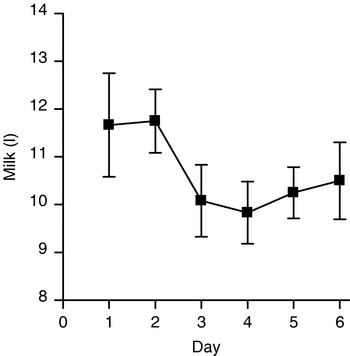
After the second day, the average milk yield decreased from 12 to 10 l (P=0·036, Student's paired t test) per milking which was performed twice daily (Fig. 5). This was true for all test groups independent of NCT concentration.
Milk performance of the whole mammary gland per milking during the application period. A summary of all cows and of milking in the morning and afternoon. Mean values±sem of 12 single values. The decrease from day 2 to day 3 was significant (P=0·036, Student's paired t test). Average milk performance of the whole mammary gland per milking during the application period. Mean values±sem of 12 single values resulting from milking in the morning and afternoon from all six cows. The decrease from day 2 to day 3 was significant (P=0·036, Student's paired t test).

Bacterial examination of milk revealed cultures sporadically positive from 19 milk samples out of 240 samples of all quarters of all six cows. From the 19 positive cultures, 12 were identified as CNS and 7 as Staph. aureus. Five grew from quarters treated with NCT (3×CNS, 2×Staph. aureus) in 3 cows, 14 from quarters treated with saline (9×CNS, 3×Staph. aureus) in 5 cows. There was no obvious pattern. At the baseline, one culture in one cow was positive for CNS. CNS and Staph. aureus occurred sporadically in different quarters in the following days and disappeared again on the respective next day in both NCT- and saline-treated quarters. On the last day, only one culture in one cow was positive for CNS.
The two animals treated with 2% NCT received 5% NCT as a first dose. One of these started to scratch the udder so that the dose was reduced to 2% in the following. No further defence reactions were observed. Milkers had the impression of a slight induration in 5 quarters on day 1 (4 test, 1 control quarter in 4 cows), in 15 quarters on day 2 (8 test, 7 control quarters in 6 cows), 5 quarters on day 3 (3 test, 2 control quarters in 4 cows), 9 quarters on day 4 (4 test, 5 control quarters in 4 cows) and 5 quarters on day 5 (3 test, 2 control quarters in 3 cows). These findings were independent of NCT concentration. In one animal treated with 5% as a first dose followed by 2% the temperature of the udder felt slightly increased once on day 2. Apart from that no signs for irritation could be observed. Slight induration, elevated SCC and positive culture for Staph. aureus i.e., formal criteria for possible mild clinical mastitis, coincided only on 1 d in one udder quarter treated with 2% NCT.
The behaviour of the cows did not change during the study. Food and water intake was normal, and no abnormal vocalizing occurred. Daily clinical examination did not reveal any pathologic findings except for the slight udder indurations described above.
Four weeks after the end of the study, high leucocyte counts were found again in three cows. Microbiological investigations revealed Candida spp. in one quarter treated with 2% NCT of one cow, in one quarter treated with 0·1% NCT of one cow, and in both quarters treated with saline in one cow. Three of these quarters were the right posterior ones. A month later the yeasts had disappeared without special treatment.
Increase of SCC by instillation of plain saline compared with no instillations in two additional cows
To confirm that the elevation of SCC in the quarters treated with saline (Fig. 4) was caused by the saline irrigations and not by diffusion of leucocytes from the NCT quarters, we treated two diagonal quarters in each of two additional cows with 100 ml saline twice daily at 9·00 and 15·00 for 3 d. The other quarters remained untreated. Indeed, in these two animals, SCC from samples removed in the morning before dosing and pooled from the respective quarters increased about tenfold in the treated quarters (Table 1). In marked contrast, no increase of SCC was detected in milk samples from the untreated control quarters. Bacterial cultures taken from treated and untreated quarters at the baseline and on day 4 remained negative for pathogenic bacteria.
Somatic cell count (×10−5) cells/ml in two additional cows treated with 100 ml saline onlyFootnote †

† Two diagonal quarters were treated with 100 ml saline twice daily for 3 d; the other two diagonal quarters remained untreated
Discussion
Mastitis is a frequently occurring disease causing considerable economic loss. Treatment with antibiotics is associated with drug residues and with the possibility of resistance development. New prospective antimicrobial agents for this condition should be of short half-life, without toxic side effects or toxic decay products and active against the causative pathogens. Our pilot study indicated that NCT met the first two requirements in vivo in the cattle, while the third one remains to be proved in vivo, although it is very suggestive since NCT turned out to be highly bactericidal in milk in vitro.
Taking into account the killing of bacteria in milk within 10 min, NCT should be by far sufficiently long acting in vivo upon instillation in the udder to exert a strong antimicrobial effect. Reaction of NCT with thio groups leads to rapid loss of oxidation capacity with formation of taurine and chloride (Gottardi & Nagl, Reference Gottardi and Nagl2002), as depicted in equation 1. Consumption of NCT by these reactions is the reason for the very fast decrease of oxidative and bactericidal activity of low concentrations (⩽0·1%) in vitro in milk. In vivo, however, 0·1% NCT was detected up to 20 min after instillation, probably owing to dilution of the milk by the irrigations. On the other hand, the more rapid decrease of oxidation capacity of 1% and 2% NCT in vivo than in vitro may be explained by continued production of milk resulting in both dilution and consumption of NCT.
The absence of an increase of serum and urine values of taurine and chloride from the baseline to the end of the study clearly indicates the absence of systemic resorption of NCT and its decay products. NCT is hydrophilic and therefore cellular uptake occurs via anion transport systems as shown in lung epithelial cells, erythrocytes and macrophages (Thomas et al. Reference Thomas, Grisham, Melton and Jefferson1985; Park et al. Reference Park, Quinn, Wright and Schuller Levis1993; Cantin, Reference Cantin1994). If small amounts came into cells by that route, NCT would be inactivated by reaction with thio groups (Gottardi & Nagl, Reference Gottardi and Nagl2002) before it could reach the bloodstream. Even if there was little resorption particularly through mucosal defects, NCT coming into contact with blood would be immediately consumed by the overwhelming amount of antioxidants. Because of these facts the only compartment with detectable NCT concentrations after the irrigations remains the udder cavity. The significant increase of serum taurine levels after oral uptake of concentrate feed is obviously an everyday phenomenon and clearly proves the tolerability of high concentrations of this amino acid in the cattle. Taurine is abundandly distributed in many tissues (O'Flaherty et al. Reference O'Flaherty, Stapleton, Redmond and Bouchier-Hayes1997). Any minimal amounts of taurine uptake by diffusion or active transporters from the applied NCT were not detected in our study and can be neglected.
In accordance with the pharmakokinetic results no hints for systemic adverse effects, but only local irritation was found. Increase of leucocytes in the milk was expected as it is known to be a very sensitive parameter (Detilleux, Reference Detilleux2004). Virtually, even saline had a significant effect indicating that injection of any fluid into the udder is a sufficient stimulus for the defence system. NCT caused a similar increase of leucocytes, but 1 d earlier than saline. This can be regarded as a sign of activity in vivo. The decrease of leucocytes after the end of the applications is in keeping with the short period of activity of NCT in vivo. The similar course of the curve of test and control udder quarters (Fig. 4) indicates the absence of irritating or toxic decay products.
To confirm that the increase of SCC in the control quarters was not caused by diffusion of leucocytes from the test quarters but by the stimulus of instillation, we injected the same amount of saline (100 ml) into the mammary gland of two additional cows. The resulting rapid 10-fold increase of SCC clearly proves that irrigation with a significant volume of saline caused irritation. Moreover, the complete absence of an increase of leucocytes in the untreated quarters demonstrates the absence of diffusion of leucocytes between the quarters, at least within the time period of a few days. This is in accordance with other studies e.g. (Bannerman et al. Reference Bannerman, Chockalingam, Paape and Hope2005; Gill et al. Reference Gill, Pacan, Carson, Leslie, Griffiths and Sabour2006). Furthermore, it is well known that the quarters of the mammary gland are separate compartments not allowing transference of instilled substances such as antiseptics (e.g., Middleton et al. Reference Middleton, Hebert, Fox, Tomaszewska and Lakritz2003). All these results confirm that the elevation of SCC in the saline-treated quarters was not caused by diffusion of leucocytes or NCT from the NCT-treated ones, but that the elevation caused by NCT was similar to that caused by an irrigation stimulus.
The slight but significant impact on milk production and slight induration of single quarters can be regarded as further signs of local side effects. Since they were independent of the NCT concentrations and of test and control quarters, they were connected with the high volume used for injection and the injection procedure rather than with NCT. To clear up this point completely, separate investigations for control and test substances and measurement of milk production in single quarters would be necessary. This has not been performed, because it was not a main criterion of the study, and because of logistic reasons. If the NCT concentration exceeds 2%, some discomfort in the animals expressed by udder scratching may occur, but we found no further side effects of the high dose of 5%. This is in accordance with previous clinical studies, where 1% was well tolerated in the human and rabbit eye and many other regions of the body mentioned above, while 3% caused conjunctival infection in one subject (Nagl et al. Reference Nagl, Miller, Daxecker, Ulmer and Gottardi1998). Recently millimolar concentrations (100 mm intra-articularly, 2 mm subcutaneously) have been shown to be well tolerated in mouse models of arthritis (Kwasny-Krochin et al. Reference Kwasny-Krochin, Bobek, Kontny, Gluszko, Biedron, Chain, Maslinski and Marcinkiewicz2002; Verdrengh & Tarkowski, Reference Verdrengh and Tarkowski2005).
The sporadic and temporary occurrence of CNS and Staph. aureus during the application period in test and control quarters clearly indicates random everyday contamination. It was not connected with the increase of leucocytes in the milk. Although fewer cultures were positive in the test group (5 v. 14 in the control group), the small sample size and the study protocol do not allow reliable conclusions for in vivo efficacy of NCT.
The contamination of the four quarters in total with Candida 4 weeks after the end of the study has to be estimated as an ascending infection. Taking into account that Candida mastitis subsequent to topical application of antibiotics has been reported in the literature (Crawshaw et al. Reference Crawshaw, MacDonald and Duncan2005), it is possible that the manipulations of irrigation are causative for the transfer of yeasts into the mammary gland. If there was a connection, this happened despite exacting hygiene including disinfection of the teats and despite the fact that NCT is fungicidal even in body fluids (Nagl & Gottardi, Reference Nagl and Gottardi1996; Nagl et al. Reference Nagl, Lass-Floerl, Neher, Gunkel and Gottardi2001). In any case the general rule of treatment as long as necessary, but as short as possible, will be valid for well tolerated antiseptics too.
Conclusion
In summary, the following conclusions can be drawn from this phase 1 study. NCT at 1% is active for a few hours after injection into the udder and excreted in the milk within one day. No residues or decay products can be found in the body, which renders dosing very well controllable. Therefore, simply the number of leucocytes is required as the measure for re-usability of the milk after NCT application. Tolerability of a standard concentration of 1% which can be expected to be effective in treatment of udder infections resembles that of saline and indicates the high safety of NCT.
We are grateful to Anton Spitzer, Mag Verena Rücker and the staff of the Teaching and Research Farm Kremesberg for animal care and for their help during the study. We acknowledge U Eichinger-Öttl and C Ertl of the laboratory for inborn errors of metabolism, for determination of taurine. We thank Assoc.Prof. Dr Hanno Ulmer, Department of Medical Statistics, Informatics, and Health Economics, Innsbruck Medical University, for statistical advice. We are grateful to Frederic Zotos, Esq, Pathogenics Inc., Hingham MA, USA, for support.