Although attachment theory originated as a framework for understanding species-normative developmental adaptation (Bowlby, 1969/Reference Bowlby1982), the larger focus of relevant empirical research has been on examining the developmental significance of individual differences in attachment-relevant behavior and representations (Cassidy & Shaver, Reference Cassidy and Shaver2008). This now vast literature on individual differences has clearly been generative, documenting attachment-related influences in a broad range of adaptational domains, including most notably: interpersonal functioning (Sroufe, Egeland, Carlson, & Collins, Reference Sroufe, Egeland, Carlson and Collins2005), the development of psychopathology (Dozier, Stovall-McClough, & Albus, Reference Dozier, Stovall-McClough, Albus, Cassidy and Shaver2008; Lyons-Ruth & Jacobvitz, Reference Lyons-Ruth, Jacobvitz, Cassidy and Shaver2008), and the intergenerational transmission of attachment-related experiences (van IJzendoorn, Reference van IJzendoorn1995).
Although typically implicit in relevant research, the attachment literature relies on a conceptualization of attachment-related individual differences that is built on two key assumptions. The first concerns the distributional properties of individual differences in (in)security and, more specifically, the expectation that attachment-related individual differences represent true categories (see Fraley & Spieker, Reference Fraley and Spieker2003; Fraley & Waller, Reference Fraley, Waller, Simpson and Rholes1998; Roisman, Fraley, & Belsky, Reference Roisman, Fraley and Belsky2007). Resolving the issue of whether categories or continua best reflect the underlying variation in attachment-related individual differences is important because many methodologists have highlighted the problems that can arise when researchers assign people to groups for the purpose of statistical analysis (Cohen, Reference Cohen1983; MacCallum, Zhang, Preacher, & Rucker, Reference MacCallum, Zhang, Preacher and Rucker2002). For example, when groups are created on the basis of artificial cut points, statistical power can be severely compromised (Fraley & Spieker, Reference Fraley and Spieker2003). The issue of taxonicity, however, has more than just methodological consequences. The focus on categories has led to the development of conceptual distinctions in the adult attachment literature, such as that between earned versus continuous security (Pearson, Cohn, Cowan, & Cowan, Reference Pearson, Cohn, Cowan and Cowan1994), that are explicitly rooted in the assumption that there are differences in kind, rather than just degree, among secure people. Thus, categories have played a role not only in the assessment of adult attachment, but in shaping the kinds of theoretical issues addressed by attachment researchers.
Often, however, the issue of the distributional properties of attachment-related individual differences has been conflated with a second, arguably more crucial set of assumptions related to how individuals vary with respect to one another on behavioral and representational measures of attachment security: that of the latent structure of these individual differences (i.e., the key axes on which individuals vary with respect to attachment-related behavior, cognition, and affect). It is this issue that is the focus of the current paper, as applied specifically to the Adult Attachment Interview (AAI; Main & Goldwyn, Reference Main and Goldwyn1998), the most widely used and well-validated instrument in developmental research for studying attachment in adults, which was based on a concerted effort to understand how adults organize their discourse when reflecting upon their early childhood experiences (Hesse, Reference Hesse, Cassidy and Shaver2008).
Attachment research in the developmental tradition offers two claims regarding the latent structure of individual differences in adult attachment. First, developmental psychologists view securityFootnote 1 in adulthood as a monolithic construct (typically referred to as “coherence”) that simultaneously involves the capacity to (a) tell an internally consistent narrative about one's childhood experiences (i.e., to “freely evaluate” early attachment experiences) (b) without becoming emotionally entangled while reflecting on past experiences, as reflected either in active or passive preoccupation. In this standard account, insecurity, by contrast, is conceptualized as taking one of two mutually incompatible organized forms. Dismissing states of mind are viewed as a defensive distancing approach in which the significance of attachment needs, experiences, or partners is minimized. Such an orientation often takes the form of idealizing childhood experiences and/or closing oneself off from evaluation of attachment experience through lack of memory or derogation. The other form of insecurity—preoccupation—is conceptualized as becoming passively or actively caught up while discussing early experiences and demonstrating emotional arousal that interferes with a balanced and autonomous evaluation of one's early childhood experiences. (Note that in addition to classifying adults as secure/autonomous, dismissing, or preoccupied, Main and Goldwyn's system also allows coders to categorize individuals as unresolved if their discourse becomes disorganized while talking about loss or abuse experiences).
This standard conceptualization of the latent structure of attachment (i.e., security contrasted with two mutually incompatible, organized forms of insecurity) serves as the foundation for categorical measures of attachment across the developmental range, including the Strange Situation procedure (Ainsworth, Blehar, Waters, & Wall, Reference Ainsworth, Blehar, Waters and Wall1978) and the AAI (Main & Goldwyn, Reference Main and Goldwyn1998). Moreover, even measures designed to explicitly assess attachment-related variation dimensionally (e.g., Waters & Deane's, Reference Waters and Deane1985, Attachment Q-set; Kobak's, Reference Kobak1993, AAI Q-Sort) have retained a latent structure based on contrasting security with insecurity, a view that assumes that “security” does not conflate two empirically distinct axes of variation (i.e., low levels of anxiety and low levels of avoidance), that might well be only modestly correlated.
Although the standard conceptualization of individual differences has in many respects been generative empirically, a closer look suggests that it may not be consistent with emerging evidence about what diverse assessments of attachment are actually measuring. For example, Fraley and Spieker (Reference Fraley and Spieker2003) demonstrated, via factor analysis, that the various behavioral indicators typically used to assign infants to attachment categories in the Strange Situation procedure actually loaded on two axes of variability reflecting attachment-related avoidance (i.e., avoidance, contact maintenance, and proximity seeking scales) and anxiety (indicated by resistance and disorganization) that were only modestly correlated. In other words, Fraley and Spieker (Reference Fraley and Spieker2003) found no evidence that the interactive behavior scales used by raters to code the Strange Situation actually assess a broad dimension of security, nor that the two major forms of insecurity are incompatible.
Similar findings have emerged with respect to adult attachment as assessed with the AAI. Bernier and colleagues (Bernier, Larose, Boivin, & Soucy, Reference Bernier, Larose, Boivin and Soucy2004; Larose, Bernier, & Soucy, Reference Larose, Bernier and Soucy2005) were the first to demonstrate that the state of mind dimensions historically used by coders to inductively categorize adults using the AAI loaded on two relatively orthogonal components: dismissing and preoccupied states of mind. Using the full range of state of mind dimensions and a large aggregate sample (N = 504), Roisman, Fraley, et al. (2007) used principal components analysis (PCA) to confirm these results, finding evidence for two weakly correlated axes on which adults vary with respect to attachment-related states of mind: one reflecting the degree to which individuals freely evaluate or defensively discuss their early experiences (i.e., dismissing states of mind: mother idealization, father idealization, coherence of mind, lack of memory, and metacognitive monitoring) and the other reflected in one of two forms of attachment-related preoccupation (i.e., preoccupied states of mind: mother anger, unresolved abuse, father anger, passivity, unresolved loss, fear of loss, and overall derogation scales). Moreover, Whipple, Bernier, and Mageau (Reference Whipple, Bernier and Mageau2011) recently reported evidence that scaling adults on these two axes revealed that dismissing states of mind uniquely predicted low levels of parental sensitivity whereas preoccupation uniquely predicted low levels of autonomy support (i.e., intrusiveness).
Such results are provocative, however: (a) evidence for this latent structure is limited to a relatively small set of studies (Bernier et al., Reference Bernier, Larose, Boivin and Soucy2004; Larose et al., Reference Larose, Bernier and Soucy2005; Roisman, Fraley, & Belsky, Reference Roisman, Fraley and Belsky2007; Whipple et al., Reference Whipple, Bernier and Mageau2011); (b) each of these studies has focused exclusively on the state of mind indicators of the standard AAI coding system (ignoring inferred experience indicators, which are AAI scales used to make inferences about adults' early experiences with caregivers based on autobiographical memories generated during the interview); and (c) so far, no empirical evidence exists regarding the predictive significance of this alternative system for characterizing attachment-related variation with respect to developmental adaptation beyond the domain of parenting.
With these challenges in mind, this paper was developed around three goals. The first is an attempt to replicate Roisman, Fraley, et al.'s (2007) scaled-up evidence for the latent structure of adult attachment using another large sample (N = 842) of adults administered the AAI. In contrast to prior studies examining the latent structure of the AAI, which have relied on the state of mind indicators that are part of Main and Goldwyn's (Reference Main and Goldwyn1998) categorical coding system, in the current study all participants' AAIs were coded using Kobak's (Reference Kobak1993) AAI Q-Sort. The AAI Q-Sort was developed in part to capture finer-grained variation in attachment strategies and experience within the major classifications of the Main and Goldwyn system by allowing raters to make more flexible, continuous judgments regarding the key criteria used to evaluate state of mind and inferred experience (Kobak, Cole, Ferenz-Gillies, Fleming, & Gamble, Reference Kobak, Cole, Ferenz-Gillies, Fleming and Gamble1993). Despite close conceptual parallels between the two systems with regard to assessing organized attachment strategies, however, the AAI Q-Sort was explicitly designed to assess variation within the three primary classifications but not in unresolved status or discourse.
Although it is limited in its ability to examine unresolved discourse, there are several potential advantages of the AAI Q-Sort for scaling participants on dismissing and preoccupied states of mind over the traditional categorical system. First, the Main and Goldwyn system has no process for ensuring interrater reliability on the individual state of mind and inferred experience scales and, to the extent that such data can be acquired, they must derive from local (i.e., laboratory-specific) demonstrations of interrater reliability on the relevant subscales. Interrater reliability on the Q-Sort, by contrast, can be computed by correlating two trained and reliable raters' sorts. Second, the Q-Sort already contains two (albeit underutilized) dimensions reflecting dismissing and preoccupied states of mind that do not assume their mutual incompatibility. In presenting for the first time a PCA based on the raw item-level Q-Sort data we can also adjudicate the assumption that inferred experience axes are (somewhat) independent of the state of mind dimensions. PCA will also allow us to examine whether variation in inferred experiences is caregiver specific (i.e., paternal vs. maternal) or related to the specific content of recalled experiences (i.e., rejection, neglect, role reversal).
Third, with the PCA-based latent structure in hand, we turn to the predictive validity of this empirically derived system for scaling adults on state of mind and inferred experience axes. Specifically, we examine whether scaling adults on the axes revealed by the PCA successfully identifies associations between attachment-related individual differences and two domains traditionally viewed as “gold standards” for adjudicating the validity of the AAI (i.e., interpersonal functioning and psychopathology). In doing so, we assess the potential “value added” of (a) conceptualizing insecurity as two relatively orthogonal rather than mutually incompatible forms and (b) unconfounding state of mind and inferred experience for making progress on outstanding questions regarding adult attachment.
With respect to interpersonal functioning, overwhelming evidence exists for the intergenerational transmission of security (van IJzendoorn, Reference van IJzendoorn1995). It is also well established that individuals who tell coherent narratives about their childhood experiences (i.e., are secure) during the AAI engage in more productive conflict resolution with their romantic partners than do insecure adults (Bouthillier, Julien, Dube, Belanger, & Hamelin, Reference Bouthillier, Julien, Dube, Belanger and Hemelin2002; Cohn, Silver, Cowan, Cowan, & Pearson, Reference Cohn, Silver, Cowan, Cowan and Pearson1992; Creasey, Reference Creasey2002; Crowell, Treboux, Gao, Pan, & Waters, Reference Crowell, Treboux, Gao, Fyffe, Pan and Waters2002; Paley, Cox, Burchinal, & Payne, Reference Paley, Cox, Burchinal and Payne1999; Roisman, Madsen, Hennighausen, Sroufe, & Collins, Reference Roisman, Madsen, Hennighausen, Sroufe and Collins2001; Wampler, Riggs, & Kimball, Reference Wampler, Riggs and Kimball2004). Despite robust findings in this area, there is room for additional clarity and precision with respect to these effects. First, if it is the case that security consists of two only modestly correlated components reflecting the degree to which adults tell an internally inconsistent childhood narrative (i.e., dismissing) versus the degree to which individuals become emotionally overwrought in describing their early experiences (i.e., preoccupied), it remains unclear which of these components is responsible for facilitating effective interpersonal functioning. Assessing the distinctive effects of the two components would mark progress toward identifying key attachment-related relationship processes rather than broad main effects of security.
Second, despite well-established theoretical expectations, we argued previously (Roisman, Reference Roisman2007) that the AAI literature to date lacks especially compelling evidence that dismissing versus preoccupied states of mind have distinctive behavioral correlates, particularly in terms of adults' interactions with romantic partners. One reason this may be is that, because within the standard conceptualization preoccupation is viewed as incompatible with a dismissing state of mind, the prevalence of preoccupied individuals is rendered too small to allow for an independent analysis of this group. In the current study, we revisit the issue of whether dismissing versus preoccupied states of mind can be demonstrated to be differentially reflected in romantic interactions by aggregating data from the relatively large number of participants (N = 530; 265 dyads) observed interacting with their partners during a conflict resolution task in a programmatic set of studies of romantically involved couples (i.e., dating, younger engaged, older married, same-sex male, and same-sex female). In this report we focus on the expression of positive and negative affect given that the primary way in which different forms of insecurity theoretically should be able to be differentiated is in patterns of emotional regulation in attachment-relevant contexts. More specifically, dismissing states of mind should be associated with the regulatory strategy of suppression of positive (and perhaps negative) affect during romantic conflict interactions, whereas preoccupation should be associated with poorer regulation vis-à-vis emotional arousal in the form of heightened negative (and possibly positive) affect expression (Cassidy, Reference Cassidy1994).
Building upon evidence for the distinctive behavioral manifestations of dismissing versus preoccupied states of mind, we finally turn to the domain of psychopathology, another outcome of central importance in relation to individual differences in attachment (Cassidy & Shaver, Reference Cassidy and Shaver2008). More specifically, after demonstrating that inferred experience and state of mind dimensions factor on separate components, we examine which of these sets of scales are more implicated in terms of increased risk for self-reported internalizing and externalizing symptomatology.
Although there is a clear theoretical basis to expect preoccupied states of mind to be associated with internalizing distress and dismissing states of mind to be associated with externalizing behavior (i.e., maximizing or minimizing attachment needs, respectively; Dozier et al., Reference Dozier, Stovall-McClough, Albus, Cassidy and Shaver2008), relevant research suggests the empirical situation is not nearly so straightforward. On the one hand, Bakermans-Kranenburg and van IJzendoorn's (Reference Bakermans-Kranenburg and van IJzendoorn2009) comprehensive meta-analysis of AAI classification distributions clearly demonstrates that, in studies of clinical samples, individuals classified as dismissing are overrepresented in groups diagnosed with externalizing problems and individuals classified as preoccupied are at risk for both externalizing and internalizing diagnoses. That said, whereas there is consistent evidence, even in nonclinical samples, that preoccupation is associated with more self-reported psychopathology (Kobak & Sceery, Reference Kobak and Sceery1988; Pianta, Egeland, & Adam, Reference Pianta, Egeland and Adam1996), it has been demonstrated several times in nonclinical samples that dismissing states of mind are actually associated with suspiciously low levels of self-reported internalizing and externalizing symptomatology.Footnote 2 Fortuna and Roisman (Reference Fortuna and Roisman2008) demonstrated recently that, whereas dismissing states of mind tend to be positively associated with self-reported symptomatology among individuals reporting high levels of life stress (as is also typically the case in clinical samples), in low- and normative-stress cohorts, insecure states of mind generally, and dismissing orientations in particular, are actually negatively associated with self-reported psychopathology.
An additional complication is that prior studies have tended not to examine variation in inferred experience while documenting associations between AAI state of mind and self-reported symptomatology. First, it is unclear to what extent inferred experience might actually mediate associations between AAI states of mind and psychopathology. For example, although studies often find that preoccupied states of mind enhance risk for internalizing symptoms (e.g., Pianta et al., Reference Pianta, Egeland and Adam1996), it is possible that such effects might be accounted for by negative inferred experiences with caregivers, an issue we explore in the current study. Second, in a series of studies examining individuals who coherently describe relatively negative childhood experiences with at least one caregiver (Pearson et al., Reference Pearson, Cohn, Cowan and Cowan1994; Roisman, Fortuna, & Holland, Reference Roisman, Fortuna and Holland2006; Roisman, Padrón, Sroufe, & Egeland, Reference Roisman, Padrón, Sroufe and Egeland2002), it has been repeatedly demonstrated that such adults (i.e., retrospectively defined earned secures) self-report about as much or more internalizing distress as do insecure adults, and report higher levels than do continuous secures (individuals who coherently describe relatively supportive experiences with both caregivers). Based on the earned-security literature, we thus have reason to expect that, irrespective of whether adults have secure or insecure states of mind regarding attachment, it is variation in their reports of the valence of their early experiences that is likely to be associated with risk for internalizing symptomatology. Taken together, we hypothesize that associations between AAI and self-reports of internalizing distress in particular are likely to derive (again, at least in normative-risk cohorts of the kind examined in this report) from inferred experience rather than state of mind, especially when such dimensions are unconfounded in relevant empirical tests. We do so by examining adult attachment-related individual differences in relation to both internalizing and externalizing symptomatology as a test of symptom specificity.
Method
Participants
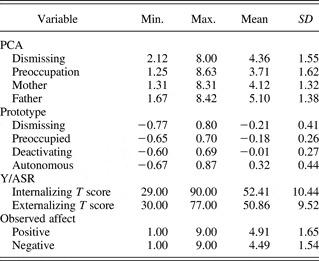
The sample for the current study (N = 842) reflects all AAI data collected to date in the Relationships Research Laboratory at the University of Illinois,Footnote 3 with the exception of interviews administered to participants in the second wave of longitudinal studies (i.e., the subsample of 68 participants from Roisman et al., Reference Roisman, Fortuna and Holland2006, who were previously administered the AAI in Roisman, Reference Roisman2006, as well as presently uncoded AAI data from a follow-up of dating couples from Holland & Roisman, Reference Holland and Roisman2010). Specifically, data were drawn from three samples of college students (Roisman, Tsai, & Chang, Reference Roisman, Tsai and Chiang2004, n = 60; Roisman, Reference Roisman2006, n = 100; Roisman et al., Reference Roisman, Fortuna and Holland2006; n = 32 subsample that had not previously been administered the AAI as part of an earlier assessment featured in Roisman, Reference Roisman2006) and six dyadic samples drawn from the community (aggregate n = 650 individuals drawn from 325 dyads) of (a) heterosexual, exclusively dating couples between 18 and 25 years of age (Holland & Roisman, Reference Holland and Roisman2010; Roisman, Clausell, Holland, Fortuna, & Eleff, Reference Roisman, Clausell, Holland, Fortuna and Elieff2008; n = 230, 115 dyads), (b) engaged couples between 18 and 30 years of age in their first engagement (Roisman, Reference Roisman2007; Roisman, Holland, et al., Reference Roisman, Holland, Fortuna, Fraley, Clausell and Clarke2007, Roisman et al., Reference Roisman, Clausell, Holland, Fortuna and Elieff2008; n = 100, 50 dyads), (c) married couples 50 years of age or older who had been married for 15+ years (Roisman, Reference Roisman2007; Roisman et al., Reference Roisman, Clausell, Holland, Fortuna and Elieff2008; n = 80, 40 dyads), (d) romantically involved same-sex male couples who were mutually committed and coupled for at least 1 year (Roisman et al., Reference Roisman, Clausell, Holland, Fortuna and Elieff2008; n = 60, 30 dyads), (e) romantically involved same-sex female couples who were mutually committed and coupled for at least one year (Roisman et al., Reference Roisman, Clausell, Holland, Fortuna and Elieff2008; n = 60, 30 dyads), and (f) young adult sibling pairs between 18 and 25 years of age (Fortuna, Roisman, Haydon, Groh, & Holland, Reference Fortuna, Roisman, Haydon and Groh2011; n = 120, 60 dyads). For the present study, data from the full aggregate sample (N = 842) were used in a PCA of item-level data from Kobak's (Reference Kobak1993) AAI Q-Sort and regression analyses focused on self-reported symptoms of psychopathology. Data from the subsample of romantically involved couples (n = 530 drawn from 265 dyads) were used in hierarchical linear modeling (HLM) analyses of observed emotion during a dyadic conflict resolution task conducted in the laboratory. The full sample was diverse with respect to age (range = 18–77 years, M = 25.99, SD = 12.25), gender-balanced (422 men, 420 women), and primarily Caucasian (76.6%).
Procedures
Prior to an in-person session, all participants completed an age-appropriate self-report measure drawn from the Achenbach assessments of symptoms of psychopathology (Young Adult Self-Report [YASR], Achenbach, Reference Achenbach1997; or Adult Self-Report [ASR], Achenbach & Rescorla, Reference Achenbach and Rescorla2003). Upon arrival at the laboratory, participants were administered the AAI by an interviewer who received extensive training in its administration from the second author. For the subsample of participants who were involved in studies of romantic relationships, couples were administered the AAI separately and subsequently participated in a standard romantic interaction task with their partners while being videotaped.
Specifically, upon completion of the AAI, research assistants administered a questionnaire listing eleven common problem areas in romantic relationships (e.g., money, communication, in-laws) to romantically involved participants separately. Participants were instructed that this form would be the only questionnaire that their partner would see and that they should use a 10-point scale to describe the degree to which each domain listed was currently a problem area in their relationship (from 1 = not a problem to 10 = is a serious problem). Participants then underwent a “revealed differences” procedure in which they were reunited with their partners and a research assistant provided the common problems questionnaires the participants had completed previously, instructing them to identify an area of disagreement in their relationship. After couples decided on a problem to discuss using the problem inventories, participants were given approximately 10 min to talk about and attempt to resolve this problem in their relationship. Couples were next instructed to take about 5 min to talk about areas of agreement in their relationship. Participants in all studies were compensated either with course credit or monetarily; details regarding compensation are presented in recent publications (see Roisman, Reference Roisman2006; Roisman et al., Reference Roisman, Tsai and Chiang2004, Reference Roisman, Fortuna and Holland2006, Reference Roisman, Clausell, Holland, Fortuna and Elieff2008; and Fortuna et al., Reference Fortuna, Roisman, Haydon and Groh2011).
Measures
AAI
The AAI (George, Kaplan, & Main, Reference George, Kaplan and Main1985) is a semistructured interview in which participants are asked to describe their early childhood relationships with their primary caregivers and the effects they perceive those experiences to have had on their development. The interview takes approximately an hour to complete and the coding system focuses on the coherence and internal consistency of participants' narratives as well as the extent to which participants become emotionally activated while discussing childhood memories.
In all of the studies that contributed data to this report, the AAI Q-Sort (Kobak, Reference Kobak1993) was used to code adults' AAI narratives. The AAI Q-Sort contains 100 cards pertaining to attachment-related states of mind, discourse, and inferred parental experience as assessed by the AAI. Cards are sorted into a forced normal distribution across nine piles from most to least characteristic of the participant's narrative in a forced, quasi-normal distribution. The distribution of participants' cards can then be correlated with four prototypic sorts based on conceptually relevant attachment dimensions: secure/autonomous (“presents an objective and well thought out picture of relationship influences vs. subject is unclear or confused about relationship influences”), deactivation versus hyperactivation (“reports negative experience not accompanied by feelings of hurt or distress vs. negative experiences are ‘felt’ or openly acknowledged”), dismissing (“adjectives supported by vague or shallow memories vs. adjectives supported by detailed episodic memories”), and preoccupied (“is confused or overwhelmed with information about parents vs. information about parents is adequate and well organized”). In practice, however, researchers have typically used the autonomous and deactivating versus hyperactivating prototype scores as a pair in analyses (e.g., Holland & Roisman, Reference Holland and Roisman2010), whereas the dismissing and preoccupied sorts are used less frequently (but see, e.g., Spangler & Zimmerman, Reference Spangler and Zimmerman1999). Of note, the four prototype sorts were created by averaging responses from several adult attachment experts meant to describe the prototypically secure, deactivating, dismissing, and preoccupied person. As such, the resulting prototypes are not directly informed by the way in which items cluster together empirically (as is examined directly in the current report via PCA).
For all AAIs coded for the present study, the AAI Q-Sort was used by raters centrally trained and certified as reliable on the Main and Goldwyn (Reference Main and Goldwyn1998) AAI categorical coding system. For the full sample featured in this paper, 38% cases (317/842) were double sorted (the percentage of double-sorted cases varied across the subsamples aggregated for this analysis; see, e.g., Roisman et al., Reference Roisman, Clausell, Holland, Fortuna and Elieff2008). Of the subset of double-coded cases, coders were reliable (≥0.6 using the Pearson–Brown prophecy formula) on 81.7% of cases. Where two coders were discrepant, a third coder sorted the case; the final sort was computed by averaging the two sorts that were most highly correlated.
Observed positive and negative affect
As noted above, a subsample of participants (n = 530; 265 dyads) were assessed in studies of romantic functioning. Based on the videotaped discussions of areas of agreement and disagreement in these dyad's relationships, trained graduate research assistants rated participants' facial, vocal, and bodily expressions of positive and negative affect during the videotaped interactions in accordance with the Interactional Dimensions Coding System (Kline et al., Reference Kline, Julien, Baucom, Hartman, Gilbert, Gonzales, Kerig and Baucom2004). Both positive and negative affect were rated separately on 9-point scales where lower scores reflected less expressed affect and higher scores reflected more expressed affect. For example, good eye contact, laughing, and orientation toward their partner were included in positive affect. Similarly, negative affect included lack of eye contact, a cold or angry voice, and a tense or rigid posture. Interrater reliability for both positive and negative affect was adequate across the subsamples featured in the current analysis (intraclass correlation coefficients [ICCs] > 0.60; see Roisman et al., Reference Roisman, Clausell, Holland, Fortuna and Elieff2008). Because the positive and negative affect variables were substantially negatively correlated (r = −.53) and we were interested in examining the differential predictive significance of the AAI state of mind dimensions in relation to the unique expression of positive versus negative affect during dyadic interactions, both dependent measures were residualized of the other (i.e., negative affect was residualized of positive affect and positive affect was residualized of negative affect) prior to use in analyses reported below.
Symptoms of psychopathology
The ASR (Achenbach & Rescorla, Reference Achenbach and Rescorla2003) and YASR (Achenbach, Reference Achenbach1997) assess psychological problems with over 100 items rated on a scale ranging from 0 (not true) to 2 (very true or often true). Samples collected before the ASR was released were administered the YASR; all other participants were administered the ASR. The following cohorts were administered the YASR: 60 participants in the study of emotional response during the AAI (Roisman et al., Reference Roisman, Tsai and Chiang2004); 100 participants in a stranger interaction study (Roisman, Reference Roisman2006); 32 participants in the experimental manipulation of earned-security (Roisman et al., Reference Roisman, Fortuna and Holland2006); and 50 engaged couples (Roisman et al., Reference Roisman, Clausell, Holland, Fortuna and Elieff2008). The following cohorts were administered the ASR: 120 participants in the sibling study (Fortuna et al., 2012); 230 participants from the dating couples study, 80 participants in the married couples study, 60 gay male participants, and 60 lesbian participants (Roisman et al., Reference Roisman, Clausell, Holland, Fortuna and Elieff2008). Age-appropriate measures and norms were applied to the various samples. Raw scores for items comprising the internalizing and externalizing scales were summed and converted to T scores for analysis (population mean = 50). As would be expected, the alpha values for the YASR and ASR internalizing and externalizing scales were acceptable across the various subsamples (>0.77).
Results
Analytic plan
In order to examine the latent structure of adult attachment as assessed by the AAI, we conducted a PCA of the 100 AAI Q-Sort items. We next correlated the dimensions that emerged from this PCA (labeled PCA derived) with the “standard” AAI Q-Sort dimensions (labeled prototype derived). Led primarily by the results of the PCA analysis, we next examined associations between attachment dimensions and two domains of functioning: observed affect expression in an attachment-related interpersonal context and self-reported internalizing and externalizing symptomatology. Note that in all analyses we examined the effects of the two state of mind dimensions prior to entering the inferred experience dimensions in the final step of each model. This allowed us to examine whether state of mind effects are robust to inferred experience dimensions as well as the unique effects of each attachment dimension net of the others in the full models.
To account for the nonindependence of partners' data in the romantic relationships assessments, we used HLM (Bryk & Raudenbush, Reference Bryk and Raudenbush1992) to examine associations between the attachment dimensions and observed positive and negative affect during the dyadic interactions (all variables were standardized prior to analysis to aid in the interpretation of the unstandardized effects reported). Linear regression analyses assessed relations among the attachment dimensions and internalizing and externalizing symptoms in the full sample (N = 842). (Note that HLM analyses not reported here examined these associations in the subsample of romantically involved participants [n = 530, 265 dyads] to ensure that shared within-dyad variance had not affected the results of the regression models; results did not differ from those reported below.) As hypotheses were articulated a priori, we report one- and two-tailed alpha levels for all analyses. Finally, descriptive statistics for all variables are presented in Table 1 and none of the effects reported were moderated by sex.
Descriptive statistics for all variables

Note: For all variables except positive and negative affect, N = 842. For positive and negative affect, N = 530. PCA, Principal components analysis; Y/ASR, Young/Adult Self-Report.
PCA of AAI Q-Sort items
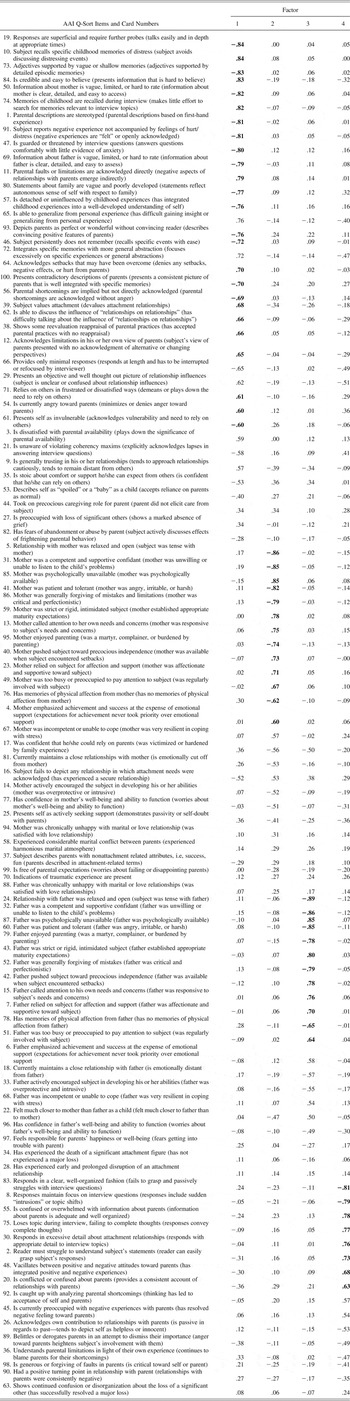
The 100 items from the AAI Q-Sort were submitted for PCA with varimax rotation. Based on examination of the scree plot and eigenvalues, a four-component solution best accounted for the data (Table 2). As expected, two of these components reflected attachment states of mind (Component 1 and Component 4); two additional factors reflected inferred experience with maternal and paternal caregivers (Components 2 and 3, respectively). Items loading highest on Component 1 represented the degree to which individuals freely evaluate or defensively discuss their childhood experiences (i.e., dismissing). Component 4 contained items involving the degree to which individuals become actively or passively caught up while discussing their early attachment experiences (i.e., preoccupied). Note that items loading on Component 1 reflect a distinction between dismissing versus autonomous indicators. We conceptualize the two dimensions as dismissing versus free to evaluate and preoccupied versus not. However, for ease of communication, we refer to Component 1 as dismissing and Component 4 as preoccupied. The two inferred experience components contained items reflecting the extent to which maternal and paternal caregivers were described as available and supportive versus rejecting neglecting, role reversing, and pressuring to achieve.
Results of Principal Components Analysis of AAI Q-Sort items

Note: Factor 1 is Dismissing (eigenvalue = 25.73), Factor 2 is Inferred Mother Experience (eigenvalue = 12.37), Factor 3 is Inferred Father Experience (eigenvalue = 8.17), and Factor 4 is Preoccupied (eigenvalue = 5.46). Bold factor loadings reflect items retained in final scales (see text). The text in parentheses indicates the low anchor for each card. Item labels have been truncated because of space constraints. AAI, Adult Attachment Interview.
Scales reflecting each component were derived by retaining items that loaded above 0.6 and did not cross-load on other factors above 0.4 (Hair, Anderson, Tatham, & Black, Reference Hair, Anderson, Tatham and Black1998). The final items retained for each dimension are indicated in bold in Table 2; eigenvalues for the four dimensions are also presented in Table 2. Mean scores on each scale were calculated for all participants. For conceptual clarity, items were reverse coded where necessary so that high scores reflected dismissing states of mind, preoccupied states of mind, and inferred negative experience with maternal and paternal caregivers. The Cronbach alpha was 0.97 for the dismissing scale, 0.94 for the preoccupied scale, 0.95 for the mother scale, and 0.95 for the father scale.
Correlations between PCA-derived and prototype scores
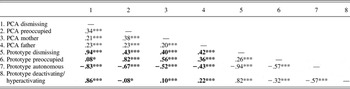
Correlations among and between the four PCA-derived scales and the four prototype scores are presented in Table 3. Three primary trends are of note. First, as expected given the orthogonal nature of the varimax rotation used to identify them, the PCA-derived scales were only modestly intercorrelated (M = 0.27, range = 0.20–0.36). For example, PCA-derived dismissing and preoccupied state of mind scales were correlated 0.34 (p < .001). Second, in contrast, the absolute values of the correlations among the four (standard) prototype scores were generally quite high (M = 0.58, range = 0.26–0.94), suggesting a degree of redundancy in particular among the security, dismissing, and deactivation/hyperactivation prototype scores. For example, the commonly used prototype-derived secure/autonomous and deactivation/ hyperactivation scales were correlated −0.57 (p < .001) in this sample. There were two exceptions to this trend: (a) the prototype-derived dismissing and preoccupied scores were only modestly correlated (r = .26, p < .001), which speaks well to their use as a pair in analyses, and (b) the deactivation/ hyperactivation and preoccupied dimensions were not particularly strongly correlated (r = −.32, p < .001). This latter result, however, is somewhat surprising in that the lower end of the deactivation dimension is meant to reflect preoccupation.
Correlations among PCA-derived scales and prototype scores

Note: Bold correlations represent those among the principal components analysis (PCA)-derived scales, and the prototype scores.
*p < .05. ***p < .001.
Third, it is important to note that the PCA-derived and prototype-derived dismissing scales were highly correlated (r = .94, p < .001), as were the two preoccupied scales (r = .82, p < .001), suggesting that these lesser used prototype scores (dismissing and preoccupied) converged with the state of mind dimensions that emerged empirically via PCA. Given this pattern of results, below we report analyses first for the four PCA-derived attachment dimensions (PCA-derived dismissing, preoccupied, negative mother experiences, and negative paternal experiences). Next, we swap out the two PCA-derived state of mind dimensions for the equivalent prototype-derived state of mind scales (prototype-derived dismissing for PCA-derived dismissing and prototype-derived preoccupied for PCA-derived preoccupied). This approach allowed us to examine whether there was any particular performance-related advantage to the PCA-derived dimensions over the more standard prototype-derived ones.
Interpersonal functioning
HLM analyses were computed to examine relations among the attachment dimensions and observed positive and negative affect for the subsample of participants who completed the romantic interaction task (n = 530; 265 dyads). Although not central to the primary goals of this analysis, we first examined the degree to which the final set of retained scales showed within-dyad convergence (e.g., evidence either of assortative mating or socialization). Specifically, we computed within-dyad ICCs on both the PCA-derived and prototype-derived state of mind scales, as well as the PCA-derived inferred experience scales. Consistent with prior research (Paley et al., Reference Paley, Cox, Burchinal and Payne1999), we found no evidence for assortative mating for the dismissing dimension (ICC = 0.06, p = .17 for the PCA-derived dimensions; ICC = 0.04, p = .27 for the prototype dimension), nor did partners converge significantly on the Father inferred experience scale (ICC = 0.03, p = .34). In contrast, we found marginally significant convergence on the Mother inferred experience scale (ICC = 0.09, p = .07) and significant convergence between partners on the preoccupied dimension of the AAI (ICC = 0.16, p < .01 for the PCA-derived dimensions; ICC = 0.18, p < .01 for the prototype dimension).
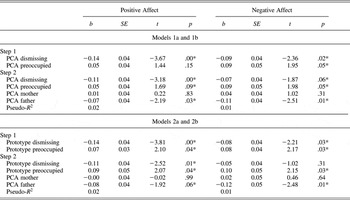
As described above, for comparison of the PCA-derived and prototype state of mind scales, one set of models was computed using the four PCA-derived dimensions to predict positive affect (Model 1a) and negative affect (Model 1b). A second set was computed using prototype-derived dismissing and preoccupied scores and the PCA-derived inferred parental experience dimensions to predict positive and negative affect (Models 2a and 2b, respectively). Pseudo-R 2 values (R-Squared in a Hierarchical Model, University of Texas, n.d.) were computed to estimate the overall effect size for each model. Results for all HLM analyses are summarized in Table 4.
Results of HLM models predicting positive and negative affect from the PCA-derived scales and from the combination of prototype state of mind and PCA-derived inferred experience scales

Note: Approximate degrees of freedom = 525. Exact p values are for two-tailed tests. HLM, hierarchical linear modeling; PCA, principal components analysis.
*p < .05 (one tailed).
PCA-derived scales
As expected, the PCA-derived dismissing scale was significantly associated with lower levels of positive and negative affect. PCA-derived preoccupation was in general associated with higher levels of positive and negative affect. In addition to these hypothesized associations, inferred negative father experience was also significantly associated with lower levels of both positive and negative affect. Inferred mother experience was not significantly associated with either positive or negative affect. Finally, it is important to note that magnitude of these effects were modest (pseudo-R 2s = .01–.02 for the full models), with the state of mind and inferred experiences scales each accounting for approximately half of the total variance explained in observed affect.
Prototype state of mind and PCA-derived inferred experience
HLM models containing the prototype dismissing and preoccupied state of mind scales and the PCA-derived inferred experience scales were computed for comparison and largely replicate the results just discussed. Prototype-derived dismissing was significantly associated with lower levels of positive affect but was not significantly associated with negative affect. Prototype-derived preoccupation was significantly associated with higher levels of positive and negative affect. Inferred negative father experience was associated with lower levels of both positive and negative affect and inferred negative mother experience was not significantly associated with either positive or negative affect. Once again, the magnitude of these effects in aggregate were modest (pseudo-R 2s = .01–.02 for the full models).
Symptoms of psychopathology
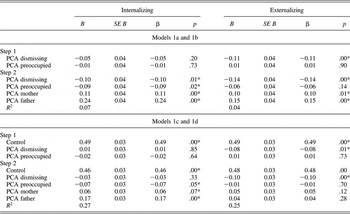
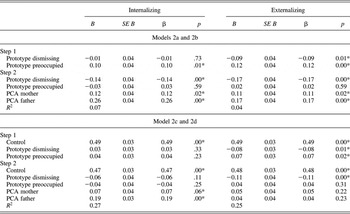
Four linear regression analyses examined associations between the attachment dimensions and self-reported symptoms of internalizing and externalizing psychopathology. Paralleling the analyses for observed affect, one set of models used the four PCA-derived scales to predict internalizing symptoms (Model 1a) and externalizing symptoms (Model 1b) and a second set used the prototype state of mind scales and PCA-derived inferred parental experience scales to predict internalizing and externalizing symptoms (Models 2a and 2b). In supplementary analyses (Models 1c, 1d, 2c, and 2d), we conservatively test the specificity of such associations to internalizing and externalizing by controlling for the opposite symptom domain. Results are summarized in Table 5 and Table 6.
Results of linear regression models predicting internalizing and externalizing symptoms from the PCA-derived scales

Note: Degrees of freedom = 836. The R 2 values for all models are significant at p < .001. Exact p values are for two-tailed tests. Step 2 of each model controls for the other symptom domain (i.e., internalizing or externalizing). PCA, principal component analysis.
*p < .05 (one tailed).
Results of linear regression models predicting internalizing and externalizing symptoms from the combination of prototype state of mind and PCA-derived inferred experience scales

Note: Degrees of freedom = 836. The R 2 values for all models are significant at p < .001. Exact p values are for two-tailed tests. Step 2 of each model controls for the other symptom domain (i.e., internalizing or externalizing). PCA, principal component analysis.
*p < .05.
PCA-derived scales
Neither PCA-derived state of mind scale was significantly associated with internalizing distress when inferred experience scales were not entered into the model (Model 1a, Step 1). In Step 2, all four PCA-derived scales were significantly associated with internalizing symptoms. However, as expected in this low-risk sample, dismissing (but also preoccupied) states of mind were modestly negatively associated with internalizing symptoms, while inferred negative maternal and paternal experiences were positively associated with internalizing distress. When externalizing symptoms were controlled (Models 1c and 1d), the dismissing dimension was no longer associated with internalizing symptoms but all other effects remained statistically significant. A second set of models was computed to examine associations between the PCA-derived scales and externalizing symptoms (Model 1b). PCA-derived dismissing was modestly negatively associated with externalizing symptoms, whereas inferred negative maternal and paternal experiences were positively associated with externalizing symptoms. PCA-derived preoccupation was not significantly associated with externalizing symptoms. When internalizing symptoms were controlled (Model 2c and 2d), only PCA-derived dismissing was significantly (negatively) associated with externalizing symptoms. In models that that did not control for the other symptom domain, the four attachment dimensions in aggregate explained 7% and 4% of the variance in the internalizing and externalizing measures, respectively, with the largest proportion of this explained variance deriving from the predictive significance of the inferred experience dimensions.
Prototype state of mind and PCA-derived inferred experience
A generally similar pattern obtained in the models using two prototype state of mind scales and the PCA-derived inferred parental experience scales (Model 2a). In Step 1, only prototype preoccupation was significantly (positively) associated with internalizing. In Step 2, prototype dismissing was negatively associated with internalizing symptoms, whereas inferred negative experiences with mothers and father were positively associated with internalizing symptoms. Preoccupation was no longer significantly associated with internalizing symptoms when inferred experience scales were taken into account. When externalizing symptoms were controlled (Model 2c), only inferred maternal and paternal experiences were significantly associated with internalizing symptoms. A second model was computed to examine associations with externalizing symptoms (Model 2b). In Step 1, prototype dismissing was negatively associated with externalizing symptoms, whereas prototype preoccupation was positively associated with externalizing symptoms. In Step 2, inferred negative experiences with mothers and fathers were positively associated with externalizing symptoms but preoccupation was no longer significantly associated with externalizing symptoms. When internalizing symptoms were controlled (Model 2d), only prototype dismissing remained significantly (negatively) associated with externalizing symptoms. Once again, the models that did not control for the other symptom domain explained 7% and 4% of the variation in internalizing and externalizing, respectively.
Discussion
This study revisited the latent structure of adult attachment as assessed by the AAI with raw item-level data generated by Kobak's (Reference Kobak1993) AAI Q-Sort. Building on evidence from Roisman, Fraley, et al. (2007; see also Bernier et al., Reference Bernier, Larose, Boivin and Soucy2004; Larose et al., Reference Larose, Bernier and Soucy2005), using PCA we identified two dimensions reflecting state of mind and two reflecting inferred experiences with caregivers. As expected, the state of mind dimensions that emerged from PCA were distributed along two axes: dismissing states of mind and preoccupation. In addition, the two inferred experience dimensions identified by the PCA were person-specific and reflective of the extent to which experiences with caregivers were recalled, broadly, as positive or negative. Of note, this latter finding is in contrast to previous emphasis (e.g., Main & Goldwyn, Reference Main and Goldwyn1998) on the specific nature of recalled experiences (i.e., loving, rejecting, involving, pressuring, and neglecting) across caregivers.
Such evidence places the standard conceptualization of individual differences in adult attachment in new light. Specifically, dismissing and preoccupied states of mind, previously viewed as incompatible, are recast as distinct but modestly correlated axes of variation. As we have noted previously (Roisman, Fraley, et al., 2007), a recognition of two latent axes of variation underlying adults' coherence of discourse (and a method for scaling individuals on such axes) would make certain phenomena, currently very difficult to reconcile within the standard frame of reference, much more theoretically comprehensible. For example, it has been known for some time that indicators of both dismissing and preoccupied states of mind are combined in certain AAI narratives currently labeled “cannot classify,” but a satisfactory approach for accounting for such individuals in analyses has been rather elusive.
Significance for theory
The emergence of modestly correlated dismissing and preoccupied dimensions, rather than a security-insecurity (i.e., autonomous–nonautonomous) dimension, replicates the latent structure of the AAI identified by Roisman, Holland, et al. (Reference Roisman, Holland, Fortuna, Fraley, Clausell and Clarke2007) and Bernier and colleagues (Reference Bernier, Larose, Boivin and Soucy2004; Larose et al., Reference Larose, Bernier and Soucy2005) using dimensions drawn from Main and Goldwyn's (Reference Main and Goldwyn1998) AAI classification system and parallels the latent structure of the Strange Situation scales identified by Fraley and Spieker (Reference Fraley and Spieker2003). Convergent evidence across sample and method is encouraging on two levels. First, mounting empirical evidence offers some confidence in the robustness of the two axes of variation specific to attachment states of mind. Second, evidence of convergence between the latent structure of attachment in infancy and adulthood is theoretically consistent with expectations that adult attachment is the developmentally elaborated analog of infant attachment (Waters, Hamilton, & Weinfield, Reference Waters, Hamilton and Weinfeld2000). Taken together, these findings point toward the potential progress that might be made by adopting and, where necessary, modifying existing methods that reflect this latent structure.
It is important that the latent structure identified here enabled more nuanced predictions than the standard conceptualization has offered in two key areas of relevance to attachment. With respect to interpersonal functioning in a romantic context, the dismissing and preoccupied state of mind dimensions differentially predicted affect expression. As expected, dismissing states of mind were associated with suppression of both positive and negative affect during a conflict resolution task whereas preoccupation was associated with activation of positive and negative affect in this context. Of note, this pattern of results was corroborated by (unreported) electrodermal evidence: in the romantically involved sample examined in this report, dismissing states of mind were positively associated with electrodermal reactivity (a physiological indicator of behavioral inhibition; Dozier & Kobak, Reference Dozier and Kobak1992; Fowles, Reference Fowles1980) during the videotaped conflict interaction procedure, whereas preoccupation was negatively associated with baseline-corrected skin conductance levels (SCLs) in this context.Footnote 4 In addition, we have already replicated the behavioral findings reported here conceptually in another study of sibling interactions where identical affect variables were coded in a videotaped conflict resolution paradigm (Fortuna et al., Reference Fortuna, Roisman, Haydon and Groh2011). We believe that such results represent progress toward identifying distinct behavioral correlates of two forms of insecurity long expected by attachment theory but thus far notably absent from the literature (see Roisman, Reference Roisman2007, for discussion). With this new approach in hand, there may be greater potential to address other areas in which we have strong theoretical predictions for functional divergence between dismissing and preoccupied states of mind but have not yet found reliable evidence of this kind (e.g., conflict and conflict resolution, support provision and acceptance, processes underlying relationship stability). In particular, an important future direction involves further substantiating the validity of the PCA-derived latent structure by applying the latent structure described in this and other reports to questions related to the stability of attachment-related variation within individuals over time and across generations (two theoretically relevant “gold standards” for validating attachment measures).
Turning toward analyses examining how the AAI state of mind dimensions predicted self-reports of psychopathology, the dismissing and preoccupied dimensions were negatively or nonsignificantly associated with internalizing and externalizing symptomatology. The results for dismissing states of mind are entirely consistent with evidence from prior studies of nonclinical samples that dismissing adults tend to report suspiciously low levels of symptomatology (Kobak & Sceery, Reference Kobak and Sceery1988; Pianta et al., Reference Pianta, Egeland and Adam1996), particularly under conditions of low life stress (Fortuna & Roisman, Reference Fortuna and Roisman2008). Although the findings for preoccupied states of mind might seem somewhat puzzling in light of prior evidence (e.g., Pianta et al., Reference Pianta, Egeland and Adam1996), in unreported bivariate analyses we found, consistent with prior reports in the literature, that prototype-derived preoccupation was positively associated with both internalizing (r = .10, p < .01) and externalizing (r = .10, p < .01) problems. The PCA-derived preoccupied scale, in contrast, was essentially uncorrelated with both internalizing (r = −.03, p = .41) and externalizing (r = −.03, p = .36). That the PCA-derived dimensions were orthogonalized to inferred negative experience dimensions, and the prototype-derived preoccupation scale was a nonsignificant predictor of internalizing and externalizing after the inferred experience dimensions entered in relevant analyses (see Results), suggests the possibility that positive associations identified in prior studies between preoccupation and symptoms of psychopathology might actually be driven by the fact that preoccupation assessed in such studies confounds variation associated with state of mind and inferred experiences.
The present findings are also consistent with previous reports implicating the co-occurrence of the recall of negative early experiences during the AAI and internalizing distress in particularFootnote 5 (Roisman et al., Reference Roisman, Padrón, Sroufe and Egeland2002, Reference Roisman, Fortuna and Holland2006). As expected, inferred negative experience with both mothers and fathers were associated with higher internalizing symptoms and such effects were notably net of the state of mind scales. It is important to reiterate that the inferred experience scales assessed by the AAI reflect retrospective accounts of childhood experiences, which we have reason to believe might not be veridical (Roisman et al., Reference Roisman, Padrón, Sroufe and Egeland2002, Reference Roisman, Fortuna and Holland2006). Concurrent reports of negative experience with caregivers and internalizing symptoms could be markers of an underlying developmental process or, as we have previously argued, might reflect the influence of something more proximal such as biased recall (Roisman et al., Reference Roisman, Fortuna and Holland2006) or, as others have suggested, current expectancies of the parent–child relationship (Kobak & Zajac, Reference Kobak, Zajac, Cicchetti and Roisman2011). These questions are currently under investigation within the earned security literature, where both experimental and prospective designs may offer clarification (Roisman & Haydon, Reference Roisman, Haydon, Cicchetti and Roisman2011).
Although the developmental significance of the inferred experience dimensions remains somewhat unclear, the current findings demonstrate that they have the potential to function as informative covariates with respect to clarifying the predictive significance of adult attachment states of mind. Moreover, we have recently begun to assess the construct validity of the PCA-derived inferred experience scales in a series of studies (Haydon, Roisman, Marks, & Fraley, Reference Haydon, Roisman, Marks and Fraley2011), finding that the inferred experience dimensions are uniquely associated with, and in some cases account for the effects of state of mind on, aspects of attachment-related information processing (including reaction time in the attachment Stroop paradigm and the valence of self-appraisals) and also demonstrate substantial convergence with self-reported attachment avoidance and anxiety when the latter are assessed at the level of specific caregivers (unlike the AAI state of mind dimensions, which are trivially associated with self-reported attachment style dimensions; Roisman, Holland, et al., Reference Roisman, Holland, Fortuna, Fraley, Clausell and Clarke2007).
One final issue concerns the implications of this work in terms of reconceptualizing a foundational construct within attachment research: security. In the present analysis, autonomous versus nonautonomous discourse did not emerge as a distinct axis of adult attachment-related variation, as assessed via the AAI. Rather, autonomous states of mind, it would appear, reflect the co-occurrence of low levels of dismissing and preoccupied states of mind. That said, in certain empirical situations it may be appropriate and advantageous to scale individuals on a broadband security–insecurity dimension, as prior studies in the literature clearly demonstrate (including our own; Holland & Roisman, Reference Holland and Roisman2010; Roisman, Holland, et al., Reference Roisman, Holland, Fortuna, Fraley, Clausell and Clarke2007). Nonetheless, the current analysis highlights a pitfall of doing so: reifying a distinction not reflected in the data and, in so doing, possibly failing to examine the potentially distinctive developmental antecedents and sequelae of the empirically distinctive elements of autonomous discourse.
Implications for AAI coding
The accumulating evidence suggest to us that the AAI captures two modestly correlated state of mind dimensions: one that reflects the degree to which individuals either freely evaluate or defensively discuss their early experiences (i.e., dismissing states of mind) and the other reflecting attachment-related preoccupation (i.e., preoccupied states of mind). Moreover, as expected on the basis of theory, the AAI also captures empirically distinctive variation in participants' recalled experiences of support or difficulty with maternal and paternal caregivers. As our data on interpersonal functioning and internalizing problems suggest, there may be some advantages to using these four dimensions (or, in some empirical situations, the two state of mind dimensions on their own) to scale participants in future studies of the AAI. Although it is possible to use elements of Main and Goldwyn's (Reference Main and Goldwyn1998) standard coding system to accomplish this (see Roisman, Fraley, et al., 2007), the clear disadvantage of doing so is that there is, at present, no mechanism in place to ensure that coders are reliably using the inferred experience and state of mind dimensions that can be used to scale participants on the four dimensions identified in this report.Footnote 6 As such, there might be an advantage to making greater use of Kobak's Q-Sort system, either by scaling participants on the individual items or in using the dismissing and preoccupied prototype scores of the AAI Q-Sort, which while a part of Kobak's system, nonetheless remain rather underutilized. That said, we cannot at this time strongly endorse either the use of PCA-derived state of mind or prototype-derived dismissing and preoccupied dimensions over the other because each approach has its strengths and limitations. For example, PCA-derived dimensions accurately reflect the underlying variation, at least within a particular data set, and are optimally orthogonalized to one another. In contrast, the use of the standard prototype scores (i.e., dismissing and preoccupied) has the advantage of participants being scaled identically on these crucial dimensions across laboratories.
Although our relatively large sample provides some confidence in the results presented here, we encourage other laboratories to examine the latent structure identified here with an eye toward replication in other (more diverse) samples (but see Kobak & Zajac, in press, who found similar results in a higher risk adolescent sample).Footnote 7 Nonetheless, we do believe that evidence supports researchers beginning to preferentially scale participants according to the latent structure identified in this and previous papers. As such, we provide specific recommendations for doing so. First, following the logic of Roisman, Fraley, et al. (2007), relatively orthogonal dismissing and preoccupied state of mind dimensions can be created by averaging the relevant AAI subscales identified in that study. At present, however, it is not clear how the inferred experience scales rated by AAI coders using the Main and Goldwyn (Reference Main and Goldwyn1998) coding system might factor if submitted to PCA. Alternatively, researchers with AAI Q-Sort data can create scales presented here by averaging the bolded items under each component (reverse-coding items where necessary) presented in Table 2. As the data from this paper suggest, however, there might be little gained in doing so as compared to simply using Kobak's (Reference Kobak1993) dismissing and preoccupied prototype scores, with the exception that using the prototype scores does have the potential for researchers to fail to consider the inferred experience dimensions that emerged from our PCA.
Although the current Q-Sort system captures a wide range of attachment-related experiences and effectively scales individuals on the four dimensions described in this report, we offer one caveat regarding its capacity to assess the full range of attachment-related individual differences. Specifically, the AAI Q-Sort system is, by design, underpowered in its capacity to capture variation in unresolved status in that it is relatively lacking in cards focused on disorganized discourse with respect to loss, abuse, and trauma (and none of these cards loaded on the PCA-derived scales in the current report).
On this point, Roisman, Fraley, et al. (2007) found that AAI subscales reflecting unresolved status and preoccupation loaded on a single factor (rather than separately, as is anticipated by the Main and Goldwyn, Reference Main and Goldwyn1998, classification system). As just mentioned, indicators of unresolved status are largely missing from the dimensions identified in the present PCA. As such, we were unable to contribute new evidence in the current study that might help determine whether unresolved states of mind might be subsumed under preoccupation more generally. Moreover, the present sample is low-risk with a relatively low base rate of unresolved discourse with respect to loss, trauma, and abuse. Thorough examination of these questions requires additional work with higher risk samples in which loss, abuse, and trauma are more prevalent.
Caveats and Conclusion
Two important caveats attach to this work. First, there is to our knowledge no empirical or simulation evidence as to whether the psychometric characteristics of Q-Sorts generally (i.e., the use of a forced normal distribution in which cards are ranked into piles) are compatible with taxometric analysis (e.g., MAXCOV-HITMAX). Although we discuss the axes of variation identified in this report as if participants are ideally scaled on them continuously, we were unable to address the issue of taxonicity of individual differences in adult attachment using the present data set. To date, there is evidence from one investigation that dismissing states of mind are distributed continuously. However, relevant evidence in the same study was indeterminate with respect to preoccupation (Roisman, Fraley, et al., 2007). As such, the issue of the taxonicity of attachment-related variation remains as an outstanding issue for future large-scale studies of the AAI (e.g., in the context of the ongoing 17.5 year assessment of the NICHD Study of Early Child Care and Youth Development).Footnote 8
Second, it should be appreciated that PCAs do not literally carve nature at its joints. Rather, when based on relatively large data sets of the kind presented herein, they provide increased confidence about the latent structure of a given method. As evidence from multiple studies (Bernier et al., Reference Bernier, Larose, Boivin and Soucy2004; Larose et al., Reference Larose, Bernier and Soucy2005; Roisman, Fraley, et al., 2007) converges on the conceptualization of individual differences in adult attachment replicated in this large-scale analysis, we believe that there is considerable reason to be confident that the AAI, as well as other diverse assessments of attachment (Fraley & Spieker, Reference Fraley and Spieker2003; Fraley, & Waller, Reference Fraley, Waller, Simpson and Rholes1998), scale participants on two key axes of attachment-related variation, which at the highest level of abstraction can be conceived of as reflecting attachment-related anxiety and avoidance (Roisman, Reference Roisman2009).