When we look at the picture in Figure 1, we all see the same objects: two nuns, a path, a house, a pasture, the sky, a tree in the background, and so on. Consequently, despite having different mother tongues, we would assume that the verbal descriptions of such a scene are similar. However, when comparing verbal descriptions of this very scene in different languages, we find that descriptions differ considerably from one language to another. The scene in Figure 1 was presented as part of a video clip in a production study (see Carroll, von Stutterheim, & Nüse, Reference Carroll, von Stutterheim, Nüse, Pechmann and Habel2004). The results revealed that speakers of English preferred to verbalize the event as given in Example (1). Speakers of German, however, tended to describe the event as given in (2).Footnote 1
(1) Two nuns are walking.
(2)

In the current study, we are interested in the ways in which speakers of different languages and learners of a second language (L2) rated the different possible descriptions of events such as those presented above.
A video still to represent stimuli data from Carroll et al. (2004). [A color version of this figure can be viewed online at http://journals.cambridge.org/aps]

English has a grammatical morpheme to mark the specificity and duration of an event (cf. Biber, Johansson, Leech, Conrad, & Finegan, Reference Biber, Johansson, Leech, Conrad and Finegan1999; Quirk, Greenbaum, Leech, & Svartvik, Reference Quirk, Greenbaum, Leech and Svartvik1985), the –ing form. This form marks the event as ongoing and specific (as opposed to generic). German lacks such a morpheme and has to employ different means to mark specificity and the duration of an event. In the example above, duration is not marked at all. However, to avoid a generic reading, the specificity of this event is indicated by means of in Richtung eines Hauses, “toward a house,” that is, by giving an endpoint. That there are clear preferences across languages suggests that the inventory of a language (having a progressive form or not) has an influence on the way such a scene is described.
Despite the wide range of possibilities for encoding the specificity and the duration of an event in individual languages, the results of previous studies showed little variation in the verbalizations utilized within languages.
Slobin (Reference Slobin and Perdue1996a, Reference Slobin, Gumperz and Levinson1996b, Reference Slobin, Niemeier and Dirve2000) looked at the manner in which motion is described and found a relationship between the inventory of a language and the descriptions of particular scenes for a number of different languages. Some languages (e.g., English and German) code the manner of motion in the lexical verb, whereas others (e.g., Spanish and French) do not (Slobin, Reference Slobin, Gumperz and Levinson1996a). Consequently, the latter have to employ other strategies to express the same information. When describing a series of events in a children's picture book, Slobin found regularities for verbal descriptions in a number of different languages that corresponded to the typological differences for these languages as proposed by Talmy (Reference Talmy and Shopen1985, Reference Talmy1991). Talmy categorized languages according to the way in which they describe path and manner of motion. So-called satellite-framed languages express path by means of a satellite to the verb (go in/out/up). In contrast, verb-framed languages code path by the main verb in the clause (to enter, to leave, to ascend). These and a number of other regularities found by Slobin (Reference Slobin, Niemeier and Dirve2000) led him to propose a modified version of linguistic relativity that he called thinking for speaking.
Based on earlier assumptions by Humboldt and Herder, Sapir and Whorf assumed a close relation between language and thought (see Gumperz & Levinson, Reference Gumperz and Levinson1996). Their so-called linguistic relativity hypothesis consists of a strong and a weak version. The former (also known as linguistic determinism) states an inseparable relationship between language and thought in a sense that thinking is only possible if a language has words to describe these thoughts. However, this notion has since been abandoned. The latter (more commonly known as linguistic relativity) also states a relationship between language and thought, albeit a less absolute one. In this view, “aspects of individuals’ thinking differ across linguistic communities according to the language they speak” (Gumperz & Levinson, Reference Gumperz and Levinson1996, p. 24).
Given the complexity of a definition of “thought,” exploring the exact nature of the relationship between language and thought presents a difficult task. Therefore, Slobin (Reference Slobin, Gumperz and Levinson1996b, p. 76) reduced the notion of thought to the process of thinking in relation to the language production and perception process. He proposed an influence of language on one's view of the world only in situations in which the speaker is involved in language production processes, that is, when “the expression of experience in linguistic terms constitutes thinking for speaking—a special form of thought that is mobilized for communication.” He argued that “one cannot verbalize experience without taking perspective, and, further, that the language being used often favours particular perspectives . . . [E]xperiences are filtered through language into verbalized events” (Slobin, Reference Slobin, Niemeier and Dirve2000, p. 107).
Von Stutterheim and Nüse (Reference von Stutterheim and Nüse2003) tried to find evidence for Slobin's thinking for speaking hypothesis, but they looked at a different part of the language inventory. They looked at the way ongoingness is coded in different languages in narratives. Some languages code ongoingness by means of a morpheme (e.g., English), whereas other languages (e.g., German) that lack such a morpheme have to employ other means. Von Stutterheim and Nüse (Reference von Stutterheim and Nüse2003) found that speakers of English segment the story into more detailed units than do speakers of German. Speakers of English used more bare verbs and rarely mentioned the endpoint or the direction of movement. In contrast, German speakers frequently used endpoints and directions to describe motion events. The results of the above study seem to suggest that there is a relationship between the use of a progressive form and the mentioning of an affected object or endpoint. Speakers of languages with obligatory grammatical progressive marking seem to be less inclined to mention an endpoint or affected object in their narratives. Speakers of languages without a grammatical form for the progressive frequently mentioned endpoints or affected objects.
In order to rule out the possibility that these preferences are the result of cultural differences rather than differences in the grammatical inventory of the languages, Carroll, von Stutterheim, and Nüse (2004) conducted a follow-up study in which they investigated whether speakers of Arabic (which is similar to English with respect to aspectual marking), Dutch, and Norwegian (both similar to German) displayed similar behavior to speakers of English and German. The results for Arabic were similar to those for English, while Dutch and Norwegian speakers behaved like German speakers. This led them to conclude that the observed differences among these languages are related to the grammatical inventory and not to differences in culture.
In their 2004 study, Carroll et al. suggested that context might also play a role in the patterns of event descriptions for narratives in different languages. They argued that strategies used in languages that lack the morphological marking of ongoingness (i.e., the use of temporal adverbs) are highly dependent on contextual information and are therefore less likely to be used in single event descriptions. Carroll et al. (Reference Carroll, von Stutterheim, Nüse, Pechmann and Habel2004) conducted a study on single event descriptions. Although the results were similar to those found for narratives in some languages, this was not the case for all of the languages incorporated in the study. Speakers of English and Arabic frequently used progressive forms, omitting endpoints in most cases. Speakers of German and Norwegian made frequent use of endpoints using a more holistic perspective. However, for Dutch, the results of the single events descriptions differed from those found for narratives: in comparison to the narrative study, speakers of Dutch used fewer endpoints and made use of a periphrastic construction, is aan het +INF (roughly translated, is currently +INF). The function of this construction is similar to the English progressive in many contexts (see also Carroll & von Stutterheim, Reference Carroll, von Stutterheim, Bohnemeyer and Pederson2010). Speakers of Dutch also used fewer endpoints than did speakers of German and Norwegian in their single events descriptions.
To see whether factors other than the availability of a progressive form influence the way single events are described, Carroll, Natale, and Starren (2008) investigated whether particular characteristics of events can explain the regularities they found in earlier studies (e.g., Carroll et al., Reference Carroll, von Stutterheim, Nüse, Pechmann and Habel2004), in particular with locomotion events (e.g., A woman is walking toward the house). In their experimental materials, they made a clear distinction between the characteristics of the event as they were displayed in the video clips, and the semantic properties of the verbs used to describe these events. They looked at single event descriptions by native speakers of French, Dutch, and Italian. For speakers of French and Dutch, they found that the characteristics of an event influenced the use of the progressive: nonlocomotion events elicited a higher frequency of progressives (Dutch 32%, French 20%) than did locomotion events (1% and 4%, respectively). For Italian this effect was less evident (46% for nonlocomotion events vs. 33% for locomotion events). Furthermore, they found an effect of the presence of a visible object in nonlocomotion events on the use of progressives. In general, the presence of a visible object increased the use of a progressive form in event descriptions. The results of the above-described studies allow for two conclusions. First, the likelihood of finding differences between different languages is higher when looking at nonlocomotion events and manipulating the presence or absence of a visible object. Second, that languages differ in their availability of a progressive form (and its sensitivity to different event characteristics) makes it interesting to compare languages with strong opposing preferences (such as English and German) to languages without clear preferences (such as Dutch).
In both narratives and single events descriptions Carroll, von Stutterheim, and their team found a number of regularities in event descriptions that are related to the inventory of individual languages. There are various other studies that also found a relationship between the inventory of different languages and the way these languages are used to describe certain situations (e.g., Allen et al., Reference Allen, Ozyürek, Kita, Brown, Turanli, Ishizuka, Beachley, Brown and Conlin2003; Naigles, Eisenberg, Kako, Highter, & McGraw, Reference Naigles, Eisenberg, Kako, Highter and McGraw1998; Papafragou, Massey, & Gleitman, Reference Papafragou, Massey and Gleitman2002, Reference Papafragou, Massey and Gleitman2006).
However, Bohnemeyer, Eisenbeiss, and Narasimhan (Reference Bohnemeyer, Eisenbeiss and Narasinhan2006) replicated and extended Slobin's (Reference Slobin and Perdue1996a, Reference Slobin, Gumperz and Levinson1996b, Reference Slobin, Niemeier and Dirve2000) studies by looking at descriptions of motion events in 17 different languages. These authors pointed out that the differences among the languages under investigation were not as clear-cut as they would have assumed them to be based on previous studies. They concluded that factors such as stimulus material and type of task might have influenced the patterns found in earlier research (see also Slobin, Reference Slobin and Gathercole2008). There are two ways to circumvent this problem: first, by manipulating task demands, for example, by creating different production tasks to look at the same phenomenon, or, second, by using a different task domain to investigate this phenomenon. One could argue that Carroll et al. (Reference Carroll, von Stutterheim, Nüse, Pechmann and Habel2004) already looked at two different task demands, namely, narratives and single event descriptions. However, for a more complete picture of the factors influencing event descriptions, we would also have to look at other task domains. Therefore, this study will explore the likelihood of certain single event descriptions in the perception domain.
Using the perception domain also provides a solution for another problem that might have influenced the results of previous production studies. Most of these studies made use of an elicitation setup, in which participants are prone to apply a certain answering strategy. Once participants have used a certain utterance type to describe a situation, they are likely to stick to the pattern of the utterance in their descriptions of the following events (for the effect of syntactic priming, see Branigan, Reference Branigan2007). This strategy might conceal how speakers of a language would normally describe an event in a less restricted setting. One way to avoid this problem is to offer participants a range of possible descriptions to choose from and to ask them to evaluate these descriptions. This could unveil subtle differences in the acceptability of different alternatives for describing the same event.
Flecken (Reference Flecken2011) carried out a perception study among native speakers of Dutch but chose a different design from the one described above. She created a number of situation descriptions covering different situation types (see Natale, Reference Natale2008) and varying the duration of the event. Participants were given these verbal descriptions and were asked to place themselves in these situations. Then they were asked to answer the question “What are you doing?” They were given two alternatives to choose from: a simple form sentence or a sentence with an is aan het construction. Flecken (Reference Flecken2011) found a relation between the duration of a situation and the preference for an is aan het construction. Longer situations attracted more is aan het constructions. The characteristics of the different situation types also seemed to influence the choice of participants. The choice for an is aan het construction was most frequently made for activitiesFootnote 2 (49%), followed by change in state situations (44%). Locomotion events attracted the fewest is aan het constructions, and this was clearly mediated by the presence of an endpoint (with endpoints 16%, without an endpoint 38%). Flecken (Reference Flecken2011) concluded that regardless of the situation type, “the variable duration turned out to be a fundamental attractor for the aan het-construction.”
The interpretation of Flecken's (2011) data in relation to earlier production data is rather complex given that participants did not rate individual sentences but had to choose between two alternatives. This implies that Flecken analyzed the preferences for one of the sentences above the other, rather than analyzing general preferences in describing a certain event type. A choice between two alternatives does not provide information on the range of possible utterances; it simply indicates that the selected one is the better one of the two. One way of circumventing this problem is by presenting the sentences individually and asking participants to rate the likelihood of using that particular utterance on a 7-point Likert scale. This is what we did in the present study using a between-subject design. This approach also permitted the presentation of more than two possible sentences describing a particular event and, consequently, a more detailed picture of the range of descriptions that is possible in the individual languages.
In the present study, we investigated the influence of the inventory of different languages on the way language is used in event descriptions; in other words, we measured the acceptability of given event descriptions for nonlocomotion events, using video stimuli that were manipulated with respect to the presence or absence of a visible object. The individual sentences to be evaluated were manipulated with respect to the presence or absence of an object in the text and the presence of a progressive form leading to four different sentences. The study was carried out among native first language (L1) speakers of Dutch, English, and German (Experiment 1), as well as Dutch learners of L2 English and German (Experiment 2). Based on results found in production data (e.g., Carroll & von Stutterheim, Reference Carroll, von Stutterheim, Bohnemeyer and Pederson2010; Carroll et al., Reference Carroll, von Stutterheim, Nüse, Pechmann and Habel2004), we expected clear preferences for speakers of English, namely, the preference for a progressive form. Similarly, for German we expected to find a preference for a simple form as well as for the mentioning of an object. However, we did not expect clear preferences for native speakers of Dutch, given that Dutch has a periphrastic construction to mark ongoingness and that this construction is not obligatory.
L1 EXPERIMENT
Method
Participants
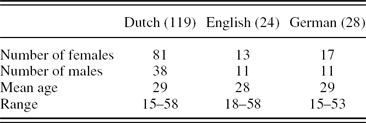
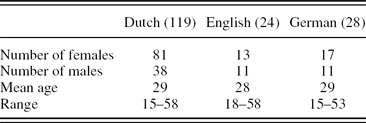
In this experiment, we compared a group of 119 Dutch native speakers to a group of 24 English native speakers and a group of 28 German native speakers (Table 1). Most of the participantsFootnote 3 were students at various faculties at the Radboud University in Nijmegen, and a few participants were from various other backgrounds.
Overview of details of participants
Materials
The stimulus set consisted of 38 video clips divided into three different categories. Category 1 consisted of 10 clips showing events without a visible object (NL –object), for example, someone who is painting without a visible picture (see Figure 2, top). Category 2 (see Figure 2, bottom) consisted of the same situations, but this time with a visible object (NL +object). Category 3 was a control category, consisting of 18 video clips showing events that do not result in a tangible productFootnote 4 (such as picture), as displayed in Figure 3.
An example of a Category 1 and 2 video clip (top) without and (bottom) with a visible object. [A color version of this figure can be viewed online at http://journals.cambridge.org/aps]
An example of a Category 3 video clip. [A color version of this figure can be viewed online at http://journals.cambridge.org/aps]
We also included 10 filler items. All video clips were 5 s long and without audio. The video clips were accompanied by one of four possible descriptions of the clip. These descriptionsFootnote 5 were manipulated with respect to the use of an object and the use of a progressive form. Listed below are the examples for English. The examples for the other languages can be found in Appendix A.
(3)
The control category sentences were also manipulated with respect to the presence of a progressive and/or object used to keep sentences across categories as constant as possible. For the above example in Figure 3 participants were offered one of the following sentences:
(4)

The filler items were always accompanied by the same sentence, either a passive construction (Two poles are being tied together) or a more complex sentence construction (Someone puts the key into the lock and opens the door). These items were included in order to distract participants from the experimental manipulation.
The length of the sentences and the word order were the same for all individual clips across the three languages (for the examples see Appendix A).Footnote 6
Design and procedure
We employed a within-subject as well as a between-subject design. The within factors were object_in_sentence, Progressive, and category. The between factors were order of presentationFootnote 7 and category per situation; for Categories 1 and 2, participants saw only one of the two possible clips per situation type (e.g., if the participant saw “painting without visible object,” he/she did not see “painting with a visible object”). Using a Latin square design, we created eight different versions of a list of video clips with a 5-s pause between the individual clips. All versions consisted of a total of 38 video clips. We also created eight versions of a questionnaire containing the sentences. Each sentence was followed by a 7-point scale, ranging from 1 (very unlikely) to 7 (very likely). On this scale, participants had to indicate the likelihood that they would use a given sentence if they had to describe the respective video clip in their own words. This part of the experiment was followed by a number of questions concerning the personal situation of the participants.
Each participant was tested individually. The presentation of the visual stimuli was done either on a TV or on a computer screen by means of a DVD. Participants were seated at a table behind the screen. They were given instructions in the language of the experiment. They were asked to fill in a paper questionnaire after each clip. After the instruction, participants could ask questions concerning the task. All communication between experimenter and participant was conducted in the language of the experiment. In total, participants had 10 s (5-s video clip and 5-s pause) to respond to each item. Overall, the experiment took about 10 min.
Results
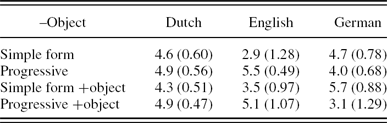
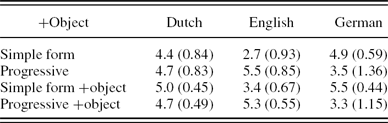
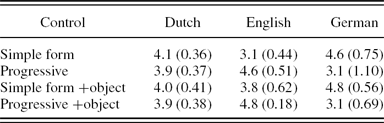
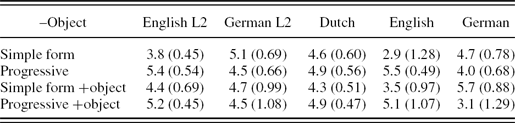
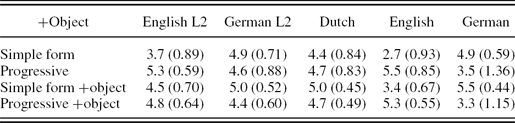
In the following, we only report results for causative events without visible object (Category 1), causative events with a visible object (Category 2), and the control category. The mean ratings for the probability of use for the three categories are presented in Table 2, Table 3, and Table 4.
Mean (standard deviation) ratings (1 = very unlikely, 7 = very likely) for events without object (Category 1)
Mean (standard deviation) ratings (1 = very unlikely, 7 = very likely) for events with a visible object (Category 2)
Mean (standard deviation) ratings (1 = very unlikely, 7 = very likely) for the control category (Category 3)
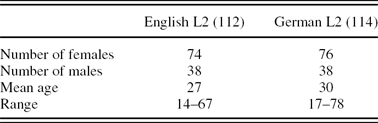
Overview of details of the Dutch participants
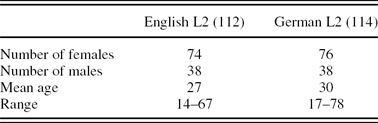
Note: L2, second language.
Analyses of variance (ANOVA) were carried out on the ratings for all conditions (we will only report analysis or comparisons that have a p smaller than .05, and for all analyses Bonferroni alpha-level adjustments were used). We will first report analyses for the individual languages followed by a comparison of the three languages.Footnote 8
Dutch
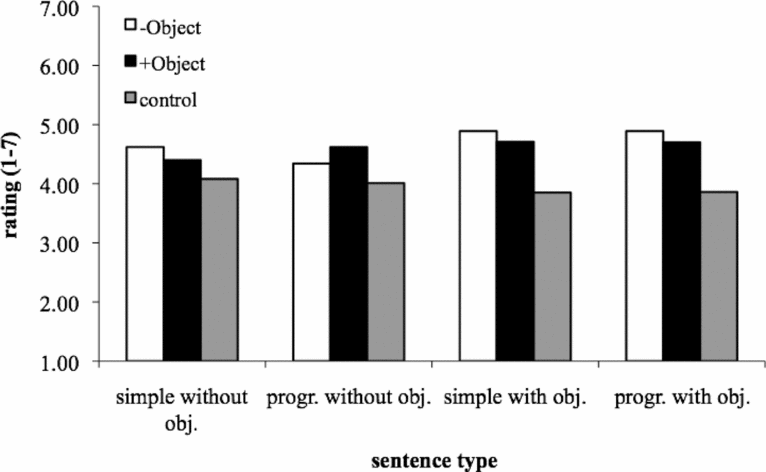
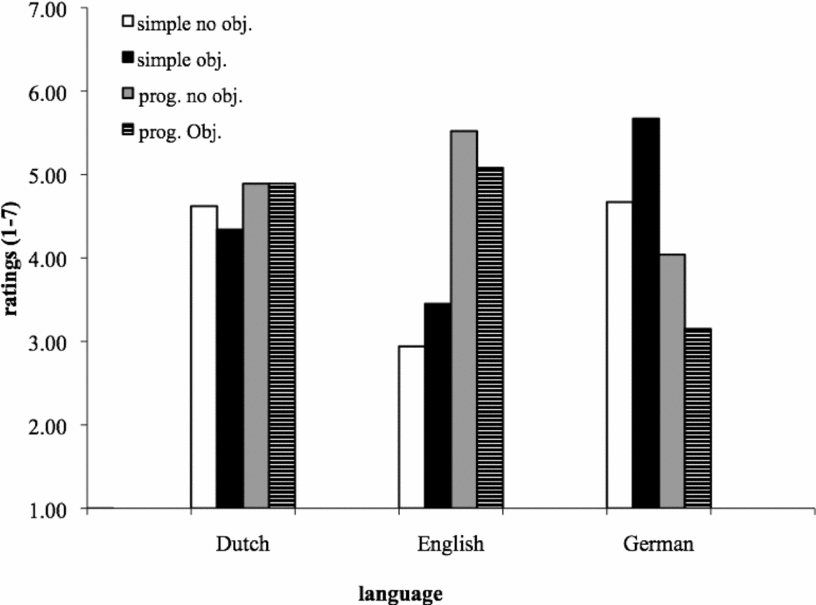
To assess the differences among the three categories, we carried out an ANOVA with Category (–object, +object, control), Progressive, and Object_in_Sentence as within-subject factors. The analysis showed a significant main effect of Category, F1 (2, 28) = 34.94, p < .001, η2 = 0.59; F2 (2, 140) = 12.02, p < .001, η2 = 0.15. The interaction of Category and Object_in_Sentence, F1 (2, 28) = 9.39, p < .01, η2 = 0.10; F2 (2, 140) < 1, and the three-way interaction among Category, Progressive, and Object_in_Sentence, F1 (2, 28) = 6.14, p < .01, η2 = 0.12; F2 (2, 140) < 1, were also significant, but only by participants. The three-way interaction among Category, Progressive, and Object_in_Sentence is due to the overall tendency to rate the sentences describing the control category situation lower than the other two category descriptions. Furthermore, the three-way interaction reflects that, for progressive sentences without a visible object, the rating patterns for –object and +object sentences were reversed compared to the patterns of the other three sentence types (as can be seen in Figure 4).
Mean ratings (1 = highly unlikely, 7 = very likely) for all four sentences types and all three categories.
Separate ANOVAs for the three categories were carried out with the factors Progressive (simple form vs. progressive form) and Object_in_Sentence (presence vs. absence of an object in the sentence). The analysis for the events without a visible object (–object) showed a significant main effect of Progressive, F1 (1, 14) = 14.46, p < .01, η2 = 0.51; F2 (1, 36) = 3.06, p = .089, η2 = 0.08, although only as a trend in the item analysis. Regardless of the presence of an object in the sentence, participants preferred sentences with a progressive form to sentences with a simple form (M = 4.9 vs. 4.5, respectively). Pairwise comparisons of all four sentence types showed that only sentences with a simple form and an object in the sentence (M = 4.3) differed significantly from both types of progressive sentences (both M = 4.9). Thus, for Dutch natives, there was no clear preference for or rejection of one of the sentence types for the events without a visible object.
For the events with a visible object (+object), the analysis showed no significant main effects. However, there was a significant interaction by participants between Progressive and Object_in_Sentence, F1 (1, 14) = 7.55, p < .05, η2 = 0.35; F2 (1, 36) < 1. Separate analyses for Progressive and Object_in_Sentence revealed a significant main effect by participants of Object_in_Sentence in simple form sentences, F1 (1, 14) = 6.36, p < .05, η2 = 0.31; F2 (1, 36) < 1, such that simple from sentences with an object in the sentence were rated higher (M = 5.0) than simple form sentences without an object (M = 4.4). Pairwise comparisons of all four sentence types also revealed the same significant difference between sentences with a simple form and an object and sentences with a simple form without an object. However, no overall clear preference for one sentence type for the events with a visible object was found.
A significant main effect of Progressive was found for the control category, F1 (1, 14) = 7.19, p < .05, η2 = 0.34; F2 (1, 36) < 1, but only by participants. Regardless of the presence of a visible object in the sentences, sentences with a simple form were rated higher than sentences with a progressive form (M = 4.0 vs. 3.9, respectively). In pairwise comparisons of all four sentence types, a significant difference was found only between simple form (M = 4.1) and progressive sentences (M = 3.9) without object.
English
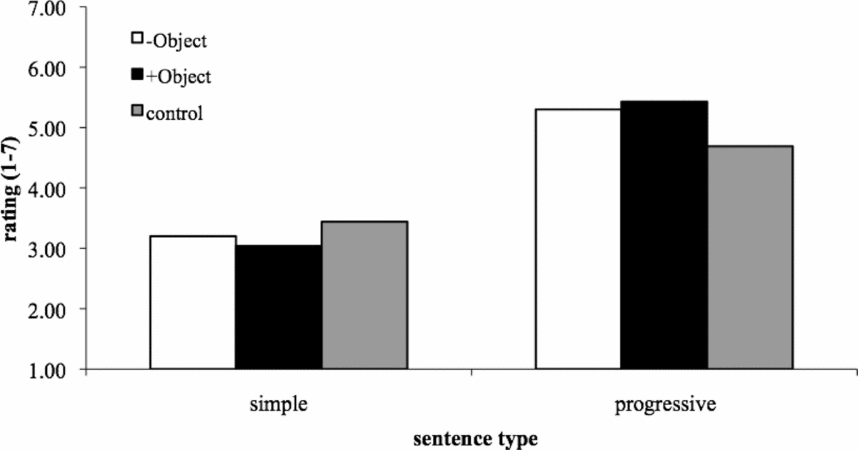
Again, an ANOVA with Category (–object, +object, control), Progressive, and Object_in_Sentence as within-subject factors was carried out to assess the differences among the three categories. Only between Category and Progressive was a significant interaction found, F1 (2, 6) = 7.87, p < .05, η2 = 0.27; F2 (2, 140) = 5.82, p < .01, η2 = 0.08. As can be seen in Figure 5, this interaction reflects the control category. For sentences with a simple form, the overall ratings were higher than for the other categories. For the progressive sentences, we found the reversed situation; the ratings were generally lower.
Mean ratings (1 = highly unlikely, 7 = very likely) of all three categories regardless of the presence of a visible object.
Separate ANOVAs including the factor Progressive (simple form vs. progressive form) and Object_in_Sentence (presence or absence of an object in the sentence) were carried out. The analysis for the –object revealed a main effect of Progressive, F1 (1, 3) = 44.12, p < .01, η2 = 0.94; F2 (1, 36) = 56.15, p < .001, η2 = 0.61. Regardless of the presence of a visible object in the sentences, sentences with a progressive form were rated higher (M = 5.3) than sentences with a simple form (M = 3.2).
For +object, a main effect of Progressive was found, F1 (1, 3) = 39.48, p < .01, η2 = 0.93; F2 (1, 36) = 68.46, p < .001, η2 = 0.66. Participants had a clear preference for sentences with a progressive form (M = 5.4), regardless of the presence of a visible object in the sentence, compared to sentences with a simple form (M = 3.0). The analysis also showed a significant interaction between Progressive and Object_in_Sentence, F1 (1, 3) = 16.69, p < .05, η2 = 0.85; F2 (1, 36) = 3.31, p = .077, η2 = 0.08, although this remained a trend by items. For sentences with a simple form, the analysis by participants demonstrated a clear dislike for sentences without an object, but there was no specific preference or dislike for sentences including a simple form with an object (M = 2.7 vs. 3.4), F1 (1, 3) = 22.31, p < .05, η2 = 0.88; F2 (1, 36) < 1. For progressive sentences, there was no clear preference for the use of an object (M = 5.5 vs. 5.3). Overall pairwise comparisons of all four sentence types showed a clear preference for the progressive sentence both with and without an object and a rejection of sentences with the simple form without an object.
For the control category, a main effect of Progressive, F1 (1, 3) = 30.02, p < .05, η2 = 0.91; F2 (1, 68) = 26.06, p < .001, η2 = 0.28, and Object_in_Sentence, F1 (1, 3) = 28.68, p < .05, η2 = 0.91; F2 (1, 68) = 3.46, p = .067, η2 = 0.05, was found, the latter only marginally significant by items. Regardless of the presence of a visible object, sentences with a progressive form were rated higher than sentences with a simple form (M = 4.7 vs. 3.4). Regardless of the use of the simple or progressive form, sentences with an object (M = 4.3) were rated higher than sentences without an object (M = 3.9).
German
The ANOVA with Category (–object, +object, control), Progressive, and Object_in_Sentence as within-subject factors revealed a significant main effect of Category only by participants, F1 (2, 6) = 7.39, p < .05, η2 = 0.71; F2 (2, 140) = 2.29, ns. This is the result of a difference in rating in the control category; overall, the ratings in this category (M = 3.9) were lower than in the other two categories (M = 4.4 and 4.3).
An ANOVA including the factors Progressive and Object_in_Sentence for –object (Category 1) displayed a significant main effect of Progressive, F1 (1, 3) = 13.77, p < .05, η2 = 0.82; F2 (1, 36) = 20.25, p < .001, η2 = 0.36. Regardless of the presence of a visible object, sentences with a simple form were rated higher than progressive sentences (M = 5.2 vs. 3.6). The analyses also showed a significant interaction of Progressive and Object_in_Sentence, F1 (1, 3) = 24.86, p < .05, η2 = 0.89; F2 (1, 36) = 5.62, p < .05, η2 = 0.14. Further analysis of the simple form sentences revealed a significant main effect of Object_in_Sentence, F1 (1, 3) = 53.10, p < .01, η2 = 0.95; F2 (1, 18) = 2.63, ns, although only by participants. Simple form sentences with an object (M = 5.7) were rated higher than sentences without an object (M = 4.7). The analysis of the progressive sentences did not reveal a main effect of Object_in_Sentence.
For +object (Category 2), a significant main effect of Progressive was found, F1 (1, 3) = 22.02, p < .05, η2 = 0.88; F2 (1, 36) = 26.61, p < .001, η2 = 0.43. Regardless of the presence of a visible object, sentences with a simple form were rated higher than sentences with a progressive form (M = 5.2 vs. 3.4, respectively). Pairwise comparison of all four sentence types showed that participants had a slight preference for simple form sentences with an object (M = 5.5). However, some of the comparisons were only marginally significant.
A main effect was found for Progressive in the control category, F1 (1, 3) = 19.07, p < .05, η2 = 0.86; F2 (1, 68) = 46.47, p < .001, η2 = 0.41. Regardless of the presence of a visible object, sentences with a simple form (M = 4.7) were rated higher than sentences with a progressive form (M = 3.1). In pairwise comparisons of all four sentence types, a clear overall preferences was found for sentences with a simple form regardless of the use of an object (M = 4.6 and 4.8). Likewise, participants rejected both types of progressive sentences (M = 3.1 and 3.0).
Comparison of the three languages
For the language comparison, an ANOVA including Category, Progressive, and Object_in_Sentence as within-subject factors, and Language as a between-subject factor, revealed a trend toward an interaction of Category and Language by participants, F1 (4, 40) = 2.65, p = .053, η2 = 0.20; F2 (2, 420) = 1.41, ns. This interaction reflects the ratings for the control category, which were significantly lower than for the other two categories in Dutch and German but not in English.
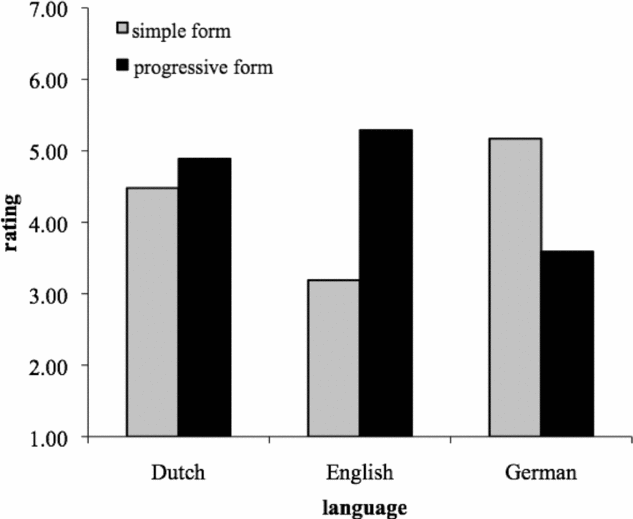
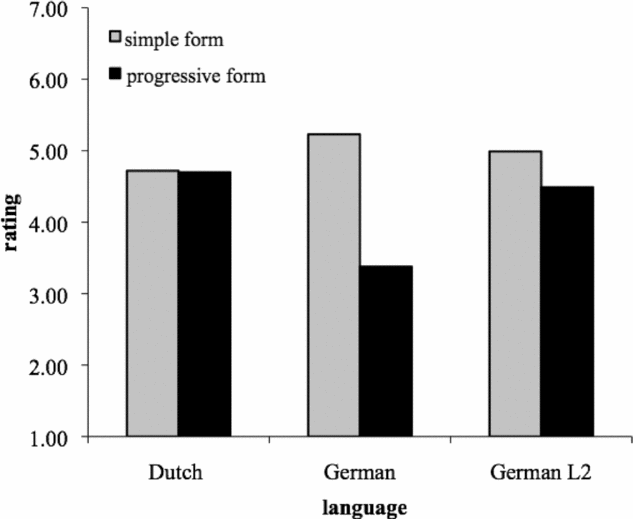
Separate ANOVAs were also carried out including the within-subject factors Progressive (simple form vs. progressive form) and Object_in_Sentence (presence or absence of an object in the sentence), and the between-subject factor Language. Analysis for the –object condition revealed a significant main effect of Progressive by participants only, F1 (1, 20) = 5.33, p < .05, η2 = 0.21; F2 (1, 108) = 2.46, ns. Furthermore, there was a significant two-way interaction of Progressive and Language, F1 (2, 20) = 46.77, p < .001, η2 = 0.82; F2 (2, 108) = 38.37, p < .001, η2 = 0.42, and a significant three-way interaction of Progressive, Object_in_Sentence, and Language, F1 (2, 20) = 9.84, p < .01, η2 = 0.50; F2 (2, 108) = 2.87, p = .061, η2 = 0.05, the latter only as a trend by items.
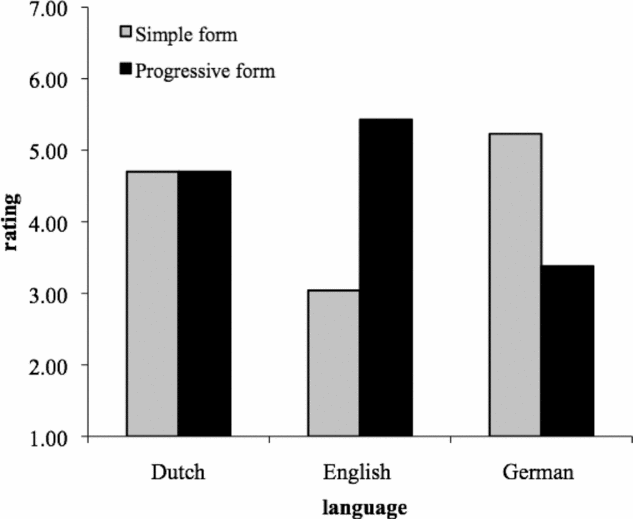
The two-way interaction between Progressive and Language is due to the pattern found for German. Other than Dutch and English natives, speakers of German preferred a simple form above a progressive form for the events without a visible object (see Figure 6).
A comparison of the mean ratings of Dutch, English, and German for simple form and progressive form regardless of the presence of objects for the events without a visible object.
The three-way interaction reflects that speakers of Dutch showed no preference for sentences with either of the two forms, or for the absence or presence of an object. Speakers of English and German favored one form over the other. Speakers of English preferred the use of the progressive form, whereas speakers of German preferred a simple form. However, their preferences for the absence or presence of an object were similar in both forms, as can be seen in Figure 7. Though there were differences between sentences with and without an object in the sentence for German, none of them proved to be significant.
A comparison of the mean ratings in all three languages for all four sentences describing events without a visible object (–object).
Analysis for the +object (Category 2) uncovered a significant interaction between Progressive and Language only, F1 (2, 20) = 47.08, p < .001, η2 = 0.83; F2 (2, 108) = 49.45, p < .001, η2 = 0.48. Figure 8 reveals that this interaction reflects that speakers of English displayed a preference for progressive sentences, whereas speakers of German clearly preferred simple form sentences. These preferences were similar to those found for –object sentences. Dutch natives displayed no clear preferences for either form.
A comparison of the mean ratings of Dutch, English, and German for simple and progressive form for events with a visible object (+object).
The control category revealed a significant interaction between Progressive and Language, F1 (2, 20) = 50.03, p < .001, η2 = 0.83; F2 (2, 204) = 35.40, p < .001, η2 = 0.26, and between Object_in_Sentence and Language by participants only, F1 (2, 20) = 4.03, p < .05, η2 = 0.29; F2 (2, 204) = 1.24, ns. The interaction between Progressive and Language reflects that, regardless of the presence or absence of an object in the sentence, speakers of German preferred a sentence with a simple form and speakers of English preferred a sentence with a progressive form, whereas Dutch natives showed no preference. The interaction between Object_in_Sentence and Language reflects the differing preferences for an object in the sentences. Regardless of the form used in the sentence, speakers of English favored the presence of an object (M = 4.9 vs. 3.9), which was not the case for the speakers of the other two languages. Separate analysis of the sentences without an object showed a significant interaction between Progressive and Language, F1 (2, 20) = 34.14, p < .001, η2 = 0.77; F2 (2, 108) = 17.49, p < .001, η2 = 0.26: speakers of German clearly preferred a sentence with a simple form (M = 4.6), whereas speakers of English preferred a progressive sentence (M = 4.6). Speakers of Dutch did not display a preference for either option (M = 3.9 vs. 4.1). The analysis for the sentences with an object showed a significant main effect of Progressive, F1 (1, 20) = 5.13, p < .05, η2 = 0.20; F2 (1, 102) = 3.04, p = .08, η2 = 0.03, although this was only marginally significant by items. A significant interaction between Progressive and Language, F1 (2, 20) = 31.49, p < .001, η2 = 0.76; F2 (2, 102) = 19.02, p < .001, η2 = 0.27, was also found. The preferences for sentences with an object were similar to those found for sentences without an object. Speakers of German preferred a sentence with a simple form (M = 4.8), speakers of English preferred a progressive sentence (M = 4.8), and Dutch natives did not prefer either form above the other (M = 3.9 vs. 4.0). A separate analysis of the sentences with a simple form revealed significant main effects of Object_in_Sentence by participants, F1 (1, 20) = 7.27, p < .05, η2 = 0.27; F2 (1, 102) = 2.24, ns, and of Language, F1 (2, 20) = 8.60, p < .01, η2 = 0.46; F2 (2, 102) = 11.40, p < .001, η2 = 0.18, and a significant interaction between Object_in_Sentence and Language by participants, F1 (2, 20) = 6.53, p < .01, η2 = 0.40; F2 (2, 102) = 1.79, ns. This interaction is because speakers of Dutch and German generally rated sentences with a simple form higher than speakers of English. However, speakers of English displayed a preference for sentences with an object (M = 3.8 vs. 3.1), which was not the case for the speakers of the other two languages. A separate analysis of the progressive sentences only revealed a significant main effect of Language, F1 (2, 20) = 12.82, p < .001, η2 = 0.56; F2 (2, 102) = 26.00, p < .001, η2 = 0.18. This is because, regardless of the presence of an object in the sentence, speakers of German had a clear dislike for progressive sentences (M = 3.1), speakers of Dutch had a marginal preference for progressive sentences (M = 3.9), whereas speakers of English showed a clear preference for the progressive (M = 4.7).
Conclusions
The ratings for all three languages differed across the categories. In line with our expectations, Dutch natives had no overall preference for any of the sentence types, regardless of the presence or absence of a visible object. As predicted, speakers of German preferred a simple form with an object. Speakers of English clearly preferred a progressive form in the sentences, but somewhat unexpectedly, they did not differentiate between the presence or the absence of an object, in the sentence or in the video clip. The ratings of the control category again revealed no preferences for any sentence type above the others for Dutch natives. However, speakers of German preferred a simple form with or without an object, whereas speakers of English preferred a progressive form regardless of the presence of an object. These findings contrast earlier findings of production studies (Carroll & von Stutterheim, Reference Carroll, von Stutterheim, Bohnemeyer and Pederson2010; Carroll et al., Reference Carroll, von Stutterheim, Nüse, Pechmann and Habel2004; von Stutterheim & Nüse, Reference von Stutterheim and Nüse2003), which suggests that these earlier results might have been dependent on the specific domain in which they were tested. The results of the L1 experiment are discussed further in the General Discussion.
We argue that the higher ratings for the progressive sentences by native speakers of English are clearly related to English having a grammaticalized form of aspect marking. German shows a clear preference for simple tense sentences that in turn reflects the restriction on the usage of progressive construction (see Krause, Reference Krause2000). Dutch is subject to change: the periphrastic construction is aan het is in the process of grammaticalization (cf. Booij, Reference Booij, Bergs and Diewald2008; Flecken, Reference Flecken2011; von Stutterheim, Carroll, & Klein, Reference von Stutterheim, Carroll, Klein, Klein and Li2009). The simple form and the is aan het construction are used side by side (von Stutterheim et al., Reference von Stutterheim, Carroll, Klein, Klein and Li2009, p. 208), and consequently Dutch native speakers display no clear preference for either above the other. Because language is not static, but constantly changing, this mediates the way languages influence the way we think for speaking. In the Dutch case, the parallelism of the options resulted in no clear preferences.
Overall, we would like to argue that part of the pattern of results is related to the inventory of the respective language (+/– progressive). Other differences (+/– object in the sentence) seem unrelated to the inventory of the language and appear to be a matter of preference. Both of these underlying causes could pose considerable problems for L2 learners with opposing preferences in L1 and L2.
It is possible that the preferences resulting from the inventory of the mother tongue have become automatized to such a degree that they are easily transferred to L2 language use. Given the results for the three languages described above, it seems that Dutch L2 learners are particularly interesting in this respect. Learning an L2 that does have a clear preference for certain forms, such as English or German, would push them toward making a decision for one of the patterns, but the question is whether they do so. We therefore carried out the same experiment among Dutch learners of English and German. We would expect Dutch learners of English to have relatively few difficulties acquiring the use of the progressive, because its use is clearly defined by the rules of English grammar. However, we expect that Dutch learners of German will differ from German native speakers because the mentioning of an object is not regulated in the rules of German grammar.
L2 EXPERIMENT
There are a number of studies on event description by L2 learners. Most of them are production studies that are based on Slobin's (1993, Reference Slobin and Perdue1996a) research on the expression of manner of motion (e.g., Cadierno, Reference Cadierno, Achard and Niemeier2004, Reference Cadierno, Han and Cadierno2010; Cadierno & Ruiz, Reference Cadierno and Ruiz2006; Han, Reference Han, Han and Cadierno2010; Hasko, Reference Hasko, Han and Cadierno2010; Kellermann & Van Hoof, Reference Kellermann and Van Hoof2003; Stam, Reference Stam, Han and Cadierno2010). All of these studies suggest that there is some influence of L1 knowledge on L2 production, especially if the L1 and the L2 differ structurally from each other, such as the differences between S- or V-languages (for a definition, see Slobin 1993, Reference Slobin, Gumperz and Levinson1996a).
There are only a few studies that focus on aspectual marking in event descriptions of L2 learners. Carroll and von Stutterheim (Reference Carroll, von Stutterheim and Ramat2002) carried out a study on event descriptions in narratives by native speakers of English and German and German learners of English. They found that learners’ use of progressives in event descriptions was similar to that of native speakers of English. However, in terms of the perspective they applied in their narratives, German learners of English adhered to the principles of their native language, whereas native speakers of English showed variability in their perspective depending on the context. In another study, von Stutterheim and Carroll (Reference von Stutterheim, Carroll, Byrnes, Weger-Guntharp and Sprang2006) looked at single event descriptions by native speakers of German, English, Norwegian, and Arabic, and German learners of English and English learners of German. They found that native Germans used endpoints in 76% of their descriptions; native speakers of English only mentioned endpoints in 25% of their descriptions. German learners of English performed almost native-English (target)-like (37%), whereas English learners of German performed native-English (source)-like, using endpoints in 32% of their descriptions. Carroll and von Stutterheim (Reference von Stutterheim, Carroll, Byrnes, Weger-Guntharp and Sprang2006, p. 48) suggested that “learners of English seem to acquire underlying linguistic knowledge associated with a form such as the progressive more easily, compared to the holistic perspective required of learners of German.” To clarify, the differences between English and German are related to the fact that aspectual marking in the form of a progressive is obligatory in English; the mentioning of an endpoint, however, is a matter of preference, and these preferences are different for both languages. This is in line with the results found by Montrul and Slabakova (Reference Montrul, Slabakova, Do, Domínguez and Johansen2001), who studied the L2 acquisition of aspectual marking in Spanish by English learners. Their results suggested that nativelike acquisition of grammaticalized aspectual marking is possible.
Carroll et al. (Reference Carroll, Natale and Starren2008) found not only that nonlocomotion events triggered a relatively more frequent use of the progressive but also that L2 learners (whose L1 differed from their L2 with respect to the availability of a progressive form) tended to transfer L1 patterns to their L2. For example, German learners of Italian seemed to adapt the native Italian pattern of progressive use, but their frequency of the use of the progressive was somewhat lower than that of Italian natives (19% for German learners of Italian and 33% for native speakers of Italian).
Just as for L1 acquisition, the studies described above are production studies. Given the results from the L1 experiment, a perception study in the L2 domain might also allow for a better insight into learners’ intuitions about possible verbal event descriptions in their L2. Such a study in the L2 domain is also interesting because here participants are offered a number of individual sentences to judge, which is an advantage when dealing with learners. Depending on the level of proficiency, learners’ availability of possible constructions might be restricted, resulting in a limited picture of what learners actually know and do in the production domain compared to the perception domain.
Method
Participants
In the L2 experiment, we compared a group of 120 Dutch learners of English and a group of 120 Dutch learners of German with the native speakers of Dutch, English, and German from the first experiment. Again most of the participants in this second experiment were students at various faculties at the Radboud University in Nijmegen, but there were also a few participants from various other backgrounds. To warrant a comparable level of proficiency in the foreign language, only participants who had acquired a secondary school diploma in the respective foreign languageFootnote 9 were included in the analyses. Eight Dutch learners of English and 6 Dutch learners of German were excluded from the analyses for this reason. This left us with 112 Dutch learners of English and 114 Dutch learners of German.
Materials, design, and procedure
We used the same materials and design as in Experiment 1.
Results
Again we only report results for Categories 1, 2, and 3. The mean ratings for the probability of use for the three categories are presented in Table 6, Table 7, and Table 8. The results of the earlier L1 analyses were included for ease of comparison.
Mean (standard deviation) ratings (1 = very unlikely, 7 = very likely) for events without a visible object (Category 1)
Note: L2, second language.
Mean (standard deviation) ratings (1 = very unlikely, 7 = very likely) for events with a visible object (Category 2)
Note: L2, second language.
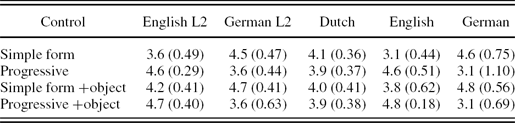
Mean (standard deviation) ratings (1 = very unlikely, 7 = very likely) for the control category (Category 3)
Note: L2, second language.
ANOVAs were carried out on the ratings for all conditions (only analyses or comparisons at p < .05 are reported, and for all analyses Bonferroni alpha-level adjustments were used). Since the main interest is the comparison of the L2 structures with the L1 structures, the separate analyses for the individual learner languages will not be reported. The two learner languages are compared with their respective source and target languages separately. Ratings were analyzed by ANOVA including the within-subject factors Progressive (simple form vs. progressive form) and Object (presence or absence of an object in the sentence), and the between-subject factor Language.
L1 English and L1 Dutch versus Dutch learners of English
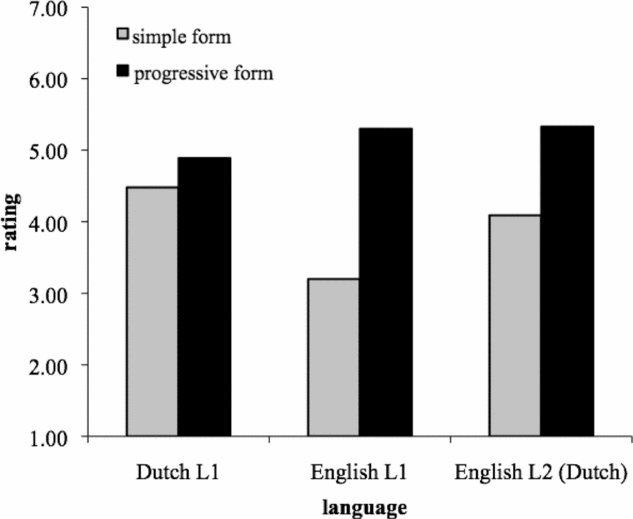
An ANOVA with the factors Language, Progressive, and Object_in_Sentence for the events without a visible object revealed a significant main effect of Progressive, F1 (1, 31) = 130.06, p < .001, η2 = 0.81; F2 (1, 108) = 80.83, p < .001, η2 = 0.43, and a significant two-way interaction between Progressive and Language, F1 (2, 31) = 19.33, p < .001, η2 = 0.56; F2 (2, 108) = 13.39, p < .001, η2 = 0.20. A three-way interaction among Progressive, Object_in_Sentence, and Language, F1 (2, 31) = 7.50, p < .01, η2 = 0.33; F2 (2, 108) = 1.35, ns, was only significant by participants. The two-way interaction reflects the pattern found for L1 Dutch and the differences in ratings by native speakers and learners of English. Native speakers of Dutch did not show any preference for either of the two sentences types (progressive and simple form), whereas native speakers of English and Dutch learners of English had a clear preference for the progressive sentences regardless of the presence of an object in the sentence. However, learners’ ratings for sentences with a simple form were significantly higher than those of the native speakers of English, as can be seen in Figure 9.
Ratings of progressive and simple sentences (1 = very unlikely, 7 = very likely) of Dutch L1, English L1, and English L2 (Dutch) for events without a visible object.
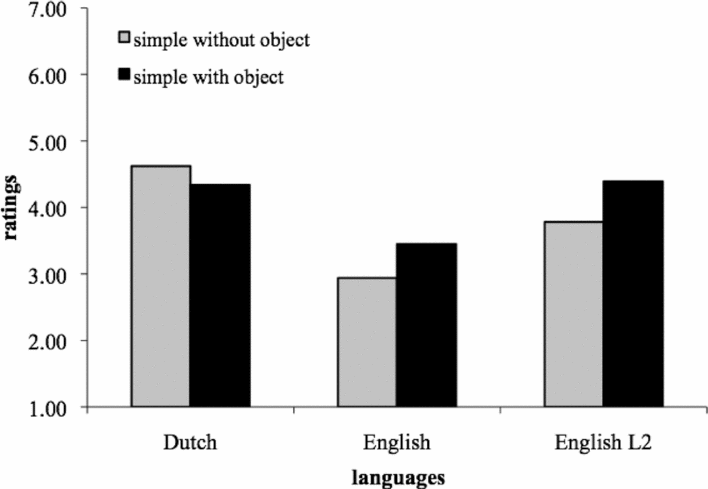
The three-way interaction reflects that native speakers of Dutch showed no preference for any of the four sentence types. Separate analysis of the sentences with a simple form revealed a significant main effect of Language, F1 (2, 31) = 8.93, p < .01, η2 = 0.37; F2 (2, 45) = 10.08, p < .001, η2 = 0.28. Pairwise comparisons of all three languages showed that native speakers of English (M = 3.2) rated sentences with a simple form lower than native speakers of Dutch (M = 4.5) and Dutch learners of English (M = 4.1). A significant interaction between Object_in_Sentence and Language, F1 (2, 31) = 6.64, p < .01, η2 = 0.30; F2 (2, 45) = 1.15, ns, was also found, but only by participants. This is because overall native speakers of English rated both sentence types lower (M = 3.2) than native speakers of Dutch and Dutch learners of English (M = 4.5 and 4.1, respectively). In addition, native speakers of Dutch and English did not display a preference for either of the two sentences with a simple form, whereas Dutch learners of English showed a clear preference for sentences with a simple form and an object (see Figure 10).
Ratings for simple sentences (1 = very unlikely, 7 = very likely) of Dutch L1, English L1, and English L2 (Dutch) for events without a visible object.
Separate analysis of the Progressive sentences only revealed a significant main effect of Language, F1 (2, 31) = 3.57, p < .05, η2 = 0.19; F2 (2, 54) = 4.35, p < .05, η2 = 0.14; pairwise comparisons of all three languages showed that, regardless of the presence or absence of an object in the sentence, sentences with a progressive form were rated higher by Dutch learners of English (M = 5.3) than by Dutch natives (M = 4.9). Their ratings were similar to that of English natives (M = 5.3).
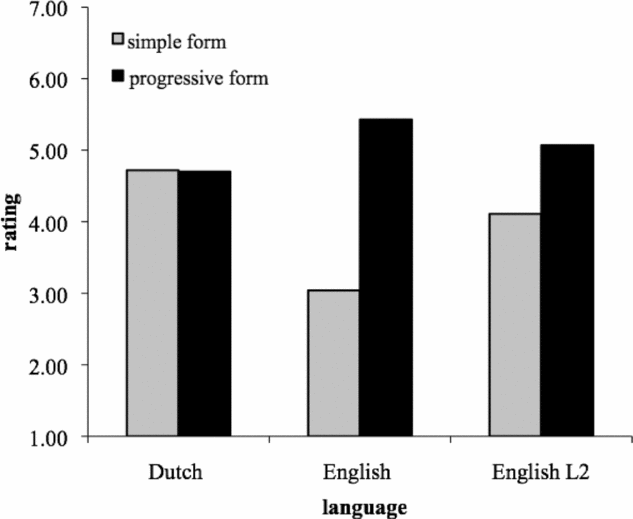
Analysis of the events with a visible object showed a significant interaction between Progressive and Language, F1 (2, 31) = 24.78, p < .001, η2 = 0.62; F2 (2,108) = 20.91, p < .001, η2 = 0.28. Figure 11 reveals that this interaction reflects that Dutch natives did not favor one sentence type above the other (regardless of the presence of an object), whereas Dutch learners of English and English natives displayed a clear preference for progressive sentences. However, this preference was much stronger for native speakers of English than for learners of English.
A comparison of the mean ratings (1 = very unlikely, 7 = very likely) of Dutch, English, and English L2 for simple and progressive form for the events with a visible object.
The control category showed a significant main effect of Language by participants, F1 (2, 31) = 5.40, p < .05, η2 = 0.29; F2 (2, 204) = 2.00, ns. Pairwise comparisons of all three languages showed that overall sentences were rated significantly higher by Dutch natives (M = 4.9) than by Dutch learners of English (M = 4.3). The ratings of English natives (M = 4.1) differed neither from the Dutch natives nor from Dutch learners of English. There was also a significant interaction between Object_in_Sentence and Language, F1 (2, 31) = 8.71, p < .01, η2 = 0.36; F2 (2, 204) = 1.24, ns, and between Progressive and Language, F1 (2, 31) = 36.94, p < .001, η2 = 0.70; F2 (2, 204) = 10.17, p < .001, η2 = 0.09, the former only by participants. The first interaction between Object_in_Sentence and Language reflects that native speakers of English and Dutch learners of English showed a preference for an object, regardless of the sentences type, whereas Dutch natives did not. The data suggests that the second interaction between Progressive and Language is caused by two factors. First, the ratings of simple and progressive sentences were reversed for Dutch natives compared to native speakers and learners of English. Second, although the general rating for native speakers and learners of English seemed to be similar, Dutch learners of English (M = 3.9) rated sentences with a simple form higher than did native speakers of English (M = 3.4). Separate analysis of the sentences with a simple form showed a significant main effect of Object_in_Sentence, F1 (1, 31) = 18.51, p < .001, η2 = 0.37; F2 (1, 102) = 5.51, p < .05, η2 = 0.05, and of Language, F1 (2, 31) = 4.19, p < .05, η2 = 0.21; F2 (2, 102) = 2.96, p = .056, η2 = 0.06, and an interaction between Object_in_Sentence and Language, F1 (2, 31) = 9.73, p < 0.01, η2 = .39; F2 (2, 102) = 1.99, ns, but the latter only by participants. This interaction is because, for the simple form, native speakers of English and Dutch learners of English displayed a preference for simple forms with an object, whereas Dutch natives had no such preference. Separate analysis of the sentences without an object showed a significant interaction between Progressive and Language, F1 (2, 31) = 34.96, p < .001, η2 = 0.69; F2 (2, 102) = 6.86, p < .01, η2 = 0.12. Native speakers of Dutch had a preference for sentences with a simple form, whereas native speakers of English and Dutch learners of English had a preference for progressive sentences. The analysis of the sentences with an object showed a significant main effect of Progressive, F1 (1, 31) = 17.40, p < .001, η2 = 0.36; F2 (1, 102) = 6.52, p < .05, η2 = 0.06, and Language, F1 (2, 31) = 11.61, p < .001, η2 = 0.43; F2 (2, 102) = 3.56, p < .05, η2 = 0.07, and a significant interaction between Progressive and Language, F1 (2, 31) = 9.99, p < .001, η2 = 0.39; F2 (2, 102) = 3.37, p < .05, η2 = 0.06. This interaction is similar to that found for sentences without an object and can be explained in the same way (see above).
L1 German and L1 Dutch versus Dutch learners of German
The analysis for the events without a visible object showed a significant main effect of Progressive, F1 (1, 31) = 7.93, p < .01, η2 = 0.20; F2 (1, 108) = 10.17, p < .01, η2 = 0.09; an interaction between Progressive and Language, F1 (2, 31) = 8.91, p < .01, η2 = 0.37; F2 (2, 108) = 12.11, p < .001, η2 = 0.18; and a significant three-way interaction among Progressive, Object_in_Sentence, and Language, F1 (2, 31) = 10.46, p < .001, η2 = 0.40; F2 (2, 108) = 3.98, p < .05, η2 = 0.07. The interaction between Progressive and Language reflects that, regardless of the presence or absence of an object, Dutch native speakers preferred progressive sentences, native speakers of German preferred sentences with a simple form, and Dutch learners of German had no preference at all. The three-way interaction reflects that Dutch native speakers had no clear preference for any of the four sentence types.
Further analysis of the sentences with a simple form showed a significant interaction of Object_in_Sentence and Language by participants, F1 (2, 31) = 5.74, p < .01, η2 = 0.27; F2 (2, 54) = 2.41, p = .099, η2 = 0.08. This interaction reflects that Dutch natives and Dutch learners of German had no preference for either of the two sentences types. German natives showed a clear preference for sentences with an object.
An analysis of progressive sentences showed a main effect of Language, F1 (2, 31) = 6.27, p < .01, η2 = 0.29; F2 (2, 54) = 14.63, p < .001, η2 = 0.35. Pairwise comparisons of the languages showed that, regardless of the presence of an object in the sentence, German natives speakers (M = 3.6) rated progressive sentences lower than did Dutch natives (M = 4.9) and Dutch learners of German (M = 4.5).
The analysis of the events with an object revealed a significant interaction between Progressive and Language, F1 (2, 31) = 10.63, p < .001, η2 = 0.40; F2 (2, 108) = 9.76, p < .001, η2 = 0.15. This interaction is again because native speakers of Dutch had no preference for either of the sentence types, whereas native speakers and Dutch learners of German preferred simple forms to the progressive ones. However, as Figure 12 reveals, the effect size was smaller for the learners.
A comparison of the mean ratings (1 = very unlikely, 7 = very likely) of Dutch, German, and German L2 for simple and progressive form for the events with a visible object.
The results of the analysis for the control category revealed a significant interaction between Progressive and Language, F1 (2, 31) = 15.18, p < .001, η2 = 0.50; F2 (2, 204) = 9.83, p < .001, η2 = 0.09. This interaction is because, despite a similar overall pattern for the ratings of simple and progressive sentences in all three languages, the effect size was smaller for Dutch (M = 4.0 vs. 3.9) than for the other two languages, respectively (M = 4.7 vs. 3.1 and M = 4.6 vs. 3.6).
Conclusions
Summing up, for events with and without a visible object in the videos, we found overall similar patterns for the L2s as for the target (native) languages. Both groups clearly preferred a progressive form to a simple form. However, contrary to our expectations, Dutch learners of English as well as native speakers of English did not object to the presence of an object in progressive sentences, regardless of the presence of an object in the film. Furthermore, Dutch learners of English differed from native speakers of English in their ratings for simple tense sentences. For events without a visible object, Dutch learners of English rated simple form sentences higher than did native speakers of English, and they differentiated between simple sentences with and without an object present in the sentences, showing a preference for the sentences with an object. Dutch learners of English also had a higher rating for simple sentences describing an event with a visible object, but contrary to native speakers of English, they made no distinction between sentences with and without an object. Native speakers rated simple sentences with an object higher than sentences without an object.
The ratings of Dutch learners of German coincided with that of native speakers of German only for videos with a clearly visible object. Here both native speakers and Dutch learners of German rated simple tense sentences higher than the progressive tense sentences regardless of the presence or absence of an object in the sentence. For events without a visible object, German native speakers had higher ratings for simple tense sentences with an object, whereas Dutch learners of German revealed no significant differences in their ratings for any of the four sentence types.
In contrast, for the control category, we found two distinct patterns for both groups of learners: Dutch learners of English preferred a progressive form and Dutch learners of German preferred a simple form. We will return to this point in the General Discussion.
GENERAL DISCUSSION
That Dutch has a periphrastic construction similar to a morphological aspect marker but can also behave as a language that lacks such a marker (e.g., German) is reflected in the lack of preference for either of the options we tested. Such a marker serves to encode the specificity of a single event as well as its duration. Our results for Dutch differ from those found in the production domain (see Carroll et al., Reference Carroll, von Stutterheim, Nüse, Pechmann and Habel2004) in which Dutch natives clearly preferred the use of progressive constructions and mention only a few endpoints. Carroll et al. (Reference Carroll, von Stutterheim, Nüse, Pechmann and Habel2004) did not find differences for nonlocomotion events, which led them to focus primarily on locomotion events. However, in a later study, Carroll et al. (Reference Carroll, Natale and Starren2008) again included nonlocomotion events similar to those used in the present study. The results of this later production study led us to expect higher ratings for progressives used in descriptions for events with a visible object, but we did not find such a preference in the current perception study. These differences between the production study and the perception study might be due to the different research domains; apparently, the preference for the use of a certain construction does not mean that other options are not possible. However, our results are also different from those by Flecken (Reference Flecken2011); in her perception study, progressive sentences were more frequently chosen for descriptions of activities but not for change in state events (which are equivalent to our nonlocomotion events). We would have expected higher ratings for progressive sentences describing activities (our control category) than for the other two categories (i.e., nonlocomotion events with as well as without object), but this was not the case. We only found higher ratings for progressive sentences describing nonlocomotion events. Task demands might be responsible for these differences: in Flecken's (2011) study, participants had to choose between two options, and they compared different possibilities rather than rating them, which also means that the underlying question of her study is different from the present one.
For native speakers of English, the inventory of the English language (having a grammatical marker for the progressive) seems to have led to a clear preference for sentences with a progressive form. However, in contrast to the production domain (cf. von Stutterheim & Nüse, Reference von Stutterheim and Nüse2003), we found neither a clear preference nor a rejection of the use of an object in progressive sentences. The information added by an object does not have an influence on the participants’ ratings of these sentences, but this information is left out when they have to describe the events themselves. The latter could also have been reinforced by the production task itself. If participants choose to leave out information once, they adhere to this pattern in their consecutive event descriptions.
The results for native speakers of German were similar to those found in the production domain (cf. von Stutterheim & Nüse, Reference von Stutterheim and Nüse2003); they displayed a clear preference for sentences with a simple form and an object for events with as well as without a visible object. The results of the control category were somewhat different: They were similar to that of English native speakers with respect to the presence or absence of an object. This might reflect the type of events depicted in this category because these events could be described using a verb without an object in German (Die Frau wäscht ab, “The woman washes up”). The presence of the additional information (as in Die Frau wäscht die Tasse ab, “The woman washes the cup”) did not have an influence on the ratings.
The patterns for learner ratings were different according to the languages being learned. Dutch learners of English performed almost targetlike when rating progressive sentences. For the events with a visible object, they preferred the progressive sentences with or without an object, just as the native speakers of English did. However, when rating events without a visible object present in the video, they made a clear distinction between the progressive descriptions regardless of the presence of an object in the description. In addition, in contrast to native speakers of English, they preferred sentences without an object. Based on the production data by Carroll et al. (Reference Carroll, von Stutterheim, Nüse, Pechmann and Habel2004), for example, we can assume that a progressive form plus an object is rarely used by native speakers and is consequently rare in the input to learners of English. Learners are less familiar with these constructions, and this resulted in lower ratings for this particular sentence type.
That ratings of sentences with a simple form were much higher for Dutch learners of English than for native speakers of English might reflect the presence of an object in the sentence. These sentence patterns are similar to those found for Dutch as the L1. These sentences with a simple form and an object were rated similarly to their L1 equivalents, whereas sentences with a simple form but without an object were rated in the same way as their target language equivalents.
As expected, Dutch learners of German have difficulties acquiring the preferences for events without a visible object: contrary to native Germans, they had no preference for either of the sentence types. For events with a visible object, the situation is somewhat more complex: just as with German natives, Dutch learners had no preference for the use of an object, but they displayed the same preferences as native speakers concerning the use of a progressive or a simple form. However, for learners the difference was smaller than for native speakers. One could argue that these results are related to the proficiency level of the Dutch learners of German. However, if this were the case, then we would also expect similar ratings for the control category; but here learners rated the different sentences targetlike, which suggests that the level of proficiency was not an issue.
What our data seem to suggest is that there are certain obligatory structures in an L2 that appear to be learned easily by learners of this language, whereas other structures are more difficult to learn even at an advanced stage of L2 acquisition. According to Slobin (Reference Slobin, Gumperz and Levinson1996b, p. 89), this is because “the ways one learns a language as a child constrain one's sensitivity to what Sapir called ‘the possible content of experience as experienced in linguistic terms.’” In other words, the language inventory of the native language determines the way in which we attend to certain details in the world when we want to describe them. This native way of paying attention also influences the way we use an L2. Such an assumption would also mean that German learners of English should have difficulties in learning the English progressive form (see Slobin, Reference Slobin, Gumperz and Levinson1996b, p. 89) because German lacks such a form. However, several production studies (e.g., Carroll et al., Reference Carroll, von Stutterheim, Nüse, Pechmann and Habel2004; von Stutterheim, & Nüse, Reference von Stutterheim and Nüse2003) have shown that this is not the case. German learners of English do not seem to have any difficulties acquiring the English progressive.
Another possible explanation for the differences and similarities between L1 and L2 in this study could be found in terms of automatization and cognitive control (e.g., Posner & Snyder, Reference Posner, Snyder and Solso1975; Schiffrin & Schneider, Reference Schiffrin and Schneider1977). Levelt (Reference Levelt1989) argues that multiple processes that take place during speech production are subject to automatization. This means that these processes are executed without conscious control and put no extra cognitive demands on the whole system. According to Levelt, these automatic processes are innate or develop over time (e.g., by learning), leading not only to more efficiency in the whole process of speech production but also to the reduction of the ability to change these processes. An L2 can be learned in different ways, with guided (school) learning and natural learning by exposure as the most opposing ways. Our participants primarily learned their respective L2 in a school setting since they were selected on the basis of a secondary school diploma in the respective L2. The acquisition of a grammatical progressive marker is relatively “easy” for these L2 learners because it is rehearsed very often while learning the grammar of the respective language. The frequent input could have led to a change in the particular automatized L1 process to the correct L2 one. However, processes that are not exposed to the same frequency of rehearsal (e.g., when to mention an object) and that are not as systematically presented as specific rules of a particular grammar are less likely to change and are likely to adhere to the L1 automatic processes. That we have seen language learners keep part of their native patterns (like mentioning an object or not) might be explained by these automatic processes, leading to a certain hurdle for L2 learners in attaining nativelike proficiency. In their study on pragmatic and grammatical awareness, Bardovi-Harlig and Dörnyei (Reference Bardovi-Harlig and Dörnyei1998) consider elements similar to the mentioning of endpoints in the present study as part of the pragmatic system of a language. They were able to show that these elements are more difficult to acquire than purely grammatical elements because the former appear less often in the input to learners than the latter. In their study, they showed that even very advanced learners of English were only able to resemble the natives if they were exposed to the L2 completely (inside and outside of the classroom). They concluded that in cases of classroom instruction a better balance should be found between how grammatical and pragmatic knowledge are taught (for an overview on SLA and classroom instruction, see also Lightbown, Reference Lightbown2000).
In sum, all native speakers demonstrated a clear preference that corresponded to the inventory of the language they speak. However, for learners there seemed to be a difference between those aspects that are rule governed (such as progressive marking in English) and those that are not governed by a rule but are a matter of preference by the speakers. The former are able to overrule native patterns for speaking, whereas the latter do not. Consequently, they are more difficult to attain as an L2 speaker. However, these results are speculative, and new experimental techniques such as eye tracking and electroencephalograms might be able to provide more evidence for this point of view.
In addition, these results suggest that providing native speakers as well as L2 learners with different linguistic options leads to a more differentiated picture of what is possible in a language and what learners know, respectively. Further research should extend this type of perception study to other languages and increase the number of native speaker participants. Our item analyses did not always follow the participant analyses (this was especially true for the native speakers of German and English), which might reflect that the number of native speaker participants was rather low, leading to insufficient statistical power for some of the comparisons. Furthermore, research should also look at more complex linguistic utterances since the production of descriptions for single events is less complex than the daily interactions engaged in by native speakers as well as learners.
APPENDIX A
Painting (no picture)
1. Iemand schildert.
2. Iemand is aan het schilderen.
3. Iemand schildert iets.
4. Iemand is iets aan het schilderen.
1. Someone paints.
2. Someone is painting.
3. Someone paints something.
4. Someone is painting something.
1. Jemand malt.
2. Jemand ist am Malen.
3. Jemand malt etwas.
4. Jemand ist etwas am Malen.
Painting (actual picture)
1. Iemand schildert.
2. Iemand is aan het schilderen.
3. Iemand schildert een schilderij.
4. Iemand is een schilderij aan het schilderen.
1. Someone paints.
2. Someone is painting.
3. Someone paints a picture.
4. Someone is painting a picture.
1. Jemand malt.
2. Jemand ist am Malen.
3. Jemand malt ein Bild.
4. Jemand ist ein Bild am Malen.
ACKNOWLEDGMENTS
This study is part of a larger project funded by the Netherlands Organization for Scientific Research (Projects 254-70-020 and 254-70-110). We thank Elizabeth de Groot, Hans Hoeken, Karen Mansfield, and two anonymous reviewers for comments on earlier versions of this paper.