Introduction
Prosper Ménière described his eponymous disorder in 1861.Reference Menière1 According to Ménière, patients suffering from Ménière's disease complained of intermittent vertiginous episodes which lasted several minutes and were associated with tinnitus and fluctuations in hearing. Ménière noted that many of these patients also reported aural fullness.Reference Atkinson2
Since Prosper Ménière's time, a number of different proposals have been made with regard to establishing a definitive diagnosis of Ménière's disease. The American Academy of Otolaryngology Head and Neck Surgery Committee on Hearing and Equilibrium have published recommended guidelines for the diagnosis of Ménière's disease in 1972, 1985 and 1995.3–6 Despite the existence of these widely accepted diagnostic criteria, it has been observed that the majority of clinicians do not always adhere to them when making a diagnosis of Ménière's disease, and when reporting the results of therapy.Reference Thorp, Shehab and Bance7
When reviewing published literature and data regarding Ménière's disease, the information presented can be rendered somewhat less useful – and certainly less comparable with other studies – when universal criteria have not been used for the diagnosis, treatment and follow up of the patient cohort described. In the conclusion of their 2003 article, Thorp et al. Reference Thorp, Shehab and Bance7 stated that:
‘One would make a plea that, in order to further the treatment of Ménière's disease, a measure of uniformity of result reporting be ensured by adherence to the American Academy of Otolaryngology Head and Neck Surgery [Committee on Hearing and Equilibrium] criteria as a precondition to journal publication in the future.’
The International Ménière's Society has also proposed standardised criteria for the definition, diagnosis and ‘measurement’ of Ménière's disease,Reference Balkany, Pillsbury and Arenberg8–Reference Arenberg and Stahle10 but these criteria have not attained universal acceptance amongst practising clinicians and the authors of relevant literature.
The American Academy of Otolaryngology Head and Neck Surgery Committee on Hearing and Equilibrium guidelines
The American Academy of Otolaryngology Head and Neck Surgery Committee on Hearing and Equilibrium has published recommended guidelines for the diagnosis of Ménière's disease in 1972,3 19854, Reference Pearson and Brackmann5 and 1995,6 each of which evolved from the previous set of guidelines so that previous or existing data could be conserved. In addition, the Committee's aims were to make the guidelines clear and simple so that they could be used in a wide variety of settings, from clinicans' personal practice to large-scale epidemiological studies of the disease.
The opening comment of the Committee's 1972 guidelines recommends the requirement for strict diagnostic criteria, on the basis that Ménière's disease is a predominantly paroxysmal and unpredictable entity:
‘Ménière's disease is capricious both in its behaviour and its response to treatment. Criteria for diagnosis may vary greatly. Its puzzling periodicity with characteristic remissions and exacerbations make the evaluation of treatment methods difficult and frustrating. A uniform set of criteria for diagnosing and judging and reporting the results of treatment is needed to facilitate and validate clinical studies of this disease.’
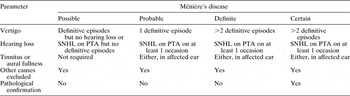
The current Committee guidelines are summarised in Table I, and consist of a diagnostic scale which, in addition to diagnoses of ‘definite Ménière's disease’ and ‘certain Ménière's disease’, includes ‘possible Ménière's disease’ and ‘probable Ménière's disease’. The Committee states that these latter groups ‘might constitute important groups to study … it would be desirable to have a treatment that would prevent progression to successive stages and further loss of hearing’.6
Breakdown of patients fulfilling the American Academy of Otolaryngology Head and Neck Surgery (AAO-HNS) diagnostic guidelines for Ménière's disease.

Summary of AAO-HNS CHE guidelines for diagnosis of Ménière's disease

In the development of their diagnostic system for Ménière's disease, the American Academy of Otolaryngology Head and Neck Surgery (AAO-HNS) Committee on Hearing and Equilibrium (CHE) employed concepts used in the diagnosis of multiple sclerosis.11 SNHL = sensorineural hearing loss; PTA = pure tone audiometry
Although this makes sense, one gets the impression that these categories have been introduced retrospectively, in order that patients with an incomplete clinical picture can be allocated to a diagnostic group.
The clinical picture of Ménière's disease clearly spans a wide spectrum. When one attempts to impose strict diagnostic criteria, there will inevitably be a cohort of patients who have clinical symptoms and signs of Ménière's disease but who do not conform to the rigidly prescribed diagnostic guidelines.
Definitions
According to the Committee guidelines, Ménière's disease is ‘a clinical disorder defined as the idiopathic syndrome of endolymphatic hydrops’.3
The New Oxford Dictionary of English definition of a disease is ‘a disorder of structure or function … especially one that produces specific signs and symptoms or that affects a specific location, and is not simply a direct result of physical injury’.Reference Pearsall and Hanks12 According to this definition, it makes sense that one could diagnose Ménière's disease by either of two methods: confirmation of altered structure and function of the inner ear, or the identification of a constellation of clinical symptoms peculiar to the disease.
The underlying pathophysiological condition in Ménière's disease is endolymphatic hydrops, for which a diagnosis can be confirmed only after death, through pathological study of the patient's temporal bones.Reference Schuknecht and Gulya13
Therefore, for the purpose of diagnosing endolymphatic hydrops during life, a distinct pattern of clinical symptoms must be present, which represents the clinical picture which is produced by the effects of the pathophysiological condition, presumed to be endolymphatic hydrops, on the inner ear.
Vertigo
Vertigo is defined by the New Oxford Dictionary of English as ‘a sensation of whirling and loss of balance, associated particularly with looking down from a great height, or caused by disease affecting the inner ear or the vestibular nerve; giddiness’.Reference Pearsall and Hanks12
It appears that whilst clinicians maintain a tendency to reserve the term ‘vertigo’ for a sensation of spinning or movement, our patients may well be using the terms as defined by the New Oxford Dictionary of English, according to which the words vertigo, giddiness and dizziness have become synonymous, and the definitions of – and differentiation between – these words have become somewhat blurred.Reference Stapleton14
The American Academy of Otolaryngology Head and Neck Surgery Committee on Hearing and Equilibrium guidelines define vertigo as ‘the sensation of motion when no motion is occurring relative to the earth's gravity’,3 in contrast to ‘motion intolerance’ which is ‘a feeling of disequilibrium, spatial disorientation, or malaise during active or passive movement’. A clear history of vertigo – according to this definition – which is spontaneous and which lasts a minimum of 20 minutes is required for a diagnosis of Ménière's disease. In the classical history, these episodes are often debilitating and accompanied by severe nausea and/or vomiting. They are not associated with loss of consciousness, and horizontal rotatory nystagmus is always present during an episode (although this phenomenon is rarely observed by the consulting clinician). To qualify for a diagnosis of definite Ménière's disease, at least two definitive episodes lasting longer than 20 minutes must occur.
Hearing loss
Patients attending a balance clinic often describe a subjective hearing loss, but when their pure tone hearing is measured they are found to have objectively normal hearing. In order to make a diagnosis of definite Ménière's disease, the American Academy of Otolaryngology Head and Neck Surgery criteria require sensorineural hearing loss to be documented in the affected ear on at least one occasion.
It is widely accepted that hearing usually fluctuates in early Ménière's disease, and in fact fluctuating hearing loss was one of the essential criteria used by Ménière in his original definition of the disease.Reference Menière1, Reference Atkinson2 However, since fluctuation in hearing is not universal, the American Academy of Otolaryngology Head and Neck Surgery Committee on Hearing and Equilibrium considers it not to be essential for the diagnosis of Ménière's disease. In clinical practice, however, it can be very helpful to observe fluctuation in hearing, through measurement of the patient's pure tone hearing on a number of different occasions. The objective observation of this pattern can help to identify fluctuating (hydropic) hearing loss and to differentiate it from gradual, progressive hearing loss due to alternative pathologies.
The American Academy of Otolaryngology Head and Neck Surgery criteria specify that diagnostic hearing loss may occur in the following forms. Firstly, the average (arithmetic mean) of hearing thresholds at 0.25, 0.5 and 1 kHz is 15 dB or more higher than the average of hearing thresholds at 1, 2 and 3 kHz. Secondly, in unilateral cases, the average of threshold values at 0.5, 1, 2 and 3 kHz is 20 dB or more poorer in the affected ear than on the opposite side. Thirdly, in bilateral cases, the average of threshold values at 0.5, 1, 2 and 3 kHz is greater than 25 dB in the studied ear. Fourthly, in the judgement of the investigator, the patient's hearing loss meets reasonable audiometric criteria for characteristic hearing loss.
The latter form takes into account a change in hearing which does not fit the criteria in the previous three forms, but which appears significant to the experienced clinician. It also allows for changes in speech recognition, in the absence of significant changes in pure tone hearing levels.
Tinnitus and aural fullness
The American Academy of Otolaryngology Head and Neck Surgery Committee for Hearing and Equilibrium suggests that, since tinnitus and aural fullness are clinical symptoms which cannot easily be quantified, the documentation of either symptom in the affected ear is sufficient to make a clinical diagnosis of Ménière's disease. The fact that – according to the Committee guidelines – it is possible to make a clinical diagnosis of Ménière's disease in the absence of a history of tinnitus, is another point on which these diagnostic guidelines differ from Prosper Ménière's original 1861 description of Ménière's disease.
Differential diagnoses
The most important feature of episodic vertigo which points toward a diagnosis is the duration of the episodes. In Ménière's disease, vertiginous episodes last at least 20 minutes, and rarely last longer than several hours.
In the absence of hearing loss, tinnitus and aural fullness, episodic vertigo is often referred to as ‘recurrent vestibulopathy’.Reference Rutka and Barber15 However, when such episodes last between 20 minutes and several hours, one might consider whether this disorder might be part of the same spectrum as Ménière's disease.
Primary autoimmune or vasculitic processes can present with episodic vertigo of the Ménière's type, and should be considered if there is a progressive, bilateral sensorineural hearing loss. The American Academy of Otolaryngology Head and Neck Surgery Committee on Hearing and Equilibrium guidelines state that a diagnosis of Ménière's disease should be questioned if there is bilateral hearing loss with a pure tone average worse than 70 dB, or word recognition worse than 50 per cent.
Ménière's disease is a clinical disorder defined as the idiopathic syndrome of endolymphatic hydrops.3 In a patient with clinical symptoms and signs consistent with endolymphatic hydrops, therefore, it is important to exclude a primary cause before attributing the patient's symptoms to an idiopathic disorder.
The presentation of balance disorders can be unpredictable, and the clinician should always be aware of the possibility of alternative otological and neurological causes for episodic vertigo. Basic otological and neurological examinations are therefore mandatory in any patient presenting with episodic vertigo, in order to exclude otological, retrocochlear and intracranial disorders, before making a diagnosis of an idiopathic condition.
In the case of bilateral Ménière's disease, the American Academy of Otolaryngology Head and Neck Surgery Committee on Hearing and Equilibrium guidelines state that, in addition to the exclusion of alternative diagnoses, the diagnosis of Ménière's disease must be established independently for each ear.
Aims of study
In view of the fact that there are two areas in which the American Academy of Otolaryngology Head and Neck Surgery Committee on Hearing and Equilibrium guidelines differ from the diagnostic criteria which Ménière described, one might wonder whether the Committee guidelines are excessively broad, and might therefore pick up a larger proportion of the patient cohort than would be diagnosed with the full set of diagnostic criteria as described by Prosper Ménière.
The aim of this study was to assess the usefulness of the American Academy of Otolaryngology Head and Neck Surgery guidelines for the diagnosis of Ménière's disease, by comparing the criteria to the clinical profiles of a clinical cohort of patients attending a specialist balance clinic.
We sought to answer the following questions. Do the American Academy of Otolaryngology Head and Neck Surgery criteria accurately define Ménière's disease as described by Prosper Ménière? Does a cohort of patients thought to have Ménière's disease fulfill the American Academy of Otolaryngology Head and Neck Surgery criteria?
Methods
In the specialist balance clinic, clinical information on every patient had been collected prospectively. A structured clinical history had been taken by a consultant neuro-otologist and recorded on a database. At their initial consultation, every patient had undergone pure tone audiography, which had been repeated on subsequent consultations if indicated.
The database contained the patients' structured clinical histories, clinical examination findings, audiological data, and the results of other investigations. Additionally, the clinician's suspected diagnosis at initial presentation had been recorded, as well as any definitive diagnosis which had been revealed by investigations, or evolution of the patient's clinical picture on subsequent consultations.
The clinical records of 650 consecutive patients attending the specialist balance clinic were analysed. Initially, the ‘suspected diagnosis’ and ‘definitive diagnosis’ sections were ignored, and the clinical data analysed, in order to find out what proportion of the cohort fulfilled the American Academy of Otolaryngology Head and Neck Surgery criteria for the diagnosis of Ménière's disease.
Subsequently, the clinical profiles of those patients fulfilling criteria for a diagnosis of Ménière's disease were analysed, to find out what proportion of patients diagnosed with Ménière's disease fulfilled the full set of diagnostic criteria described by Prosper Ménière, and how many of them were subsequently found to have other pathology.
Results
Of all patients attending the specialist balance clinic, we found the following. Episodic, true vertigo lasting a minimum of 20 minutes was reported by 322/650 patients (49.5 per cent). Symptoms of aural fullness and/or tinnitus were reported by 432/650 patients (66.5 per cent). Sensorineural hearing loss (either bilateral or on the same side as the tinnitus and/or aural fullness) was found to be present on at least one occasion in 356/650 patients (54.8 per cent). Overall, 151/650 patients (23.2 per cent) fulfilled all three criteria.
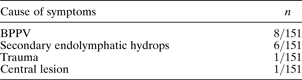
However, these results were obtained prior to exclusion of patients having a recognised cause for their symptoms. Of all patients fulfilling the diagnostic guidelines for the diagnosis of Ménière's disease, 16/151 (10.7 per cent) had a definitive cause for their symptoms identified (Table II), and 135/151 (89.4 per cent) had no identifiable cause for their symptoms.
Patients fulfilling AAO-HNS criteria but having an identifiable cause for their symptoms
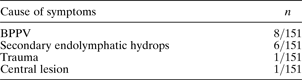
AAO-HNS = American Academy of Otolaryngology Head and Neck Surgery; BPPV = benign paroxysmal positional vertigo
Therefore, according to the American Academy of Otolaryngology Head and Neck Surgery guidelines, 135/650 (20.8 per cent) of our clinical cohort fit the pattern of symptoms consistent with Ménière's disease.
Of all patients attending the balance clinic, 45/650 (6.9 per cent) fulfilled Prosper Ménière's diagnostic criteria for Ménière's disease, and all 45 (100 per cent) of these also fulfilled the American Academy of Otolaryngology Head and Neck Surgery guidelines for the diagnosis of Ménière's disease.
Of the 135 patients fulfilling the American Academy of Otolaryngology Head and Neck Surgery guidelines for the diagnosis of Ménière's disease, 45 (33.3 per cent) had a full spectrum of symptoms as described by Prosper Ménière.
Seventeen of the 135 patients (12.6 per cent) reported aural fullness but had never experienced tinnitus, and 68 patients (50.4 per cent) had a hearing loss which was diagnostic according to the American Academy of Otolaryngology Head and Neck Surgery guidelines; however, the patients did not describe fluctuation in their hearing, nor was a hearing fluctuation recorded on sequential pure tone audiograms. These two groups – diagnosable with definite Ménière's disease according to the American Academy of Otolaryngology Head and Neck Surgery guidelines – were considered by an experienced specialist (the second author) to have suspected or possible Ménière's disease and were subsequently offered similar treatment modalities to those patients with a complete set of symptoms.
Five of the 135 patients (3.7 per cent) fulfilling the American Academy of Otolaryngology Head and Neck Surgery guidelines were diagnosed with vestibular migraine. There is much epidemiological data, but no definitive evidence, of a link between migraine and episodic vertigo, and at present the International Classification of Headache DisordersReference Oleson16 does not include vestibular migraine amongst its definitions. In view of the fact that there is a likely link between the two, and that – like Ménière's disease – migraine has no reliable and accessible objective test or investigation, we did not include this small cohort in the group of patients subsequently found to have definitive causes for their episodic balance symptoms.
Discussion
The results of this study confirm that the American Academy of Otolaryngology Head and Neck Surgery guidelines for the diagnosis of Ménière's disease capture a larger cohort of patients than the criteria originally described by Prosper Ménière in 1861.
As there is no definitive diagnostic test for Ménière's disease, it is impossible to calculate the exact sensitivity and specificity of each set of diagnostic criteria. However, it is clear that the American Academy of Otolaryngology Head and Neck Surgery guidelines, being slightly looser, pick up cases which would not be picked up by Ménière's diagnostic criteria, whilst Ménière's criteria require a full set of symptoms and will inevitably fail to pick up cases which do not include a complete set of symptoms. Every patient satisfying Ménière's diagnostic criteria also fulfilled the American Academy of Otolaryngology Head and Neck Surgery guidelines for the diagnosis of Ménière's disease. One might consider, therefore, that the American Academy of Otolaryngology Head and Neck Surgery guidelines are relatively more sensitive and less specific, whilst Ménière's diagnostic criteria are relatively more specific and less sensitive.
There is a threefold discrepancy between the proportions of patients fulfilling the American Academy of Otolaryngology Head and Neck Surgery guidelines (20.8 per cent of the clinical cohort) and those satisfying Ménière's diagnostic criteria (6.9 per cent of the clinical cohort).
In keeping with the Committee on Hearing and Equilibrium's statement that groups of patients not fulfilling every diagnostic criterion ‘might constitute important groups to study’,6 it is clear that careful documentation of clinical data for patients with balance symptoms is necessary, in order that these data can be reliably used in future studies.
Clinical diagnosis of Ménière's disease
At the level of individual patients consulting individual clinicans, the application of differing sets of diagnostic criteria for Ménière's disease would probably be of very little consequence, not least because experienced clinicans use their knowledge, experience and common sense to make diagnoses and plan treatment options.
Ménière's disease is not appropriate for clinical diagnosis on the sole basis of a fixed protocol. Although the use of prescribed diagnostic guidelines is recommended, it is clear that idiopathic endolymphatic hydrops exists across a spectrum. Ménière's disease appears not to be a discrete clinical entity, and should therefore not be considered as such in clinical practice, but merely for the purpose of data recording, audit and the comparison of published cohorts.
Provided the clinician is vigilant, experienced enough to recognise signs and symptoms of other conditions, and knows when to instigate appropriate investigations and treatments, the application of different diagnostic criteria would have very little impact in terms of treatment modalities.
We agree with Thorp et al. Reference Thorp, Shehab and Bance7 that clinical trials and published series of patients which do not follow a standardised set of diagnostic criteria are essentially meaningless. Although the application of different diagnostic criteria would make little difference on an individual clinical level, there is a potential loss of important data (which could be beneficially used in the development of new diagnostic and treatment modalities for Ménière's disease) if standardised definitions and criteria are not implemented.
Why are the American Academy of Otolaryngology Head and Neck Surgery guidelines not followed?
One must consider the reasons why the established diagnostic criteria for Ménière's disease are not always adhered to in published series.Reference Thorp, Shehab and Bance7 Indeed, considering the data presented by Thorp et al., extrapolation of their findings might lead one to wonder about the extent to which these guidelines are followed in the clinical practice of individual clinicians.
With the exception of audiometric measurements, the diagnosis of Ménière's disease is a clinical one, which rests largely upon the clarity and accuracy of the patient's history, as well as the interview technique of the clinician. A clear, concise clinical picture which satisfies the Ménière's disease diagnostic guidelines is not always present; only 27 per cent of patients who do ultimately fulfil these criteria satisfy such criteria at first presentation to an otolaryngologist.Reference Haid, Watermeier and Wolf17
• Ménière's disease is a diagnosis requiring expert clinical judgment. There are no diagnostic tests, and many patients meet some but not all of the diagnostic criteria
• There are several discrepancies between the criteria required for the diagnosis of Ménière's disease described by Prosper Ménière, and the American Academy of Otolaryngology Head and Neck Surgery guidelines for the diagnosis of Ménière's disease
• In the clinical setting, diagnosis according to the American Academy of Otolaryngology Head and Neck Surgery guidelines produced a thrice larger cohort of patients than diagnosis according to Ménière's definition
• The application of different diagnostic criteria has little effect on patients' treatment options
• Ideally, definition of Ménière's disease should be standardised across published series, in order that results are reliable and comparable
• We recommend introducing stricter criteria for the diagnosis of definite Ménière's disease, based on Prosper Ménière's description of the disease
There are rarely any clinical findings in Ménière's disease patients who are not currently suffering an acute episode. However, clinical examination is essential in order to exclude other otological and neurological causes of episodic vertigo. In the absence of clinical findings, in a patient with a clinical history which does not quite fulfil the American Academy of Otolaryngology Head and Neck Surgery criteria for Ménière's disease diagnosis, the clinician might therefore allocate a diagnosis of ‘probable Ménière's disease’ or ‘possible Ménière's disease’. Alternatively, they may carry out vestibular investigations in order to clarify their patient's neuro-otological status.
Despite evidence to the contrary, authors of published literature appear to have had a tendency to use vestibular tests to confirm their diagnosis of Ménière's disease, and this appears to be one of the major reasons why the American Academy of Otolaryngology Head and Neck Surgery guidelines are not always followed. Kim et al. Reference Kim, Wiet and Battista18 found that 67 per cent of American Neurotology Society members who responded to a postal survey relied on electrocochleography and/or electronystagmography – even in the presence of a diagnostic history, examination and pure tone audiometry – to make a diagnosis of Ménière's disease.
Studies suggest the following: that between 35 and 70 per cent of patients with Ménière's disease show abnormal results on electrocochleography; that only 54 per cent of patients with unilateral Ménière's disease demonstrate unilateral vestibular hypofunction on electronystagmography;Reference Conlon and Gibson19–Reference Wexler, Harker and Voots23 and that 25 per cent of patients will have normal findings on electronystagmography.Reference Dobie, Snyder and Donaldson24
The future
There is great potential for future work in this area. The clinical diagnosis and treatment of patients with balance symptoms is imprecise, and the pathology of vestibular conditions is still not fully understood.
Although ‘moving the goalposts’ of a clinical diagnosis of Ménière's disease will have little impact on the practice of individual clinicians and the treatment modalities available to individual patients, it is clear that standardised criteria need to be adhered to in order to enable reliable comparison of local and published data.
As recommended by the American Academy of Otolaryngology Head and Neck Surgery Committee on Hearing and Equilibrium, the identification of patient cohorts with an incomplete profile of symptoms could be invaluable in helping us better understand the clinical course of such patients, and the impact of different treatment options on the course of the disease. This will only be effective if every author defines their patient cohort by the same strict guidelines.
Whilst we agree with Thorp et al. Reference Thorp, Shehab and Bance7 that adherence to standardised diagnostic criteria should be a precondition of journal publication, the results of this study suggest that the American Academy of Otolaryngology Head and Neck Surgery guidelines for the diagnosis of ‘definite Ménière's disease’ might be rather too broad, and that it might be beneficial to introduce a more definitive diagnostic category – based on Prosper Ménière's description of the disease – in future editions of the guidelines.
Conclusion
Ménière's disease is a diagnosis requiring expert clinical judgment. There are no diagnostic tests, and many patients meet some but not all of the diagnostic criteria.
There are several discrepancies between the criteria required for the diagnosis of Ménière's disease described by Prosper Ménière, and the American Academy of Otolaryngology Head and Neck Surgery guidelines for the diagnosis of Ménière's disease. In the clinical setting, diagnosis according to the American Academy of Otolaryngology Head and Neck Surgery guidelines produced a thrice larger cohort of patients, compared with diagnosis according to Ménière's definition.
The application of different diagnostic criteria has little effect on the treatment options available to patients. However, ideally, the definition of Ménière's disease should be standardised across published series, in order that results be reliable and comparable.
We would recommend introducing stricter criteria for the diagnosis of definite Ménière's disease, based on Prosper Ménière's description of the disease.