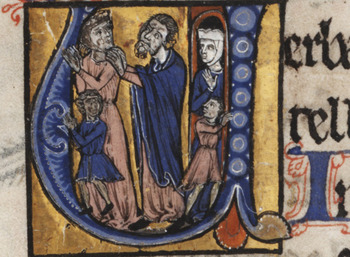
Sarah saw the son whom Hagar the Egyptian had borne to Abraham playing. She said to Abraham, “Cast out that slave-woman and her son, for the son of that slave shall not share in the inheritance with my son Isaac.” The matter distressed Abraham greatly, for it concerned a son of his. But God said to Abraham, “Do not be distressed over the boy or your slave; whatever Sarah tells you, do as she says, for it is through Isaac that offspring shall be continued for you. As for the son of the slave-woman, I will make a nation of him, too, for he is your seed.”Footnote 1
I. Biblical Typologies and Medieval Communities
In two separate letters written first to King Philip Augustus of France (1165–1223) and then to the archbishop of Sens and the bishop of Paris in 1205, Pope Innocent III (r. 1198–1216) decried the behavior of Jews in Christian lands, complaining that they repaid Christian generosity with insolence by their usury, hiring of Christian domestic servants and wet-nurses, building of new synagogues alongside and higher than churches, and worse.Footnote 2 Referencing St. Paul's allegorical rendering of the biblical figures Sarah and Hagar in his Epistle to the Galatians, Innocent invoked the Jews' state of “perpetual servitude” and warned against the children of the freewoman (i.e., Christians) serving the children of the bondwoman (i.e., Jews).Footnote 3 Innocent followed St. Augustine of Hippo (354–430) and a longstanding Christian tradition in recognizing the legitimacy of a Jewish presence in Christian society, but he was quite clear that the Jews' position should be a subservient one. The pope insisted on the obligation of the king of France, the duke of Burgundy, and the countess of Troyes to uphold the proper order of society, and he enjoined the bishops to use the power of excommunication to help them meet it. About a century later, Oldradus de Ponte (d. after 1337), a master of law, disputed a question at the papal court in Avignon asking whether it might, under certain circumstances, be acceptable for a Christian prince to expel Jews from his kingdom and whether it was appropriate for a pope to encourage him to take such action. In the wake of the expulsion of the Jews from French royal lands by King Philip the Fair (1268–1314) in 1306, this question was timely and of more than theoretical interest. Short on arguments in favor of the proposition—canon law quite clearly supported a controlled, semi-autonomous Jewish presence in Christian society—Oldradus concluded that while Jews who maintain a peaceful presence should not be disturbed, the toleration of Jews in Christian society was based “on Christian piety and as a matter of grace,” and such toleration “ought not, therefore, to be ascribed to necessity.” After some elaboration, he continued, “All this [i.e., a policy of expulsion] seems clearly prefigured in that slave woman [Hagar] from whom they descend since, because she conducted herself haughtily and ungratefully to the free woman [Sarah], who signifies the Church, she was expelled. For it was said, ‘Expel the slave woman and her son.’”Footnote 4 Oldradus thus framed the Jews' expulsion from Christian lands in terms of the biblical conflict between mistress and servant.Footnote 5 Just as, according to the standard Christian interpretation of the text, Sarah found it necessary to chastise Hagar for her insolence and eventually to cast her out with her son, so a contemporary Christian ruler might find it necessary to send away Jews previously allowed to live among Christians. Particularly noteworthy is the way Oldradus handles the typology such that Sarah stands for the Church as a body (“the free woman . . . signifies the Church”) while Hagar stands for Jewish individuals (“that slave woman from whom they descend”).
Pope Innocent and Oldradus both sought to establish, or at least support, specific policies on the foundation of an allegorical reading of biblical text. In doing so, they extended an established identification of Hagar with the old law, synagogue, or a vague Jewish “other” into a figure representative of the Jews living in their midst. The centrality of Paul's Galatians allegory in western Christian liturgical and exegetical traditions and the malleability of the allegory in Christian interpretation made it a useful framework for thinking about contemporary Christian-Jewish relations: established Christian biblical interpretation helped to shape Christian thinking about how Jews should live within Christian society, while changes in Jewish-Christian coexistence encouraged new forms of attention to a relevant biblical text. Reverberations of the Sarah-Hagar allegory were increasingly inserted into discussions of social policy.Footnote 6
Ancient and medieval Christian and Jewish use of biblical typologies to frame intercommunal tension is well known. St. Augustine, following earlier Christian theologians, had identified Jews with the biblical Cain, condemned to wander the globe for the crime of fratricide, and this powerful image proved compelling.Footnote 7 Christian authors assigned to themselves the role of Sarah to the Jews' Hagar, Isaac to the Jews' Ishmael, Jacob to the Jews' Esau. Jews, for their part, depicted themselves as Isaac on Abraham's altar, children of Jacob pursued by a wild Christian Esau. The polemical turn to biblical typologies was developed in late antiquity, but the nature of the typologies and the way they were used changed over time. While there is some disagreement about the extent to which biblical interpretation reflected tensions created by actual encounter with a religious other in antiquity, there is no question that over the course of the Middle Ages it came to function in this way. Any number of biblical typologies came to serve in polemical engagement and the construction of religious identities (and counter-identities), but the Sarah-Hagar typology was distinctive and especially compelling for Christian thinkers. Its foundation in the New Testament was partly responsible, of course, but it seems that the complexity of the counterpoints of Sarah-Hagar, Isaac-Ishmael, free-slave, miraculous motherhood-natural motherhood made the narrative a particularly fruitful one for exploration, interpretation, expansion, and adaptation. What follows is a consideration of the ramifications of biblical typology—an examination of the way one particularly rich typological reading came to give meaning to relationships between real Christians and Jews in medieval Europe.
II. The Sarah-Hagar Narrative and Its Early Interpretation
The biblical figure Hagar was the matriarch Sarah's Egyptian handmaiden and the mother of Abraham's first-born son Ishmael. The story of Abraham, Sarah, Hagar, and their children is told primarily in chapters 16, 21, and 25 in the book of Genesis. In spite of God's early promise of numerous offspring, Abram and Sarai remained without children into old age, and so Sarai suggested that Abram conceive a son through her servant Hagar. From the time Hagar became pregnant, the relationship between the two women became fraught. Adele Reinhartz and Miriam Walfish describe the two women as bound in a state of tension over inequalities in social status and fertility, with the unfolding of their relationship “propelled by the actions of the two women themselves.”Footnote 8 This is more important an observation than might at first appear, as the fate not just of Abraham's offspring, but also of the covenant with God, hinges on the relationship between the two. Eventually, Sarai, renamed by God as Sarah, did give birth to a son, Isaac, and shortly after his weaning she insisted that Abram, now Abraham, send Hagar and Ishmael away so that Ishmael would not inherit along with her son. The text describes Hagar's despair in the wilderness when she thinks her son will die of thirst, and God's intervention in keeping Ishmael alive. Although God more than once states an intention to maintain the covenant with Abraham through Sarah's son Isaac, God also assures both Hagar and Abraham that their son Ishmael will likewise become a great people. According to Genesis 25, Ishmael eventually had twelve sons, founders of twelve tribes. The Genesis narrative is unsettling, depicting both Hagar and Sarah in an ambiguous moral light. No one in the story is depicted as entirely blameless, which opened up much room for later readers to speculate upon the motives and behaviors of the various characters.
Josephus's account of the Sarah and Hagar story in Jewish Antiquities addressed some of the moral issues that would be of central concern to later Jewish and Christian writers. According to Josephus, the harsh treatment Hagar received when pregnant with Ishmael was due to her own insolence and arrogant treatment of her mistress. He also depicts Sarah's later decision to send Ishmael away as reasonable given her obligation to protect her son Isaac's interests. He points out that God sanctioned the decision and that Hagar anyway was clearly under God's protection as she set out on her new course; through Ishmael she would be blessed. Josephus also insists that Sarah loved Ishmael like her own son until after Isaac was born and she discerned a potential conflict of interest. Sarah's treatment of Hagar is not cruel in this version, and the banishing of Hagar simply prepares the way for a divergence of paths between Isaac and Ishmael.Footnote 9 In Josephus, we also see an already established tradition identifying the descendants of Ishmael with Arab tribes: “When [Ishmael] was grown up, he married a wife, by birth an Egyptian, from whence the mother was herself derived originally. Of this wife were born to Ishmael twelve sons . . . These inhabited all the country from Euphrates to the Red Sea, and called it Nabatene. They are an Arabian nation, and name their tribes from these, both because of their own virtue, and because of the dignity of Abraham their father.”Footnote 10 Josephus substitutes the term “Arab” for “Ishmaelite” in his work, as in his telling of the Joseph story: “But Judas, being one of Jacob's sons also, seeing some Arabians, of the posterity of Ishmael, carrying spices and Syrian wares out of the land of Gilead to the Egyptians, after Ruben was gone, advised his brethren to draw Joseph out of the pit, and sell him to the Arabians.”Footnote 11
There are many stories in rabbinic literature dealing with the relationship between Abraham, Sarah, and Hagar. These Midrashim explore the complicated moral landscape of the triangle created by Hagar's physical relationship with Abraham. Often the rabbis, like Josephus, look to defend Sarah's character, which requires them to find some fault with Hagar, but the moral ambiguity of the situation remains evident. Hagar is sometimes depicted as having behaved badly toward her mistress or is accused of having practiced idolatry, but she is also depicted as a noble daughter of Pharaoh, and a wife of Abraham rather than a concubine.Footnote 12 Since Sarah's call to banish Hagar came about after Sarah witnessed Ishmael “playing” with Isaac, the rabbis also consider what this “play” (מצחק) might have entailed, proposing that Ishmael engaged in idolatry, or immoral sexual behavior, or taunted Isaac over the inheritance.Footnote 13 The rabbis were more interested in the patriarchs and matriarchs than they were in the question of Ishmael's fate, and Carol Bakhos notes that before the rise of Islam there was only a limited engagement with Ishmael, sometimes explicitly linking him with contemporary Arab tribes, but most often presented as vaguely “unfit” for Abraham's inheritance—a “rabbinic other.”Footnote 14 Given that much of the Near East in late antiquity was under Christian rule, it should not be surprising that rabbinic attention was more consistently directed toward an exploration of the Jacob-Esau relationship, with Esau serving as a stand-in for Christian power.Footnote 15 But with the growth of Islam in the seventh century, Bakhos finds a decidedly more negative depiction of Ishmael, as well as a more fixed association of him with Arabs, and more broadly with Islam: “Indeed, the changing ethnic, religious, and political landscape of the Near East in the seventh century affected later rabbinic depictions of Ishmael whereby he becomes the eponymous prototype of Islam . . . Even though not all depictions after the Islamic conquest are invidious, there is a greater rabbinic tendency to portray Ishmael critically than is found in pre-Islamic rabbinic sources.”Footnote 16
While rabbinic depictions of Ishmael as a symbol of Islam tended toward negative portrayal, Muslim interpreters embraced an identity as descendants of Ishmael unproblematically, with a family narrative different in substantive ways from the biblical account. The Qur'an itself lacks explicit reference to Arab descent from Ishmael, but the association was fixed fairly early in Islam's formative period. In Gordon Newby's reconstruction of Muhammad ibn Ishaq's eighth-century biography of Muhammad we find the tradition fully developed:
From Ibn Hamid, who got it from Salamah, who got it from Muhammad b. Ishaq, who got it from al-Hasan b. Umrah, who got it from Sammak b. Harb, who got it from Khalid b. Ar'arah, Ali b. Abu Talib, peace be upon him said: When God commanded Abraham to visit the Ka'bah and call mankind to the Pilgrimage, Abraham left Syria with his son Ishmael and Ishmael's mother, Hagar. And God sent the Shechinah with him, a wind which had a tongue with which Abraham could talk in the morning, and travel with so that it brought him to Mecca. When it came to the place of the Ka'bah, the Shechinah went around it. Then it said to Abraham, Build over me; build over me; build over me. So Abraham laid the foundations and raised up the Temple, he and Ishmael, until they stopped at the place of the cornerstone…
So Abraham went with Ishmael and his mother, Hagar, to the place of the stone (in Mecca) and settled them there. Abraham ordered Hagar, the mother of Ishmael, to make a hut. “My Lord, I have settled some of my progeny in an uncultivable valley near your Holy House . . . that they may be thankful” [Q 14:37]. Then he left them at the Temple and departed for his other family in Syria.Footnote 17
Medieval Jewish and Muslim exegetes thus shared an understanding of Arab (and so Muslim) descent from Hagar through her son Ishmael and of Jewish descent from Sarah through her son Isaac. Christian tradition was more complex and ambiguous, as Paul's Galatians allegory in the New Testament encouraged Christians to view themselves as the adoptive and legitimate children of Abraham and Sarah, dismissing Jewish adherents of the old law as children of the rejected Hagar.Footnote 18 Patristic authors certainly knew Josephus and would have been familiar with Jewish texts associating Ishmael with Arabs. Nevertheless, they were drawn by Paul's genealogical allegory and their developing predisposition toward spiritual interpretation of scripture to highlight Isaac and Ishmael as Christian and Jewish figures respectively.
Paul's Epistle to the Galatians was addressed to a community of gentile followers of Jesus who had apparently begun to take on some of the ritual, ceremonial precepts of Jewish law. The letter, like much of Paul's writing, seeks to articulate a viable relationship between gentile followers of Jesus and Jewish tradition. His allegory of Sarah and Hagar as two testaments pointed a way for gentile communities of Jesus-followers to take their place as authentic heirs of Abraham without taking on the obligations of the law. Galatians 4:22–31 establishes the genealogical claim:
For it is written that Abraham had two sons: the one by a bondwoman and the other by a free woman. But he who was of the bondwoman was born according to the flesh: but he of the free woman was by promise. Which things are said by an allegory. For these are the two testaments. The one from Mount Sina, engendering unto bondage, which is Agar. For Sina is a mountain in Arabia, which hath affinity to that Jerusalem which now is: and is in bondage with her children. But that Jerusalem which is above is free: which is our mother. For it is written: Rejoice, thou barren, that bearest not: break forth and cry thou that travailest not: for many are the children of the desolate, more than of her that hath a husband. Now we, brethren, as Isaac was, are the children of promise. But as then he that was born according to the flesh persecuted him that was after the spirit: so also it is now. But what saith the scripture? Cast out the bondwoman and her son: for the son of the bondwoman shall not be heir with the son of the free woman. So then, brethren, we are not the children of the bondwoman but of the free: by the freedom wherewith Christ has made us free.Footnote 19
New Testament and Pauline scholars have vigorously debated the nature of Paul's claim here and the importance of Abrahamic inheritance for gentile followers of Jesus.Footnote 20 Whatever Paul himself might have intended with this allegory, the idea of gentile Christians as Abraham's heirs and the association of Sarah and Hagar with Ecclesia and Synagoga became normative early in Christian history, insistently inserting itself into Christian self-understanding. In addition, Paul's use of allegory in this passage established a foundation for allegorical readings of Jewish scripture in a developing proto-Christian tradition, and that, too, became normative. The importance of the reading for Christian hermeneutics distinguishes the Galatians allegory from Paul's invocation of Isaac-Ishmael and Jacob-Esau in Romans 9. In Galatians, the method Paul used to weave gentile followers of Jesus into the Genesis genealogy not only reinforced the identification of Sarah as mother of that community, but, more importantly, also established allegory as a legitimate way to draw meaning out of Jewish Scripture for the community that would become Christian. As Margaret Mitchell has put it, “The route to early Christian defense of non-literal reading (by whatever name), it seems, goes straight through the corpus Paulinum,” and the Galatians allegory is one of the key passages later exegetes use to demonstrate the possibilities of such reading.Footnote 21 Origen (c. 185-c. 284) imported the Galatians allegory into his homily on Genesis to encourage readers to a spiritual reading of scripture rather than a literal one. For Origen, Hagar thirsting in the desert was a symbol of the Jews (Synagoga), unable to drink the water of scripture that was right in front of them: “For now the Jews lie around the well itself, but their eyes are closed and they cannot drink from the well of the Law and the prophets.” One day, Origen explained, the “veil of the letter”— a direct allusion to Paul's words in 2 Corinthians 3Footnote 22—would be removed by God's intervention, and Synagoga would be able to see the “living water” that was Christ. Origen amplified and transformed Paul's allegorical reading of Genesis, highlighting the necessity of figurative exegesis of scripture.Footnote 23 Not only did Origen name the Jews as blind to the true (spiritual) meaning of the text, he warned that Christians, too, needed to be on guard: “But let us also beware, for frequently we also lie around the well ‘of living water,’ that is around the divine Scriptures and err in them. We hold the books and we read them, but we do not touch upon the spiritual sense. And, therefore, there is need for tears and incessant prayer that the Lord may open our eyes.”Footnote 24 Tension between observance and nonobservance of the law as established in Paul had evolved into a tension between literal and allegorical readings of scripture, between a presumed Christian spirit and Jewish carnality.
With the ideal of spiritual interpretation established, the Galatians allegory was inserted into other passages of scripture. The standard interpretation of Psalm 5—the triumph of Christianity over Jewish persecutors—demonstrates interplay between Genesis 16–21, Galatians 4, and the psalm's title. Jerome's Latin Vulgate translation of the psalms followed the Septuagint version of the text rather than the Hebrew text.Footnote 25 The Septuagint, drawing, most likely, on existing Jewish traditions, played with the ambiguity of the Hebrew text to wrest: “unto the end for she who receives the inheritance” out of what might more straightforwardly be read, “to the conductor on the flutes,” and Jerome followed suit. Menatseaḥ (מנצח) meaning “conductor” can also mean “end,” or telos (τέλος) in Greek, while neḥilot (נחילות) a particular instrument, can be vocalized differently to read naḥalot (נחלות), inheritances. In Christian terms, “unto the end, for she who receives the inheritance” could only refer to Sarah (Ecclesia), which meant that the rejected ones of verse six, those “who cannot stand before God's eyes,” must be the children of Hagar (Synagoga). The reference to “inheritance” called Paul's allegorical reading of Genesis to mind, and this shaped Latin Christian reading of the entire psalm.
III. Ishmaelites as Arabs or Saracens in Christian Interpretation
Paul's association of a slave-bound Hagar and her son Ishmael with Synagogue competed with the tradition inherited from Josephus and elsewhere that identified Ishmael as the father of the Arab tribes. The mere existence of the Pauline allegory in the New Testament did not necessitate a reading of Genesis that adhered to Paul's genealogy; Eastern Christians tended to ignore the Pauline allegory in their readings of Genesis. This was particularly the case within the sphere of the Antiochene school of exegesis, with its emphasis on historical rather than allegorical readings of scripture generally, but it seems also to have been true in Byzantium more broadly.Footnote 26 John of Damascus (d. 743), for example, provided an etymology of names for Arab invaders based on earlier interpretations: they were called Hagarenes because they were born of Hagar; they were called Ishmaelites because they descended from Ishmael, they were called Saracens because Sarah sent them away without an inheritance.Footnote 27 The ancient association of Arabs with Hagar and Ishmael made it easy for Byzantine Christians, newly displaced from Jerusalem and the Holy Land, to frame their current state of crisis in biblical terms.
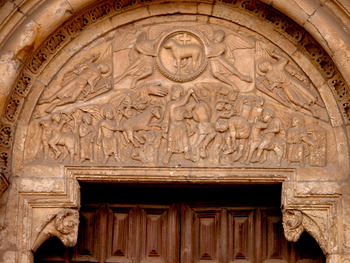
In the Latin West, Paul's New Testament allegory came early on to dominate readings of Genesis. Nevertheless, when polemical imperative called for it, Christian exegetes also embraced the Byzantine identification of Muslims with Ishmael.Footnote 28 Bishop Haimo of Auxerre (d. 865/866), for example, worked the Muslim presence into his ninth-century Psalms commentary by explaining that: “The free woman signifies the New Law, her son Isaac denotes the Christian people. The slave woman is the Old Law, her son Ishmael is the infidel horde [i.e., Muslims].”Footnote 29 Although this made for a lopsided allegory, it did allow Haimo to have it both ways—to preserve Paul's Genesis allegory in the Psalm and to see it also as an invocation of God's wrath on Muslim invaders. This depiction of conflict between a Christian Isaac and Muslim Ishmael was an important trope in medieval Christian-Muslim polemic. The identification of Muslim invaders with Hagar and Ishmael was embraced especially in Iberia where the encounter was most immediate. Isidore of Seville (c. 560–636) identified Saracens as descendants of Abraham through Ishmael in his Chronicon (615), although perhaps because they had not yet arrived in the Iberian Peninsula at the time of his writing, he had little to say about them. The anonymous Cronica Prophetica (c. 833), in contrast, developed an elaborate narrative about Saracen invaders of Spain as children of Ishmael: “The word of the Lord was made known to Ezekiel, saying: ‘Son of man, set your face against Ishmael and speak to them saying: “I gave you power over other peoples, I multiplied you, I strengthened you, and put in your right hand a sword and in your left hand arrows, so that you would destroy peoples and they would be leveled before your face like straw in the face of fire.”’”Footnote 30 Christian Visigoths play the role of conquered Gog in the prophecy, which promised that the Ishmaelites would soon suffer at the hands of those they formerly enslaved. In the one hundred and seventieth year of Ishmaelite rule of Iberia, the Chronica predicted, Gog would throw off “the yoke of the Ishmaelites,” and regain the land. Depictions of Hagar or Ishmael as Muslim in medieval art are surprisingly rare, but one of the best known examples of the image in monumental art, the Agnus Dei tympanum in the twelfth-century Romanesque Church of San Isidoro of Léon, is from the same region as the Chronica prophetica, an area out of which Christians launched attacks on Muslim-controlled lands in the late eleventh and twelfth centuries.Footnote 31 The image clearly incorporates a Saracen presence into the narrative of Abraham's binding of Isaac, a typological reference to the crucifixion. (Figure 1)
Abraham's Sacrifice of Isaac, Church of San Isidoro, Léon, 12th c. Photograph by Therese Martin.

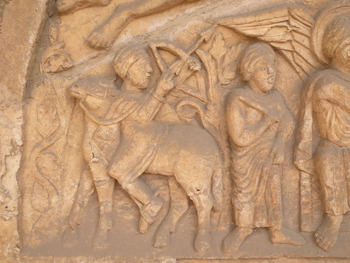
The relief portrays Christ as the lamb of God set above scenes from Abraham's binding of Isaac as described in Genesis 22:1–18. Although in the biblical text Hagar and Ishmael have already been sent away before this drama unfolds, here they are present, standing off to the left of these scenes as witnesses to both the old and the new sacrifices. Genesis 21:20 states that after Ishmael was sent away, God remained with him, he lived in the wild and became an archer. In this image, Ishmael is portrayed not simply as an archer, which was customary, but specifically as a Saracen, wearing a turban, riding horseback with short stirrups, his body, bow, and arrow turned around behind him in a manner typically used to represent the Saracen. Next to Ishmael stands his mother, Hagar, one hand hitching her skirt above her knee. John Williams compares the iconography here with a similar representation of an adulterous woman in a roughly contemporary portal from Santiago de Compostela, suggesting that the gesture was meant to indicate a range of licentious behaviors. Williams rejects the idea that the gesture references Hagar's status as concubine, and instead argues convincingly that it represents medieval Christian assumptions about the hypersexual character and behavior of Muslim women. Ishmael's turban and stirrups mark him out as Saracen, while Hagar's provocative stance marks her out as such.Footnote 32 (Figure 2)
Detail from Abraham's Sacrifice of Isaac: Ishmael as Saracen Archer, Church of San Isidoro, Léon, 12th c. Photograph by Therese Martin.

IV. The Multiple Senses of Scripture and Christian Reading of Sarah and Hagar
When tensions between Latin Christians and Muslims took center stage (during the early years of Muslim conquest, or during centuries of interaction in Iberia, or during the Crusades), the association of Ishmael with “the infidel horde” according to the historical sense of scripture was available as a rhetorical tool. But if Latin Christian biblical exegetes sometimes described Arab Muslims as the descendants of Hagar according to the literal-historical sense, the Jews filled that role according to the more important spiritual sense, which was often the only sense addressed. Very early in the Patristic period, Christian exegetes formed a primary division between literal (or historical) interpretation and spiritual interpretation, with a further articulation of distinctions within the spiritual sense constructing threefold or fourfold hermeneutical schemes. Origen, for example, elaborated a threefold understanding of scripture, distinguishing between literal, allegorical, and moral senses, while John Cassian (c. 360–435) divided the spiritual sense into three subcategories—the allegorical, the moral, and the anagogical.Footnote 33 Christian exegetes favored spirit over letter for centuries, at least until the twelfth century. Jerome (342–420) had done extensive work on the historical sense of scripture, and his work quickly became authoritative. It was frequently cited, but there was little interest in revisiting or expanding upon it. Gregory the Great's (c. 540–604) influential Moralia in Job provided a popular model for Latin biblical commentary. His three-fold sense included “historical foundations,” “spiritual understanding of allegory,” and “the loveliness of morality,” or “speculative understanding.”Footnote 34 Foundations in history (i.e., the letter) were important insofar as they provided a springboard for spiritual and moral lessons. The general approach to Latin Bible exegesis after Gregory changed little until the twelfth century, and had mainly to do with the uses of biblical text, the presentation and dissemination of the text, and modes of studying rather than hermeneutics.Footnote 35 Even the Glossa ordinaria, a great achievement of eleventh- and twelfth-century scholastic culture, was innovative primarily in terms of technique and presentation rather than content.Footnote 36 Readings of Genesis throughout this period reflect the same approach established by Origen: Genesis was read through the lens of Paul's Letter to the Galatians, and Hagar represented carnality generally and the old law or Synagoga specifically.
Given the primacy of the spiritual senses until the twelfth century, it is no surprise to find that the Genesis narrative about Sarah and Hagar was commonly read through the lens of Paul's Galatians allegory, nor should it be surprising to see the image of freewoman and bondwoman interpolated into a range other biblical passages. While some early medieval exegetes had distinguished between Hagar as mother of Synagoga according to the spirit and as mother of Saracens according to the letter, the dominant image of Sarah's handmaiden was as “mother of the Jews.” Isidore of Seville had identified Saracens as children of Hagar in his Chronicon, but in his commentary on Genesis he adhered closely to Paul's allegory, intensifying the rhetoric to include the Jewish people as well as an abstract Synagogue as the rejected servant. Concerning the expulsion of Hagar in Genesis 21, he wrote, “Hagar wandered in the wilderness with her son signifies that the synagogue and its people, expelled from its land, wanders over the whole world without priest or sacrifice, completely ignorant of the way, which is Christ.”Footnote 37 Haimo of Auxerre, who, as we have already seen, found a way to include the Saracens in his interpretation of Sarah, Isaac, Hagar and Ishmael in Psalm 5, leaves them out of his Galatians commentary, explaining that Paul uses the term “allegory” to refer to spiritual interpretation, and this Genesis narrative therefore demanded spiritual interpretation. He provided a preliminary explanation of the literal sense, in which “Hagar and Sarah were two women and Isaac and Ishmael two men,” but they play their biblical roles, and there is no mention of relationship to Saracens. When he comes to verse 30, “What does Scripture say? Cast out the handmaid and her child,” he explains that “as long as Jews want to be the sons of the serving woman and to persecute the son of the free woman; that is, as long as they want to be subject to the law through circumcision and sacrifices according to the law, not believing that by the passion of Christ they are able to be saved; and as long as they want to persecute we who have already been made free, they are to be cast out from the inheritance of the church.”Footnote 38
Haimo's Genesis commentary does quote Jerome briefly at Genesis 16:12, explaining that where the Latin text reads “a rustic man” the Hebrew reads “a wild ass of a man,” which corresponds with Ishmael's role as father of the Saracens, who live a life of wandering, constantly at odds with their neighbors.Footnote 39 But then he turns quickly to an allegorical reading, in which he explains that Hagar stands for “Synagogue,” who in servitude brought forth the Jewish people, who have been dispersed as wanderers over the whole earth for their lack of faith, while Sarah stands for “Church,” who was once barren, but became fruitful and brought forth the Catholic people in the freedom of faith and grace.Footnote 40 We see in Haimo a subtle adaptation common in early medieval commentary in which Sarah and Hagar become identified not just with “Old Law” and “New Law,” Synagoga and Ecclesia, or the primacy of spirit over carnality, but with Christian people and Jewish people.
If it is hard to imagine how medieval readers might have taken seriously the notion of the Jews as persecutors of Christians, we see in Peter Lombard's commentary that the Jews and others play this role simply by mocking Christian belief. As Peter wrote in the commentary to Psalm 5:
The title of this psalm alludes to the Genesis narrative, where we read that Abraham had two sons, one of the slave woman Hagar, namely Ishmael, and the other of the free woman Sarah, namely Isaac. Ishmael was the elder and persecuted Isaac in “playing” with him. Sarah, understanding Ishmael's “playing” with Isaac to be persecution, said to her husband “Send the slave woman and her son away from the house.” Therefore, the slave woman was sent away from the house with her son, and the free woman and her son obtained the inheritance. And the title is seen to look back to that narrative, to which certain words of the psalm also allude. The psalm deals not with history, however, but with its significance. The free woman, Sarah, who gave birth not by nature but by grace, signifies the Church, whom God begets as spiritual children, not according to flesh, but by the grace of God. The servant signifies Synagogue, who serves for temporal things, and the whole body of the wicked, who are in plenty, and abound on the earth; they persecute the Church and her children with torment and mocking; she nevertheless pursues the eternal inheritance, from which those have been excluded. And this is the sense of the title of the psalm, directing us toward the end, that is, toward eternal inheritance.Footnote 41
Peter, who identifies Remigius of Auxerre as his source here, makes Synagogue the persecutor of the Church, but as for Remigius, Synagogue is understood broadly as a collection of those who pursue temporal gain and wickedness—Jews, yes, but also, as Remigius stated explicitly, pagans, false Christians, and others who pursue evil.Footnote 42 Persecution did not require physical strength, but only self-satisfied unbelief.
The widely disseminated Glossa ordinaria demonstrates the extent to which Hagar came to serve primarily as a figure for the Jewish people. Casting Jews into the role of the insolent servant and highlighting tension between them and the Christian community, the gloss noted at Genesis 16 that Hagar represents the earthly Jerusalem and the carnality of the old law while Sarah represents the heavenly Jerusalem and the promise of the new law. The gloss goes on to contrast Hagar's generation of a carnal people with Sara's generation of a free people. According to the gloss, the passage signifies that “the elder people, generated in servitude, would not remain in the house of Sarah, that is, the eternal church.” The gloss further explains that Hagar and Ishmael (the Jews) are born into carnal servitude to the law, while Sarah and Isaac (the Christians) are born into the freedom of grace.Footnote 43 The gloss on Galatians 4 emphasizes the haughtiness of the Jews in Paul's association of Hagar with Mount Sinai: “This location is mentioned by the Apostle to signify that the Jews held themselves against other peoples through their pride in the law, or they were proud and haughty on account of that same law, which is Hagar, that is, signified through Hagar. Hagar was dispossessed, dispossessed from her inheritance.”Footnote 44
The Glossa ordinaria may have been largely a compilation of ancient and Carolingian authorities, but it constructed its own interpretive universe and because of its embrace as a reference in the schools, it had an important role in shaping new thinking among the educated elite. One of the things these new Bible study tools helped to do was to fix certain interpretations over others, as, for example, making the standard reading of Hagar as representative of the Jews, rather than the equally available reading of Hagar as representative of the Saracen.
V. Hermeneutical Developments and the Reading of Hagar in the Thirteenth Century
Developments in western European intellectual culture in the twelfth century helped to bring about new approaches to the study of scripture, which contributed to a new interest in the literal-historical sense of the text.Footnote 45 This new emphasis on literal interpretation developed alongside continuing attention to spiritual exegesis. During this period, the fourfold sense of scripture articulated by John Cassian was embraced in the schools and became normative. The turn to the letter began in Northern France at the same time that Rabbi Solomon ben Isaac of Troyes (Rashi, d. 1105) and his followers began to emphasize narrative order and the plain sense of the text in Jewish biblical interpretation.Footnote 46 Many of the Christian exegetes most committed to literal historical interpretation were influenced by these trends in Jewish interpretation, and most viewed the text of the Hebrew Bible and contemporary Jewish exegesis to be essential for Christian understanding of the text.Footnote 47 By the thirteenth century, literal exegesis had been thoroughly embraced and incorporated into the teaching of the Bible in the schools as part of a standard fourfold hermeneutic structure in which, as a popular poem taught, “The letter teaches events, allegory what to believe, tropology what to do, anagogy what you should hope for.”Footnote 48 In spite of the clarity of this hermeneutical scheme, the understanding of what constituted the literal sense came to vary considerably. Literal exegetes in the twelfth century tended to equate the literal sense with historical meaning. Often turning to Jewish interpretation rather than Patristic authors for direction, they kept Christian theology separate from the literal sense. Although many, perhaps most commentators from the twelfth century saw the Galatians allegory as the primary meaning of the Sarah-Hagar narrative, not all did. Those exegetes most committed to the study of the literal sense avoided reference to the allegory in their treatment of Genesis. Andrew of St. Victor, a student of Hugh of St. Victor and one of the first Christians to highlight the literal-historical sense of the Bible the twelfth century, makes absolutely no connection between Hagar and Jews or Sarah and Christians in his Genesis commentary. He uses Jerome as a resource for the Hebrew text and remained strictly within a biblical context in his comments.Footnote 49 Peter Comester's Historia scholastica likewise kept Galatians out of the Genesis narrative.Footnote 50
The most developed example of this strain of exegesis is found in the Franciscan Nicholas of Lyra's early fourteenth-century Postilla litteralis super bibliam, a work notable for its emphasis on the literal sense of scripture and frequent appeal to Jewish interpretations, especially through the writing of the great French rabbi Rashi. Nicholas makes no mention of new or old law, church or synagogue in his treatment of Hagar in Genesis. Instead, Sarah's handmaiden appears as Pharaoh's daughter, a beautiful princess, and Abraham's legitimate wife according to the customs of the time. He follows Rashi in reading her as mother of the Ishmaelite Saracens with no reference at all to her as figure of Synagoga or the Jews. Nicholas avoids the association of Sarah and Hagar with Psalm 5 entirely. He treats the title of the Psalm by accounting for the difference between the Hebrew and Latin Vulgate versions of the text, describing the word neḥilot as equivocal, meaning either an instrument or as the plural form of the word for inheritance. As he usually does when confronted with conflict between Hebrew and Latin readings, he follows Rashi in reading neḥilot as an instrument to be used in singing the Psalm. If one insists on adhering to the word as “inheritance,” he writes, then one ought to speak of the inheritance of the twelve tribes of Israel. For Nicholas, the literal sense of the Psalm cannot possibly refer to church, although that may well be the spiritual meaning of the text.Footnote 51
There is an inescapable tension between such narrowly defined literal historical interpretation of Genesis (particularly in the positive valuation of Hagar) and the demands of the Galatians text, which puts allegory front and center. Nicholas began his discussion of Galatians 4 by highlighting the allegorical nature of Paul's Sarah-Hagar dichotomy. Nicholas tried to account for the language of Paul's text, in which Hagar remains a servant rather than a wife: “Know that Hagar, the mother of Ishmael, was the wife of Abraham, as is said in [the commentary on] Genesis 17. Since Sarah, however, was his first (principal) wife, therefore Hagar retains here the label “servant/slave.”Footnote 52 Nicholas cannot even begin to discuss Paul's allegory without first accounting for this disjunction between the nobility of Hagar, wife of Abraham, as she appears in his Genesis commentary and this far more dismissive depiction of her in Galatians. Nicholas continues with a close reading of the allegory, stopping midway to make sure that his reader understands the distinction between the allegory Paul is constructing and the literal sense of Genesis. He carefully rehearses the four senses of scripture, how they interact, and makes clear that it is the mystical sense that is being exploited by Paul here. The reluctance to embrace Paul's allegorical rendering of Genesis represented an exception to the rule. Most Christian exegetes continued to read the Galatians allegory into their understanding of Genesis and Psalms. And while some did this under the rubric of spiritual or mystical interpretation, it became increasingly common after the thirteenth century to bring such interpretations within the umbrella of literal exegesis.
While Nicholas's extraordinarily popular commentary may be seen to represent the culmination of a tradition of literal historical exegesis that had been developing since the twelfth century, it also stood as something of an outlier in a changing landscape.Footnote 53 Over the course of the thirteenth century, exegetes developed an increasingly complex understanding of the literal sense. Spurred by the introduction of Aristotelian thought into scholastic culture, theologians applied Aristotelian ideas on causality to their reading of the Bible, developing new theories of authorship and authorial intention. The literal sense came to be defined by Dominican figures like Thomas Aquinas, Nicholas Gorran, and Hugh of St. Cher as not only the historical or outward sense of the text, but also the primary meaning intended by the author. Since the text was held to have divine as well as human authorship, much theologically informed material that was at one time considered part of the spiritual sense came to be understood as part of the literal sense.Footnote 54 The reading of Abraham, Sarah, Hagar, and their children in exegesis naturally was affected by these changes.
Hugh of St. Cher's commentary on Genesis begins its discussion of Sarah and Hagar with a clear emphasis on the biblical historical context for the narrative, justifying Abraham's behavior in taking on Hagar as a concubine, pointing out the significance of God's direct naming of Ishmael, and so on. He also quotes Jerome and the Historia scholastica on Hic est ferus homo, explaining that the Hebrew reads Phara, or “wild ass,” and that his “hand against everyone” was a prophetic reference to Ishmael's descendants, contemporary Saracens.Footnote 55 But when the commentary gets to verse 21 and the banishing of Hagar, it moves immediately to a mystical interpretation in which Sarah prefigures the Virgin Mary and Isaac Christ. When he returns to literal interpretation of the passage on Isaac's circumcision, he points out the difference in age at circumcision between Isaac and Ishmael and notes that Arabs continue to circumcise at thirteenth because they descend from Ishmael.Footnote 56 Citing references from Baruch, Romans, Isaiah, and Jeremiah, among others, the commentary specifically identifies Hagar with worldly pleasures, and Ishamel's “playing” with the pursuit of those pleasures. Although he alludes to the Galatians allegory by noting that Paul identified Ishmael's “playing” as persecution, Hugh avoids associating Hagar with Jews specifically, instead associating her with all misguided investment in worldly things.
Although Hugh's commentary on Genesis did not bring the rejection of Synagogue or the Jews to bear in the reading of Hagar's banishment, the commentary on Galatians acknowledged it to be the standard interpretation of the Genesis text. In his commentary on Galatians, Hugh described the allegory as “the generally received interpretation of Genesis, deriving not from words of history, but from the sense,”Footnote 57 and then went on to follow the Glossa ordinaria closely, including the passage about the Jews' pride in the law being their undoing. Hugh embraced Paul's allegory thoroughly at Psalm 5, as key to the primary sense of the text. Hugh echoed Peter Lombard and others in framing Jews as spiritual persecutors of Christians—the vanquishing of the Jews is then the subject of the Psalm. “We read in Genesis 21 that Abraham had a son, Isaac, of the free woman Sarah, and he had Ishmael of the servant woman Hagar. The son of the servant woman persecuted the son of the free woman. In this persecution, Sarah understood spiritual persecution and said, ‘Send away the servant woman and her son.’ . . . By the servant woman and her son should be understood Synagogue, which persecutes Church, and she will not therefore receive the inheritance of Sacred Scripture.”Footnote 58 Thomas Aquinas likewise highlighted the Sarah-Hagar allegory in his commentary on Psalm 5, but he granted first that the reference to Abraham's heirs could mean David's ancestors according to the letter. According to the mystical sense conferred by Galatians 4, however, the Christian community holds the inheritance that the Jews rejected, and so the Psalm is about the church.Footnote 59
The Joachite Franciscan Peter Olivi demonstrated a particularly interesting fusion of Genesis with the Galatians tradition, historicizing the allegory in a way that forwarded his concern about the state of the church and the need for reform. In his hands, Hagar stands for the corrupt “Carnal Church” of his own day. In an evocative passage, Olivi contrast's Sara with Hagar: “By Hagar the handmaiden of Sarah is meant flesh or sensuality, which is handmaiden to the mind, and science, which is handmaiden to knowledge of the heavens, and the Old Law, which is handmaiden to the New Law, and the dying letter, which is handmaiden to life-giving grace, and the Active Church, which is handmaiden to the Contemplative Church, and worldly goods, which are handmaidens to spiritual goods, and the Church militant, which is handmaiden to the Church triumphant.”Footnote 60 Olivi glosses the banishment of Hagar in Genesis 21 as a prophecy of the transition from what he calls “Carnal Church” to the coming “Spiritual Church” of apocalyptic last days, something that will unfold in real (historical) time. In this interpretation, the primary signification of the Genesis narrative is the rejection of Synagoga with her ceremonial and judicial precepts. The spiritual meaning refers to the need to banish carnality from the church. Just as it was difficult for Abraham to cast out Hagar, signifying how difficult it was for God to dismiss the old law given to the Jews, so the church will find it difficult to allow carnality to give way to true spirituality. For Olivi, the primary sense of Genesis 21 is the rejection of the synagogue, the spiritual sense is the parallel banishing of carnality from the church.Footnote 61
VI. Illuminating the Sarah-Hagar Story
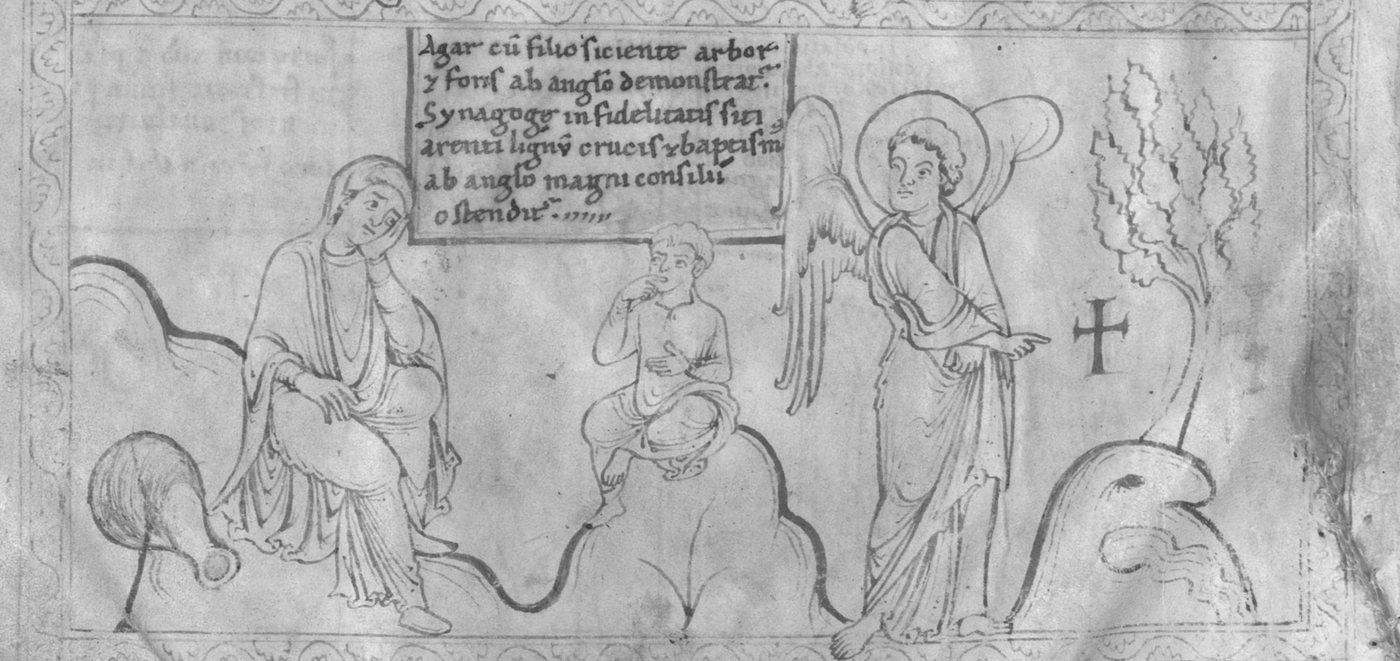
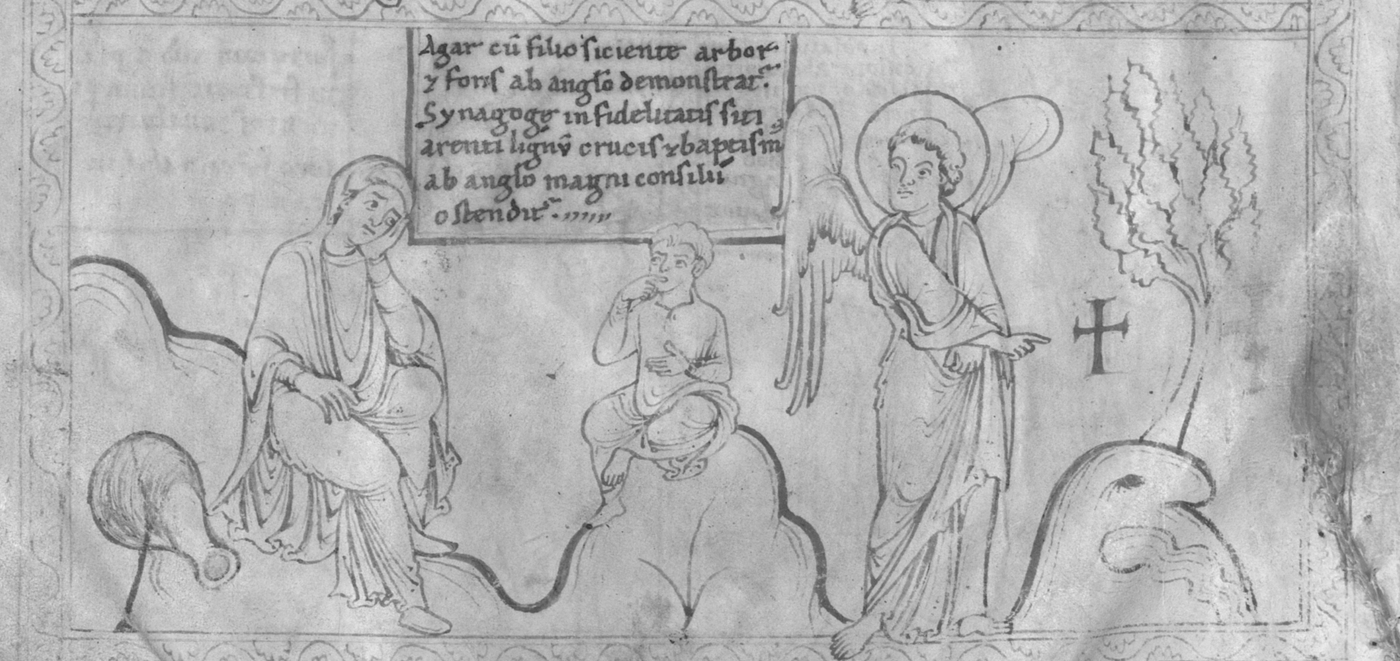
The twelfth century Latin Dialogue in Praise of the Holy Cross represents an early transformation of an allegorical reading of Genesis into a visualized historical depiction of the rejection of “Synagogue.”Footnote 62 The illustrated book, produced in a monastic setting in Regensburg-Prüfening around 1170, uses the device of a dialogue between master and disciple to present typological readings of key Old Testament passages. The text opens with a series of illustrations of Bible scenes spread across six folios. Latin captions accompany the images, frequently explaining the literal narrative and providing the typological interpretation. A small, red cross accompanies the action across the historical books of the Old Testament, leading eventually out of typological reading and into a dramatization of the passion and crucifixion of Christ as recounted in the New Testament. In the discussion of Genesis 21, the text explicitly calls Ishmael a type for synagogue, but also for Jewish error and perfidy.Footnote 63 (Figure 3)
Dialogue in Praise of the Holy Cross: “Hagar and her son are thirsty, and a tree and well are shown by the angel. Synagogue suffers the thirst of infidelity, and the wood of the cross and baptism are shown by an angel of great wisdom.” Munich, Bayerische Staatsbibliothek, MS CLM 14159 fol. 1v.
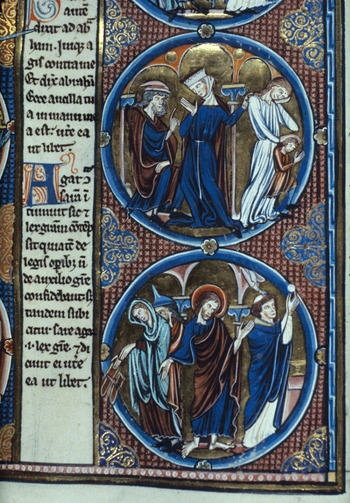
The thirteenth-century Bible moralisée made the connection between Hagar, Synagoga, and Jews visually explicit in its treatment of Genesis. Moralized Bibles were lavishly illustrated volumes in either Latin or the vernacular, aimed at an elite lay audience.Footnote 64 An abbreviated version of Biblical text appears in columns, and running alongside are paired roundels, the top one illustrating the historical sense of the text and the bottom one demonstrating the moral lesson one should take away from it. The moral interpretation presented at Genesis 16 is the elevation of Ecclesia over Synagoga, in a condensed version of the biblical story that conflates Genesis 16 and 21. The upper image shows Sarah complaining to Abraham about Hagar, but here that takes place after Ishmael's birth rather than before. Abraham says to Sara, “Behold your handmaiden is in your hand, treat her as you will,” and Sarah is depicted as sending Hagar and Ishmael away. The lower image shows Jesus in place of Abraham, casting out “Synagogue” and the Jews with her (represented by a man wearing a Jew's hat behind “Synagogue” and her tablets) while Sarah is now represented by a priest raising up the Eucharist. (Figure 4)
Moralized Bible, Gen. 16, University of Oxford, Bodleian Library MS Bodl. 270, fol. 13v. 13th c.

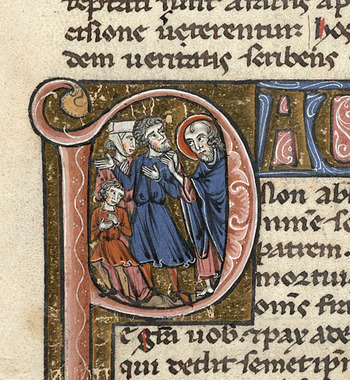
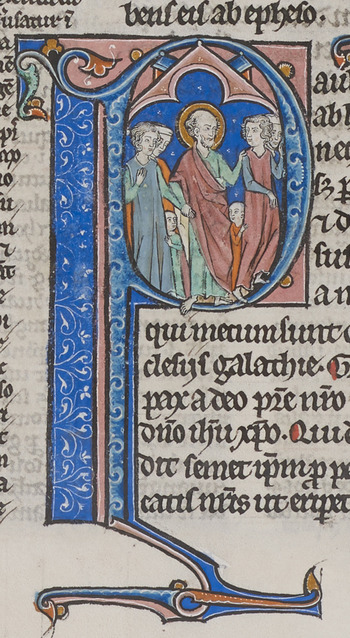
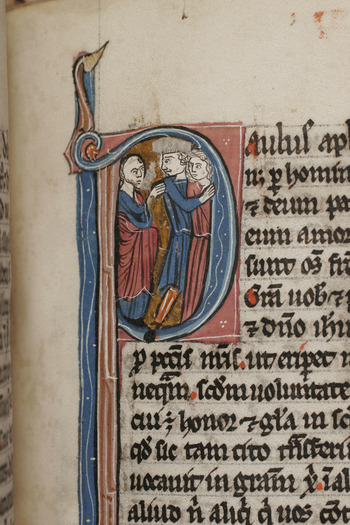
We see increasing interest in such depictions of Hagar's expulsion as the triumph of “Church” over “Synagogue” in the illumination of traditional Bibles as well. Over the course of the twelfth and thirteenth centuries, it became increasingly common to illuminate the Pauline Epistles with elaborate initials. Luba Eleen's detailed study of the tradition identifies three primary ways illuminators depicted Paul's Apostolic role: Paul holds a cross in front of a gentile audience or a symbolic Synagoga, Paul holds a sword against the infidel, or Paul teaches in front of a crowd of converts.Footnote 65 The single exception to this trend is in the Epistle to the Galatians, where historiated initials commonly depict the banishment of Hagar, often with Paul himself entering the scene to urge Abraham on. In these manuscripts, the banishment of Hagar—more pointedly the banishment of Hagar as Jew—stands out as a central episode in the history of the church. (Figure 5, Figure 6, Figure 7)
Epistle to the Galatians. Göttweig Stiftsbibliothek Cod. 55, fol. 266r, 13th c.

Epistle to the Galatians, Nantes, Musée Dobrée MS 8, vol. 2, fol. 492r, 13th c. Photograph © Cliché IRHT-CNRS / Musée Dobrée—Grand patrimoine de Loire-Atlantique.

Epistle to the Galatians, Dijon, Bibliothèque municipale de Dijon, MS 4, fol. 376r, 13th c. Photograph by E. Juvin.

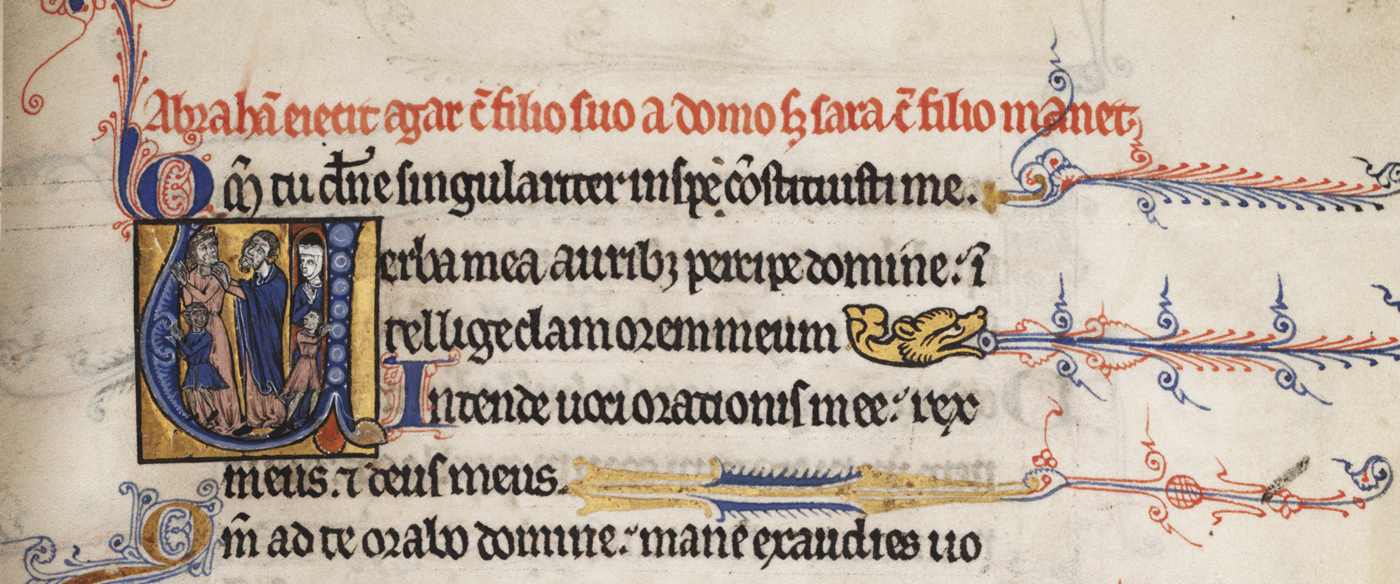
The Lewis Psalter takes the image used in Galatians and brings it to the illustration of Psalm 5.Footnote 66 Not only is the Galatians interpretation used to read the Psalm title and significance of the psalm, the image of a banished Hagar introduces the material. The Psalm title itself is not included in the manuscript, but a rubricated description of the historiated initial describes the context: “Abraham expels Hagar and her son from the house but Sarah and her son remain.” This image is the only illuminated initial in the manuscript to feature characters other than David, Jesus, God the father, or the apostles. King Herod and Pilot do appear once, but only to play their necessary roles in Jesus's passion. As with illustrations of Paul's Epistles, the depiction of Hagar's banishment stands out in its context. (Figure 8, Figure 9)
Psalm 5, Philadelphia, Free Library of Philadelphia, Rare Book Department, MS Lewis E 185, fol. 34r, 13th c.
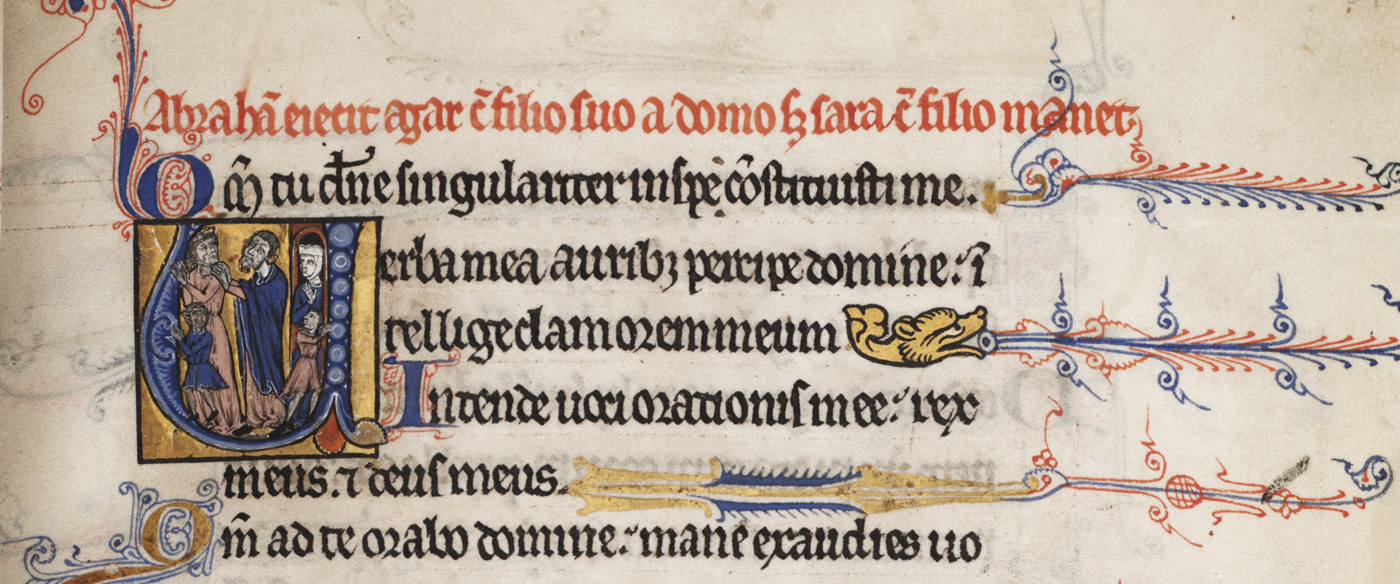
Detail from Psalm 5, Philadelphia, Free Library of Philadelphia, Rare Book Department, MS Lewis E 185, fol. 34r, 13th c.

VII. Sarah and Hagar in Sermon Literature
By the Carolingian period, a liturgical cycle of Gospel and Epistle readings had been fixed in the Latin west, and the Galatians 4 allegory came to be read on the Fourth Sunday in Lent (Laetare Sunday).Footnote 67 The need to preach on the text at a key point in the liturgical cycle every year meant that the allegory had much broader currency than it might otherwise have had.Footnote 68 Sermons reflect trends in exegesis and presume an association of Hagar with the old law, with carnality, with the antithesis of Christian faith and morality, and with Jewish people. Lenten sermons do not routinely connect the figure of Hagar with Jews, but more often than not they communicate a negative view of Hagar as unrepentant carnality, sometimes explicitly linked with Jewish carnality, and they call forcefully for her banishment, both from the individual soul and from Christian society.
The prolific twelfth-century exegete Honorius of Augstodinensis specifically identified Ishmael as the rejected Jews in a sermon for the fourth Sunday in Lent:
Abraham had two sons, one of the serving woman and one of the free woman. But the serving woman was expelled with her son, and the free one along with her son received the inheritance. By Abraham should be understood God the Father, by Hagar the Old Law, by Ishmael the people according to the flesh [i.e., the Jews], by Sarah the New Law; by Isaac the Christian people should be understood . . . And therefore Sarah, despised by Hagar, afflicted her, and Ishmael, having pushed Isaac toward mortal danger, was ordered to be banished. So it is with the spirit, the mistress, and flesh, her handmaiden.Footnote 69
He describes the tension between flesh and spirit, and the necessity of using fasting, vigils, and such to keep carnality in check.Footnote 70
Bertrand de la Tour, a Franciscan (c. 1262–1332), wrote a complete cycle of sermons for Lent, which included an extensive treatment of Galatians 4 for Laetare Sunday.Footnote 71 He began by considering Sarah, Hagar, Isaac, and Ishmael from historical perspective, focusing particularly on the question of Abraham's marriages, the number of his wives, his relationship with Isaac and Ishmael, and so on. When discussing the historical basis of Paul's Genesis allegory, he draws from scholastic commentaries, noting “Arab and Saracen” descent from Ishmael, explaining Ishmael's participation in the covenant of circumcision at age thirteen, in consequence of which the custom of the Saracens is to circumcise at age thirteen.Footnote 72 Once Bertrand moves on from his historical discussion, he offers interpretations of Paul's allegory from a range of perspectives: Sarah and Hagar stand for the church and synagogue or new and old law respectively; “children of the slave woman” meant not only Jews, pagans, and heretics, but also bad Christians; although allegory identified Jews with Hagar, according to the letter, the Jews descended from Sarah (and ought to be called Saracens) while the Saracens descended from Hagar the Egyptian and ought properly be called Hagarenes. Or, since Christians alone have chosen the freedom of the church, Christians are the ones who ought to be called Saracens while all the rest, who live according to the flesh rather than the spirit, might be called uniformly Hagarenes.”Footnote 73 He understood the biblical figures to represent the fate of Jews and Christians as two peoples, not just two competing religious traditions, writing that Abraham's sons “figure the two Laws, or the two Testaments from which God gave rise to two peoples, namely Jewish and Catholic.”Footnote 74 Bertrand includes the common Christian association of Jews with the slave by noting that God birthed the Jewish people as figured by Ishmael, to serve out of fear of punishment and by the promise of temporal benefit. On the other hand, God birthed the Christian people as free, to serve not out of fear but love, and not for the promise of worldly goods, but heavenly ones. Again and again Bertrand makes an association between the synagogue, the Jewish people, and Hagar as a figure for both. When he glossed the passage “cast out the serving woman and her son,” he wrote, “Now Synagogue and the Jews and heretics have been cast out of the Church just as from society and true freedom. Thus it says Cast out the serving woman—that is, the Synagogue—and her son—that is, each Jew . . . the son of the slave woman shall not inherit—the Jew is the son of Synagogue—cum filio libere—that is, with the Christian son of the Church.”Footnote 75
VIII. Hagar and Jewish Communities in Europe
Through the hermeneutical changes of the twelfth through fourteenth centuries, most Christians read the Galatians allegory into their understanding of Genesis, Psalms, and a range of other places, sometimes as part of the literal sense itself. The allegory of Hagar as Synagogue was so strong that it simply became part of the Christian perception of Jews in their day. When Innocent III or Oldradus de Ponte invoked the image of Hagar as Jew, they were drawing from the early Christian association of Hagar with the old law or, later, with something one could call Synagoga in contrast to Ecclesia. But over time, Hagar came increasingly to be understood as a signifier not only for an abstract Synagoga, but for Jews as a people. With Innocent III, we see yet another expansion of the symbol, such that Hagar comes to represent actual Jews with whom one might have contact. Innocent III brought the language of biblical typology into Christian thinking about the proper place of Jews in Christian society, and Oldradus de Ponte connected that with existing canon law on Jews. If one needed to justify the expulsion of a community of Jews, one could turn to the well-worn image of Hagar's banishment. Peter Bertrand (1280–1349) copied Oldradus's question on Jewish expulsion together with another related question on Jews and Saracens in a commentary on a collection of canon law, the Apparatus sexti libri decretalium.Footnote 76 Peter does not attribute his source, but an examination of the two texts finds a verbatim borrowing. Peter was present in Avignon both before and after Oldradus disputed his question, and he may well have been present for the disputation itself. But the closeness of the texts suggests that he was working from a written text rather than from notes or memory. His decision to recapitulate the material in his commentary is interesting because of his close ties to the French king Philip V, under whose reign some conversation seems to have taken place concerning an expulsion of the Jews 1322. Although Elizabeth A. R. Brown has argued that no expulsion actually took place, at the least a discussion of expulsion did take place in the context of the suppression of a supposed plot by lepers to poison wells in southern France.Footnote 77 Further, Petrus composed his commentary sometime after 1334, after many years as a bishop, first in Nevers and then Autun. He worked extensively in an administrative capacity for a series of French kings and Avignonese popes, including John XXII and Benedict XII. In sum, he was far more involved and invested in politics and Jewish policy than Oldradus seems to have been.
Innocent and Oldradus would have recognized their identification of Hagar with Jews to be allegorical—even if they seem to engage with the relationship as if it came out of a literal-historical reading of the text.Footnote 78 Edward Synan, who published some of Innocent's letters in his 1965 work, The Popes and the Jews in the Middle Ages, found Innocent's use of the Sarah-Hagar allegory exceedingly strange, and wrote that the “application to the ordinances of the earthly city of an allegory on the mysteries of predestination is a suspiciously facile justification of medieval social and religious groupings; only an excessively hardy exegesis of St. Paul's reflections on Abraham's children can pretend to see in these insights directives for the formulation of public law.”Footnote 79 Kenneth Stow has argued that Oldradus's consilium represented a radical new turn when he linked traditions in Roman and Canon Law with Innocent's image of the Jew as Hagar.Footnote 80 Particularly troublesome, according to Stow, was the way in which Oldradus linked the Jews' legal status as servants of the king with their state of perpetual servitude, ordained and monitored by God. Innocent's application of Paul's allegory to living Jewish communities in his own day added a new element to Christian rhetoric and Christian thinking about Jews, while Oldradus's concilium demonstrates the ramifications of treating biblical typology as a kind of historical truth. But Oldradus was hardly alone; Innocent's imagery found its way into all sorts of texts and contexts in the years following its appearance, including Bible commentaries, sermons, pastoral manuals, and legal documents. The increasingly regular identification of Hagar not only with the old law as Galatians had it, or with the synagogue as a collective signifier for Jewish community generally, but with specific, living Jewish communities, undoubtedly reflects increasing tension between Christians and their Jewish neighbors over the course of the thirteenth and fourteenth centuries. The image found traction in part because it was convenient in delineating boundaries for proper Jewish-Christian relationship. But the emphasis on Jews as descendants of Hagar in the fourteenth century may also have been facilitated by changes in biblical hermeneutics during the period, including increasingly blurred lines between literal and various forms of spiritual interpretation.
In 1403 a Jewish midwife was brought to trial, accused of causing the death of her Christian patient in Marseille. The trial record begins by invoking Innocent's bull, Etsi Judeos, and the image of the Jew as “insolent servant” to warn about the dangers of Jewish-Christian coexistence and to frame the guilt of the midwife in terms of collective Jewish guilt.Footnote 81 The historicizing of allegory held importance not only as a location of the reordering of literal and mystical in late medieval exegesis, but also as source and justification for policies that would have an increasingly deleterious effect on Jewish life in Christian society.
IX. The Jewish Perspective
And what of the Jews? Did they engage polemically with Christian interpretations of the Sarah-Hagar story? Medieval Jewish interpretations of Sarah, Hagar, Isaac, and Ishmael tended to stay fairly close to the midrashic tradition. Rashi quotes extensively from Bereshit Rabbah, Pirkei de Rabbi Eliezer, and Midrash Tanchuma. Devorah Schoenfeld notes that in weaving together texts written first in a Christian environment and then in a Muslim one the way he does, Rashi draws polemical readings of Ishmael aimed at a Muslim other and applies them to a Christian other.Footnote 82 But the tensions between Isaac and Ishmael were not nearly as compelling to Jewish European exegetes as was the tension between Jacob and Esau. We see this in the narrative cycles of medieval haggadot, where the frames typically skip over any reference to Ishmael at all.Footnote 83 The Golden Haggadah is representative of this pattern. In its elaborate illustrated narrative of biblical history, it devotes only a few frames to the patriarchs. Only four frames depict scenes from Abraham's life. Right after the building of the Tower of Babel, we find the scene of King Nimrod throwing Abraham into a furnace. From there we move directly to a scene of the three angels visiting Abraham and Sarah, bringing news of Isaac's impending conception; next we see the story of Lot and his wife fleeing Sodom, and then finally a frame devoted to the binding of Isaac. There is no depiction of Ishmael at all in the Abraham narrative. After the binding of Isaac, the images move directly to a frame containing two scenes from the Jacob-Esau conflict: Jacob taking Esau's blessing, and Esau returning from the hunt with a hare for his father. Two additional frames dwell on Jacob's fate: his dream of angels climbing up and down the ladder, and his night spent wrestling with the angel, at which point he receives the name Israel. From there, the images shift to the story of Joseph and his dreams. The Sarajevo Haggadah similarly ignores the existence of Ishmael. From the tower of Babel, the cycle moves directly to Lot's wife turning to a pillar of salt, followed immediately by two frames dedicated to the binding of Isaac and the appearance of the ram as substitute offering. The next frame depicts Isaac receiving Rebecca as wife, and the following set of four frames depicts the next generation. First Rebecca gives birth to twins. There are then three images related to Jacob taking Esau's blessing and an image of Jacob's dream of angels on a ladder before the cycle moves abruptly to Joseph and his dreams. If Christians worked out tensions between themselves and Jews through imagery of Jews as banished Hagar or Ishmael, Jews worked out these tensions by pointing to the Jacob-Esau story. As Katrin Kogman Appel and others have made clear, the flourishing of Jewish narrative art was tied in with the broader diffusion of manuscript art in Christian urban centers. The haggadot produced in Northern Spain in the late thirteenth and fourteenth centuries were sometimes done in Christian workshops and sometimes in Jewish ones. But there is no doubt that the illumination cycles from Genesis and Exodus that accompany many Spanish haggadot during this period are linked with contemporary Christian iconography. Therefore, as both Kogman Appel and Marc Michael EpsteinFootnote 84 have reminded us, the choices that Jewish manuscript producers or patrons make reflect an intentional engagement with existing traditions. It makes perfect sense that Jews living in a Christian environment would highlight the sibling narrative featuring Jacob and Esau rather than the narrative of Isaac and Ishmael. Israel Yuval and others have written extensively about Jewish and Christian interpretation of Jacob and Esau as figures for Christian-Jewish polemical engagement. But the legal distinction in the Isaac and Ishmael story between slave and free and the tension between two mothers as well as two sons, lent it a particular usefulness for Christian supersessionist claims, a usefulness not matched in Jewish engagement with Christians.
X. Conclusion: Historicizing Allegory?
What does it mean to historicize allegorical interpretation? Even if medieval Christians knew that the identification of Hagar with Jews was an allegorical one as stated explicitly in Galatians, they nonetheless came to use the interpretation as if it represented historical reality. The blurring of boundaries between literal and spiritual interpretation in the late thirteenth and fourteenth centuries does not mean that scholars stopped distinguishing between the historical sense and its signification. Hugh of St. Cher, for example, presented a straightforward historical interpretation of Sarah and Hagar before turning to what he called the mystical significance. But the rapid movement back and forth between strict historical letter and highly theological interpretations of the letter made the distinctions less stable and consistent than they had been before. As Denys the Carthusian wrote in the fifteenth century, “Every passage of holy scripture has a literal meaning, which is not always what is signified by the literal words, but is often what is designated through the thing that is signified by the literal words.”Footnote 85 From the middle of the thirteenth century, Christians increasingly came to think and act as if Hagar was truly, historically the ancestor of the Jews, and to think of them accordingly. This article does not claim a direct cause and effect between Christian engagement with the figure of Hagar as representation of the Jew and developing Christian policies of expulsion or banishment. But it does seem as if the proliferation of such imagery from the thirteenth century on provided a new framework for thinking about Jewish policies that moved beyond Augustine's insistence on toleration. Precisely because expulsion policies were so theologically problematic, the readily available association of living Jews with the haughty, disrespectful, ungrateful servant sent away by Abraham (a figure for God, after all), provided a much-needed justification for increasingly harsh treatments of Jews in Christian society.