Introduction
Impaired social functioning is among the core features of schizophrenia and numerous studies of patients with schizophrenia have reported specific abnormalities in various aspects of social cognition, including theory of mind, empathy, emotion perception, emotion processing and experience of agency (Bellack et al. Reference Bellack, Morrison, Wixted and Mueser1990; Pinkham et al. Reference Pinkham, Penn, Perkins and Lieberman2003). Because patients with schizophrenia often display poor social skills and frequently misinterpret social cues, their impaired social cognition can in some cases result in social isolation, making this one of the most disabling clinical features of the disease (APA, 1994).
An essential aspect of social perception, which has been found to be related to better social function in schizophrenia, is the ability to adequately process facial appearances (Hooker & Park, Reference Hooker and Park2002; Pollice et al. Reference Pollice, Roncone, Falloon, Mazza, De Risio, Necozione, Morosini and Casacchia2002). In many situations, individuals use the information conveyed by facial appearances to decide whether another person should be approached or avoided, trusted or distrusted. Such trustworthiness evaluations form an important aspect of real-life social cognition because they involve making decisions which directly influence social behaviour. Together with problems in affect recognition, problems with evaluating trustworthiness could be an important factor which leads to problems in social behaviour and possibly victimization of schizophrenia patients. Unfortunately, however, at this time no empirical study has examined the relationship between victimization and impairments in trustworthiness evaluation or affect recognition.
Over the last decade, there has been considerable interest in the issue of how social cognition based on facial appearances is implemented in the brain, and recent progress in the research fields of neuropsychology and functional cognitive imaging indicates that a restricted network of brain areas is consistently involved in the processing of facial social information (Adolphs et al. Reference Adolphs, Tranel and Damasio1998; McCabe et al. Reference McCabe, Houser, Ryan, Smith and Trouard2001; Winston et al. Reference Winston, Strange, O'Doherty and Dolan2002). This network consists of several key brain areas. The amygdala is active during vigilance and attention to emotionally relevant information (Brothers et al. Reference Brothers, Ring and Kling1990; Adolphs et al. Reference Adolphs, Tranel and Damasio1998; Phelps, Reference Phelps2006). The orbitofrontal cortex is implicated in the anticipation of future outcomes of social behaviour and stimuli (O'Doherty et al. Reference O'Doherty, Winston, Critchley, Perrett, Burt and Dolan2003; Kringelbach & Rolls, Reference Kringelbach and Rolls2004; Amodio & Frith, Reference Amodio and Frith2006). The superior temporal cortex acts as an association area that monitors and interprets the behaviour of others (Brothers, Reference Brothers1990; Pelphrey & Morris, Reference Pelphrey and Morris2006). The insula is involved in the perception and representation of aversive affective states (Sprengelmeyer et al. Reference Sprengelmeyer, Young, Calder, Karnat, Lange, Hömberg, Perrett and Rowland1996; Sanfey et al. Reference Sanfey, Rilling, Aronson, Nystrom and Cohen2003). The fusiform gyrus, which is part of the occipital lobe, is active during face perception (Kanwisher et al. Reference Kanwisher, McDermott and Chun1997) and the anterior cingulate cortex (ACC) monitors the performance of brain systems that evaluate the behavioural relevance of stimuli (Druzgal & D'Eposito, Reference Druzgal and D'Eposito2001). In the light of the impairments in social information processing that are found in schizophrenia it seems likely that patients with schizophrenia show abnormalities in the network outlined above. Indeed, there is a growing number of neuroimaging studies which report dysfunction in several of the brain areas described above in patients with schizophrenia, most notably the amygdala and prefrontal areas (Habel et al. Reference Habel, Klein, Shah, Toni, Zilles, Falkai and Schneider2004; Lee et al. Reference Lee, Farrow, Spence and Woodruff2004; Brunet-Gouet & Decety, Reference Brunet-Gouet and Decety2006). Interestingly, decreased amygdala reactivity has also been demonstrated in siblings of patients with schizophrenia (Habel et al. Reference Habel, Klein, Shah, Toni, Zilles, Falkai and Schneider2004). However, what causes these dysfunctions remains an important question.
Although the precise aetiology of schizophrenia is not completely understood, compelling evidence from family, twin and adoption studies suggests that hereditary factors play an important role in its pathogenesis (McGuffin et al. Reference McGuffin, Owen and Farmer1995). It has been proposed that in combination with environmental factors, a high genetic risk of schizophrenia may variably manifest itself in a schizophrenia ‘spectrum’ phenotype that can range from mild schizotypal traits to severe schizophrenia (Johns & van Os, Reference Johns and van Os2001). If such a schizophrenia spectrum phenotype exists, this would suggest that cardinal social deficits of schizophrenia can also be observed in biological first-degree relatives of schizophrenia patients, since they share approximately 50% of their genes. Indeed, previous research demonstrates that relatives display measurable deficits in theory of mind, visual scan paths of emotional faces, perception of non-verbal social cues, as well as in their ability to verbalize emotions (Toomey et al. Reference Toomey, Seidman, Lyons, Faraone and Tsuang1999; Loughland et al. Reference Loughland, Williams and Harris2004; Marjoram et al. Reference Marjoram, Job, Whalley, Gountouna, McIntosh, Simonotto, Cunningham-Owens, Johnstone and Lawrie2006; vant Wout et al. Reference van't Wout, Aleman, Bermond and Kahn2007).
The present study investigates complex social information processing in patients with schizophrenia as well as in siblings of patients with schizophrenia using a psychological task that requires subjects to make trustworthiness judgements about faces. This task has previously been used in a functional magnetic resonance imaging (fMRI) experiment (Winston et al. Reference Winston, Strange, O'Doherty and Dolan2002) that revealed task-related activation in the amygdala, right insula, superior temporal cortex and fusiform gyrus. Furthermore, patient groups with known damage to the amygdala were found to give abnormally positive ratings of trustworthiness (Adolphs et al. Reference Adolphs, Tranel and Damasio1998, Reference Adolphs, Sears and Piven2001). Using a task of which the neural correlates are known has the advantage that task performance can be more readily interpreted in terms of performance of the brain mechanisms that are involved. In the present study, explicit trustworthiness judgements made by patients and healthy first-degree relatives were compared with those of healthy matched controls. Because trustworthiness judgements of emotionally neutral faces involve complex social judgements and thus place relatively high demands on social information processing (Adolphs et al. Reference Adolphs, Sears and Piven2001), we conjectured that the trustworthiness judgement task would be sensitive to subtle differences in social information processing. Based on the earlier findings of focal brain dysfunction in schizophrenia described above, we hypothesized that patients with schizophrenia would give abnormal trustworthiness ratings compared with healthy controls.
In addition to patients, the present study involves siblings. Studying core features of schizophrenia such as social cognition in siblings of schizophrenia patients is a valuable strategy for several reasons. First, these high-risk individuals are not clinically psychotic and have not been treated with antipsychotic medication. In this way, the investigation of social processing in siblings enables us to study deficits related to schizophrenia without major confounding influences, and results may serve to validate the results observed in patients. Second, if social information processing deficits are observed in high-risk individuals, these deficits at least in part reflect a vulnerability to schizophrenia. The identification of such premorbid vulnerability markers is important by itself, because these markers could be used for early detection of schizophrenia. Based on the earlier findings of behavioural deficits in siblings that are comparable to those found in patients described above, we hypothesized that patients with schizophrenia would give abnormal trustworthiness ratings compared with healthy controls.
Method
Participants
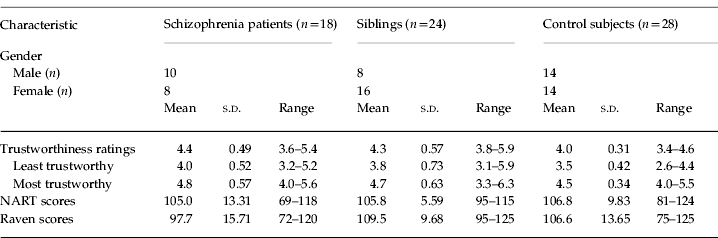
Eighteen patients with schizophrenia (10 men and 8 women; mean age 30.3 years, s.d.=9.1), 24 healthy siblings of patients with schizophrenia (8 men and 16 women; mean age 33.8 years, s.d.=9.9) and 28 healthy control subjects (14 men, 14 women; mean age 33.4 years, s.d.=8.5) participated in the study. Siblings were sisters or brothers of patients with schizophrenia, though not necessarily of patients from our patient group. The patient group participated in a separate research programme from the relative and control groups; consequently the patient group contains a smaller number of subjects. The groups were tested for significant differences in age, sex and intellectual ability. Intellectual ability was measured with a combination of the Raven Advanced Progressive Matrices test of non-verbal reasoning (Raven et al. Reference Raven, Raven and Court1993; Lezak, Reference Lezak1995) and the Dutch translation of the National Adult Reading Test, NART (Nelson & Willison, Reference Nelson and Willison1991), which provide an estimate of performance and verbal intelligence respectively. (See Table 1 for demographic variables of the groups.) We established the presence of psychopathology in patients using the Comprehensive Assessment of Symptoms and History (CASH; Andreasen et al. Reference Andreasen, Flaum and Arndt1992) which was administered by a psychiatrist. All patients fulfilled DSM-IV criteria for schizophrenia as measured with CASH, were clinically stable and received atypical antipsychotic medication. Thirteen patients were taking clozapine (mean dose 290 mg/day), two patients were taking olanzapine (mean dose 17.5 mg/day), one patient quetiapine (400 mg/day), another risperidone (1 mg/day) and one pimozide (4 mg/day). Patients with schizophrenia were drawn from the patient population of the University Medical Center Utrecht where clozapine is prescribed as a second-line treatment and not only for severely refractory patients; therefore the relatively large number of patients who received clozapine does not reflect selection from a special population. Symptoms were rated independently by two trained raters using the Positive and Negative Syndrome Scale (PANSS; Kay et al. Reference Kay, Opler and Fiszbein1987). Mean score on positive symptoms was 10.3 (s.d.=3.2, range 7–18), mean score on negative symptoms was 13.1 (s.d.=3.8, range 8–21) and mean score on general psychopathology was 22.9 (s.d.=4.2, range 17–33). Duration of illness was 9.9 (s.d.=10.3, range 1–38) and mean age of onset of psychotic symptoms was 22.5 (s.d.=5.5, range 17–39). The absence of psychopathology in healthy siblings and control subjects was confirmed with the Mini International Neuropsychiatric Interview (MINI; Sheehan et al. Reference Sheehan, Lecrubier, Sheehan, Janavs, Weiller, Keskiner, Schinka, Knapp, Sheehan and Dunbar1997). The present study was carried out in accordance with the latest version of the Declaration of Helsinki and the study design was reviewed and approved by the local ethics committee. Informed written consent was obtained from all participants after the nature of the procedures had been fully explained before testing.
Characteristics of the sample, ratings of trustworthiness of faces and intelligence test scores

NART, National Adult Reading Test.
Trustworthiness evaluation
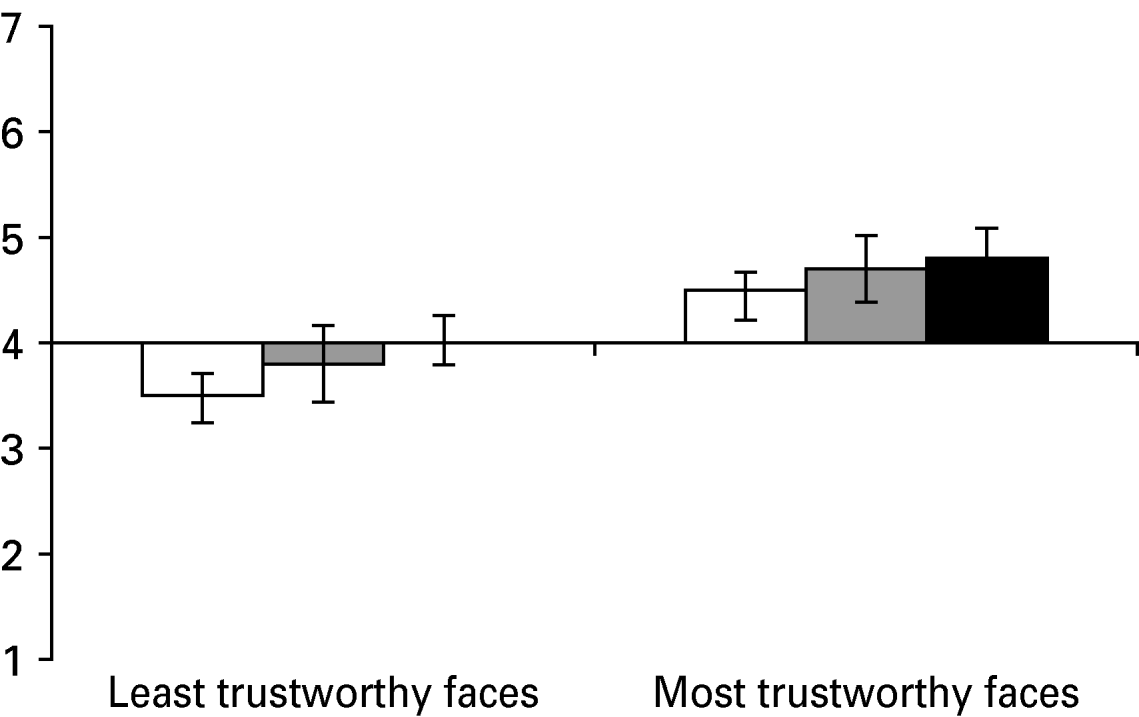
During an adapted version of a self-paced computerized task (Winston et al. Reference Winston, Strange, O'Doherty and Dolan2002), subjects viewed 120 greyscale frontal photographic images of emotionally neutral faces and made trustworthiness judgements about each individual face on a scale that ranged from 1 (highly untrustworthy) to 7 (highly trustworthy) (Fig. 1). The images were selected from a larger set of images on the basis of trustworthiness and emotional valence ratings given by 36 healthy subjects in a separate pilot study (9 men, 27 women; mean age 21.6 years, s.d.=3.3). The images used in the present study cover the full range of trustworthiness ratings. Because a strong correlation was found between perceived trustworthiness and facial expressions of anger and happiness in a previous study (Winston et al. Reference Winston, Strange, O'Doherty and Dolan2002), we selected images that were given low ‘anger’ and ‘ happiness’ ratings by subjects in our pilot study. Of the images used in the present study, 75 were from the set used by Adolphs et al. in their study of social cognition in patients with bilateral amygdala damage (Adolphs et al. Reference Adolphs, Tranel and Damasio1998). In order to obtain a sufficient number of images for our analyses, these images were supplemented with 45 comparable images from the psychological image collection of the Psychology Department of Stirling University (PICS, 2002). All 120 images were rated during the pilot study. Following the trustworthiness judgement task, patients and controls performed a self-paced non-computerized version of the Benton general face recognition task (Benton et al. Reference Benton, Hamsher, Varney and Spreen1983), which was included to control for possible abnormalities in the general ability to recognize faces among patients.
Mean ratings and standard deviation of trustworthiness of faces (1=‘highly untrustworthy’, 4=‘neutral’, 7=‘highly trustworthy’). The bars on the left represent the 60 faces which controls judged to be the least trustworthy; the bars on the right represent the 60 faces which controls judged to be the most trustworthy.

Data analysis
Following Adolphs and co-workers (Reference Adolphs, Sears and Piven2001) we divided the set of face-stimuli into a set with the 60 least trustworthy and a set with the 60 most trustworthy faces, according to the trustworthiness ratings of the healthy controls. We analysed these data with a repeated-measures analysis of variance (ANOVA), with factors of face type (least trustworthy faces, most trustworthy) and group (patients, relatives, controls), followed by appropriate post hoc tests. A separate repeated-measures ANOVA with factors of face type (least trustworthy, most trustworthy faces), group (patients, relatives, controls) and gender (male, female) was performed to test for possible effects of gender or group×gender interaction effects on trustworthiness judgements. In addition, the correlation between mean antipsychotic medication dose in chlorpromazine equivalents and trustworthiness ratings was analysed in the patient group using Pearson's correlation coefficient with the α-level set at 0.05, two-tailed.
Results
The experimental groups did not differ with regard to possible confounding factors such as sex (non-parametric χ2=2.36, p=0.31), age [F(2,67)=0.87, p=0.42], or general intellectual ability [F(2,67)=2.31, p=0.11]. (See Table 1 for characteristics of the sample.)
We found a significant main effect of face type [F(1,67)=131.47, p<0.001] and a significant main effect of group, indicating that the experimental groups made different trustworthiness ratings [F(2,67)=3.49, p=0.036; see Table 1]. Subsequent post hoc tests showed that trustworthiness ratings of patients [F(1,44)=7.89, p=0.007; see Table 1] and relatives [F(1,50)=4.31, p=0.043; see Table 1] were significantly higher than the ratings of healthy controls. We found the group×face type interaction effect to be non-significant [F(2,67)=0.72, p=0.49]. There was no significant main effect of gender [F(1,64)=0.147, p=0.703] and no gender×group interaction effect [F(2,64)=0.761, p=0.471] in our second ANOVA. There also was no significant difference between patients and controls with regard to their performance on the Benton face-recognition task [F(1,37)=0.95, p=0.34], indicating that patients were generally able to recognize faces. We found no significant correlation between mean antipsychotic dose and trustworthiness ratings (r=−0.45, p=0.107).
Discussion
The aim of this study was to investigate whether social information processing is affected in patients with schizophrenia and unaffected siblings using an experimental paradigm that requires subjects to make trustworthiness evaluations about unfamiliar faces with neutral expressions. Two main findings emerged from our study. The first finding is that patients with schizophrenia judged unfamiliar faces to be more trustworthy than healthy control subjects did. The second finding was that siblings of patients with schizophrenia displayed a similar, albeit attenuated bias in judging trustworthiness. These findings will be discussed below.
On average, patients judged faces to be more trustworthy than healthy controls did. This finding of increased trustworthiness ratings by schizophrenia patients for faces that are normally judged to be untrustworthy may seem counterintuitive at first glance. Schizophrenia is associated with paranoia, and one would expect paranoid people to judge others in general as untrustworthy. However, our finding of increased trustworthiness ratings in schizophrenia is consistent with a body of work on reduced social cognitive abilities in schizophrenia (Penn et al. Reference Penn, Corrigan, Bentall, Racenstein and Newman1997; Addington & Addington, Reference Addington and Addington1998; Addington et al. Reference Addington, McCleary and Munroe-Blum1998; Hall et al. Reference Hall, Harris, Sprengelmeyer, Sprengelmeyer, Young, Santos, Johnstone and Lawrie2004; Brunet-Gouet & Decety, Reference Brunet-Gouet and Decety2006; Couture et al. Reference Couture, Penn and Roberts2006) and is also consistent with the considerable amount of evidence of amygdala dysfunction in schizophrenia (Aleman & Kahn, Reference Aleman and Kahn2005). With regard to our sample, we would like to note that the patient group was not acutely psychotic, but stabilized on antipsychotic medication, and that mean PANSS scores for paranoid delusions were low. We do not suspect that the difference in trustworthiness ratings can be largely accounted for in terms of general face recognition deficits, as patients did not differ significantly from control subjects in this regard. Furthermore, we found the same pattern of results in unaffected siblings who participated in the study, which suggests that the findings are not likely to be attributable to the patients' medication use or other confounding variables associated with schizophrenia. Another possible explanation for the higher trustworthiness ratings in the patient and sibling groups might be that these groups, on average, use different numbers from controls to express themselves, which would result in differences in ratings on rating scales, even those not related to social cognition. Although the present study did not include a separate rating task, such as an age judgement task where no group differences would be expected to control for this possibility, an earlier study which required schizophrenia patients to rate pleasantness and unpleasantness of odours found that patients with schizophrenia rated stimulus intensity similarly to controls (Crespo-Facorro et al. Reference Crespo-Facorro, Paradiso, Andreasen, O'Leary, Watkins, Ponto and Hichwa2001). Furthermore, a study by Kohler et al. (Reference Kohler, Bilker, Hagendoorn, Gur and Gur2000) which involved both an age and an emotion recognition task found no relation between age judgements and severity of symptoms of schizophrenia patients, while errors on the emotion recognition task were related to the schizophrenia symptoms alogia, hallucinations and thought disorder. Given these findings we do not suspect that the higher trustworthiness ratings found in the present study reflect a general response bias in the patient and sibling groups. Making complex social judgements on the basis of faces requires combined activation within a network of brain areas and, given that our study is limited to a behavioural outcome measure, any conclusions regarding the functioning of specific brain areas must be tentative. However, several aspects of the patients' bias in trustworthiness evaluations warrant some speculation. For example, the positive bias in trustworthiness judgements is identical to that reported in patients with bilateral amygdala lesions, albeit with a smaller magnitude (Adolphs et al. Reference Adolphs, Tranel and Damasio1998). Furthermore, comparable abnormalities in trustworthiness judgements have been demonstrated in autistic subjects (Adolphs et al. Reference Adolphs, Sears and Piven2001), a group in which structural grey matter abnormalities of the amygdala have been reported (Abell et al. Reference Abell, Krams, Ashburner, Passingham, Friston, Frackowiak, Happe, Frith and Frith1999). The idea that the amygdala is dysfunctional in schizophrenia is supported by numerous functional imaging studies which demonstrated reduced reactivity of the amygdala in response to processing of social–emotional cues such as facial affect (Schneider et al. Reference Schneider, Weiss, Kessler, Salloum, Posse, Grodd and Muller-Gartner1998; Gur et al. Reference Gur, McGrath, Chan, Schroeder, Turner, Turetsky, Kohler, Alsop, Maldjian, Ragland and Gur2002; Hempel et al. Reference Hempel, Hempel, Schonknecht, Stippich and Schroder2003; Williams et al. Reference Williams, Das, Harris, Liddell, Brammer, Olivieri, Skerrett, Phillips, David, Peduto and Gordon2004; see Aleman & Kahn, Reference Aleman and Kahn2005 for review). In addition, previous studies report amygdala volume reductions in schizophrenia patients (Wright et al. Reference Wright, Rabe-Hesketh, Woodruff, David, Murray and Bullmore2000; Hulshoff Pol et al. Reference Hulshoff Pol, Schnack, Mandl, van Haren, Koning, Collins, Evans and Kahn2001) and populations at risk of developing schizophrenia (Keshavan et al. Reference Keshavan, Montrose, Pierri, Dick, Rosenberg, Talagala and Sweeney1997; Seidman et al. Reference Seidman, Faraone, Goldstein, Goodman, Kremen, Matsuda, Hoge, Kennedy, Makris, Caviness and Tsuang1997; van Rijn et al. Reference van Rijn, Aleman, Swaab and Kahn2005). However, even though our findings seem to reflect amygdala dysfunction, there are other neuropsychological explanations for the present findings. Besides the amygdala, other areas have been found to be involved in the explicit judgements of trustworthiness: the superior temporal cortex and the insula (Winston et al. Reference Winston, Strange, O'Doherty and Dolan2002). Because of its involvement in representing negative affective value, dysfunction of the insula may be expected to give rise to a positive bias in trustworthiness evaluations, but the evidence supporting this latter hypothesis in schizophrenia is scarce. Several structural imaging studies report insular grey matter volume reductions in schizophrenia (Wright et al. Reference Wright, Ellison, Sharma, Friston, Murray and McGuire1999; Crespo-Facorro et al. Reference Crespo-Facorro, Kim, Andreasen, O'Leary, Bockholt and Magnotta2000; Hulshoff Pol et al. Reference Hulshoff Pol, Schnack, Mandl, van Haren, Koning, Collins, Evans and Kahn2001; Kawasaki et al. Reference Kawasaki, Suzuki, Kherif, Takahashi, Zhou, Nakamura, Matsui, Sumiyoshi, Seto and Kurachi2007). But to our knowledge, only one functional imaging study reports reduced insular activation in schizophrenia patients during a task which involved working memory processing of faces (Yoo & Choi, Reference Yoo and Choi2005). Taken together, we consider these findings to suggest that the present finding of a positive bias in trustworthiness ratings in patients could be a reflection of amygdala dysfunction, possibly in combination with dysfunction in the insular cortex. However, given earlier findings in schizophrenia patients of impaired social judgements that have not been clearly linked to amygdala function, such as judgements of intelligence and distinctiveness (Hall et al. Reference Hall, Harris, Sprengelmeyer, Sprengelmeyer, Young, Santos, Johnstone and Lawrie2004), the possibility that trustworthiness judgements are part of a more general deficit in the ability to make social judgements should also be considered.
Obviously, inaccurate social judgements of constructs like trustworthiness can have far-reaching consequences for social functioning. Although no study has yet investigated the functional consequences of impaired trustworthiness evaluation in itself, there is substantial supportive evidence that demonstrates a relationship between social cognition and social functioning in schizophrenia (Ihnen et al. Reference Ihnen, Penn, Corrigan and Martin1998; Hooker & Park, Reference Hooker and Park2002; Roncone et al. Reference Roncone, Falloon, Mazza, De Risio, Pollice, Necozione, Morosini and Casacchia2002; Brune, Reference Brune2005).
Unaffected siblings of patients with schizophrenia show a similar, albeit attenuated positive bias in trustworthiness judgements, which suggests that abnormal trustworthiness evaluations, at least in part, reflect vulnerability for schizophrenia. This finding could have an interesting implication, namely that a test of complex social cognition could be used as a vulnerability marker for identifying people who are at high risk of developing schizophrenia, possibly in combination with other vulnerability markers. Clearly, findings predictive of the development of schizophrenia could be used for guiding interventions. But of course, replication would be important before application in clinical practice.
It should be noted that the present patient sample is high functioning and displays relatively low levels of psychopathology. Hence, trustworthiness evaluation might be different in more typical groups of schizophrenia patients characterized by more severe psychopathology. In addition, the present study investigated only trustworthiness evaluation of neutral faces, which display fewer social cues compared with the faces that are commonly encountered in daily life. The fact that we used neutral faces may also explain the relatively low overall sensitivity of the trustworthiness task. Another point which deserves attention is that group differences in general intellectual ability are a common potential confound in studies involving schizophrenia patients. Schizophrenia is associated with intellectual decline and one of the most robust facts of the neuropsychological literature is that schizophrenia patients tend to have lower IQs than the test standardization populations by approximately 10 points or 2/3 of standard deviation (Aylward et al. Reference Aylward, Walker and Bettes1984). Although our groups did not differ significantly with regard to general intellectual ability, this trend towards lower intellectual ability scores was also present in our schizophrenia patient group and this might confound our finding of lower trustworthiness judgements. Furthermore, it would have been interesting to investigate whether this is a specific deficit for trust evaluation or evaluative judgements in general by including age or gender evaluation of faces. Future research should elucidate these possibilities.
To conclude, our results show that patients with schizophrenia and siblings of patients with schizophrenia on average judge faces to be more trustworthy than do controls. This pattern of higher trustworthiness evaluation in patients and siblings is consistent with observations using a comparable trustworthiness judgement task in patients with amygdala lesions and in autistic subjects. Our finding of a comparable pattern in trustworthiness evaluations in siblings suggests that abnormal trustworthiness evaluation, at least in part, reflects vulnerability for schizophrenia. These findings of abnormal trustworthiness evaluation could contribute to an increased understanding of disadvantageous social behaviour or social isolation in patients with schizophrenia and possibly in individuals at high risk for developing schizophrenia.
Acknowledgements
The authors thank Professor Ralph Adolphs for his generous permission to use the set of faces used by his research group. D. Baas, A. Aleman and M. van't Wout were supported by an Innovational Research grant from the Netherlands Organisation for Scientific Research, NWO (no. 016.026.027).
Declaration of Interest
None.