Aivazovsky
During the nineteenth century the Armenian-Russian painter Hovhannes Aivazyan (1817–1900), better known as Ivan Konstantinovich Aivazovsky, was one of the most famous marine artists in Europe. In 1840 he travelled to Italy, and two years later he took an exhibition of his work around major western cities, including London, Amsterdam, Paris and Rome. That exposure brought him widespread acclaim. Pope Gregory XVI bought the picture Chaos for the Vatican and another piece, The bay of Naples by moonlight, received a verse tribute, in Italian, from no less an admirer than J.M.W. Turner, Aivazovsky's senior by some 40 years (Bolton Reference Bolton2008: 23). Emperor Nicholas I was an enthusiastic patron. When the artist visited Sebastopol during the Crimean War the Emperor declared that: ‘Whatever Aivazovsky paints, I will buy’, only to be prevented by his death in 1855 from actually doing so (Caffiero and Samarine Reference Caffiero and Samarine2000: 46). When Aivazovsky himself died in 1900 he left over 6000 works. Although many hang in galleries in Russia and elsewhere outside Ukraine, most of them, including the subject of this article, are held at the Aivazovsky Museum in Feodosiya, Ukraine, which was established by the artist in 1880 as his residence in that agreeable town. It is a measure of the prestige held by the painter at the time of his moving to Feodosiya that the imperial railways established a station for his personal use just opposite the house.
The received view
Ledyanyye gory [Ice mountains] (Fig. 1) was completed in 1870. The consensus has been, first, that it shows an Antarctic scene, because of the height of the largest berg, and second, that it refers to the Russian Antarctic expedition of 1819–1821, commanded by Captain F.F. Bellingshausen in HIMS Vostok, because that had been the only Russian Antarctic voyage to date, because the artist had been on good terms with Admiral M.P. Lazarev (1788–1851), who commanded the expedition's second ship HIMS Mirnyi while still a lieutenant, and lastly because 1870 was the fiftieth anniversary of the expedition's first season in the Antarctic. A statue of Bellingshausen was erected at Kronstadt in that year after much advance publicity (Pilipenko Reference Pilipenko1991: 178; Caffiero and Samarine Reference Caffiero and Samarine2000: 294).
Ledyanyye gory [Ice mountains in the Antarctic], Ivan Konstantinovich Aivazovsky, 1870. Source: http://www.aivazovski.ru

This appears persuasive but there is little primary evidence to support it. At least, none has ever been cited, which admittedly is not quite the same thing when it comes to reviewing Russian and Soviet literature. Apart from the painting itself, therefore, the only primary clue known to the author is its title. But even that is uncertain. Long known simply as Ice mountains (or modernised as Icebergs), a recent scholarly study now lists the work as Ice mountains in the Antarctic (Caffiero and Samarine Reference Caffiero and Samarine2000: 294). At least one commentator has declined to adopt the Antarctic interpretation (Lyall Reference Lyall1999: 172), but since Caffiero and Samarine worked with the best sources available and have since proposed, with every justification, to follow their book with a full catalogue raissonné of the artist's work, their authority for what Aivazovsky himself called the picture should be accepted, especially in view of the fact that the artist left extensive lists of his paintings which they must have examined. But although that settles the question of the hemisphere, at the cost of creating an unimportant puzzle about why previous commentators neglected to use the full title, it leaves several other matters unresolved.
Historicity
Aivazovsky's seascapes fall into two distinct groups, those which represent historical events, such as Brig ‘Mercury’ attacked by two Turkish frigates, portraying an incident in the Russo-Turkish war of 1828–1829, and those with broader thematic scope, such as The ninth wave, reflecting the Russian belief that the ninth wave is always the largest in much the same way as for the English it is the seventh. If the artist had given the painting a title of the first sort, such as Sloop ‘Mirnyi’ in the southern ice ocean, there would be little more to say. In choosing a title of the second sort, however, Aivazovsky seems to have thought that the icebergs themselves were the main subject and that no reference to any particular voyage, let alone to a specific event within such a voyage, should be understood.
Two further general points can be mentioned here. First, Aivazovsky rarely painted icescapes and had little or no direct experience of heavy ice conditions at sea. But second, he may have had access to visual records of the Bellingshausen expedition that were created by its artist, Pavel Nikolayevich Mikhailov (1786–1840), either directly, since most of Mikhailov's work was stored at the Academy of Arts, of which Aivazovsky was a member, from the 1850s onwards (Suris Reference Suris1962: 70), or indirectly, through the lithographs of Mikhailov's images in Bellingshausen's Atlas volume (Bellingshausen Reference Bellingshausen1831). However there is no reference in the literature to his having consulted either of those possible sources.
The ship – guns and masts
Most evidence for the iconography of the picture is therefore internal. Starting with the ship, her structure and rig are certainly those of a Russian sloop-of-war in the early nineteenth century, such as those of Bellingshausen's squadron. But if so which? Both ships had carronades on the spardeck and light cannon on the maindeck. The number of maindeck gunports might therefore help to identify the vessel in the picture. But unfortunately the number of gunports cannot be made out, and even if they could be, the scanty sources for the lines of the two Bellingshausen sloops are not much help. Thus one of Mikhailov's sketches shows Mirnyi with 11 maindeck gunports on her starboard side, although with 14 cannon she needed only between 7 and 9 (to allow for some being moved to serve as chasers if required) (Petrova Reference Petrova2012: 8). (There is no reference to chasers in any primary source.) Turning to Luchininov's version of Vostok's lines, based on the original plans, here too there are 11 gunports a side, this time for 16 cannon (Luchininov Reference Luchininov1973: 7). Although she was newly built, Vostok may well have carried less metal than she was designed for on her first, peaceful, voyage. But Mirnyi was converted from a transport to a warship solely for the Bellingshausen voyage, which makes it hard to understand why she was given 22 gunports for 14 guns.
The best structural clue to the ship's identity is provided by her topmasts (the second section of the mast assembly), which are markedly shorter than the sections above and below them. According to Bellingshausen the topmasts on Vostok were shortened by 3 1/2 feet during the passage from Tenerife to Rio in 1819 (Bellingshausen Reference Bellingshausen1831, I: 78–79), and according to Lazarev they were shortened still further at Port Jackson in 1820 (Lazarev Reference Lazarev1918: 57), but there is no record of Mirnyi having been similarly modified. In fact, she had enough trouble keeping up with Vostok without shortening her masts and reducing her sail area. Added to which Mikhailov's sketch, which is perhaps the best evidence that we have for Mirnyi's configuration during the expedition, shows her three topmasts with roughly equal heights to their respective mainmasts, thus probably quite unlike Vostok (Petrova Reference Petrova2012: 8). However Mikhailov is unreliable on technical matters. Elsewhere he sketched both sloops with short topmasts at Port Jackson (Petrova Reference Petrova2012: 35, 37), and both with quite long topmasts both early, in Southern aurora (Petrova Reference Petrova2012: 33), and late in the voyage, in View of Macquarie Island (Petrova Reference Petrova2012: 67).
The balance of the inadequate structural evidence suggests that the sloop may be Vostok. Or at least, that she is not Mirnyi.
The ship – flags
The vessel in the picture flies the tricolour ensign that is now the national flag of Russia. In the early nineteenth century, however, that was the civil rather than the naval ensign, which was the St Andrew's Cross. The civil ensign was flown by naval transports as well as by the merchant marine, but Bellingshausen's vessels were warships. Although Mirnyi was the converted transport ship Ladoga, and would be ‘de-converted’ back to Ladoga again after returning to Kronstadt, the protocol in such matters was strict. There is no evidence that Mirnyi was somehow ‘allowed’ to keep her old flag for sentimental reasons, still less that the whole squadron flew the civil ensign officially and formally, as they might conceivably have done to underline their peaceful scientific mission. On the contrary, Mikhailov always drew both sloops with naval ensigns.
Furthermore the ship is wearing a red-and-white tailed pennant at her mainmast truck which resembles neither the pennants in Mikhailov's paintings of the expedition, nor anything else from the Imperial Russian Navy on the Flags of the World website, http://www.crwflags.com/fotw/flags/ru~hist.html, but which does resemble the pennants worn by the Turkish frigates in Aivazovsky's Brig ‘Mercury’ painting.
The flags suggest, therefore, that the ship is neither Vostok nor Mirnyi
The ship – status
Whichever ship is depicted or suggested, there is something very odd about her situation. The scene is portrayed in daylight, possibly towards evening if we are looking west or south-west with some sort of coastline emerging from the left. The ship is in good physical condition. She is lying to her best bower anchor with all sail stowed and her boats lashed down amidships. The officer of the watch is at his normal station on the poop (in the stern), and another figure, perhaps a petty officer, appears to be supervising a work party of some sort in the bows. (One of the clearer online versions is at: http://www.tanais.info/art/pic/aivazovsky50.html.)
None of the surviving accounts, however, states that either ship was ever anchored while in the ice fields. (In the twentieth century, mariners sometimes complained that Antarctic waters were too deep to offer the relief of a short spell at anchor, even when ice and wind conditions might have allowed it (Bulkeley Reference Bulkeley2012).) Whatever is going on, there appears to be no emergency, since neither sails nor boats are being deployed. But can the commander afford to be complacent? To one experienced eye the ship appears to be in considerable danger, on a lee shore with the wind at about Force 4. ‘Look at the flag and the choppiness of the sea. The wind is onshore with a dangerous (very) backdraught. I wouldn't anchor there under any circumstances!’ (I.R. Stone, personal communication, 6 May 2012). Added to which the lee shore in question is potentially in motion and composed of dangerously unstable material.
Another striking aspect of the picture is the lack of any ice or snow on the ship, something which Aivazovsky included in other wintry or polar scenes. The day would have to have been exceptionally fine for that to have been so. Perhaps major elements of the picture, such as the sunlight on the ice and the contrast between the geometrical spars of the ship and the wilderness around her, were motivated by other goals than narrative verisimilitude. The more colourful civil ensign may also have been preferred against the pale blue and white of the St Andrew's Cross for painterly reasons, given that there are so many blues and whites elsewhere in the picture. In short, the status of the ship gives no indication of her identity, but like the title it suggests that we may be looking, not so much at a ‘real’ event, as at an allegory of the triumph of human reason over wild nature.
A failed hypothesis
For some time the author entertained the hypothesis that the painting shows a religious service, with the chaplain standing in the bows to address the crew, some of whom are bowed or kneeling, before him. If that were the case, it would then be worth considering which such event, several of which were described by Bellingshausen, this might be. However the prayer flag, which is mentioned by Bellingshausen more than once, is not flying and the group of people in the bows is much too small for a service when hardly any hands are occupied elsewhere, and which in any case would probably have been conducted in the waist rather than the bows.
Possible referents
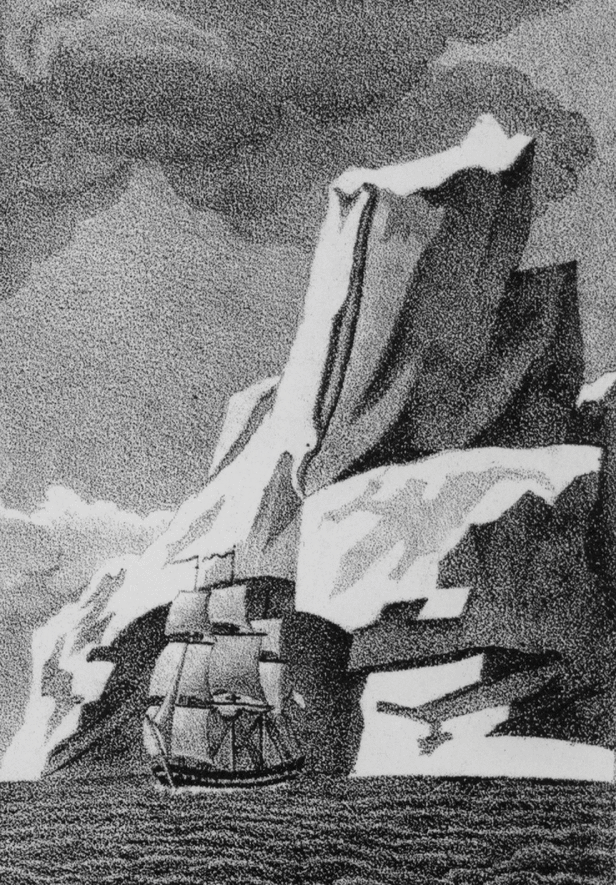
Although the title and other aspects of the picture suggest that it has little directly to do with the Bellingshausen expedition, some elements may owe something, at least, to that event. It is appropriate to mention, at this point, that Aivazovsky was famous for his powers of memory; it was on that strength that he was appointed an official naval artist in 1844. That having been so, certain textual and visual passages in primary sources may be reflected in the picture. First, the central part of the composition, a Russian sailing ship in front of a towering iceberg, may refer to a similar representation of HIMS Mirnyi by the expedition's artist, Mikhailov, that was first sketched in January 1820 (Bellingshausen Reference Bellingshausen1831, Atlas: plate 12; Fig. 2). A few simple geometric transformations, applied to the relevant detail in Mikhailov's picture, would produce a striking similarity between the two, give or take their differences in style and the fact that Mikhailov's Mirnyi was proceeding under full sail and with long topmasts, whereas Aivazovsky's ship lies at anchor with short topmasts and all sails furled. Both pictures also show an ice arch, though not in the same part of the composition.
Detail from Vid ledyanykh ostrov [View of ice islands], Pavel Nikolayevich Mikhailov (Bellingshausen Reference Bellingshausen1831 Atlas: plate 12), from an original sketch dated 8 January 1820 (O.S.).
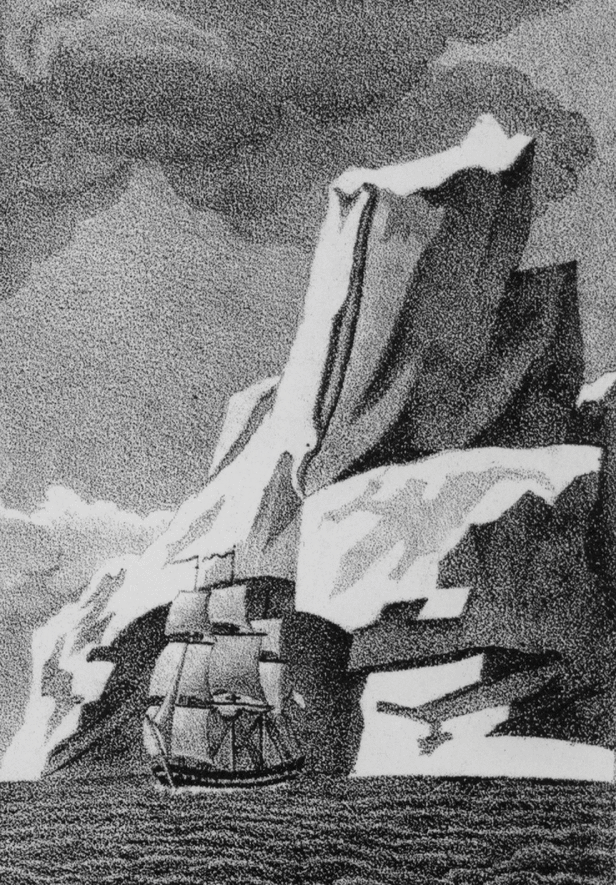
Setting aside the possible influence of Mikhailov's January image, the painting also shares some elements with Bellingshausen's description of the expedition's first encounter with a major, land-like ice formation a month later, at the limit of one of their probes, in February 1820. According to Bellingshausen they saw, behind massive icebergs, a ‘main’ or ‘continent’ of ice [materik l’da] which rose away from them until it passed out of sight (Bellingshausen Reference Bellingshausen1831, I: 189). That is what the land-like ice formation in the background of Aivazovsky's painting also does.
A reference to that passage in Bellingshausen's narrative is made less probable, however, by the fact that the iceberg behind the ship is not tabular, six of which Bellingshausen tells us were arrayed in front of his ice main on the day in question (Bellingshausen Reference Bellingshausen1831, I: 189). But Aivazovsky's creative process may well have been eclectic, combining his fellow-artist's visual record of a craggy and heavily-eroded berg with Bellingshausen's verbal description of massive bergs in front of an even more massive, land-like ice feature.
Conclusions
Falling as it did in the second half of the nineteenth century, Aivazovsky's ice masterpiece was a significant cultural event. It is regrettable, therefore, that it should have been overlooked in recent studies of the cultural history of the Antarctic, which rightly encompassed imagined representations of the region alongside descriptive ones (Pyne Reference Pyne2004; Fox 2005).
The available evidence suggests that although Ledyanyye gory may have been inspired by the Bellingshausen expedition Aivazovsky did not conceive it as a representation of that enterprise, still less of any particular incident within it. He may even have included such ‘inaccurate’ elements as the ensign and the anchor by way of signalling that his ‘idle’ vessel is no more than ‘a painted ship upon a painted ocean’, in the words of Coleridge. As the title underlines, it is the ‘ice, mast-high’ that is the true subject of the painting.
Acknowledgements
The author is grateful to the Aivazovsky Museum at Feodosiya, Ukraine, for sending him photographs of the painting, to Ian and Olga Stone for their fruitless but valiant efforts in the same quarter, and to ‘Aivazovsky Ivan Konstantinovich: the artist's website’ (http://www.aivazovski.ru), which generously permits free use of its images for academic purposes.