Radiological terror events (RTEs) present a threat that requires national, state, and local preparedness.1 Although little research has been conducted on the public’s response to RTEs, studies have demonstrated that nuclear technology and radiation are perceived as extremely risky,Reference Becker2, Reference Slovic3 eliciting feelings of fear, distress, helplessness, and confusion.Reference Nutbeam4, Reference Rosa and Freudenberg5 While some post hoc analyses of terrorist emergencies (eg, September 11, Boston bombings) suggest that most individuals generally follow government instructions, studies also indicate that significant barriers may exist in high-outrage situations, such as the explosion of a “dirty bomb,”Reference Blendon, Benson and DesRoches6, Reference Blendon, Benson and DesRoches7 including distrust and lack of confidence in government or public health authorities, fear of subsequent attacks, and beliefs that needed supplies or help will not be available.Reference Meredith, Eisenman and Rhodes8-Reference Wray, Rivers and Whitworth10 One study indicated that only 60% of participants reported that they would comply with instructions given by emergency preparedness planners in the event of an RTE.Reference Lasker11
Barriers may be exacerbated in vulnerable urban African American populations with less trust of authority or government services. Events related to Hurricane Katrina presented a situation in which minority populations’ distrust of the government motivated some behaviors counter to safety, such as not responding to the evacuation call.Reference Blendon, Benson and DesRoches7 In the case of a dirty bomb, several studies have noted a distrust of the government, particularly among minority populations and those with low education levels, owing to the fear of discrimination or unequal treatment during such emergencies.Reference Wray, Becker and Henderson9, Reference Wray, Rivers and Whitworth10, 12 Most of these studies, however, did not focus on the unique challenges of urban African Americans, who may be not only less trusting of information but also not able to easily access response information.Reference Wray, Rivers and Whitworth10, Reference Vanderford, Nastoff and Telfer13, Reference James, Hawkins and Rowel14 This study aimed to understand these unique challenges by conducting a series of focus groups with low-income, urban African American residents to explore their knowledge of what a dirty bomb is, their intended behaviors should one occur, and their barriers to complying with “shelter in place” recommendations.
The radioactive materials used to make dirty bombs are easily accessible owing to their widespread use in nuclear, industrial, and medical facilities and the lax regulatory programs that oversee these materials.Reference Conklin and Liotta15 The US Department of State has acknowledged that it “appears feasible” for terrorists to acquire the components of a dirty bomb, because radiological materials are available in almost every country, with many housed in facilities considered to be vulnerable to attack.16 In the United States, the Nuclear Regulatory Commission has noted that violations of security procedures surrounding radiological material are common (personal communication in the form of briefing slides provided by the Nuclear Regulatory Commission, July 31, 2010). Over 100 incidents of theft and other unauthorized activities involving nuclear and radioactive materials are reported to the International Atomic Energy Agency (IAEA) every year.17
While the IAEA maintains that more action is needed to prevent militant groups from acquiring nuclear material,17 history has shown that terror groups have successfully constructed small dirty bombs.18 For example, since September 11, a number of individuals associated with al-Qaida have been arrested and prosecuted for planning to or actually acquiring the materials needed to create a dirty bomb.19 In addition to the widespread availability of radiological materials, dirty bombs are compact and are easily detonated by one individual.20 As such, the threat posed by RTEs is clear.
Public trust and confidence can help mitigate and improve the ability to manage a terror threat.Reference Eisenman, Wold and Setodji21 Risk communication is essential to containing the public’s fear and fatalism and for ensuring public cooperation during crisis events.22 However, risk communication is especially challenging when applying the messages to high-risk, high-outrage situationsReference Sandman23 such as RTEs, given their capacity to produce widespread fear, which reduces complexity of information processing and inhibits memory abilities.Reference Nutbeam4 These limitations are further accentuated in urban populations. Many living in these areas are already distrustful of government and official information sources such as the police.Reference Sharp and Johnson24, Reference Marschall and Shah25 If communication during an RTE uses complicated terminology or assumes the public has more information and understanding than they do, trust is further diminished among individuals most at risk for negative outcomes.
The only published research into public perceptions of RTEs and risk communication messages was funded by the Centers for Disease Control and Prevention (CDC) and was carried out between 2002 and 2004. Dozens of qualitative focus groups with demographically and geographically diverse populations were held throughout the country for the purpose of understanding public perceptions about chemical, biological, and radiological terror scenarios.Reference Becker2 Few participants were urban African Americans, however, and the groups did not specifically examine how lack of trust of authorities may impact response. In addition, this research did not examine the needs of this community in terms of a risk communication framework, attempting to understand perceived sources of information, barriers to preparedness messages, and preferred channels of communication. Thus, the present qualitative study aimed to broaden our understanding of how urban African Americans perceive RTEs and their willingness to comply with recommended actions within a communication framework.
Methods
Participants and Setting
Three focus groups for this study took place over a 3-month period and were conducted with mostly African Americans living in low-income areas of Philadelphia. The focus groups were structured to elicit risk perceptions related to an RTE. Two groups were of mixed genders and ages (primarily middle-aged participants, 25 women and 2 men) and one group comprised young men (10 men under 25 years of age). Participants were recruited from 2 Philadelphia community centers, both of which are located in areas with high poverty. According to US Census data, both targeted areas have approximately 50% or more individuals and families living below poverty limits and have low education levels, with over 30% of adults not having earned a high school diploma.26 The participants mirrored these characteristics. This was the formative phase of a larger 3-phase study that developed a literacy-appropriate decision aid on sheltering in place for urban residents with limited literacy.
Participants were recruited by the directors of the community centers, with additional flyers placed throughout the locations. Individuals aged 18 years and older were eligible for the focus groups and interested participants contacted the director and signed up for 1 of 15 slots for each group. Of the 45 potential participants, 37 (82.2%) attended and participated in the focus groups. Each group met for approximately 1 hour and participants received an incentive of a $20 gift card for a local store and 2 public transportation tokens. The focus groups were conducted between October 2009 and March 2010 and the study and all its materials were approved by the Institutional Review Board.
Implementation
Focus groups were moderated by the principal investigator, who has degrees in public health and communications and has considerable experience working with urban African Americans. A moderator’s guide was developed for this study and tailored for the audience by use of existing literature on perceptions of radiation and radiological terror.Reference Becker2 Questions helped to identify the range of cognitive and affective issues that may be important in understanding the perceptions of dirty bombs in urban African Americans. The issues were separated into 4 topic areas: (1) perceptions of emergency situations, (2) knowledge of a dirty bomb, (3) reaction to dirty bomb scenarios, and (4) comprehension of information provided.
To begin the focus groups, the participants were asked to name and rank types of disasters they thought were most likely to affect them. This was a guided discussion, with the moderator asking the participants to list the types of emergencies that “could happen to you or someone in the city.” This icebreaker helped to frame the discussion of dirty bombs by having participants think about an RTE explosion in the context of other more common emergencies such as fires, hurricanes, and floods. After asking for their general knowledge about what a dirty bomb is and how it is similar or not similar to an atomic bomb, a brief tutorial was given and participants had the opportunity to ask questions. The tutorial was based on the CDC’s Frequently Asked Questions about dirty bombs,27 with the content modified to be culturally sensitive and written at a sixth-grade reading level.
The rest of the focus group questions were asked in the context of a dirty bomb exploding in an area adjacent to the Liberty Bell, which is located in downtown Philadelphia, approximately the same distance to the 2 study sites. The scenario presented asked participants to imagine they wake up and turn on the radio to hear that Homeland Security has raised the terror threat level and that a threat from a terrorist group has been received. An hour later another report indicates that a terrorist attack has occurred in Philadelphia and that a dirty bomb has exploded next to the Liberty Bell. The news reports indicate that the bomb squad is at the scene and does not know the level of radioactive contamination or how far it has spread. The reporter is urging people to protect themselves, including staying inside. On the basis of this scenario, the participants were then asked to discuss how they would feel about the event, what kind of information they would want, who they would most trust to communicate information, what their first reaction would be, and whether they felt their community’s needs would be addressed by local, state, and national authorities.
Evaluation
Digital audiotapes of focus groups were copied and transcribed by study staff. We utilized the Krueger method of analyzing narrative data: familiarization, identifying a thematic framework, indexing, charting, mapping, and interpretation.Reference Krueger28 Thematic categories were developed and quotes were indexed and charted according to those categories to reduce data.Reference Rabiee29 Data were coded by at least 2 coders and intercoder reliability rates were randomly assessed. Interpretation of the supporting quotes was conducted, accessing context, internal consistency, frequency of comments, specificity of comments, intensity of comments, and “big ideas.”Reference Krueger and Casey30 These analyses were checked by the principal investigator, co-investigators, and research assistants for reliability and content validity.
Results
Participant Description
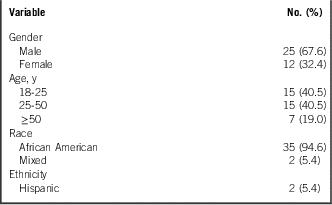
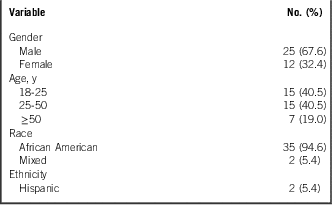
Of the 37 participants, 67.6% were male and over 80% were between the ages of 18 and 50 years. The age range was 18 to 67 years. Most participants self-identified as African American (94.6%), and 5.4% said they considered themselves to be Hispanic (Table 1).
Demographic Description of the Focus Group Participants
Focus Group Themes
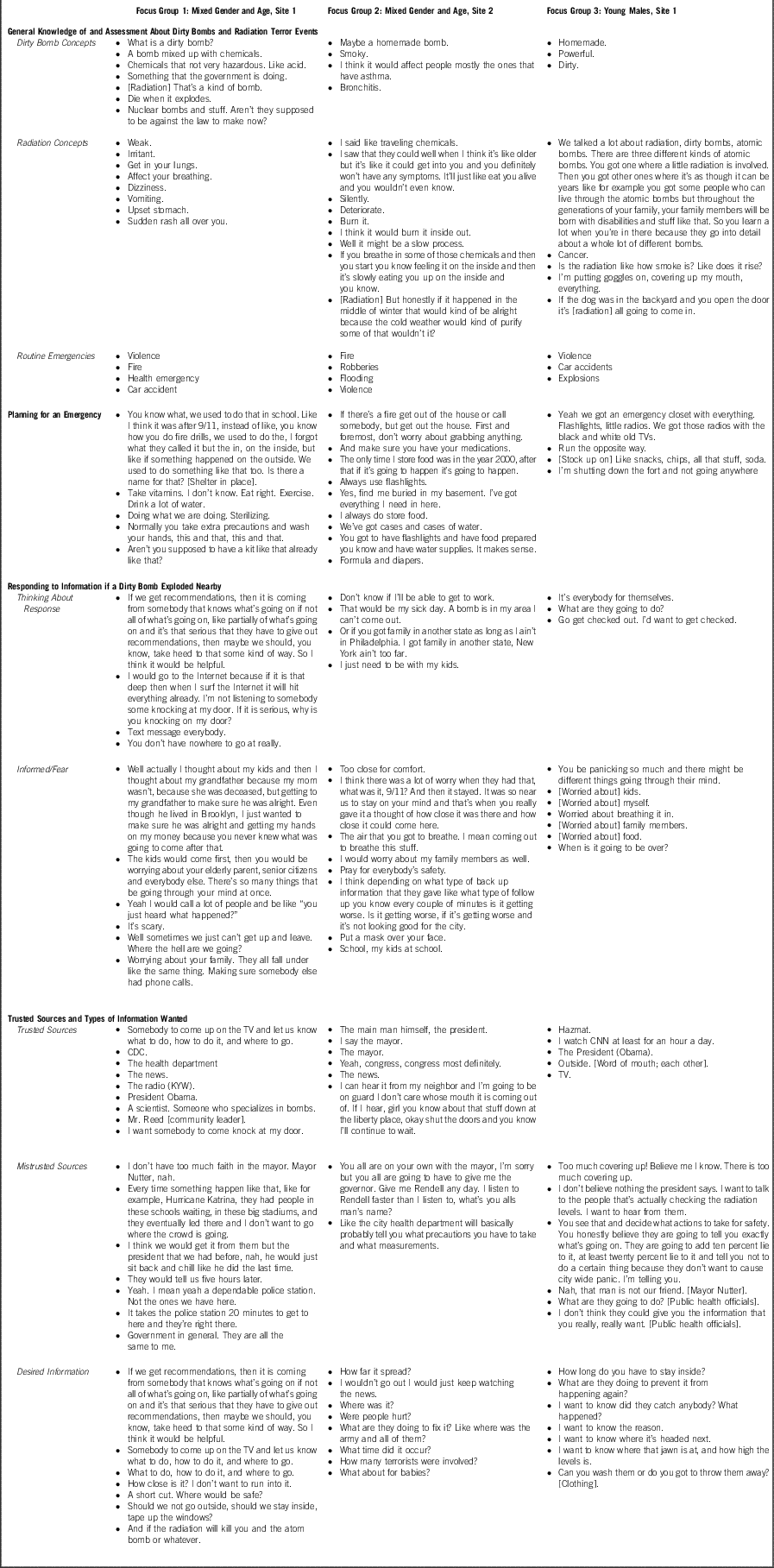
Four significant themes emerged during the analysis: (1) general knowledge of and assessment of dirty bombs, (2) planning for emergencies and how planning might impact or mitigate a dirty bomb, (3) response to information sources during a dirty bomb and preferred information providers, and (4) trust of information sources, beliefs about how government would respond, and types of information wanted if a dirty bomb occurred (Table 2).
Focus Group Quotations by Theme

General Knowledge and Assessment of Dirty Bombs and Radiological Terror Events
Participants from all 3 focus groups had little or no prior knowledge about dirty bombs or radiation. With the exception of a few middle-aged participants and one young male who previously served in the military, few had ever heard of a dirty bomb prior to the focus group. Many indicated that they thought a dirty bomb was mixed with chemicals that were not hazardous or caused a lot of smoke. Some participants said it was “powerful,” but others said it was a “homemade bomb” and one thought it “was something that the government is doing.” Common concerns about radiation were that it causes sickness, is associated with illnesses like cancer, can be absorbed by the body slowly, and is invisible, making it hard to detect. There were a number of misconceptions about radiation. As examples, one participant thought that if the bomb exploded in the winter it would not be as dangerous “because the cold weather would kind of purify” the radiation; another thought radiation was like smoke and it would rise.
Overall, participants did not feel that dirty bomb explosions were likely to happen in the Philadelphia area. Common emergency threats that did concern participants included fires, violence, car crashes, and medical emergencies. When asked to rank dirty bombs in the list of emergencies given at the beginning of each group, all groups put it at the bottom of the list, feeling that it was not as likely to occur as the other emergencies.
Planning for an Emergency
Emergency planning was not articulated as a priority for the majority of participants in the focus groups, though many cited having extra water and food. Although they suggested that it was a good idea to have an emergency escape plan and extra medicine, the general consensus was that nobody had actually carried out these preparations. Participants in all of the groups made references to being quickly reactive instead of proactive with emergencies; recent last-minute trips to the grocery stores for the impending snow storms in the area were frequently highlighted. In general, many knew that they should have emergency materials, and some knew about the concept of shelter in place, but most participants could not specifically describe the strategy.
Responding to Information if a Dirty Bomb Exploded Nearby
When the participants were asked to imagine the scenario, a few individuals across the 3 groups indicated that they would stay in place, citing: “I’m shutting down the fort and not going anywhere,” and “Yes, find me buried in my basement. I’ve got everything I need in here.”
However, most participants provided reasons for leaving their homes during such an event, and these differed greatly between the older and the younger men and women. Participants in the middle-aged groups said that even if they were told to stay inside, they would still want to search for their aging parents, their children, and their pets. Many from the young male group expressed concern about their personal safety and would want to find out accurate information, which they said they could only do by leaving their homes to talk to others. One participant said “You be panicking so much and there might be different things going through their mind,” justifying why he would want to leave his house and go talk with others about what was going on. Another said it’s “everybody for themselves.”
Trusted Sources and Types of Information Wanted
The possible responses to such an event were largely dependent on how much trust the participants had in the spokespersons responsible for communicating about the event. Most men and women in the groups expressed distrust for government agencies, police, and the mayor of Philadelphia, in particular. One participant illustrated this mistrust, saying “You all are on your own with the mayor. I’m sorry but you all are going to have to give me the governor.” Younger participants (generally those younger than 25 years of age) also articulated distrust for television news, noting that the news is “seventy-five percent untruth and twenty-five percent truth.” Participants who communicated the greatest levels of distrust were also more likely to have doubts about whether they would follow recommendations to stay inside. Confusion about when to shelter in place versus when to evacuate was often coupled with doubt about whether spokespersons would tell them “the truth” about what was happening, or whether spokespersons would tell them “what they want people to hear to just keep everyone calm.” More trusted information sources included the local hazardous materials teams on the scene, local news media (particularly the older groups), the local health department, and President Obama. Many also indicated that they would trust their community center director and their neighbors more than the information they heard on the news.
Many participants felt that their community’s needs would not be tended to because of their location. Many talked about either problems with local authorities, such as police, or examples of disparities in national response, such as during Hurricane Katrina. A young male participant summed up his distrust of government, saying, “You honestly believe they are going to tell you exactly what’s going on? They are going to add ten percent lie to it, at least 20 percent lie to it, and tell you not to do a certain thing because they don’t want to cause city wide panic.”
Desired information in a dirty bomb explosion included where it had occurred, how many were hurt, whether terrorists were involved, and what was being done to “fix it.” The young males were most concerned with the reason for the explosion and whether something was being done to prevent it from happening again. Older participants were most interested in what actions to take, where it was safe, and what they should do to stay safe.
Discussion
The 3 focus groups conducted in this study were designed to elicit perceptions of risk related to an RTE and willingness to comply with recommended actions and to understand these responses in the context of a communication framework. This framework can be applied by understanding perceptions of the messages regarding a dirty bomb, how lack of trust may affect source of information, and how different communication channels may affect acceptance of preparedness messages.
Although preparedness for an RTE on federal, state, and local levels is of high priority, this urban population knows little about dirty bombs and does not harbor concerns that an RTE is likely to occur in Philadelphia. Although a few participants perceived a dirty bomb explosion to be quite serious, most did not express fear when confronted with the scenario of a dirty bomb explosion, thinking about its effect on others or that it was not that serious or hazardous. Some participants had trouble conceptualizing a dirty bomb and used their own understanding of nonradiological terror events as a way of making sense of the information. To these individuals, the threat of a dirty bomb was somewhat amorphous, grouped in with other events that they conceptualized as similar. Even after the tutorial, some misunderstanding persisted about the risk posed and how a dirty bomb compares to other nuclear devices. Overall, there was more concern about emergency threats that are likely to afflict residents in low-income, urban neighborhoods such as fire, violence, car crashes, and medical emergencies, which are genuine concerns for this population. As such, any emergency preparations by these participants, if they exist at all, are modest and limited to potentially having extra water and food accessible.
The reactions of these participants are notable because they contrast to those described by Becker, who reported participants’ reactions as “fearful, worried, scared, and upset.”Reference Becker2, Reference Becker31 Our participants expressed a far lower level of concern regarding an RTE. While this may be because of the difference in the populations (eg, the majority of Becker’s groups were middle class and well educated, including the African Americans) or because at the time of Becker’s research September 11 was more recent and people were in general more fearful about potential terror attacks, the difference is significant to how risk communication may be accepted and received. Although fear represents a challenge in risk communication situations because this response often leads to less considered and less rational behavior, the implications of nonchalance are equally challenging. This type of response requires a communication strategy that straddles a fine line between raising the level of interest and concern without leading to potentially irrational behavior. At the opposite side of the “fear continuum,”Reference Sandman32 public apathy can produce similar challenges to risk communication.
This is especially true in populations that mistrust their local authorities. As seen with this group, very little trust in local police or the mayor existed, with participants indicating that they did not feel their needs were addressed in everyday concerns (eg, police coming quickly when called), which would be further exacerbated in an emergency situation. Many participants were more concerned with getting the “whole truth” and feeling that they would want to talk to their family or neighbors as a way to ensure this. This reliance on word of mouth also poses a challenge to developing effective risk communication, which may mean using nontraditional spokespeople as channels of information.
This strategy, however, is far more intensive, requiring identification of those people and training them in what and how information is provided. These sources of information also have to be credible and trusted, which could be difficult. Prior research has pointed to government distrust by minority populationsReference Blendon, Benson and DesRoches7 and these groups confirm that only communication by the president would be generally trusted in the event of an emergency situation (ie, “the main man himself, the president”), whereas a few mentions of Congress, the governor, or a representative from the health department are noted. Younger men in particular felt that the government and public health officials would cover up important information. To some extent, this distrust was initiated by prior emergency events witnessed by the participants, such as people in New Orleans being herded into schools and the stadium during Hurricane Katrina.
An even greater sense of distrust was associated with local authorities, such as the mayor, the police, and health officials. The participants believed that they would not receive full information from these sources, that transmission of information would be delayed, and that help and support would not be quickly forthcoming. The mayor was considered ineffective and “not our friend,” whereas the police were considered unresponsive to neighborhood needs: “it takes the police station 20 minutes to get here, and they’re right here.” Consistent with Becker’s findings,Reference Becker2, Reference Becker31 the news media represent a credible information source for a majority of the participants, including both television and radio news. Participants mentioned specific local news anchors or radio stations as trustworthy but felt that national news was not. Clearly, the most trusted sources of information were those that were local and community-based, including friends, neighbors, and community leaders or advocates (such as the leaders of the community centers). The local community leaders were the people who appeared to garner the most trust and are in the best position to offer an influential voice in the event of an RTE.
Having a trusted person provide response recommendations will also be important because reinforcing messages that urge individuals to take specific actions in the event of a dirty bomb is also challenging, given participant responses when asked about the type of information they would require. A handful of the older participants indicated that they would want to know what to do and where to go to stay safe. However, the majority of participants, particularly men younger than 25, said that they would want to know more about the situation, including, “I want to know where it’s headed next” and “I want to know did they catch anybody,” rather than seeking out the appropriate actions they should take in the emergency situation. These participants did not necessarily feel that they needed guidance to react appropriately to a dirty bomb.
A positive note is that the participants did appear to understand the notion of sheltering in place. However, reactions to the recommendation to shelter in place varied by demographic profile. Overall, women and older men indicated that they would be worried about their families and noted their desire to leave to check on and protect their parents or children. Younger men felt the need to reach out to those around them in order to corroborate the information they were given and to determine an appropriate response to the emergency situation. This need to interact with others, which is not unusual in a close urban setting, makes shelter in place a particularly difficult and challenging directive for this population.
Limitations
This research was conducted among African Americans who live in poor urban areas in Philadelphia. As a result, the insights discussed here represent a small group of men and women and cannot be generalized to a broader population. There is also a wide age disparity, which may impact our findings. In addition, all of the individuals who participated in the focus groups had a connection to the community center or community groups accessed, and as a result may differ from other residents in the same socioeconomic groups or living in the same geographic areas. Although the findings here are important to report and are the first to explore how perceptions of radiological terror may differ in this population, they cannot be construed as representative of any other populations or any other minority populations.
Conclusion
In the event of a radiological terror emergency, protecting the most vulnerable groups in the population will be critically important. Urban African Americans, who have limited trust in local authorities, require special attention to ensure their safety. A risk communication intervention, designed through empirical research to meet the information needs and capabilities of this urban population, can drive and support desirable behaviors in the face of this potentially dangerous situation. A number of challenges exist, however, when considering the design of an effective risk communication program. These include the recognition of an RTE as a true hazard, one as serious as other daily emergency situations these individuals face; the need to establish a local leader or advocate as a spokesperson; and inculcating the importance of sheltering in place, regardless of competing family-centric desires and the need for more locally based information. These focus groups provide new and important insights into the challenges of protecting this segment of the population and offer guidance as to how to address the challenges that are likely to be encountered in the event of an RTE.