Introduction
Colonial policy is only one aspect of national policy; each generation evolves its own social philosophy with no direct reference to colonial affairs, and inevitably colonial policy is framed in terms of broad general conceptions which dominate the national outlook, and reflects the emergence of new general ideas.Footnote 1
J. S. Furnivall's account of the impact of British colonialism on Burma has become the cornerstone of subsequent work on the subject. Yet given his importance in the field, there has been surprisingly little critical evaluation of his work.Footnote 2 This is all the more surprising when nearly fifty years have passed since the publication of his masterwork, Colonial Policy and Practice. Furnivall himself, in the passage above, invites a re-examination of his work by suggesting it should be historicized to determine the degree to which it rests on the social philosophies and national policies of his own generation.
Here I propose to critically examine one central argument of Colonial Policy and Practice: that British officials imposed a Liberal regime on British Burma which devastated its traditional economy and destroyed its communities.Footnote 3 Evaluating this claim requires the interrogation of Furnivall's definition of Liberalism, asking how well it describes the behaviour of British officials, and investigating whether it caused the problems he describes.
Imperialism certainly brought tremendous change to Burma, much of it destructive. However, it is a significant distortion to characterize the colonial regime as Liberal, especially in its early years. Liberalism, as a coherent social philosophy, is most relevant only to a later period of colonial Burma, when Furnivall himself served.Footnote 4 Yet as Furnivall himself notes, those early years when the British first took possession of Burma were critical in determining the country's later economic and social trajectory. In the early years the basic administrative pattern of the country was created, binding subsequent officials.
Instead of Liberalism, there were two dominant influences on British colonial administration in Burma prior to the twentieth century. One was local conditions, and the other was the influence of the administrative experience of other provinces of British India.
In the period following the first Anglo-Burmese war of 1824–1825, local precedent dominated and British plans were almost totally irrelevant. As backwaters of the Bengal presidency the newly acquired provinces of Arakan and Tenasserim received few resources and personnel. As a consequence they were so under-governed that in practice they reverted to traditional forms of administration.
After the annexation of Pegu in 1852 the capture of the commercial centre of Rangoon improved the administration's economic position and permitted a more robust administration. This administration, however, was staffed primarily by military officers and officials from other parts of India, and their thinking was dominated less by European ideologies than by the politics of colonial India. Debates over administrative policy elsewhere in India were therefore an important influence in this later period. Liberalism and other British political philosophies had little influence in these debates.
Indian influence declined significantly only in the 1890s. Burma separated from Bengal to become a province of India in its own right in 1886, and in 1937 became a separate crown colony. During this period the capacity of the British administration to effect change expanded steadily. At the same time, Indian models became gradually less important, as officials were increasingly assigned directly to Burma, rather than spending a formative period elsewhere in India. Furthermore, the educational and professional background of colonial administrators began to change. Military officers became less prominent, and university-educated officials more common. This led to an increasingly ideological administration in the early twentieth century, one dominated by the Liberal views that Furnivall projected back into the earliest history of the colony.
Furnivall's reading of British Liberalism into earlier periods of British Burma was guided at least in part by his own Fabian-influenced political project of advocating a more kindly, paternalistic version of British colonialism.Footnote 5 As a result, to read Furnivall's account as a straightforward description of the impact of British rule on Burma risks serious distortions. British administration was not guided by a master plan. It consisted of a series of short-term improvisations, and much of its impact resulted from the unanticipated consequences of poorly-planned policies, subsequently reinterpreted by Furnivall as a coherent narrative.
This paper will first discuss Furnivall's account of Liberalism and contrast it with the most common Indian models of administration. Then a review of the development of the British administration in Burma will show how it was dominated at first by local practice, later by Indian models, and only at the very end by European ideologies. Finally, Furnivall's use of Liberalism is discussed, which shows a misunderstanding of the structure of the pre-colonial economy not consistent with emerging scholarly work on the topic.
Furnivall's Liberalism and India
Furnivall argues that the first British officials in Burma substituted a Liberal political economy for traditional institutions, destroying communities and exposing farmers to the world economy. He notes that British officials attempted to understand Burma, but that they failed, and ultimately imposed administrative arrangements and policies derived from Liberal preconceptions they had brought with them from Britain. Furnivall identifies Liberalism with British policy in India from 1813, when the East India Company lost its trade monopoly.Footnote 6
The first question is what Furnivall meant by Liberalism, a much-debated term for which hundreds of definitions have been offered. Furnivall provides a classical definition of the term, which includes ‘doctrines of economic freedom: freedom of trade, enterprise and property, and equality before the law’. In British India these principles were tied to the interests of British manufacturers and merchants. Furnivall also notes that Liberalism linked social progress to limited government, which would permit maximum freedom to all under the law. It was thought by Liberals that these doctrines would lead to economic progress, which in turn would ‘guarantee the general welfare’. Free trade, a minimal state and the belief that these would lead to economic progress are thus the core Liberal beliefs for Furnivall. Yet he implicitly adds another dimension to the definition, opposing Liberalism to the conservation of tradition: ‘regard for native custom still survived’, he writes, ‘but in practice, from the earliest days of British rule in Burma, Liberal doctrines prevailed’.Footnote 7 This sets up an implied dichotomy between Liberalism and change on the one hand, and timeless tradition on the other. This dichotomy becomes important to Furnivall's argument because it permits him to infer that all change in Burmese economy and society was due to the pernicious influence of Liberalism.
Furnivall consistently uses ‘Liberalism’ with a capital L, rhetorically giving it a weighty, concrete quality. However, in 1825 when the first Anglo-Burmese war occurred, there was nothing resembling a ‘Liberal’ administration, even in England itself. Liberalism as a political force (rather than a political philosophy) developed in England only after the passage of the Corn Laws in 1815, and arguably did not become a dominant force there until the 1840s.
Liberal reform in India actually preceded that in England. This means that British officials could hardly have been reflexively applying administrative models and policies they had learned in England.Footnote 8 Furthermore, the application of Liberalism as a coherent political philosophy to India was never straightforward. Indian policy was a battleground in which differing conceptions of Liberal philosophy developed, and tested their claims to universal reach, and where opposing political projects sought justification in contending political philosophies.Footnote 9 Utilitarians for example saw India as a vast opportunity to demonstrate how an active government could transform a backward people. In this they were opposed to the less organized free-trade Liberals, who opposed the East India Company's monopoly on trade, and advocated minimal government interference.Footnote 10
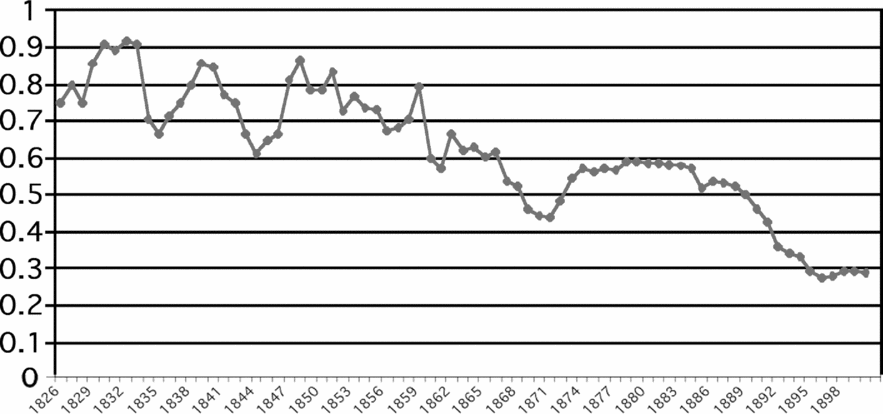
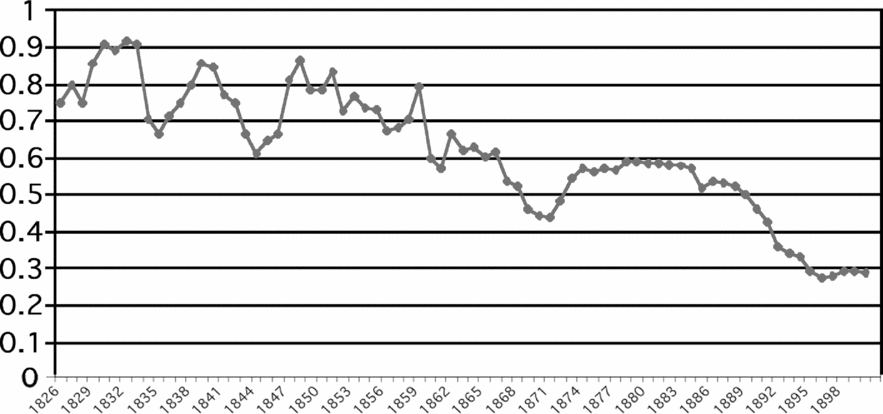
These contending versions of Liberalism, in turn, only indirectly affected Indian policy debates. To the degree that British officials came to Burma with preconceived notions, these were usually based upon their experience in other provinces of India. It is difficult to find examples of British colonial officials in Burma speaking the language of Liberalism. Instead they speak in terms of administrative practice in other parts of British India.Footnote 11 This is not surprising: prior to the Third Anglo-Burmese war most of them had long experience in other provinces before being assigned to Burma. Of a total of 348 officials employed in the administration and the secretariat between 1824 and 1900 for whom information is available, 56 per cent had held posts elsewhere in India before coming to Burma.Footnote 12 As Figure 1 shows, that percentage was highest in the early years of British rule, which Furnivall identifies as the most important for determining the British impact on Burmese society. In the 1830s it rose above 90 per cent. Senior appointments went even more disproportionately to officials with extensive experience elsewhere in India, and it was not until 1905 that British Burma got a chief executive who had started his career in the province.
Proportion of officials beginning their careers elsewhere in India,1825–190013
The fact that so many British officials in Burma had extensive experience elsewhere in India, helps explain a persistent confusion they displayed. Officials were keenly aware of the differences between India and Burma, and had an intense interest in local culture. They frequently saw themselves as champions of the interests of Burma against the exploitation of the Indian government.Footnote 14 Yet they also reflexively turned to Indian models and precedents in dealing with Burmese problems.
The primary models available in British India were Cornwallis’ Bengal System and the ryotwari model of Thomas Munro. Each had partisans, but Liberal ideals rested uneasily on both. Liberals of all stripes, and any other British interests seeking to influence policy in India, needed to work through one or the other, or both.Footnote 15
The Bengal system of Cornwallis was based on zemindars, large landholders who formed an intermediate class of administrators. Zemindars paid a fixed rent to the government and in exchange received rights to extract revenue from farmers on their estates. This practice could be considered equally liberal or illiberal, depending on one's ‘Liberalism’. One might see it as confirming landlords in possession of their property, thus upholding a core Liberal principle. On the other hand, one might take the Utilitarian position that landlords were essentially parasites who extracted rents without contributing to the productive process, suggesting the Liberal policy would be to liberate the peasants.
The Bengal system separated revenue and executive authority, with each district having a separate executive officer and magistrate. This was meant to provide a separation of powers that would prevent any tendency towards corruption or despotism. Once again, one could see this as upholding the rule of law, another core Liberal principle, or as impeding progress by imposing an arbitrary set of bureaucratic procedures that were inappropriate for India's level of development, thereby violating Utilitarian principles.
The alternative system was the ryotwari model associated with Thomas Munro in Madras and, after the Mutiny, with the Lawrences and the Punjab and Northwest Frontier Province. This model emphasized individual peasant (ryot) tenures taxed directly by the state. It thus could also be represented as defending of property rights, in this case those of peasant cultivators. It featured omnicompetent district officers who fused judicial and executive functions, and the maintenance of local law, including multiple local law codes. Critics claimed this undermined the rule of law and invited corruption by European officials, but defenders, including some Utilitarians, saw it as a benevolent paternalism which could be employed to educate Indians and raise them to a higher standard of civilization.Footnote 16
Although Burma was part of Bengal until 1886, it was never placed under the Bengal system. Instead it was classified as a ‘non-regulation’ province, meaning that it was under the executive authority of the Governor-General rather than the various acts passed by the British Parliament to regulate the East India Company, and later the India Office. The non-regulation provision was created for tracts that had been recently conquered, were in a state of unrest, or inhabited by ‘primitive’ tribes deemed unfit to have a regular revenue and administration. Over time it became increasingly difficult to justify Burma's non-regulation status, but it was never changed while Burma remained part of India. In 1937, when Burma became a separate crown colony, it was one of only two non-regulation provinces in India.Footnote 17
Burma's status as a non-regulation province had two important consequences. One was that it never fell under the Bengal system, with a brief, nugatory exception in Arakan, discussed below. In effect, Burma was governed using Munro's ryotwari system. The second difference was that ‘military civilians’—military officers seconded to civil administration—tended to dominate, especially in the early years (see Figure 2).
Proportion of military civilians in the Burma administration,1824–190018

Parliamentary law forbade the employment of military officers in civil positions in India's regulation provinces. In the non-regulation provinces, however, military officers were regarded as ideal to fill the role of the omnicompetent district official, dispensing justice on horseback, unhindered by elaborate rules and regulations, unchecked by other officials and therefore more respected by the people.Footnote 19
Military civilians tended to be more sympathetic to the paternalistic Munro system, and to dislike the elaborate separation of powers and legal formality of the Bengal system. Many of the civilian administrators in Burma came from Bengal, but the most important tended to come from other non-regulation areas such as the Punjab and Northwest Frontier Province. While the Governor-General, and later the Viceroy, had extraordinary authority in governing the non-regulation provinces, in practice they relied heavily on the advice of local officials. The Commissioners of Burma thus had unusual leeway in organizing the province as they saw fit, and tended to follow the Munro model.
It is important, however, not to exaggerate the importance of models and systems to the British administrators. As Rabitoy has pointed out, ‘it is a mistake to assume that the British thought in terms of implementing a system’.Footnote 20 Nineteenth-century British officials were not rigid ideologues; they were pragmatic and flexible administrators who thought in terms of concrete goals, primarily raising revenue while maintaining political stability. Administrative models were only instruments for achieving those goals, although they did tend to work within the administrative models they knew best.
Furthermore, in the early period of British rule the administration's capacity to make significant changes on the ground was severely limited by the fact that there were simply not enough European officials. When conscious attempts were made to introduce a particular administrative model, they often failed because they did not mesh with conditions on the ground, as for instance in Arakan in the 1820s, discussed below.
Whatever Liberal preconceptions British officials brought to Burma were thus constrained by countervailing factors: the challenge of raising revenue while maintaining stability, the fact that the pre-existing models of administration with which they had actual experience were those of India, and the reality that they had to work with local officials. In this context, even if British officials could override the local status quo, their preconceptions were drawn most immediately from India, and were only more distantly related to political and ideological debates in Britain.
The development of the Burma administration
The problems faced by British officials changed over time. In the earliest period, after the first Anglo-Burmese war, pioneering British officials actually had very little capacity to administer their new territories, because there were so few of them and they had to rely on officials from the Burmese regime who were familiar with local conditions. After the second Anglo-Burmese war and the annexation of Pegu, British officials in the administration developed greater administrative capacity. Although many older usages carried over, British officials were better able to alter administrative systems. Their thinking about such systems depended almost entirely on analogies drawn from elsewhere in British India. After the third Anglo-Burmese war, the administration expanded and was much better able to control Burmese officials. Even so, it retained many practices from the Burmese monarchy, some quite illiberal. The administrative innovations it did impose were still drawn directly from Indian models. Only in the twentieth century did the administration really assume the ideological cast that Furnivall suggests, and by that point British officials were largely bound by precedent.
First Steps: Arakan and Tenasserim 1825–1852
The first British acquisitions in Burma followed the 1824–1825 Anglo-Burmese war, and occurred at a time when Munro's ryotwari system was in ascendancy. However, Arakan and Tenasserim were annexed as districts of the province of Bengal. This led to a tension: Bengal was the stronghold of Cornwallis’ zemindar system, and, as we shall see, the officers assigned to Arakan in particular were adherents of that system. On the other hand most officials appointed to Tenasserim came from Prince of Wales Island, which was also part of Bengal, but more distant and governed rather differently. These officials were therefore less attached to the Bengal system.
Nearly all the personnel who worked in the administration between the first and second Anglo-Burmese wars began their careers outside Burma—over 85 per cent of the 58 officials for whom information is available (see Figure 1). These officials had an average eleven years’ experience in other parts of India. Most therefore came with administrative preconceptions formed elsewhere, although they also demonstrated a lively interest in the customs and political organization that had preceded them in Burma.
Furnivall emphasizes the path-breaking career of Anthony Maingy, the first civil officer appointed to Tenasserim, in setting the Liberal administrative pattern for Burma. However, even by Furnivall's own account Maingy was less than successful, and there is substantial evidence that Furnivall mischaracterizes what Maingy set out to do. Furnivall bases his argument on Maingy's announcement that he would ‘provide. . .a Civil and Political Administration on the most liberal and equitable principles’.Footnote 21 However, this is less than conclusive proof of Maingy's Liberal intentions, particularly given his later actions, discussed in detail below. Indeed, the ‘liberal’ in this sentence assumes quite a different aspect in the lower case.
According to Furnivall, the Liberalism of the British administration was not doctrinaire so much as the result of a failure to make sense of new and strange circumstances. Administrators inevitably slipped into their own native prejudices, because they could not understand local customs. Furthermore, Maingy had been given conflicting instructions to govern both on (lower-case) liberal principles and according to native custom. He found it difficult to discern native custom and ‘naturally chose the Liberal system that he understood’.Footnote 22
While Furnivall is right to point out that Maingy, and other early British administrators in Burma, had difficulty understanding the local context, the larger issue was that inadequate European staffing made it difficult for them to change administrative practice at all. In 1826 the new administrations of Tenasserim and Arakan each consisted of two European administrators, with a small contingent of Indian troops under British officers and a scattering of part-time dockmasters, customs collectors and the like. Even the most ideological administrator would have been unable effectively to implement a new system under these conditions. The new administration was forced to rely heavily on Burmese officials, who had a strong tendency to lapse into the administrative patterns most familiar to them, namely those used by the Burmese monarchy.
In the Burmese system the authority of village leaders (thugyis—literally ‘big men’) was recognized by the central government, and they were responsible for maintaining order, settling disputes and collecting revenue. They were subordinate to a ‘circle headman’ (myo thugyi). The authority of thugyis and myo thugyis was personal, and their territories overlapped. This system was anathema to British administrative theories developed in India, which envisioned territorially defined jurisdiction following regulations issued by the central government under the supervision of a British official.Footnote 23
Even on Furnivall's own account, Maingy's ostensibly Liberal administration of Tenasserim soon lapsed. Striking a note that would echo in 1852 and 1886, Maingy sought to retain local officials who had served in the royal administration. Maingy assumed that the established local officials he calls ‘soogees’ [thugyis] would be employed, and was anxious to appoint an ‘Aikon-woon [akun-wun], or collector of landed revenues’. He wrote, ‘The same feelings of apprehension do not exist with me, as have been entertained here [by others] regarding the employment of Burmese formerly in authority’.Footnote 24 Not only was he willing to recruit former officials, he was also at pains to determine how the former system worked, and to replicate it with minor adjustments. Furnivall himself admits to this. He claims first that the new system,
changed the whole character of local administration. It encroached on the autonomy of the circle by interfering with its internal administration; it converted the hereditary chieftain into a salaried official; and, for the rule of authority, based on personal relations, it substituted a territorial system based on law, placing all the people regardless of race or class under the legal authority of the circle headmen.Footnote 25
Yet in the very next paragraph he admits that ‘the plan worked out very differently in practice’, that ‘the circle headman had to be left practically unsupervised, to run their charges in their own way’, and that the payment of salaries was soon suspended and ‘the Burmese system of payment by a commission on revenue collections was revived’.Footnote 26
Local officials retained the custom of employing personal jurisdiction over their followers, rather than adhering to the territorial boundaries drawn by the British. This meant that personal patronage rather than the bureaucratic hierarchy envisioned by the British determined the structure of authority. Thus,
A. . .striking instance of reversion to the Burmese system is that twenty years after the introduction of British rule it was discovered that, within the same tract, two or three different circle headmen might still be exercising a personal criminal and revenue jurisdiction over their own people, regardless of the territorial system nominally in force since the beginning of British rule. . . . The people were still managing their own affairs much as under their own rulers.Footnote 27
Similarly, ‘Burmese methods of raising money for the state were retained or gradually re-introduced’.Footnote 28 Contrary to the claim that Maingy introduced a Liberal economy based on free trade, these measures included institutions inimical to all varieties of British Liberalism, such as tax-farming and the selling of monopolies.Footnote 29 Initially Maingy authorized the export of rice, something that the Burmese monarchs had not permitted. However, he subsequently reversed this decision, for the same reason that the Burmese had: food shortages. Maingy noted that he preferred ‘deviation from Political Maxim to the misery of a starving population.Footnote 30 While the Burmese kings followed a different set of ‘political maxims’ they too had permitted the export of rice when it was abundant, and restricted it when it was not.Footnote 31
It appears therefore that in Tenasserim, which Furnivall sees as so influential on the later development of the British administration in Burma, the impact of British rule prior to the second Anglo-Burmese war was not very great. There were simply too few British officials to police the behaviour of their subordinates very closely. This was most true in Tenasserim, because Bengal was far away. In Arakan, British officials had a greater impact on the administrative system in the short term, with consequences that are instructive: they were forced to back down after nearly provoking a rebellion.
Because Arakan was contiguous with the Chittagong district of Bengal it was placed under the Collector of Chittagong. British officials there had access to greater resources from Bengal and were probably subject to greater oversight as well. Furnivall dismisses the administration of Arakan on the grounds that it was not authentically British Burma. Yet Arakan actually provides a better test for his argument, precisely because British officials had greater impact there than in Tenasserim.
Initially Arakan was placed under the authority of Campbell Robertson, who simultaneously retained his position as a magistrate in Chittagong. He received instructions similar to Maingy's:
to collect revenue, to organize efficient police, to administer Civil and Criminal justice, adhering as far as possible to local usages and institutions, except when they are plainly at variance with the principles of humanity and natural equity.Footnote 32
However, Robertson apparently considered his duties in Chittagong to be more important, and he turned over the administration to two co-commissioners, Paton and Hunter. Hunter's background is uncertain, but Paton had been a magistrate in Calcutta, and understood the Bengal system well. He and Hunter set out to replicate it in Arakan. They immediately encountered difficulties finding local figures to fill the role of the zemindars. The closest approximations were the ‘circle chiefs’ who had collected revenue for the Burmese monarchs. These officials did not have any rights to the land cultivated by taxpayers, however. They merely held the right to collect the revenue. This inconvenient fact forced an ad hoc adjustment: kyouks were made responsible for paying a promised sum, and in exchange were given the authority to collect tax. In effect this made them into tax-farmers and gave them an incentive to squeeze as much revenue as possible from taxpayers. As a consequence, collections rose rapidly, provoking discontent from taxpayers and nearly precipitating a revolt.Footnote 33
Colonel Bogle, who was appointed commissioner of Arakan after 1836, made extensive revisions to the tax system which brought it closer to the practice of the Burmese monarchy. Revenue was assessed for villages collectively. It was collected by the village headmen, who then paid it to circle headmen. The circle headmen were responsible for assessing villages and were accountable for the revenue. The system was territorial, at least according to Arthur Phayre's 1841 description, suggesting that the British administration ultimately had more impact in Arakan than in Tenasserim. However, that impact was not particularly Liberal. For instance cultivators did not have title to their land, which was considered the property of the state. This principle was inherited from the Burmese, and clearly militated against liberalisms of both the free traders and the Utilitarians.
British administration between the first and second Anglo-Burmese wars was thus significantly constrained by local circumstances, and had difficulty reshaping the administration in the new provinces. Those changes that were effected were not typically Liberal. This pattern changed significantly only after the annexation of Pegu.
Lower Burma after the annexation of Pegu, 1852–1885
After the British annexation of Pegu in 1852, the Government of India made a comment that was unwittingly revealing about the impact of British rule in Tenasserim and Arakan:
The enquiries which have diligently been made during the summer have led to the conclusion that the whole social and existing administrative system in Pegu assimilates so closely to that existing in Tenasserim and in Arracan, that the details of the administration for the new Province not less than its general form, may be taken from the administration which has long been in force in the provinces on each side of it.Footnote 34
This puts a new perspective on Furnivall's assertion that Arthur Phayre, the new deputy commissioner of Pegu, ‘adopted. . .the system which had grown up in Tenasserim under the direction of the Bengal Government’.Footnote 35 The Government of India and its local officials understood that the system existing in Tenasserim and Arakan was substantially the same as that employed by the Burmese monarchy. Furthermore, they seem to have approved, since the above passage occurs in a letter validating Phayre's proposals for Pegu.
The concern over replicate traditions of local administration extended to recruiting officials from families who had served in the royal administration. We have already seen how Maingy sought to secure the services of officials of the previous regime at the outset of British administration in Tenasserim. After the annexation of Pegu, the British did the same. For instance, while good character and ability were important considerations for the post of headman, a hereditary claim was also considered to be desirable.Footnote 36
At the same time, there was a strong tendency to think about Burma in terms of Indian models. The Governor-General's summary of the system proposed by Phayre in Pegu lists local officials with their traditional Burmese titles, paired with Indian equivalents. It is assumed that the two are more or less the same.Footnote 37
Pegu, like its neighbours Arakan and Tenasserim, was made a non-regulation province and military civilians dominated in the early years (Figure 2). The annexation of Pegu occurred under Governor-General Dalhousie, an advocate of the ryotwari system. Dalhousie was sympathetic to the Utilitarians in India House, who advocated both territorial expansion and centralization of the bureaucracy. These could only be attained by the employment of military civilians, because the civil service cadre was not large enough to staff the new acquisitions, and parliamentary regulations on recruitment prevented its rapid expansion.Footnote 38
Arakan, Pegu and Tenasserim were united as a single province called Lower Burma in 1862. The Burma administration began to enjoy greater autonomy after this.Footnote 39 Even so, it tended still to adhere to its former practices. Most British officials continued to be drawn from other provinces of India. Of 168 officials for whom information is available who worked in the Burma administration or secretariat in this period, 65 per cent began their careers elsewhere, each with an average 8.8 years’ experience before coming to Burma. Aside from a brief dip between 1869 and 1872, more than 50 per cent of the executive staff of the province continued to be appointed from elsewhere in India until the 1890s. The position of chief commissioner for Lower Burma was instituted in this period, and all the occupants of that office began their service elsewhere, with an average of 16.7 years’ service elsewhere in India before being posted to Burma.
After the creation of a unified British Burma administration terms drawn from India continued to creep into descriptions of the administrative structure, suggesting that British officials continued to see India as a model for Burma. Britons inside and outside the administration repeatedly equated local titles with Indian counterparts.Footnote 40 The 1866 Temple and Bruce Report on the administration of Pegu for instance sets out a list of Indian equivalents for all native officials, announcing that ‘all the above officers were known under the Burmese Government, so that it may be said that the essence of local institutions has been preserved in Pegu’.Footnote 41
At the same time, the British resolutely adhered to local titles for their native subordinates, and engaged in heated debate over issues such as the correct term of address in Burmese for a district officer.Footnote 42 Respect for tradition had manifold implications, however, and not all were welcome. The administration for instance spent years trying to force European officers to desist from requiring formal prostrations called ‘shiko’ from their Burmese subjects, apparently without much success.Footnote 43
This period saw an explosion of work on Buddhist law with the goal of codifying a standardized version for use in the courts. This interest in local law was not an idiosyncrasy of the Burma administration; it was part of a conviction shared widely among British officials that the best way to rule India was by ‘codifying and reinstituting the ruling practices that had been developed by previous states and rulers’,Footnote 44 albeit in a rationalized fashion. In 1859 the administration of Pegu compiled a code of Burmese customary family law,Footnote 45 similar to the Muslim and Hindu codes which had already been created in Bengal. Beginning in 1874, there followed a remarkable string of projects to enhance the study of local law by native jurists, including translations of local versions of the laws of Manu and the Dhammathat, two foundational Buddhist legal texts.Footnote 46 In 1883 the Educational Syndicate established two lectureships in Buddhist Law.Footnote 47 As late as 1894 a fresh digest of Buddhist Law was prepared, including commentaries from no less an eminence than the Kinwun Mingyi.Footnote 48
Yet at the same time, Indian precedents continually crept into the judicial institutions and law of British Burma. Thus, for instance, the report on the administration of Pegu for 1859/60 indicates that Burmese Buddhist law was used for some aspects of family law, but that the Punjab code was followed for others.Footnote 49 The Judicial Bill of 1871 was modelled on the Bengal Civil Courts Act of the same year.Footnote 50 Two years later the Government of India suggested the Northwest Provinces as a model for reforming the criminal courts of British Burma.Footnote 51 The model for judicial proceedings to which the Government was a party was drawn from Hyderabad.Footnote 52
This increased emphasis on legal codification reflects a growing use of the courts which accompanied the increasing capacities of the administration after the annexation of Pegu, and particularly after the creation of Lower Burma as a single administrative unit in 1862. Even so, it continued to follow many earlier patterns, including the retention of hereditary Burmese officials and the search for Indian models to understand Burma.
The strong emphasis on continuity in local authority legitimized one aspect of the ryotwari system as practiced in South India. There British revenue officials theoretically had direct contact with individual cultivators, reviewing their assessments annually based on local conditions. In practice this rarely happened, because the scope of the task was too great. British officials did make annual revenue tours but relied almost entirely on local hereditary officials who prepared the tax registers and apportioned the tax burden within the villages.Footnote 53 In Burma the retention of traditional local officials from the monarchy in effect similarly legitimized in practice what was in theory a deviation from the theory of ryotwari in south India.
The annexation of Upper Burma
Initially the new administration in Upper Burma followed its predecessors in its concern with perpetuating the personnel, customs and revenue procedures of the previous regime. They had a good deal more to work with, since the foundation of the standardized Buddhist law code had been laid down earlier, and they had access to a great deal more information about the former regime. Some of this came from British merchants, who had become increasingly active in both Lower (British) and Upper (Burmese) Burma after 1852. The British also had maintained residents in the Burmese capital on and off for many years. Furthermore, there were now a larger number of British officials competent in the Burmese language to collect information, and a large number of former Burmese officials cooperated with the British.
The major concern of the political officers who accompanied British troops after the Third Anglo-Burmese war was convincing local officials to submit to the British and return to their posts.Footnote 54 In part this was necessary to reduce the disruption caused by the war and encourage pacification. After the war, however, the British perpetuated an aristocracy of sorts by giving preference to hereditary claimants in thugyi appointments.Footnote 55 To encourage social stability they even provided special educational opportunities for the heirs of thugyis, perpetuating a hereditary inequality of opportunity, something deeply repugnant to Liberal principles.Footnote 56
The British also largely preserved existing tax structures, although they were vastly more effective at collecting taxes than were the Burmese. We have seen how British officials largely preserved the tax system of each new acquisition, including such illiberal features as tax-farms and monopolies. The British retained the separate tax structure of Upper Burma established under King Mindon. This included the thathameda head-tax,Footnote 57 ‘notwithstanding that such an impost violates all modern principles of finance’, according to one former official. ‘Indeed,’ he continues, ‘had not the Burmese kings in the plenitude of their wisdom established it, it is quite certain that the Indian Government would never have dreamed of such a novelty’.Footnote 58 The government also retained and rented state lands, as well as managing forest reserves and state enterprises.Footnote 59 So far were they from champions of Liberalism that they, like the Burmese kings, demanded corvee labour, a practice of servitude as illiberal as one could imagine.
In the period after the third Anglo-Burmese war, British officials were increasingly appointed directly to Burma. In the period between 1885 and 1900, only 41 per cent of officials appointed to the British administration in Burma or the secretariat had careers elsewhere in India, with a steady downward trend over the period. Those who did serve outside Burma first only had an average 6.7 years’ experience elsewhere (see Figure 1). Military civilian officials declined to only 23 per cent over this period (see Figure 2).
However, leadership positions remained heavily weighted towards those who had previously served elsewhere. Once again, no chief commissioner was appointed in this period who had not served elsewhere in British India, and the mean number of years of service prior to Burma actually rose to 23.3 years. Burma remained a non-regulation province, although this became increasingly difficult to justify. Suggestions by the Government of India that judicial and executive powers be separated met with vociferous protests from officials in Burma whenever they were aired.Footnote 60
At the same time, the resources available to administrators in Burma increased after the annexation of Upper Burma. The lengthy pacification campaign meant that administrators had larger military and police forces to call upon. In addition, the functional administration had become much more elaborate by the beginning of the 1890s. Prior to this the government of British Burma was run by executive officials—the commissioners and their subordinates—with relatively few functionally specialized officials. Now an elaborate set of officials proliferated, handling public works, railways, public health, land surveying, veterinary and agricultural services and so on. This substantially increased the density of British officials on the ground and the technical capacity of the British administration.Footnote 61 Increasing British capacities gave the administration greater freedom to shape institutions. As a result British misunderstandings of Burmese society based on analogies with India had greater potential to effect real change, including increasingly significant unintended consequences.Footnote 62
The best example of this is Crosthwaite's village system, enacted in 1887, which placed villagers under the authority of a village headman and made them jointly responsible for the behaviour of all members of the village. In Lower Burma, in contrast, the primary unit of local administration was the much larger ‘circle’, under a circle headman who resembled the myo-thugyi of the royal administration more closely than the thugyi (headman) of the new village system.Footnote 63
Crosthwaite's career in India began in the Northwest Frontier and Central Provinces, where a similar village system called mahalwari had been created as a modification of Munro's ryotwari system. The major innovation was that taxes were assessed not on individual farmers, but on the village as a whole, preserving what was held to be immemorial tradition, but also reconciling the theory of ryotwari with the reality that village officials, rather than British officials, did nearly all the work at the local level. On his appointment as chief commissioner of Burma, Crosthwaite decided this system conformed to Burmese tradition as well. However, in describing the system he constantly invoked the model of the village system in Bombay:
In Bombay we have inherited a ryotwari system from the Mahratta Government, and we have likewise inherited a system of village officials which we have wisely confirmed by law and maintained. It is proposed to give the headman in Burma the powers which are exercised by the patels in Bombay villages with very beneficial results.Footnote 64
This system was seen as appropriate to Burma because of its social structure and revenue system: ‘there are no zemindars or middlemen between the Government and the cultivator’. Yet in the same document, ‘giving’ the headmen such powers is referred to as an attempt to ‘strengthen or re-constitute the indigenous village-system, which has been weakened by various influences’.Footnote 65 The possibility of differences between the Mahratta administrative system and that of traditional Burma was never addressed, nor is the logical difficulty of ‘giving’ local officials powers that they ostensibly had always held.
Although Furnivall indicts the entire British administration from 1824 onwards for destroying Burmese society by introducing Liberal policies, he sees the village system as the apogee of these destructive policies. Yet there are at least two problems with this characterization.
First, the village system was opposed by most officials with extensive experience in Burma.Footnote 66 In fact, an attempt to introduce a similar village system had been attempted in Tenasserim in the 1850s, but was abandoned because it was ‘universally disapproved of by the inhabitants in every district of these provinces’.Footnote 67
Second, it is questionable whether the village system can be characterized as Liberal. Indeed, it was more usually associated with conservative political thought.Footnote 68 There is no particular reason for supposing that investing administrative power in a village headman rather than a circle headman was intrinsically more or less Liberal. However, the notion of collective village responsibility was clearly contrary to Liberal values as articulated by Furnivall, which emphasized individual autonomy. On Furnivall's own terms, the village system can only be described as an illiberal policy.
Furnivall's Burma
The Burma that Furnivall knew personally was quite different from the earlier periods in which he locates the origins and essence of British colonial administration. A combination of changing educational and career patterns in the civil service and an increasingly politicized populace created a more ideological administration, which moreover was increasingly divorced from direct contact with India. As a consequence, British officials were increasingly influenced by European political ideologies rather than by Indian experience. Yet those officials were bound to serve in a system that had been created before they were in office, and which many regarded as irrational.
By Furnivall's day the administration of Burma was composed almost entirely of civilians who had never served elsewhere in India. Of 120 officials in the territorial administration and secretariat on the eve of the Japanese invasion, only seven had begun their careers elsewhere in India.Footnote 69 All seven had served in the military, and Burma was their first civil post.Footnote 70 This meant that very few members of the administration had any administrative experience elsewhere in India.
In addition it was increasingly common for British officials to have at least some university education before being posted to Burma.Footnote 71 They therefore were more likely to be versed in political ideologies, and to interpret events through ideological lenses. The Burmese population had changed as well. It was more highly politicized, and political leaders were increasingly inclined to articulate their grievances in the language of European political ideologies. The creation of the Young Men's Buddhist Association in 1906 and the Communist Party of Burma in 1939 are the most obvious examples.Footnote 72 Burmese activists were also influenced by the Indian nationalist movement. These developments gave politics and administration a more ideological flavour.Footnote 73
Furnivall himself exemplified this trend. He was educated at Cambridge and posted directly to Burma, where he became a member of the Fabian Society.Footnote 74 Furnivall's own activities during his tenure in the Indian civil service (ICS) were not strongly ideological, focusing primarily on educational endeavours, such as co-founding the Burma Research Society, and later a book club. He had not yet undertaken his study of comparative colonial administration or encountered the Dutch officials in The Netherlands East Indies who became his model for a new, activist breed of colonial officialdom. Yet it seems that he also felt constrained by the bureaucratic inertia of the government of British Burma, which he saw as placing the colony firmly on a path towards the dominance of free trade.
Although Furnivall was not very active politically as an ICS officer, his later activities and scholarly writings clearly resonate with Fabian ideas. While there was debate within the Fabian society about the colonies, in general the Fabians tended to be sympathetic to a humanitarian version of colonial rule.Footnote 75 The theme of the Society's 1945 collection entitled Fabian Colonial Essays, to which Furnivall contributed, was the responsibility of the colonial powers to retain their colonies in order to improve social and economic conditions there. The colonies would eventually attain autonomy in partnership with the former colonial masters, but first needed to be strengthened and protected from the predatory forces of free trade. This vision sounds conservative and patronising in retrospect, but it embodied the Fabian suspicion of radical social change and revolution, and its emphasis on gradual, progressive change.
Arthur Creech Jones in his introduction to Fabian Colonial Essays echoes Furnivall's work, writing that in the colonies too much
was left to private enterprise, to speculators, concession hunters, profit seekers and land-grabbers, who had too little sentiment in their hearts for the backward people who were so conveniently exploitable.Footnote 76
Yet the backward nature of the societies which enabled British imperial control, and therefore the destructive effects of British colonialism, also demanded continued engagement, to develop those societies to the point that they could govern themselves. Simply granting independence would be an abrogation of imperial responsibility. According to Creech Jones, Fabian socialists,
cannot stop their ears to the claims of colonial peoples and renounce responsibility towards British territories because of some sentimental inclination to ‘liberation’ or international administration.Footnote 77
Foremost among the reasons for continued colonial presence was the pernicious influence of free trade capitalism, which the dependent regions could not withstand on their own: the same forces that Furnivall identifies with Liberalism.
Furnivall's own contribution to the volume previewed his arguments in Colonial Policy and Practice, holding up a model of colonial administrators as ‘social engineers’. By applying science to their management of the colonies, these social engineers could break down the barriers of plural society and engender a political class capable of leading this new society and protecting it from free trade.Footnote 78
In this context it is hardly surprising that Furnivall framed his interpretation of the impact of British rule in terms of Liberalism. However, Furnivall's reading into the past of the more ideological colonial regime he experienced had significant consequences for the way in which that past was understood, both by Furnivall and his academic audience, and hence for subsequent work on Burmese politics, economics and society. Below, one example of how Furnivall's view may handicap our understanding of Burma is discussed, relating to his interpretation of the economic consequences of British rule.
Interpreting the pre-colonial economy
British insistence on the creation of domestic markets and linkages to the global economy is the centrepiece of Furnivall's argument about the impact of British Liberalism. He claims that marketization and monetization of the economy under the British unleashed economic rationality and dissolved the social bonds that held traditional society together.Footnote 79 To make this argument work, these trends must have been absent prior to British rule. Accordingly, Furnivall argues that pre-colonial Burma's economy was localized and based on barter, rather than cash. Only under British rule did the economy become monetized.Footnote 80 However Furnivall himself refers to peasants engaging in wage labour in the pre-colonial period by making salt, fishing, and working as boatmen.Footnote 81
There is a great deal of evidence to suggest that Burma had a thriving, monetized commercial economy prior to British rule. Lieberman argues that this was the culmination of trends that began in the early fourteenth century.Footnote 82 Recent work on late Kon-baung thet-kayit (moneylending) contracts offers considerable evidence of monetization. For instance, it is clear from these documents that taxes were often demanded and paid for in specie, rather than in kind as Furnivall suggests. This is confirmed in the early Kon-baung sit-tans, translated by Trager and Koenig, which commonly refer to payments of fees and taxes in fixed weights of silver or copper.Footnote 83 The payment of taxes in specie money in turn presupposes a cash economy to draw from. The sale of tax-farms and monopolies also suggests a fairly well-developed commercial economy, since both represent investments made in anticipation of cash profits.Footnote 84 Furnivall himself reports that Maingy found and perpetuated these practices in Tenasserim in 1824.Footnote 85
In addition, Toe Hla's work shows quite conclusively that credit and loans were common in the Kon-baung economy. Most of the lenders were members of the elite, but this was not necessarily true of the borrowers. The reasons for borrowing are also revealing: the most common reason was for the payment of taxes. In addition, people borrowed capital for commercial ventures, to repay other debts, or to buy government office.Footnote 86 The indemnity imposed by the British after the first Anglo-Burmese war required particularly onerous taxes, but the government did succeed in paying it off—in cash.
Furthermore, lending money for interest was a widespread practice. Thant Myint-U argues that there was a wide-ranging system of money-lending originating from the king which created ‘a system of indebtedness [that] roughly paralleled political structures, the king standing at the apex of a lucrative lending machine’.Footnote 87 This system was facilitated by a professional banking class, the thuhtay. The mortgaging of land for cash was a common practice, one that would make little sense in a non-monetized economy.Footnote 88 The pattern of debtors losing their land and being reduced to servile status or penury was also known well before British rule, although increased exposure to the international economy under British rule appears to have considerably amplified this particular problem.Footnote 89
The monetization of the economy was tied to the growth of commerce.Footnote 90 Furnivall's own account of the differing economies of upper and lower Burma suggests that long-distance trade was necessary, and this in turn would suggest some degree of commercial sophistication.Footnote 91 Numerous sources attest to the existence of considerable internal trade, sufficient to support specialized artisan villages and small factories.Footnote 92 The government even sponsored festivals and trade fairs in upper Burma and the Shan States, reminiscent of the medieval European trade fairs credited with the economic revival of the late Middle Ages.Footnote 93 The sale of monopolies similarly depended on a commercialized economy, since monopoly goods can only be controlled in the context of market exchange.Footnote 94
There is also evidence of an export trade in the pre-colonial period, despite Furnivall's claim that prior to the colonial period Burma ‘had little to attract the outer world’.Footnote 95 For instance, export monopolies were purchased by Chinese traders, who transported the goods overland to Yunnan.Footnote 96 Cotton was the largest single item of trade passing from Burma through the Shan States to Yunnan.Footnote 97 The large-scale export of cotton in turn implies cash-cropping by Burmese farmers. Symes also discusses teak export and a ship-building industry in lower Burma.Footnote 98 Other seaborne exports included rice, ivory, fruit, betel nut, gold and silver.Footnote 99
Rice was especially important. Rice exports led the massive economic changes that swept colonial Burma, triggering a massive influx of migrants into the Irrawaddy Delta, and the attendant dislocation of what became a frontier society.Footnote 100 To attribute these changes to British colonial rule supposes that the Burmese kings would never have permitted an export trade in rice. Yet this is far from certain. When rice was abundant the Burmese monarchs did in fact permit its export. Furthermore, we have seen that Maingy behaved precisely as the Burmese had, banning rice exports when food was in short supply. Furnivall's presumption is that colonialism was primarily responsible for economic change in Burma through its promotion of free-trade capitalism, but he does not attempt to distinguish its impact from that of economic globalization, which affected all the regional economies, regardless of their colonial status.Footnote 101
Furnivall's account of the pre-colonial economy is, therefore, not viable. There was considerable commerce in the pre-colonial economy, including an export trade, relying on cash and facilitated by mortgages and other forms of credit. If Furnivall's description of the pre-colonial economy is not tenable, then his account of the economic impact of British imperialism cannot be either. In effect, Furnivall attributes all the negative consequences of globalization on nineteenth-century Burma to British misrule, ignoring the possibility that much the same might have happened regardless of who governed. If the pre-modern Burmese economy was more monetized and marketized than Furnivall believed, it is necessary to make a greater distinction between the impact of colonialism and that of globalization.
Conclusion
Furnivall had access to many of the sources used by others to reconstruct the history of the pre-colonial economy, and indeed often cites information that cuts against his own thesis. How did he go astray?
Furnivall's interpretation must be understood in the context of his own views. A university-educated administrator sympathetic to Fabian socialism, Furnivall believed the British had failed in their duty to assist the Burmese in making progress toward modernity.Footnote 102 Furnivall was thus not a critic of British imperialism in Burma per se, but rather of particular policies. For him the sins of the British were not acts of commission (the conquest of Burma) but of omission (failing to improve the conquered population). British colonialism would have been justified for him if it had served the Burmese by advancing education, blunting the negative effects of the world economy, integrating the plural society and preparing the population for self-government. In a sense Furnivall was offering the last possible defence of British rule in Burma, that it need not have been the way it was, and could have been better.
In his contribution to Fabian Colonial Essays Furnivall developed a vision of continued colonial influence under Fabian principles, which he later elaborated in Colonial Policy and Practice. He envisions a system of regional colonial boards under a revived League of Nations, which would monitor the progress of the colonial powers in improving their colonial charges. The primary goal of this arrangement would be the collection of data to place colonial administration on a scientific basis, a project not dissimilar to his own in Colonial Power and Practice. Indeed, in his contribution to Fabian Colonial Essays he goes out of his way to praise Dutch administrators in The Netherlands East Indies as ‘social engineers’.Footnote 103 Yet by 1948, when Colonial Power and Practice was published, this plan was already an anachronistic fantasy. Burma attained independence that year, and Indonesia would get its independence the year after, following an armed struggle that raged against the Dutch social engineers, even while Furnivall praised them in print. Yet there is barely a whisper of anti-colonial resistance in Colonial Policy and Practice. Instead of recognizing these struggles, the final chapter of the book elaborates Furnivall's plan for regional colonial councils under a ‘World Council or other global organization’ which will enable the colonial powers to belatedly remedy their earlier mistakes. ‘Western political societies survive by their inherent vigour’, he writes, ‘but in the tropics social will must be conserved and strengthened by artificial respiration until the patient can safely stand alone’.Footnote 104 Some former ICS officers, including Furnivall, acted as consultants to the new government, but for better or worse the British legacy was complete. There would be no ICS social engineers with years or decades to prepare the country for independence. On Furnivall's estimation, it had to be admitted that the British colonial regime had a net negative impact on Burma, and that it had failed to prepare the Burmese for self-government.
In seeking the reason for this failure, Furnivall turned to one of Fabian socialism's off-the-shelf villains: free-trade Liberalism. The notion that earlier generations of British administrators were fatally influenced by ideologies imported from Europe came naturally to him, because it was true for many of his colleagues. Alien to them were many of the debates and concerns that had driven the behaviour of earlier administrators like Anthony Maingy and Arthur Phayre. In this sense Furnivall permitted his ideological project to contaminate his scholarly one.
Historicizing Furnivall's work by placing it in the context of his own generation of thinking on social and political issues and colonial policy helps clarify Burma's history and his place in it. Furnivall framed colonial politics in a way that reflected his own time. His interpretation of the impact of British colonial rule demands critical re-evaluation in this light.