Doubt is not a pleasant condition, but certainty is an absurd one.
(Voltaire)1. Introduction
Climate change science has always been primarily motivated by concern about determining how serious change in climate due to human-generated increases in greenhouse gases might be and what we as human beings might do about it. Two major strategies for managing climate change have long been identified: mitigation, or reducing the emissions we produce, and adaptation, coping with the climate change that cannot be avoided. In this regard climate change research has always been concerned, implicitly or explicitly, with informing policy at international, national, state, and local scales. However, as climate change science has matured and as the climate has continued to change, the urgency and the directness of the connection to decision making have increased. The most recent report of the Intergovernmental Panel on Climate Change (IPCC) states that “most of the observed increase in global average temperatures since the mid-20th century is very likely due to the observed increase in anthropogenic greenhouse gas concentrations” (Solomon et al. Reference Tebaldi and Knutti2007, 432). One sees a shift in the central question regarding climate change, from “is climate change happening” to “what do we do about it?” This emphasizes further the decision-making side of climate change. One issue very much connected with climate change is that of uncertainty. We do not know precisely how and how much climate will change in the twenty-first century, on global, regional, and local spatial scales. Managing the uncertainty surrounding climate change is a very important issue in light of the myriad decisions that need to be made in the coming decades (Jones and Mearns Reference Jones, Mearns, Lim and Spanger-Siegfreid2005).
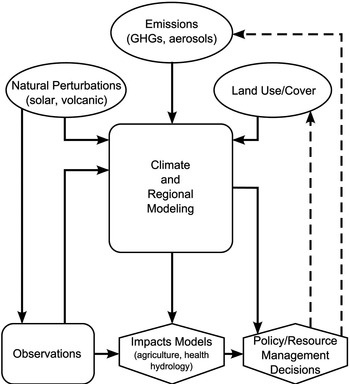
There are numerous uncertainties associated with future climate change. Among the chief uncertainties are the natural internal variability of the climate system, the pathway of future emissions of greenhouse gases, and how the climate system will respond to the increases in greenhouse gases (Meehl et al. Reference Meehl2007). But there are other uncertainties as well. Future climate is most often studied through the application of complex climate models that simulate the processes that are responsible for climate. These include processes of the atmosphere, ocean, land surface, as well as cycling of key elements such as carbon. While these models have steadily become more complex and robust over the past 2 decades, there are still unknown processes, poorly understood processes, or processes that are difficult to model that affect the climate system (Petersen Reference Solomon2006). Thus, the climate change problem is viewed as one imbued with “deep uncertainty” (Lempert et al. Reference Lempert2004). It is particularly difficult to quantify the uncertainty of these latter factors. Various “cascades of uncertainty” have been constructed to represent the relationship among the known uncertainties, which include more than the two major factors of future emissions and response of the climate system (fig. 1). Other components include the conversion of emissions to concentrations (that part of emissions that remain in the atmosphere), the response of global models to the concentrations, the application of methods to increase the spatial resolution of the global model results (i.e., downscaling), application of these results to impacts models (e.g., water resource and crop models) to determine the effects of the climate change on sectors such as agriculture, and then determination of management options to either reduce greenhouse gases (mitigation) or cope with the climate change that cannot be avoided (adaptation). Each step in this cascade contains its own uncertainties (Mearns et al. Reference Mearns2001). While recently considerable effort has gone into quantifying the uncertainty in future climate through the application of probabilistic methods, most of these efforts are still in a research mode and have not been applied to real decision-making contexts regarding mitigation and adaptation to climate change. One reason for this is that methods are relatively new, and there is no consensus regarding what the probability density functions (pdfs) of future (regional) climate change should look like; in other words, there are uncertainties about the distributions themselves, especially on regional scales (Parker Reference Parson2006; Christensen et al. Reference Christensen2007; Tebaldi and Knutti Reference Tebaldi2007).
The cascade of uncertainty in climate change research. The top-down cascade starts with uncertainties regarding emissions of greenhouse gases and aerosols. There are other uncertainties from natural fluctuations such as aerosols from volcanoes and fluctuations in solar output as well as changes in land use that can affect the climate system. The emissions/concentrations are used as inputs to global and regional models to simulate the response of the climate system to the increased greenhouse gases. Different climate models produce different responses, so there is considerable uncertainty in this response. Observations of climate are used to evaluate the quality of the simulations. Finally, in research on the effect of climate change on human and natural systems, the results of the climate models are used to determine the impacts of climate change on systems such as agriculture and water resources. Decisions on how to manage the climate change to reduce the negative impacts on these systems are then made, and these decisions in turn can potentially affect land use and the production of emissions (dashed lines).

One key debate that is central to the climate change issue is the appropriate role of the scientific enterprise in relation to these uncertainties. Is the role of science to reduce these uncertainties, so that it is supposedly easier to take actions, or should its proper purview be to discover, elucidate, and quantify important uncertainties? Of course these goals are not necessarily in conflict (CCSP 2009). But which takes priority can affect the course of climate science research. A case in point is one of the stated goals of the U.S. Climate Change Science Program (CCSP), which was the major climate science program initiated by the Bush administration. One of the major goals of the program was stated to be to “reduce uncertainty in projections of how the Earth's climate and related systems may change in the future” (CCSP 2003, 278). Concern was expressed that this goal, which likely could not be met in the short term, would become a convenient excuse for inaction on climate change, since it would be posed that there is “too much uncertainty” to act. The CCSP was strongly criticized later in its lifetime for focusing on reducing uncertainty (NRC Reference Nakicenovic2007).
There was recent experience with what “failure” to reduce uncertainties looked like. In the Intergovernmental Panel on Climate Change (IPCC) 2001 Assessment Report (Houghton et al. Reference Houghton2001), the range of anticipated change in global mean temperature by the end of the twenty-first century actually increased compared to that of the 1995 IPCC report (Houghton et al. Reference Houghton1995).Footnote 1 This was sometimes interpreted to mean that the uncertainty about future climate change had increased. One perspective was that this indicated a failure in climate change science if the assumption of progress being based on reducing uncertainty is accepted and if a simple estimate of the range of global temperature change is taken to be a central metric of uncertainty.
This view of the uncertainties related to climate change is based on a “top-down” approach in which one starts with the climate change science and travels through multiple layers of uncertainty to finally reach a decision point (Mearns et al. Reference Mearns2001). However, there are other ways of framing uncertainty in the climate change issue. One of the most prominent is the notion of starting with the vulnerability of sectors and systems and the possible decision framework rather than starting with the climate science. This is also framed as moving from a “predict-then-act” framework to an “assess-risk-of-policy” framework, wherein various policy options are considered and the effects of uncertainties in the climate and other systems on those specific options are evaluated (Lempert et al. Reference Lempert2004). This latter approach puts more emphasis on the decision-making part of the cascade of uncertainty and essentially stands the cascade on its head. However, this approach is less familiar to climate scientists and is outside their normal frame of reference.
2. Methods for Characterizing Uncertainty in the Climate Change Issue
Regardless of the approach taken, at some point quantification of uncertainty becomes an issue. And for a long time formal (i.e., probabilistic) methods of quantifying uncertainty were eschewed. This was a function of numerous factors: the particular paradigm of climate science (that one's goal is to home in on the “true” value of change in global temperature by steadily improving climate models until a consensus is reached for the right reason), lack of appropriate interdisciplinarity between climate scientists and statisticians, the limited number of climate models participating in well-structured climate model experiment programs (e.g., in Houghton et al. [Reference Houghton2001], only nine global climate models participated in the IPCC structured experiments using a specific set of emissions scenarios developed for input to climate models [Nakicenovic et al. 2000]), and debates regarding what uncertainties can and cannot be happily rendered through probabilistic techniques. Work on quantifying uncertainties in climate models at various spatial scales has experienced the most rapid development in the past 8 years or so. There has been more debate and less progress in quantifying uncertainty of emissions scenarios. The difficulty of doing so was underscored by the initial position taken on how to interpret the different emissions scenarios developed for the IPCC (Nakicenovic et al. 2000).
2.1. Uncertainty in Scenarios of Greenhouse Gas Emissions in the Future
The Special Report on Emissions Scenarios (SRES; Nakicenovic et al. 2000) was developed from story lines about how the world at very large regional scales might develop in the twenty-first century. On the basis of these story lines, quantitative information about the main factors that would drive the production of emissions was developed. This included projections of population, technological development, agriculture, land use, economic development represented by gross domestic product, and so forth. The authors declined to assign probabilities to the 40 or so future emissions scenarios they developed and stated that they were all equally sound, but warned against interpreting this to mean they were all equally likely (with a probability of 1/40, e.g.). Debate on this point has continued to this day. One central issue is the reflexivity problem, which refers to the difficulty of representing decisions in the scenarios themselves without their becoming circular or contradictory. This particularly comes into play when dealing with scenarios with substantial socioeconomic components as in the case with emissions scenarios (Parson et al. Reference Petersen2007). While there has been some progress in quantifying the uncertainty using probabilistic methods in certain aspects of the inputs to emissions scenarios (e.g., population; O'Neill Reference Parker2004), other aspects pose potentially insurmountable difficulties (e.g., probabilities of the future course of technology). Be that as it may, when the SRES scenarios were used as inputs to climate models, several researchers immediately made assumptions about their probabilities and employed them along with results from global climate models to come up with 95% confidence intervals for global mean temperature change out to the end of the twenty-first century (Wigley and Raper Reference Wigley and Raper2001; Webster et al. Reference Wigley and Raper2003).
Currently, plans for the IPCC Fifth Assessment Reports are under way. A new approach to developing socioeconomic, emissions, and climate scenarios has been instituted whereby first a series of representative concentration pathways (RCPs) has been chosen, which can be used to drive climate models early in the IPCC timetable, and the details of the socioeconomic conditions consistent with these pathways can be developed using integrated assessment models at the same time the climate model runs are produced (Moss et al. Reference Moss2008). This parallel approach to scenario development, as opposed to the sequential approach, is more efficient given the needs of the various communities participating in this effort. It is assumed that different combinations of socioeconomic conditions could lead to the same RCP. However, this situation will likely make it more difficult to develop probabilities for the RCPs, the emissions leading to the RCPs, as well as the socioeconomic conditions that lead to the emissions.
2.2. Uncertainty in Climate Model Simulations
Methods focusing on results from climate models fall into roughly two camps: those that focus on the global scale and those that focus more particularly on the regional scale. Global scale analyses have focused on determining the probability of change in global temperature (see above) and also on climate sensitivity.Footnote 2 For the first time, in the most recent IPCC report (Meehl et al. Reference Meehl2007), a complete probabilistic treatment of climate sensitivity was presented.
There are also two different types of climate simulation experiments considered as bases for developing probabilistic methods: (1) multimodel ensembles, sometime called ensembles of opportunity, and (2) perturbed physics ensembles (PPEs). In the former, model simulations that have used the same emission/concentration scenarios are collected, and their results are used as the basic data for generating probabilistic information about the future. In the latter case, major poorly constrained parameters from a single global climate model are altered in different combinations, the “new” model version is run, and the total combination of simulations forms the basic data set (Murphy et al. Reference Murphy2007). Bayesian methods are usually used to develop the pdfs at various spatial scales, but particularly the regional scale (e.g., Tebaldi et al. Reference Tebaldi and Lobell2004; Greene, Goddard, and Lal Reference Greene, Goddard and Lal2006; for a review, see Tebaldi and Knutti [Reference Tebaldi2007]). Conditional probabilities are usually developed (conditioned on different emissions pathways) in these methods to avoid the difficulty of attaching probabilities to different emissions/concentrations projections.
2.3. The Uncertainty of Spatial Scale
While global models do produce results on regional scales (e.g., the scale of the southwestern United States), the resolution of these models limits the level of detail that can be garnered from these experiments. Global models are run at spatial resolutions of several hundred kilometers. This coarse resolution has been of particular concern to the climate impacts community that uses results of climate models to drive impacts models (e.g., water resource or crop models). While much has been made for several decades about this problem of “mismatch” of scale between the global climate models that are run at resolutions in the hundreds of kilometers and the resolution at which impacts models are used (tens of kilometers or less; e.g., Fowler and Wilby Reference Fowler and Wilby2007), very little work has been done in formally quantifying the uncertainty that results from applying methods to increase the spatial resolution of global climate model results.
There are also several different types of downscaling. Simple downscaling refers to the simplest techniques for generating higher-resolution climate change information, either by taking the coarse scale change in climate (e.g., a 3°C temperature change) and adding that change to a higher-resolution observed data set (known as the “delta method”; Mearns et al. Reference Mearns2001) or correcting the biases in the climate model output and spatially interpolating the coarse scale climate change to a higher resolution (e.g., 10 kilometers; Maurer et al. Reference Maurer2007). Statistical downscaling refers to approaches whereby large-scale climate features (e.g., 500-millibar heights) over a region are statistically related (e.g., via regression techniques) to observed local climate conditions (e.g., monthly mean temperature at a point observation). This relationship is assumed to hold for future changes in the larger-scale field, from which a new changed local climate is determined. Dynamical downscaling usually refers to the application of regional physics-based climate models to regional domains or to the application of global atmospheric models run with prescribed lower boundary conditions of sea surface temperatures and sea ice extent.
The literature on downscaling global climate model results is vast, but owing partially to the regional specificity of these efforts, very limited progress in quantifying uncertainties related to the means of downscaling has been put forward. In order to quantify the uncertainty due to spatial scale, in dynamical downscaling experiments, a number of runs using the same global climate models to provide boundary conditions for the regional models must be produced. It has only been in the past few years that such coordination among multiregional model experiments has been accomplished. However, two ongoing programs are attempting to make progress here: the ENSEMBLES program in Europe (Hewitt and Griggs Reference Hewitt and Griggs2004) and the North American Regional Climate Change Assessment Program (NARCCAP; Mearns et al. Reference Mearns2009). Both use a number of regional climate models nested in a series of global models and then simulate future climate at higher resolution (50 kilometers for NARCCAP, 25 kilometers for ENSEMBLES) compared to the driving global models. Both programs are producing probabilistic information at these higher resolutions.
2.4. Weighting of Climate Model Simulations
Another aspect of the methods in quantifying uncertainty across climate model experiments (regardless of spatial resolution) is the issue of what weight to give to each climate model simulation. Traditionally in the IPCC reports, for example, each global climate model result is given equal weight; that is, they all have the same value in terms of their information content regarding future climate change (Christensen et al. Reference Christensen2007; Meehl et al. Reference Meehl2007). However, another view is that models vary in their “quality,” and this should be reflected in differential weighting of their results in any quantification of uncertainty. Giorgi and Mearns (Reference Giorgi and Mearns2002) first attempted a weighting scheme based on two main factors: the relative bias of the model for the variable under consideration and the degree of convergence of the model results. Models that are farther from the center of the distribution of model results are down-weighted. This reflects the belief that agreement among models reflects a greater likelihood for that result. Giorgi and Mearns (Reference Giorgi and Mearns2003) went on to apply their weighting scheme in determining the probability of threshold exceedences, and thus their paper became the first to apply weighting in a probabilistic context for climate change. Tebaldi et al. (Reference Tebaldi and Lobell2004, Reference Tebaldi2005) went on to formalize the basic features of the Giorgi and Mearns method using a Bayesian approach. Other possible means of weighting models in developing probabilities of regional climate change have also been devised. Greene et al. (Reference Greene, Goddard and Lal2006), for example, essentially considered a model's ability to reproduce regional trends in climate in addition to reproduction of mean conditions.
While there have by now been numerous methods developed to produce probabilistic information about climate change, the problem of how to weight different models remains a significant one. This problem is closely related to the issue in philosophy of science of model confirmation and interpretation (Parker Reference Parson2006; Lloyd Reference Lloyd2009). Essentially the current state of affairs is that there is no clear consensus on what models need to get “right” to have greater confidence in their projections of the future (Gleckler, Taylor, and Doutriaux Reference Gleckler, Taylor and Doutriaux2008), and it is usually the case that different models perform well on the basis of certain metrics but not others and that these abilities vary across regions.
3. Application of Probabilities of Regional Climate Change to Impacts of Climate Change, Risk Assessments, and Adaptation Planning
One main motivation for quantifying uncertainty about climate change is use in risk assessments regarding climate change, and this implies applying the pdfs to impacts contexts that would result in measures of risk. Risk assessments then figure into decision making on how to reduce the risks. Risk is conventionally defined as the likelihood of an event times its consequence. Risk assessment approaches to climate change have come to the fore in the last decade, and a number of papers have now been published using this approach (Carter et al. Reference Carter and Parry2007).
One aspect of uncertainty that has not been fully explored is the uncertainty in impacts models themselves. While there has been some work in exploring this uncertainty (see, e.g., Mearns et al. [Reference Mearns1999] for an example using two different crop models), this uncertainty has been underexplored compared to the uncertainty in future climate. Recently there has been renewed interest in further exploration of this uncertainty.
For example, New et al. (2007) used physics permutation ensembles from the UK Hadley Centre climate model to develop probabilities of climate change (i.e., temperature, precipitation, evaporation) from 1 and 2×CO2 experiments. They then applied this probabilistic information to a hydrologic model to simulate changes in discharge of the River Thames. They also varied the parameters of the hydrologic model to explore that model's uncertainties. When using the standard version of the hydrologic model (and thus considering only the uncertainty in the climate change), they found interesting bimodal distributions of the quantiles of percentage change in flow. The distributions extend across both negative and positive changes in flow, and the low-flow quantile has a strong negative skew. Including the uncertainty in the hydrology model adds an additional 23%–35% to the uncertainty in flow. These results provide a good deal more information than if only the single standard version of the Hadley model and the hydrology model had been used, which indicated increases in flow.
Tebaldi and Lobell (Reference Webster2008) used the Tebaldi et al. (Reference Tebaldi2005) approach to investigate changes in crop yields due to climate change on a global scale. They used a statistical crop-climate model for three major grain crops and incorporated changes in the probability of temperature and precipitation using the suite of climate model results produced for the IPCC Fourth Assessment Report for a middle-range emissions scenario. They also varied aspects of the crop-climate statistical model to explore the uncertainty in that relationship. They explored the uncertainty in changes in crop yield due to uncertainty of climate change, uncertainty in the crop-climate relationships, and the two combined. Uncertainties in changes in yield were significant for the climate change uncertainty alone case, the crop model uncertainty alone, and the combination of the two. This was particularly striking for maize, which experienced the largest decreases in yield. They determined that by 2030 there would be an 80% probability of a 10% decrease in yield of maize. (Note, however, that no adaptation to climate change was used in this study, e.g., changing cultivars or planting dates.)
The two examples presented above are primarily research studies, but such methods are slowly working their way into actual adaptation planning. For example, Groves et al. (Reference Groves, Knopman, Lempert, Berry and Wainfan2007) and Groves and Lempert (Reference Groves and Lempert2008) worked with water managers in the Inland Empire water district of California using a robust decision-making (RDM) protocol in which they presented climate change information to the managers and exercised the RDM model to determine what combinations of possible policy options were robust against the uncertainty in future climate change. RDM embraces the observation that decision makers often manage situations with large uncertainties by selecting strategies that perform well across the wide-range and poorly characterized uncertainty (Groves and Lempert Reference Groves, Lempert, Knopman and Berry2007). In brief, the RDM approach starts with proposed policy actions. Integrated assessment computer simulations calculate the performance of the policy action over a wide range of future states. For the most part they found that providing climate change scenarios (representing a reasonable range of possible future climate change) was sufficient for the managers to think concretely about their possible adaptation strategies assuming both population increase and climate change in the future.
However, the probabilistic information presented to them based on the Tebaldi et al. (Reference Tebaldi2005) approach did help them focus on low-probability but high-consequence events such as extreme deficits in water resources. The water district plans to incorporate what they learned through working with these researchers into their future water resource plans.
4. Conclusions and Next Steps
Methods of quantifying uncertainty in the climate system have advanced dramatically in the past half decade, and further refinements to techniques are inevitable. But much of this type of information is still not viewed as being well enough developed to apply to actual adaptation planning by various resource sectors. In the IPCC 2007 report, the section on quantifying uncertainty of climate change on regional scales was relegated to a research frontier section of the chapter (Christensen et al. Reference Christensen2007) so as to avoid overinterpretation of the pdfs of regional climate change that are presented there. One problem related to the future of quantification methods in climate change is the diversity of information that resource managers, for example, find most useful. Some indeed do prefer probabilistic information, while others prefer a few concrete scenarios that bracket important ranges of climate change. It should be very enlightening to see how the UK Climate Projections for 2009 are used for impacts research, risk assessment, and adaptation planning (Murphy et al. Reference Murphy2009). Probabilistic information about future climate change is being provided at a 25-kilometer spatial resolution for various 30-year future time periods. Both PPE and multimodel ensembles are included for formulating the final probabilities of climate change.
One of the key lessons learned in research so far is the importance of considering the decision-making context of the users of probabilistic information about climate change and thus recognizing that in some cases much simpler means of representing uncertainty are sufficient (e.g., a range for change of temperature for a particular region). Ranges of changes in climate change variables, along with some qualitative likelihood statements, were used for the adaptation planning for New York City (NPCC Reference O'Neill2009).
Still, the issue of how to determine the credibility of simulations of future climate change remains one of the most important issues for future research. Some will argue that the safest approach is to continue with the ultra democratic approach of one model, one vote, as has prevailed in the context of IPCC reports. It will be of considerable interest to see if the next round of IPCC reports for the fifth assessment, which is currently being planned, will continue the practice of using the one model, one vote approach and whether more probabilistic information will be “mainstreamed” in the report rather than being relegated to frontiers of research sections.
Finally, it is anticipated that greater focus on decision making regarding climate change will continue and that this focus will have a greater impact on the development of climate change research. There has already been a shift in emphasis in climate science to focus on aspects of future climate that will have particular impacts on human society, for example, extreme events such as floods, hurricane intensity and frequency, and heat waves; this tendency will continue. The specific needs of stakeholders for information on uncertainty regarding climate change are likely to grow in importance in shaping how methods in quantification of uncertainty develop in the future.