Introduction
Pepper (Capsicum annuum L.) is a commercially important vegetable because of its traits related to pungency, colour and high vitamin C content. Pepper is used as a food product, in the cosmetic industry, and for pharmaceutical purposes such as in anticancer and anti-inflammatory drugs, as well as in aerosol sprays (Bosland and Votava, Reference Bosland and Votava2012).
A range of natural genetic resources have been collected and managed for Capsicum (Bosland, Reference Bosland1992). Lists of genes affecting traits including plant architecture and leaf, flower and fruit phenotypes have been reported in a previous study (Wang and Bosland, Reference Wang and Bosland2006). By contrast, genetic studies using induced mutants are scarce due to the limited numbers of mutants in pepper.
Mutant populations have been developed in a range of species using mutagens such as ionizing radiations and chemical mutagens (Lippert et al., Reference Lippert, Bergh and Cook1964; Alcantara et al., Reference Alcantara, Bosland and Smith1966). Among the chemical mutagens, ethyl methanesulfonate (EMS) is the most widely used mutagen because of its high mutation rate, low lethality and ease of handling (Tadmor et al., Reference Tadmor, Katzir, Meir, Yaniv-Yaakov, Sa'ar, Baumkoler, Lavee, Lewinsohn, Schaffer and Buerger2007). EMS generates nucleotide substitutions and concomitant amino-acid changes, which can result in altered protein composition with phenotypic loss or gain effects (Parry et al., Reference Parry, Madgwick, Bayon, Tearall, Hernandez-Lopez, Baudo, Rakszegi, Hamada, Al-Yassin, Ouabbou, Labhilili and Phillips2009).
Mutagenesis has been successfully used in the breeding programmes of many vegetable crops. Notable examples are the improvement of starch content in potato (Muth et al., Reference Muth, Hartje, Twyman, Hofferbert, Tacke and Prüfer2008) and delayed ripening for long shelf life and reduced height and yellow fruit colour in tomato (Triques et al., Reference Triques, Sturbois, Gallais, Dalmais, Chauvin, Clepet, Aubourg, Rameau, Caboche and Bendahmane2007; Okabe et al., Reference Okabe, Asamizu, Saito, Matsukura, Ariizumi, Brès, Rothan, Mizoguchi and Ezura2011). EMS-induced mutant populations have also been utilized for genetic studies in pepper. A single recessive mutant, flaccid, has been used for studies of turgor pressure and drought stress physiology in pepper (Bosland, Reference Bosland2002).
Previously, we had generated M1 mutant lines from Yuwol-cho (C. annuum L.) with 1.5% EMS (Jeong et al., Reference Jeong, Kwon, Pandeya, Hwang, Hoang, Bae and Kang2011). The objective of the present study was to select EMS mutants from this population and characterize the various morphological changes in the M2 mutant lines.
Materials and methods
Plant materials and mutagenesis methods
A Korean local landrace, C. annuum ‘Yuwol-cho’, was treated with EMS. Seeds were pre-soaked in distilled water at 24°C and shaken in an incubator for 18 h. The seeds were then drenched in 1.5% EMS (Sigma-Aldrich, Saint Louis, Missouri, USA) solution in 0.1 M phosphate buffer, pH 7.0, and subsequently incubated at 20°C for 12 h. EMS-treated seeds were washed with 0.5% (v/v) ethyl acetate (Sigma-Aldrich, Saint Louis, Missouri, USA) in 0.1 M phosphate buffer (pH 7.0) for 50 min (Jeong et al., Reference Jeong, Kwon, Pandeya, Hwang, Hoang, Bae and Kang2011). M1 and M2 seeds were sown in 72-plug trays in a glass greenhouse and then cultivated in small pots in a greenhouse (Seoul National University, Suwon, Korea).
Construction of mutant lines
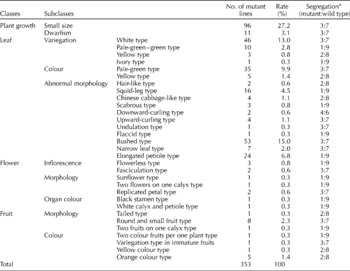
Mutant lines derived from Yuwol-cho have been constructed since 2009. A total of 3945 M2 mutant lines were used in this study (Table S2, available online). To evaluate the mutant lines, the phenotypic variations of 1480 M2 mutant lines (about 37.5% of the population) were screened (Table 1). For each mutant line, ten individuals were grown to carry out phenotypic evaluation.
List of phenotypic categories and mutant characteristics

a The number of progeny exhibiting wild-type or mutant phenotype in the M2 mutant lines is reported.
Phenotype screening in M2 mutant lines
Phenotypes were evaluated in M2 mutant lines. Phenotypic variations were characterized and categorized according to four classes and ten subclasses (Menda et al., Reference Menda, Semel, Peled, Eshed and Zamir2004; Minoia et al., Reference Minoia, Petrozza, D'Onofrio, Piron and Mosca2010). The various mutant phenotypes described were as follows: plant growth (small size and dwarfism), leaf development (variegation, colour and morphological changes), flower development (inflorescence, morphological and organ colour changes) and fruit development (morphological and colour changes).
Results and discussion
Classification of mutants
Among the 3945 M2 mutant lines, 1480 were screened to evaluate traits that could be useful for crop improvement. Phenotypic alterations were categorized into four classes and further subcategorized into ten subclasses (Table 1). The mutation frequencies in each category varied. Mutants were given names according to their phenotypic characteristics (Wang and Bosland, Reference Wang and Bosland2006), with new names being designated if there were no previous examples of similar phenotypes (Table S1, available online). Most of the mutant phenotypes segregated at a ratio of 1:3, indicating that they were inherited recessively (Table 1). In addition, 123 of the 1480 M2 lines exhibited pleiotropic phenotypes, in which more than one phenotypic trait was affected (Menda et al., Reference Menda, Semel, Peled, Eshed and Zamir2004). For example, downward-curling leaves and replicated petals with small round fruits were observed among the M2 mutant lines.
Mutants exhibiting plant growth and leaf abnormalities
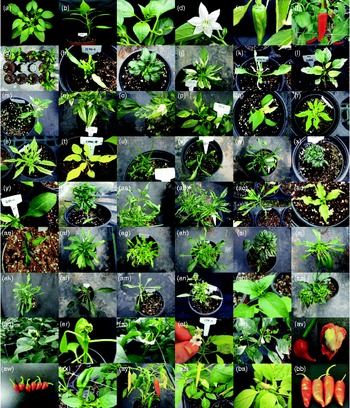
Among the 1480 M2 mutant lines, abnormal phenotypic variations were observed in 353 (24%) mutant lines compared with the wild type (Fig. 1(a)–(f)). The highest number of morphological variations was observed for leaf morphology. In the plant growth category, 96 M2 mutant lines were significantly shorter than the wild type, Yuwol-cho (Fig. 1(g)). Moreover, dwarf plants that exhibited retarded growth and generated no flowers were observed in 11 M2 mutant lines (Fig. 1(h) and (i)), similar to mutants reported by Daskalov (Reference Daskalov1973; Reference Daskalov1974).
Examples of various mutant phenotypes. (a)–(f) Wild type: horizontal and vertical whole plant, normal leaf, normal flower, immature fruit and mature fruit, (g) small plant, (h)–(i) dwarf plant, (j)–(q) variegated leaf: white, pale green–green, mottled yellow, and ivory colour, (r)–(t) leaf colour: pale green and yellow, (u)–(am) abnormal morphology: wiry mutant, squid-leg leaf, cabbage-like leaf, scabrous leaf, downward- and upward-curling leaf, flaccid, compact and fused leaf, narrow leaf, and elongated petiole leaf, (an)–(ap) inflorescence: flowerless and formation of floral clusters similar to the fasciculate mutant type, (aq)–(as) flower morphology: many petals and floral organs, two flowers on one calyx and replicated petals, (at) and (au) flower organ colour: black stamen and white calyx and petiole, (av)–(ax) fruit morphology: tailed fruit with no seed and abnormal ovary, small and round fruit, and two fruits on one calyx, and (ay)–(bb) fruit colour: orange and yellow fruits on one plant, variegation type in immature stage and orange, yellow and orange fruits.

Leaf colour changes and variegated patterning were observed in 100 M2 mutant lines. Among these, 60 mutant lines had mottled white, pale-green–dark-green, generally yellowish leaves, and a half-ivory-coloured leaf (Fig. 1(j)–(q)). Pale-green and yellow leaves were observed in 40 M2 mutant lines (Fig. 1(r)–(t)). There were 120 M2 mutant lines that exhibited abnormal leaf morphology. These included hair-like leaves, squid-leg leaves, Chinese cabbage-like leaves, scabrous leaves, downward- and upward-curling leaves, undulating leaves, wilting leaves, compact leaves, broad or narrow leaves, and elongated petiole leaves (Fig. 1(u)–(am)). Most of the lines exhibiting phenotypic variations in leaf morphology did not generate flowers and fruits, except for those with downward-curling leaves.
Mutants exhibiting abnormal flower or fruit development
Five distinct changes in flower characteristics were observed in the mutant lines. These included a flowerless type and differences in the number of flowers produced on one branch (Fig. 1(an)–(ap)). These phenotypes were similar to those of mutants reported by Van der Beek and Ltifi (Reference Van der Beek and Ltifi1990) and Elitzur et al. (Reference Elitzur, Nahum, Borovsky, Pekker, Eshed and Paran2009). There were also three floral organ phenotypes such as sunflower shape, two flowers per one calyx and replicated petals (Fig. 1(aq)–(as)), and two altered stamen colour mutants (black stamen and white calyx and petiole) were observed (Fig. 1(at)–(au)). In addition, tailed fruits, small and round fruits, and two fruits from one calyx were observed in ten M2 mutant lines (Fig. 1(av)–(ax)). Orange and yellow fruits, with variegation at the immature stage (variegated and pale-green fruits), were observed in eight M2 mutant lines (Fig. 1(ay)–(bb)).
In conclusion, we evaluated EMS-induced phenotypes in 1480 M2 mutant lines (approximately 37.5% of the total M2 mutant lines). The various mutant phenotypes can be used as materials for breeding and genetic studies. For example, the ivory variegation in leaves and dwarf plants can be used for generating ornamental plants, as well as the squid-leg leaves, Chinese cabbage-like leaves and hair-like leaves are useful for genetic studies. Specifically, Paran et al. (Reference Paran, Borovsky, Nahon and Cohen2007) reported that hair-like leaves (wiry leaf mutation) often occur in tomato (2% of total), but are rarely found in pepper. Nevertheless, two wiry mutant lines were observed in the mutant population evaluated in the present study. These examples could be used for either forward genetics using EMS mutant populations and phenotypic data or reverse genetics through a high-throughput TILLING platform in pepper. Therefore, the phenotypic data obtained in this study will contribute to the identification of novel genes controlling phenotypes related to crop improvement and genetic studies in C. annuum.
Supplementary material
To view supplementary material for this article, please visit http://dx.doi.org/10.1017/S1479262114000434
Acknowledgements
This study was supported by a grant from the Technology Development Program for Agriculture and Forestry (308020-05) and the Golden Seed Project, Ministry of Agriculture, Food and Rural Affairs (MAFRA), Ministry of Oceans and Fisheries (MOF), Rural Development Administration (RDA) and Korea Forest Service (KFS), Republic of Korea.