INTRODUCTION
Rice, which is a particularly thermophilic crop, is the most important source of calories for half of the world's population (Zhao & Fitzgerald Reference Zhao and Fitzgerald2013). Low temperatures affect not only rice yield but also grain quality and even its survival by affecting the physiological growth of crops and perturbing plant metabolism (Obata & Fernie Reference Obata and Fernie2012). Low temperatures reduce both sink activity and carbohydrate exports from leaves, which disrupts the balance of assimilated carbon, increasing the amount of carbohydrates within the leaf and root and, consequently, influencing respiration (Labate & Leegood Reference Labate and Leegood1989). Low temperatures also typically decrease the respiration rate (R) and production of adenosine triphosphate (ATP), which may be associated with changes in respiration pathways (Kurimoto et al. Reference Kurimoto, Millar, Lambers, Day and Noguchi2004; Atkin et al. Reference Atkin, Sherlock, Fitter, Jarvis, Hughes, Campbell, Hurry and Hodge2009; Karasawa et al. Reference Karasawa, Hodge and Fitter2012).
Two respiratory electron transport chain pathways exist in plant mitochondria, the cytochrome c oxidase (COX) pathway and the alternative oxidase (AOX) pathway. The alternative pathway is not coupled to hydrogen ion (H+) translocation and, consequently, is uncoupled from ATP production. Therefore, COX is the main pathway in the process of plant growth under normal conditions (Maxwell et al. Reference Maxwell, Wang and McIntosh1999). The exposure of plants to abiotic stress leads to changes in electron portioning between the two electron transport pathways (Ribas-Carbo et al. Reference Ribas-Carbo, Aroca, Gonzalez-Meler, Irigoyen and Sanchez-Diaz2000). It has been suggested that AOX is involved in the optimization of respiratory metabolism, which facilitates the continuous turnover of the tricarboxylic acid (TCA) cycle under changing developmental conditions (Li et al. Reference Li, Liang, Li, Duan, Li, Yang, Qin, Li, Wei and Yang2013). The other physiological role of AOX is to prevent the excess generation of reactive oxygen species, which can damage a wide range of macromolecules, leading to cell death (Vanlerberghe et al. Reference Vanlerberghe, Cvetkovska and Wang2009; Dinakar et al. Reference Dinakar, Abhaypratap, Yearla, Raghavendra and Padmasree2010a; Wang et al. Reference Wang, Rajakulendran, Amirsadeghi and Vanlerberghe2011). Moreover, several studies have demonstrated the existence of a close relationship between the AOX pathway and pyruvate (Pastore et al. Reference Pastore, Trono, Laus, Di Fonzo and Passarella2001; Dinakar et al. Reference Dinakar, Raghavendra and Padmasree2010b), which is a key metabolite and can ensure the functioning of the TCA cycle in mitochondria (Aliverdieva et al. Reference Aliverdieva, Mamaev, Lagutina and Sholtz2006). Increases in AOX activity correlates well with the increase in intracellular pyruvate levels, and decreased pyruvate levels also lead to decreased AOX protein levels, signifying the importance of pyruvate in activating AOX (Oliver et al. Reference Oliver, Lunn, Urbanczyk-Wochniak, Lytovchenko, van Dongen, Faix, Schmalzlin, Fernie and Geigenberger2008; Dinakar et al. Reference Dinakar, Raghavendra and Padmasree2010b).
In terrestrial ecosystems, symbiotic associations between plant roots and arbuscular mycorrhizal fungi (AMF) are usually ubiquitous (Parniske Reference Parniske2008). This symbiosis is more often than not thought of in functional terms as a straightforward exchange of plant carbohydrates for fungal phosphorus (P) and nitrogen (N), which subsequently has been shown to increase plant P and N absorption (Perez-Moreno & Read Reference Perez-Moreno and Read2001; Govindarajulu et al. Reference Govindarajulu, Pfeffer, Jin, Abubaker, Douds, Allen, Bucking, Lammers and Shachar-Hill2005). Mycorrhizal colonization has also been shown to increase resistance of plants to various stresses (Campos-Soriano et al. Reference Campos-Soriano, Garcia-Martinez and San Segundo2012; Lee et al. Reference Lee, Muneer, Jung, Avice, Ourry and Kim2012b; Liu et al. Reference Liu, Li, Hou, Zhu, Rai, He and Tian2013), and higher root respiration has also been observed in arbuscular mycorrhizal (AM) associations under stress conditions (Valentine & Kleinert Reference Valentine and Kleinert2007; Atkin et al. Reference Atkin, Sherlock, Fitter, Jarvis, Hughes, Campbell, Hurry and Hodge2009). In non-mycorrhizal plants, root respiration varies in proportion to plant tissue nutrient concentrations, for instance N and P (Atkinson et al. Reference Atkinson, Hellicar, Fitter and Atkin2007; Valentine & Kleinert Reference Valentine and Kleinert2007). Accordingly, as the availability of mineral nutrient concentrations change, the AM root respiration rate (R) is expected to change because of an increased nutrient absorption rate (Hughes et al. Reference Hughes, Hodge, Fitter and Atkin2008). However, there are few reports that estimate the activity of AOX and COX pathways in mycorrhizal and non-mycorrhizal plants, particularly under different biotic and abiotic stress conditions.
The establishment and functioning of AM symbiosis requires a high degree of coordination between the two partners, which is based on a finely regulated molecular dialogue of signalling molecules, of which strigolactones have become essential cues (Akiyama & Hayashi Reference Akiyama and Hayashi2006; Requena et al. Reference Requena, Serrano, Ocon and Breuninger2007). Strigolactones are derived from carotenoids, and DWARF 27 (D27), a β-carotene isomerase, converting all-trans-β-carotene into 9-cis-β-carotene, is involved in the initial step of strigolactone biosynthesis (Lin et al. Reference Lin, Wang, Qian, Yan, Meng, Fu, Yan, Jiang, Su, Li and Wang2009; Alder et al. Reference Alder, Jamil, Marzorati, Bruno, Vermathen, Bigler, Ghisla, Bouwmeester, Beyer and Al-Babili2012). Two carotenoid cleavage dioxygenases, CCD7 (D17 in rice) and CCD8 (D10 in rice), are involved in the further carotenoid cleavage to produce the strigolactones intermediate carlactone (Matusova et al. Reference Matusova, Rani, Verstappen, Franssen, Beale and Bouwmeester2005; de Saint Germain et al. Reference de Saint Germain, Bonhomme, Boyer and Rameau2013). Moreover, the MORE AXILLARY GROWTH 1 (MAX1) gene, encoding a cytochrome P450, is also required for strigolactone biosynthesis, probably acting after carlactone formation, but is the only strigolactone biosynthetic enzyme left with an unknown function (Booker et al. Reference Booker, Sieberer, Wright, Williamson, Willett, Stirnberg, Turnbull, Srinivasan, Goddard and Leyser2005; Ruyter-Spira et al. Reference Ruyter-Spira, Al-Babili, van der Krol and Bouwmeester2013). A recent report demonstrated that, under nutrient deficiency, the host plant could increase the production of strigolactone to attract AMF and thus promote fungal development and symbiotic relationship establishment (López-Ráez et al. Reference López-Ráez, Pozo and García-Garrido2011). Research on the mechanism by which AMF alleviates salt stress also identified the important role of strigolactones in AMF symbiosis, which act as a ‘cry for help’ signal from the host (Aroca et al. Reference Aroca, Ruiz-Lozano, Zamarreno, Paz, Garcia-Mina, Pozo and López-Ráez2013). The studies mentioned above demonstrated the crucial role of strigolactone in the AM symbiont under abiotic stress. However, there currently are no known studies regarding the role of strigolactone under low temperature.
A major aspect of AMF-enhanced plant stress resistance is enhanced N and P absorption (Lee et al. Reference Lee, Muneer, Avice, Jung and Kim2012a; Liu et al. Reference Liu, Li, Hou, Zhu, Rai, He and Tian2013), in which the energy process is an integral component. Therefore, it is particularly important to clarify the changes in the respiration metabolism capacity of mycorrhizal plants under low-temperature stress. Also, the mechanisms for these changes, particularly the molecular mechanism that regulates and balances the COX and AOX pathways under low-temperature stress after being infected by AMF, have been unclear to date. In reference to these problems, a pot experiment was conducted to verify the following hypotheses: (1) under low-temperature stress, the host plant first sends distress signalling molecules to AMF, which promotes mutualistic relationship establishment. Subsequently, AMF increases the respiratory sink strength of the host, and accelerates the TCA cycle, consequently increasing ATP production. (2) Meanwhile, AMF might enhance either the COX or AOX pathways or both pathways, and accordingly help the resistance of the host plant to low-temperature stress.
MATERIALS AND METHODS
Arbuscular mycorrhizal fungi and soil materials
The AMF that was used for inoculation (Glomus intraradices, BGC BJ09) was provided by the Institute of Plant Nutrition and Resource, Beijing Academy of Agriculture and Forestry in China. Mycorrhizal inoculation was achieved by adding 25 g inoculum with a spore density of 35 000/20 ml to each pot; 25 g of sterilized inoculum and 10 ml of filtered fungal inoculum suspension for inoculation were added to the control pots.
The plant growth substrate was a soil mixture of one part sand, one part vermiculite and one part perlite (v/v/v); the latter two materials were added to increase the porosity of the mixture. Each pot (160 mm high×130 mm wide) contained 1 kg of mixed soil (pH 5·2), containing 6·3, 17·1 and 107·5 mg/kg available N, P and potassium (K), respectively. The soil was autoclaved for 2 h at 121 °C and pots were sterilized with 75% alcohol before filling.
Plant growth conditions and temperature treatment
Uniform, full rice seeds were soaked in 0·5% sodium hypochlorite and 75% alcohol for 5 and 30 min, respectively, for sterilization. Seeds were then rinsed three times with double-distilled water and kept in an incubator at 20/30±2·0 °C (night/day) for 10 days before being transplanted into pots. Six uniform rice seedlings were transplanted into each pot (20 pots in total) and the pots were arranged randomly in a block design in a growth chamber that was set to a 16 h light/8 h dark cycle at 25±1·5 °C with light provided by fluorescent lamps at 2000 lx light intensity and with 70% relative humidity. Pots were watered every other day with c. 100 ml Hoagland solution, modified for N and P to 75% of normal concentration to create conditions of insufficient N and P to promote mycorrhizal fungal colonization.
To investigate the effect of temperature on rice growth and development, temperature treatments were applied after 90 days of growth to both the mycorrhizal and non-mycorrhizal plants at the panicle initiation stage (GS 30 on the BBCH scale: Meier Reference Meier2001), which is the stage most sensitive to low temperature. Two temperature treatments, 15±1·5 and 25±1·5 °C, were applied (Liu et al. Reference Liu, Li, Hou, Zhu, Rai, He and Tian2013) and sustained for 7 days before harvest. Each treatment was performed with five biological replicates using a completely random design.
Plant physiological parameters and mycorrhizal colonization rate measurement
After harvesting, samples were rinsed with distilled water, dried with filter paper and root length of each plant measured. The relative water content (RWC) of the plant roots was determined using a gravimetric approach. Briefly, recently picked roots were weighed to determine their fresh weight (FW), soaked in water for 4–6 h and reweighed to determine their turgid fresh weight (TW). The roots were then dried at 105 °C for 30 min and 70 °C for 24 h to determine the dry weight (DW). The RWC of the roots was then calculated as follows:
 $${\rm RWC}\left( \% \right) = \left( {{\rm FW} - {\rm DW}} \right)/\left( {{\rm TW} - {\rm DW}} \right) \times {\rm 1}00$$
AM colonization was calculated according to Phillips & Hayman (Reference Phillips and Hayman1970). Rice root segments were cut into 1·0 cm pieces and stained with trypan blue. Mycorrhizal colonization was then determined according to Trouvelot et al. (Reference Trouvelot, Fardeau, Plenchette, Gianinazzi and Gianinazzapearson1986).
Detection of soluble sugar, starch concentrations, total N and P, and chlorophyll
The soluble sugar concentration was determined based on the method of Fuentes et al. (Reference Fuentes, Baltazar, Merca, Ismail and Johnson2010). A 500 mg sample of dry tissue was extracted with 80% ethanol at 80 °C for 10 min in a final volume of 50 ml and then filtered through filter paper (Whatman, 1001-090), of which 1 ml was collected and combined with 5 ml of anthrone chromogenic reagent (100 mg anthrone plus 100 ml 72% H2SO4). The absorption at 620 nm of the sample was measured using ultra-violet spectrophotometer with glucose as standard.
The starch concentration was determined by enzymatic hydrolysis following the method of Fuentes et al. (Reference Fuentes, Baltazar, Merca, Ismail and Johnson2010). The residue that was obtained after the analysis of soluble sugars was oven-dried at 70 °C overnight. A sample of c. 200 mg was added to acetate buffer pH 4·6, placed in a boiling-water bath for 3 h, and then 2 ml of acetate buffer pH 4·6 and 1 ml of amyloglucosidase solution were added. The mixture was incubated in a water bath at 37 °C for 24 h. Approximately 5 ml of the anthrone reagent was added to a portion of the extract, and the absorbance of each sample was read at 630 nm. The quantity of glucose that was released from the enzymatic hydrolysis was determined from a standard curve. The values for starch concentration were determined by multiplying absorbance measurements by a factor of 0·90.
The measurement of total N and P was performed according to Nelson & Sommers (Reference Nelson and Sommers1973) and analysed using a SmartChem automated discrete analyser (AMS, Italy). The total amount of N and P per pot was calculated by the percentage of N and P and the dry biomass of the roots (mg/pot DW).
Rice leaves were collected and fresh weight was determined. Chlorophyll was extracted with ethanol and its concentration was assayed based on the absorbance of the extract at 645 and 663 nm (Wintermans & de Mots Reference Wintermans and de Mots1965).
Detection of adenosine triphosphate concentration
The ATP concentration was measured in the roots of plants grown under normal and low-temperature conditions following the method of Kaklewski et al. (Reference Kaklewski, Nowak and Ligocki2008) with slight modifications. For the ATP assay, 1 g fresh tissue was ground with a mortar with 3 ml 1·5 m HClO4 and then centrifuged at 20 000 g. The supernatant was neutralized with 5 m KOH. Before the assay, the extract was diluted with Hepes buffer, pH 7·4. The ATP concentration was measured, in five replicates, using an ATP monitoring kit (LKB Wallac, Turku, Finland) and a Lumat LB 9570 luminometer.
High-performance liquid chromatography analysis for pyruvate
A 0·5 g sample of fresh roots was adequately ground in 1·0 ml of hydrochloric acid (HCl) (containing 0·1 mm EDTA-Na2) with a small amount of quartz sand and homogenized after adding 2·5 ml H2O. The homogenate was collected in a 5 ml centrifuge tube, incubated at 80 °C for 10 min in a water bath, and then kept in an ice bath for 5 min. The mix was centrifuged at 12 000 g at 4 °C for 10 min. The supernatant was filtered using a 0·45 μm membrane filter, collected in a 1·5 ml Eppendorf tube, and placed on ice. In total, 50 μl of filtrate was added to two Eppendorf tubes, which were marked as tubes A and B. Then, 25 μl of 0·2 m sodium hydroxide (NaOH), 40 μl of 10 mm phenylhydrazine hydrochloride and 35 μl of 0·1 m phosphate buffer (pH 7·0, a mixture of dipotassium phosphate (K2HPO4) and monopotassium phosphate (KH2PO4)) were added to tube A and incubated for 20 min. Phosphate buffer was replaced by 35 μl glycolate oxidase in tube B and incubated at 30 °C for 10 min in a water bath.
Pyruvate was determined by high-performance liquid chromatography (Waters) using a C18 column (Waters 3·9×150 mm, 10 μm) at 35 °C. The wavelength was set to 324 nm, with a flow rate of 1·5 ml/min and an injection volume of 10 μl. Methanol and phosphate buffer (13 mm KH2PO4; 1 mm K2HPO4, pH 6·0), in a volume ratio of 5 : 95, were used as the solvents. The pyruvate concentration was the difference between tubes B and A.
Gene expression by using quantitative real-time polymerase chain reaction
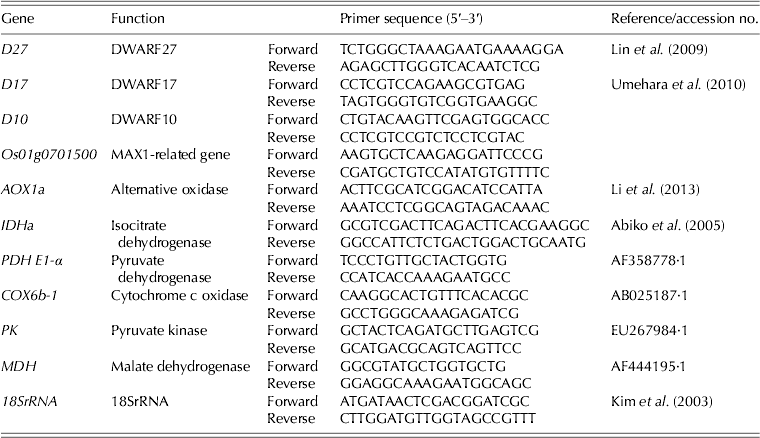
Total RNA that was used for quantitative real-time polymerase chain reaction (qRT-PCR) was extracted from c. 100 mg of frozen root samples using Trizol reagent plus an RNA Purification Kit (Invitrogen, Carlsbad, CA, USA), which included the DNase treatment, according to the manufacturer's protocol. Total RNA was quantified using a spectrophotometer following electrophoresis on a 0·8% (w/v) agarose gel to assess the concentration and integrity of the sample. Approximately, 1 μg of total RNA was transcribed into cDNA using Superscript III Reverse Transcriptase (Invitrogen, Karlsruhe, Germany). The quality of the cDNA was assessed through qRT-PCR using primers for the actin-1 and 18SrRNA genes.
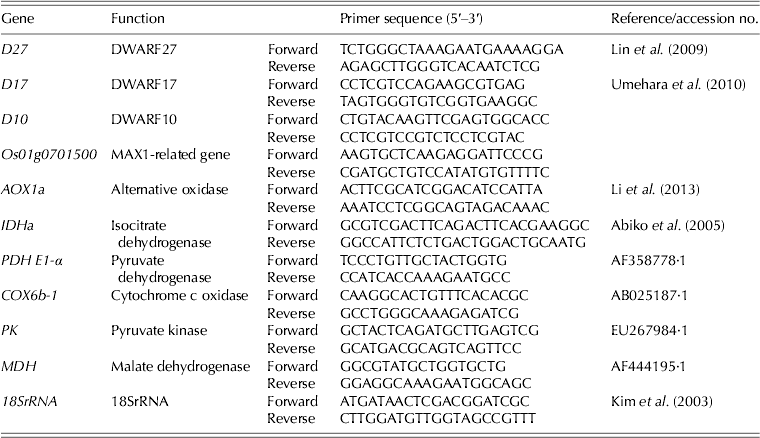
The qRT-PCR was performed using an Agilent M×3000P Analyser (Agilent Technologies Ltd., Santa Clara, CA, USA) in a 15 μl reaction volume (1 μl cDNA and 2 μl primer mix) and 7·5 μl SYBR Green Master Mix (Agilent Technologies Ltd., Santa Clara, CA, USA). It was performed on three independent biological samples with three replicate analyses. Primers for qRT-PCR were designed using the software PrimerExpress (Version 5.0, Applied Biosystems) or were selected from previous studies (Kim et al. Reference Kim, Nam, Kim, Kim and Chang2003; Abiko et al. Reference Abiko, Obara, Ushioda, Hayakawa, Hodges and Yamaya2005; Umehara et al. Reference Umehara, Hanada, Magome, Takeda-Kamiya and Yamaguchi2010; Li et al. Reference Li, Liang, Li, Duan, Li, Yang, Qin, Li, Wei and Yang2013), and all primer sequences are shown in Table 1. The sequences for all primers were checked using the Basic Local Alignment Search Tool against the databases of the National Centre for Biotechnology Information (http://www.ncbi.nlm.nih.gov/). For rice, 18S rRNA was used as the reference gene (Kim et al. Reference Kim, Nam, Kim, Kim and Chang2003). The comparative ΔΔCT method was used to measure changes in the expression of selected genes relative to untreated controls (Winer et al. Reference Winer, Jung, Shackel and Williams1999). The formula for the calculation is
 $${\rm Relative}\ {\rm expression = 2}^{ - \left[ {\Delta \Delta C_t} \right]}$$
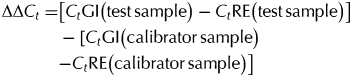 $$\eqalign{\Delta \Delta C_t = & \left[ {C_t {\rm GI} \left( {{\rm test}\,{\rm sample}} \right) - C_t {\rm RE}\left( {{\rm test}\,{\rm sample}} \right)}\right] \cr & - [C_t {\rm GI}\left( {{\rm calibrator}\,{\rm sample}} \right) \cr & \left. { - C_t {\rm RE}\left( {{\rm calibrator}\,{\rm sample}} \right)} \right]} $$
where C t is the cycle number at which the fluorescence generated within a reaction crosses the threshold line; GI is the gene to be detected; and RE is the reference gene. The calibrator sample is a sample used as the basis for comparative expression results (treatment of non-mycorrhizal rice at 25 °C in the current experiment).
List of primers used for quantitative real-time polymerase chain reaction
Statistical analysis
Statistical analyses were performed using SPSS version 15·0 for the means and s.d. Biochemical and physiological measurements were subject to an ANOVA, and significant differences between individual means were determined using Duncan's test at the 5% confidence level based on three biological replicates for each treatment.
RESULTS
Gene expression pattern of the synthesis of strigolactone of rice at low temperature
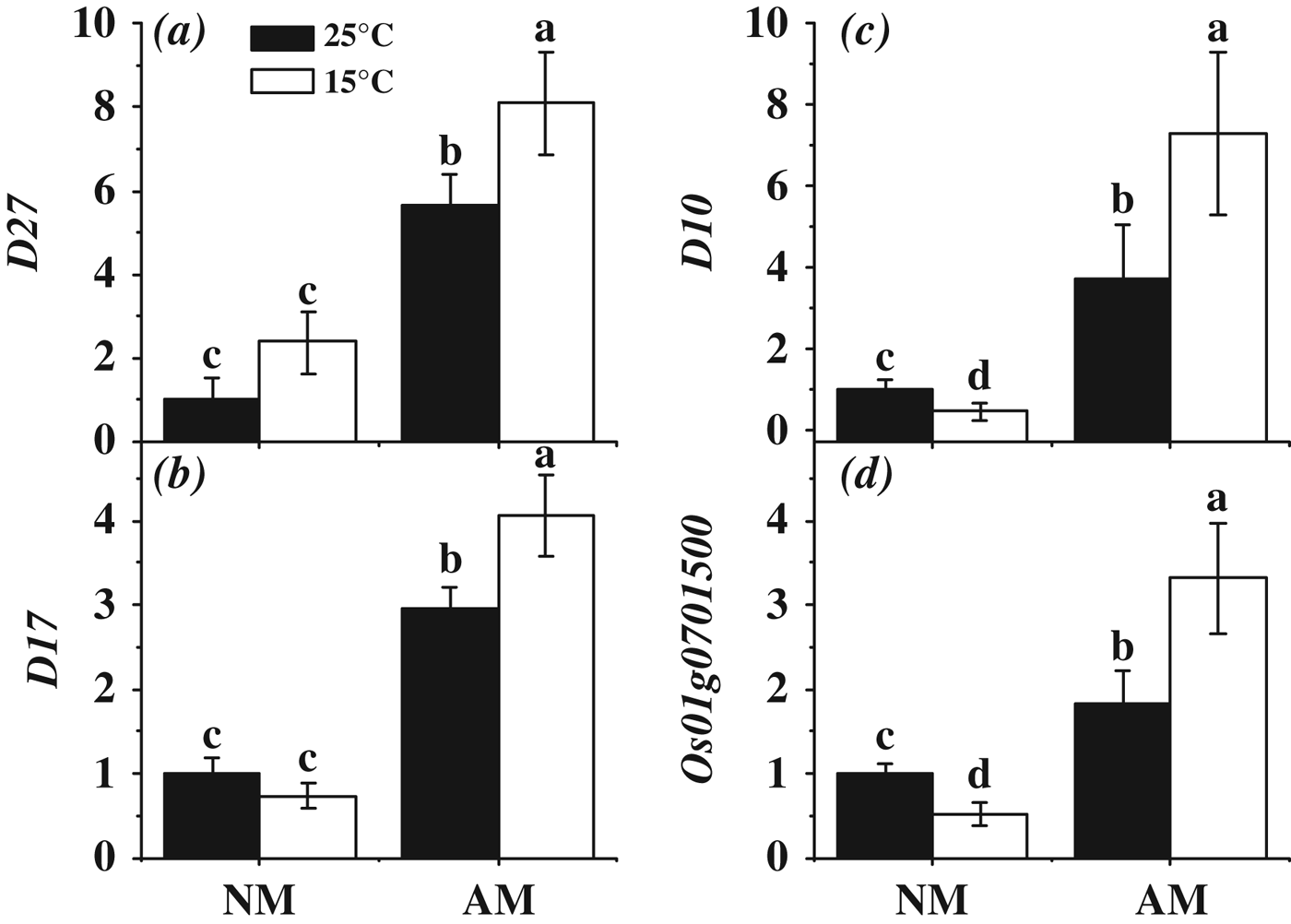
To investigate the synthesis of strigolactone, the transcript levels of DWARF (D) and MORE AXILLARY GROWTH 1 (MAX1) genes were measured by qRT-PCR: D27, D17, D10 and MAX1-related gene (Os01g0701500) were affected significantly (P<0·05) by the presence of AMF in the current experiment. Infection by AMF increased expression of these genes in host roots at normal temperature (25 °C) (Fig. 1). Under low-temperature stress (15 °C), the expression levels of D27 and D17 in non-mycorrhizal rice roots were similar to the level at normal temperature, while the transcript levels of D10 and Os01g0701500 were lower than that at the normal temperature. In contrast, the D27, D17, D10 and Os01g0701500 expression levels were increased significantly (P<0·05) in mycorrhizal rice roots at low temperature in comparison with the normal temperature and expression levels also remained higher (P<0·05) than in non-mycorrhizal rice roots.
Relative expression levels of D27 (a), D17 (b), D10 (c) and Os01g0701500 (d) in rice roots (Oryza sativa) treated with different temperatures 25 °C (black bars) and 15 °C (white bars). AM: mycorrhizal rice; NM: non-mycorrhizal rice, where the arbuscular mycorrhizal fungi (AMF) were Glomus intraradices. Values are the means±s.e. of three biological replicates. Duncan's multiple-range test was used to identify significant differences at P<0·05.

Arbuscular mycorrhizal fungi enhanced the accumulation of the respiration substrate pool
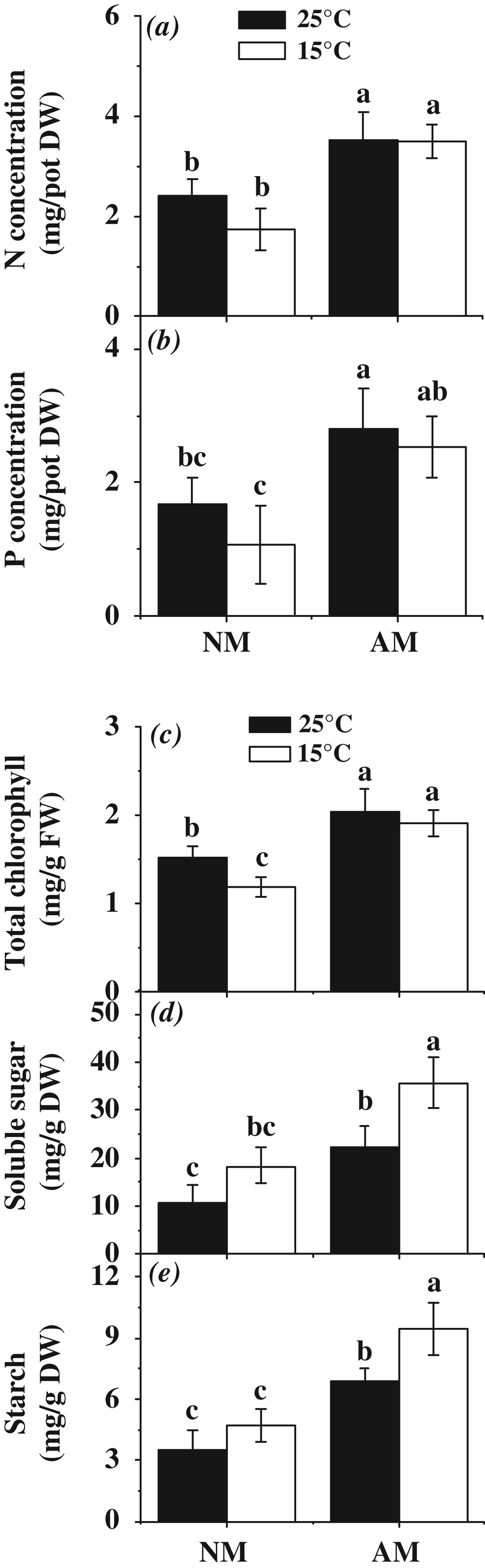
Because N and P play crucial roles in plant photosynthesis, the concentrations of N and P under different temperatures in mycorrhizal and non-mycorrhizal rice were determined. It was found that mycorrhizal rice roots contained higher N and P concentrations than non-mycorrhizal rice under both normal and low-temperature conditions, but the difference was more obvious at low temperature (Figs 2(a) and (b)). In addition, quantitative assay of chlorophyll concentration in rice leaves showed that AMF colonization enhanced chlorophyll accumulation and maintained relatively higher concentration under low-temperature stress in comparison with that in non-mycorrhizal rice leaves at low temperature (Fig. 2(c)).
Concentrations of N (a) and P (b), total chlorophyll concentration (c), soluble sugar (d) and starch (e) concentration in rice roots (O. sativa) that were treated with different temperatures 25 °C (black bars) and 15 °C (white bars). DW: dry weight; AM: mycorrhizal rice; NM: non-mycorrhizal rice, where the AMF were G. intraradices. Values are the means±s.e. of five biological replicates. Duncan's multiple-range test was used to identify significant differences at P<0·05.
Sugar and starch are the main substrates of respiration: the current research investigated the soluble sugar and starch concentrations under different temperature conditions. The results demonstrated that AMF colonization significantly (P<0·05) increased the soluble sugar and starch concentrations of rice roots at the normal temperature in comparison with non-colonized rice roots (Figs 2(d) and (e)). Although low-temperature stress increased the soluble sugar and starch concentrations in both non-mycorrhizal and mycorrhizal rice roots, their concentrations remained significantly (P<0·05) higher in rice roots that were colonized by AMF, which suggested that AMF-enhanced rice root respiration by increasing its respiration substrate concentrations under normal and low-temperature conditions.
Changes in indexes for the tricarboxylic acid cycle under different temperatures and arbuscular mycorrhizal fungi conditions
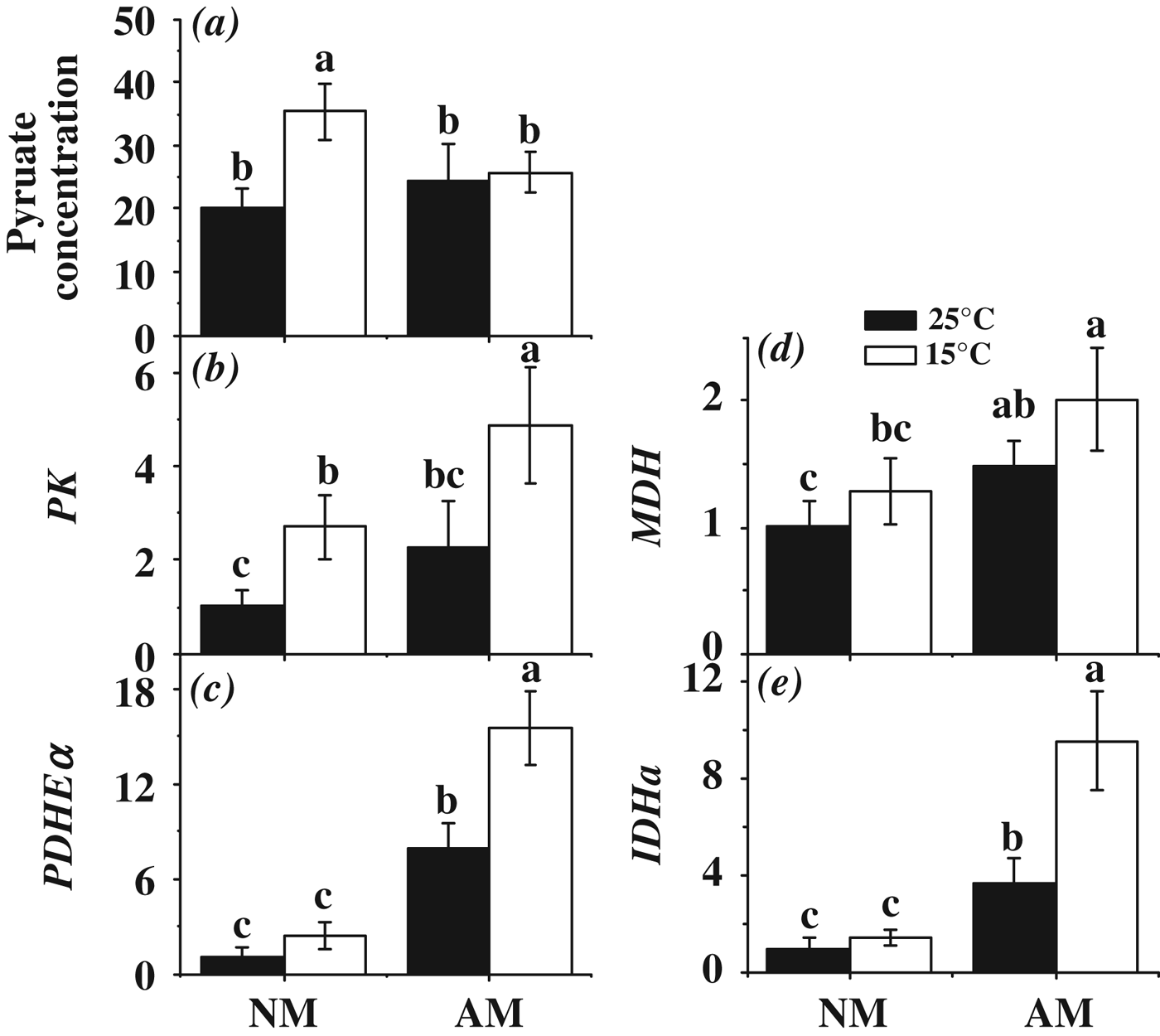
The TCA cycle is the key process of respiration with much energy (ATP) production. The pyruvate concentration, which is one of the most important substrates of the TCA cycle, and the expression of key genes of pyruvate metabolism and the TCA cycle, were investigated. No significant change was found in pyruvate concentration at normal temperature between rice colonized with AMF and without AMF, whereas, under the low-temperature condition, the pyruvate concentration increased significantly (P<0·05) in non-mycorrhizal rice roots but was unchanged in mycorrhizal rice roots (Fig. 3(a)). The expression of pyruvate kinase (PK), which is a key enzyme in pyruvate synthesis, demonstrated that AMF improved the synthesis of pyruvate, especially under low-temperature conditions (Fig. 3(b)), and enhanced the degradation of pyruvate as shown in the data for pyruvate dehydrogenase Eα (PDHEα) expression (Fig. 3(c)). Furthermore, the low temperature resulted in the increased expression of PK and PDHEα in mycorrhizal rice roots, whereas PDHEα expression level was unchanged in non-mycorrhizal roots, which resulted in higher pyruvate concentration at low temperature.
Pyruvate concentration (mg/g FW) (a), relative expression level of pyruvate kinase (b), pyruvate dehydrogenase Eα (c), malate dehydrogenase (d) and isocitrate dehyhydrogenase a (e) in rice roots (O. sativa) that were treated with different temperatures of 25 °C (black bars) and 15 °C (white bars). FW: fresh weight; AM: mycorrhizal rice; NM: non-mycorrhizal rice, where the AMF were G. intraradices. Values are the means±s.e. of three biological replicates. Duncan's multiple-range test was used to identify significant differences at P<0·05.
Expression levels of genes for the key enzymes of the TCA cycle, malate dehydrogenase (MDH) and isocitrate dehyhydrogenase a (IDHa) were higher in mycorrhizal rice roots than that in non-mycorrhizal rice roots at the normal temperature (Figs 3(d) and (e)). Moreover, the expression of MDH and IDHa in mycorrhizal rice roots remained relatively high under low-temperature stress, particularly the expression level of IDHa.
Differences in indexes for the electron transport chain in non-mycorrhizal and mycorrhizal rice under low-temperature stress
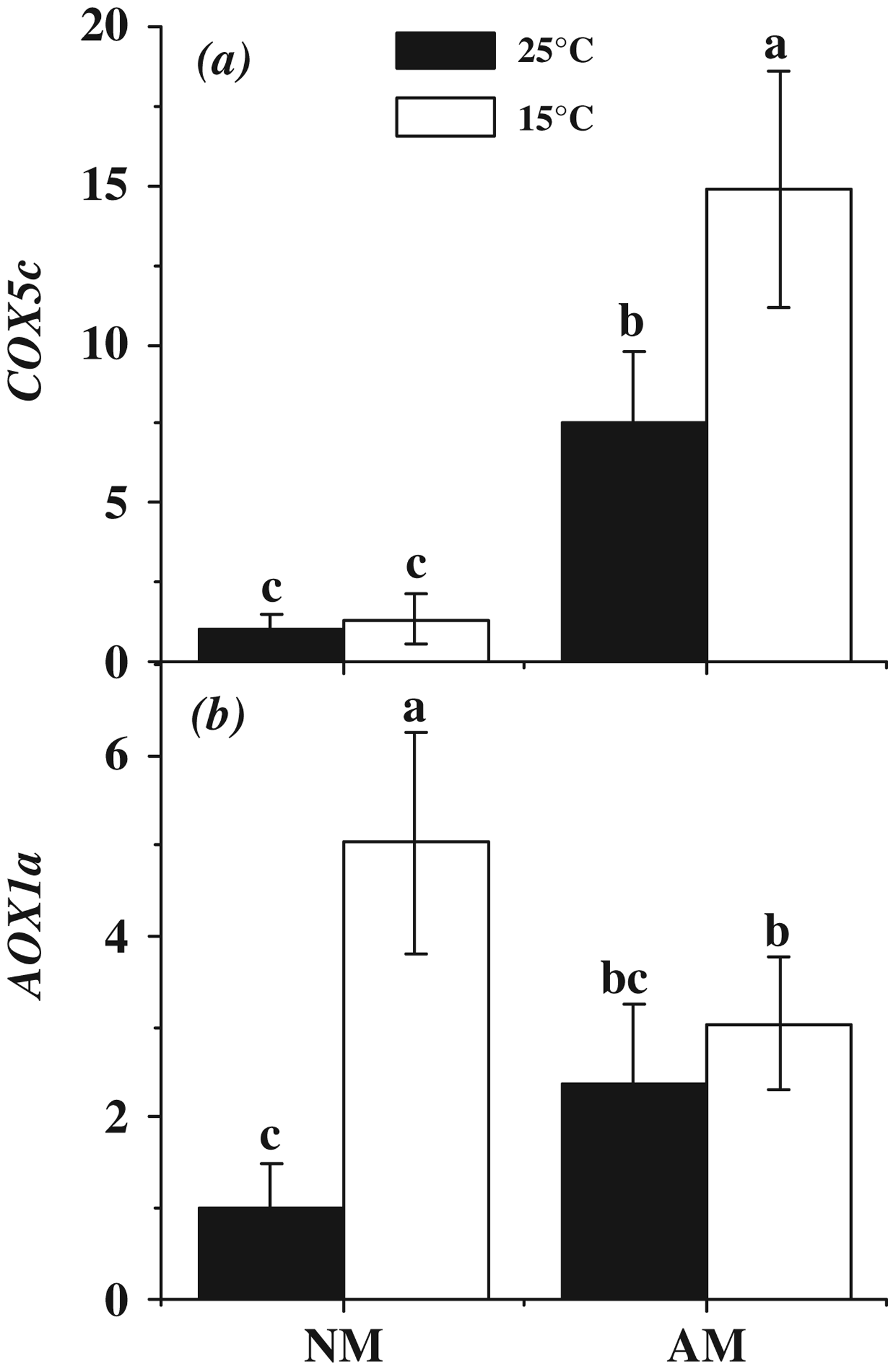
The two electron transport pathways that exist in higher plants are controlled by cytochrome c oxidase (COX) and AOX, respectively. The expression levels of these two genes were examined, and results showed that AMF increased COX5c expression levels at normal temperature (Fig. 4(a)). In addition, under the low-temperature condition, the expression of COX5c was significantly (P<0·05) increased in mycorrhizal rice roots and unchanged in non-mycorrhizal rice roots. However, the expression of AOX1a in non-mycorrhizal rice roots was notably increased due to the effect of low-temperature stress and higher than that in mycorrhizal rice roots (Fig. 4(b)). In contrast, AMF infection did not affect the expression of AOX1a under low-temperature stress.
Relative expression levels of COX5c (a) and AOX1a (b) in rice roots (O. sativa) that were treated with different temperatures of 25 °C (black bars) and 15 °C (white bars). AM: mycorrhizal rice; NM: non-mycorrhizal rice, where the AMF were G. intraradices.. Values are the means±s.e. of three biological replicates. Duncan's multiple-range test was used to identify significant differences at P<0·05.
Arbuscular mycorrhizal fungi increased adenosine triphosphate concentration in the host under low-temperature stress
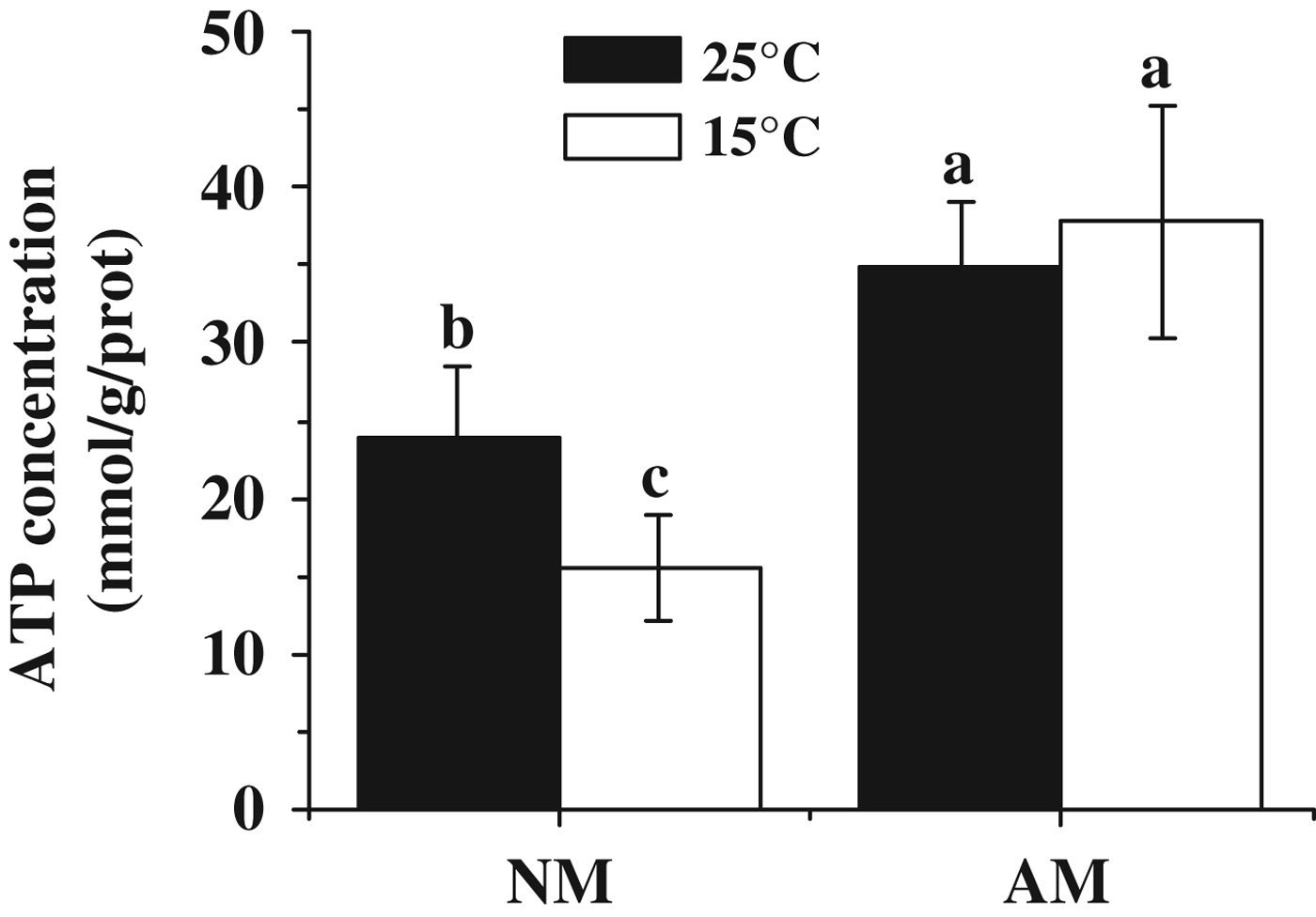
The current results demonstrated that the existence of AMF affects the concentration of ATP in the host plant (Fig. 5). Mycorrhizal rice roots contained higher ATP concentration under both normal and low-temperature conditions. Low-temperature stress had a different effect on ATP production in mycorrhizal and non-mycorrhizal rice roots; for non-mycorrhizal rice roots, ATP production declined at the low temperature, whereas there was no difference between normal and low temperature in mycorrhizal rice roots. This result suggests that AMF could help the host maintain relatively high ATP production under stress conditions.
Adenosine triphosphate concentration in rice roots (O. sativa) that were treated with different temperatures of 25 °C (black bars) and 15 °C (white bars). AM: mycorrhizal rice; NM: non-mycorrhizal rice, where the AMF were G. intraradices. Values are the means±s.e. of five biological replicates. Duncan's multiple-range test was used to identify significant differences at P<0·05.
Changes in plant physiological parameters under low-temperature stress
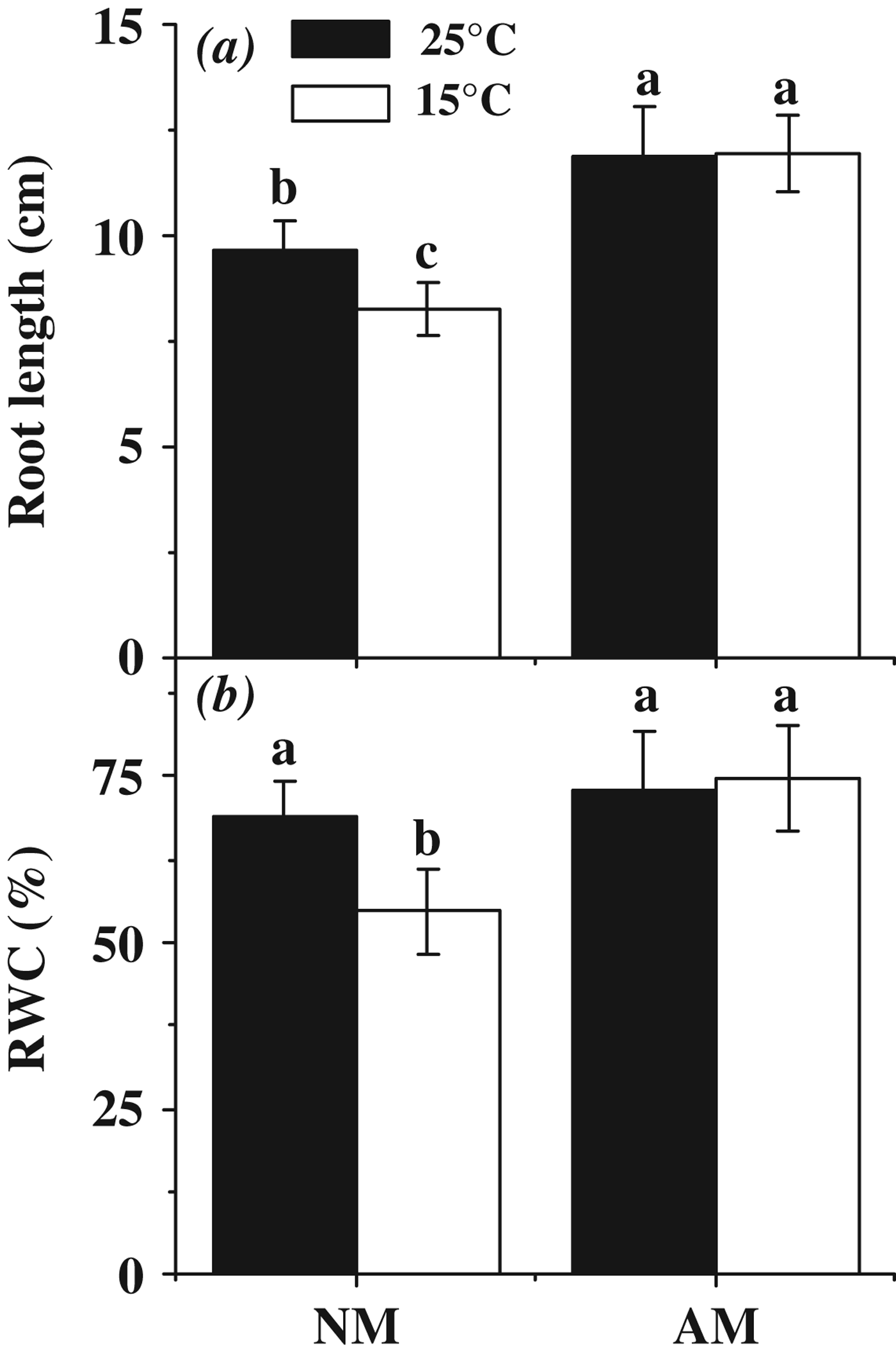
Colonization by AMF significantly (P<0·05) increased the growth of rice roots at both normal and low temperatures. The low-temperature stress reduced the growth of non-mycorrhizal rice roots. In contrast, the root length of mycorrhizal rice was virtually identical to those from the normal temperature condition (Fig. 6(a)). Furthermore, AMF colonization also improved the root relative water concentration which was more noticeable at the low temperature. Although the low-temperature stress notably decreased the RWC in non-mycorrhizal rice roots that of mycorrhizal rice remained unchanged (Fig. 6(b)). Regarding AMF colonization, the results demonstrated that the root colonization rate of AMF was c. 43·4–47·8% and that temperature had no effect on root colonization (data not shown).
Root length (a) and relative water content (b) in rice roots (O. sativa) treated with different temperatures of 25 °C (black bars) and 15 °C (white bars). AM: mycorrhizal rice; NM: non-mycorrhizal rice, where the AMF were G. intraradices. Values are the means±s.e. of five biological replicates. Duncan's multiple-range test was used to identify significant differences at P<0·05.
DISCUSSION
Arbuscular mycorrhizal fungi are known as an effective measure that helps to increase the resistance of host plants to low-temperature conditions. Although there has been significant evidence regarding the characterization of changes in plant respiration under low-temperature conditions in non-mycorrhizal and mycorrhizal plants and the majority of studies have elucidated the positive effect of AMF on host respiration, the deeper mechanisms remain to be demonstrated.
Arbuscular mycorrhizal fungi increased host respiration substrates in response to low-temperature stress
Arbuscular mycorrhizal symbiosis is a mutualistic association that has been established between AMF and most terrestrial plants, and this association is recognized as a key step in the evolution from aquatic to terrestrial plants. Strigolactones are a new class of plant hormones that are exuded into the soil, where they act as key host-detection signals for AMF, not only for stimulating their metabolism and hyphal branching but also as germination stimulants for the seeds of root parasitic plants (López-Ráez et al. Reference López-Ráez, Pozo and García-Garrido2011). An increase in the production of strigolactone has been suggested under salt stress in mycorrhizal plants, which probably further stimulates AM fungal development and symbiosis, thus overcoming the stress (Aroca et al. Reference Aroca, Ruiz-Lozano, Zamarreno, Paz, Garcia-Mina, Pozo and López-Ráez2013). Of five MAX1-related genes reported including Os01g070090, Os01g0701400, Os01g0701500, Os02g0221900 and Os06g0565100, it was chosen in the current study to assay the expression of Os01g0701500 because it was phosphate-starvation inducible (Umehara et al. Reference Umehara, Hanada, Magome, Takeda-Kamiya and Yamaguchi2010). The results of strigolactone biosynthetic gene expression demonstrated that the expression levels of D27, D17, D10 and MAX1-related genes were rapidly increased under low-temperature stress in mycorrhizal rice roots, suggesting the biosynthesis of strigolactone is positive in mycorrhizal plants under low-temperature stress and that strigolactone might play a crucial signalling role in AMF-enhanced rice cold tolerance.
Nitrogen is important for the growth of plants because it is one of the basic elements for the synthesis of enzymes and chlorophyll. As a macro-element, P participates in the establishment of healthy physiological growth and is the key component of biological cell life material, such as nucleic acids and nucleoproteins, as well as ATP. In the current study, the concentrations of N and P was examined and results demonstrated that AMF increased N and P absorption under stress conditions, which is consistent with the results of previous studies (Lee et al. Reference Lee, Muneer, Avice, Jung and Kim2012a; Liu et al. Reference Liu, Li, Hou, Zhu, Rai, He and Tian2013).
Almost 0·20 of host plant photosynthetically fixed carbon was transferred to the AM fungus, so mycorrhizal roots might contain higher levels of soluble sugar and starch, even under high respiration conditions, in comparison with non-mycorrhizal roots (Jakobsen & Rosendahl Reference Jakobsen and Rosendahl1990; Liu et al. Reference Liu, Li, Hou, Zhu, Rai, He and Tian2013). These increased levels of carbohydrates are used both for the roots’ respiration and are transferred to AMF for the nutrient exchange between both symbiotic sides. Soluble sugar and starch, which are the main carbohydrates produced in photosynthesis, are important substrates of respiration. In the present study, total chlorophyll, soluble sugar and starch concentrations were measured and it was found that mycorrhizal rice had higher total chlorophyll, soluble sugar and starch concentrations than non-mycorrhizal rice when exposed to low-temperature stress, which suggested that the existence of AMF improves host photosynthesis and increases the C pool strength for respiration. Therefore, it can be concluded that under low-temperature stress, AMF might first receive a ‘cry for help’ signal from the host, and subsequently promote increased host photosynthesis, which results in an increased supply of substrates for respiration.
Arbuscular mycorrhizal fungi affect on host respiration under low-temperature stress
Respiration can be divided into three main pathways: glycolysis, the mitochondrial TCA cycle and mitochondrial electron transport. Low temperature decreases photosynthesis and respiration in crops, and there is a strong positive interaction between the phenomena of photosynthesis and respiration (Nunes-Nesi et al. Reference Nunes-Nesi, Sulpice, Gibon and Fernie2008). The existence of AMF could enhance host plant respiration and thereby assist host plants to better tolerate a stressful environment (Karasawa et al. Reference Karasawa, Hodge and Fitter2012). However, the changes in pyruvate metabolism and in the TCA cycle in mycorrhizal plants under low-temperature stress have been seldom investigated. In the present study, the pyruvate concentration and the relative expression of genes related to pyruvate metabolism were measured. Interestingly, there was lower pyruvate concentration in mycorrhizal rice roots than in non-mycorrhizal rice under low-temperature conditions. Meanwhile, it was found that the expression levels of PK and PDHEα in mycorrhizal rice roots were both higher than in non-mycorrhizal rice under low-temperature conditions. Lower pyruvate concentration in mycorrhizal rice than non-mycorrhizal rice may be due to the relatively higher PDHEα expression levels for the metabolism of pyruvate in mycorrhizal rice. However, for non-mycorrhizal rice, the relatively lower PDHEα level in comparison with mycorrhizal rice under low-temperature stress may contribute to the accumulation of pyruvate under low-temperature stress.
The degradation products of pyruvate metabolism are the main substrates of the TCA cycle; therefore, AMF should accelerate the TCA cycle at low temperature. Hence, the expression levels of two key genes of the TCA cycle were examined. The results demonstrated that mycorrhizal rice roots had higher MDH and IDHa expression levels than non-mycorrhizal rice roots when exposed to low-temperature stress. The TCA cycle is a central metabolic hub for the interacting pathways of respiration, nitrogen assimilation and photorespiration; therefore, maintaining a well-balanced TCA cycle is an important mechanism that AMF uses to assist the host plant in overcoming cold stress.
The reducing equivalents that are generated from TCA cycle activity are used by the mitochondrial electron transport chain to power the synthesis of ATP (Fernie et al. Reference Fernie, Carrari and Sweetlove2004). There are two electron transport chains in higher plants, i.e. the COX and AOX pathways. In contrast with the non-phosphorylating AOX pathway, electron flux via the COX pathway results in proton translocation and subsequently, ATP synthesis. Electron partitioning has also been identified and in particular the role of the AOX pathway in protecting non-mycorrhizal plants from abiotic stress (Florez-Sarasa et al. Reference Florez-Sarasa, Flexas, Rasmusson, Umbach, Siedow and Ribas-Carbo2011; Zhang et al. Reference Zhang, Zhang, Gao, Meng, Yang, Liu and Meng2012). Therefore, it was expected that the COX pathway would be more active in mycorrhizal plants than in non-mycorrhizal plants. In the current study, the results of gene transcript level measurements indicated that mycorrhizal rice had a higher COX5c expression level in comparison with non-mycorrhizal rice at a normal temperature. In contrast to COX, mycorrhizal and non-mycorrhizal rice exhibited the same AOX1a expression level. Different changes in the electron transport chain were presented in mycorrhizal and non-mycorrhizal plants under cold-stress conditions. For non-mycorrhizal rice, the AOX1a expression level increased rapidly under low-temperature stress, and the level of COX5c was unchanged. However, the opposite trend existed in mycorrhizal rice; low-temperature stress did not affect the AOX pathway but maintained the COX5c transcript at a level identical to that under normal temperature conditions. Therefore, the respiration pathway was different in mycorrhizal and non-mycorrhizal plants under low-temperature stress, during which the AOX pathway was dominant in non-mycorrhizal rice, whereas the COX pathway was dominant in mycorrhizal rice. It seems that AMF can ensure that plants maintain their natural respiration status under low-temperature stress.
As mentioned above, an interesting phenomenon emerged: higher pyruvate levels were found in non-mycorrhizal rice roots than in mycorrhizal rice roots under stress conditions. A close relationship exists between pyruvate and the electron transport pathways; increased pyruvate levels in plants can activate the AOX pathway, which, in turn, plays an important role in abiotic stress (Oliver et al. Reference Oliver, Lunn, Urbanczyk-Wochniak, Lytovchenko, van Dongen, Faix, Schmalzlin, Fernie and Geigenberger2008). Hence, this correlation can explain the higher pyruvate concentration and AOX1a expression level in non-mycorrhizal rice, whereas, in mycorrhizal rice, AMF may enhance the COX pathway and pyruvate degradation to provide sufficient substrates for the TCA cycle, thus accelerating the TCA cycle.
Arbuscular mycorrhizal fungi increased adenosine triphosphate production to maintain host growth
In the processes of growth and nutrient uptake in higher plants, high energy, i.e. ATP, is required (Kurimoto et al. Reference Kurimoto, Millar, Lambers, Day and Noguchi2004). Moreover, the exchange of carbon and nutrients between the root and mycorrhizal fungi could also lead to an increased demand for respiratory products in the plant (Hughes et al. Reference Hughes, Hodge, Fitter and Atkin2008); therefore, sufficient ATP production is crucial to plant growth and to the AM symbiosis establishment. Under low-temperature conditions, the production of ATP in non-mycorrhizal rice decreased significantly, whereas mycorrhizal rice had the same ATP level as under the normal temperature, which suggested that the respiratory efficiency of mycorrhizal plants results from lowering the expression level of AOX genes and increasing the capacity of the COX pathway under low-temperature stress. The increase in the COX pathway under low-temperature stress in mycorrhizal plants may have been a consequence of maintaining a rapid electron flow via the COX pathway because higher energy is required for AM symbiosis (Hughes et al. Reference Hughes, Hodge, Fitter and Atkin2008). Furthermore, high ATP production would be expected to avoid excessive reactive oxygen species formation by maximizing the electron flow from ubiquinol to the COX pathway (Kurimoto et al. Reference Kurimoto, Millar, Lambers, Day and Noguchi2004). Accordingly, a stable mycorrhizal colonization rate under low-temperature conditions (Gavito & Azcon-Aguilar Reference Gavito and Azcon-Aguilar2012) and improved growth conditions, such as root length and RWC, were found in mycorrhizal plants.
In conclusion, it could be hypothesized that under low-temperature stress, the host plant might first send a ‘cry for help’ signal, specifically strigolactone, to AMF, which promotes the establishment of mycorrhizal symbiosis. Then, AMF increases the host nutrient absorption and maintains the regular COX pathway and TCA cycle, resulting in the rapid turnover of ATP and improved conditions for plant growth. In contrast to mycorrhizal rice, AOX was the predominant electron transport pathway, which resulted in reduced ATP production and inferior growth compared with mycorrhizal plants.
We are thankful for the help from Dr Bin Zhang, Lina Ma, Dan Zhang, Shengqun Liu, Xiancan Zhu, Haichao Wei, Lixing Wei and Bingsheng Lv for experiments. This work is supported by Natural Science Foundation of China (NSFC) (Y4E1041001), Jilin Province Science and Technology Agency (Y3D1191001) and Key Deployment Project of Chinese Academy of Sciences (Y3B1101001).