INTRODUCTION
How does knowing an additional language influence reading acquisition in at-risk readers? The linguistic and cognitive benefits of knowing additional languages are well established (Bialystok, Reference Bialystok2001; Bruck & Genesee, Reference Bruck and Genesee1995), and can potentially facilitate learning to read (Lapkin, Hart & Turnbull, Reference Lapkin, Hart and Turnbull2003). This study examines reading growth across early elementary years in children who are at specific risk of reading difficulties, extending studies that have examined influences of additional languages for at-risk readers. We focus on French immersion as an educational context that promotes language acquisition by exposing children to an additional language as a medium of classroom instruction.
Immersion and reading development
Research over the past four decades has established that children in early immersion, which begins in kindergarten, achieve English-language reading skills similarly to children in English contexts if some English reading instruction is provided in the immersion curriculum (Genesee & Jared, Reference Genesee and Jared2008). Without first language literacy instruction, immersion children can perform worse than non-immersion children on first language literacy measures (Genesee, Reference Genesee2007; Turnbull, Lapkin & Hart, Reference Turnbull, Lapkin and Hart2001).
Despite comparable achievement in immersion and non-immersion contexts, there are compelling theoretical and empirical reasons to expect that exposure to an additional language can enhance first language reading development for both at-risk and not-at-risk readers (Geva & Clifton, Reference Geva and Clifton1994; Lapkin et al., Reference Lapkin, Hart and Turnbull2003). Cross-language transfer of linguistic and academic skills, awareness of the structural differences in spoken and written forms of additional languages, and enhanced development of executive control, particularly in attention (Bialystok, Reference Bialystok2001; Comeau, Cormier, Grandmaison & Lacroix, Reference Comeau, Cormier, Grandmaison and Lacroix1999; Deacon, Wade-Woolley & Kirby, Reference Deacon, Wade-Woolley and Kirby2007; Reference Deacon, Wade-Woolley and Kirby2009; Ziegler & Goswami, Reference Ziegler and Goswami2005) have the potential to facilitate emerging first language phonological awareness, decoding and reading comprehension for at-risk and not-at-risk readers in the early elementary years.
Phonological awareness
Bilingual children show stronger phonological awareness than monolingual children, although the extent of the difference may depend on the degree of exposure to the second language, and structural characteristics of the child's languages (Kuo & Anderson, Reference Kuo and Anderson2010; Rubin & Turner, Reference Rubin and Turner1989).
Phonological awareness, fundamental to reading acquisition (Anthony, Lonigan, Driscoll, Phillips & Burgess, Reference Anthony, Lonigan, Driscoll, Phillips and Burgess2003), involves identifying and manipulating speech sounds at the syllable, onset−rime and individual phoneme levels, and typically develops from understanding syllable-level structures to understanding phonemes (Ziegler & Goswami, Reference Ziegler and Goswami2005). Exposure to the dominant phonological characteristics and oral structures of first and additional languages can influence the quality and rate of phonological awareness development in children (Bruck & Genesee, Reference Bruck and Genesee1995) and promote accelerated development of the salient units in those languages (Anthony & Francis, Reference Anthony and Francis2005).
Schooling in an additional language, particularly if learning to read occurs in both languages, can promote emerging phonological awareness (Kovelman, Baker & Petitto, Reference Kovelman, Baker and Petitto2008). Kovelman and colleagues found that English-speaking French immersion children learning to read exclusively in French developed distinctly French patterns of phonological awareness, compared to children who learned to read in both languages, who showed patterns of phonological awareness that involved characteristics of both French and English.
Exposure to the additional language in the immersion context can transfer to and facilitate phonological awareness development in the first language (Cisero & Royer, Reference Cisero and Royer1995; Comeau et al., Reference Comeau, Cormier, Grandmaison and Lacroix1999). English-speaking children in French immersion are more skilled than English program peers at analyzing the phonemic structure and internal syllabic structure of orally presented English words (Rubin & Turner, Reference Rubin and Turner1989). French is a syllable-timed language, unlike English, which is stress-timed. French speakers, when processing units of speech, place greater emphasis on a syllabic routine, whereas English speakers rely more heavily on phonemic routines of segmentation (Bruck, Genesee & Caravolas, Reference Bruck, Genesee, Caravolas and Blachman1997). Bruck and Genesee (Reference Bruck and Genesee1995) drew attention to this distinction in the salient phonological features of the two languages in accounting for different patterns of phonological awareness abilities in English-speaking children attending monolingual English and French immersion programs.
Language-specific knowledge of suprasegmental stress (accented syllables in words), and prosodic information (pitch, volume and speech rate), is exploited in spoken word recognition both for segmenting speech and for lexical access (Wong & Perrachione, Reference Wong and Perrachione2007). English-speaking children attending French immersion may benefit from exposure to French-specific suprasegmental patterns. They may develop stronger syllable awareness, sensitivity and ability to manipulate multiphonemic syllable units in spoken language, whereas English speakers attending non-immersion programs may develop stronger phoneme awareness, sensitivity and ability to manipulate individual sounds in spoken language. Superior syllable awareness of French immersion students may be a product of the structural differences between French and English (Bruck & Genesee, Reference Bruck and Genesee1995; Rubin & Turner, Reference Rubin and Turner1989; Tingley et al., Reference Tingley, Dore, Lopez, Parsons, Campbell, Bird and Cleave2004; Ziegler & Goswami, Reference Ziegler and Goswami2005). In addition, cross-language transfer of suprasegmental patterns has been demonstrated in English-speaking children attending French immersion (Comeau et al., Reference Comeau, Cormier, Grandmaison and Lacroix1999), and in French-speaking children schooled in Dutch (Goetry, Wade-Woolley, Kolinsky & Mousty, Reference Goetry, Wade-Woolley, Kolinsky and Mousty2006). Comeau and colleagues also showed that growth in word decoding in French, but not English, was associated with growth in phonological awareness, measured by syllable and phonemic segmentation tasks. Hence, word decoding in French is associated with heightened phonological skills involving phoneme- and syllable-level analyses.
Cross-language transfer of phonological information and exposure to French suprasegmental patterns in the immersion experience can be beneficial to emerging first-language syllable and phoneme awareness, and could facilitate further language and reading development in the first language (Bruck & Genesee, Reference Bruck and Genesee1995; Cisero & Royer, Reference Cisero and Royer1995; Comeau et al., Reference Comeau, Cormier, Grandmaison and Lacroix1999; Ziegler & Goswami, Reference Ziegler and Goswami2005).
Decoding
Given that phonological awareness is the key predictive factor in early reading achievement (e.g. Hogan, Catts & Little, Reference Hogan, Catts and Little2005) it is feasible that strengthened phonological awareness in immersion children facilitates growth in decoding skills in both languages. In French, syllable awareness is the best predictor of early reading skills, whereas in English, phoneme awareness is the best predictor of early reading skills (Bruck et al., Reference Bruck, Genesee, Caravolas and Blachman1997) with syllable awareness predicting additional unique variance in English reading (Hogan et al., Reference Hogan, Catts and Little2005). The stronger syllable awareness skills that emerge in French immersion contexts could contribute to emerging decoding skills in both French and English.
Comeau et al. (Reference Comeau, Cormier, Grandmaison and Lacroix1999) found, in a sample of French immersion children, significant relationships among first-language phonological awareness and first- and second-language word decoding, and among second-language phonological awareness and first- and second-language word decoding. These relationships show that cross-language transfer is possible for phonological awareness and word decoding.
French immersion children may have an advantage over non-immersion children in developing reading skills that are influenced by factors in addition to phonological awareness. Wood (Reference Wood2000) demonstrated that decoding depends on both phonological and orthographic processing. The relationship between phonological awareness and decoding is greatest in kindergarten and Grade 1, and decreases in strength in later grades. Wood found strong correlations among abilities in orthographic analogy use, phoneme deletion and reading, showing that orthographic analogy use and phoneme deletion account for significant unique variance in children's reading scores.
The difficulties associated with learning to decode English words, given its deep orthographic structure and its complex syllable structure, are well documented. Children learning to read in English typically require a longer acquisition period than children learning to read in other alphabetic languages with shallow orthographies and simple syllabic structure (Seymour, Aro, Erskine & Cost Action Group, Reference Seymour, Aro, Erskine and Cost Action2003). Bruck et al. (Reference Bruck, Genesee, Caravolas and Blachman1997) showed that English-speaking children have poorer decoding scores than French-speaking children at the end of Grade 1, making twice as many errors in comparison to French speakers. They attributed this difference to the comparatively more transparent and consistent orthography of written French, compared to written English. Given the difficulty experienced by children learning to read in English in comparison to children learning to read in French, which has a relatively simple syllabic structure (Seymour et al., Reference Seymour, Aro, Erskine and Cost Action2003), exposure to spoken and written French may provide an opportunity to English-speaking children attending French immersion for scaffolding in emerging grapheme–phoneme correspondence abilities and phonological decoding strategies. Exposure to irregular spelling patterns in English may pose unique challenges in developing grapheme–phoneme correspondence abilities for children learning to read in English only.
French immersion children might benefit from cross-language transfer of graphemic−phonemic mappings, related to exposure to orthographic patterns in the two writing systems (Goswami, Gombert & Barrera, Reference Goswami, Gombert and Barrera1998; Kuo & Anderson, Reference Kuo and Anderson2010). In addition, in immersion children, French orthographic processing accounts for significant unique variance in English decoding, indicating potential benefits of cross-language transfer of orthographic knowledge (Deacon et al., Reference Deacon, Wade-Woolley and Kirby2009).
The dominant phonological characteristics of children's languages can influence the type of decoding strategies that are developed, related to the nature of phonological grain sizes in the spoken languages (McBride-Chang, Tong, Shu, Wong, Leung & Tardif, Reference McBride-Chang, Tong, Shu, Wong, Leung and Tardif2008; Share, Reference Share2008; Ziegler & Goswami, Reference Ziegler and Goswami2005). Large and small grain-size units are relevant for reading in English. Given that in English small grain-size units at the phoneme level have inconsistent orthographic correspondences (Ziegler & Goswami, Reference Ziegler and Goswami2005), learning large grain-size units at the syllable and other levels can be important to early reading acquisition (McBride-Chang et al., Reference McBride-Chang, Tong, Shu, Wong, Leung and Tardif2008). Learning syllable-level correspondences is influenced by an awareness of these units in spoken language (McBride-Chang et al., Reference McBride-Chang, Tong, Shu, Wong, Leung and Tardif2008. In immersion contexts, where exposure to French highlights the syllable in spoken language, the added exposure to syllable-timed spoken language may facilitate learning large grain-size units, and hence promote emerging English decoding skills. Exposure to speech and to reading experiences in the additional language can facilitate the development of knowledge of and skills in using grain-size units and strategies that are best suited for effective decoding in the first language – small and large in English, and large in French. Flexibility in applying alternative grain-size strategies would be particularly useful in reducing the cognitive switching costs involved when decoding mixed grain-size items (Ziegler & Goswami, Reference Ziegler and Goswami2005).
Hence, the accumulated benefits of cross-language transfer of skills in syllable and phoneme awareness, of French and English orthographic patterns, and skilled application of strategies related to the phonological grain-size differences between French and English in reducing strategy switching costs, can be beneficial to the development of English decoding skills in immersion children.
Reading comprehension
The ability to understand the meaning of a passage of text might be enhanced by experience in French immersion, particularly by the later elementary school grades (Lapkin et al., Reference Lapkin, Hart and Turnbull2003). A variety of factors can influence emerging reading comprehension in immersion. The simple view of reading (Kirby & Savage, Reference Kirby and Savage2008) describes reading comprehension as the product of decoding and listening comprehension skills. Improved decoding ability can contribute to better reading comprehension abilities in immersion children. In addition, the reader's knowledge of and ability to engage cultural schemata, discourse structures and inference making are processes that can influence listening comprehension abilities, and thus facilitate reading comprehension.
Skilled readers who are proficient in additional languages can spontaneously exploit similarities between languages to comprehend text (Ringbom, Reference Ringbom2007). Jimenez, Garcia and Pearson (Reference Jimenez, Garcia and Pearson1995) found that Spanish–English bilingual readers make explicit use of structural similarities between Spanish and English when completing reading comprehension tasks. The explicit use of linguistic similarity helps skilled readers interpret difficult text. Language-appropriate strategies, such as phonological recoding in English, or holistic strategies in French, are used spontaneously in reading text in each language by proficient bilingual readers (Segalowitz & Hebert, Reference Segalowitz and Hebert1990), whereas bilinguals with unequal reading rates tend to favor strategies that are dominant in their stronger language. However, a child exposed to an additional language in immersion may benefit from strengthened control processes (Bialystok, Reference Bialystok2001), which can promote emerging comprehension skills.
Bialystok (Reference Bialystok2001) distinguished between control (attention) and analysis (conceptualization and representation) in cognitive processing in bilinguals, arguing that bilinguals experience stronger control processes: selecting relevant aspects of stimuli that are useful in achieving goals, ignoring irrelevant information, and understanding relationships between words. Analytic information processing, however, is similar between monolinguals and bilinguals. The selective benefits to control processes are a consequence of practice by bilinguals in inhibiting activation of the non-relevant language during language processes; it is assumed that both languages are active whenever language information is processed (Bialystok, Reference Bialystok2001). Strengthened control processes are assumed to extend to other domains of cognitive processing.
Bilingual children, for example, are better than monolinguals at judging the grammaticality of sentences with semantic anomalies (Bialystok, Reference Bialystok1986). This indicates that bilingual children have the ability to apply a high level of inhibitory attentional control to tasks that involve textual ambiguities. This type of control may facilitate the development of comprehension abilities in bilingual children, given that attentional processes and the ability to identify relations among words are critical in determining the coherent meaning and parsing of text (Bialystok, Reference Bialystok2001). The ability to inhibit irrelevant information distinguishes good from poor comprehenders (Cain, Reference Cain2006).
Children in immersion may benefit from exposure to additional language structures. As children begin to acquire knowledge of sentence structure as a product of their spoken language experiences in French in immersion, this knowledge may have a positive impact on reading comprehension, reflecting potential for cross-language transfer of syntactic and morphological information. Evidence of cross-language transfer in morphological awareness, the ability to recognize and manipulate root and grammatical morphemes in spoken language, and its influences on both French and English decoding, has been found in immersion children as early as Grade 1 (Deacon et al., Reference Deacon, Wade-Woolley and Kirby2007). Given the influence of morphological awareness on comprehension, including in learners of additional languages (Droop & Verhoeven, Reference Droop, Verhoeven, Reitsma and Verhoeven1998), cross-language transfer of morphological awareness in immersion may facilitate emerging reading comprehension ability.
Evidence for improved control processes, particularly in identifying relations among words and ignoring irrelevant information, and for cross-language transfer of morphological information, indicates that growth in comprehension among immersion children can be enhanced over and above benefits derived from improved phonological awareness and decoding.
Immersion and reading development in at-risk readers
A great deal of research has examined the suitability of immersion for children identified as being at-risk of academic achievement difficulty, focusing primarily on children with low cognitive abilities (e.g. Genesee, Reference Genesee1976), language impairment (e.g. Bruck, Reference Bruck1982), and low socioeconomic backgrounds (e.g. Bruck, Tucker & Jakimik, Reference Bruck, Tucker and Jakimik1975). Results show that at-risk children typically achieve as well in immersion contexts as do matched at-risk children in non-immersion contexts. However, very little research has examined the progress of children with specific risk of reading failure. Genesee (Reference Genesee2007), reviewing research on at-risk children in immersion contexts, identified only two published articles focusing on immersion children with specific reading risk.
Geva and Clifton (Reference Geva and Clifton1994), in a comparison of good and poor readers in English non-immersion and French immersion programs in Grade 2, found similar reading profiles within their reading ability levels, regardless of program. However, in general, they found that children in French immersion contexts typically scored lower in reading fluency than children in English programs. Although no specific differences were found between programs in the poor reader group, the study did not assess how reading skills change over time, depending on reading ability. MacCoubrey, Wade-Woolley, Klinger and Kirby (Reference MacCoubrey, Wade-Woolley, Klinger and Kirby2004) found that early English-language indicators of success in reading are as effective at identifying at-risk readers in immersion programs as they are for those in English programs, providing indirect evidence of comparability of reading achievement in at-risk readers in both programs.
The research indicating that at-risk readers in immersion contexts are likely to experience the same reading outcomes as their at-risk peers attending English programs (Genesee, Reference Genesee2007; Genesee & Jared, Reference Genesee and Jared2008) is generally limited to one-time comparisons of children with and without reading difficulty: Geva and Clifton (Reference Geva and Clifton1994) focused on Grade 2 children; MacCoubrey et al. (Reference MacCoubrey, Wade-Woolley, Klinger and Kirby2004) focused on children in kindergarten. Hence, very little information is available on rates of growth in reading skills, particularly reading comprehension (Genesee, Reference Genesee2007), of immersion children at-risk of reading difficulty during the early elementary years. A lower threshold of additional language exposure might be sufficient to influence faster growth in reading in at-risk readers attending immersion programs compared to not-at-risk readers. Exposure to an additional language could ameliorate the syllable and onset–rime level difficulties that are early manifestations of deficient phonemic representations that underlie reading difficulties of many at-risk readers (Goswami, Reference Goswami2002).
The present study
The present study examined the influence of early immersion on English reading development – on final status and growth rates − in at-risk readers from Grade 1 to Grade 3, a period of significant acquisition of reading skills. Children with and without risk of reading difficulty attending French immersion and English programs were recruited to investigate the following questions:
1. How do children at-risk of reading difficulty attending French immersion differ from at-risk children attending English programs in final status and growth rates in phonological awareness, decoding and reading comprehension?
2. How do children at-risk of reading difficulty attending French immersion differ from not-at-risk children attending French immersion in final status and growth rates in phonological awareness, decoding and reading comprehension?
If exposure to spoken and written French in immersion is sufficient to influence English reading development, then children in immersion will develop stronger phonological awareness, decoding and reading comprehension abilities in comparison to English program children. This would be demonstrated in higher final ability in Grade 3 and more rapid linear improvement over the first three years of elementary schooling in children attending French immersion. Greater benefits of French immersion experience for at-risk readers than for not-at-risk readers would provide indirect but compelling evidence that specific reading-related difficulties experienced by at-risk readers in phonological awareness, decoding and reading comprehension can be ameliorated partially by exposure to an additional language.
METHOD
Participants
Children were recruited in Grade 1 as part of a larger longitudinal study of early years reading. At the first testing occasion, they included twenty-three students from two early French immersion schools, and twenty-three students from three English elementary schools from neighborhoods of similar median income levels in Winnipeg, Canada. One immersion and two English program schools were located in an urban school division, and the other immersion and English program schools were located in a suburban school division. English was the sole home language of all children, who were of European descent. Two immersion program children were excluded from multilevel modeling and regression analyses (see ‘Results’ section) due to attrition after the first testing occasion, as data from at least two testing occasions were required for these analyses.
Teachers at each grade level in French immersion and English programs reported using a balanced approach to reading instruction, which included explicit phonics teaching and guided reading. Reading instruction in French immersion was provided in both French and English over the duration of the study, and in the English program instruction was provided in English only, according to provincial government curriculum guidelines. In early French immersion, 100% of instructional time in kindergarten was in French, and 75% to 80% in French in Grades 1 to 3 (Manitoba Education, Training and Youth, 2002). We used exposure to an additional language at school, rather than proficiency in the additional language, as the criterion for grouping participants to avoid selection bias due to differences in language aptitude (e.g. Kuo & Anderson, Reference Kuo and Anderson2010). Additional sources of selection bias, such as family background differences, and at-risk reading status based on different criteria were possible between programs. Hence, matching school neighborhood income, and validating teacher-nominated at-risk readers using standardized population norms helped to reduce potential program-specific selection bias.
Reader groups
Participating Grade 1 teachers in each school nominated at-risk readers, defined as children who showed evidence of reading difficulty based on performance on in-class reading activities, prior to the first testing occasion. The teachers matched their nominated at-risk readers with typically developing students, who demonstrated average performance on in-class reading activities, on the basis of gender and home language. At-risk status was subsequently verified using a battery of diagnostic tests, including standard scores of the Woodcock Reading Mastery Test – Revised/Normative Update (WRMT; Woodcock, Reference Woodcock1998), Word Attack and Word Identification, Word Comprehension, and Passage Comprehension subtests, and of the Wide Range Achievement Test – 3 (WRAT; Wilkinson, Reference Wilkinson1993), reading and spelling subtests administered at the first testing occasion. This procedure was similar to that used by Bruck (Reference Bruck1982) in studying at-risk children. Our criterion for at-risk status verification was performance at 0·5 SD or more below the population norm standardized average score on at least one of the diagnostic tests. The majority of at-risk readers scored below our threshold on both decoding and comprehension measures, but three immersion and one English program children scored below threshold on only comprehension measures. Removing these four participants from the analysis did not change the outcomes, and so we report results using the full sample.
Reader and program subgroup matching
The twelve at-risk and eleven not-at-risk readers in the immersion group were individually matched with children from a pool of fifty-seven at-risk and not-at-risk students from English program schools located within the same school division. Matching characteristics, obtained prior to and during the first testing occasion, were applied in the following order of priority: teacher-reported reading-risk status, population-normed standard scores from the Elision subtest of the Comprehensive Test of Phonological Processing (CTOPP; Wagner, Torgesen & Rashotte, Reference Wagner, Torgesen and Rashotte1999), Blending Words subtest of the CTOPP, a composite IQ standard score consisting of the Vocabulary and Matrix Reasoning subtests of the Wechsler Abbreviated Scale of Intelligence (WASI; Wechsler, Reference Wechsler1999), Woodcock Reading Mastery Test – Revised/Normative Update (WRMT; Woodcock, Reference Woodcock1998) Word Identification, Word Attack, Word Comprehension, and Passage Comprehension standard scores.
In matching for the two CTOPP measures, students from both programs were divided into three groups according to performance: above average (score >11), average (scores between 9 and 11 inclusive), and below average (score <9). English program candidates were then matched with French immersion participants on Elision performance within their reader groups. If a perfect match could not be made, or if more than one English program candidate was a perfect match with a given French immersion student, then the English program candidate with the closest match on subsequent characteristics was selected following the priority order of characteristics. Matching of potential candidates was restricted to those whose performance differed by no more than one standard deviation on the reading skill characteristics used in subsequent iterations.
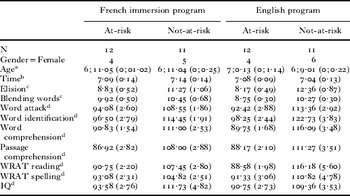
Subgroup characteristics are given in Table 1. The distributions of at-risk and not-at-risk children, and of males and females in each program were not significantly different. Reader and program subgroups did not differ significantly on age or time in school prior to the start of the first testing occasion. It was expected that no significant differences would exist between program groups on the matching criteria, but that the teacher-nominated reading-risk group would perform worse on the reading measures than the not-at-risk group. Adequate matching was verified by 2-way ANOVAs involving program group and reader group, indicating no significant differences between the program groups on matching or outcome measures at the first testing occasion (all Fs <1·00). Reader groups differed significantly on reading and phonological diagnostic measures, as well as on outcome measures at the first testing occasion (see Tables 1 and 2), as expected, with at-risk readers performing worse than not-at-risk readers. The two reader groups differed unexpectedly on mean IQ, with at-risk readers performing lower than not-at-risk readers, but each group's mean IQ was in the average range. No interaction effects between reader group and program group were found for any of the diagnostic or initial outcome variables. Because of the reader group difference on IQ, we included IQ as a control factor in multilevel modeling and regression analyses.
Program and reader subgroup characteristics and population-normed reading-related standard scores at the initial testing occasion

notes: a. years;months.days; b. months.days since start of Grade 1 at first testing occasion; c. standard scores with population mean 10 and standard deviation 3; d. standard scores with population mean 100 and standard deviation 15.
Design and procedure
Outcome variables included measures of phonological awareness, decoding and reading comprehension. Predictors included school program (French immersion and English), reading-risk status (at-risk and not-at-risk), and time – number of months prior to the end of the final testing occasion. Control factors included IQ measured at the first testing occasion, phonological awareness performance at the first testing occasion as the autoregressor for phonological awareness, and a control for decoding and comprehension, and the decoding performance at the first testing occasion as the autoregressor for decoding and a control for comprehension.
Measures were taken at five testing occasions, beginning in the spring of the Grade 1 year. Subsequent measurement occasions occurred at approximately six-month intervals until the spring of Grade 3. There was variability within and between children in the length of the intervals between testing occasions, which was accommodated in multilevel modeling (Singer & Willett, Reference Singer and Willett2003), the procedure used to model linear growth and final Grade 3 status on outcomes.
Children were tested individually in quiet rooms in their schools by trained honors and graduate psychology students, who were not informed of the reading-risk status of the children. During each testing occasion, data were collected in two 45-minute sessions conducted on different days within two weeks of one another. The order of tests was the same across testing occasions, with reading skills measured in the first session and phonological awareness measured in the second session.
Material
Raw accuracy scores on each subtest, using standard assessment procedures, were converted to standard scores based on sample results over all testing occasions. Composite outcomes were calculated by averaging these standardized subtest scores for phonological awareness, decoding and reading comprehension. Taking the average of sample-based standard scores permitted equal weighting of contributing subtest scores to each of the outcomes, retained developmental change information, and simplified interpretation of results.
Phonological awareness
Elision (Cronbach's α=0·89) and Blending Words (Cronbach's α=0·84) subtests of the CTOPP were used to create our index of phonological awareness (Wagner et al., Reference Wagner, Torgesen and Rashotte1999). Elision involves sound deletion, reflecting the ability to manipulate single phonemes or groups of two or more phonemes. Children say a word, delete a specified phoneme, rime or syllable from a word, and recombine and articulate the remaining phonemes, rimes and syllables. Test items are words that have combinations of at least two phonemes remaining after the deletion. Blending Words, measuring phoneme awareness – the ability to manipulate individual phonemes – involves children listening to series of individual phonemes and combining the sounds to articulate resulting words. Each subtest contains twenty items. The sample-based standard scores from the two subtests were averaged to provide the final composite phonological awareness measure.
Decoding
The Word Attack and Word Identification subtests of the WRMT (Form G) were used to create a composite decoding measure. WRMT subtests have split-half reliabilities ranging from 0·86 to 0·99. Items in each subtest progressively increase in difficulty level, and involve items of varied grain sizes. Administration involves a stop rule of six consecutive errors. The Word Attack subtest measures non-word decoding. By requiring children to read pronounceable non-words, the subtest measures ability to apply phonological awareness skills to processing unfamiliar items, and reflects skills used to sound out unfamiliar words. The Word Attack subtest is comprised of forty-five items. The Word Identification subtest required children to read orally regularly and irregularly spelled words. The subtest is comprised of 106 items. The final composite decoding score consisted of the averaged sample-based standard scores from each subtest.
Comprehension
The Word Comprehension and Passage Comprehension subtests of the WRMT (Form G) were used for our comprehension outcome. Word Comprehension is composed of three component measures of knowledge of antonyms, synonyms and analogy relations respectively, involving a total of 146 items. Three sets of standard scores, based on participants' raw scores in each component measure taken across testing occasions, were calculated, and these three measures were averaged to create Word Comprehension standard scores. Passage Comprehension involves sixty-eight CLOZE-like items, in which children read passages aloud and supply a missing word for each item. The two sets of sample-based standard scores from Word Comprehension and Passage Comprehension were averaged to create the composite comprehension outcome. The items involved a substantial decoding requirement, but given that they provide information on relations between words and on understanding of passages, they can be considered valid indicators of reading comprehension (Keenan, Betjemann & Olson, Reference Keenan, Betjemann and Olson2008).
RESULTS
Missing data
Two participants in the immersion program, one in each reader group, were excluded completely because they had moved to other schools by the second testing occasion. Removing the paired English program participants from the sample did not change the results. Hence, results are reported for the full sample, less the two excluded immersion children. Attrition also occurred in later testing occasions: two at-risk readers in immersion, and one in the English program moved schools after the third testing occasion, and one at-risk reader in immersion moved after the fourth testing occasion. Comparisons of children who were lost to attrition with children who remained, on measures taken in the first testing occasion, showed no significant differences within reader groups (all ps>0·10 on t-test comparisons). Three additional children missed sessions in single testing occasions (see Table 2). We conducted multilevel modeling, with maximum likelihood imputation for missing data, which permitted use of the complete dataset for all participants who experienced at least two testing occasions.
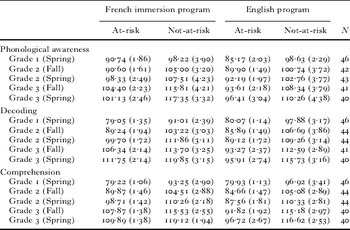
Mean accuracy (standard errors in parentheses) on the composite outcomes for the program and reader subgroups and overall sample size at each testing occasion

note: Phonological awareness, based on Elision and Blending words subtests, involving 40 items total; Decoding, based on Word attack and Word identification subtests, involving 151 items total; Comprehension, based on Word comprehension and Passage comprehension subtests, involving 214 items total. Standard administration procedures, including stop rules, were followed. Results are reported in standard scores with sample mean 100 and standard deviation 15 calculated from participant scores across testing occasions.
Descriptive statistics
Mean outcome accuracy of program and reader subgroups across all testing occasions is given in Table 2. All four subgroups improved on all outcomes across waves, but the rates of growth appeared faster in French immersion than in the English program. Program×reader group factorial ANOVAs on outcomes at each testing occasion showed reader group differences were maintained on all outcomes at each testing occasion, with at-risk readers scoring lower than not-at-risk readers (ps<0·001; η2s, indicating effect sizes, ranged from 0·19 to 0·36 for phonological awareness, 0·32 to 0·52 for decoding, and 0·44 to 0·59 for reading comprehension). Significant program differences emerged for phonological awareness at the fourth testing occasion (p<0·05; η2=0·08), and for decoding and comprehension at the last three testing occasions (ps <0·05; η2s ranged from 0·08 to 0·15 for decoding, and from 0·06 to 0·12 for comprehension), showing immersion children performing better than English program children. A significant interaction was found for decoding at the fourth testing occasion (p<0·05; η2=0·07). Bonferroni-corrected t-tests indicated that at-risk readers in immersion performed better than at-risk readers in the English program, and that in the English program not-at-risk readers performed better than at-risk readers. An interaction was found for reading comprehension at the fourth testing occasion (p<0·01; η2=0·11). At-risk readers in immersion performed better than at-risk readers in the English program. A significant interaction at the fifth testing occasion (p<0·05; η2=0·06) showed that at-risk readers in immersion performed better than at-risk readers in the English program; not-at-risk readers performed better than at-risk readers in each program.
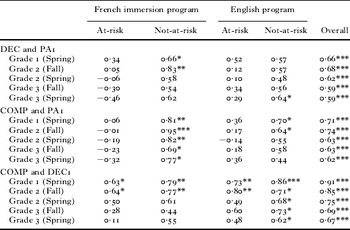
Significant positive correlations were obtained among all factors across all testing occasions. These indicate that control measures may account for significant variance in growth trajectories, and justified our use of those controls in multilevel models and in hierarchical regression. Table 3 lists correlations among outcomes and reading-related controls for the program and reader subgroups, along with respective overall correlations. The pattern of correlations was generally similar at the outset of the study for the two at-risk reading subgroups, although a positive correlation between initial phonological awareness and decoding was found for not-at-risk readers in the immersion program in the first two testing occasions. The correlation patterns changed differentially among subgroups across testing occasions.
Correlation coefficients for reading outcomes measured at each testing occasion and controls measured at the first testing occasion for the program and reader subgroups, and for the overall sample

notes: PA1=phonological awareness at first testing occasion; DEC1=decoding at first testing occasion; DEC=decoding; COMP=reading comprehension; * p<0·05; ** p<0·01; *** p<0·001.
Growth modeling: influences of immersion, reading-risk and initial abilities on final abilities and linear growth in outcomes
Growth modeling began with fitting data to unconditional models, to establish the shape of change in the outcomes as a function of time, before examining what factors predict change. This process involved deciding what type of curve best fits the longitudinal data. We used model-fitting techniques to identify the simplest type of curve (linear or curvilinear or both) that provided an acceptable fit of the data. We then examined what factors predict the change identified in the unconditional models.
Time was centered at the end of the final testing occasion, and given as number of months prior to the end of the last testing occasion. This allowed us to set the intercept at the end of Grade 3, indicating final status, and to interpret linear growth as the instantaneous rate of change at the intercept and curvilinear growth as the instantaneous change in rate of change at the intercept.
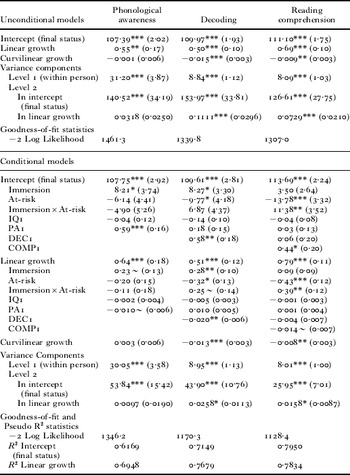
After fitting the unconditional models, conditional models that included predictors, controls and autoregressors (initial abilities at the first testing occasion on respective outcomes) were tested to examine unique influences of immersion and reading-risk on final status and linear growth. We report unconditional and final conditional models that include all factors in Table 4.
Unconditional and conditional growth models for phonological awareness, decoding and reading comprehension

notes: Standard errors in parentheses. IQ1: Intelligence score at the first testing occasion; PA1: phonological awareness at the first testing occasion; DEC1: decoding at the first testing occasion; COMP1: reading comprehension at the first testing occasion; ~p<0·10; * p<0·05; ** p<0·01; *** p<0·001.
Unconditional models
Model fit comparisons between a model that included only the intercept and models that included linear (Time) and quadratic curvilinear (Time2) components, using change in −2 log likelihood, a χ2 statistic, indicated good fits (ps<0·001), with significant linear growth in phonological awareness and significant linear and curvilinear growth in decoding and comprehension (see Table 4).
We found significant remaining variability that could be accounted for by predictors, controls and autoregressors for the intercept in phonological awareness, and for the intercept and linear growth in decoding and comprehension. Given the theoretical and empirical literature indicating potential curvilinear growth in reading skills in the time period under investigation (McCoach, O'Connell, Reis & Levitt, Reference McCoach, O'Connell, Reis and Levitt2006), we included the unconditional curvilinear term in models for all outcomes, but did not consider predictors of curvilinear growth because significant remaining variance in the curvilinear terms for phonological awareness and decoding was not found. Hence, we assumed that influences of predictors on degree of curvature were similar across subgroups for each outcome.
Conditional models
We chose to be consistent in our analysis plan to examine influences of immersion, reading-risk status, and the interaction between immersion and reading-risk status on the intercept and linear growth only, in order to make meaningful comparisons of patterns of influence across outcomes. We added initial phonological awareness ability (initial status) as an autoregressor for the phonological awareness outcome, and as a control for the decoding and reading comprehension outcomes. Likewise, we included initial decoding ability as an autoregressor for decoding and as a control for comprehension. Finally, initial reading comprehension ability was included as an autoregressor for reading comprehension.
Program (English=0, immersion=1), reading-risk status (not-at-risk=0, at-risk=1), and the interaction between program and reading-risk status were fixed (level-2) factors, as were initial status in IQ, phonological awareness, decoding and reading comprehension. Initial status factors were centered for ease of interpretation. Initial status for IQ was centered on the population mean, and initial status for phonological awareness, decoding and reading comprehension were centered on their respective mean scores in the first testing occasion.
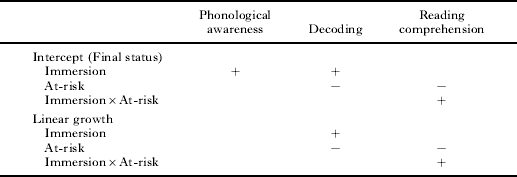
Incorporating level-2 predictors produced better fits of the data in comparison with unconditional models (all Δχ2ps<0·001, based on change in −2 log likelihood statistics) (see Table 4). A summary of significant predictors and direction of effects for final status and linear growth in the conditional models for all outcomes is given in Table 5, showing positive influences of immersion and the interaction between immersion and reading-risk status, and negative influences of at-risk reading status.
Summary of the results for each dependent variable with respect to the immersion and at-risk reading status predictors
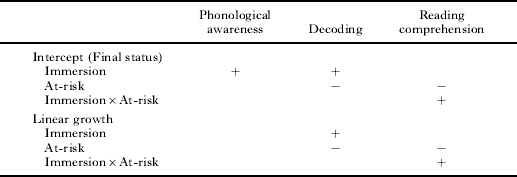
note: Significant variance accounted for by the predictors, based on final fixed models for each outcome, is identified by each symbol, with “+” indicating positive coefficient values (for example, higher final status and quicker linear growth in the immersion group for decoding, and in the at-risk readers in immersion for reading comprehension) and “−” indicating negative coefficient values (lower final status, and slower linear growth in the at-risk group for decoding).
Phonological awareness
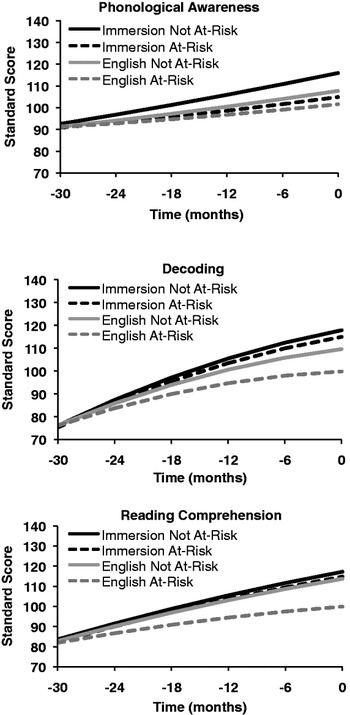
The influences of immersion and reading-risk, after initial IQ and the phonological awareness autoregressor were included, are given in Tables 4 and 5. Model-estimated growth for each subgroup is depicted in Figure 1. Immersion was a significant predictor of final status, indicating that children in immersion performed better than children in the English program at the end of the study. The influence of immersion on linear growth approached significance (p=0·08), indicating a trend for children in immersion to develop phonological awareness at a more rapid rate than children in the English program. The phonological awareness autoregressor was a significant predictor of variance in final status, showing that higher initial status in phonological awareness was associated with higher final status. The negative influence of the autoregressor on linear growth approached significance.
Model estimated growth trajectories in accuracy on the three outcomes in not-at-risk and at-risk readers attending immersion and English programs, in sample-based standard scores (M=100, SD=15). Time indicates number of months prior to the end of the final testing occasion. Estimates were calculated with centered IQ, phonological awareness, decoding and comprehension controls set to 0.

The pseudo-R 2 statistics, indicating proportion of variance accounted for by the full model in comparison with the unconditional model (Singer & Willett, Reference Singer and Willett2003), showed an increase in proportion of variance accounted for by the conditional model for the intercept and linear growth in comparison with proportions of variance accounted for by the unconditional model (see Table 4). The change in the pseudo-R 2 statistic, giving an index of effect size (Singer & Willett, Reference Singer and Willett2003) for each of immersion experience, at-risk reading status and the interaction between these two fixed effects, involved subtracting the full model's pseudo-R 2 statistic from the pseudo-R 2 statistics of reduced models that did not include the specific target predictors. For final status and linear growth respectively, they were: 5·64 and 19·42 percent for immersion, 2·44 and 12·22 percent for reading-risk, and 1·06 and 1·90 percent for the interaction. These indicate weak to moderate effect sizes.
Decoding
The influences of immersion, reading-risk status, and the interaction, after controlling for initial IQ, phonological awareness, and the decoding autoregressor, are given in Tables 4 and 5. Estimated growth is depicted for each of the four subgroups in Figure 1. There was a positive influence of immersion on final status: immersion children performed at a higher level than English program children, indicating a benefit of immersion on decoding achievement. At-risk readers performed worse than not-at-risk readers in final status.
There was a significant positive influence of immersion on linear growth, showing that children in immersion improved in decoding at a more rapid rate than children in the English program. However, the negative influence of reading-risk status indicated that at-risk readers in general improved at a slower rate than not-at-risk readers (see Figure 1). The decoding autoregressor accounted for significant variance in final status (showing higher initial decoding ability was associated with higher final status in decoding), and for linear growth (showing higher initial decoding ability was associated with slower linear growth). The IQ and phonological awareness controls were not significant. These results indicate positive influences of immersion on final status and growth in decoding.
The effect sizes for immersion, reading-risk and the interaction were indicated by the change in the pseudo-R 2 statistics between the full model and reduced models. For final status and linear growth respectively, these were 5·26 and 8·43 percent for immersion, 4·19 and 5·93 percent for reading-risk, and 1·82 and 3·38 percent for the interaction, indicating weak to moderate effect sizes.
Reading comprehension
The influences of immersion, reading-risk status, and the interaction, after incorporating control factors and the reading comprehension autoregressor, are given in Tables 4 and 5. Estimated growth, is depicted for the four subgroups in Figure 1. At-risk readers' final status was lower than that of not-at-risk readers. The interaction term between immersion and reading-risk status was significant, indicating a subgroup-specific benefit of immersion on final status in reading comprehension for at-risk readers.
Reading-risk status was significant in predicting linear growth: at-risk readers experienced slower linear growth than not-at-risk readers. However, a significant interaction between immersion and reading-risk status indicated that at-risk readers in immersion grew at a quicker rate than at-risk readers in the English program (see Figure 1). The comprehension autoregressor was significant in accounting for variance in final status, indicating that better comprehenders at the outset had higher final levels in reading comprehension. The autoregressor was approaching significance for linear growth, indicating a trend toward slower growth for children who had higher initial comprehension scores.
The effect sizes for the predictors indicated by the change in the pseudo-R 2 statistic were, for final status and linear growth respectively, 1·16 and 1·34 percent for immersion, 10·72 and 18·39 percent for reading-risk, and 6·57 and 13·60 percent for the interaction. These indicate weak to moderate effect sizes of the predictors.
Growth in control measures predicting growth in outcomes
Initial (static) abilities in control measures might not have accounted for all variance in linear growth in outcomes uniquely related to these factors. Growth in control measures might account for additional variance in growth in outcomes, and might mediate influences of immersion and reading-risk status on linear growth. To determine the additional influences of growth in control measures on growth in outcomes, we conducted hierarchical regression analyses. First, correlations of model-estimated individual slopes in control measures and outcomes were calculated. Then hierarchical regression analyses were conducted to examine the unique contributions of linear growth in control measures in accounting for variance in linear growth in outcomes, after influences of the autoregressor, immersion and reading-risk status factors, and static control measures (scores at the first testing occasion) were entered. See Compton (Reference Compton2000) for a detailed example of this procedure.
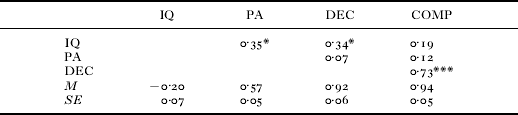
Correlations for the overall sample are given in Table 6. Linear growth in IQ was significantly correlated with linear growth in phonological awareness and in decoding; higher rates of growth in IQ were associated with higher rates of growth in phonological awareness and in decoding. In addition, linear growth in decoding was significantly correlated with linear growth in reading comprehension; children whose decoding skills increased at a more rapid rate tended to experience more rapid growth in reading comprehension, consistent with the simple view of reading comprehension. Hierarchical regression analyses were conducted to determine if growth in control measures accounted for unique variance in growth in outcomes, and to further test the significance of immersion and reading-risk predictors in accounting for unique variance in growth in outcomes.
Correlations between growth in outcomes and growth in control factors for the complete sample
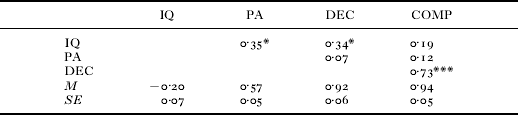
notes: IQ: linear growth in intelligence; PA: linear growth in phonological awareness; DEC: linear growth in decoding; COMP: linear growth in reading comprehension; mean scores correspond to slope in units of number of standard score points per month; * p<0·05; *** p<0·001.
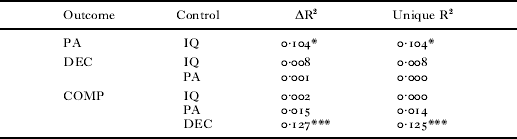
Linear growth in IQ accounted for unique variance in linear growth in phonological awareness, after controlling for initial status in phonological awareness and IQ, immersion, reading-risk, and the interaction between immersion and reading-risk. Neither linear growth in IQ nor linear growth in phonological awareness accounted for unique variance in linear growth in decoding. Finally, linear growth in decoding was a unique predictor of linear growth in reading comprehension, after the autoregressor, control measures, and immersion and reading-risk predictors were accounted for.
Table 7 gives the results of the final set of hierarchical regression analyses, first showing the change in proportion of variance accounted for when linear growth in each control measure was added to regression equations individually, and second, to provide an index of unique contributions, after all predictors and control measures, including static (initial abilities) and dynamic (linear growth) factors, were entered into the regression equations. These analyses confirmed that linear growth in IQ predicted unique variance in linear growth in phonological awareness, and that linear growth in decoding accounted for unique variance in linear growth in reading comprehension. Immersion and reading-risk status as predictors of model-estimated linear growth in decoding were marginally significant in the regression analysis (p=0·10, and p=0·07, respectively), but the influence of reading-risk status and the interaction between immersion and reading-risk status in predicting linear growth in comprehension were significant in the regression analysis.
Proportion of variance in linear growth of the three outcomes attributed to linear growth of control factors after effects of autoregressor, initial abilities in control measures and immersion and reading-risk predictors are partialed out
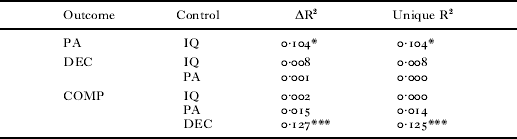
notes: IQ: linear growth in intelligence; PA: linear growth in phonological awareness; DEC: linear growth in decoding; COMP: linear growth in reading comprehension; outcome and control variables are estimated linear slope terms derived from the multilevel modeling analyses; p<0·05; *** p<0·001.
DISCUSSION
We examined how exposure to an additional language in an educational context, in French immersion, contributes to growth in phonological awareness, decoding and reading comprehension in at-risk and not-at-risk readers over the first three years of formal schooling. Experience in French immersion was associated with benefits to final status in phonological awareness and in decoding, and to growth in decoding for both reader groups. Immersion experience for at-risk readers showed a distinct pattern of higher final status and more rapid linear growth in reading comprehension. In addition, growth in phonological awareness was uniquely associated with growth in IQ and growth in reading comprehension was uniquely associated with growth in decoding. The pattern of influences of immersion, reading-risk status, and the interaction, identified in multilevel modeling, was maintained after growth in controls was included in regression analyses of model-estimated linear growth in comprehension, and the pattern was marginally significant in decoding. These findings must be considered preliminary indications of beneficial influences of exposure to an additional language in the context of immersion, given the modest sample size, our liberal definition of at-risk reading status, and that the data in this study are correlational. The explanations we discuss below for each outcome are indirectly supported by the data, but are consistent with the patterns that were found.
Immersion and phonological awareness
The higher final status in the immersion group is consistent with findings demonstrating cross-language transfer of phonological knowledge in immersion children (e.g. Comeau et al., Reference Comeau, Cormier, Grandmaison and Lacroix1999). Exposure to additional structural forms of shared phonemes in each language and to syllable-timed oral structures that are specific to French might have facilitated growth in English-language phonological awareness among immersion children (Anthony & Francis, Reference Anthony and Francis2005; Bruck & Genesee, Reference Bruck and Genesee1995; Comeau et al., Reference Comeau, Cormier, Grandmaison and Lacroix1999; Tingley et al., Reference Tingley, Dore, Lopez, Parsons, Campbell, Bird and Cleave2004). The structural differences between spoken English and French might not have been large enough for a wider range of phonemes and syllable-stress to contribute to faster linear growth in immersion. Structural differences between English and other languages with more clearly marked boundaries between syllables, such as Turkish, Greek and Italian (Anthony & Francis, Reference Anthony and Francis2005), might be needed to show differential influences on linear growth in phonological awareness at early grade levels. However, the influence of immersion experience on final status demonstrates that program differences in children's phonological awareness abilities can emerge after three years of exposure to spoken and written French in immersion.
The effect of immersion on final status in phonological awareness remained after controlling for the phonological awareness autoregressor in multilevel modeling. Children in immersion in this study were learning to read in both French and English. Reciprocal influences of reading in an additional language could have contributed to the higher final status in phonological awareness by cross-language transfer of French reading skills to English phonological awareness, which was not experienced by English program children. Comeau et al. (Reference Comeau, Cormier, Grandmaison and Lacroix1999) demonstrated this type of cross-language transfer between French reading and English phonological awareness in immersion children, as did Kovelman et al. (Reference Kovelman, Baker and Petitto2008) in children attending Spanish–English bilingual schools, and Leikin, Schwartz and Share (Reference Leikin, Schwartz and Share2010) in biliterate (Russian–Hebrew) children in Grade 1. The present study provides an extension of findings to include longitudinal growth to the end of Grade 3. However, because the present study did not include measures of French phonological and reading skills, our interpretation of the result is speculative. Nevertheless, the data are consistent with cross-language transfer of phonological skills from French to English, a consequence of reading instruction in and exposure to spoken forms of two languages, as a plausible mechanism underlying the beneficial influence of immersion experience on final status in English phonological awareness.
Immersion and decoding
We found that experience in French immersion was associated with higher final status and more rapid linear growth in decoding by the end of Grade 3, although limits to the influence on growth were found in the regression analysis. There are several potential reasons why these effects emerged.
First, the beneficial influences on decoding in immersion children might have been a consequence of faster growth in phonological awareness, facilitating the development of representations of links between individual letters and letter clusters, their labels and the sounds they represent. Hence, it is possible that cross-language transfer of emerging phonological awareness skills facilitated development of English decoding in immersion children, consistent with Comeau et al. (Reference Comeau, Cormier, Grandmaison and Lacroix1999). However, phonological awareness was not a unique predictor of final status or linear growth in decoding (see Table 4), and the correlation between linear growth in phonological awareness and linear growth in decoding was not significant (see Tables 6 and 7) – findings that are not consistent with this conclusion. The decoding autoregressor might have masked relations between phonological awareness and decoding in multilevel modeling. In a reduced model without the autoregressor, initial phonological awareness was significant in accounting for variance in final status in decoding. Cross-language transfer of orthographic skills could also explain the influence of immersion on final status and linear growth in decoding, after controlling for influences of initial IQ, phonological awareness and the decoding autoregressor. The result is consistent with research showing that orthographic skills in one language can facilitate decoding development in an additional language, especially given that English and French are sufficiently similar orthographically – with regard to alphabet and orthographic depth – to support such transfer (Deacon et al., Reference Deacon, Wade-Woolley and Kirby2009).
The higher final status and trend toward more rapid linear growth in decoding in immersion are also consistent with the interpretation that children in immersion were capable of greater flexibility in sublexical decoding strategy use. Because children in immersion were learning to read in both French and English, requiring both small and large phonological grain-size unit strategies (Ziegler & Goswami, Reference Ziegler and Goswami2005), they may have become more effective at applying small and large grain-size strategies when decoding unfamiliar items. The Word Attack and Word Identification subtests of the WRMT involve mixed grain-size items requiring both large and small phonological unit decoding strategies. The switching costs experienced in decoding these mixed grain-size lists might have been ameliorated by immersion children's effectiveness in switching decoding strategies.
The findings of higher final status and trend toward more rapid growth in immersion contribute to the literature on influences of exposure to additional languages by demonstrating that early growth in decoding skill acquisition can be positively influenced by additional language exposure that begins only at the outset of formal schooling. These findings constitute indirect evidence, but they are nevertheless consistent with cross-language transfer, and improved capabilities in using small- and large-grain phonological strategies in decoding.
Immersion and reading comprehension
There was no differential improvement in comprehension ability in typically developing readers in immersion – both program groups developed comprehension skills at the same rate, and there were no differences in final status. The cognitive benefits of exposure to an additional language in the classroom might not have established themselves sufficiently to bring about differential rates of improvement or higher performance at the end of Grade 3. This result is consistent with previous research, which shows that for typically developing readers the process of learning to read in immersion contexts is not different from the process in non-immersion contexts (Genesee, Reference Genesee2007; Genesee & Jared, Reference Genesee and Jared2008), notwithstanding our results on decoding and phonological awareness mentioned above.
Children may not have had sufficient exposure to the additional language for changes in control processes in executive functioning related to reading comprehension to become manifest (Bialystok, Reference Bialystok2001). The Grade 6 children in Lapkin et al.'s (Reference Lapkin, Hart and Turnbull2003) study, showing superior performance on comprehension tasks, might have achieved sufficient classroom-based French language experience for benefits involving control processes, like the ability to identify semantic relations between words and ignoring irrelevant information, to influence reading comprehension. The same children in Lapkin et al.'s study at the Grade 3 level had not yet showed evidence of differential improvement compared to English program children.
The absence of a global benefit of immersion on linear growth and final status in reading comprehension might have been a function of the comprehension test used, given the influence of decoding on performance (Keenan et al., Reference Keenan, Betjemann and Olson2008) – any effect of immersion on reading comprehension might have been absorbed by the autoregressor and decoding control in the analysis. A reduced model that omitted the autoregressor and decoding control resulted in a significant influence of immersion on linear growth in reading comprehension. The positive relation between growth in decoding and growth in reading comprehension in the hierarchical regression analysis reflects the tie between reading comprehension and decoding, as specified in the simple view of reading (Kirby & Savage, Reference Kirby and Savage2008).
French immersion and children at-risk of reading disability
The general patterns that emerged for at-risk readers for decoding and reading comprehension included lower final status and slower linear growth. There were no differential effects for at-risk readers in final status and linear growth in phonological awareness, which likely reflect the influences of the phonological awareness autoregressor. A reduced model that did not include the phonological awareness autoregressor showed a significant negative influence of reading risk on final status in phonological awareness. There were no significant influences of the interaction between immersion and reading risk status for final ability and growth rates in phonological awareness and decoding, indicating that influences of immersion experience were not different for at-risk readers for these two outcomes.
Beneficial patterns for growth rates and for final status specific to at-risk readers in the immersion context were experienced for reading comprehension, showing higher final status and faster linear growth in comprehension, results that were maintained after including control factors and the autoregressor in the final model (see Table 4). The unique influence of immersion on reading comprehension for at-risk readers indicates that more than initial cognitive ability, phonological awareness, decoding and reading comprehension underlie results for reading comprehension final status and linear growth. The influence of immersion for at-risk readers' linear growth persisted even after entering terms for growth in phonological awareness and in decoding in hierarchical regression.
Results are consistent with Bialystok's perspectives on improved executive functioning as a product of exposure to additional languages, which then influence comprehension, and with potential cross-language transfer of morphological knowledge. In our case, though, the benefits were manifested in at-risk readers only, indicating the possibility that there may have been more room to grow in executive functions and in morphological knowledge in comparison with not-at risk readers, and that immersion experience was sufficient to begin to close the gap. A lower threshold of exposure to the additional language might have been sufficient for linguistic and cognitive benefits – whether cross-language transfer, improved decoding strategy use, or executive control – to promote improved reading comprehension for at-risk readers in immersion. Given the controls for IQ, phonological awareness, decoding and the comprehension autoregressor, the evidence for benefits of enhanced executive control and cross-language transfer of morphological knowledge for at-risk readers is compelling. However, with no direct measure of executive functioning or morphological knowledge, particularly in French, these explanations require additional research to be validated.
Limitations
The heterogeneity of needs experienced by at-risk readers makes it likely that not all children with a risk of reading difficulty will experience the same degree of benefit from immersion experience. Our at-risk reader definition was lenient, allowing both mild and severe levels of difficulty in our sample. In addition, our small sample size might not have captured the full heterogeneity of reading difficulties. The results for children with more extreme needs might have been different. Children with more severe reading difficulties might require intense, explicit and systematic programming in immersion settings to experience the kind of gains in reading demonstrated in this study. Examining how the immersion experience, in comparison with non-immersion contexts, influences responses to intervention for specific reading outcomes in at-risk and severely disabled readers would expand our understanding of the potential protective aspects of immersion.
It is possible that at-risk students received more effective teaching and intervention programming in immersion contexts. However, all schools in the study used the same intervention programming available to at-risk children in French immersion and English programs, and teachers reported using consistent teaching methods for reading instruction between programs. Given these similarities, the program-specific influences that emerged provide indirect support for the potential protective influences of exposure to additional languages for at-risk readers.
Despite the limits of the correlational nature of this study, the longitudinal design tracking growth across three grade levels, the use of closely matched reader groups in immersion and English programs, and inclusion of control factors in our analyses are strengths that permit us to have confidence in the validity of the patterns that were identified, and to make preliminary conclusions consistent with those patterns. Cross-language transfer of orthographic and morphological knowledge to emerging English decoding and reading comprehension in immersion can be established definitively if these skills were assessed in French (e.g. Comeau et al., Reference Comeau, Cormier, Grandmaison and Lacroix1999; Deacon et al., Reference Deacon, Wade-Woolley and Kirby2007; Reference Deacon, Wade-Woolley and Kirby2009; Leikin et al., Reference Leikin, Schwartz and Share2010). Testing skills involved in the use of large and small grain-size word recognition strategies and executive processes using outcomes including fluency and comprehension measures less dependent on decoding would further validate our explanations of influences of immersion experiences.
The generalizability of findings can be broadened beyond English native speakers in immersion by examining the development of reading skills of immigrant children who are at-risk readers in immersion, and influences of exposure by at-risk readers to additional languages in educational contexts that involve languages other than French and English.
Conclusion
This preliminary analysis of emerging reading abilities of at-risk readers extends previous findings by tracking longitudinal influences of immersion experience on growth across three reading-related skills. We add to the literature by demonstrating higher final status in phonological awareness, and benefits to final status and growth in decoding as a function of immersion experience for both typically developing and at-risk readers, and higher final status and more rapid growth in reading comprehension in at-risk readers in immersion. The results of this study show that French immersion, as an educational context that exposes children to an additional language, can be beneficial to reading achievement.