Introduction
Low-dose rate prostate brachytherapy using permanent implantation of I-125 seeds is a well-established treatment techniqueReference Vigneri, Sherati and Potters1 for low risk disease, which has been in widespread use for over a decade. Post implant dosimetry based on CT (PICT) has been recommended for use by European Society for Radiotherapy & Oncology (ESTRO) and the American Brachytherapy Society (ABS).Reference Nag, Bice and DeWyngaert2–Reference Ash, Flynn and Ballermann4 However, there is a lack of studies reporting the accuracy and reliability of the PICT technique. Recent adverse publicity about prostate brachytherapy and investigations into large-scale incidents of poor implant quality and the use of PICTReference Hagan, Habeeb, Moore and Williamson5 heightens the need for a robust method for quality assessment.
A dose–response relationship has been observed following treatment with I-125 prostate brachytherapy. Single-centre studiesReference Potters, Cao, Calugaru, Torre, Fern and Wang6, Reference Stock, Stone, Tabert, Iannuzzi and DeWyngaert7 have demonstrated that, when D90 – the dose, in Grays, that covers 90% of the prostate volume outlined on the PICT scan is ≥90% of the prescribed dose, biochemical relapse free survival is greater than for those patients whose D90 Gy ≤ 90% of the prescribed dose. This demonstrates the usefulness of PICT dosimetry but also the need for a reliable and robust determination of D90. The difficulty arises when looking for a consensus on what is an acceptable quality implant when defining limits for D90 across a multicentre study.
Post implant dosimetry is dependent on the ability of the observer to delineate to a high degree of accuracy the prostate volume and the associated organs at risk (OAR) as well as identifying the actual source locations. Soft tissue differentiation is the major difficult in prostate volume delineation.Reference Narayana, Roberson, Winfield and McLaughlin8, Reference Yu, Anderson and Li9 For the purpose of this study delineation of prostate volume was the key objective and OAR tissues, i.e. the rectum was not delineated.
This study was designed to quantify variations between centres in performing CT-based post implant dosimetry, and led to an assessment of the general uncertainty associated with reported quality metrics. This study is relevant in establishing the usefulness of PICT with the advent of intra-operative live planning, and in assessing the need to develop post implant dosimetry studies using different imaging modalities, i.e. CT–MR fusion. This study builds on previous studies by Al-Qaisieh et al.Reference Al-Qaisieh, Ash, Bottemley and Carey10 and Mzenda et al.Reference Mzenda, Palmer and Hayman11 with a larger cohort of participating centres and an online questionnaire to evaluate the centres’ experience, protocols and dosimetry limits.
This work was proposed and coordinated by the Institute of Physics Engineering in Medicine (IPEM) Regional Audit Group E (Central South Coast, www.AuditgroupE.org.uk), and opened to all centres in the United Kingdom and Ireland. Interdepartmental audit is seen as an extremely useful tool in mitigating significant dosimetry errors and improving working practices, and should be applied in all treatment modalities in radiotherapy.Reference Palmer, Mzenda, Kearton and Wills12 This is the first such audit to consider PICT.
The key objectives of this study were:
• How consistently can the prostate volume be defined on PICT?
• What is the correlation between volume definition and dosimetric quality parameters for PICT?
• Does the use of automatic or manual seed finding software, or different planning systems or versions affect PICT results?
• How do more experienced centres (>500 patients treated) compare with less experienced centres (<100 patients treated) in PICT analysis?
• Are there any differences in the results of this study compared with related publication from 10 years ago?Reference Mzenda, Palmer and Hayman11, Reference Al-Qaisieh13
Materials and methods
Patient selection and treatment planning
CT data sets from four patients were selected for this study to represent different and difficult implant circumstances. Selection was based on the pre-implant plan and PICT dosimetry at the investigators centre.
Patient 1 was selected because of the high central dose region, V150 > 60%, patient 2 was overall deemed to be a good quality implant, patient 3 had poor CT image quality because of the patient's artificial hip causing streaking artefacts on the CT images and patient 4 had a low central dose region, V150 < 40%.
All patients had been treated with I-125 permanent implant seed brachytherapy as a monotherapy, at one centre, using between 94 and 98 seeds per patient with prostate volumes on ultrasound of between 33 and 40 cm3. The prescribed dose was 145 Gy to the planning target volume (prostate capsule plus 3 mm margin, zero margin to posterior) in all cases. The patients were planned using a standard two-stage transrectal ultrasound (TRUS) volume and implantation technique. All treatment plans were created using the modified uniform method, which increases the dose at the periphery and reduces the dose centrally in proximity to the urethra.Reference Salember, Lavagnini and Nickers3, Reference Ash, Flynn and Ballermann4 The planning systems used in the participating centres were Varian Medical Systems Variseed© (version 8·0·1) in eight centres, and iBt Bebig© PSID system in one centre. All used a line model function for dose calculations (TG43 U1 formulism).Reference Rivard, Coursey and DeWerd14 All needles were pre-loaded with Oncura Rapid Strand© RS-RX I-125 (source model 6711) seeds of activity 0·394 mCi.
CT scanning post implant
The CT scans were acquired with the patient supine between 28 and 30 days after the implant to comply with the recommended optimal timing to reduce the effect of the post-implant oedema on the volume.Reference Nag, Bice and DeWyngaert2 All CT scans were then transferred to a Neo Logica Dicom Anonymizer Light VIIS where the data sets were anonymised.
PICT audit protocol
All participating centres were provided with the intended pre-implant treatment plan, source activity, the ultrasound-defined prostate dimensions and the PICT data set for the four patients. Centres were instructed to follow their own local protocol to complete the outlining on the CT scans and identify the seed locations, and to report the following dosimetric parameters which are commonly used to define the quality of the implant:
• D90, the dose, in Grays, that covers 90% of the prostate volume outlined on the PICT scan.
• V100, the percentage volume of the prostate that receives 100% of the prescribed dose.
• V150, the percentage volume of the prostate that receives 150% of the prescribed dose.
Online questionnaire analysis
An online questionnaire was issued to all participating centres, to obtain specific background information on their PICT service and procedures. Centres were asked for the total number of patients treated, how long they have been offering a prostate brachytherapy service, and the dosimetry parameter ranges used to classify acceptable quality in both treatment plans/live-planned implants, and post implant dosimetry.
Volumetric and geometric analysis
The CT-based prostate volume computations were performed by the treatment planning systems (Variseed at eight centres and PSID at one centre). The size of the prostate was compared, and the base and apex slices identified.
Seed displacement analysis
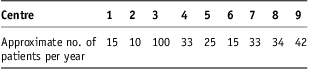
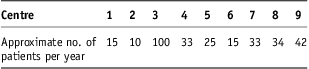
The post implant dosimetry analysis from six centres was compatible for import to the investigator's Variseed software, and the coordinates of each seed were exported and analysed using Microsoft Excel®. Centre 3 was selected as the control centre for Seed Displacement Analysis Only, see Table 1 having treated >500 patients since 1999 and all other centres’ seed locations were compared to these.
Average number of patients receiving I-125 seed brachytherapy at each participating centre
DVH analysis
PICT dosimetry was performed using dose volume histogram (DVH) parameters, as recommended by ESTRO/EAU/EORTC,Reference Salember, Lavagnini and Nickers3 by each of the participating centres on their own planning software. A total of 36 DVHs were generated and returned for analysis, using D90, V100 and V150. All continuous numerical variables were presented as mean values with ranges and standard deviations.
Results
Volumetric and geometric analysis
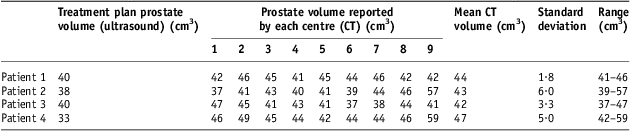
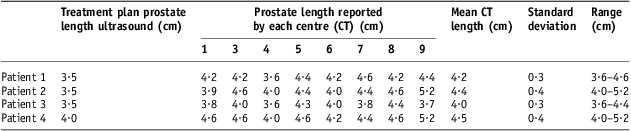
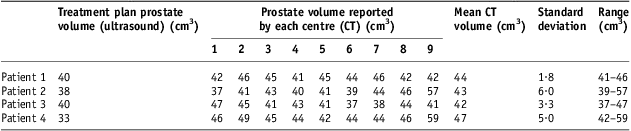
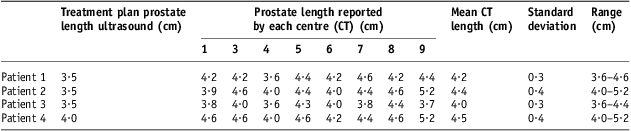
The range of volumes for the prostate as reported by the participating centres is given in Table 2. There was a significant variation between centres for all patients, with the largest range of 39–57 cm3, with a standard deviation of 6·0 cm3, for patient 3. Table 3 presents the variation in reported prostate length between centres, which also shows large variation with a maximum range of 1·2 cm for patients 2 and 4, for mean lengths of 4·4 and 4·5 cm, respectively.
Prostate volumes reported by each centre from analysis of PICT audit data
Abbreviation: PICT, post implant CT.
Prostate lengths reported by each centre from analysis of PICT audit data
Abbreviation: PICT, post implant CT.
Figure 1 shows transverse and sagittal CT images for the four audit patients with overlays of each prostate volume drawn by the individual centres. Large differences are observed in the outlining of the posterior extent of the prostate, e.g., when distinguishing prostate tissue from the anterior wall of the rectum. The sagittal view shows a maximum variation in the prostate base of 0·8 cm and at the apex exceeding 1 cm. Figure 1c was selected to challenge the centres with a CT data set of relatively poor image quality. This patient had an artificial hip causing streaking artefacts. However, there is relatively good agreement in the drawn outlines, with a maximum difference at the base and apex of 0·4 cm. Good correlation is seen between the majority of the centres in Figure 1d, however, one centre has clearly modified their outline on the transverse image to incorporate an anterior placed seed. The sagittal image in Figure 1d also shows definition of the base plane by one centre to be very different (>1 cm) to that of the other seven centres (agreement within 0·4 cm).
Transverse (left) and sagittal (right) CT images of patients 1 to 4, (a) to (d), respectively, showing the prostate outlines drawn by the nine radiotherapy centres.

Seed displacement analysis
The coordinate data for each identified seed was available from six centres. Of these, four demonstrated good correlation of seed locations with a small number of maximum variations of <0·1 cm. These centres use the same version of planning software and an automatic seedfinder software option followed by a manual check of seed locations. The remaining two centres had numerous small magnitude differences, of around 0·1 cm. These centres were conducting manual seed identification or using an older version of planning software, or both. This was consistent across all four patients. Variations in seed location occurred most commonly in areas of high seed density.
DVH analysis
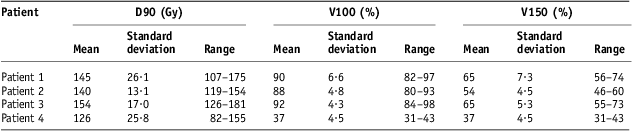
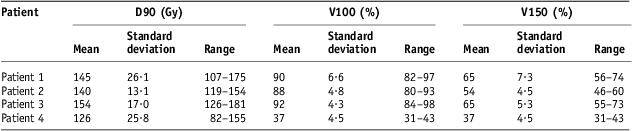
The mean, standard deviation and range of D90, V100 and V150 dosimetric parameters are given in Table 4 calculated from all nine participating centres. DVH analysis revealed the largest variation in these parameters is for D90, across all centres for the four patients, with a maximum standard deviation of 26·1 on a mean dose of 145 Gy for patient 1. V100 and V150 were more stable parameters across all nine centres with a maximum standard deviation of 6·6% on 90% V100, and 7·3% on 65% V150. All centres reported the anticipated low V150 for patient 4 with the range being 31–43.
Dosimetry parameters D90, V100 and V150 from the PICT audit data returned from nine centres
Notes: D90, the dose, in Grays, that covers 90% of the prostate volume outlined on the post implant CT scan.
V100, the percentage volume of the prostate that receives 100% of the prescribed dose.
V150, the percentage volume of the prostate that receives 150% of the prescribed dose.
Online questionnaire analysis
The online questionnaire was completed by all of the nine participating centres. The average number of patients treated with prostate brachytherapy per year at each centre is shown in Table 1, ranging from 10 to 100. PICT outlining of prostate and OARs are performed by a physicist at 60% of the centres and by an oncologist, urologist or radiologist at 40%. 60% of the centres have the outlines independently checked.
PICT is carried out at 4–6 weeks post implant in 70% of the surveyed centres, at 6–8 weeks in 20% of centres and on day 0/1 in 10% (i.e. one centre).
Table 5 presents the consensus dosimetric parameters that are used to classify a plan as being acceptable, both for pre-planning or live planning and for PICT analysis, across the nine participating centres. These parameters are expressed as a minimum value or range, as appropriate, and a mean value. There was some variation in the prostate dose acceptability criteria; although all agreed D90 > 135 Gy and V100 > 85% is a minimum requirement. If the post implant dosimetry indicates a poor implant centre 3 will perform a boost treatment to improve the dosimetry, but all other centres have no protocol for salvage, boost or re-implant following poor dosimetry at PICT, and will assess results on a case-by-case basis.
Consensus dosimetric parameters for acceptable pre-plan/live planning and PICT dosimetry for all nine centres

Notes: D90, the dose, in Grays, that covers 90% of the prostate volume outlined on the post implant CT scan.
V100, the percentage volume of the prostate that receives 100% of the prescribed dose.
V150, the percentage volume of the prostate that receives 150% of the prescribed dose.
Discussion
PICT dosimetry is an appropriate and relatively reliable method of assessing the quality of the I-125 implant but has limiting factors including the image modality, image quality and subjectivity of the observer. Significant inter-observer variability is apparent in this study of nine centres completing four patients’ PICT dosimetry. The variation in the drawn prostate outline on PICT is the primary contributing factor to the resultant variation in dosimetric parameters, e.g. D90 Gy, rather than the ability to correctly identify seed locations, even in the presence of significant deterioration of image quality.
• How consistently can the prostate volume be defined on PICT?
Figure 1 shows reasonable consistency in prostate outlining in some cases, but significant variation in others. The images also illustrate how outlines may be varied in some cases to specifically include seeds in the absence of any indicating image data to distinguish prostate tissue. It is difficult to eliminate ‘human nature’ to outline the seeds rather than the prostate when the latter is unclear. The volume of the prostate derived on CT is larger than the volume derived on the TRUS, as evidenced in Table 2. Taking into account the planning margins added to the TRUS volume, the coverage of the prostate by the prescribed dose will be less than that planned. Prostate volume size can increase by a maximum of 40% when outlined on CT when compared with ultrasound.Reference Yu, Anderson and Li9, Reference Crook, Milosevic and Catton15
Good consistency does not of course imply good accuracy, and in the absence of MRI soft-tissue image data, only the relative consistency between centres rather than the absolute accuracy of the outlines can be assessed.
• What is the correlation between volume definition and dosimetric quality parameters for PICT?
Variation is observed across the volume definition and the dosimetric parameters for all four patients in all nine centres. In this study, it is believed that the variations in outlining are the primary effect on the relatively high standard deviation in reported D90 of 20·5 Gy on a mean value of 141 Gy.
Figure 1d demonstrates a poor quality implant based on dosimetric parameters V100 and V150. However, half of the centres reported an acceptable D90 value for this patient. This highlights the importance of assessing all the dosimetric parameters, since V150 is sensitive to the differences in definition of base and apex, and V100 will highlight the differences in volumeReference Salember, Lavagnini and Nickers3.
When CT data is inherently insufficient to identify prostate tissue absolutely this unavoidably impacts post implant dosimetry accuracy.
• Does the use of automatic or manual seed finding software, or different planning systems or versions affect PICT results?
Automatic seed identification software for PICT dosimetry has been adopted by seven of eight participating centres using the same planning software Variseed. The results show that the automatic seed finder software has reduced the seed location errors between individual centres and allows a more accurate comparison of seed locations.
• How do more experienced centres (>500 patients treated) compare with less experienced centres (<100 patients treated) in PICT analysis and are there any differences in the results of this study to a related analysis conducted 10 years ago? Reference Al-Qaisieh, Ash, Bottemley and Carey10, Reference Al-Qaisieh13
The results from the online questionnaire combined with the dosimetry provided by all centres showed no significant differences between centres which have been conducting I-125 prostate brachytherapy for longer, and in greater numbers, than those with less experience. A comparison observing centre 5 (<100 patients treated) and centre nine for patient 4 shows a volume difference of 17 cm3 and length difference of 1·4 cm led to a D90 range of 82–147 Gy. Centre 3 who has also treated >500 patients in the past 10 years had a smaller volume and length discrepancy and therefore D90 was 115 Gy. This variability cannot be due just to inexperience as centres 3 and 9 have treated >500 patients in the past 10 years this shows considerable variability in volume definition, and hence reported dosimetric parameters, for individual patients in this study.
Comparing the key findings from Al-Qaisieh et al.,Reference Al-Qaisieh, Ash, Bottemley and Carey10, Reference Al-Qaisieh13 this study has observed that each centre's ability to delineate the prostate is unique and subjective. Centres 1, 8 and 9 for patient 1 have defined a prostate volume of 42 cm3 the D90 is 140, 175 and 118 Gy, respectively, demonstrating observers have outlined the prostate differently with a similar prostate volume however the definition of the base and apex of the prostate differed for the three centres.
Just as in Al-Qaisieh,Reference Al-Qaisieh, Ash, Bottemley and Carey10, Reference Al-Qaisieh13 a patient with poor image quality was included in this study – patient 3 – but unlike the previous study, variation was low for this patient. This does not necessarily mean that the prostate has been delineated accurately, but it dose suggest that the participating centres may be following similar techniques to outline the prostate when image quality is an issue.
A mean prostate volume of 44 cm3 and standard deviation variation of 4 cm3 were observed in this study this is ∼10% variation in prostate delineation and it correlates with those quoted in Mzenda et al. 2010.Reference Mzenda, Palmer and Hayman11 This demonstrates the observer's subjective approach to delineation of the prostate rather than a centre's protocol is causing variations in outlined prostate volume.
Conclusions
The dosimetric parameters D90, V100 and V150 are valid indicators of the quality of a prostate seed implant, but must be used with full knowledge of the potential uncertainty in these values because of prostate outlining variability. This is particularly significant for D90, which had a mean standard deviation of 20 Gy on a mean dose of 141 Gy over the four patients considered in this nine centre intercomparison.
There is significant variation in the prostate outline drawn on PICT, particularly when identifying the base and apex. Variations of up to 1·0 cm were seen on the CT data sets used in this study.
There was good consistency in seed identification on PICT across all centres and patients considered, with some indication of improvements when using the automatic seed finder software combined with a manual check.
The variability in prostate outlining and hence the uncertainty in D90 values, as reported in this study, may be a reflection of the inherent limitation of accuracy from CT-based post-implant analysis. The use of MRI imaging in which prostate tissue can be more accurately localised is a solution but availability is limited, hence, it is proposed that CT-based post-implant dosimetry is valid provided that uncertainties in quoted dosimetric results are explicitly evaluated and stated.
PICT is a valuable approach to determine the relative quality of a prostate brachytherapy seed implant, within inherent limitations of the technique, as identified in this study. However, a lack of standardised approach to post implant dosimetry and apparent variability in outlining may reduce the ability to accurately compare PICT dosimetry in multi-centre trials.
Interdepartmental audit can play a role in improving work practices through departments working together to improve and ensure consistency of techniques and may therefore allow for the much need multicentre clinical trials.
Acknowledgements
The authors wish to acknowledge the contribution of all staff who completed the audit, and members of the IPEM Interdepartmental Audit Group E who discussed and commented on the audit proposal and Matthew Hayman of Innovation with Substance for the online questionnaire facility.