Introduction
UK studies have not found an overall ‘deployment effect’ on the prevalence of post-traumatic stress disorder (PTSD) in regular armed forces personnel deployed to Iraq and Afghanistan (Hotopf et al. Reference Hotopf, Hull, Fear, Browne, Horn, Iversen, Jones, Murphy, Bland, Earnshaw, Greenberg, Hughes, Tate, Dandeker, Rona and Wessely2006; Rona et al. Reference Rona, Hooper, Jones, Iversen, Hull, Murphy, Hotopf and Wessely2009; Fear et al. Reference Fear, Jones, Murphy, Hull, Iversen, Coker, Machell, Sundin, Woodhead, Jones, Greenberg, Landau, Dandeker, Rona, Hotopf and Wessely2010). Some US studies, by contrast, have demonstrated a meaningful effect of deployment on PTSD prevalence (HPA&E, 2006) or an increase in score on a continuous PTSD scale (Vasterling et al. Reference Vasterling, Proctor, Friedman, Hoge, Heeren, King and King2010), although the US Millennium Cohort, a population-based cohort of military personnel, showed no overall increase in the rate of PTSD in deployed veterans (Smith et al. Reference Smith, Ryan, Wingard, Slymen, Sallis and Kritz-Silverstein2008). Where US and UK studies have been consistent is that having a combat role or high combat exposure is associated with PTSD (Cabrera et al. Reference Cabrera, Hoge, Bliese, Castro and Messer2007; Smith et al. Reference Smith, Ryan, Wingard, Slymen, Sallis and Kritz-Silverstein2008; Rona et al. Reference Rona, Hooper, Jones, Iversen, Hull, Murphy, Hotopf and Wessely2009; Fear et al. Reference Fear, Jones, Murphy, Hull, Iversen, Coker, Machell, Sundin, Woodhead, Jones, Greenberg, Landau, Dandeker, Rona, Hotopf and Wessely2010). The considerable variation in reported prevalence of PTSD between studies and the apparent lack of a deployment effect in some studies have been the subject of several recent reviews (Ramchand et al. Reference Ramchand, Schell, Karney, Osilla, Burns and Caldarone2010; Richardson et al. Reference Richardson, Frueh and Acierno2010; Sundin et al. Reference Sundin, Fear, Iversen, Rona and Wessely2010; Kok et al. Reference Kok, Herrell, Thomas and Hoge2012). Many factors are proposed as contributors to the variability including sampling strategy, level of combat exposure and choice of comparison group.
At first sight, the lack of difference in the prevalence of PTSD between UK personnel deployed or not deployed to Iraq or Afghanistan seems counterintuitive. However, it is possible that personnel in the non-deployed group have been exposed to traumatic events such as assaults, accidents during military training or accidents caused by risk-taking behaviours (Fear et al. Reference Fear, Iversen, Chatterjee, Jones, Greenberg, Hull, Rona, Hotopf and Wessely2008) and that such exposures are as likely to lead to PTSD symptoms as deployment. It is also possible that the similarity in prevalence of PTSD reflects the inclusion of personnel in the non-deployed group who have deployed elsewhere on peace-enforcement operations (e.g. Kosovo, Bosnia, Ivory Coast) that nonetheless involve exposure to traumatic stressors, such as witnessing atrocities or threat of death from a hostile population (Greenberg et al. Reference Greenberg, Iversen, Hull, Bland and Wessely2008).
We know little about the reasons for possible PTSD in military personnel who have not deployed as most studies have focused on the effects of traumatic exposure during combat operations or peace-enforcement operations (Bremner et al. Reference Bremner, Southwick, Darnell and Charney1996; Litz et al. Reference Litz, Orsillo, Friedman, Ehlich and Batres1997; Hoge et al. Reference Hoge, Auchterlonie and Milliken2006; Schell & Marshall, Reference Schell, Marshall, Tanielian and Jaycox2008). There are several risk factors that have been found to be related to PTSD such as ethnicity and other demographic factors (Brewin et al. Reference Brewin, Andrews and Valentine2000), childhood adversity (Iversen et al. Reference Iversen, Fear, Simonoff, Hull, Horn, Greenberg, Hotopf, Rona and Wessely2007; Koenen et al. Reference Koenen, Moffitt, Poulton, Martin and Caspi2007), experience of previous trauma and previous mental health problems (Ozer et al. Reference Ozer, Best, Lipsey and Weiss2003), all of which may be relevant in the military. We could assume that sociodemographic factors contribute to the development of PTSD after a traumatic experience, but experiencing adverse family relationships when growing up could act as a vulnerability factor or, in young new recruits, might be a causal factor.
In a large study of UK military personnel assessed after the initial phase of the Iraq war and again between 2007 and 2009 when operations in Iraq and Afghanistan were taking place (Hotopf et al. Reference Hotopf, Hull, Fear, Browne, Horn, Iversen, Jones, Murphy, Bland, Earnshaw, Greenberg, Hughes, Tate, Dandeker, Rona and Wessely2006; Fear et al. Reference Fear, Jones, Murphy, Hull, Iversen, Coker, Machell, Sundin, Woodhead, Jones, Greenberg, Landau, Dandeker, Rona, Hotopf and Wessely2010), a large group of non-deployed personnel was randomly selected as a comparison group. The aims of the current study were to assess whether the lack of difference in the prevalence of PTSD between those deployed to Iraq or Afghanistan and the comparison group can be explained by the inclusion, in the comparison group, of personnel who have deployed elsewhere and who have a high rate of PTSD; and to assess the factors associated with PTSD in those not deployed, or deployed but not to Iraq or Afghanistan, in contrast to those deployed to Iraq and/or Afghanistan.
Method
Study design and participants
Participants in this cohort study were contacted between 2004 and 2006 (phase 1 of the study) and again between 2007 and 2009 (phase 2) (Hotopf et al. Reference Hotopf, Hull, Fear, Browne, Horn, Iversen, Jones, Murphy, Bland, Earnshaw, Greenberg, Hughes, Tate, Dandeker, Rona and Wessely2006; Fear et al. Reference Fear, Jones, Murphy, Hull, Iversen, Coker, Machell, Sundin, Woodhead, Jones, Greenberg, Landau, Dandeker, Rona, Hotopf and Wessely2010). The first phase included a randomly selected sample deployed to the Iraq war between 18 January and 28 April 2003 (TELIC sample; TELIC is the UK codename for operations in Iraq) and another randomly selected sample not deployed to Iraq at that time (era sample). A total of 10 272 participants responded (59% response rate) and 9395 were available for follow-up at phase 2 (Fear et al. Reference Fear, Jones, Murphy, Hull, Iversen, Coker, Machell, Sundin, Woodhead, Jones, Greenberg, Landau, Dandeker, Rona, Hotopf and Wessely2010). Of these, 6427 completed the phase 2 questionnaire (68% response rate). Response at phase 2 was not associated with mental health status, including probable PTSD, at phase 1 (Fear et al. Reference Fear, Jones, Murphy, Hull, Iversen, Coker, Machell, Sundin, Woodhead, Jones, Greenberg, Landau, Dandeker, Rona, Hotopf and Wessely2010).
In addition, two new samples were included at phase 2: a random sample of personnel deployed to Afghanistan between April 2006 and April 2007 (UK Operation HERRICK), and a random sample, the replenishment sample, of personnel who joined the military since the cohort was recruited in 2003. The HERRICK sample was selected to reflect the expansion of military operations in Afghanistan and the replenishment sample was selected to ensure the sample continued to reflect the demographic characteristics of UK armed forces. The HERRICK sample included 1789 individuals and the replenishment sample 6628. Subjects selected originally in the era sample or the TELIC sample at phase 1 could have been deployed subsequently to later operations in Iraq or Afghanistan, and subjects from the replenishment and HERRICK samples could have been deployed to Iraq or Afghanistan (Fear et al. Reference Fear, Jones, Murphy, Hull, Iversen, Coker, Machell, Sundin, Woodhead, Jones, Greenberg, Landau, Dandeker, Rona, Hotopf and Wessely2010). Reservists were omitted from this analysis because in a previous analysis a significant interaction was found between deployment status, type of engagement (regular or reservists) and PTSD status (Fear et al. Reference Fear, Jones, Murphy, Hull, Iversen, Coker, Machell, Sundin, Woodhead, Jones, Greenberg, Landau, Dandeker, Rona, Hotopf and Wessely2010). As 1710 reservists and 13 regular personnel in the HERRICK sample who were subsequently found not to have deployed were omitted, 8261 out of 9984 responders were available for the analysis. The response rates for regulars of the follow-up, HERRICK and replenishment samples were 67.7, 51.3 and 42.9%, respectively.
Ethical approval for both phases of the study was granted by the Ministry of Defence research ethics committee (MoDREC) and the King's College Hospital local research ethics committee.
Measurements
PTSD, the outcome measure in this analysis, was assessed using the PTSD CheckList – Civilian Version (PCL-C), a 17-item questionnaire. Probable PTSD cases were those with a score of ⩾50 (PCL score range 17–85) (Blanchard et al. Reference Blanchard, Jones-Alexander, Buckley and Forneris1996). Possible trauma exposure variables in the analysis were serious accident reported at phase 2 of the study, role in the parent unit (combat or non-combat) and deployment history.
Participants were asked if they had had a serious accident in the past 5 years (requiring a visit to an accident and emergency department or similar). Those who reported an accident were asked the cause and at phase 2 could select from: road traffic accident, sport accident, accident at home, accident at work, drink-related accident, military training accident and fight-related accident.
Participants were asked their role in their parent unit at phase 1 for the follow-up sample and at phase 2 for the replenishment and HERRICK samples. Personnel who had deployed were also asked their main role during deployment. Role was dichotomized to combat or non-combat. We used role in parent unit rather than role during deployment to allow the inclusion of both deployed and not deployed groups in the analysis. The κ statistics of agreement between role in parent unit and role in deployment theatre was 0.68 (p < 0.0001) for those deployed to Iraq and/or Afghanistan and increased to 0.74 (p < 0.0001) in those who provided role in parent unit and role during deployment at phase 2, demonstrating substantial agreement (Landis & Koch, Reference Landis and Koch1977).
Participants were asked to indicate each of the operations they had deployed to from a list of major operations supplied by the UK MoD. In addition to Iraq and Afghanistan, these included peacekeeping operations in the Balkans, operations in Congo, Sierra Leone and Angola, the Falklands and Gulf wars, and operations in Northern Ireland. Participants who did not indicate any of these operations or deployed only to training exercises or UK fire-fighting support operations were classified as not deployed. Participants were classified as: deployed including to Iraq or Afghanistan; deployed elsewhere not including Iraq or Afghanistan; not deployed.
Two measures of adversity when growing up were used based on a 16-item scale. These measures, derived from a factor analysis, were: (i) childhood adversity relating to family relationships and (ii) childhood antisocial behaviour (Iversen et al. Reference Iversen, Fear, Simonoff, Hull, Horn, Greenberg, Hotopf, Rona and Wessely2007; MacManus et al. Reference MacManus, Dean, Iversen, Hull, Jones, Fahy, Wessely and Fear2012). Other variables were: sex, age at completion of the phase 2 questionnaire, education level, marital status (in relationship or single/ex-relationship), service [Naval Services (including Royal Marines), Army, Royal Air Force (RAF)], rank [officer, non-commissioned officer (NCO), other ranks], serving status (serving or discharged) and sample (follow-up, replenishment and HERRICK).
Analysis
We used multivariable logistic regressions to assess the association between PTSD and risk factors in each of the three groups (not deployed; deployed to Iraq and/or Afghanistan; deployed elsewhere but not to Iraq or Afghanistan), adjusting for sex, age, education, marital status, service and rank. Serial multivariable logistic analyses were carried out to assess the association of PTSD with childhood factors (model 1), service factors and deployment status (model 2), serving status (model 3) and serious accident (model 4) in the total sample. The models were adjusted for sex, age, education and marital status. The adequacy of the final model was tested using a specification test and goodness of fit was checked using the Hosmer–Lemeshow test. A third logistic analysis was carried out to explore whether there were differences in the risk of PTSD by cause of serious accident.
Weights were created to account for sampling fractions and response rate differences at phase 2. All data analyses were conducted in Stata version 11.2 (Stata Corporation, USA). Analyses presented here used the survey commands. Weighted percentages and odds ratios (ORs) are presented in the tables with unweighted cell counts.
Results
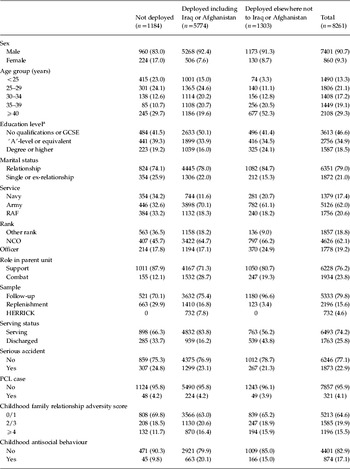
The prevalence of possible PTSD at phase 2 was 4.2% in those deployed to Iraq or Afghanistan or in those not deployed and 3.9% in those deployed elsewhere. The percentage of females, those under 25 years old and other ranks was higher in the not deployed group, but the percentage of Army personnel was higher in the two deployment groups (Table 1). Fewer people had left service in the group deployed to Iraq or Afghanistan than in the not deployed or deployed elsewhere groups, reflecting the differences in age distribution across the groups. The percentage of officers was highest in the deployed elsewhere group and the percentage of other ranks was lowest. Having had a serious accident in the past 5 years was similar in the three deployment groups.
Description of participants by deployment status (n=8261)

NCO, Non-commissioned officer; PCL, Post-traumatic stress disorder (PTSD) CheckList.
Values given as n (%): percentages are weighted to account for sampling fractions and response rate differences.
a GCSEs are examinations usually taken at age 16. A-levels are usually taken at age 18 and are required for entry to university.
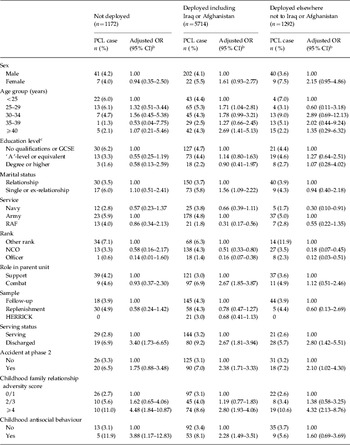
In analyses adjusted for sociodemographic and service-demographic factors and stratified by deployment group, low rank, having left service and high childhood adversity score were associated with possible PTSD regardless of deployment group. The effect sizes were intermediate (OR 2–4) or substantial (OR >4) (Table 2). Having had a serious accident in the past 5 years was significantly associated with PTSD in the two deployment groups, the effect size being intermediate, but the association was not significant in the not deployed group. Possible PTSD was less frequent in RAF personnel deployed to Iraq and/or Afghanistan and less frequent in Naval Services personnel who deployed elsewhere. A combat role in the parent unit was a risk factor for PTSD in those who deployed to Iraq or Afghanistan with an intermediate effect size, but not in the other two groups. Gender was not associated with PTSD.
The association of PTSD at phase 2 with demographic, service, accident and pre-enlistment variables by deployment status (n=8178)a

PTSD, Post-traumatic stress disorder; PCL, PTSD CheckList; RAF, Royal Air Force; NCO, non-commissioned officer; OR, odds ratio; CI, confidence interval.
a Eighty-three people did not complete the PCL.
b Adjusted for sex, age, education, marital status, service and rank.
c GCSEs are examinations usually taken at age 16. A-levels are usually taken at age 18 and are required for entry to university.
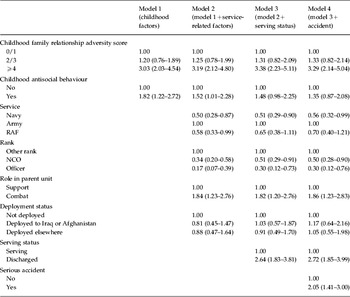
Table 3 shows the results of serial regression analyses, of the whole sample, involving four models. The full model shows that lower rank, having a combat role, having left service, having a serious accident and a high childhood adversity score were independently associated with PTSD symptoms. The effect size of rank, serving status, childhood adversity and having had a serious accident were intermediate and greater than for holding a combat role. Deployment status, service branch and childhood antisocial behaviour were not independent risk factors for PTSD. We repeated the analysis in Table 3 but using multinomial logistic regression compared ‘subthreshold’ PTSD (PCL score 30–49) to no PTSD and ‘probable’ PTSD (PCL score ⩾50) to no PTSD. As with PTSD, subthreshold PTSD was significantly associated with childhood adversity, lowest rank and having had a serious accident but the effect sizes were lower. Subthreshold PTSD was not associated with deployment. Having a combat role and having left service were not significantly associated with subthreshold PTSD but the lower confidence limit was only just below 1 in both cases (0.99 and 0.97 respectively). (Results are available from the authors.)
The association of PTSD with possible explanatory factors: serial multivariable logistic regressions including childhood factors (model 1), service demographic and deployment factors (model 2), serving status (model 3) and accident (model 4)

PTSD, Post-traumatic stress disorder; RAF, Royal Air Force; NCO, non-commissioned officer.
Values given as odds ratio (OR) (95% confidence interval); ORs adjusted for sex, age, education, marital status and all variables in model.
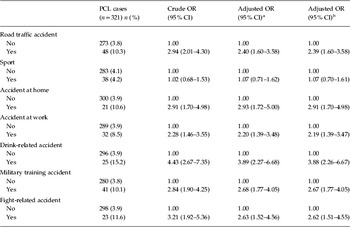
With the exception of accident caused by sport, all types of serious accident were associated with PTSD (Table 4). The association with drink-related accident was the highest.
Association between PTSD and cause of accident in the whole sample (n=8178)

PTSD, Post-traumatic stress disorder; PCL, PTSD CheckList; OR, odds ratio; CI, confidence interval.
a Adjusted for sex, age, marital status, education, service and rank.
b Adjusted additionally for deployment status (not deployed, deployed to Iraq or Afghanistan, deployed elsewhere).
Discussion
The main findings of this study were that lower rank, having had a serious accident, having left service and childhood adversity were consistently associated with PTSD regardless of deployment status whereas deployment to Iraq, Afghanistan or elsewhere was not associated with PTSD. A combat role in the parent unit in those deployed to Iraq and/or Afghanistan was positively associated with PTSD, but a combat role was not explanatory of PTSD in those deployed elsewhere and those who did not deploy. The effect size of holding a combat role in Iraq or Afghanistan was not greater than the effect of the other risk factors for PTSD. The pattern of associations was similar for subthreshold PTSD but the strength of the associations was lower.
A primary issue in this study is the definition of non-deployed personnel. Deployment is an inherent characteristic of military service. We included in the not deployed group those who had completed training but had not deployed to any of the operations in the list supplied by the MoD. The list supplied was of major operational deployments going back to the Falklands war in 1982 and these were, in the main, land-based operations although involving personnel from all services. Many routine naval deployments, such as submarine patrols or surveillance of sea areas with a high level of drug trafficking, would not have been included. We need to accept that some degree of deployment-like exposure would be experienced by personnel who have been assigned to the not deployed group. This issue may have reduced, but only slightly, the contrast between the not deployed and the deployed groups. A true not deployed cohort is hard to find in the UK armed forces and might in fact be unrepresentative, containing an excess of young, newly trained and therefore lower ranked individuals or an excess of those unfit to deploy.
Despite the problem in the definition of non-deployed personnel, the relevant finding was that many factors unrelated to deployment, such as discharge from service, serious accidents, childhood adversity and rank, were all associated with possible PTSD, with an intermediate or substantial effect size after adjustment for social and service demographic factors. Accidents such as vehicle accident may have occurred during deployment. However, other accidents may be due to occupational activities unrelated to deployment (training or work-related accidents) or to non-occupational activities (accidents at home, fights or alcohol-related accidents).
The association of childhood adversity with PTSD has been reported previously (Brewin et al. Reference Brewin, Andrews and Valentine2000; Cabrera et al. Reference Cabrera, Hoge, Bliese, Castro and Messer2007; Iversen et al. Reference Iversen, Fear, Simonoff, Hull, Horn, Greenberg, Hotopf, Rona and Wessely2007), as has the association with rank (Iversen et al. Reference Iversen, Fear, Ehlers, Hughes, Hull, Earnshaw, Greenberg, Rona, Wessely and Hotopf2008). Serious accidents are recognized traumatic events fulfilling the DSM-IV criterion A for PTSD (Perkonigg et al. Reference Perkonigg, Kessler, Storz and Wittchen2000), and discharge from service has been shown to be associated with mental ill health (Hoge et al. Reference Hoge, Lesikar, Guevara, Lange, Brundage, Engel, Messer and Orman2002), including PTSD (Creamer et al. Reference Creamer, Carboon, Forbes, McKenzie, McFarlane, Kelsall and Sim2006).
Although discharge from service may itself be the result of mental illness or factors associated with mental illness, there could also be a readiness to acknowledge symptoms of mental illness once separated from the military. Service personnel who may feel the need to demonstrate resilience may be unable to acknowledge symptoms of mental illness while in service (Iversen et al. Reference Iversen, van Staden, Hughes, Greenberg, Hotopf, Rona, Thornicroft, Wessely and Fear2011), but be less reluctant to do so once they have left.
The prevalence of PTSD in personnel not deployed to Iraq or Afghanistan was 4% in both phases of our large cohort study and 3% in a smaller study carried out in the year before the 2003 Iraq war (Hotopf et al. Reference Hotopf, Hull, Fear, Browne, Horn, Iversen, Jones, Murphy, Bland, Earnshaw, Greenberg, Hughes, Tate, Dandeker, Rona and Wessely2006; Rona et al. Reference Rona, Hooper, Jones, Hull, Browne, Horn, Murphy, Hotopf and Wessely2006; Fear et al. Reference Fear, Jones, Murphy, Hull, Iversen, Coker, Machell, Sundin, Woodhead, Jones, Greenberg, Landau, Dandeker, Rona, Hotopf and Wessely2010); a rate that is similar to that found in an English community-based representative sample of under 55-year-olds (McManus et al. Reference McManus, Meltzer, Wessely, McManus, Meltzer, Brugha, Bebbington and Jenkins2009). In US military studies, the PTSD prevalence in non-deployed personnel varied between 3% and 5% using a similar measure to the UK military study (Hoge et al. Reference Hoge, Castro, Messer, McGurk, Cotting and Koffman2004; Smith et al. Reference Smith, Ryan, Wingard, Slymen, Sallis and Kritz-Silverstein2008), similar to the 1-year prevalence of 3.5% in the US National Comorbidity Survey Replication (Kessler et al. Reference Kessler, Chiu, Demler, Merikangas and Walters2005). The PTSD prevalence in deployed and non-deployed UK military personnel is not dissimilar to that reported in civilian populations in most Anglo-Saxon and West European countries (Oakley Browne et al. Reference Oakley Browne, Wells and Scott2006; Darves-Bornoz et al. Reference Darves-Bornoz, Alonso, de Girolamo, de Graaf, Haro, Kovess-Masfety, Lepine, Nachbaur, Negre-Pages, Vilagut and Gasquet2008; van Ameringen et al. Reference van Ameringen, Mancini, Patterson and Boyle2008). The apparent similarity of PTSD prevalence in military and general populations may be due to the higher prevalence of PTSD in women compared to PTSD in men in the general population, a difference not found in military populations where the proportion of women is considerably lower (Kessler et al. Reference Kessler, Sonnega, Bromet, Hughes and Nelson1995; Brewin et al. Reference Brewin, Andrews and Valentine2000; Rona et al. Reference Rona, Fear, Hull and Wessely2007).
Strengths and weaknesses
This study is based on a large randomly selected sample representing the UK armed forces. The study covers a long period of operations in Iraq (2003–2009) and Afghanistan (2004–2009), and includes many variables that can account for PTSD.
This was a cross-sectional study so temporality of events could not be established. It is possible that PTSD symptoms predated the deployment or accident reported. Another weakness, as in the majority of studies in the military, is that pre-enlistment information such as childhood adversity was obtained in adulthood and recall bias may be a contributing factor. Prospective studies have demonstrated a link between childhood adversity and PTSD (Koenen et al. Reference Koenen, Moffitt, Poulton, Martin and Caspi2007; Storr et al. Reference Storr, Ialongo, Anthony and Breslau2007). A further limitation is that we were unable to construct a combat exposure scale for the non-deployed and deployed elsewhere groups but used role in parent unit to assign a combat or non-combat role. As discussed earlier, another problem is the difficulty of defining a not deployed group.
Conclusions
Although a combat role, endorsed by approximately 25% of personnel in the group deployed to Iraq or Afghanistan, is associated with increased reporting of PTSD symptoms, for the majority of those deployed to Iraq, Afghanistan or operations elsewhere, the risk of PTSD is no greater than for those who have not deployed. The relatively low prevalence of PTSD, regardless of deployment status, and the lack of a deployment effect on PTSD indicate that other factors unrelated to deployment may play an important role. Other factors such as accidents, low rank and childhood adversity may be at least as important as a combat role in increasing the risk for PTSD in UK armed forces personnel. The increased risk in those who have left service requires more purposeful investigation to ascertain whether it corresponds to a real increase in possible PTSD or reflects a greater willingness to report symptoms after separating from service. Our results have implications for clinical practice insofar as military health practitioners should be ready to explore more thoroughly traumatic events that are unrelated to deployment and that could have occurred in service or predate military service.
Acknowledgements
This study was funded by the UK MoD. The authors' work was independent of the funders and the paper was disclosed to the MoD at the point of submission.
Declaration of Interest
S.W. is part funded by the South London and Maudsley National Health Service (NHS) Foundation Trust/Institute of Psychiatry National Institute of Health Research (NIHR) Biomedical Research Centre, and is Honorary Civilian Consultant Advisor in Psychiatry to the British Army and a Trustee of Combat Stress, a UK charity that provides services and support for veterans with mental health problems.