INTRODUCTION
Thoracican barnacles are generally simultaneous hermaphrodites. However, in many species, dwarf males are also known (Darwin, Reference Darwin1851). Dwarf males are tiny individuals that usually attach to specific sites of large (non-dwarf) individuals. In some pedunculate barnacles such as the scalpellid Litoscalpellum nipponense (Pilsbry), large individuals are females (Hiro, Reference Hiro1937). Therefore, three types of sexuality are known in barnacles: (1) hermaphrodites; (2) hermaphrodites with dwarf males (androdioecy); and (3) females with dwarf males (dioecy). Krüger (Reference Krüger1920) referred to the coexistence of females, hermaphrodites and dwarf males (trioecy) in the scalpellids, Trianguloscalpellum regium (Thompson) and Ornatoscalpellum stroemii (M. Sars). However, the existence of hermaphrodites in these species has not been confirmed and the exact pattern of sexuality remains unclear.
Few studies have been conducted regarding the reproductive or larval ecology of deep water barnacles, except for a recently published study by Buhl-Mortensen & Høeg (Reference Buhl-Mortensen and Høeg2006). In general, most thoracican barnacles have planktotrophic larvae (Barnes, Reference Barnes1989); however, all deep water scalpellids on which there is adequate information have lecithotrophic larvae (Barnes, Reference Barnes1989; Buhl-Mortensen & Høeg, Reference Buhl-Mortensen and Høeg2006). The size of egg tends to be larger in lecithotrophic species than in planktotrophic species (Barnes, Reference Barnes1989). In addition, most lecithotrophic pedunculates release their larvae as nauplii, whereas some species such as Ornatoscalpellum stroemii release their larvae as cyprids (Buhl-Mortensen & Høeg, Reference Buhl-Mortensen and Høeg2006).
Dwarf males of barnacles have been variously discussed regarding the morphology, function and adaptive significance (Darwin, Reference Darwin1851; Pilsbry, Reference Pilsbry1908; Charnov, Reference Charnov and Southward1987; Klepal, Reference Klepal1987; Yusa et al., Reference Yusa, Yamato and Marumura2001; Buhl-Mortensen & Høeg, Reference Buhl-Mortensen and Høeg2006). However, the crucial points are yet to be resolved due mainly to the scarcity of information. Although not in thoracicans, Gotelli & Spivey (Reference Gotelli and Spivey1992) studied the adaptive significance of dwarf males in the acrothoracican barnacle Trypetesa lampas (Hancock) reporting that dwarf males preferentially attached close to the fertilization sites of the female. They also reported that the numbers of males on the left and right sides of the females were more evenly distributed than expected under a random distribution. They regarded these findings as evidence for the presence of male–male competition for a better access to the fertilization sites and suggested that being small is advantageous to such access. In the rhizocephalan Sacculina carcini, males already occupying the female's receptacles prevent other males from entering the same receptacles (Høeg, Reference Høeg1987). However, preference for specific sites by males or competition among dwarf males has not been studied in the thoracican barnacles.
Scalpellum stearnsii Pilsbry is a pedunculate barnacle living at depths of 100−500 m from Japan to Indonesia (Pilsbry, Reference Pilsbry1911; Broch, Reference Broch1922; Nilsson-Cantell, Reference Nilsson-Cantell1934; Hiro, Reference Hiro1939). Information on the overall ecology of S. stearnsii is limited and little is known about their reproductive ecology. Hiro (Reference Hiro1937) reported that large individuals of S. stearnsii are females. Krüger (Reference Krüger1920) and Barnes (Reference Barnes1989) referred to the coexistence of females, hermaphrodites and dwarf males in S. stearnsii, and Buhl-Mortensen & Høeg (Reference Buhl-Mortensen and Høeg2006) considered this species to be androdioecious. However, none of these studies showed any clear evidence for the presence of hermaphrodites. Hiro (Reference Hiro1937) also reported that one large individual may accommodate up to 100 sac-like dwarf males. Other reproductive characteristics, including size of eggs and type of the larvae, are unknown.
This study deals with general aspects of the reproductive ecology of S. stearnsii including: (1) the sexuality of large individuals; (2) characteristics of eggs and larvae; and (3) characteristics of dwarf males.
MATERIALS AND METHODS
Collection of Scalpellum stearnsii
Scalpellum stearnsii were collected by trawling with shrimp nets for Parahaliporus sibogae (De Man) around 30 km off Nomaike Fishery Port, Satsuma Peninsula, southern Japan (31°33′N 129°52′E) from April to December 2004. The sea-floor (at 380−430 m depth) was sandy to muddy with pebbles and shell debris, to which the barnacles were found attached.
In April, the barnacles were preserved in 5% seawater formalin after collection and were then transferred into >70% ethanol. The barnacles in other collections were preserved in >70% ethanol. We examined a total of 103 barnacles: 43 were collected in early April, 17 from mid-April to mid-September, 20 in late September and 23 in mid-December.
Measurements of barnacles
We made the following measurements for each non-dwarf individual. Firstly, a part of the left capitulum was cut and removed, and the presence or absence of a penis was observed under a stereoscopic microscope. When the barnacle had an egg mass, it was removed for later measurements. All parts (excluding the egg mass) were wiped lightly with a paper towel and weighed to the nearest 0.01 g for individuals of 0.1 g or more and up to two significant figures for lighter individuals. Subsequently, the lengths of the capitulum and peduncle were measured for each barnacle. The longest part of the capitulum was measured to the nearest 0.05 mm by micrometer calipers. The peduncle length was recorded as the mean value of the longest and shortest parts measured to the nearest 0.5 mm by curvilinear rulers. The total length of the barnacle was calculated by adding the capitulum length to the peduncle length.
Individuals were recorded for the presence or absence of an egg mass. Egg masses were observed under a stereoscopic microscope and the developmental stage of the embryos recorded as uncleaved eggs, developing embryos, or nauplii before hatching. The egg masses were weighed as described above. Five egg masses with almost-hatched nauplii were unable to be weighed because they became fragmented and many nauplii were lost.
The number of eggs in an egg mass was counted for ten randomly selected individuals with uncleaved eggs. Ten eggs from each of these individuals were selected and the major axis of each egg was measured to the nearest 0.01 mm by a micrometer.
The number and positions of dwarf males were observed in each non-dwarf individual under a stereoscopic microscope. There were ten or more small cavities (‘receptacles’; Buhl-Mortensen & Høeg, Reference Buhl-Mortensen and Høeg2006) in a line along both left and right occludent margins of the non-dwarf individuals and each male occupied a single receptacle. The receptacles were numbered from the lowest part (No.1; presumably nearest to the fertilization site) to the highest (No.10, or sometimes more). The position of each male was recorded as the identification number of the receptacle it occupied.
After removal from the receptacle, the length and width of each dwarf male was measured to the nearest 0.01 mm by a micrometer for 17 randomly-selected males. Assuming that the dwarf males were spheroid in shape, we calculated the volume of dwarf males.
Rearing of adults and larvae
We reared 19 individuals of Scalpellum stearnsii collected in September and December 2004 in a tank filled with about 200 l of artificial seawater (Yashima Chemical Corporation, Osaka) in the laboratory. The seawater was maintained at 13−15°C, circulated by pumps and filtered. The individuals were fed ad libitum on artificial food pellets for fish (‘Pack de akamushi’; Gex Corporation, Osaka) and boiled small (~1 cm) sardines.
During rearing of the adult barnacles, we sampled the water to look for nauplius larvae. Occasionally, the larvae were collected in a fine net and transferred into glass bowls containing about 100 ml artificial seawater maintained at 13−15°C. Crushed mollusc shells were put in the glassware as a substratum for settlement. The seawater was changed every day. During rearing, we collected 20 nauplii and five cyprids randomly. Their major axes were measured to the nearest 0.01 mm.
Statistical analysis
The effects of sampling month on barnacle size and reproduction were studied by analysis of variance (ANOVA). The relationships between total length, weight and egg mass weight were studied by simple linear regression. The effect of body weight on the presence or absence of an egg mass was studied by logistic regression. The factors that may affect the number of dwarf males were studied by multiple regression.
To determine whether the dwarf males preferentially occupied receptacles nearer the fertilization site (i.e. the lower receptacles), their positions were compared with a random settlement pattern. The expected distribution under a null hypothesis was that the dwarf males settled in each receptacle with the same probability. A χ2-test was conducted to determine whether the observed distribution was different from the expected one, for the left and right occludent margins separately. The rare males that occupied the 11th or greater receptacles were excluded from this analysis.
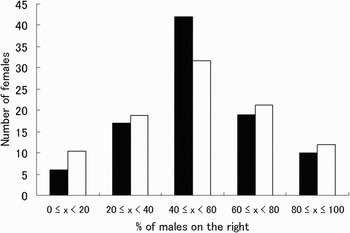
To test whether the dwarf males settled on the left and right margins randomly the statistical test described by Gotelli & Spivey (Reference Gotelli and Spivey1992) was used with modifications. For each non-dwarf individual, the proportion of dwarf males on the right margin was recorded as 0−19.9%, 20−39.9%, 40−59.9%, 60−79.9% or 80−100%. If the dwarf males settled randomly on the left and right margins, the proportions of the dwarf males on the right margins of non-dwarf individuals should follow a binomial distribution with an average of 50%. The observed proportions were tested against the null hypothesis using the χ2-test.
All statistical analyses were conducted with JMP IN v. 5.1.1 (SAS Institute, 2004).
RESULTS
None of the 103 non-dwarf individuals of Scalpellum stearnsii had a penis. Therefore, the individuals were not hermaphrodites but females. Among them, 71 individuals (69%) were solitary.
Among the 103 barnacles, all ten small individuals (<5 g in weight) were collected in December. However, among barnacles heavier than 5 g, there were no significant differences between four collection periods (April, April−September, September and December) in body weight (N = 93, F = 2.15, P = 0.10; ANOVA) or egg mass weight (N = 88 excluding five individuals with unknown egg mass weights; F = 1.75, P = 0.16; ANOVA). Therefore, we pooled all data for further analysis without considering seasonal trends.
Allometric relationships
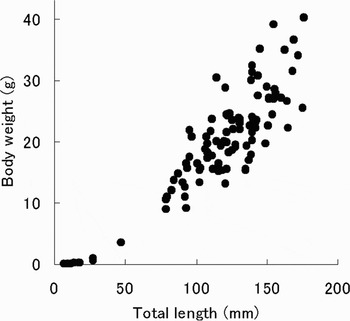
The body weight of Scalpellum stearnsii ranged from 0.0093 to 40.08 g (mean ± SD = 19.58 ± 8.95 g; N = 103). The capitulum length was 5.40−60.15 mm (45.32 ± 12.10 mm) and the peduncle length was 1.85−121.00 mm (71.12 ± 29.11 mm). The total length was 7.25−176.60 mm (116.44 ± 39.74 mm).
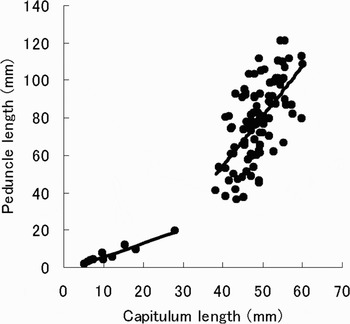
Overall, there was a positive relationship between total length and body weight (Figure 1). The relationship between log10 [total length (mm)] (x) and log10 [body weight + 1 (g)] (y) could be expressed as: y = 1.30x–1.40 (N = 103, R 2 = 0.94, P < 0.001). The relationship between capitulum length and peduncle length changed with growth (Figure 2). When it was less than 35 mm, the length of the capitulum (x mm) increased at a rate similar to that of the peduncle (y mm) (Figure 2; N = 10, y = 0.74x−1.74, R 2 = 0.92, P < 0.001). However, when the capitulum exceeded 35 mm, the peduncle grew faster than the capitulum (Figure 2; N = 93, y = 2.67x –52.33, R 2 = 0.39, P < 0.001).
Relationship between total length and body weight.

Relationship between capitulum length and peduncle length. Regression lines are shown for small (<30 mm) and large (≥30 mm) females separately.

Eggs
As in other pedunculate barnacles, the egg masses of Scalpellum stearnsii were present in the mantle cavity around the lower part of the body, attached to the ovigerous frenae.
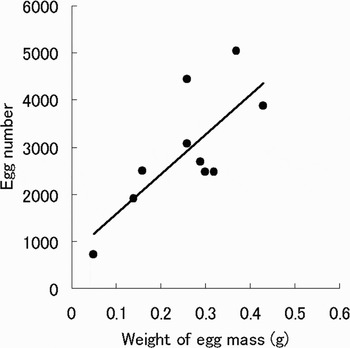
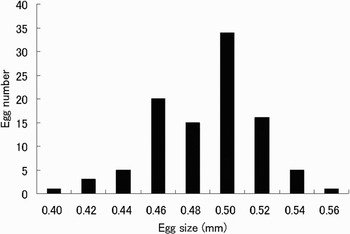
Ovigerous females weighed from 9.0 to 32.4 g (mean ± SD = 20.19 ± 5.61 g) and the total length was 79.15–165.00 mm (120.10 ± 23.15 mm) (N = 45). Among 93 females 9.0 g or heavier, 48% were ovigerous. The weight of the egg mass ranged from 0.05 to 0.61 g (mean ± SD = 0.27 ± 0.12 g; N = 40 with known weights). Among ten randomly-chosen females, the number of eggs in the egg masses ranged from 713 to 5039 (2911 ± 1259). There was a significantly positive relationship between egg mass weight (x g) and number of eggs (y) (Figure 3; N = 10, y = 8414x + 740, R 2 = 0.57, P < 0.05), indicating that egg mass weight can be used as an index of fecundity. Among ten eggs from each of the ten individuals (N = 100), the major axis ranged from 0.41 to 0.58 mm (mean ± SD = 0.50 ± 0.03 mm). The size–frequency graph is likely to be almost unimodal (Figure 4).
Relationship between egg mass weight and number of eggs. The regression line is shown.

Distribution of egg sizes.

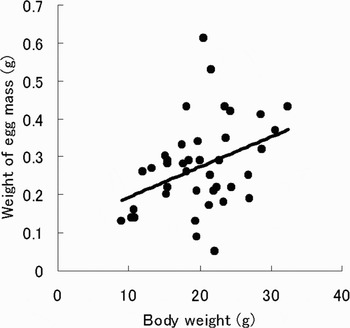
There was no significant effect of body weight on the presence or absence of an egg mass (N = 103, likelihood ratio χ2 = 0.37, P = 0.54). Body weight significantly affected egg mass weight among ovigerous females (Figure 5; N = 40, y = 0.0079x + 0.12, P < 0.05), but the relationship was weak (R 2 = 0.14).
Relationship between body weight and egg mass weight in brooding females (N = 40). The regression line is shown.

Dwarf males
The total number of dwarf males per female ranged from 0 to 35 (mean ± SD = 5.90 ± 5.11; N = 103). The number of dwarf males on the right capitulum was 0−17 (2.91 ± 2.55) and that on the left was 0−18 (2.99 ± 2.79). The length and width of dwarf males were 0.38−0.88 mm (0.68 ± 0.13 mm; N = 17) and 0.18−0.51 mm (0.42 ± 0.09 mm), respectively. Their volumes ranged from 0.01 to 0.11 mm3 (0.07 ± 0.03 mm3).
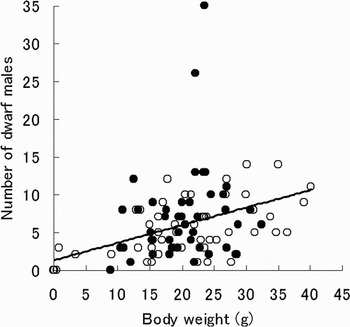
Female body weight had a significantly positive effect on the number of males (Figure 6), whereas egg mass weight did not (N = 98; body weight: P < 0.001; egg mass weight: P = 0.24; multiple regression). The simple regression equation for female weight (x g) and number of males (y) was y = 0.25 x + 2.05 (N = 45). The lowest body weight of a female with dwarf males was 0.86 g; this female was non-ovigerous. Among the ovigerous females, the effect of female body weight on the number of males was almost significant (N = 40, P = 0.06).
Relationship between female body weight and number of dwarf males present on the female. •, ovigerous females; ○, non-ovigerous females. The regression line is shown based on all females.

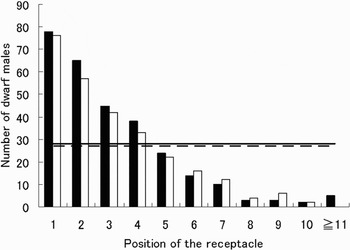
The distribution of dwarf males was skewed significantly towards the lower part of the occludent margins than that expected under the null hypothesis that males settle in each receptacle with the same probability (Figure 7; N = 282 on the right capitulum, χ2 = 238.38, P < 0.001; N = 270 on the left, χ2 = 204.74, P < 0.001).
Relationship between receptacle position and number of dwarf males. Black bar, number of dwarf males on the right capitulum; white bar, number of males on the left. The unbroken and dashed lines are expected numbers of males on the right and left capitula, respectively.

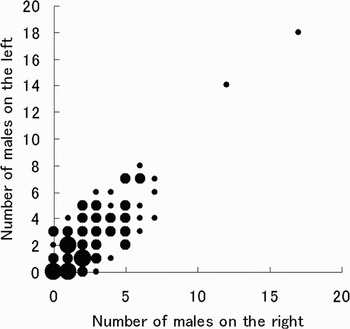
There was a significantly positive correlation between the number of dwarf males on the right capitulum and that on the left in the same female (Figure 8; N = 103, R 2 = 0.69, P < 0.001). However, when the proportions of males on the right capitulum of females were compared against the null hypothesis of a binomial distribution with an average of 50%, there was no significant difference between the actual and expected values (Figure 9; N = 94, χ2 = 5.97, P = 0.40), indicating that the males did not distribute more evenly on both sides than expected.
Relationship between the number of dwarf males on the right capitulum and that on the left. •, N = 1; •, N = 2–4; •, N = 5–9.

Proportion of dwarf males on the right capitulum. Black bar, actual value; white bar, expected value.

Rearing of Scalpellum stearnsii
All 19 individuals of Scalpellum stearnsii survived the rearing period of 7−9 months. During rearing, several individuals moulted and released nauplius larvae. When reared, many nauplii metamorphosed into cyprids without feeding. After the metamorphosis, the cyprids lived for two or three weeks. However, the cyprids did not attach to the mollusc shells in the glassware or metamorphose into juvenile barnacles.
The major axis of the nauplii was 0.58−0.69 mm (mean ± SD = 0.63 ± 0.03 mm; N = 20) and that of the cyprids was 0.84−0.91 mm (0.87 ± 0.03 mm; N = 5).
DISCUSSION
Allometric relationships
The size of the peduncle relative to that of the capitulum increased with growth (Figure 2). This tendency is known in other pedunculate barnacles such as Leucolepas longa Southward & Jones (Tunnicliffe & Southward, Reference Tunnicliffe and Southward2004). Tunnicliffe & Southward (Reference Tunnicliffe and Southward2004) listed some possible causes of the very long peduncle in L. longa, including effect of crowding or larger areas covered for feeding. In Scalpellum stearnsii, crowding is negligible, because most (69%) individuals were solitary. Instead, such changes in the relative size of the peduncle may reflect a shift in resource allocation from growth to reproduction, since the capitulum contains the body and the peduncle the ovary.
Sexual expression
There were no hermaphrodites among the 103 individuals of Scalpellum stearnsii collected in this study. However, two hermaphroditic Arcoscalpellum sp. were found attached to the peduncles of female S. stearnsii. The form and size of these two species were similar so it is possible that previous authors (e.g. Krüger, Reference Krüger1920) mistook Arcoscalpellum sp. for S. stearnsii. In any case, there has been no clear evidence that S. stearnsii has hermaphroditic individuals. Likewise, Ornatoscalpellum stroemii, which had been reported to be trioecious (Krüger, Reference Krüger1920), was recently categorized as dioecious (Buhl-Mortensen & Høeg, Reference Buhl-Mortensen and Høeg2006). In Scalpellum stearnsii, the high proportion of solitary individuals (69%) agrees with a theoretical expectation that large (non-dwarf) individuals should become females when they are solitary (Charnov, Reference Charnov and Southward1987; Yusa et al., Reference Yusa, Yamato and Marumura2001). Ornatoscalpellum stroemii appear to form groups, but they are dominated by immature individuals (Buhl-Mortensen & Høeg, Reference Buhl-Mortensen and Høeg2006); hence dioecy in this species does not contradict with the theory.
Eggs and larvae
This study has revealed several characteristics concerning eggs and larvae of Scalpellum stearnsii. Firstly, the eggs of S. stearnsii (0.50 mm) were larger than those of most other thoracican barnacles with planktotrophic larvae (0.2−0.3 mm) (Barnes, Reference Barnes1989) and comparable to those of other deep-sea scalpellids with lecithotrophic larvae (Buhl-Mortensen & Høeg, Reference Buhl-Mortensen and Høeg2006). Secondly, the larvae of S. stearnsii are released as nauplii, since egg masses with well-developed nauplii became fragmented and many nauplii were lost during handling and no cyprids were found in the mantle cavity of the female. In contrast, Ornatoscalpellum stroemii brood their larvae up to the cypris stage (Buhl-Mortensen & Høeg, Reference Buhl-Mortensen and Høeg2006). Thirdly, the nauplii of S. stearnsii are lecithotrophic. When we reared hatched nauplii of S. stearnsii, many metamorphosed into cyprids without feeding. These characteristics follow the general trend that deep-sea crustaceans tend to lay lecithotrophic or direct-developing eggs in response to low food availability (Herring, Reference Herring2001).
The distribution of egg size appeared to be almost unimodal (Figure 4). Therefore, in S. stearnsii, there is no sexual dimorphism at the egg stage. As far as we observed, there appears to be no sexual dimorphism at the nauplius or cypris stages, either. In contrast, the size distribution of cyprids of Euscalpellum squamuliferum (Weltner) (Scalpellidae) was bimodal, with cyprids that become dwarf males being smaller than those that become hermaphrodites (Barnes, Reference Barnes1989). However, lack of sexual dimorphism does not necessarily mean lack of genetic component of sex determination. For example, in Scalpellum scalpellum, there are two types of cyprid: one develops into hermaphrodites and the other can develop into males or hermaphrodites depending on the environments (Svane, Reference Svane1986). However, the two cyprid types are indistinguishable from each other by their size or shape (Svane, Reference Svane1986). The mode of sex determination in S. stearnsii requires further study.
In this study, there was no effect of body weight on the presence or absence of an egg mass. It may be the case that breeding by females is affected by food availability, which tends to be low in the deep sea (Herring, Reference Herring2001). Females that obtain food may lay eggs and those that fail may not. The relatively low proportion of ovigerous females (48%) supports this suggestion. The proportion of ovigerous females in other barnacles is generally higher; for example, it is 69% in Lepas anatifera Linnaeus (Zann & Harker, Reference Zann and Harker1978) and 72% in Conchoderma auritum (Linnaeus) among mature individuals (Barnes, Reference Barnes1989). Even when the female S. stearnsii do lay eggs, the number of eggs may also depend on food availability. This is supported by the significant but low (R 2 = 0.14) coefficient of the regression of egg mass weight on body weight among ovigerous females (Figure 5). The R 2 values in other barnacles are generally higher; for example, R 2 in Koleolepas avis (Hiro) is 0.77 (Yusa et al., Reference Yusa, Yamato and Marumura2001). We calculated the relationship between body size and number of eggs in Octolasmis warwickii Gray and L. anatifera from the graph in Zann & Harker (Reference Zann and Harker1978); R 2 was 0.93 in O. warwickii (N = 36) and 0.78 in L. anatifera (N = 20).
Dwarf males
Although little is known about dwarf males in the Thoracica, the size and shape of dwarf males of Scalpellum stearnsii resemble those of other deep-sea scalpellids with relevant information (Klepal, Reference Klepal1987; Buhl-Mortensen & Høeg, Reference Buhl-Mortensen and Høeg2006). In S. stearnsii, during the metamorphosis from the cyprid into the dwarf male, the maximum length shows a slight decrease; 0.84–0.91 mm and 0.38–0.88 mm, respectively. Because they lack cirri and mouth, dwarf males apparently do not feed (Pilsbry, Reference Pilsbry1908; Klepal, Reference Klepal1987) and scarcely grow. Yamaguchi et al. (Reference Yamaguchi, Ozaki, Yusa and Takahashi2007), who analysed theoretically the growth of dwarf males in barnacles, predicted that dwarf males do not grow: (i) when food is scarce as in deep seas; and (ii) when sperm competition is low, i.e. large individuals are females and not hermaphrodites. The non-feeding male in S. stearnsii hence agrees with the theory.
One of the most interesting characteristics in the reproductive ecology of Scalpellum stearnsii is the large number of males per female. On average six were present per female, with the maximum being 35 in this study. Hiro (Reference Hiro1937) even reported that nearly 100 males attached on a female. Males are generally fewer in other scalpellids, e.g. 0–8 in S. scalpellum and 1–2 in Ornatoscalpellum stroemii (Buhl-Mortensen & Høeg, Reference Buhl-Mortensen and Høeg2006). Although the sex ratio of cyprids (i.e. the proportion of male cyprids relative to female/hermaphroditic ones) may affect the apparent sex ratio of the adults, the mode of sex determination and larval sex ratios are unknown in S. stearnsii. However, the large number of males per female in S. stearnsii may be due to a great difference in survival of males and females reaching sexual maturity. Mature females of S. stearnsii are large, ranging from 80 to 180 mm (Figure 1), and they apparently live long, since none died during the cultivation period of 7−9 months in this study. On the other hand, the life-span of dwarf males is supposed to be short, presumably less than one year, as suggested in Scalpellum scalpellum (Svane, Reference Svane1986). Therefore, females should have much lower survival than dwarf males to reach sexual maturity. These will heavily bias the apparent sex ratio towards males. This idea is supported by the fact that females are also large (30–43 mm in capitulum length) in Arcoscalpellum michelottianum, another scalpellid with many males (6–12 per female; Buhl-Mortensen & Høeg, Reference Buhl-Mortensen and Høeg2006).
There was a positive relationship between female body size and number of dwarf males in Scalpellum stearnsii. A similar relationship has been reported in Koleolepas avis (Yusa et al., Reference Yusa, Yamato and Marumura2001). Two explanations are possible for such a relationship. Firstly, large, older females accumulate more males over time. This is unlikely in S. stearnsii if males live for a much shorter time than females. Secondly, cyprids that will become males tend to settle on large females more frequently than on small females. It is possible that male cyprids prefer large females, which tend to lay more eggs.
Dwarf males were strongly aggregated towards the lower part of the occludent margins (Figure 7). The fertilization success of dwarf males is expected to be high at this position, because it is nearer to the female's gonopores. This attachment pattern, as well as the fact that more males attached to larger females, suggests that males actively choose settlement sites to achieve higher fertilization success. However, the proportions of dwarf males on the left and right capitula were not significantly different from a random distribution (Figure 9). In Trypetesa lampas, because males choose the least crowded part of the female's disc for settlement, the distribution of males on the left and right sides was more even than random (Gotelli & Spivey, Reference Gotelli and Spivey1992). In S. stearnsii, an even distribution was not detected, indicating that selection of settlement sites by male cyprids is not perfect.
ACKNOWLEDGEMENTS
We thank Mr Y. Ishimabushi working at Nomaike Fishery Port for collecting and allowing us access to the material. We also thank Dr K. Wada and other members of the Laboratory of Animal Ecology, Nara Women's University for discussion and encouragement and Drs J.T. Høeg and G. Walker for critical review of the manuscript.