INTRODUCTION
The psychological and psychiatric dimensions of care have been identified by the American National Consensus Project for Quality in Palliative Care (2009). Caring relatives as informal caregivers are important—when present, perhaps the most important—personal resources for terminally ill persons. Caring relatives experience distress at a similar or even higher level than that of the ill family member. They are burdened with care efforts as well as psychological strain throughout the progression of a fatal disease, and with experiences of loss as well as anticipatory grief. Popek and Hönig (Reference Popek and Hönig2015) highlighted that distress in relatives is still unrecognized, underreported, and undertreated, partially because of the presence of negative emotions—such as hostile interaction patterns, low emotional expressions, and high-conflict tendencies. Kent et al. (Reference Kent, Rowland and Northhouse2016) recently recognized and highlighted four important areas that support both caregivers and patients.
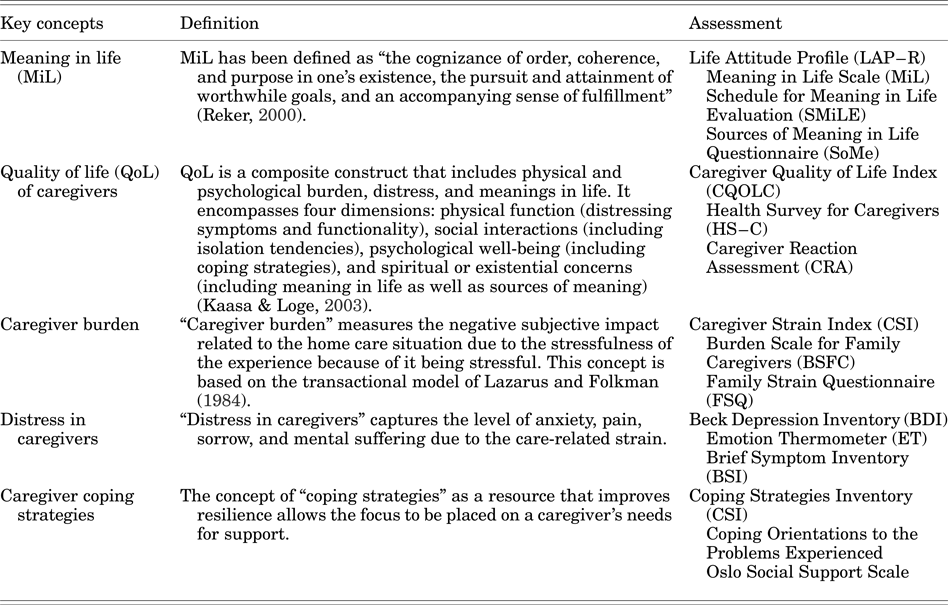
The present study focuses on the importance and robustness of “meaning in life” as well as “sources of meaning” in caring relatives as informal caregivers of terminally ill family members—that is, those with a life expectancy of less than six months—within a period of three months after the onset of a supporting and visiting palliative nurse team. Existential approaches emphasize the importance of “meaning” as one of the most relevant factors supporting quality of life, protecting against depression and anxiety (Scheffold et al., Reference Scheffold, Mehnert and Müller2014) as well as providing resilience in a “limit situation” (Valdés-Stauber, Reference Valdés-Stauber2016). Because clinical and psychosocial variables have to be taken into account as potentially influencing meaning in life and sources of meaning, it is important to clarify the core concepts. “Meaning in life” is partially associated with other relevant concepts in palliative care involving informal caregivers, such as “quality of the caregiver's life,” “caregiver's burden,” “distress of caregivers,” and “coping strategies of caregivers (which are presented in Table 1). It can be assumed that a strong or stable sense of meaning in life might positively influence “resilience” in such an existentially limited situation for family caregivers, protecting them against demoralization. With this in mind, we can expect that “sources of meaning” could constitute an important resilience factor for family caregivers who have the personal challenge of having to cope with both the burden of care and the “anticipatory grief,” and being confronted with the finite nature of life and the loss of a family member. For research purposes, it is important to differentiate between more abstract descriptions of the “meaning of life” and the “meaning in life” that is related to the circumstances at hand (Wong, Reference Wong, Wong and Fry1998). It may be assumed that meaning in life could balance the “sense of impotence” in life-limiting situations, such as, for instance, in the care of terminally ill family members. Research has demonstrated that family caregivers of palliative patients may also develop anxiety and depression (Götze et al., Reference Götze, Brähler and Gansera2014) and that the symptom intensity in caring relatives is even higher than that in terminally ill family members (Skleranova et al., Reference Skleranova, Krümpelmann and Haun2015). An important investigation in this context conducted by O'Hara et al. (Reference O'Hara, Hull and Lyons2010) explored the associations between objective caregiver burden, and distress and symptom intensity, demonstrating that objective burden and stress burden are related to lower patient quality of life, higher symptom intensity, and higher depressed mood. A higher objective burden was detected in caregivers who perceived that patients had unmet needs. Research on caregivers' burden, distress, and quality of life has demonstrated the importance of nursing assistance in order to ensure that more time for care is available as well as to enhance such personal resources as hope, coping strategies, and sense of coherence or personal meanings. At the same time, a reduction in the sense of guilt due to negative feelings helps to relieve personal burden. According to Tang et al. (Reference Tang, Cheng and Lee2013), a sense of meaning seems to mediate the effects of caregiving stressors (appraisals of caregiving confidence and subjective caregiving burden) on the depressive distress of family caregivers while providing end-of-life support.
Although “meaning in life” overlaps with other concepts, it is also differentiated from these related concepts (meaning of life overlaps with, but is also differentiated from, other related concepts)

The relationship between psychopathology and meaning in life is of paramount importance. Hence, it has been repeatedly observed that the prevalence of mood and anxiety disorders is high in cancer patients' caregivers and is correlated with reported lower self-efficacy (Mazzotti et al., Reference Mazzotti, Sebastiani and Antonini Cappellini2013; Ugalde et al., Reference Ugalde, Krishnasamy and Schofield2014). The identification of anxiety and depression in family caregivers is highly important, as both are associated with a discrepancy in a patient's evaluation of distress due to symptom burden in the sense of an overestimation by stressed family caregivers (Oechsle et al., Reference Oechsle, Goerth and Bokemeyer2013). It has also been demonstrated that patients' coping strategies and prognostic understanding (e.g., resilience issues) are associated with family caregivers' depression and anxiety symptoms (Nipp et al., Reference Nipp, El-Jawahri and Fishbein2016). Psychopathological burden is overall associated with higher distress levels, a reduction in quality of life, and specific coping strategies like emotion-focused coping (Choi et al., Reference Choi, Hwang and Hwang2016; Freitas et al., Reference Freitas, Andreoulakis and Alves2015; Govina et al., Reference Govina, Kotronoulas and Mystakidou2015; Pérez-Ordóñez et al., Reference Pérez-Ordóñez, Frias-Osuna and Romero-Rodríguez2016). Psychotherapy in palliative care focuses on both patients and family caregivers as recipients. Patients suffering from advanced illness react individually to symptom distress, decreasing functionality, progression of illness, and awareness of the approach of the end of life. Depression, anxiety, and grief are the most common reactions that occur simultaneously in family caregivers. The sources of meaning outlined by Frankl (Frankl, Reference Frankl1985; Reference Frankl1994) constitute a lucid theoretical framework for psychotherapy in palliative care as adapted by meaning-centered psychotherapy (MCP) and its adaptation for caregivers (MCP–C). This approach is a structured psychotherapeutic intervention that targets existential distress and spiritual well-being among patients with advanced cancer. MCP highlights significant areas of growth, including an increased understanding of the historical context, shaping their experience of providing care, the recognition of the need for improved self-care, reconnecting with meaningful activities, and the possibility of continued connectedness to others and the world despite the limitations caused by the burden of care (Applebaum et al., Reference Applebaum, Farran and Marziliano2014). Both individual and group meaning-centered psychotherapy for advanced cancer patients have been theoretically developed and empirically investigated (Applebaum et al., Reference Applebaum, Kulikowski and Breitbart2015; Breitbart, Reference Breitbart2002; Breitbart et al., Reference Breitbart, Rosenfeld and Gibson2010; Reference Breitbart, Rosenfeld and Pessin2015). There are other well-investigated existential psychotherapeutic approaches, such as dignity therapy (Chochinov et al., Reference Chochinov, Kristjanson and Breitbart2011), existential behavioral therapy for informal caregivers (Fegg et al., Reference Fegg, Kramer and L'Hoste2008; Thurn et al., Reference Thurn, Brandstätter and Fensterer2015), and mindfulness-based stress reduction (Hou et al., Reference Hou, Wong and Yip2014; Kögler et al., Reference Kögler, Brandstätter and Borasio2015).
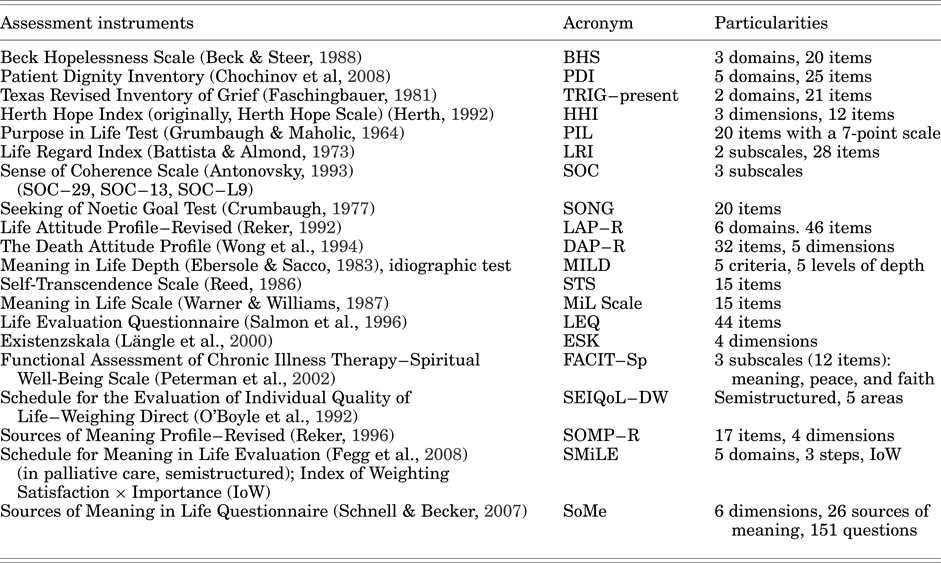
The present investigation focuses on possible changes or robustness of sources of meaning in family caregivers. Furthermore, it explores possible associations between sources of meaning and psychosocial as well as clinical variables in both terminally ill family members and their caring relatives as informal caregivers. The present authors gave priority to the Sources of Meaning Questionnaire over the Life Attitude Profile because the SoMe represents a novel and comprehensive tool in German-speaking countries that is worthy of being implemented in different settings. The SoMe Questionnaire is important to this research purpose due to the stable character of the defined sources of meaning that may be considered as a component of personality. An overview of the scope of assessment instruments in investigations about existential issues is given in Table 2.
Assessment instruments in investigations about existential (meaning) issues

The hypothesis of the present authors is that, even in a life-limiting situation, as the care of terminally ill relatives could be considered, sources of meaning as well as superordinate dimensions of meaning in life may remain robust.
OBJECTIVES
The aim of our investigation was to assess the development of “meaning in life” as well as sources of meaning in caregivers of terminally ill family members. These participants were supported by a palliative nursing team and observed within a three-month period after the onset of the support by the team. In detail, three research objectives were set:
1. To find out whether there are changing patterns in existential attitudes and in sources of meaning of the target group within the surveyed period.
2. To find out whether there are statistically significant differences between the uncompleted subsample due to the death of the ill family member before fulfillment of the survey period and the completed subsample of those still alive at the end of the survey period.
3. To find out whether there are, at the onset of the survey period, cross-sectional relevant associations for the whole sample between sources of meaning and the clinical as well as psychosocial variables.
METHOD
Study Design
In this naturalistic study, patients nursed by the outreach palliative nursing team (named the “clinic home interface”) were prospectively followed over three months. The Sources of Meaning and Meaning in Life Questionnaire (SoMe) was administered to 100 caregivers of terminally ill patients at four measurement timepoints: immediately before the onset of palliative care (t 0), and one week, one month, and three months after t 0. The inclusion criteria were a need for home nursing and agreement to participate in the study. The exclusion criteria were a lack of relatives, admission to a hospice, and insufficient communication with caring relatives. Out of the 182 patients who started to use the care service, 82 could not be included in the study due to the following reasons: an early death (24), admission to a hospice (5), lack of relatives (5), communication barriers (3) or early cessation of participation (6), patient declined to participate (18), and the caring relative(s) declined to participate (21). Out of the initial cohort of 100 participants, 76 dropped out from our study before the conclusion of the survey period due to the death of the terminally ill family member.
Setting Description
Doctors treating the patient both in the hospital during inpatient treatment and as general practitioners contacted an outreach palliative nursing team when home palliative support is needed. The nursing intervention entails a prompt first interview with both the patient and the caring relative(s), and the collected information was entered into a special palliative program (Pallidoc). An individualized case plan as well as palliative medication were discussed and detailed in the plan. Home nursing consists of basic nursing assistance, counseling, psychological support, relief of symptom burden, psychoeducation, and empowerment of relatives. Home visits are flexibly scheduled according to needs, from once a week to daily. Each visit lasts for from 30 to 60 minutes. In addition, telephone counseling is offered. Team meetings with treating doctors take place three times a week. After the death of a patient, a compassionate visit and grief counseling are ensured.
Ethical Approval
Our investigation was approved by the ethics committee of the Technical University of Munich (registration no. 5742/13). In accordance with the committee, agreeing participants signed an informed consent.
Assessment
Assessment was performed at four timepoints: t 0 (immediately before commencement of visiting palliative nursing, t 1 (one week after beginning), t 2 (one month after beginning), and t 3 (three months after beginning). Sources of meaning were set as outcome (dependent) variables, whereas sociodemographic and clinical variables were set as independent variables.
Variables and Assessment Instruments
The following variables were set as relevant for the present investigation, for both terminally ill patients and caring relatives:
1 Sociodemographic and clinical variables on the relatives' part: age, gender, relatedness to patient, cohabitation, education, employment status, presence of medical condition or of psychological strain, economical concerns, or other burdens independent of caring for a terminally ill family member.
2 Sociodemographic and clinical variables on the patients' part: kind of terminal disease, age, gender, duration of disease, physical burden (four categories), psychological burden (six categories), performance status measured by means of the WHO/Eastern Cooperative Oncology Group (ECOG) Scale and the Palliative Performance Scale (PPSv2).
3 Assessment of existential attitudes of caring relatives by means of the SoMe, consisting of a total score, 6 dimensions, and 26 sources of meaning scales.
Standardized Instruments
Basic Documentation for Psycho-Oncology (PO–Bado)
The PO–Bado is a validated assessment scale of physical and psychological burden in oncology patients developed in Germany and translated into English. It is available in three versions: the standard version (PO–Bado, 17 items), the short form (PO–Bado, SF–7), and the breast cancer version (PO–Bado, BC–21) (Herschbach et al., Reference Herschbach, Book and Brandl2008). The standard version includes sociodemographic and clinical data as well as a physical distress scale (4 items), a psychological distress scale (8 items), and an additional distress scale (4 items) rated on the basis of a 5-point Likert-type scale. ECOG performance status is included and separately described below. The documentation form is normally filled out after the first interview with a patient and records the patient's condition over the previous 3 days (Marten-Mittag et al., Reference Marten-Mittag, Book and Buchhold2015). In the present investigation, the authors adopted two items from the PO–Bado: (1) total score for psychological distress (sum of scores for each mood swing, cognitive impairment, anxiety, grief, sleep disorders, helplessness, shame, and other psychological strains); and (2) total score for physical distress (sum of scores each for fatigue, pain, functional limitations, and other physical strains).
The Eastern Cooperative Oncology Group (ECOG) Performance Status Scale
This instrument describes a patient's level of functioning in terms of their ability to care for themselves, daily activities, and physical ability (walking, working, etc.). The scale was developed by the Eastern Cooperative Oncology Group (2016) and includes the following grades: 0 (fully active, able to carry on all pre-disease performance without restriction); 1 (restricted in physically strenuous activity but ambulatory and able to carry out work of a light or sedentary nature); 2 (ambulatory and capable of all self-care but unable to carry out any work activities; up and about more than 50% of waking hours); 3 (capable of only limited self-care; confined to bed or chair more than 50% of waking hours); 4 (completely disabled; cannot carry out any self-care; totally confined to bed or chair); 5 (dead). The ECOG scale was frequently compared with Karnofsky Performance Status (100–0), which also includes a distribution in six ranges (http://ecog-acrin.org/resources/ecog-performance-status).
Palliative Performance Scale of the Victoria Hospice Society (PPSv2)
This scale (Victoria Hospice Society, 2006) assesses the performance level from 100 down to 0 based on five categories: (1) ambulation, (2) activity and extent of disease, (3) self-care, (4) intake, and (5) level of consciousness. PPS scores increment solely in 10% steps, and they are determined by reading horizontally at each level (from ambulation toward level of consciousness) to find a “best fit” for the patient, who is then assigned a PPS percentage score. Items on the left are stronger determinants and take precedence over others (see http://palliative.info/resource_material/PPSv2.pdf).
The Sources of Meaning and Meaning in Life Questionnaire (SoMe)
This instrument offers separate scales to measure a positive and a negative dimension of meaning: meaningfulness (a fundamental sense of meaning and belonging) versus crisis of meaning (the evaluation of life as frustratingly empty and devoid of meaning). Additionally, the SoMe assesses 26 sources of meaning as basic orientations, empirically identified as ultimate meanings underlying human cognition, behavior, and emotion. Orthogonal as well as oblique factor analyses suggest a summary of these by four dimensions:
■ Self-transcendence: commitment to objectives beyond one's immediate needs (divided into vertical as well as horizontal self-transcendence).
■ Self-actualization: employing, challenging, and fostering one's capacities.
■ Order: holding onto values, practicality, decency, and the tried and tested.
■ Well-being and relatedness: cultivating and enjoying life's pleasures in privacy and company.
Meaningfulness predicts positive well-being but is not predictive of negative well-being, while crisis of meaning is a strong predictor for both positive and negative well-being. The advantages of the SoMe in comparison to other oft-used scales in research on meaning in life (see Introduction) are as follows: “meaningfulness” and “crisis of meaning” are viewed as relatively independent dimensions, which implies that variation in one can occur without reciprocal variation in the other. In construction of questions and scales, both directions are considered as contradictory (psychological opposites) and not as contraries (grammatical antonyms—e.g., meaningfulness vs. no meaningfulness). Finally, scale values are not conceived of as corresponding to two mutually exclusive poles, but are built on a six-level scale from 0 (“I do not agree at all”) to 5 (“I agree entirely”) (Schnell & Becker, Reference Schnell and Becker2007).
Statistical Analyses
Calculations were performed for the full sample (N = 100), for the uncompleted sample because of death before accomplishing the survey period (n = 76), as well as for the completed subsample (patients who completed all measurement timepoints, n = 24). Descriptive statistics included percentages for dichotomous and categorical variables, and means and standard deviations for metric variables. Univariate ANOVA (for metric variables) and chi-square (χ2) tests (for categorical variables) were performed in order to compare values corresponding to the sources of meaning as well as to psychosocial and clinical variables between the whole sample and the completed subsample. The change in sources of meaning was estimated only for the completed subsample using a growth curve regression model. Bivariate regression models were both linear and quadratic. As descriptive portrayal demonstrates, for the majority of sources of meaning, a parabolic course with an inflection point at t 1 fits better the data than linear regression. Time was considered in the regression models as an (irregular) interval-scaled variable. Multivariate regressions with dimensions of meaning in life as dependent variables were performed for the whole sample (as no significant differences between the uncompleted and completed subsamples were found) by means of random-effects models: dependent variables changed over time (four timepoints), whereas regressors remained constant. The statistical package (Stata 13) employed accounts for the statistical significance of the model by means of an F test (Wald χ2), and the parameters sigma (σ) and rho (ρ) accounted for the fit by means of residual analyses. Stata's commands handle missing data by omitting the missing values. If any of the variables listed after the “regression command” were missing, list-wise deletion of missing data occurred automatically.
RESULTS
Sample Characteristics
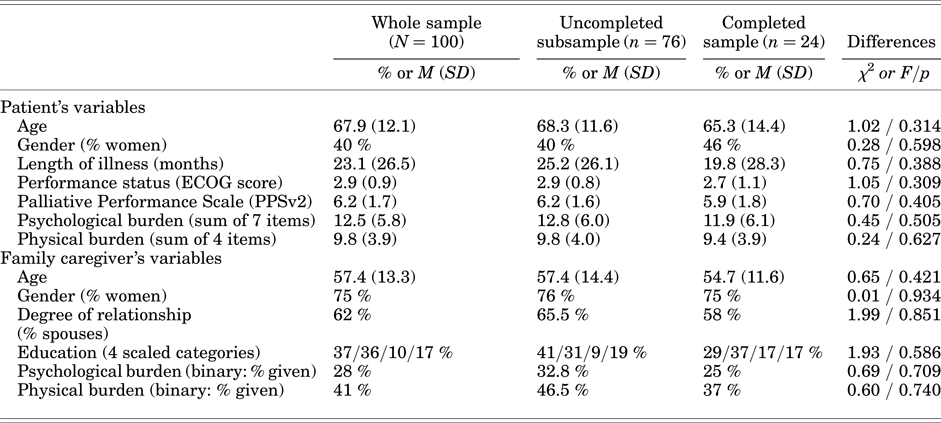
The sample characteristics are presented in Table 5 for the whole sample, for the uncompleted subsample, and for the completed subsample. No statistical differences for either subsample were found. In the whole sample, 40% of terminal patients were women. The average age was 68 (SD = 12.1), and patients were ill for almost 2 years (SD = 26.5 months). Caregiving relatives of the terminally ill were mostly spouses (62%) or parents (29%). According to medical variables, 94% of the sample suffered from cancer. Their average physical strain amounted to 9.8 points (especially with respect to performance status and fatigue) and the psychological strain to 12.5 points (especially fear and hopelessness). The performance status was considerably impaired (ECOG score = 2.9): 70% of patients were confined to bed for 50–100% of daytime, and 40% showed a PPS level <40%.
Family caregivers were mostly women (75%) and on average 10 years younger than patients. Some 63% of family caregivers had attended a secondary school or college, three-quarters had completed an apprenticeship, and about a quarter (27%) had completed their studies. Half of the caring relatives (49%) were employed; a third devoted themselves solely to the care of the ill family member, and 18% were retired. A total of 41% of family caregivers suffered from a current physical strain and 28% from a current psychological strain (both variables considered as binary: 0 = no strain, 1 = any strain).
Development of Sources of Meaning
In this section, we investigate the possible changing patterns of meaning in life and in sources of meaning of the target group within the period of the survey.
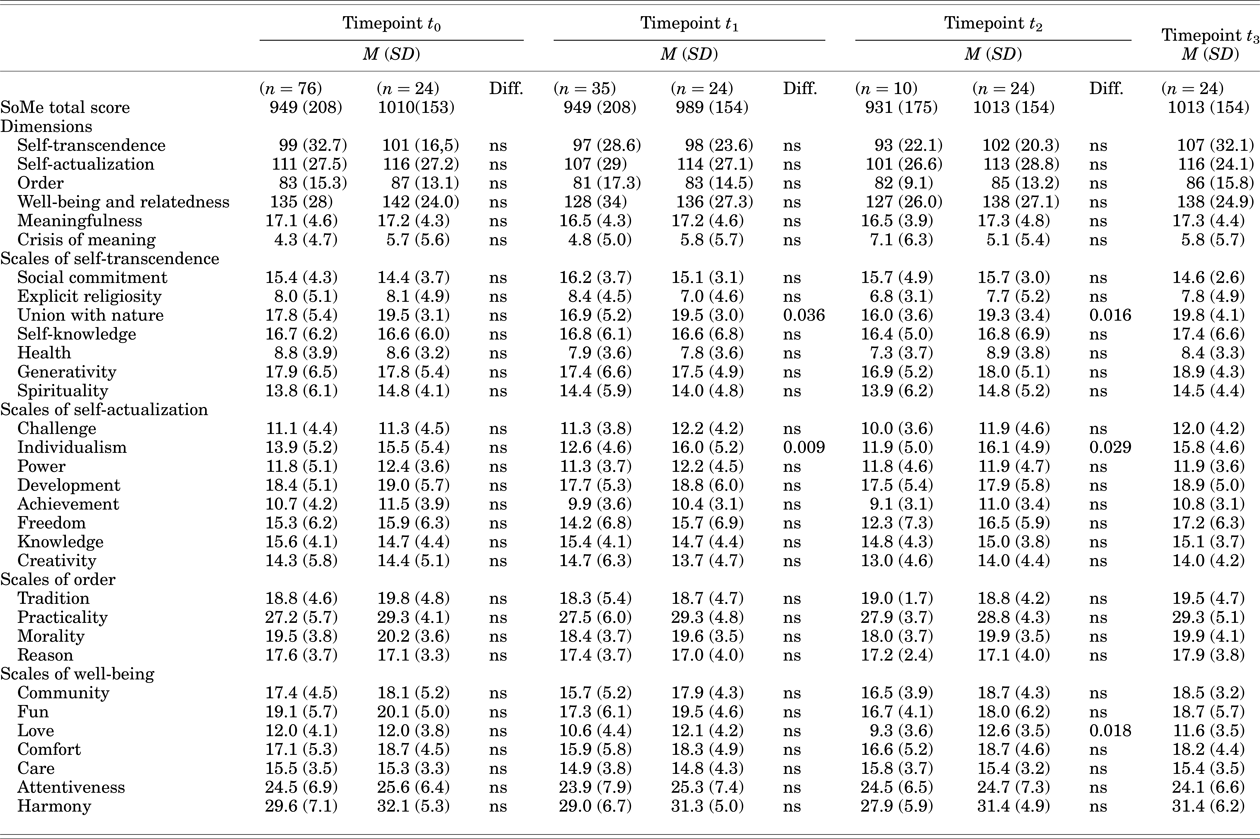
At first, values for sources of meaning and their superordinate dimensions were assessed, and the uncompleted subsample compared with the completed subsample (Table 3). Significant differences were only found for two sources of meaning—union with nature and individualism—which are stronger for relatives of the completed subsample at timepoints t 1 and t 2.
Values for each dimension and source of meaning for the uncompleted sample compared with the completed sample

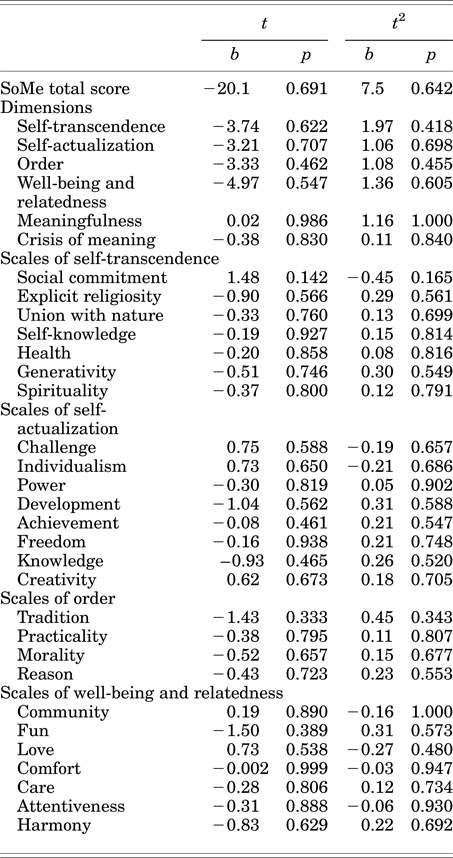
In a second step, the results of the growth curve analyses for the completed subsample revealed no statistically significant change in parameters either linearly or quadratically, as shown in Table 4. Descriptive statistics (Table 3) as well as regression coefficients, both linear and quadratic (Table 4), indicated a parabolic course of the sense of meaning for the majority of sources of meaning, characterized by an initial decrease one week after the start of the caring service, followed by a gradual increase after one month and recovery of the starting value after three months. Quadratic regression models with time as regressor (t 2) displayed inversely poled associations (positive instead of negative and negative instead of positive in linear models).
Regression on time (both linear and quadratic, respectively parabolic) for completed sample (N = 24)

t = time as linear interval-scaled variable; t 2 = time as quadratic (parabolic) interval-scaled variable; b = not standardized regression coefficient; p = level of statistical significance.
Assessment of Associations
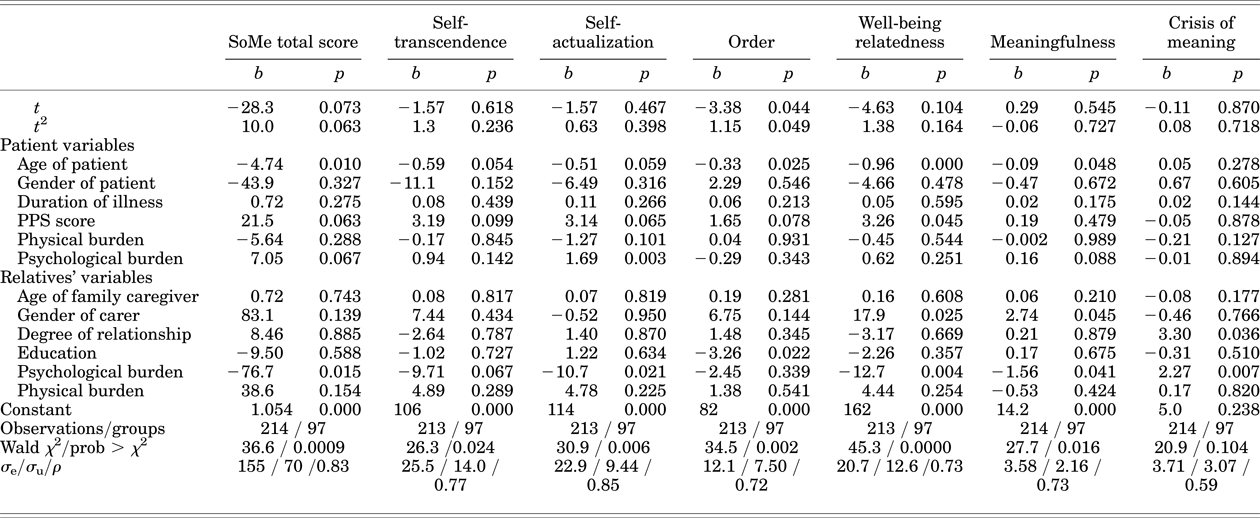
Cross-sectional associations between total SoMe score and the scores of meaning dimensions as dependent variables with six patients and six relatives showed that independent variables were calculated by means of random-effects multivariate regression analyses. These analyses included time as both a linear and quadratic regressor (see Table 6). As in the bivariate tests, only the dimension “order” in caring relatives changed significantly during the survey period, decreasing in a linear model (b = –3.38, p = 0.044) or a parabolic one, with t 1 as the lowest and the inflection point (b = 1.15, p = 0.049). Only a few significant associations were found, especially for patient age and for the psychological burden of caring relatives. The patient's age was negatively associated with total SoMe score (b = –4.74, p = 0.010), order (b = –0.33, p = 0.025), well-being and relatedness (b = –0.96, p < 0.001), and meaningfulness (b = –0.09, p = 0.048), and also tendentiously for self-transcendence and self-actualization but not for crisis of meaning. Two further positive associations were found for patient variables: between patients' psychological burden and self-actualization of caring relatives (b = 1.69, p = 0.003) and between patient autonomy measured by PPS and well-being and relatedness of caring relatives (b = 3.26, p = 0.045). Regarding relatives' variables, a negative association between psychological burden of caring relatives and their dimensions of meaning was found in most analyses: with total SoMe score (b = –76.7, p = 0.015); self-actualization (b = –10.7, p = 0.021); well-being and relatedness (b = –12.7, p = 0.004); meaningfulness (b = –1.56, p = 0.041); and a positive association with crisis of meaning (b = 2.27, p = 0.007); also, tendentiously for “self-transcendence” but not for the dimension of “order.” Well-being and relatedness as well as meaningfulness changed significantly more for female than for male caregivers during the survey period. The crisis of meaning in caregivers increased significantly more when the ill family member was a spouse (b = 3.30, p = 0.036). Higher levels of caregiver education were negatively associated with the dimension of “order” (b = –3.26, p = 0.022).
Description of variables, comparing the whole sample, the uncompleted, and the completed subsamples at t 0

M = mean; SD = standard deviation; % = relative frequency; χ2/F = values at χ2, respectively F distributions; p = level of significance.
Multivariate random effects regression analyses for SoMe total score and dimensions according to selected patient and carer variables (fixed) for the whole sample (N = 100)

SoMe = Sources of Meaning and Meaning in Life Questionnaire; b = regression coefficient; p = level of significance; t = time linear; t 2 = time quadratic; N = sample size; gender (0 = men; 1 = women); duration of illness in months; education = type of school in ascending order (interval-scaled here as metric); degree of relationship (1 = partner, 0 = parent and others); the Wald χ2 is an F test to see whether at least one coefficient in the model is different from zero; σu = SD of residuals within individuals u i; σe = SD of residuals (overall error term) e i; ρ = share of estimated variance of the overall error accounted for by the individual effect u i.
DISCUSSION
The most relevant result of the present investigation with regard to sources of meaning in relatives caring for patients with terminal illness receiving home care by an outreach palliative nursing team is that informal caregivers are able to keep their sense of meaning (assessed by the SoMe) relatively stable during the final stage of their ill family member's disease. Meaning in life as well as sources of meaning, measured by means of the SoMe, seemed to be robust factors even during such a burdening period, characterized by farewells and anticipatory grief. Therefore, we could confirm the starting hypothesis. Although not statistically significant, the parabolic course of the pattern for the majority of sources of meaning indicated an adjustment process during the survey period. The age of ill family members as well as the presence of psychological burden in caring relatives seemed to be the best predictors for changes in the investigated sources of meaning.
The parabolic development of the majority of sources of meaning displayed a low point and simultaneous inflection point one week after the onset of home care by an outreach palliative nursing team, which is difficult to interpret. The authors consider it plausible that due to the onset of support a sort of relieving regressive reaction on the part of the burden-bearing relatives takes place. After some weeks, reality seems to prevail, with starting levels once again being reached for both the uncompleted (until measurement timepoint t 2) as well as the completed subsample (until timepoint t 3).
Multivariate random effects regression models for the whole sample show a negative association between patient age and development of most superordinate dimensions in caring relatives. Since the age differences were not correlated with degree of relationship (spouses or parents), the authors hypothesize that chances for communication decrease with age because of increasing frailty not least due to higher levels of comorbidity. This negative association calls for improvement in social commitment opportunities for caring relatives in this sensitive phase of the caring process.
The second most relevant correlation found was between the presence of any relevant psychological burden in caring relatives and total SoMe score, as well as with the superordinate meaning dimensions, with the exception of “order.” In particular, the positive association with “crisis of meaning” as the most indicative dimension (Schnell, Reference Schnell2009) suggests that the presence of psychopathological-relevant symptoms in family caregivers could be a negative prognostic factor for them to consider quality of life (Padmaja et al., Reference Padmaja, Vanlalhruaii and Rana2016), though in this investigation quality of life was not assessed separately. The finding that the level of psychological burden in terminally ill family members is positively associated with “self-actualization” of caring relatives is unexpected and contrary to the findings of other studies. For instance, in a German investigation by Götze et al. (Reference Götze, Brähler and Gansera2014), patients' and caregivers' anxiety and depression scores were significantly correlated, so that the authors recommended considering both parties involved as an emotional system rather than as two individuals. This assumption can be acknowledged by our present findings, but in another sense. We interpret the result as indicating that the psychopathological burden on the part of terminal patients involves an existential challenge for caring relatives to cope with hopelessness as a sort of “moral delegation” on the part of discouraged ill family members, at least for this sample, and, according to the SoMe Questionnaire. However, Lohne et al. (Reference Lohne, Miaskowski and Rustøen2012) found that family caregivers with lower hope scores reported higher levels of caregiver strain according to the Herth Hope Index.
Our results indicate that sources of meaning, as a part of personality within the SoMe theoretical framework, remain stable, even under existential pressure, such as in the care of terminally ill family members. The only exceptions are the negative influences of patient age and the presence of psychological burden in caring relatives on the course of their meaning in life during the survey period. The results also indicate the important support needs of caring relatives, particularly when palliative care becomes necessary, when patients are terminal and older, and especially when family caregivers demonstrate psychological strains. In a cross-sectional survey of 188 patient–family caregiver dyads, Skleranova et al. (Reference Skleranova, Krümpelmann and Haun2015) found that caregivers were more distressed and exhibited higher anxiety scores compared to patients. According to Merckaert et al. (Reference Merckaert, Libert and Lieutnant2013), “one out of five caregivers desires formal psychological support, although one of two caregivers experiences significant levels of distress.” That support consists in particular of emotional relief, coping skills training, counseling, and needs-adapted interventions. With this in mind, complex intervention programs such as the Carer Support Needs Assessment Tool (CSNAT) have been developed (Grande et al., Reference Grande, Austin and Ewing2015). In a sample of 354 family caregivers of community-dwelling hospice patients with advanced cancer, the coping skills intervention seemed to be more effective in improving quality of life and reducing the burdens related to patient symptoms than treatment as usual alone or with additional emotional support (McMillan et al., Reference McMillan, Small and Weitzner2006). This demonstrates the importance of skills and cognitive control beyond emotional support. Further, important approaches could be adapted from psychotherapy programs for cancer and palliative patients, such as dignity psychotherapy (Chochinov, Reference Chochinov2002), meaning-centered counseling (Wong, Reference Wong, Wong and Fry1998), and meaning-centered group psychotherapy (Greenstein & Blaubart, Reference Greenstein and Breitbart2000), recently developed for caregivers, with encouraging results (Applebaum et al., Reference Applebaum, Kulikowski and Breitbart2015).
LIMITATIONS OF THE STUDY AND CONCLUSIONS
According to our hypothesis, “sources of meaning” and “meaning in life” seem to remain robust in relatives caring for terminally ill family members during the three-month survey period. Particular associations between sources of meaning and the age of patients as well as the psychological burden of both patients and informal caregivers have to be taken into account when it comes to support planning.
An important limitation of our investigation with respect to larger multivariate models is the small number of enrolled participants. Group comparisons in different settings could both confirm and refute the developmental pattern of sources of meaning found by means of logistic or multinomial regression models. Finally, the implementation of quality-of-life, coping competence, and clinical questionnaires could reveal convergences or divergences with existential issues, but we have to bear in mind that family caregivers were burdened with only one implemented questionnaire in our study. A complementary focus could be the implementation of assessment tools that target existential issues more accurately, based on the theoretical frameworks of Frankl and Yalom. The important tests include the Schedule for Meaning in Life Evaluation (SMiLE) and Life Attitudes Profile–Revised (LAP–R), which could be compared with the present results assessed by the SoMe.
By means of qualitative research, further investigations could assess the existential trajectories of family caregivers and could also expand the survey to after the death of the patient in order to explore patterns of sources of meaning during bereavement and in the long term, as portrayed by Brandstätter et al. (Reference Brandstätter, Kögler and Baumann2014). Care setting comparisons are scientifically desirable, but they are not always ethically feasible.
DISCLOSURES
The authors hereby state that they have no conflicts of interest to declare.