1. Introduction
With the development of satellite navigation technology, research on high-sensitivity satellite navigation receivers for weak signals has received much attention. Accurate signal tracking is the premise and basis of receivers for navigation and positioning. In weak signal environments, satellite navigation receivers need to track satellite signals continuously to generate measurement parameters such as pseudo-distance and Doppler frequency for positioning and velocity calculation.
There are three basic methods to improve receiver tracking performance for weak signals: lengthen the integration time, optimise the tracking loop structure, and make use of external sensor information to assist. Extending the coherent integration time is the most beneficial way to improve the signal to noise ratio (SNR). However, the coherent integration time is limited by a variety of factors, for instance, the data bit transitions (Kazemi, Reference Kazemi2010). The bit transitions are reduced via the squaring operation in non-coherent combination, but the noise is also squared, incurring so-called squaring loss (Kaplan and Hegarty, Reference Kaplan and Hegarty2006; Borio et al., Reference Borio, Sokolova and Lachapelle2009).
In terms of tracking loop structure optimisation, Kalman filter can be used to replace the discriminator and loop filter for the carrier and/or code loop (Psiaki et al., Reference Psiaki, Jung and Jung2002). Compared with traditional loop filters, which use the same weight, Kalman filter can change the weight of relevant parameters according to the changes of measured noise and system noise (Ziedan and Garrison, Reference Ziedan and Garrison2004; Humphreys et al., Reference Humphreys, Psiaki and Kintner2005; Petovello and Lachapelle, Reference Petovello and Lachapelle2006). The vector tracking loop combines the tracking of different channels into a single extended Kalman filter. In vector tracking loop structure, individual loop filters are replaced by one navigation filter (Lashley, Reference Lashley2006; Pany and Eissfeller, Reference Pany and Eissfeller2006). After the position and velocity of the receiver are obtained, the pseudo-distances and pseudo-distance rates corresponding to each satellite can be calculated by combining the satellite ephemeris, and then the estimated pseudo-distances and pseudo-distance rates can be used to control the generation of local replica carrier and replica code (Lashley and Bevly, Reference Lashley and Bevly2007; Lashley and Bevly, Reference Lashley and Bevly2009). Because the noise in all tracking channels is reduced, and strong signal channels can assist weak signal channels, it brings better weak signal and anti-interference tracking capability (Shafaati et al., Reference Shafaati, Tao, Broumandan and Lachapelle2018; Xu and Hsu, Reference Xu and Hsu2019).
In addition, external sensor information can be used to assist tracking loop. The most common method is to compensate the code loop and carrier loop by providing Doppler frequency estimates from the inertial navigation system (Chiou, Reference Chiou2005; Gebre-Egziabher et al., Reference Gebre-Egziabher, Razavi, Enge, Gautier, Pullen and Akos2005). Inertial navigation information can reduce the bandwidth of tracking loop so that it can obtain weak signal tracking capability with dynamics (Landis et al., Reference Landis, Thorvaldsen, Fink, Sherman and Holmes2006; O'Driscoll et al., Reference O'Driscoll, Petovello and Lachapelle2008; Lashley et al., Reference Lashley, Bevly and Hung2009; Li et al., Reference Li, Petovello, Lachapelle and Basnayake2010).
In weak signal environments, when the power of the useful signal is much lower than that of the thermal noise, it is necessary first to adopt a longer integration time to obtain the gain and improve the SNR. In the process of signal tracking, the signal synchronisation information can be used to eliminate the restriction of data bit symbol jump, so as to lengthen the integration time and achieve higher SNR. In addition, the limiting factors such as thermal noise and frequency tracking error in the tracking loop need to be effectively suppressed by means of tracking loop optimisation and external information assistance.
The paper proposes a tracking loop filtering method assisted by inertial navigation. Compared with the previous research in this field, the paper has two novel contributions: (i) the estimation of carrier Doppler frequency and input of the local replica code NCO (numerically controlled oscillator) and carrier NCO are obtained by formula derivation using the inertial information and (ii) for the inertial-aided loop, the Kalman filter is designed to reduce phase jitter caused by thermal noise.
The rest of this paper is organised as follows. Section 2 analyses the basic principle of inertial information assisting tracking loop. Section 3 gives a detailed description of the proposed algorithm. Section 4 presents simulations results and analysis. Finally, section 5 is the conclusion.
2. Analysis of principle of inertial-aided tracking loop
In the process of signal tracking, the residual frequency tracking error can attenuate the coherence integral. The greater the frequency error, the greater the attenuation of coherent integral. When the tracking ability of weak signal is improved by extending the integration time, the attenuation becomes more and more serious with extension of the integration time.
The carrier Doppler frequency of the received signal mainly comes from the relative motion between the receiver and the satellite. The Doppler frequency ${f_d}$ is equal to the difference between the signal receiving frequency and transmitting frequency, namely:

where ${f_r}$ is the signal receiving frequency and ${f_{}}$
 is the transmitting frequency.
If the position and speed of the receiver and the satellite are known, the carrier Doppler frequency of the received signal can be obtained. The calculation formula is:

where $\textbf{v}$ is the speed of the receiver; ${\textbf{v}^{(s)}}$
 is the satellite velocity; $\lambda$
 is the carrier wavelength transmitted by the satellite; f is the carrier frequency ($\lambda = c/f$
 , c is the speed of light); ${\textbf{1}^{(s)}}$
 is the unit observation vector of the satellite at the receiver (${\textbf{1}^{(s)}} = ({\boldsymbol{r}_u} - {\boldsymbol{r}_{si}})/(|{{\boldsymbol{r}_u} - {\boldsymbol{r}_{si}}} |)$
 , ${\boldsymbol{r}_{si}}$
 is the position of the satellite and ${\boldsymbol{r}_u}$
 is the position vector of the user receiver).
The inertial navigation information can reflect the dynamic changes of the receiver, and the Doppler frequency can be estimated by inertial information. When the receiver is in the state of high-speed motion, inertial devices with higher accuracy are adopted to provide relatively accurate position and speed of the receiver, and accurate satellite position is obtained by using real-time demodulated satellite ephemeris. The estimated error of Doppler frequency obtained by calculation can reach within 50 Hz. If the approximate satellite position is provided by the satellite almanac within one week, the estimated error of carrier Doppler frequency obtained is 200 Hz.
The control of tracking loop can be assisted to reduce the frequency tracking error and offset dynamic stress of the tracking loop to improve frequency accuracy.
3. Proposed inertial-aided Kalman filter-based tracking loop algorithm
In traditional receivers, parameters such as loop bandwidth and integration time are usually set in the receiver design according to the application scenario, and will not be adjusted according to changes in the environment during the actual use, which greatly limits the signal tracking performance of the receiver. When the satellite navigation receiver works in a weak signal environment, the tracking error is usually larger due to the low signal noise and large phase jitter in the tracking loop.
Inertial information can effectively reduce the frequency tracking error by assisting the tracking loop. On this basis, it is necessary to further optimise the loop parameters. Kalman filter, as an optimal estimation filtering method, adjusts the estimations of state variates through the update of variate measurements, so as to achieve accurate tracking of state variates. The Kalman filter theory can be applied to the signal tracking process of a receiver to obtain better loop tracking effect.
3.1. Inertial-aided Kalman filter-based tracking loop
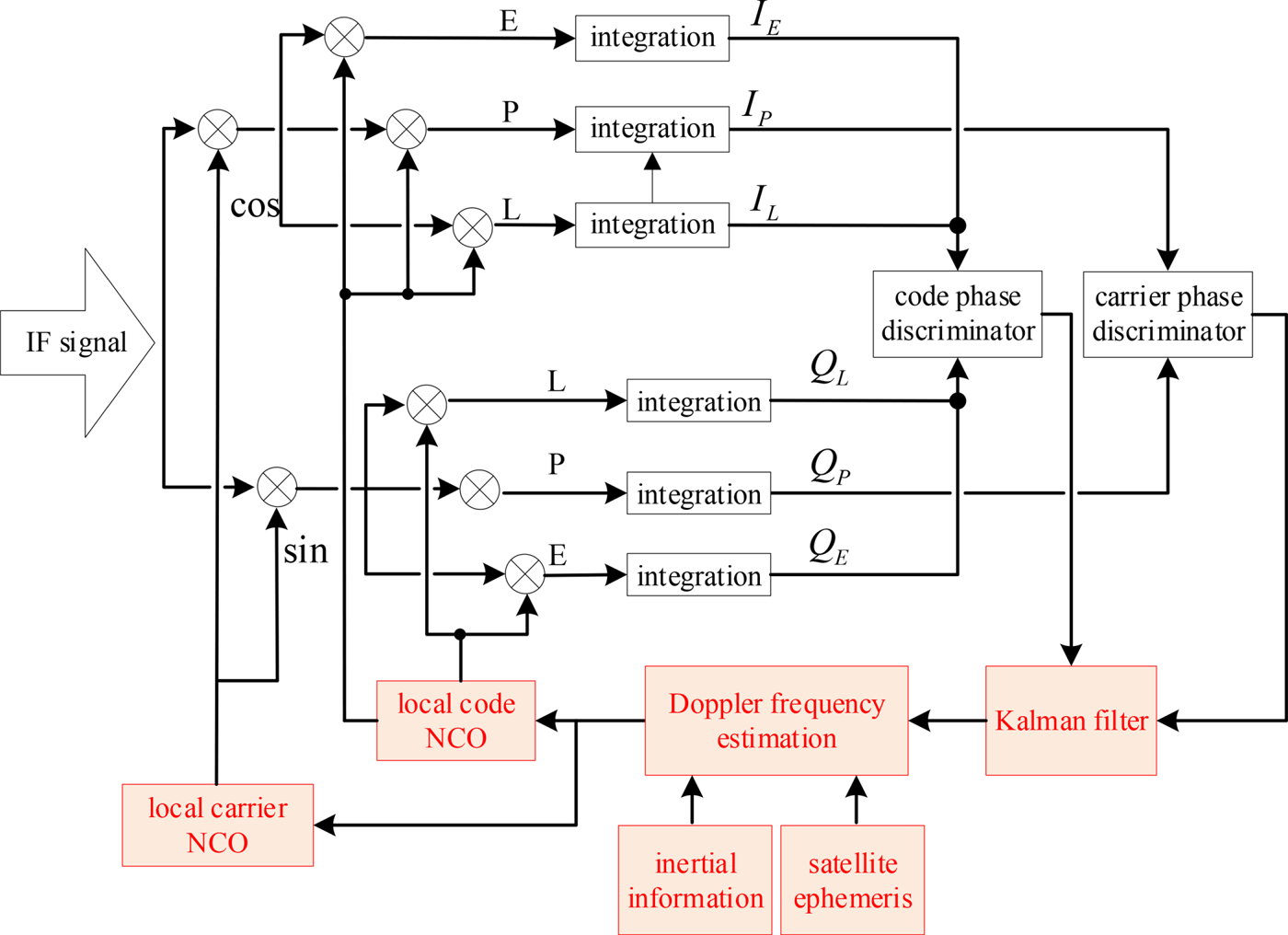
A schematic diagram of one channel tracking loop aided by the inertial information is shown in Figure 1.
Basic structure diagram of inertial-aided Kalman filter-based tracking loop

The inertial-aided Kalman filter-based tracking loop consists of the following parts:
1. The information of the inertial navigation system and the satellite ephemeris information are used to calculate the Doppler frequency parameters caused by the relative motion between the receiver and the satellites.
2. The tracking loops are filtered using Kalman filters and estimate the error of control.
3. The input of the local replica code NCO and local replica carrier NCO are calculated and generated.
3.2. Doppler frequency estimation
The inertial navigation system continuously outputs position and velocity information. At the same time, satellite position information can be obtained by using real-time demodulated satellite ephemeris. Based on Equation (1), the carrier Doppler frequency estimation can be obtained as:

where $\boldsymbol{r}_I^{}$ and ${\textbf{v}_I}$
 are the position and velocity vector of the inertial navigation system; $\boldsymbol{r}_s^{}$
 and ${\textbf{v}_s}$
 are the position and velocity vector of the satellite; $\lambda$
 is the carrier wavelength transmitted by the satellite.
3.3. Kalman filter
According to the characteristics of loop tracking, the state variates of Kalman filter are defined as:

where $\Delta \tau$ is the phase difference between the local replica code and the received code, $\Delta \phi$
 , $\Delta \omega$
 and $\Delta \dot{\omega }$
 are the phase difference, angular frequency difference and the change rate of angular frequency difference between the local replica carrier and the received carrier, and T is the correlation integration time. The following relationship exists between the state vector ${\boldsymbol{x}_k}$
 and ${\boldsymbol{x}_{k - 1}}$
 :

where $\boldsymbol{u}$ is the system input variable, that is, the control frequency of the local replica carrier and code. According to the relations above, the system state equation can be expressed as:

where $\boldsymbol{W}$ stands for system noise.
The output of the phase discriminator is selected as the observation variable, and the phase discrimination result - currently represents the average of the phase difference from time to time, which can be expressed as:


Therefore, the relationship between the observed variables $\Delta {\tau _{k,k - 1}}$ and $\Delta {\phi _{k,k - 1}}$
 and the state variables can be obtained. By adjusting Equation (4), we can obtain:


The system observation equation is obtained as follows:

where $\boldsymbol{V}$ represents measurement noise.
3.4. NCO generation
After the Kalman filter model is obtained, the state variables can be further used to calculate the local replica signal NCO generation to carry out feedback control, and the Kalman filter can replace the traditional loop filters.
Through the establishment of the Kalman filter model above, we can obtain:

The ultimate purpose of the tracking loop is to make the phase difference between the local replica signal and the received signal be zero. Therefore, set $\Delta {\tau _{k + 1}}$ and $\Delta {\phi _{k + 1}}$
 to be zero in the equation, and the system input variable ${\boldsymbol{u}_k}$
 can be obtained as follows:

The input of the code NCO and carrier NCO can be obtained as:

So far, the tracking loop has realised the closed loop control.
4. Simulation results and analysis
4.1. Algorithm simulation
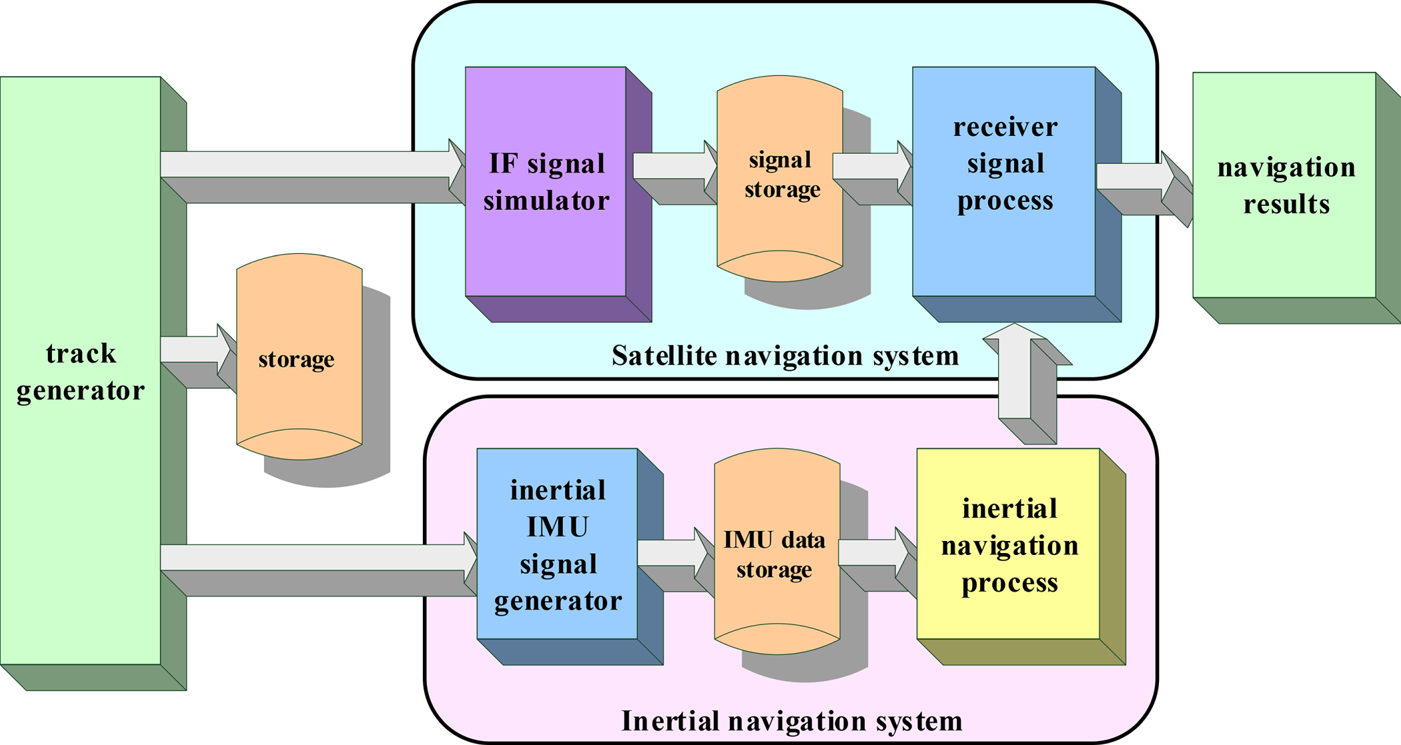
To achieve a comprehensive assessment of the proposed scheme, a simulation platform is arranged, including inertial navigation simulation system, intermediate frequency signal simulation system and satellite navigation receiver software system. The simulation platform structure is shown in Figure 2, including flight track generator, inertial IMU (inertial measurement unit) signal generator, inertial navigation calculation, intermediate frequency signal simulators and receiver signal processing module.
Diagram of the simulation platform

The IMU signal simulation includes the output data of the gyroscopes and the accelerometers. In the simulation process, the drift error of the gyroscope with time and the random error of the accelerometer are respectively considered.
The drift error of the gyroscope is defined as:

where ${\varepsilon _b}$ and ${\varepsilon _r}$
 represent random constant drift and first order Markov process.


where $\beta$ is the time constant of inverse correlation and ${\omega _1}$
 is white noise.
The random error of the accelerometer is a first order Markov process and is defined as:

where $\mu$ is the time constant of inverse correlation and ${\omega _2}$
 is white noise.
Simulation parameters are set as shown in Table 1.
Inertial device simulation parameter settings

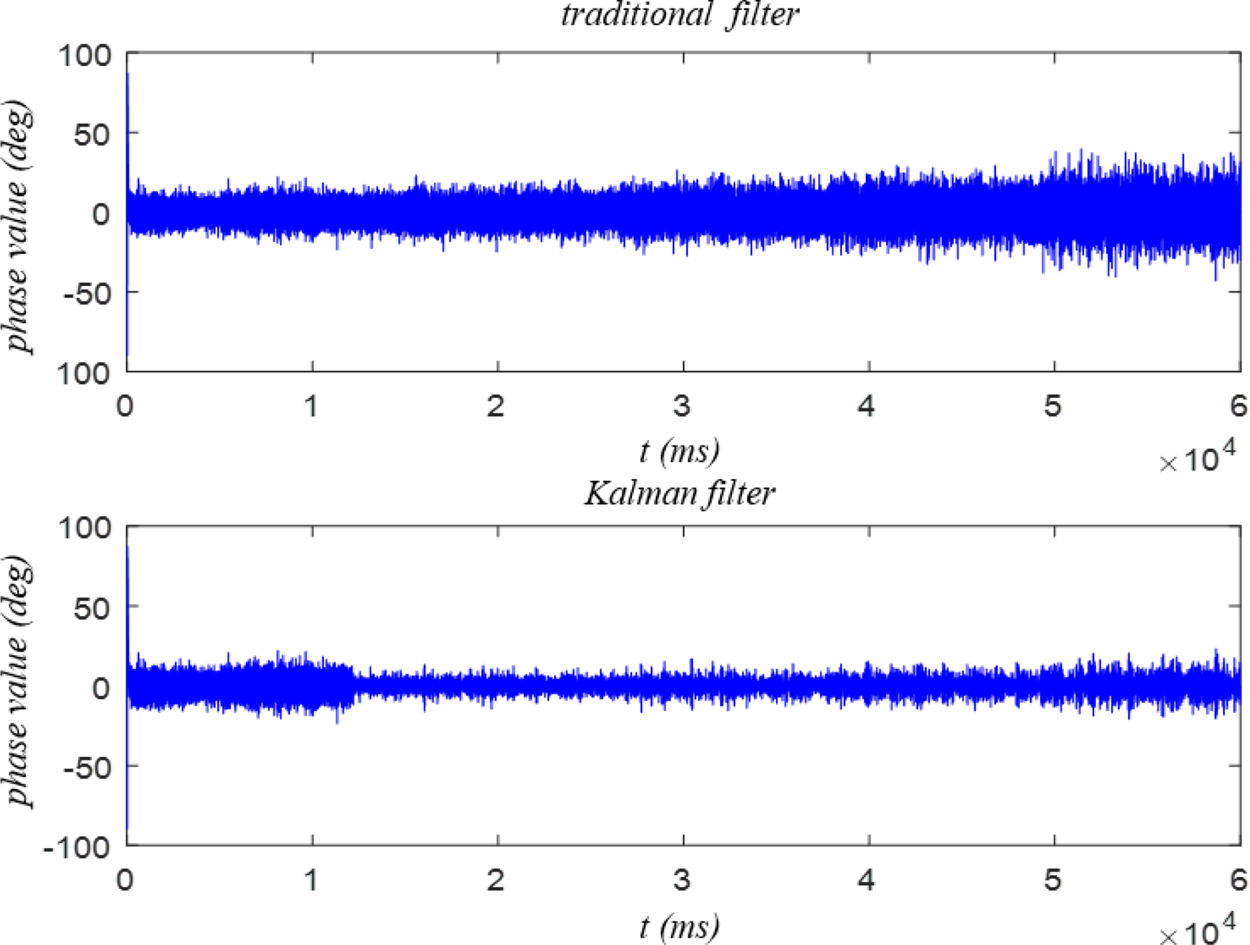
The inertial navigation solution includes the attitude matrix solution and the navigation solution, and the attitude matrix solution adopts the quaternion method. In order to verify and analyse the loop tracking effect of the designed Kalman filter structure, a comparative test is designed to test the filtering effect of the traditional loop filter and the inertial-aided Kalman filter. The user receiver is designed to move in a straight line with a variable acceleration of 1 g/s to the east. Two receiver channels are designed to track the same satellite at the same time. One channel adopts the traditional loop filter structure for tracking. The carrier loop filter bandwidth is set at 20 Hz. The other channel adopts the designed inertial-aided Kalman filter structure. The output of the carrier phase detector of the two channels is shown in Figure 3.
Phase discrimination results of traditional loop and inertial-aided Kalman filter-based tracking loop

As can be seen from Figure 3, in the first channel using the traditional loop filter, due to the constant loop parameters, the change rate of signal Doppler frequency increases with the increase of carrier acceleration, and the loop gradually loses the accurate tracking of signal frequency. The output value of the phase detector becomes larger, and the loop is close to losing the lock.
In the second channel using the inertial-aided Kalman filter structure, in about 12 s or so, with the completion of bit synchronisation and frame synchronisation signal, the pseudorange and ephemeris are obtained. With the condition of inertial information assistance, the frequency tracking error is reduced after inertial information assistance, and the phase jitter caused by thermal noise in the loop is reduced by Kalman filter. The output value of phase detector is significantly reduced, which can be equivalent to the decrease of loop bandwidth, and better tracking effect is obtained.
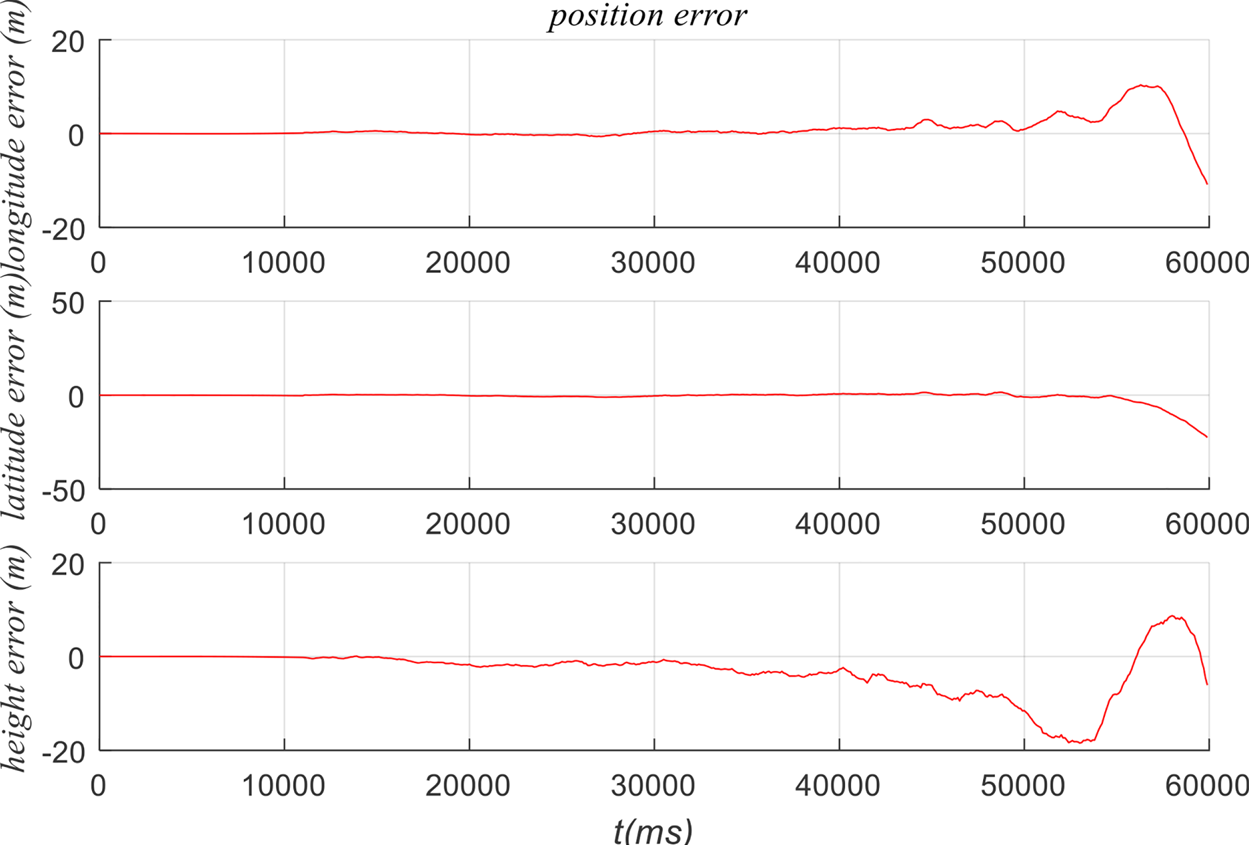
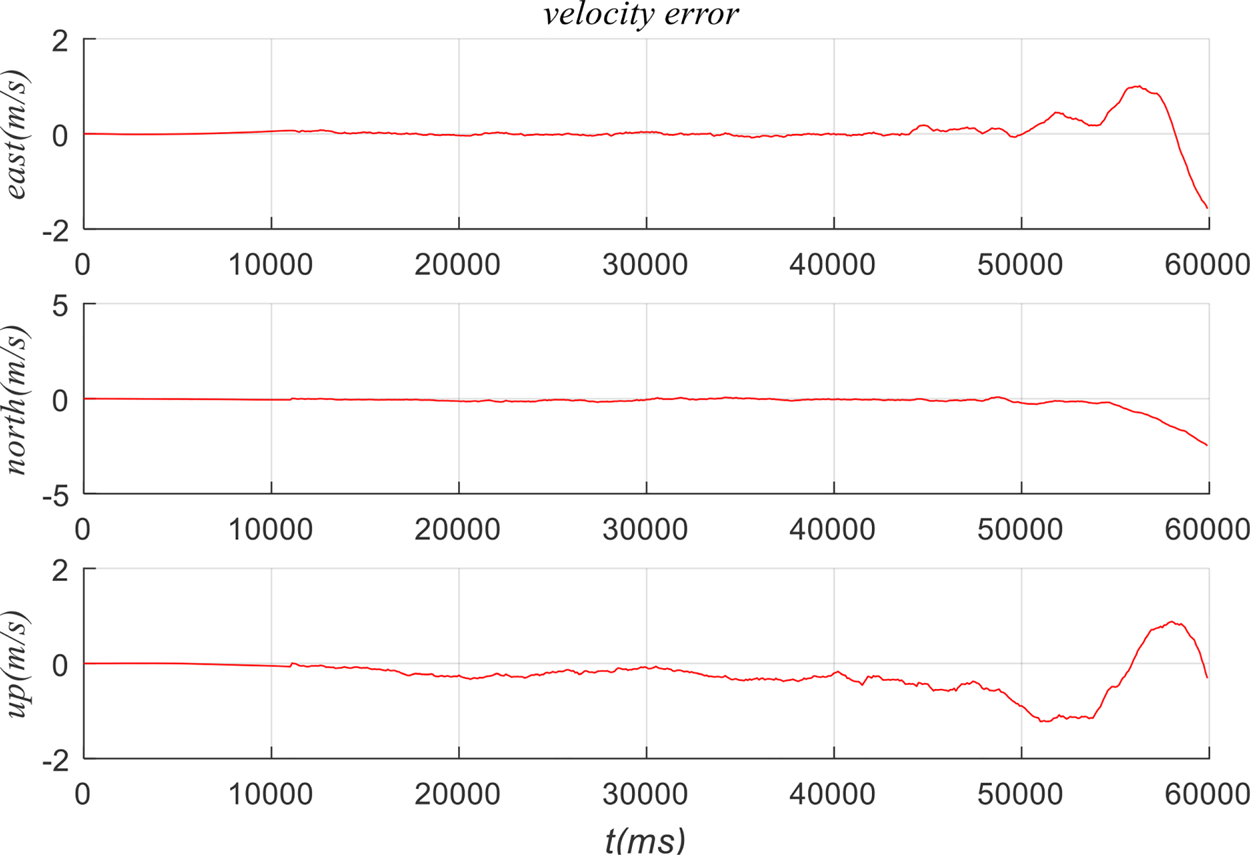
In addition, with the accumulation of time, the output value of the phase detector also increases with the adoption of the inertial-aided Kalman filter structure. This is because the errors of the inertial navigation system will gradually accumulate in the process of the navigation solution, resulting in an increasing error in the estimation of Doppler frequency. The position error and velocity error are shown in Figures 4 and 5.
Position error of the proposed algorithm

Velocity error of the proposed algorithm

As can be seen from these figures, the position error and velocity error gradually diverge, as does the carrier phase value in Figure 3.
4.2. Real data tests
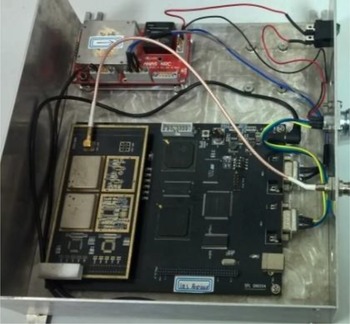
To confirm the feasibility of the proposed tracking loop filter algorithm, real data tests on a Beidou/inertial combination navigation platform are conducted. The test platform is shown in Figure 6; it consists of a MEMS (micro-electromechanical system) inertial unit, a DSP-TMS320C6713B and a FPGA-EP4CE115F23, and an AD8347 used as the quadrature down-conversion mixer. The receiver sampling frequency is 62 MHz and IF (intermediate frequency) carrier frequency is 4⋅098 MHz, the carrier loop filter bandwidth is 20 Hz. The proposed tracking loop filter algorithm assisted by inertial information is realised in the receiver, meanwhile, the combined navigation information is used to correct the inertial navigation.
Beidou/inertial combination navigation test platform

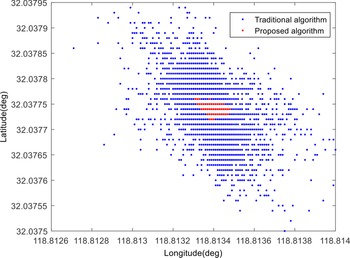
The platform is held stationary for a long time. At the same time, the traditional receiver is used as a comparison. The positioning results of the two systems are shown in Figure 7. For a period of time, the positioning results of the traditional receiver fluctuate greatly, which is related to the change in the number of satellites involved in positioning calculation. The position results are statistically analysed as shown in Table 2.
Positioning results of the traditional algorithm and the proposed algorithm

Mean square errors of positioning results of the traditional algorithm and the proposed algorithm

It can be seen that the positioning accuracy and stability of the proposed algorithm are better than that of the traditional algorithm, indicating that the tracking loop filter algorithm can effectively reduce the loop tracking error, improve the quality of measurement information, and further improve the positioning accuracy. Based on the static test results above, the feasibility of the proposed algorithm has been verified.
5. Conclusion
In order to improve the tracking performance of satellite navigation receivers for weak signals, the effect of thermal noise and dynamic stress in tracking loops should be considered. The optimisation of tracking loop and inertial signal assistance are studied and a tracking loop optimal filtering algorithm with inertial information is proposed. The inertial information is used to offset the dynamic stress of the loop, and the Kalman filter is optimised to obtain better tracking effect of the loop. Simulation tests and real data tests are carried out and verify the feasibility and validity of the proposed algorithm.
Acknowledgements
This work was funded by project ZR2020QD047 supported by Shandong Provincial Natural Science Foundation, the Applied Basic Research Project of Qingdao (18-2-2-42-jch) and Talent Introduction Plan for Youth Innovation Team in Universities of Shandong Province (Innovation team of satellite positioning and navigation). The authors would like to thank the anonymous reviewers for their helpful comments and valuable remarks.