Implications
Recent surveys report feeding costs representing 20% to 50% of the operational costs in horse farming systems. Lactating saddle mares with high nutritional requirements are commonly supplemented with barley at pasture. Here, we demonstrate that under unlimited herbage conditions, mares’ adaptive capacities enable to meet feed requirements and to produce foals with a satisfying growth and conformation while relying on grass only. Supplementation should thus not be systematic, which appears an efficient way to increase farmers’ incomes and decrease the environmental footprint of horse farming systems by reducing the inputs required for production.
Introduction
Agroecology opens up new perspectives for the design of sustainable animal farming systems. Identifying key ecological processes to be optimized within livestock farming systems, Dumont et al. (Reference Dumont, Fortun-Lamothe, Jouven, Thomas and Tichit2013) proposed five principles, among which developing feeding systems based on natural resources to decrease the inputs needed for production, and adopting management practices aiming to improve animal health. There is indeed a need to consider reduction of all types of inputs via an alternative set of practices to intensive agriculture. This includes making the best possible use of animal adaptive capacities and of natural resources not directly utilizable by humans. Also, the use of anthelmintics needs to be minimized to limit the spread of resistance to synthetic chemical drugs, and prevent pharmaceutical residues polluting the environment (Athanasiadou et al., Reference Athanasiadou, Houdijk and Kyriazakis2008; Traversa et al., Reference Traversa, Castagna, von Samson-Himmelstjerna, Meloni, Bartolini, Geurden, Pearce, Woringer, Besognet, Milillo and D’Espois2012).
In horse farming systems, an important challenge is thus to maintain animal performances while maximizing the proportion of herbage in the diet (i.e. limiting the use of concentrate feeds). Surveys carried out in 250 professional horse farms in France report low incomes in horse breeding despite a growing demand for saddle horses (Morhain, Reference Morhain2011). Feeding costs represent 20% to 50% of operational costs according to the system. Grazed forages represent only 30% of the diet of athlete horses (racehorses, sport horses with high performance) and farmers rely strongly on concentrate feeds to meet horses’ nutritional requirements. The use of grazed forage is higher in systems raising horses for sport and leisure; it is however still impaired by a lack of confidence in a feed resource that varies in quantity and quality according to climatic hazard, leading to high inter-annual variability in grass growth. Moreover, little is known on how to feed horses at pasture apart from some recent research on growing horses (Grace et al., Reference Grace, Gee, Firth and Shaw2002a; Edouard et al., Reference Edouard, Fleurance, Dumont, Baumont and Duncan2009 and Reference Edouard, Duncan, Dumont, Baumont and Fleurance2010). Animals with high nutritional requirements such as lactating mares are therefore commonly supplemented with concentrates at pasture to ensure animal performance and this even under unlimited grass growth (Miraglia et al., Reference Miraglia, Saastamoinen and Martin-Rosset2006).
Systematic supplementation is indeed questionable. First, energy supplementation can cause various types of animal health issues (colic, gastric ulcer, obesity, etc.) when horses are grazed on high-quality pastures (Jansson et al., Reference Jansson, Saastamoinen and Lindberg2012). In addition, horses can consume larger amount of forages than cattle (Menard et al., Reference Menard, Duncan, Fleurance, Georges and Lila2002). Mares fed different types of hay indoors always met their energy requirements, whereas lactating suckler cows fed the same forages had a poorly positive or even negative energy balance when forage quality decreased (Thériez et al., Reference Thériez, Petit and Martin-Rosset1994). Since some studies in temperate areas have concluded on the possibility to feed suckler cows on grazed forages only (e.g. Drennan and Mc Gee, Reference Drennan and McGee2008; Bedoin and Kristensen, Reference Bedoin and Kristensen2013), this opens options to suppress energy supplementation in lactating mares.
One reason why supplementation could however present an interest for grazing mares would be through its possible benefits on the expression of immunity against gastrointestinal nematodes; this represents a severe challenge to horse performance and health (Kornaś et al., Reference Kornaś, Cabaret, Skalska and Nowosad2010; Scantlebury et al., Reference Scantlebury, Peachey, Hodgkinson, Matthews, Trawford, Mulugeta, Tefera and Pinchbeck2013). In ruminants, manipulation of host protein nutrition indeed helped hosts to regulate worm population, that is to decrease worm number, size and fecundity (Coop and Holmes, Reference Coop and Holmes1996; Athanasiadou et al., Reference Athanasiadou, Houdijk and Kyriazakis2008). It has also been shown that supplementation with barley tended to reduce nematode egg excretion in grazing sheep (Ferre et al., Reference Ferre, Brusa, Manzanera, Rojo-Vázquez, Buratovich and Mantecón1995).
The objective of this 4-month study was to test the hypothesis that, under unlimited grass growth, it is possible to feed lactating mares with grazed herbage only without affecting performance of mares and foals. We therefore compared performance and daily intake of energy-supplemented (with barley) and non-supplemented mares grazing together a permanent pasture. We also assessed whether mares of the two groups differed in their ability to decrease their parasite burden.
Material and methods
Experimental design
The experiment was conducted at the experimental farm of the French Horse and Riding Institute (IFCE) in Chamberet, France (01°43′14′′ E – 45°35′03′′ N, altitude 440 m) using 16 lactating saddle mares that were experimentally infected with cyathostome larvae at the start of measurements. Mares were either supplemented with barley (S group) or not (NS group), and rotationally grazed a fertile permanent pasture during three vegetation cycles. Mares received a mineral and vitamin supplement. The grazing period began once the 16 mares had foaled (6 June 2012) and ended when foals were on average 5-month old (2 October 2012). We compared foal growth and mares’ body condition between treatments and measured voluntary intake by mares to explain observed performances. Faecal egg counts were used to estimate mare parasite burden.
Animals and pre-experimental conditions
During pregnancy, the 16 mares (Anglo-Arab and French Saddle breeds, 6 to 16 years old) were individually fed indoors with 90% of forage represented by hay (85% DM, 6.6% CP, 31.5% CF: crude fibre), haylage (69% DM, 12.2% CP, 31.3% CF) and wheat straw (88% DM, 3.5% CP, 42.0% CF), and 10% of concentrate (including 61.5% barley, 35% soya bean meal, 3.5% minerals and vitamins) according to their requirements and body condition scores (BCS) (INRA, 2012). They were managed in order to achieve BCS of around 3 at the start of the experiment, on a scale ranging from 0 (emaciated horse) to 5 (obese; Martin-Rosset et al., Reference Martin-Rosset, Vernet, Dubroeuc, Arnaud, Picard and Vermorel2008). Daily intake measurements were made in March with grass hay offered ad libitum for 8 days following 6 days of adaptation to estimate the intake capacity of each mare. At the end of April, mares were treated against gastrointestinal parasites using Ivermectin (Eqvalan®, Merial, France) to ensure subsequent homogeneous infestation. After foaling, the S and NS groups of eight mares were balanced for their intake capacity, foaling date (19 April to 27 May 2012), parasitic sensitivity (estimated from faecal egg counts measured in February 2012), BCS (S: 2.8±0.2; NS: 3.2±0.2) and liveweight at foaling (S: 575.0±20.2 kg; NS: 586.6±16.1 kg).
Experimental treatments
On 1 June, all mares were experimentally infected with 5000 cyathostome larvae administered with a naso-gastric tube; this infestation should have led to a moderate level of adult worm infestation for naturally infected horses (Collobert-Laugier et al., Reference Collobert-Laugier, Hoste, Sevin and Dorchies2002). These small strongyle nematodes are the main parasites affecting horses at pasture (Love et al., Reference Love, Murphy and Mellor1999). At high levels of infestation, horses exhibit clinical signs of anaemia, hypoalbuminaemia, partial anorexia, weight loss and diarrhoea (Kornaś et al., Reference Kornaś, Cabaret, Skalska and Nowosad2010; Scantlebury et al., Reference Scantlebury, Peachey, Hodgkinson, Matthews, Trawford, Mulugeta, Tefera and Pinchbeck2013). From 6 June to 2 October, S mares received a daily supplement of rolled barley at pasture (88.1% DM, 11.6% CP, InVivo Labs laboratory, Vannes, France) according to their lactation stage and liveweight (on average 2.5 kg DM/day), so that it accounted for 60% of their energy requirements for lactation (INRA, 2012). NS mares received 260 g DM of rolled barley daily to get them eating 100 g of small coloured plastic balls mixed with barley in order to individualize faeces at pasture (see voluntary intake and daily grazing time). We assume that it is unlikely to affect the expression of immunity against cyathostomes since these 260 g represent 3% of total energy requirements only. All mares were habituated to being individually fed with barley indoors the week before the experiment.
Pasture composition and grazing management
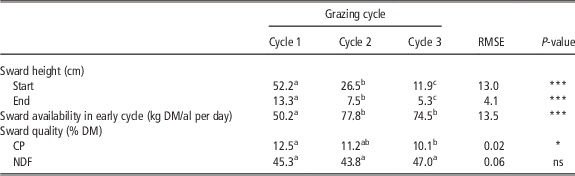
The pasture was sown for more than 10 years and contained 25 plant species, with grass species accounting for 60% of vegetation cover. Most abundant species were rough bluegrass (Poa trivialis), perennial ryegrass (Lolium perenne), cocksfoot (Dactylis glomerata), tall fescue (Festuca arundinacea), white clover (Trifolium repens) and dandelion (Taraxacum sp.). The pasture was divided into five paddocks (1.36 to 3.37 ha); three paddocks only were used in the first rotation cycle, and the two other paddocks were added during the second and third cycles. Stocking rate was 3.1 livestock units (LU)/ha (one saddle mare and its foal=1.2 LU; INRA, 2012) during the first cycle (from 6 June to 5 July) and 1.5 LU/ha during the second (from 6 July to 19 August) and third cycles (from 20 August to 2 October), when grass growth was much slower. In each grazing cycle, these stocking rates ensured grazing availability to remain non-limiting (Table 1), with mares moving to a new paddock every 5 to 12 days.
Vegetation characteristics according to cycle: sward height, sward availability in the 1st paddock and CP and NDF content (cycle1: 6 June to 5 July; cycle 2: 6 July to 19 August; cycle 3: 20 August to 2 October)

DM=dry matter.
a,bFor each variable, means with different letters are significantly different at P<0.05.
*=P<0.05; ***=P<0.001.
Sward height, biomass and quality
Sward height was measured in each paddock before and after each grazing cycle at 100 to 150 random points per paddock (according to surface) using a graduated sward stick. For each cycle, herbage biomass was measured in the first paddock of the rotation, 2 to 3 days before intake measurements began. Sixteen 0.5 m² (10 cm×5 m) strips were cut to 2 cm above ground level with manual lawnmowers to obtain samples accounting for variability in sward structure and composition. Samples were dried for 72 h at 60°C to estimate dry matter content. Eight sward samples per paddock and per cycle were randomly selected to be analysed for CP (Dumas method), CF (Weende method) and NDF (Goering and Van Soest, Reference Goering and Van Soest1970). Analyses were performed by InVivo Labs laboratory (Table 1).
Pasture contamination and faecal egg excretion
Pasture contamination by parasites was assessed in each paddock at the beginning and end of the experiment, and twice per grazing cycle before the intake and grazing time measurements began. The number of infective third-stage larvae (L3) per kg of dry herbage was measured using 100×4 grass pinches (between thumb and forefinger, about 0.4 g of fresh grass) randomly selected in each paddock (Gruner and Sauve, Reference Gruner and Sauve1982). No infective larvae were found in pastures during the first 2 months of the experiment. The density of larvae then increased from 400 L3 kg/DM of herbage at the end of July to 12 050 L3 kg/DM of herbage at the end of September. As the pre-patent period (time between infection and nematode egg-laying) is 2 months after infection (Cabaret, Reference Cabaret2011), the faecal egg counts (FEC) measured in mares between June and September are the result of experimental infection on 1 June and of how it was modulated by energy supplementation.
FECs were carried out on the faeces taken from the rectum of the mares at the start of the experiment, and then every 2 weeks from July to September. The McMaster technique, modified by Raynaud (Reference Raynaud1970) (ClNa, density=1.18 to 1.20; 360 g/L), was used with a minimal detection level of 15 eggs per gram of fresh faeces. Mares were treated against gastrointestinal parasites using Ivermectin (Eqvalan®) at the end of the experiment.
Animal performance
Foals were weighed weekly at the same time of day in June and July, when they were mainly sucking their dams (Martin-Rosset et al., Reference Martin-Rosset, Doreau and Cloix1978), and then every 2 weeks at the same time as their dams when they increased their grazing time. Mares were weighed at the same time of day during the first half of their staying in a new paddock. Their BCS (Martin-Rosset et al., Reference Martin-Rosset, Vernet, Dubroeuc, Arnaud, Picard and Vermorel2008) was evaluated monthly by the same observer. Height at withers and cannon bone width was measured for the 16 foals at the end of March 2013, when foals were 322 (±3) days old on average.
Voluntary intake and daily grazing time
Daily grass dry matter intake (GDMI) was measured for each mare once per cycle during four consecutive days during the second half of the staying of mares in the first paddock (cycle 1: 11 to 14 June; cycle 2: 10 to 13 July; cycle 3: 27 to 30 August) as:
 $${\rm GDMI}={\rm FO}/\left( {{\rm 1}\,{\minus}\,{\rm GDMD}} \right),$$
where FO is the dry weight of faecal output over 24-h attributable to grass and GDMD is the dry matter digestibility of ingested grass expressed as a percentage.
In horses, faeces dry matter content makes it possible to collect them without losses or contamination. We therefore used the method of total faecal collection which has been considered as the reference method in the Herbage Intake Handbook (Penning, Reference Penning2004). This method was used in a large number of horse studies (Duncan, Reference Duncan1992; Mésochina et al., Reference Mésochina, Peyraud, Duncan, Micol and Trillaud-Geyl2000; Fleurance et al., Reference Fleurance, Duncan and Mallevaud2001; Grace et al., Reference Grace, Gee, Firth and Shaw2002a and Reference Grace, Shaw, Gee and Firth2002b; Edouard et al., Reference Edouard, Fleurance, Dumont, Baumont and Duncan2009 and Reference Edouard, Duncan, Dumont, Baumont and Fleurance2010; Fleurance et al., Reference Fleurance, Duncan, Fritz, Gordon and Grenier-Loustalot2010). Estimation of FO required collecting the total amount of faeces produced daily over 4 successive days after the paddock had been cleaned of faeces. Individualization of faeces was made possible by mixing the small plastic balls of different colours (one colour per mare) with the barley. Total daily FO were weighed individually, and a subsample was dried for 72 h at 80°C to determine faecal DM and CP (Dumas method) contents (InVivo Labs laboratory). Faecal DM output attributable to grass (FO) was then calculated by subtracting the indigestible DM attributable to barley (INRA, 2012) from the total faecal DM output (Delagarde et al., Reference Delagarde, Peyraud and Delaby1999).
Dry matter digestibility of ingested grass (GDMD) was estimated from faecal CP content attributable to grass according to the equation of Mésochina et al. (Reference Mésochina, Martin-Rosset, Peyraud, Duncan, Micol and Boulot1998):
GDMD=73.4−(178.72/faecal CP content)
This equation based on faecal CP also accounts for non-dietary faecal nitrogen losses (microbial, endogenous and metabolic). Mésochina et al. (Reference Mésochina, Martin-Rosset, Peyraud, Duncan, Micol and Boulot1998) stressed that the conditions of application of this equation were for herbage CP content higher than 7g/kg DM, which limits nitrogen recycling by horses; this was always the case in the present experiment (Table 1). The faecal CP content attributable to grass was calculated by dividing the amount of faecal CP attributable to grass by the faecal DM output attributable to grass (FO). The amount of faecal CP attributable to grass was calculated by subtracting the amount of faecal CP attributable to barley from the total CP amount excreted from faeces (Delagarde et al., Reference Delagarde, Peyraud and Delaby1999). The amount of faecal CP attributable to barley was calculated from the CP content of barley and from the apparent CP digestibility of barley (INRA, 2012).
Total DM intake (TDMI) was calculated as the sum of GDMI and barley dry matter intake (BDMI) that was recorded when mares were supplemented. We then calculated the daily total digestible dry matter intake (TDDMI) as:
 $${\rm TDDMI}={\rm GDMI}\,{\times}\,{\rm GDMD}\,{\plus}\,{\rm BDMI}\,{\times}\,{\rm BDMD}$$
where BDMD is barley dry matter digestibility (INRA, 2012).
Net energy (NE) intake was estimated from net energy content of swards and barley according to Martin-Rosset et al. (Reference Martin-Rosset, Vermorel, Doreau, Tisserand and Andrieu1994):
 $${\rm NE}\,{\rm content}\,{\rm of}\,{\rm swards}\,\left( {{\rm kcal}/{\rm kg}\,{\rm DM}} \right)\,=\,\left( {0.{\rm 825}\,{\minus}\,0.00{\rm 11}\,{\times}\,{\rm CF}\,{\plus}\,0.000{\rm 6}\,{\times}\,{\rm CP}} \right)\,{\times}\,{\rm 225}0$$
where 2250 is the net energy content (kcal) of 1 kg of fresh standard barley (INRA, 2012).
Daily grazing time of the mares and their foals was recorded in the third paddock at each cycle using 22-h scan sampling (2 h were spent indoors for barley supplementation) with one observation every 10 min. The observer recorded whether the animals were grazing (including swallowing and searching for food) or not. Animals were previously habituated to the presence of the observers and to the use of a torch at night.
Statistical analyses
Data were analysed using the PROC Mixed procedure of SAS for repeated measurements. Mare liveweight time course was analysed separately from early June to early September (which includes the intake measurement period), and from early to late September using linear models. Foal growth was analysed at each grazing cycle. For liveweight and BCS, the model included the main effects of treatment, date, and the interaction between treatment and date (treatment×date). Initial liveweight or BCS was taken as a covariate. Height at withers and cannon bone width were analysed in a model including the main effects of treatment, age and the interaction between treatment and age. Faecal egg excretion by mares was analysed in a model including the main effects of treatment, date, and the interaction between treatment and date (treatment×date). Finally, daily intake and grazing time were analysed in a model including the main effects of treatment, grazing cycle and the interaction between treatment and grazing cycle (treatment×cycle). Individual animal was taken as the statistical unit in each model, and this even for grazing time as Iason and Elston (Reference Iason and Elston2002) discussed that there is ample opportunity for variability between individuals grazing together in total daily time grazing. Differences between treatments and between grazing cycle or date were investigated using the Tukey correction for multiple comparisons.
Results
Animal performance and faecal egg excretion
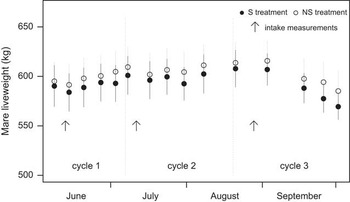
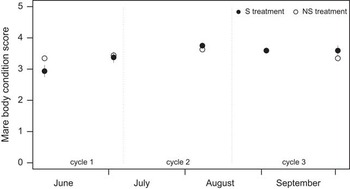
We did not find any treatment effect on mares’ liveweight (treatment, P>0.05; Figure 1) from the start of the experiment in June to early September. The mares gained 18.6 kg on average during this period (June v. early September, P<0.001). In September, both supplemented (S) and non-supplemented (NS) mares lost weight (−34.0±3.2 kg, start v. end of September, P<0.001; Figure 1). BCS of mares were high during the whole experiment (>3 for mares in both groups) and we found a significant treatment×date interaction (P<0.01, Figure 2).
Liveweight time course of supplemented (S) and non-supplemented (NS) mares (mean±s.e.) (June v. early September, P<0.001 and start v. end of September, P<0.001; treatment, P>0.05).

Body condition score time course of supplemented (S) and non-supplemented (NS) mares (mean±s.e.) (treatment×date, P<0.01).

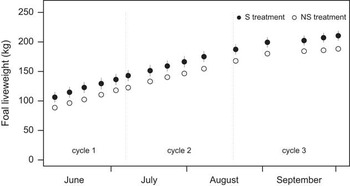
Foals gained weight at each cycle (cycle 1: 1293±114 g/day, start v. end, P<0.001; cycle 2: 1029±58 g/day, P<0.001; cycle 3: 559±148 g/day, P<0.001; Figure 3) and grew similarly whether their mares were supplemented or not (treatment, P>0.05). At 11 months, foals had the same height at withers (137.3±0.9 cm, treatment: P>0.05) and cannon bone width (3.6±0.1 cm, treatment: P>0.05).
Influence of mare supplementation on foal growth (S, supplemented mares; NS, non-supplemented mares) (mean±s.e.) (cycle 1: start v. end, P<0.001, cycle 2: start v. end, P<0.001, cycle 3: start v. end, P<0.01; treatment, P>0.05).

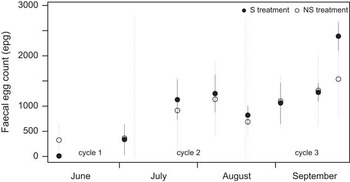
Mares in both groups increased faecal egg excretion during the experiment (date, P<0.001), with a tendency for S mares to excrete nematode eggs earlier (treatment×date, P=0.074; Figure 4).
Changes in the faecal nematode egg excretion (FEC) of supplemented (S) and non-supplemented (NS) mares throughout the experiment (mean±s.e.) (treatment×date, P=0.074).

Mare daily intake
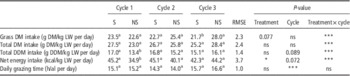
Daily GDMI of S mares remained stable at around 22.6 g DM/kg LW per day (i.e. 13.5 kg DM/al per day), whereas NS mares increased daily GDMI from 22.6 to 28.0 g DM/kg LW per day (13.5 to 17.2 kg DM/al per day) between mid-June and the end of August (treatment×cycle, P<0.001, Table 2). At the end of August, NS mares grazed more than S mares (P<0.01). Similarly, TDMI (grass+barley) of S mares remained stable during the experiment, whereas that of NS mares increased (treatment×cycle, P<0.001, Table 2). No significant differences in TDMI were found between the two groups whatever the grazing cycle. TDDMI of supplemented mares tended to decrease during the experiment (P=0.081 between the first and third cycles), whereas it increased in non-supplemented mares (treatment×cycle, P<0.001, Table 2). As a consequence, the net energy intake of NS mares increased during the experiment, whereas that of S mares remained stable (treatment×cycle, P<0.001). Net energy intake was similar between NS and S mares in cycles 2 and 3 (Table 2). Mares met their energy requirements with both treatments (between 122% and 137% according to grazing cycle in S mares, 97% to 144% in NS mares).
Grass dry matter intake, total dry matter intake, total digestible dry matter intake, net energy intake and daily grazing time for supplemented (S) and non-supplemented (NS) mares along the grazing season

S=supplemented mares; NS=non-supplemented mares; DM=dry matter; DDM=digestible dry matter; LW=liveweight.
a,bFor each variable and each grazing cycle, means with different letters are significantly different at P<0.05.
*=P<0.05; ***=P<0.001.
Daily grazing time
Daily grazing time of mares did not significantly differ between S and NS mares (P>0.05, Table 2). Mares in both groups decreased their grazing time between the first and second cycle, and spent more time grazing during the third cycle (P<0.001).
Foals increased their daily grazing time (P<0.001) during the experiment (cycle 1: 6.1±0.4 h, cycle 2: 8.7±0.3 h, cycle 3: 11.4±0.6 h). Their daily grazing time was unaffected by mare supplementation (treatment, P>0.05).
Discussion
This study aimed to test whether under unlimited grass growth is it possible to feed lactating mares with grazed herbage only without affecting performance of mares and foals. Daily intake was used as an explanatory variable, and we also analysed whether energy supplementation affects the expression of mare immunity against gastrointestinal nematodes.
Animal performance
Foals grew similarly whether the mares were supplemented or not, and their average daily gains between 1 and 5 months of age were satisfying according to recommendations for this type of horses (Trillaud-Geyl et al., Reference Trillaud-Geyl, Brohier, Baynast, Baudoin, Rossier and Lapierre1990; Miraglia et al., Reference Miraglia, Saastamoinen and Martin-Rosset2006). Their size and bone growth at 11 months of age were also satisfying (Donabédian et al., Reference Donabédian, Fleurance, Peronad, Roberte, Lepagef, Trillaud-Geyl, Legerg, Ricard, Bergero and Martin-Rosset2006), and similar between treatments. Mares maintained a high BCS (>3) and slightly increased their liveweight from June to early September. In September, they lost weight in both treatments, which could be explained by a decrease in herbage availability. Such weight loss may be partly explained by a decrease in digestive tract content (Martin-Rosset et al., Reference Martin-Rosset, Doreau and Espinasse1986) since mares’ BCS were optimal and did not decrease, which suggests that body reserves were not affected. Our hypothesis that, under unlimited grass growth, lactating mares can be fed with grazed forages only without affecting performance of mares and foals was therefore confirmed.
Doreau et al. (Reference Doreau, Boulot and Chilliard1993) have discussed that mares fed a hay-based diet indoors equally allocated nutritional resources between milk yield to foal growth and their own body condition. Given that mare liveweight, foal growth and foal grazing duration evolved similarly between S and NS mares, we can assume that supplementation did not affect the trade-off between reserve mobilization and foal growth. Whether this would also apply to mares in poorer body condition remains to be investigated as conflicting results have been reported in the literature (Martin-Rosset and Doreau, Reference Martin-Rosset and Doreau1980; Henneke et al., Reference Henneke, Potter and Kreider1981; Doreau et al., Reference Doreau, Boulot and Chilliard1993). Mares from different breeds could also express different resource allocation patterns, as observed in suckler cows: under limited grass growth cattle breeds with a higher milk yield potential indeed maintained milk yield to the detriment of body condition, whereas those with lower milk potential reduced milk yield but lost less liveweight (D’hour et al., Reference D’hour, Petit, Pradel and Garel1995; Farruggia et al., Reference Farruggia, Dumont, D'hour and Egal2008).
Mare daily intake
Non-supplemented mares increased daily GDMI by 24% between mid-June and the end of August, and achieved a higher GDMI compared with supplemented mares during the third grazing cycle. Consequently, net energy intake was similar between S and NS mares during the second and third cycles, and mares met their energy requirements whether they were supplemented or not. Daily grazing time did not significantly differ between S and NS mares, which suggests that NS mares achieved higher herbage intake by increasing biting rate and/or bite mass. Consistently, lactating donkeys and ponies adapted their grazing behaviour to meet their nutritional requirements by increasing biting rate but not grazing time (Lamoot et al., Reference Lamoot, Vandenberghe, Bauwens and Hoffmann2005).
In this study, we also confirmed that substitution rates (i.e. kg DM reduction in forage intake/kg DM of concentrates eaten) can be >1 in horses as it has been observed in indoor trials (+0.3 to +2.4 according to horse type and forage characteristics; INRA, 2012). This is almost never observed in cattle (Delagarde et al., Reference Delagarde, Prache, D’hour and Petit2001) and suggests that intake regulation could be driven more by the energy metabolism in horses than in ruminants, where intake is mainly under the influence of physical regulation (Särkijärvi et al., Reference Särkijärvi, Sormunen-Cristian, Heikkilä, Rinne and Saastamoinen2012). Variability of substitution rates between grazing cycles (−0.3 to +1.6) is however difficult to explain since variations in both mare requirements and sward characteristics were confounded.
Our values of voluntary intake by non-supplemented mares, between 22.6 and 28.0 g DM/kg LW per day, are consistent with those measured by Grace et al. (Reference Grace, Shaw, Gee and Firth2002b) in lactating Thoroughbred mares grazing ryegrass and white clover pastures (24 g DM/kg LW per day on average). They are low compared with those reported by Duncan (Reference Duncan1992) for Camargue lactating mares grazing wet grasslands (38 g DM/kg LW per day). In this last experiment, mares probably compensated for poor forage quality (mean DM digestibility of ingested grass=48.9% v. 57.8% in our study) by increasing intake.
Faecal egg excretion
Egg outputs increased throughout the experiment from an average of 150 to 2011 epg, which corresponds to a high infection compared with the 200 epg considered as the cut-off for anthelmintic treatment (Cabaret, Reference Cabaret2011). Faecal egg excretion did not differ between S and NS mares. The high herbage intake by NS mares, enabling them to ingest the same amount of energy as S mares from the second cycle, might explain why S mares did not improve their ability to regulate parasite burden. Due to the severe challenges caused by gastrointestinal nematodes of horse performance, welfare and health, it is important to test whether other types of supplementation could reduce horse parasite burden. Feeding small ruminants with protein-rich diets around parturition has been shown to partly alleviate peri-parturient rise in egg excretion (Donaldson et al., Reference Donaldson, van Houtert and Sykes2001; Houdijk et al., Reference Houdijk, Kyriazakis, Jackson, Huntley and Coop2003). The consumption of tannin-rich legumes such as sainfoin (Onobrychis viciifolia) also affects the rate of establishment of infective larvae when tannins are consumed concomitantly to animal infection: tannins can even reduce worm number and fertility in case of patent infection (Hoste et al., Reference Hoste, Martinez-Ortiz-De-Montellano, Manolaraki, Brunet, Ojeda-Robertos, Fourquaux, Torres-Acosta and Sandoval-Castro2012).
Conclusion
Our hypothesis that, under unlimited grass growth, it is possible to feed lactating mares with grazed herbage only without affecting performance of mares and foals was confirmed. Energy supplementation also did not affect the expression of mare immunity against gastrointestinal nematodes. Cereals need water, mineral fertilization and energy for sowing and harvesting. Relying more on grass for feeding horses thus reduces the environmental footprint of horse farming systems, and enables to spare resources and arable land for human food supply. Our results stress that energy supplementation should not be systematic for lactating mares, but rather be optimized according to sward availability and quality.
Acknowledgements
The PhD thesis of C. Collas is funded by the French Horse and Riding Institute (IFCE) and the Animal Physiology and Livestock Farming System (Phase) division of INRA. The authors thank the Carnot Institute for Animal Health (ICSA) for complementary funding. They are also grateful to the staff of the experimental farm, particularly P. Dupuy, J. Bellonie, J.L. Larry, C. Dubois, to students C. Ceglowski and M. Duclouet for their technical assistance, and to R. Delagarde, J. Agabriel and N. Rossignol for methodological and statistical advice.