

%20--%3e%3c!DOCTYPE%20svg%20PUBLIC%20'-//W3C//DTD%20SVG%201.0//EN'%20'http://www.w3.org/TR/2001/REC-SVG-20010904/DTD/svg10.dtd'%3e%3csvg%20version='1.0'%20id='Layer_1'%20xmlns='http://www.w3.org/2000/svg'%20xmlns:xlink='http://www.w3.org/1999/xlink'%20x='0px'%20y='0px'%20width='64px'%20height='64px'%20viewBox='5.5%20-3.5%2064%2064'%20enable-background='new%205.5%20-3.5%2064%2064'%20xml:space='preserve'%3e%3cg%3e%3ccircle%20fill='%23FFFFFF'%20fill-opacity='0'%20cx='37.785'%20cy='28.501'%20r='28.836'/%3e%3cpath%20fill='%23595959'%20d='M37.441-3.5c8.951,0,16.572,3.125,22.857,9.372c3.008,3.009,5.295,6.448,6.857,10.314%20c1.561,3.867,2.344,7.971,2.344,12.314c0,4.381-0.773,8.486-2.314,12.313c-1.543,3.828-3.82,7.21-6.828,10.143%20c-3.123,3.085-6.666,5.448-10.629,7.086c-3.961,1.638-8.057,2.457-12.285,2.457s-8.276-0.808-12.143-2.429%20c-3.866-1.618-7.333-3.961-10.4-7.027c-3.067-3.066-5.4-6.524-7-10.372S5.5,32.767,5.5,28.5c0-4.229,0.809-8.295,2.428-12.2%20c1.619-3.905,3.972-7.4,7.057-10.486C21.08-0.394,28.565-3.5,37.441-3.5z%20M37.557,2.272c-7.314,0-13.467,2.553-18.458,7.657%20c-2.515,2.553-4.448,5.419-5.8,8.6c-1.354,3.181-2.029,6.505-2.029,9.972c0,3.429,0.675,6.734,2.029,9.913%20c1.353,3.183,3.285,6.021,5.8,8.516c2.514,2.496,5.351,4.399,8.515,5.715c3.161,1.314,6.476,1.971,9.943,1.971%20c3.428,0,6.75-0.665,9.973-1.999c3.219-1.335,6.121-3.257,8.713-5.771c4.99-4.876,7.484-10.99,7.484-18.344%20c0-3.543-0.648-6.895-1.943-10.057c-1.293-3.162-3.18-5.98-5.654-8.458C50.984,4.844,44.795,2.272,37.557,2.272z%20M37.156,23.187%20l-4.287,2.229c-0.458-0.951-1.019-1.619-1.685-2c-0.667-0.38-1.286-0.571-1.858-0.571c-2.856,0-4.286,1.885-4.286,5.657%20c0,1.714,0.362,3.084,1.085,4.113c0.724,1.029,1.791,1.544,3.201,1.544c1.867,0,3.181-0.915,3.944-2.743l3.942,2%20c-0.838,1.563-2,2.791-3.486,3.686c-1.484,0.896-3.123,1.343-4.914,1.343c-2.857,0-5.163-0.875-6.915-2.629%20c-1.752-1.752-2.628-4.19-2.628-7.313c0-3.048,0.886-5.466,2.657-7.257c1.771-1.79,4.009-2.686,6.715-2.686%20C32.604,18.558,35.441,20.101,37.156,23.187z%20M55.613,23.187l-4.229,2.229c-0.457-0.951-1.02-1.619-1.686-2%20c-0.668-0.38-1.307-0.571-1.914-0.571c-2.857,0-4.287,1.885-4.287,5.657c0,1.714,0.363,3.084,1.086,4.113%20c0.723,1.029,1.789,1.544,3.201,1.544c1.865,0,3.18-0.915,3.941-2.743l4,2c-0.875,1.563-2.057,2.791-3.541,3.686%20c-1.486,0.896-3.105,1.343-4.857,1.343c-2.896,0-5.209-0.875-6.941-2.629c-1.736-1.752-2.602-4.19-2.602-7.313%20c0-3.048,0.885-5.466,2.658-7.257c1.77-1.79,4.008-2.686,6.713-2.686C51.117,18.558,53.938,20.101,55.613,23.187z'/%3e%3c/g%3e%3c/svg%3e)
%20--%3e%3c!DOCTYPE%20svg%20PUBLIC%20'-//W3C//DTD%20SVG%201.0//EN'%20'http://www.w3.org/TR/2001/REC-SVG-20010904/DTD/svg10.dtd'%3e%3csvg%20version='1.0'%20id='Layer_1'%20xmlns='http://www.w3.org/2000/svg'%20xmlns:xlink='http://www.w3.org/1999/xlink'%20x='0px'%20y='0px'%20width='64px'%20height='64px'%20viewBox='5.5%20-3.5%2064%2064'%20enable-background='new%205.5%20-3.5%2064%2064'%20xml:space='preserve'%3e%3cg%3e%3ccircle%20fill='%23FFFFFF'%20fill-opacity='0'%20cx='37.637'%20cy='28.806'%20r='28.276'/%3e%3cg%3e%3cpath%20fill='%23595959'%20d='M37.443-3.5c8.988,0,16.57,3.085,22.742,9.257C66.393,11.967,69.5,19.548,69.5,28.5c0,8.991-3.049,16.476-9.145,22.456%20C53.879,57.319,46.242,60.5,37.443,60.5c-8.649,0-16.153-3.144-22.514-9.43C8.644,44.784,5.5,37.262,5.5,28.5%20c0-8.761,3.144-16.342,9.429-22.742C21.101-0.415,28.604-3.5,37.443-3.5z%20M37.557,2.272c-7.276,0-13.428,2.553-18.457,7.657%20c-5.22,5.334-7.829,11.525-7.829,18.572c0,7.086,2.59,13.22,7.77,18.398c5.181,5.182,11.352,7.771,18.514,7.771%20c7.123,0,13.334-2.607,18.629-7.828c5.029-4.838,7.543-10.952,7.543-18.343c0-7.276-2.553-13.465-7.656-18.571%20C50.967,4.824,44.795,2.272,37.557,2.272z%20M46.129,20.557v13.085h-3.656v15.542h-9.944V33.643h-3.656V20.557%20c0-0.572,0.2-1.057,0.599-1.457c0.401-0.399,0.887-0.6,1.457-0.6h13.144c0.533,0,1.01,0.2,1.428,0.6%20C45.918,19.5,46.129,19.986,46.129,20.557z%20M33.042,12.329c0-3.008,1.485-4.514,4.458-4.514s4.457,1.504,4.457,4.514%20c0,2.971-1.486,4.457-4.457,4.457S33.042,15.3,33.042,12.329z'/%3e%3c/g%3e%3c/g%3e%3c/svg%3e)
Myocarditis is an inflammatory disorder that may cause cardiovascular disease affecting the heart’s ability to distribute blood throughout the body. 1 Myocarditis is an uncommon complication, and frequently the result of viral infections such as influenza and severe acute respiratory syndrome coronavirus 2 (SARS-CoV-2). 2 Estimates show that individuals who contracted coronavirus disease 2019 (COVID-19) were 16 times more likely to develop myocarditis than those who were never infected. Reference Boehmer, Kompaniyets and Lavery3 Additionally, myocarditis may present after SARS-CoV-2 vaccine uptake, as indicated through reportings in the Vaccine Adverse Event Reporting System (VAERS) demonstrating an increase in myocarditis and pericarditis following mRNA SARS-CoV-2 vaccine uptake. Reference Singh, Kaur and Cedeno4 Younger males tend to be the most at risk for SARS-CoV-2 vaccine adverse effects; however, the incidence of myocarditis following vaccine uptake is low and clinical presentation tends to be mild. Reference Mevorach, Anis and Cedar5 Regarding COVID-19 hospitalizations, 20-30% of hospitalizations presented with cardiovascular manifestations, Reference Sawalha, Abozenah and Kadado6 and patients presenting with abnormal troponin levels, as seen in myocarditis, are at an increased risk for adverse outcomes and mortality. Reference Long, Brady and Koyfman7 While myocarditis by means of SARS-CoV-2 natural infection has proven to be more common and severe than myocarditis by means of SARS-CoV-2 vaccines, public interest in the SARS-CoV-2 vaccines has been rising.
Due to the initial lack of information and high demand for reassuring answers regarding COVID-19, massive coverage across the media contributed to confusion and skepticism to scientific data, Reference Tagliabue, Galassi and Mariani8 particularly concerning the SARS-CoV-2 vaccines. Reference Puri, Coomes and Haghbayan9 Shortly after SARS-CoV-2 vaccine dissemination, rare cases of vaccine-induced myocarditis were reported. These rare cases became disproportionately covered on social media, compared with rates of myocarditis from COVID-19. Reference Rivas10–Reference Gundry14 With social distancing and quarantine keeping many isolated, social media platforms experienced amplified usage Reference Limaye, Sauer and Ali15 with anti-vaccine content garnering greater engagement. Reference Blankenship, Goff and Yin16
Given the unique relationship between quarantine, social distancing, lack of initial information, and the need for answers, public interest was at the mercy of presumptuous headlines and clickbait. The media’s dominant coverage of myocarditis following vaccine dissemination, rather than natural infection, may have contributed to the skewed public interest pertaining to myocarditis and the SARS-CoV-2 vaccines. Thus, the objective of our study was to assess trends in public interest in myocarditis during the course of the pandemic and the SARS-CoV-2 vaccine rollout in the United States. By assessing public interest in myocarditis, we aim to find a link between media coverage and the perceived versus actual risk of myocarditis associated with SARS-CoV-2 infection and SARS-CoV-2 vaccine uptake.
Methods
We conducted a longitudinal assessment of public interest in myocarditis, and its association with actual COVID-19–related myocarditis events during the first wave of the pandemic and SARS-CoV-2 vaccine-related myocarditis following the vaccine rollout. To complete this objective, we used data from 3 sources: a report from the Morbidity and Mortality Weekly Report (MMWR), the Vaccine Adverse Event Reporting (VAERS) database, and from Google Trends (trends.google.com).
Sources
The MMWR report from September 3, 2021 Reference Boehmer, Kompaniyets and Lavery3 showed COVID-19–related myocarditis cases from March 2020 to January 2021. VAERS is a system that collects data on the potential side effects of vaccines. It is mandatory for physicians to report any effect a vaccine has on a patient after vaccine uptake. This system is managed by both the Centers for Disease Control and Prevention (CDC) and the US Food and Drug Administration (FDA). The goal of this database is to increase the public’s safety when taking vaccines and give information back to the CDC and FDA to assist with future development of vaccines. 17 Google Trends is reliable and efficacious Reference Rovetta18 in assessing public interest because it assigns a value to a Google search, known as Relative Search Interest (RSI), based on search frequency for a given term. Google searches are indexed, through Google Trends, on a scale of 1-100 based on a peak search in a given timeframe, with greater numbers correlating with increased search interest.
Data Collection
First, we extrapolated data for COVID-19–related myocarditis (prevaccine rollout) from the MMWR report. Reference Boehmer, Kompaniyets and Lavery3 This report showed COVID-19–related myocarditis cases from March 2020 to January 2021. Next, we extracted data from the Vaccine Adverse Event Reporting (VAERS) database for COVID-19 vaccine-related myocarditis. We searched VAERS over the course of 2020 through 2022 for monthly reported symptoms of the “COVID-19 vaccine” including myocarditis, carditis, immune-mediated myocarditis, and pericarditis. Finally, we used Google Trends to assess public interest in myocarditis from January 1, 2019, to January 1, 2022, using the search term “myocarditis.”
Analysis
We plotted raw data from the 3 sources to visualize the data. Next, we calculated ratios of (1) myocarditis to cases of COVID-19 and (2) ratio of SARS-CoV-2 vaccine-related myocarditis to total number of vaccines given. We graphed these ratio trends in comparison to RSI as well. Finally, we assessed correlations of RSI and COVID-19– and vaccine-related myocarditis events before (January 2019 to March 2021) and after the vaccines were released to the general public (December 2020 to January 2022).
Results
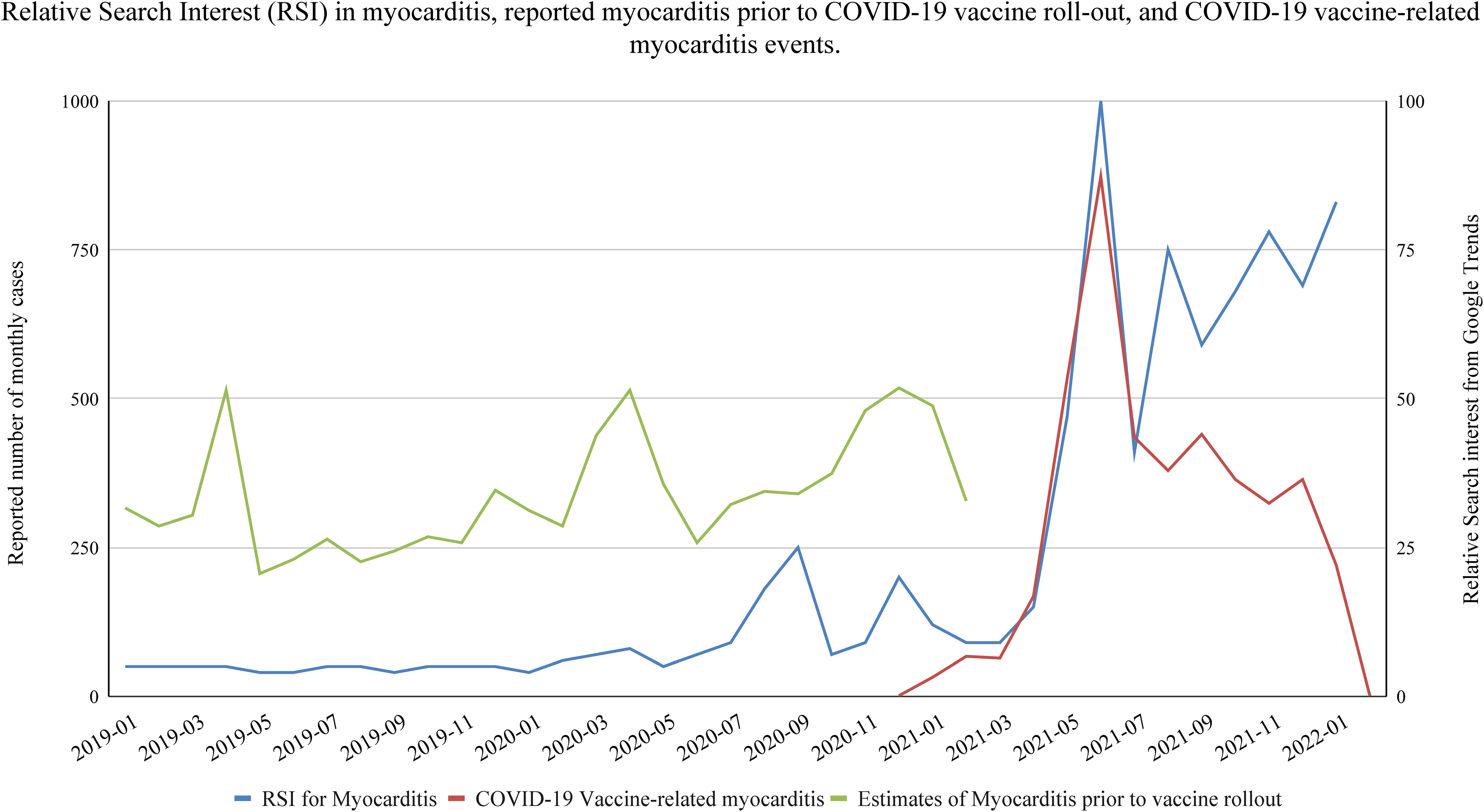
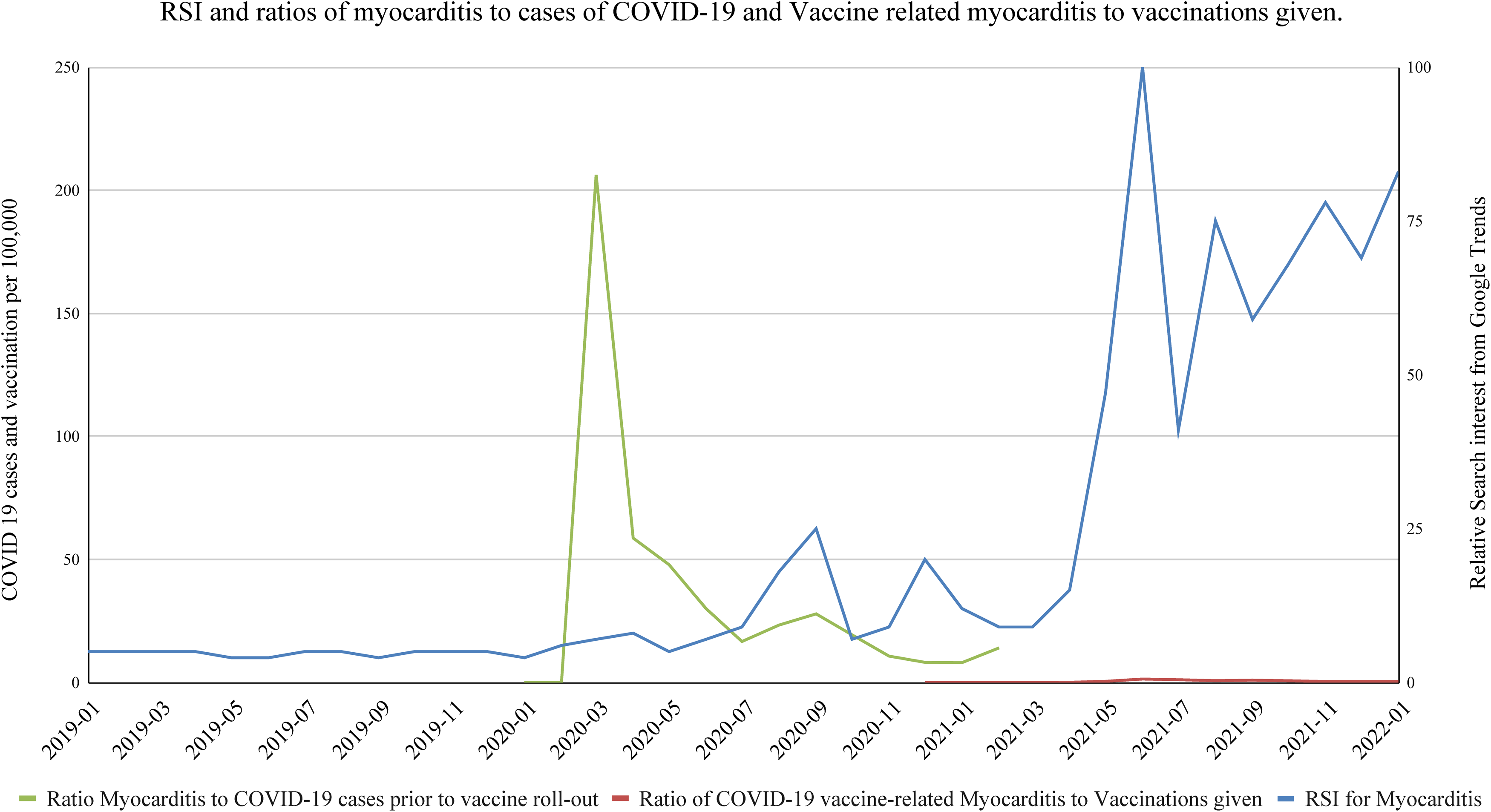
Results show that RSI was low before and during the initial phase of the pandemic (before vaccine rollout) and peaked in April 2021, during the initial vaccine push (Figure 1). Ratios of COVID-19 myocarditis were much higher during the first months of the pandemic (April 2020) and tapered as they approached the fall months. The ratio of myocarditis related to the SARS-CoV-2 vaccines was considerably lower than the ratio of myocarditis from natural infection (Figure 2).
Comparison of the RSI for myocarditis throughout the SARS-CoV-2 pandemic with the number of reported vaccine-related myocarditis cases and the number of estimated COVID-19 myocarditis cases.
RSI for myocarditis throughout the SARS-CoV-2 pandemic compared to the ratio of myocarditis to COVID-19 cases and the ratio of vaccine-related myocarditis to vaccines given.
The correlation between RSI and myocarditis before the vaccine rollout in March 2021 was weak (R = .289; P = 0.316). From March 2021 through January 2022, the correlation between RSI and SARS-CoV-2 vaccine-related myocarditis events was strong (R = .854; P < 0.0001) (Figure 1).
Discussion
The results of our study show that public interest in myocarditis was low during the initial phase of the COVID-19 pandemic despite a relatively high number of myocarditis cases related to COVID-19; however, interest spiked during the early stages of the SARS-CoV-2 vaccine rollout and remained high through 2021. This was likely due to the media sensationalization of myocarditis following the emergency use authorization (EUA) and uptake of the SARS-CoV-2 vaccines when the ratio of events to vaccines given was extremely low. While the EUA was one of the first times a vaccine had received this designation, mRNA vaccines are not new. Functional mRNA has been successfully incorporated into human cells since 1978. Reference Ostro, Giacomoni and Lavelle19 Over time, the development of mRNA and its use in vaccines has gradually progressed. Reference Dolgin20
In July 2020, before the vaccines were approved by the FDA for adults, 21 a team of data analysts looked at over 2 million tweets in the United States and United Kingdom to analyze the general public’s opinion. From these data, 10% of those who were hesitant about taking the vaccines stated they believed the development was “rushed.” Reference Ray22 Furthermore, studies published soon after the vaccine rollout showed risks of developing myocarditis following SARS-CoV-2 vaccine uptake versus natural infection are 0.001% and 0.15%, respectively. Reference Boehmer, Kompaniyets and Lavery3 Although the SARS-CoV-2 vaccines have proven to be efficacious in preventing COVID-19, they also are effective at preventing severe disease outcomes. Reference Tregoning, Flight and Higham23 Therefore, the benefits of the SARS-CoV-2 vaccine significantly outweigh the risks of vaccine uptake and COVID-19. Despite these published benefits, RSI in myocarditis following vaccine rollout was disproportionate to the actual cases of vaccine-induced myocarditis. Thus, SARS-CoV-2 vaccine hesitancy is a major barrier to halting the pandemic.
Hesitancy has remained prevalent for various reasons, Reference Troiano and Nardi24 starting with the initial lack of factual information regarding the origin of the virus and conspiracy theories circulating on the Internet, Reference Islam, Kamal and Kabir25 which likely contributed to the public’s skewed interest toward vaccines and interest in myocarditis as our data suggests. Additionally, hesitancy has the ability to decrease health-care coverage while encouraging infectious disease outbreaks. Reference Kennedy26 For example, the eradication of poliomyelitis faced a similar situation in 2004 when misleading information and public misperception regarding the polio vaccine led to a reemergence of polio in 13 countries where it had previously been eradicated. Reference Aylward and Heymann27
The sensationalization of myocarditis by media sources and the spread of misleading information has developed another sort of pandemic called an “infodemic.” 28 This “infodemic” is responsible for the dissemination of false claims regarding SARS-CoV-2 vaccines that are easily spread through the use of social media, which saw a global 20-80% increase in usage during the pandemic. Reference Naeem, Bhatti and Khan29 Additionally, the probability for an individual to believe misleading information may be a result of their health literacy and perceived risk Reference Islam, Kamal and Kabir25 leading to increased SARS-CoV-2 vaccine hesitancy. Reference Freeman, Waite and Rosebrock30
Thus, improving health literacy skills can empower communities to overcome health inequity while strengthening community resilience toward infectious diseases such as COVID-19. Reference Spring31 One way to accomplish this would be to increase surveillance and add disclaimers to posts shared on social media platforms and provide links to access to factual information, while also regulating or flagging sites where fake news is being distributed. Reference Waszak, Kasprzycka-Waszak and Kubanek32 Several methods to combat the spread of misinformation have been mentioned in the literature such as using artificial intelligence to flag misinformation while providing guidelines or checklists, created by behavioral and science researchers, to help the public discern factual information Reference Bin Naeem and Kamel Boulos33 Furthermore, evidence-based strategies to increase media and information literacy such as the “MIL CLICKS” initiative 34 will enable the public to determine the validity of a claim to promote a more health literate society.
Limitations
As an online search engine, limitations can arise. Google Trends data are restricted to those individuals who use this platform as a way to seek information. This excludes people who do not use the Internet or choose to use a different search engine to gather information about myocarditis and COVID-19. These limitations are minimal due to 86.99% of the US population using Google as their primary search engine. 35
Conclusions
Our findings show that search interest in myocarditis was low until SARS-CoV-2 vaccines were rolled out, in which media coverage intensely focused on a relatively small number of cases. This was despite data showing that risks for developing myocarditis was 150× greater due to natural infection and a higher continual number of myocarditis cases before the rollout. This study highlights both the benefits of COVID-19 vaccine uptake and the impact of the media on public interest. Increasing health literacy and halting the spread of vaccine misinformation are necessary strategies for combating vaccine hesitancy—certainly worthwhile efforts in the wake of a pandemic.
Author contributions
M.H. provided substantial contributions to conception and design, acquisition of data, or analysis and interpretation of data; D.P., R.W., and R.K. drafted the article or revised it critically for important intellectual content; B.G. and M.H. gave final approval of the version of the article to be published; and all authors agree to be accountable for all aspects of the work in ensuring that questions related to the accuracy or integrity of any part of the work are appropriately investigated and resolved.
Funding
This study received no funding.
Conflicts of interest/declarations
Dr. Hartwell receives research support through the National Institutes for Justice unrelated to the current work and the Health Resources Services Administration. Dr. Greiner is supported by training grant T32 AI155385 from the U.S. National Institutes of Health, unrelated to this work.
Ethical statement
This project does not qualify as human subject research as defined in 45 CFR 46.102 (d) and (f) and is not subject to oversight by the institutional review board.


 Open access

